The 26-year-old O’Connor is shot dead as he sits in a car outside his mother’s house in Whitecliffe Parade in Ballymurphy. He comes from a well-known republican family and is understood to have been involved in welfare work for “Real IRA” prisoners. Royal Ulster Constabulary (RUC) sources do not suggest a motive for the shooting, except to say it is not sectarian and they believe it is a result of an inter-republican dispute. Continuity IRA sources deny their organisation is involved and the killing is condemned by Republican Sinn Féin.
O’Connor had just left his mother’s home and got into the passenger seat of a car when two hooded gunmen approach on foot and shoot him at point-blank range. He is hit in the head and dies instantly. A relative who is in the driver’s seat is uninjured.
O’Connor’s cousin, who lives nearby, says, “I heard one shot, then a silence, and then four more shots in quick succession.” Tensions between mainstream and dissident republicans at the time are high in Belfast but without serious violence.
O’Connor, who lives nearby in the Springhill Estate, is married with two young sons. His grandfather, Francisco Notarantonio, was shot dead by the Ulster Defence Association (UDA) in highly controversial circumstances at the same house 13 years earlier. That killing is at the centre of a legal battle between the British Ministry of Defence and the Sunday People over allegations of security force involvement.
O’Connor’s killing is condemned by First Minister of Northern IrelandDavid Trimble. He calls on the RUC Chief Constable, Ronnie Flanagan, to state who he believes is responsible. “I understand a police operation is still ongoing and there may very well be further developments, but the question we will all ask is who was responsible for this murder.”
The killing is condemned by Republican Sinn Féin. A Sinn Féin councillor, Sean McKnight, says local people are “shocked” by the killing. “We call on those responsible for this deliberate shooting to declare themselves and spell out to the people what their motives are,” a spokesman says. “Local sources indicate the deceased man was associated with the 32 County Sovereignty Movement. Republican Sinn Féin has no hesitation in condemning this action and points out the obvious dangers that lie ahead.”
The Social Democratic and Labour Party (SDLP) representative for Belfast West, Alex Attwood, condemns the murder as pointless but says no one should “rush to premature judgment” about who is responsible. “The overwhelming mass of political and wider opinion is determined to consolidate the political and peace process and no words, no acts and no narrow politics will destabilise it.”
(From “Leading ‘Real IRA’ member is shot dead in Ballymurphy” by Suzanne Breen, The Irish Times, October 14, 2000)
Early in the day the government rushes legislation through the House of Commons providing for the suspension of the Executive if the Irish Republican Army (IRA) fails to decommission all its arms by May 2000 in line with a timetable, yet to be drawn up. It refuses to accept any Ulster Unionist amendments. But within 12 hours, British Prime MinisterTony Blair signals that three new amendments will be included to tighten the so-called failsafe mechanism when the bill is debated in the House of Lords in the evening.
The first amendment makes clear that decommissioning must proceed in line with a timetable to be drawn up by General John de Chastelain. The second provides for the automatic suspension of the Executive, while the third provides for the party in default to be clearly identified.
They fail to sway Trimble, who criticises The Way Forward as a hastily concocted scheme. However, he does leave the door open for further negotiations to save the agreement. “If there was a clear watertight scheme, in which there was at the outset an unequivocal commitment to change and a process that genuinely guaranteed to deliver that change, we would have to consider whether a scruple over a period of days could be justified.”
Sinn Féin is furious with party president Gerry Adams saying, “Those who may genuinely want to deal with the issue of guns are going about it in absolutely the worst and wrong way.” The party wants the assembly to be wound up immediately, and all members’ wages to be stopped. It wants the British and Irish governments to continue to implement all aspects of the agreement which are within their control. Adams is enraged by Blair’s move to amend the failsafe legislation. His party says it will consider applying for judicial review of the amended bill, believing it to compromise the International Commission on Decommissioning and unlawfully conflict with the agreement.
Blair and TaoiseachBertie Ahern announce on the following day that the 15-month-old and ailing Good Friday Agreement will go into a review procedure involving all the political parties and be effectively parked over the summer.
Trimble, leader of the Ulster Unionists, resists intense government pressure as he refuses to back the British and Irish governments’ blueprint providing for a power-sharing executive the following week and IRA decommissioning in the summer. He repeats his party’s view that Sinn Féin can only join his cabinet once the IRA has started to hand over its weapons.
The outcome is a bitter personal setback for Blair. In a last-minute televised appeal to the Unionists not to “close the door’ on an agreement, he appears to acknowledge that they will have to try to find another way forward. “I believe in the end we will get an agreement on this. Whether we manage it by tomorrow morning, that is more difficult,” he says.
Trimble complains he had too little time to secure backing within his split party for The Way Forward, which the governments issued twelve days earlier after a week of intense negotiations at Stormont Castle. Blair’s handling of the affair is questioned.
Trimble’s problem with the legislative failsafe is that it punishes all parties for an IRA transgression of a decommissioning timetable, yet to be drawn up. It provides for the executive to be suspended, rather than carry on with Sinn Féin’s two ministerial posts allocated to other parties. The nationalist Social Democratic and Labour Party (SDLP), which could have given Trimble cover on the issue of expulsion, declines to say whether it will vote for Sinn Féin’s expulsion, which infuriates Ulster Unionists.
Negotiations to save the Good Friday Agreement have gone through four deadlines during the year. There are fears that the latest delay might lead to Sinn Féin withdrawing its declaration on IRA arms.
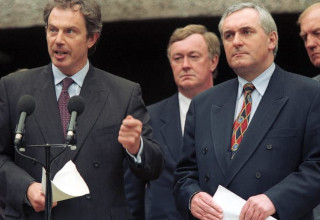
(Pictured: British Prime Minister Tony Blair and Taoiseach Bertie Ahern present a joint British-Irish blueprint for implementation of the Good Friday Agreement at Stormont Castle in Belfast, June 2, 1999 | Sean Gallup | Getty Images)
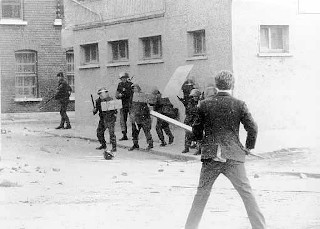
British troops are the target of sporadic rioting in the RepublicanBogside area of Derry in the four days leading up to the rioting.
At about 1:00 AM on the morning of July 8, 1971, in the Bogside area of Derry, Seamus Cusack, 28, a local man who is a welder and former boxer, is shot in the upper part of the leg by a soldier of the Crown Forces. He dies about forty minutes later in Letterkenny Hospital in the Republic of Ireland.
Cusack’s death gives rise to further disturbances in the city. Troops open fire, initially with rubber bullets and CS gas, but they fail to disperse the crowd. The rioters retaliate by throwing three nail bombs. The army returns fire. During this exchange, George Desmond Beattie, 19, is shot in the stomach by a soldier and dies instantly at about 3:15 PM. Five soldiers are reportedly injured during the skirmishes.
There is a lull in the violence after Beattie is shot and a group of factory girls march in silence through the area carrying black bags.
Army marksmen claim one of the men they shot was armed with a rifle and another was about to throw a petrol or nail bomb. It is unclear which incident Cusack is involved in, but an inquest hears that he could have been saved if he had gone to a local hospital instead of one 20 miles south of the border in County Donegal. Apparently, his rescuers fear they would be arrested by police if he had been taken to the local hospital.
In the evening the Ministry of Defence announces that an additional 500 men from the First King’s Own Scottish Borderers are to be sent to Northern Ireland the following day. This brings to 1,400 the total number of men drafted to Northern Ireland over the previous ten days in preparation for the upcoming traditional The Twelfth celebrations on July 12.
From June 7, 1921, until March 30, 1972, the devolved legislature for Northern Ireland is the Parliament of Northern Ireland, which always has an Ulster Unionist Party (UUP) majority and always elects a UUP government. The Parliament is suspended on March 30, 1972.
Shortly after this first parliament is abolished, attempts begin to restore devolution on a new basis that will see power shared between Irish nationalists and unionists. To this end a new parliament, the Northern Ireland Assembly, is established by the Government of the United Kingdom on May 3, 1973.
Following the June 28 elections, the Northern Ireland Constitution Act 1973, which receives the Royal Assent on July 18, 1973, abolishes the suspended Parliament of Northern Ireland and the post of Governor and makes provision for a devolved administration consisting of an Executive chosen by the Assembly.
One hundred eight members are elected by single transferable vote from Northern Ireland’s eighteen Westminster constituencies, with five to eight seats for each depending on its population. The Assembly meets for the first time on July 31, 1973.
After opposition from within the Ulster Unionist Party and the Ulster Workers’ Council strike over the proposal of an all-Ireland council, the Executive and Assembly collapses on May 28, 1974, when Brian Faulkner resigns as Chief Executive. The Northern Ireland Assembly is abolished by the Northern Ireland Act 1974.
In 1982 another Northern Ireland Assembly is established at Stormont, initially as a body to scrutinise the actions of the Secretary of State, the British minister with responsibility for Northern Ireland. It receives little support from Irish nationalists and is officially dissolved in 1986.
The Northern Ireland Act 1998 formally establishes the Assembly in law, in accordance with the Good Friday Agreement. The first election of Members of the Northern Ireland Assembly is on June 25, 1998, and it first meets on July 1, 1998. However, it only exists in “shadow” form until December 2, 1999, when full powers are devolved to the Assembly. Since then, the Assembly has operated intermittently and has been suspended on five occasions.
Trimble has vowed to quit as head of the Stormont Executive, where his party shares power with Sinn Féin, if the Irish Republican Party (IRA) has not started to get rid of its guns by July 1. Paisley, however, has accused Trimble and British Prime MinisterTony Blair of breaking their promises to the people of Northern Ireland by allowing into government a party linked to a terrorist group, without prior arms decommissioning.
While Clinton is no longer the most powerful man in the world, his charisma and his past efforts to keep the peace process moving are still appreciated by many. He receives Northern Ireland political leaders countless times at the White House and gives support and encouragement by phone during difficult periods of the peace talks.
The leader of the Social Democratic and Labour Party (SDLP), John Hume, who welcomes Clinton to Derry, says the former president has done a great deal of good for all the people of Ireland. But the Democratic Unionist Party (DUP) deputy leader, Peter Robinson, claims that Clinton and Blair could have a negative effect on Trimble’s campaign. “As a unionist, I wouldn’t like to be sitting next to either of them just before an election,” he said. “Blair’s name is associated with the now-broken pledges he wrote on a board here just before the [Good Friday agreement] referendum, so for him to come over and moralise now won’t do much good. And Clinton is so disgraced and powerless that, while he might prop up the nationalist SDLP and Sinn Féin vote, he’ll have no impact on unionists voters.”
(Pictured: Bill Clinton and SDLP leader John Hume at public address at Guildhall Square in Derry. Sinn Féin leader Gerry Adams and Chelsea Clinton are in the second row.)
Northern Ireland is plunged into a new crisis after Benedict Hughes, a Catholic, is shot dead on January 21, 1998, as he is getting into his car after finishing his work in a loyalist area of south Belfast. It is the latest murder aimed at wrecking the peace process and the eighth sectarian killing since Christmas.
Hughes, age 55, dies in a hail of bullets in Sandy Row shortly after 5:00 PM, as he is preparing to travel back to his Suffolk Crescent home in west Belfast. The father of three is shot at least five times in the neck and chest as he tries to get into his car which is parked in Utility Street off the Donegall Road. He is taken to the Royal Victoria Hospital where he later dies. The lone gunman makes off on foot in the direction of Felt Street.
The attack comes after the funeral of Fergal McCusker, a Catholic shot dead by the Loyalist Volunteer Force (LVF) just days earlier and ahead of the funerals of Catholic taxi driver Larry Brennan and prominent loyalist Jim Guiney held on January 22.
When forensic people arrive on the scene soon after the shooting, the area is packed with onlookers who believe the shot man is a Protestant.
As a recovery truck comes to remove Hughes’s car later that night, small groups of people are still watching the scene. The Rev. Richard Darmody, the rector of nearby St. Aidan’s Church in Sandy Row, who went to the scene thinking the victim was one of his parishioners, condemns the murder. “I’m shocked and horrified that the life of an innocent person has been taken and that another family has been plunged into grief and pain. I feel very concerned about where this is going to lead, and the possibility of more lives being taken, and more families being bereaved.”
There is no immediate admission of responsibility. However, the blame is placed firmly on loyalists, either the LVF, which has admitted being behind a series of recent killings, or the Ulster Freedom Fighters, which has remained silent, but which is suspected by the security forces of having joined the killings.
SDLP councillor Alastair McDonnell says the peace process is not in crisis. Hughes was “an innocent Catholic who was just trying to earn a living, who has no connections with any political or paramilitary grouping. If he had he wouldn’t have worked here.” He adds that there is a “small handful of evil people” who do not want to see peace.
Alliance spokesman Dr. Philip McGarry says there is “no excuse, no justification for causing pain to yet another family.”
(From: “Catholic shot dead leaving work in loyalist Sandy Row” by Louise McCall, The Irish Times, January 22, 1998)
Máiría Cahill is elected to Seanad Éireann on November 13, 2015 after winning a by-election held to fill the seat left vacant after the resignation of the Labour Party‘s Jimmy Harte. She wins 122 of the 188 valid votes cast in an election in which only Teachta Dálas (TDs) and Senators can cast a vote.
Cahill is born in 1981 into a prominent republican extended family in West Belfast. Her great-uncle Joe Cahill is one of the founders and chief of staff of the Provisional Irish Republican Army (IRA) in the 1970s. She is a cousin of both Siobhán O’Hanlon, a prominent republican activist in the IRA and later in Sinn Féin until her death in 2006, and her sister Eilis O’Hanlon, a political commentator for the Irish Independent and critic of both the IRA and Sinn Féin. She also claims her grandfather recruited Gerry Adams into the IRA.
Cahill is elected National Secretary of Ógra Shinn Féin and works for Sinn Féin between 1998 and 2001. She quits Sinn Féin in 2001 when she moves to the United States. She later returns and works on two election campaigns for the party before growing disillusioned at her treatment and leaving for good.
In February 2015, Cahill receives a James Larkin Thirst for Justice award from the Irish Labour Party. In November 2015, she receives a Special Recognition Award in the Irish Tatler‘s Woman of the Year Awards.
In October 2015, Labour Party leader Joan Burton announces Cahill has joined the party and she, along with her deputy Alan Kelly, will put her forward as the party’s nominee in a by-election to Seanad Éireann’s Industrial and Commercial Panel. The by-election has been occasioned by the resignation of Senator Jimmy Harte due to illness. Cahill secures the party’s nomination unopposed and wins the election in November 13 on the first count, with 122 first preferences out of 188 valid votes from Oireachtas members.
Cahill is criticised by Senator David Norris for failing to satisfactorily answer questions on her links to dissident republican groups and for failing to take part in media debates with other candidates. Norris later states that she is “an interesting and vital voice in Seanad Éireann.”
In a March 2016 interview with Catherine Shanahan of the Irish Examiner, Kathleen Lynch, a former Labour party TD and Minister of state, states she has no idea as to why Cahill was chosen as the party’s by-election candidate. Cahill does not contest the 2016 Seanad elections.
Cahill is co-opted into a Social Democratic and Labour Party (SDLP) council seat in Lisburn and Castlereagh council in July 2018. She has to withdraw from the local election campaign in April 2019, due to a law requiring candidates to publish their home addresses. Cahill is unable to do so due to threats made against her. The British Government subsequently apologises.
Hume, 61, the Catholic head of the Social Democratic and Labor Party, is cited by the Nobel Committee in Oslo for having been the “clearest and most consistent of Northern Ireland’s political leaders in his work for a peaceful solution.”
Trimble, 54, the Protestant leader of the Ulster Unionist Party, is honored for having demonstrated “great political courage when, at a critical stage in the process, he advocated solutions which led to the peace agreement.”
The accord, signed on April 10 and known as the Good Friday Agreement, gives the 1.7 million residents of Northern Ireland a respite from the sectarian violence that has claimed more than 3,200 lives in the previous 30 years. It also opens the possibility of lasting stability for the first time since the establishment of Northern Ireland with partition from Ireland in 1921.
Forging concessions from fiercely antagonistic populations, the accord seeks to balance the Protestant majority’s wish to remain part of Britain with Catholic desires to strengthen ties to the Republic of Ireland to the south. The committee, seeing in Northern Ireland’s two warring groups a dispute with notable similarities to violent tribal confrontations elsewhere, expresses the hope that the accord will serve “to inspire peaceful solutions to other religious, ethnic and national conflicts around the world.”
Adams, in New York on a fund-raising trip for Sinn Féin, welcomes the Oslo announcement and particularly praises Hume, who is widely seen as having helped persuade the IRA to adopt a cease-fire and having eased Sinn Féin’s entry into the talks. “Indeed, there would be no peace process but for his courage and vision,” Adams says, adding, “No one deserves this accolade more.” He also wishes Trimble well and says the prize imposes on everyone the responsibility to “push ahead through the speedy implementation of the agreement.”
In the unforgiving politics of Northern Ireland, the Unionist dissidents and members of other Protestant parties who do not join in the peace talks attack both Trimble and Hume. Ian Paisley Jr., son of the head of the Democratic Unionist Party, calls the Nobel Committee’s decision a “farce” and says of the winners, “These people have not delivered peace, and they are not peacemakers.”
Trimble says he is “slightly uncomfortable” with the award because so many other people have been involved beside him in reaching the settlement and much remains to be done to put it in place. “We know that while we have the makings of peace, it is not wholly secure yet,” he tells the BBC from Denver, where he is on an 11-city North American tour to spur foreign investment in Ulster. “I hope it does not turn out to be premature.”
Hume receives word of the prize at his home in Londonderry and terms it “an expression of the total endorsement of the work of very many people.” He adds, “This isn’t just an award to David Trimble and myself. It is an award to all the people in Northern Ireland.”
In Washington, D.C., President Clinton says “how very pleased” he is, “personally and as President, that the Nobel Prize Committee has rewarded the courage and the people of Northern Ireland by giving the Nobel Peace Prize to John Hume and to David Trimble.” He adds “a special word of thanks” to George Mitchell, who issues a statement praising Hume and Trimble as “fully deserving of this honor.”
The peace talks began in the summer of 1996. They eventually draw the participation of 8 of the 10 Northern Irish parties, with many of the men around the table convicted murderers and bombers who had emerged from prison with a commitment to peaceful resolution to what for nearly a century have been referred to wearily as “the Troubles.” The paramilitary groups had also made the tactical decision that violence would not secure their goals; a shared conviction that gives these talks a chance for success that past fitful attempts at settlement lacked.
The peace talks move in a desultory manner until Blair takes office in May 1997 and highlights the cause of peace in Northern Ireland as an early commitment. At his and Ahern’s urging, the IRA declares a cease-fire in July, and by September Sinn Féin is permitted to join the talks.
Blair also gives Trimble and Adams unprecedented access to 10 Downing Street, and the Ulster Protestants report that they obtained from Clinton the most sympathetic hearing they ever had from an American President, allaying their longtime suspicions of Washington’s bias in favor of the Catholic minority.
(From: “2 Ulster Peacemakers Win the Nobel Prize,” The New York Times, Warren Hoge, October 17, 1998)
In August 2005, it is announced that in response to the Provisional IRA declaration that its campaign is over, and in accordance with the Good Friday Agreement provisions, Operation Banner would end by August 1, 2007. This involves troops based in Northern Ireland being reduced to 5,000, and only for training purposes. Security is entirely transferred to the police. The Northern Ireland Resident battalions of the Royal Irish Regiment, which had grown out of the Ulster Defence Regiment, stand down on September 1, 2006. The operation officially ends at midnight on July 31, 2007, making it the longest continuous deployment in the British Army’s history, lasting over 38 years.
While the withdrawal of troops is welcomed by the nationalist parties Social Democratic and Labour Party and Sinn Féin, the unionist Democratic Unionist Party and Ulster Unionist Party oppose the decision, which they regard as premature. The main reasons behind their resistance are the continuing activity of republican dissident groups, the loss of security-related jobs for the protestant community and the perception of the British Army presence as an affirmation of the political union with Great Britain.
According to the Ministry of Defence, 1,441 serving British military personnel die in Operation Banner, 722 of whom are killed in paramilitary attacks and 719 of whom die as a result of other causes. The British military kills 307 people during the operation, about 51% of whom are civilians and 42% of whom are members of republican paramilitaries.
(Pictured: Two British soldiers on duty at a vehicle checkpoint near the A5 Omagh/Armagh road junction)
As Sinn Féin maintains a policy of abstentionism in regard to the Parliament of the United Kingdom, the 2017 election marks the first parliament since 1964 without any Irish nationalist MPs who take their seats in the House of Commons in Westminster.
Nationally, the governing Conservative Party falls eight seats short of a parliamentary majority after the election, reduced to four if the absence of Sinn Féin is taken into account. The DUP thus holds the balance of power and announces on June 10 that it will support the Conservative government on a “confidence and supply” basis.
Five seats change hands in Northern Ireland. The SDLP loses its seats in Foyle and South Down to Sinn Féin and the constituency of Belfast South to the DUP. Meanwhile, the UUP loses South Antrim to the DUP and Fermanagh and South Tyrone to Sinn Féin. The number of unionist and nationalist representatives, eleven and seven respectively, remain unchanged from the 2015 United Kingdom general election, although none of the nationalist members are participating in the current Parliament.