

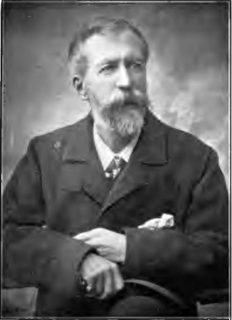
Richard Francis Caulfield Orpen, Irish architect, painter, illustrator and designer, is born on December 24, 1863.
Orpen is born to Anne (née Caulfield) and Arthur Herbert Orpen, a solicitor of Oriel, Blackrock, Dublin. His maternal grandfather is the Bishop of Nassau, Charles Caulfield. He is the eldest of four brothers and two sisters. His youngest brother is William, the painter. He attends St. Columba’s College in Whitechurch, Dublin, and graduates from Trinity College Dublin (TCD) with a BA in 1885. While attending St. Columba’s, he publishes an Irish comic alphabet for the present times in 1881, which is a mix of cartoons and verse mocking Charles Stewart Parnell and the home rule movement.
Orpen wants to pursue painting, but “for family reasons” he becomes an architect. He spends eleven years with Thomas Drew, initially as a pupil, and later as a managing assistant from 1885 to 1892. From around 1884, he attends the annual excursions of the English Architectural Association. Around 1890, he establishes his own architectural practice in Drew’s offices at 22 Clare Street, Dublin. In 1896, he moves his office to 7 Leinster Street. In 1888 he is elected as a member of the Royal Institute of the Architects of Ireland (RIAI), serving as a council member from 1902 to 1910, as honorary secretary from 1903 to 1905, and as president from 1914 to 1917. He designs the institute’s official seal in 1909. In 1904, the Irish Builder describes him as the “originator of the bungalow in Ireland.”
From 1888, Orpen exhibits with the Royal Hibernian Academy (RHA), with watercolours and architectural drawings. He continues to exhibit with them until 1936. He collaborates with Percy French on a number of projects, including illustrating Racquetry Rhymes (1888) and The First Lord Liftinant and Other Tales (1890). He provides cartoons for French’s periodical, The Jarvey. His architectural illustrations are included in H. Goldsmith Whitton’s Handbook of the Irish Parliament Houses… (1891). He is one of the original members of the Architectural Association of Ireland, serving as its first president in 1896, and as vice-president in 1910.
Orpen is appointed the architect to St. Columba’s from 1897 to 1938, following a fire at the college in 1896. He becomes a fellow of the college, and the sanatorium becomes known as the Orpen building. He is an active member of the Arts and Crafts Society of Ireland, serving as secretary in 1895, on the committee in 1904, and in 1917 sits on the organising committee for the fifth exhibition. In 1906, he is a founding member of the Arts Club. In 1906 he moves his architectural practice to 13 South Frederick Street, and moves into a house he designed, Coologe, Carrickmines, County Dublin.
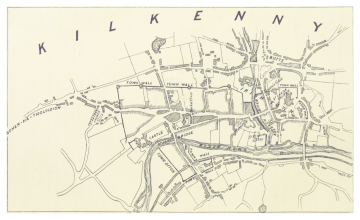
At the 1907 Irish International Exhibition, Dublin, Orpen exhibits a number of chalk drawings. The same year he designs the cover of a satirical pamphlet, The Abbey row, not edited by W. B. Yeats, which mocks The Arrow and the riots at the first production of The Playboy of the Western World. He unveils a bust of Hugh Lane at the opening of the Municipal Gallery of Modern Art on Harcourt Street in 1908. He is appointed secretary to the municipal gallery committee by Lane. In 1910, he is appointed architect to Christ Church Cathedral, as well as architect to St. Canice’s Cathedral, Kilkenny, and St. Patrick’s Cathedral, Dublin. In 1911 he is elected an associate of the Royal Hibernian Academy, a full member in 1912, and was the academy’s secretary from 1925 to 1937.
From 1910 to 1914, Orpen is in an architectural partnership with Page Dickinson, with the two collaborating on plans for the new Dublin municipal gallery and conversion of the Turkish Baths, Lincoln Place. Lane rejects his and Dickinson’s gallery plans, leading to him refusing to work with Lane’s choice of architect, Sir Edwin Lutyens. In 1914, he is appointed a guardian of the National Gallery of Ireland, and lectures at the Dublin Metropolitan School of Art on architectural history in 1914 and 1915. He is involved in the design of a number of memorials including the setting for a bronze relief by Beatrice Campbell for the members of the Royal Irish Regiment killed in the Second Boer War and the war memorial at the Rathgar Methodist church. He serves as president of the arts and crafts section of the Royal Dublin Society (RDS). He is also a governor of the Royal National Hospital for Consumption for Ireland in Newcastle, County Wicklow.
Orpen marries Violet Caulfield in 1900. They are both descended from William Caulfeild, 1st Viscount Charlemont. He dies on March 27, 1938, at his home, Coologe, and is buried in Dean’s Grange Cemetery.
Orpen features as one of the many portraits in Seán Keating‘s Homage to Sir Hugh Lane. St. Columba’s College holds a portrait of Orpen by his brother, William, as well as a memorial stained-glass window to him by Catherine O’Brien.

 seamus dubhghaill