Blair urges Protestant waverers to keep the Good Friday Agreement alive and insists that IRA disarmament, which the pro-British unionists are demanding, is “part of the agreement.”
Britain says two monitors, former President of FinlandMartti Ahtisaari and South AfricanCyril Ramaphosa, have reported to the province’s disarmament commission. “We and the Irish government understand from the decommissioning commission that a second inspection of IRA dumps has now taken place, and they have received a report to that effect from President Ahtisaari and Mr. Ramaphosa,” a Northern Ireland Office statement says.
The IRA discloses the inspection, aimed to show that arms from its long anti-British war are no longer being used, as tension grows ahead of a crucial October 28 conference of the Protestant Ulster Unionist Party (UUP). “We specifically announced that we would repeat the inspection of a number of arms dumps by third parties to confirm that our weapons are secure,” the IRA says. “We now wish to confirm that this re-inspection has taken place and thank those involved for their co-operation.”
Ramaphosa and Ahtisaari first examine arms stockpiles in June 2000.
The IRA is observing a ceasefire following a 30-year war against British rule in Northern Ireland.
U.S. PresidentBill Clinton joins Britain and Ireland in applauding the IRA’s decision that it will permit a fresh look at some of its hidden arsenal.
However, as Blair arrives three bomb alerts underline the fragility of a peace that has been shaken by sporadic attacks by armed dissidents who oppose the 1998 Good Friday Agreement. A detective escapes injury when a bomb under his car fails to explode in a carpark at Antrim, north Belfast. A police spokesman blames Protestant “loyalistparamilitaries.” Army bomb experts also deal with two “suspicious objects” found in other parts of the province, police say.
Blair’s visit is seen as a bid to garner support for First MinisterDavid Trimble, who is under pressure from within his Ulster Unionist Party over his decision to share power with Sinn Féin, even though the IRA has not disarmed.
Blair appeals to unionists ahead of their conference not to squander the accord’s hard-won political advances. He warns that disarmament will be out of reach if the coalition falls. “This is the only way forward for the future. If the Executive collapses and the Assembly then collapses, which must automatically happen, you don’t have a process at all, you don’t have decommissioning,” he tells reporters.
Confirmation of the second inspection is seen as a lift for the peace process which might ease pressure on Trimble.
UUP hardliners on Saturday, October 28, plan to urge grassroots members to back their demand for Trimble to pull out of the ruling coalition by November 30 if the IRA has not disarmed by that time. However, Trimble, at a news conference, dismisses the five-week deadline as “a crude device.”
(From: “IRA confirms arms dump inspections,” CNN.com, October 26, 2000 | Pictured: David Trimble, Seamus Mallon and Tony Blair at Stormont. Photograph: Eric Luke/The Irish Times)
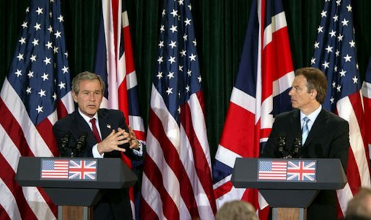
The two leaders meet at Hillsborough Castle and begin their sessions on April 7 with a half-hour walk through the gardens before dinner. The following day they hold a press conference and further talks, including a session on the Northern Ireland peace effort.
Bush and Blair, Bush’s closest ally in confronting Saddam Hussein, come together to discuss questions made increasingly urgent by the rapid military progress American and British forces have made and to plan for a postwar Iraq. They seek to bridge their differences over how much of a role to give the United Nations in rebuilding the country and putting together a new government.
Blair has been under pressure at home and from much of Europe to support giving the United Nations a strong role in stabilizing Iraq. The White House, however, has consistently signaled that it wants the United States and Britain to play the lead role in creating a new Iraqi government.
United States Secretary of StateColin L. Powell tells reporters traveling with the president that the United States is sending officials to the region to begin assembling a group of Iraqis who will constitute an interim governing authority and will be put in place alongside the American-led military and civilian authorities. In a sign of the speed with which the maneuvering for power in post-Hussein Iraq is unfolding, Ahmed Chalabi, the leader of the main Iraqi exile opposition group, the Iraqi National Congress (INC), is reported to be heading to Baghdad from southern Iraq.
“The hostilities phase is coming to a conclusion,” Powell says. “It’s time for all of us to think about the post-hostilities phase, how we create a representative government consisting of all elements of Iraqi society.”
Powell and British officials play down the magnitude of the differences between the United States and Britain over the United Nations role. The United Nations, Powell says, will have “an endorsing role to play to the interim authority to give it legitimacy,” a formulation that appears to reserve for the United States and Britain the right to select the leaders of the temporary postwar administration. A spokesman for Blair uses similar language, referring to the United Nations’ being involved “in a way that endorses that new Iraqi authority” as a step toward establishing a full-fledged Iraqi government.
Initially, primary responsibility for administering Iraq would rest with a team led by a retired United States Armylieutenant general, Jay Garner, and the interim Iraqi authority would be likely to begin assuming power after that, perhaps 90 days later, the British spokesman says.
Clearly wary of getting into another diplomatic squabble with other members of the United Nations Security Council, Powell and other administration officials have emphasized in recent days that the United States and Britain, having waged the war and paid for it with blood and money, will not be drawn into a negotiation with countries like France and Germany over the immediate postwar period.
Powell emphasizes, however, that part of his focus will now be on “healing” diplomatic wounds and granting the United Nations an important role once Iraq is stabilized.
At the United Nations, Secretary-GeneralKofi Annan says he will travel to Britain, France, Germany and Russia in the coming week to test whether the Security Council might be able to agree on a postwar plan. He announces that he has been working on post-conflict issues with a special adviser, Rafeeuddin Ahmed. He says he expects the United Nations to play an important role, whether as a political facilitator or dealing with issues like reconstruction or human rights. “Above all, the U.N. involvement does bring legitimacy, which is necessary, necessary for the country, for the region and for the peoples around the world,” Annan says.
Bush’s trip to see Blair here is the third British-American summit meeting in as many weeks. It coincides with news that American forces are attacking the presidential palaces and other symbols of the Iraqi government in the heart of Baghdad and that British soldiers have taken control of Iraq’s second-largest city, Basra.
The presence of the two leaders draws crowds of antiwar protesters and set off a local debate about whether this city, which has been trying to put behind it a history of sectarian violence, is an appropriate location for a war council.
The city authorities in Belfast have to divert traffic and clear public buildings in various locations following a series of bomb scares. The scenes are reminiscent of the conflicted time before the Northern Ireland peace agreement in 1998 put an end to organized sectarian violence that cost the lives of more than 3,600 people over three decades.
In the conversations about Iraq, Blair plays his customary role of trying to bridge trans-Atlantic differences. He hopes to placate criticism at home and ease relations with his European neighbors by pushing for a United Nations resolution authorizing an interim governing authority.
He had earlier envisaged a more prominent role for the United Nations, but he emerged from his last meeting with Bush, at Camp David on March 27, emphasizing the need for the United Nations to endorse the transition plans rather than play a central part in the plans, as he had advocated at the first summit meeting, in the Azores on March 16.
Europeans express alarm at what they see as the marginalization of the United Nations. At the same time, European critics of the war, like France, Germany and Russia, may object to Blair’s compromise proposal on grounds that it legitimizes a war they oppose. Even in Britain, the one European country where the war has majority support, there is great resistance to American domination of the postwar running of Iraq. An opinion poll in The Daily Telegraph shows that while Britons’ enthusiasm for the war has grown to a high of 60 percent and their approval of Blair’s conduct has also risen, there is only 2 percent approval of an American-controlled administration of Iraq.
Powell says the United States is only trying to lay out a plan under which military control of Iraq can give way to a mix of civilian and military control, including substantial involvement by Iraqis, and then to a full-fledged government. He says United Nations involvement might be necessary to convince banks and financial markets that they can safely and legally lend money to Iraq. Asked about peacekeeping duties, he says NATO is open to the possibility of helping to provide postwar security or assisting in the search for weapons of mass destruction.
Planning for the peace has exposed differences not only between the United States and Britain, but also within the Bush administration and between the administration and Congress.
Blair chose to hold his meeting with Bush in Northern Ireland in part so that the president can lend his support to the long-running efforts by Britain and Ireland to find a peaceful solution to the strife between Catholics and Protestants in the province. The White House, however, seems not to be paying much attention to Northern Ireland diplomacy. The schedules and credentials it distributes to reporters list the site as “Belfast, Ireland.”
(From: “Bush Meets With Blair to Discuss Postwar Iraq” by Richard W. Stevenson and Warren Hoge, The New York Times, http://www.nytimes.com, April 8, 2003)
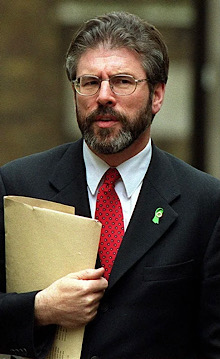
On January 21, 2002, Sinn Féin‘s four MPs take the historic step of signing up to use the facilities of the House of Commons, whose authority over Northern Irelandrepublicans have been fighting for almost a century. Party policy is also changed to allow MPs to sit in the Irish Parliament, the Dáil.
Amid concern among some republicans that the move comes close to recognising British rule, Sinn Féin president and Belfast West MP, Gerry Adams, insists that his party will never take its seats at Westminster. “There will never ever be Sinn Féin MPs sitting in the British houses of parliament,” he tells a Westminster press conference.
However, flanked by his three fellow Sinn Féin MPs, Martin McGuinness (Mid Ulster), Pat Doherty (West Tyrone) and Michelle Gildernew (Fermanagh and South Tyrone), Adams says taking up seats in the Dáil is a very different proposition from doing so the Commons. No Sinn Féin member would take the loyalty oath to the Queen, needed to take up a seat in Parliament, but that was a mere side issue to the key question of sovereignty, he says. Even if the oath were amended, the party would still refuse to take its seats because republicans do not recognise parliament’s jurisdiction over Northern Ireland.
“There are lots of things which there can be no certainty of and there are some things of which we can be certain,” Adams says. “There will never, ever be Sinn Féin MPs sitting in the British Houses of Parliament. The transfer of power by London and Dublin to the Assembly in the north … is all proof of where we see the political centre of gravity on the island of Ireland and that is in the island of Ireland.”
Adams insists his party’s presence in the Commons is a “temporary” measure until they can join the parliament of a united Ireland.
A ban on MPs using Commons facilities without taking the loyalty oath was lifted in December 2001 to Conservative fury. Tories end three decades of cross-party cooperation over the move, which also entitles Sinn Féin’s four MPs to allowances of £107,000 a year each.
Shadow Secretary of State for Northern IrelandQuentin Davies claims Adams plans to use the cash for party political campaigning – something forbidden by Westminster rules. He accuses British Prime MinisterTony Blair of “deliberately contributing to a great propaganda coup in which … the British Government are licking their boots.” The Prime Minister’s spokesman says Blair acknowledges “many victims do feel very strongly about what has happened, but the Prime Minister’s view is that this peace process has saved many lives.”
Sitting alongside a giant Irish tricolour inside his new office, Adams likens his presence there to that of MPs who had served in the British Army and intelligence services – suggesting some of them still do. He also dismisses concerns about the misuse of the money, accusing those “complaining loudest” of being from parties “indicted for corruption and sleaze.”
Sinn Féin’s move into their new offices coincides with a “routine” meeting with the Prime Minister in Downing Street to discuss the peace process. The Sinn Féin president uses publicity surrounding the controversial move to issue a new challenge to Blair to tackle the loyalist “killing campaign.” Adams is joined in Downing Street by his three fellow Sinn Féin MPs.
“There have been 300 bombs over the last nine or ten months,” Adams says. “The British Prime Minister has to face up to the reality that the threat to the peace process within Northern Ireland comes from within loyalism.”
Adams blames Betty Boothroyd‘s decision to bar Sinn Féin MPs from using Commons facilities for the current controversy. “We are here, elected, with our mandate renewed and increased,” he adds.
Adams is asked how he would react if he met former Cabinet minister Lord Tebbit and his wife, who was badly injured by the 1984 Provisional Irish Republican Army (IRA) bomb attack at the Tories conference at the Grand Brighton Hotel in Brighton, at the Commons. “I don’t ignore anyone. As someone who has been wounded and shot and someone whose house has been bombed, I understand precisely how others who have suffered more than me feel about all of this,” Adams replies. “I would like to think that as part of building a peace process that all of us agree there must be dialogue.”
(Pictured: from left, Sinn Fein MPs Michelle Gildernew, Martin McGuinness, Gerry Adams and Pat Doherty)
Hume does not complete his clerical studies but does obtain an M.A. degree in French and history from the college in 1958. He then returns home to his native Derry, where he becomes a teacher at his alma mater, St. Columb’s College. He is a founding member of the Credit Union movement in the city and is chair of the University for Derry Committee in 1965, an unsuccessful fight to have Northern Ireland’s second university established in Derry in the mid-1960s.
Hume becomes the youngest ever President of the Irish League of Credit Unions at age 27. He serves in the role from 1964 to 1968. He once says that “all the things I’ve been doing, it’s the thing I’m proudest of because no movement has done more good for the people of Ireland, north and south, than the credit union movement.”
Hume becomes a leading figure in the civil rights movement in the late 1960s along with people such as Hugh Logue. He is a prominent figure in the Derry Citizens’ Action Committee. The DCAC is set up in the wake of the October 5, 1968, march through Derry which had caused much attention to be drawn towards the situation in Northern Ireland. The purpose of the DCAC is to make use of the publicity surrounding recent events to bring to light grievances in Derry that had been suppressed by the Unionist Government for years. The DCAC, unlike the Northern Ireland Civil Rights Association (NICRA), is aimed specifically at a local campaign, improving the situation in Derry for everyone, and maintaining a peaceful stance. The committee also has a Stewards Association that is there to prevent any violence at marches or sit-downs.
In October 1971, Hume joins four Westminster MPs in a 48-hour hunger strike to protest at the internment without trial of hundreds of suspected Irish republicans. State papers that have been released under the 30-year rule that an Irish diplomat eight years later in 1979 believes Hume supported the return of internment.
Hume is directly involved in secret talks with the British government and Sinn Féin, in an effort to bring Sinn Féin to the discussion table openly. The talks are speculated to lead directly to the Anglo-Irish Agreement in 1985.
The vast majority of unionists reject the agreement and stage a massive and peaceful public rally in Belfast City Centre to demonstrate their distaste. Many Republicans and nationalists also reject it, as they see it as not going far enough. Hume, however, continues dialogue with both governments and Sinn Féin. The “Hume–Adams process” eventually delivers the 1994 Irish Republican Army (IRA) ceasefire which ultimately provides the relatively peaceful backdrop against which the Good Friday agreement is brokered.
In 2015, Hume is diagnosed with Alzheimer’s disease, of which he had first displayed symptoms in the late 1990s. He dies in the early hours of August 3, 2020, at a nursing home in Derry, at the age of 83. On his death, former Labour Party leader and prime ministerTony Blair says, “John Hume was a political titan; a visionary who refused to believe the future had to be the same as the past.” The Dalai Lama says on Twitter, “John Hume’s deep conviction in the power of dialogue and negotiations to resolve conflict was unwavering… It was his leadership and his faith in the power of negotiations that enabled the 1998 Good Friday Agreement to be reached. His steady persistence set an example for us all to follow.”
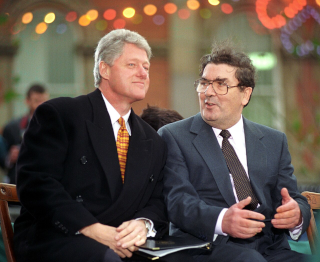
(Pictured: John Hume with U.S. President Bill Clinton in 1995)
Cole starts his career in print journalism in 1945, joining the Belfast Telegraph as a reporter and industrial correspondent. He subsequently works as a political reporter for the paper. He gains a scoop when he interviews the then Prime Minister, Clement Attlee, who is holidaying in Ireland.
Cole joins The Guardian, then The Manchester Guardian, in 1956, reporting on industrial issues. He transfers to the London office in 1957 as the paper’s labour correspondent. Appointed news editor in 1963, succeeding Nesta Roberts, he takes on the task of reorganising the paper’s “amateurish” system for gathering news. He heads opposition to a proposed merger with The Times in the mid-1960s, and later serves as deputy editor under Alastair Hetherington. When Hetherington leaves in 1975, Cole is in the running for the editorship, but fails to secure the post, for reasons which may include his commitment to the cause of unionism in Northern Ireland, as well as what is seen by some as inflexibility and a lack of flair. Unwilling to continue at The Guardian, he then joins The Observer as deputy editor under Donald Trelford, remaining there for six years.
After Tiny Rowland takes over as proprietor of The Observer in 1981, Cole gives evidence against him at the Monopolies Commission. The following day he receives a call from the BBC offering him the job of political editor, succeeding John Simpson. He has little previous television experience but proves a “natural broadcaster.” Reporting through most of the premiership of Margaret Thatcher, he becomes a familiar figure on television and radio.
Cole’s health is put under strain by the workload, and he suffers a heart attack in February 1984. Returning to report on that year’s conference season, he covers the Brighton hotel bombing, getting a “memorable” interview with Thatcher on the pavement in its immediate aftermath, in which she declares that the Tory conference will take place as normal. An astute observer of the political scene, he is one of the earliest to forecast Thatcher’s resignation as Prime Minister in 1990, in what colleague David McKie refers to as “perhaps his greatest exclusive.”
Cole establishes a strong reputation for his “gentle but probing” interviewing style, for his political assessments, and for presenting analysis rather than “bland reporting.” Held in enormous affection by viewers, he is trusted by both politicians and the public. He is known for speaking in the language used by ordinary people rather than so-called Westminster experts. His distinctive Northern Irish accent leads the way for BBC broadcasters with regional accents.
Cole retires as political editor in 1992 at the age of 65, compulsory at the time, but continues to appear on television, including making programmes on golf and travel. He also continues to appear on the BBC programme Westminster Live for several years after he retired as political editor.
In addition to his journalistic writing, Cole authors several books. The earliest are The Poor of the Earth, on developing countries, and The Thatcher Years (1987). After his retirement as BBC political editor, he spends more time writing. His political memoir, As It Seemed to Me, appears in 1995 and becomes a best-seller. He also publishes a novel, A Clouded Peace (2001), set in his birthplace of Belfast in 1977.
In 2007, Cole writes an article for the British Journalism Review, blaming both politicians and the media for the fact that parliamentarians are held in such low esteem, being particularly scathing of Alastair Campbell‘s influence during Tony Blair‘s premiership.
In 1966, the Eisenhower Fellowships selects Cole to represent Great Britain. He receives the Royal Television Society‘s Journalist of the Year award in 1991. After his retirement in 1992, he is awarded an honorary degree from the Open University as Doctor of the University and receives the Richard Dimbleby Award from BAFTA in 1993. He turns down a CBE in 1993, citing the former The Guardian newspaper rule that journalists can only accept gifts which can be consumed within 24 hours.
In his private life Cole is a supporter of the Labour Party and is a believer in the trades union movement. He considers that the combating of unemployment is one of the most important political issues. He is a British Republican and a committed Christian, associating in the latter part of his life with the United Reformed Church at Kingston upon Thames.
Cole suffers health problems in retirement including heart problems and two minor strokes. In 2009, he is diagnosed with cancer. He subsequently develops aphasia. He dies at his home at Claygate in the county of Surrey on November 7, 2013.
Tributes are paid by journalists, broadcasters and politicians across the political spectrum. Prime Minister David Cameron calls Cole a “titan at the BBC” and an “extraordinary broadcaster.” Labour Party leader Ed Miliband says that “my generation grew up watching John Cole. He conveyed the drama and importance of politics.” The Scottish First MinisterAlex Salmond says that Cole is “an extremely able journalist but also extraordinarily helpful and generous to a young politician.” The BBC’s political editor at the time, Nick Robinson, writes that Cole “shaped the way all in my trade do our jobs.”
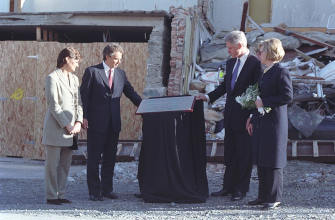
Following the unveiling, they walk through the town’s main street, Market Street, which bore the brunt of the explosion. Clinton, First LadyHillary Clinton, who earlier placed a wreath at the newly-unveiled plaque, Blair and his wife Cherie meet and shake hands with many of the crowd, who are clearly pleased to see them. They also visit Watterson’s drapers shop, where three members of staff had been killed, and lay a wreath.
Earlier, in the town’s leisure centre, they meet the victims of the Omagh bombing, and the family and friends of those who died. Blair and Clinton spend about an hour talking to people in Omagh. They meet some of the people who had been injured in the blast, including a group who have been released from hospital for the day especially to meet the president. Una McGurk is discharged from the Altnagelvin Area Hospital in Derry, and sisters Laura and Nicola Hamilton from the Ulster Hospital in Dundonald, on the outskirts of east Belfast. Thirty-four people remain in hospital, three – two women and a man – in critical conditions.
Downing Street later says the Blairs and Clintons were “deeply moved” by their meeting in the gymnasium. The prime minister’s official spokesman says Blair found the courage and determination of the people he met “positively inspirational.”
The first person Clinton speaks to is a young girl who has both eyes covered with bandages. He also meets a boy wearing a Leeds United F.C. shirt who is unable to shake the president’s hand because both his hands are still bandaged.
Before arriving in Omagh, Clinton puts the issue of decommissioning at the top of his priorities for change in Northern Ireland. He says these priorities are “To decommission weapons of war that are obsolete in a Northern Ireland at peace, to move forward with a formation of an executive council, adapt your police force so it has the confidence, respect and support of all the people, to end street justice, because defining crime, applying punishment and enforcing the law, must be left to the peoples’ elected representatives, the courts and the police, and to pursue early release for prisoners whose organisations have truly abandoned violence and to help them find a productive, constructive place in society.”
(From: “Clinton consoles bomb victims,” BBC News, news.bbc.co.uk, September 4, 1998)
McLynn grows up with two younger brothers in Galway. She studies History of Art and Modern English at Trinity College Dublin but is more heavily involved in the college’s drama society. She graduates with an MA.
Although McLynn is in her early thirties when playing Mrs. Doyle in Father Ted, makeup is used to make her look far older to fit the character’s elderly profile. She receives a British Comedy Award for her performances in 1996. The award is presented to her by Tony Blair.
McLynn is critically acclaimed for her performance in the 2005 film Gypo, receiving an Irish Film & Television Academy award nomination for Best Actress.
McLynn appears as Libby Croker in Shameless, which is produced by the British broadcaster Channel 4. In January 2011 it is announced that she has left the show, reportedly after a “difficult year.” She also plays the role of Alice’s mother in the Comedy Central show Threesome. She stars in Samuel Beckett’s Happy Days at the Crucible Theatre, Sheffield, in 2011. She plays Mary Whyte in the BBC’s 2013 sitcom Father Figure.
In 2014, McLynn plays the part of Evelyn in “Kiss for the Camera”, a series three episode of the BBC comedy Pramface. On May 12, 2014, she joins the cast of EastEnders as Yvonne Cotton, the mother of Charlie Cotton (Declan Bennett) and ex-daughter-in-law of Dot Branning (June Brown). After starting as a recurring character, she quickly becomes a regular when her character’s storylines escalate. She makes her final appearance on January 13, 2015, at the end of her contract. However, she returns to the soap opera on May 14, 2015 for one single episode to give evidence against Dot during Nick Cotton‘s (John Altman) murder trial.
In 2017, McLynn appears as the mother of lead character Marcella in Roisin Conaty‘s E4 comedy GameFace, and in April 2018 she portrays Sister Mary in the BBC Two biopic Dave Allen At Peace. She appears as a minor character named Mrs. Trattner in the 2018 film Johnny English Strikes Again.
In 2021 McLynn appears as Oona in the E4 S6 of Inside No. 9. She also appears as Carol, a bar landlady, in the film Last Night in Soho, which is released in October 2021. She also appears in Doctor Who, as Mary in the New Year’s special “Eve of the Daleks.”
McLynn is married to theatrical agent Richard Cook. She is a patron of the children’s charity World Vision Ireland and is president of Friends of Innisfree Housing Association. She is also a patron for Littlehill Animal Rescue, Sanctuary in Ireland and Birmingham Greyhound Protection.
O’Hagan, known to all and sundry simply as JB, dies on Monday, April 23, 2001, in the town in which he was born almost 79 years previously and from which he and his wife Bernadette had been exiled for 25 years during the current phase of the conflict. As befitted a soldier of Óglaigh na hÉireann, a uniformed IRA Guard of Honour attends O’Hagan’s body in the wake house and it is six of his comrades who carry the coffin, bedecked in the Irish Tricolour and beret and gloves, from the family home on the first section of its journey to St. Paul’s Chapel for the Funeral Mass.
Up to 2,000 people attend the funeral and businesses in the bustling North Armagh town close along the route as a mark of respect. At St. Colman’s Cemetery just outside the town, Sinn Féin President Gerry Adams pays fulsome tribute to a republican who had been active from the 1940s into the 1990s and right up to his sudden death. Adams notes O’Hagan’s strong faith and welcomes the tribute paid during the Funeral Mass to JB’s republican beliefs and exploits. He adds, however, that it is high time the Catholic hierarchy reverses its directive banning the Tricolour from republican funerals in church premises. “Our National Flag should be allowed to stay on the coffin for the entire ceremony,” he says.
“I have always associated JB with Bernadette,” he tells those gathered at the graveside, “even though they were apart for so many years. They were married for 52 years, and Bernadette told me yesterday that she wouldn’t change a day of it, that she was proud of him and of his life.”
“In many ways he died the way he had lived, very quietly, modestly, not complaining, unassuming to the end. He was one of the most respected republicans of our time. There is no greater tribute that can be paid to any man or woman than to be known as a decent human being and Joe B. was that and more.”
Adams goes on to briefly record the extraordinary history of O’Hagan’s involvement in the republican struggle, as soldier and political activist, since he first joined the IRA in 1940, including that famous 1973 escape from Mountjoy Jail by helicopter, accompanied by Kevin Mallon and the late Seamus Twomey.
“JB grew up in the 1920s in a state abandoned by the Irish Government, where nationalists were subjected to the B-Specials and the Special Powers Act. He stood up at a time when standing up was a very very dangerous thing to do,” says Adams. “It is a wonder to me that he was active in every decade from the 1940s on. There is a mighty man!”
“He also personifies why Irish republicanism has never been defeated. He was an example of a physical force republican who was prepared to support and exhaust other means of struggle. He saw armed struggle as a means rather than as an end, but he never ceased to be an unrepentant republican and to work always for the establishment of an Irish Republic based on national rights for the people of this island. He supported the Good Friday Agreement not as an end but as an effort to build a new accord with our opponents and enemies. Political unionism has found it very difficult to deal with this strategy.”
“Joe B was very philosophical and very wise. He is representative of that republican element who never broke a promise in their lives.”
“Those who seek to defeat the republican struggle by blaming the IRA for everything need to know that none of this will work. That is because of the work that JB and people like him put into this struggle. We won’t be worn down or accept anything less than our full rights. The message for David Trimble and Tony Blair is that it is impossible for us to accept inequality, injustice and second-class citizenship. That is the past. We are looking to the future.”
“Joe B’s passing has left a huge gap, but we should celebrate his life. He touched so many of us. Joe B kept us right. The flame he kept flickering in the lean times is burning brightly now because of his contribution.”
Adams extends his solidarity and sympathy and that of all those present to Bernadette, to O’Hagan’s children, Barry, Kevin, Fintan, Siobhán, Felim and Dara, to his eleven grandchildren and four great-grandchildren, his sisters and entire family circle.
At the end of the Funeral Mass for O’Hagan, the O’Hagan family lead by Joe’s son Fintan place the Irish Tricolour on the coffin before the remains are taken from the chapel. This act is borne out of anger and frustration.
O’Hagan was a republican, an honourable man and a religious man who went to Mass every day. So, his family feels that the Catholic Church, that was as much an influence on O’Hagan’s life as was his republicanism, should respect his wish and allow his coffin to be draped in the Tricolour. The family appeals to the Catholic Church authorities and Adams intercedes on their behalf, but they are refused the right to grant O’Hagan his wish that the Flag not be removed from his coffin.
Dara O’Hagan, the Sinn Féin Northern Ireland Assembly member for Upper Bann, tells the bishop that by sticking to their old policy the Catholic Church is criminalising republicanism and indeed criminalising her father.
Also, the Catholic hierarchy misses a great opportunity to heal a hurt that has existed for over 20 years, when the remains of IRA Volunteer Kevin `Dee’ Delaney were refused entry into Corpus Christi Church in Springhill while bearing the Irish Tricolour. The rancour and hurt felt by republicans over this slight, coming as it does, in conjunction with the British Government’s attempts to criminalise republicanism, has long been an insult that republicans have resented. After all, churches are the people’s property as it is their money and effort that build them. The people of Springhill and the Greater Ballymurphy area paid £5 a brick for the Corpus Christi building and the Delaney family no doubt contributed to that fund.
By taking matters into their own hands, the O’Hagan family claims back some ground for republicans and sends a message to the bishops that they have a part to play in this new political era and that they need to look at their attitude to republicanism.
O’Hagan’s wife Bernadette says that as Fintan draped the Irish Trocolour on Joe’s coffin and the church burst into spontaneous applause, her heart was lifted. “I was so glad, and I walked down the aisle with a smile on my face,” said Bernadette.
(From: “Unassuming and mighty man laid to rest” by Martin Spain, An Phoblacht Republican News, May 3, 2001)
On February 1, 1998, up to 40,000 people march from the nationalistCreggan estate to the Bogside area of Derry to commemorate the 26th anniversary of Bloody Sunday and to remember the 14 people who died after paratroopers opened fire during disturbances 26 years earlier. Organisers say it is one of the biggest Bloody Sunday marches to date.
Jean Heggarty, whose brother Kevin was among those killed on January 31, 1972, pays tribute to the families’ quest for truth. “The families have never doubted the truth would survive. Due to their determination 26 years later, Tony Blair stated in the House of Commons that he would establish the truth,” she says.
John Kelly, whose brother Michael was killed, says, “The families have had a long struggle but what Tony Blair has said has really surprised us. I think we are in a more jovial mood after that announcement.”
The Sinn Féin chief negotiator, Martin McGuinness, calls for prosecutions to result from the new Bloody Sunday inquiry. He says those commanding the paratroopers on the day should be called to account for their actions.
McGuinness includes in his remarks General Sir Robert Ford, who was Commander of Land Forces in Northern Ireland at the time of the killings. “I think the role of General Ford in particular is going to come under the microscope,” he says. “If people such as General Ford are found to be complicit in the killings then I think they should be subjected to proceedings in the courts. The implications of all that are enormous for the British establishment.”
In the immediate aftermath of the shootings, General Ford told the BBC that his men had returned only three shots after having between 10 and 20 rounds fired at them.
(From: “Special Report: Remembering Bloody Sunday,” BBC News, news.bbc.co.uk, February 1, 1998 | Pictured: In driving rain, relatives lay wreaths at the Bloody Sunday memorial)
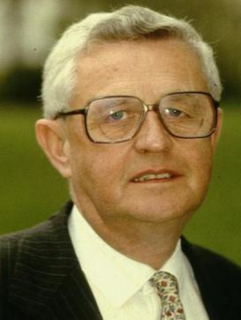
Hutton becomes a Queen’s Counsel in 1970. From 1979 to 1989, as Sir Brian Hutton, he is a High Court judge. In 1989, he becomes Lord Chief Justice of Northern Ireland, becoming a member of the Privy Council of Northern Ireland, before moving to England to become a Lord of Appeal in Ordinary on January 6, 1997. He is consequently granted a life peerage as Baron Hutton, of Bresagh in the County of Down.
On March 30, 1994, as Lord Chief Justice of Northern Ireland, Hutton dismisses Private Lee Clegg‘s appeal against his controversial murder conviction. On March 21, 2002 he is one of four Law Lords to reject David Shayler‘s application to use a “public interest” defence as defined in section 1 of the Official Secrets Act 1989 at his trial.
Hutton represents the Ministry of Defence at the inquest into the killing of civil rights marchers on “Bloody Sunday.” Later, he publicly reprimands Major Hubert O’Neil, the coroner presiding over the inquest, when the coroner accuses the British Army of murder, as this contradicts the findings of the Widgery Tribunal.
Hutton also comes to public attention in 1999 during the extradition proceedings of former Chilean dictator General Augusto Pinochet. Pinochet had been arrested in London on torture allegations by request of a Spanish judge. Five Law Lords, the UK’s highest court, decide by a 3-2 majority that Pinochet is to be extradited to Spain. The verdict is then overturned by a panel of seven Law Lords, including Hutton, on the grounds that Lord Lennie Hoffmann, one of the five Law Lords, has links to human rights group Amnesty International which had campaigned for Pinochet’s extradition.
In 1978, Hutton defends the UK at the European Court of Human Rights in the case of Ireland v United Kingdom, when the court decides that the interrogation techniques used were “inhuman and degrading” and breached the European Convention on Human Rights, but do not amount to “torture.” The court also finds that the practice of internment in Northern Ireland had not breached the Convention. He sentences ten men to 1,001 years in prison on the word of “supergrass” informer Robert Quigley, who is granted immunity in 1984.
Hutton is appointed by Tony Blair‘s government to chair the inquiry on the circumstances surrounding the death of scientist David Kelly. The inquiry commences on August 11, 2003. Many observers are surprised when he delivers his report on January 28, 2004 and clears the British Government in large part. His criticism of the BBC is regarded by some as unduly harsh with one critic commenting that Hutton had given the “benefit of judgement to virtually everyone in the government and no-one in the BBC.” In response to the verdict, the front page of The Independent newspaper consists of one word, “Whitewash?”
Peter Oborne writes in The Spectator in January 2004: “Legal opinion in Northern Ireland, where Lord Hutton practised for most of his career, emphasises the caution of his judgments. He is said to have been habitually chary of making precedents. But few people seriously doubt Hutton’s fairness or independence. Though [he is] a dour Presbyterian, there were spectacular acquittals of some very grisly IRA terrorist suspects when he was a judge in the Diplock era.”
Hutton retires as a Law Lord on January 11, 2004. He remains a member of the House of Lords until retiring under the House of Lords Reform Act 2014 on April 23, 2018.