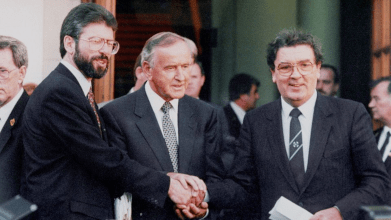
The Provisional Irish Republican Army (IRA) announces a ceasefire on August 31, 1994, after a quarter century of what it calls its “armed struggle” to get the British out of Northern Ireland. The statement comes just after 11:00 a.m. BST and says there will be a “complete cessation of military operations” from midnight and that the organisation is willing to enter into inclusive talks on the political future of the Province.
The statement raises hopes for peace and an end to 25 years of bombing and shooting that led to the deaths of more than 3,000 people. There is scepticism from the loyalist community and celebration in the Catholic areas of Belfast and Derry.
But loyalists are suspicious of the declaration and fear it may lead to a sell-out in which Northern Ireland’s position within the United Kingdom is under threat. The Ulster Unionist Party (UUP) MPJames Molyneaux says no moves towards talks should begin until the IRA has added the word “permanent” to the ceasefire declaration.
The announcement comes 18 months after secret talks began between the British Government and Irish republicans. It leads to the Anglo-Irish Downing Street Declaration in December 1993 which states that any change in the partition of Ireland can only come with the consent of those living north of the border. It also challenges republicans to renounce violence.
Ian Paisley, leader of the hardline Democratic Unionist Party (DUP), rejects the wording of the declaration and says it is an “insult to the people [the IRA] has slaughtered because there was no expression of regret.”
Seven weeks later, on October 13, the loyalist terrorist groups announce their own ceasefire. On December 9, British officials meet Sinn Féin representatives for their first formal talks in 22 years.
The IRA ceasefire ends on February 9, 1996, when it plants a huge bomb in the London Docklands. It kills two, injures more than 100 and causes more than £85m of damage.
A new ceasefire is finally announced in July 1997.
(Pictured: (L to R) Sinn Féin President Gerry Adams, Taoiseach Albert Reynolds and Social Democratic and Labour Party leader John Hume)
McElwee, the sixth of twelve children, is born on November 30, 1957, into the small, whitewashed home built by his father, along the Tamlaghtduff Road in Bellaghy, County Derry, Northern Ireland. He attended St. Mary’s primary in Bellaghy, and then Clady intermediate. After leaving school he goes to Magherafelt technical college for a while but later changes his mind and goes to Ballymena training centre to begin an apprenticeship as a motor mechanic. Harassment from loyalist workers there forces him to leave and he then goes to work with a local mechanic.
McElwee and his cousin Francis Hughes form an independent Republican unit, which for several years carries out ambushes on British Army patrols as well as bomb attacks in neighbouring towns such as Magherafelt, Castledawson, and Maghera.
In October 1976, McElwee takes part in a planned bombing blitz on the town of Ballymena. Along with several colleagues, he is transporting one of the bombs, which explodes prematurely and blinds him in his right eye. He is transferred from the Ballymena hospital to the Royal Victoria Hospital in Belfast for emergency surgery to save his remaining eye. It is three weeks before he is able to see at all.
After six weeks McElwee is transferred again, this time to the military wing of the Musgrave Park Hospital. One week before Christmas, he is charged and sent to Crumlin Road Gaol.
At McElwee’s subsequent trial in September 1977, having spent over eight months on remand in Crumlin Road, he is charged and sentenced to 20 years’ imprisonment for possession of explosives and the murder of Yvonne Dunlop, who is killed when one of the firebombs destroys the shop where she is employed. His murder charge is reduced to manslaughter on appeal, although the original jail term stands. He returns to the blanket protest he had joined immediately after his trial, in the H-Blocks of Long Kesh.
Imprisonment is particularly harsh for McElwee and his brother Benedict who are frequently singled out for brutality by prison warders, outraged at the stubborn refusal of the two to accept any form of criminal status. On one occasion he is put on the boards for fourteen days for refusing to call a prison warder ‘sir.’ In a letter smuggled out to his sister Mary, Benedict writes of the imprint of a warder’s boot on his back and arms after a typical assault. However, throughout the brutality and degradation they have to endure serves only to deepen yet further, and harder, their resistance to criminalisation.
McElwee joins the 1981 Irish hunger strike on June 7, 1981, and died on August 8, 1981, after 62 days on the strike. Indicative of the callousness of the British government towards prisoners and their families alike, he is denied the comfort of his brother’s presence at that tragic moment. He dies after 62 days of slow agonising hunger strike with no company other than prison warders – colleagues of those who had brutalised, degraded and tortured him for three-and-a-half years.
In 2009, Republican Sinn Féin (RSF) name their Waterfordcumann after McElwee, replacing that of George Lennon, O/C of the Waterford Flying Column who led the IRA anti-Treaty Republicans into Waterford City in March 1922. The Waterford RSF had adopted the Lennon name without the permission of his son who noted that his father had, in later years, become a committed pacifist and opponent of the Vietnam War.
McElwee is the main subject of the song Farewell to Bellaghy, which also mentions his cousin Francis Hughes, other members of the independent Republican unit and deceased volunteers of the South Derry Brigade of the Provisional IRA. He is also the subject of The Crucifucks‘ song The Story of Thomas McElwee.
In Bangor, County Down, a group of loyalist protesters put up a Union Flag outside the offices of Sinn Féin education minister Martin McGuinness at his department’s Rathgael House headquarters. Another group of PUP protesters demonstrate at government buildings in Adelaide Street in Belfast city centre, where the Union Flag is flying above two of the government buildings in the street.
The PUP’s Billy Hutchinson criticises Sinn Féin ministers over their refusal to fly the Union Flag. “These people cannot even recognise that we have a monarch who’s 100 years old and they can’t even fly the flag, just because they think that everything that is British is no good,” he says. “These people forget that they have lived in Britain all their lives, most of them. They weren’t even born at Partition (of Ireland).” He adds that Sinn Féin’s ministers should accept that they are “British ministers in a British state.”
However, Sinn Féin’s Alex Maskey condemns the protests as “intimidating and sectarian.” He says Sinn Féin’s position on the flying of flags is designed not to cause offence. “Where British cultural and political symbols are invoked in public life, equivalent Irish cultural and political symbols should be given equal prominence. Where this cannot be agreed, no such symbols should fly,” he says.
The issue of flags has been emotive and divisive in Northern Ireland. The Sinn Féin ministers anger unionists on May 2 by ordering their civil servants not to fly the flag as part of the Coronation Day celebrations. The row reaches a head when the anti-agreement Democratic Unionist Party (DUP) attempts to guarantee the flying of the Union Flag with an assembly motion in June. However, the party fails to win enough support for their motion to be passed.
There are about 13 days in the year when the Union Flag is flown on designated government offices in the United Kingdom. Government buildings across the UK – from Whitehall ministries to town council offices are expected to raise the Union Flag on these days.
It is the second time in a week that the health minister has run into controversy. On Wednesday, August 2, she is confronted by angry loyalist protesters during an official visit to a County Antrim hospital. Around 20 demonstrators picket the Lagan Valley Hospital in Lisburn, while she is on a visit to see a GP scheme as part of a programme to learn about aspects of the health service. The tyres on the minister’s car are let down and an egg is thrown. De Brun is forced to leave the complex by another door.
(From: “Trimble joins Union Flag row,” BBC News, news.bbc.co.uk, Friday, August 4, 2000 | Pictured: Protesters picket the Department of Health)
Paisley is born on April 6, 1926, in Armagh, County Armagh. He becomes a Protestant evangelical minister in 1946 and remains one for the rest of his life. In 1951, he co-founds the fundamentalist Free Presbyterian Church of Ulster and is its leader until 2008. He becomes known for his fiery speeches and regularly preaches and protests against Catholicism, ecumenism and homosexuality. He gains a large group of followers who are referred to as “Paisleyites.”
Paisley becomes involved in Ulster unionist/loyalist politics in the late 1950s. In the mid-late 1960s he leads and instigates loyalist opposition to the Catholic civil rights movement in Northern Ireland. This leads to the outbreak of the Troubles in the late 1960s, a conflict that engulfs Northern Ireland for the next thirty years. In 1970, he becomes Member of Parliament for North Antrim and the following year he founds the Democratic Unionist Party (DUP), which he leads for almost forty years. In 1979, he becomes a Member of the European Parliament.
In 2005, Paisley’s DUP becomes the largest unionist party in Northern Ireland, displacing the Ulster Unionist Party (UUP), which has dominated unionist politics since 1905. In 2007, following the St. Andrews Agreement, the DUP finally agrees to share power with republican party Sinn Féin and consent to all-Ireland governance in certain matters. He and Sinn Féin’s Martin McGuinness become First Minister and deputy First Minister respectively in May 2007. He steps down as First Minister and DUP leader in May 2008 and leaves politics in 2011. He is made a life peer in 2010 as Baron Bannside.
In November 2011, Paisley announces to his congregation that he is retiring as a minister. He delivers his final sermon to a packed attendance at the Martyrs’ Memorial Hall on December 18, 2011, and finally retires from his religious ministry on January 27, 2012.
Paisley dies in Belfast on September 12, 2014. He is buried in Ballygowan, County Down on September 15 following a private funeral and a public memorial for 800 invited guests is held in the Ulster Hall on October 19. An obituary in The New York Times reports that late in life Paisley had moderated and softened his stances against Roman Catholics but that “the legacies of fighting and religious hatreds remained.”
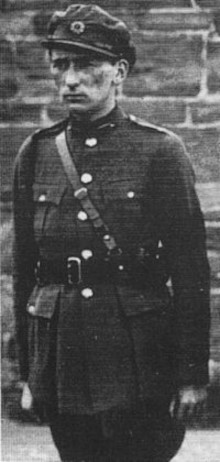
Tobin is born William Joseph Tobin at 13 Great Georges Street in Cork, County Cork, on November 15, 1895, the eldest son of Mary Agnes (nee Butler) and David Tobin, a hardware clerk. He has two younger siblings, Katherine and Nicholas Augustine Tobin, also born in Cork. His family moves to John Street in Kilkenny and then to Dublin. He goes to school in Kilkenny and is an apprentice in a hardware shop at the time of the 1916 Easter Rising. As a participant in the Rising he fights in the Four Courts garrison under Edward Daly. He is arrested, court martialed, and sentenced to death but his sentence is commuted to life imprisonment. He is a prisoner in Kilmainham, Mountjoy, Lewes, Dartmoor, Broadmoor and Pentonville prisons. He is released in June 1917.
In October 1921, Tobin travels with the Irish Treaty Delegation as part of Collins’ personal staff.
Tim Pat Coogan and James Mackay have examined Tobin’s involvement in the assassination of British Field MarshalSir Henry Wilson. Wilson’s public tirades about Collins is evidence of mutual personal dislike between the two men. In May 1922 Collins tells Tobin “We’ll kill a member of that bunch” to the news of “bloody pogroms” in Belfast. Wilson is intimately involved with the Ulster loyalist cause, including the Curragh Mutiny and the establishment of the Ulster Special Constabulary. Just before the shooting, Coogan places Tobin in London. He meets courier Peig Ni Braonain at Euston Station collecting a document that has been sent from Dublin. Returning to Dublin before the incident, he is jubilant when he tells defence ministerRichard Mulcahy about Wilson’s death. Mulcahy is appalled and threatens to resign.
In October 1922, Tobin’s brother Nicholas, a Free State captain, is accidentally shot dead by his own troops during the raid and capture of a bomb making factory at number 8 Gardiner’s Place, Dublin.
Tobin believes in the stepping stone doctrine which sees the Treaty as a stage towards full independence. With the outbreak of the Irish Civil War he remains loyal to Collins and takes the Pro-Treaty side. He leads in the fight against the Anti-Treaty IRA in the south. Disillusioned with the continuing hostilities and in the aftermath of the death of Collins, he forms an association called the IRA Organisation (IRAO) or “Old Irish Republican Army” to distinguish themselves from the anti-treaty insurgents.
Richard Mulcahy, the new Irish defence minister, proposes to reduce the army from 55,000 to 18,000 men in the immediate post- Civil-War period. Tobin knows his own position is to be affected and shares the perception that the Irish Army treats former British officers better than former IRA officers. On March 7, 1924, Tobin, together with Colonel Charlie Dalton, sends an ultimatum to President of the Executive Council of the Irish Free StateW. T. Cosgrave demanding an end to the army demobilisation. The immediate response is an order for the arrest of the two men on a charge of mutiny. The cabinet, already wary of the Irish Army, orders an inquiry and appoints Garda CommissionerEoin O’Duffy to the army command.
On March 18, the mutineers assemble with hostile intent at a Dublin pub. An order is made to arrest the mutineers and the cabinet demands the resignation of the army council. The generals resign, affirming the subservience of the military to the civilian government of the new state.
In later years, Tobin rebuilds relations with his Civil War foes and joins Éamon de Valera‘s Anti-Treaty Fianna Fáil party. He joins up with Joseph McGrath to form the Irish Hospitals’ Sweepstake in the 1930s. Many other former army comrades find work in this lottery. He leaves the Sweep in 1938. After World War II, he becomes Superintendent of the Oireachtas for the Irish Dáil.
On October 14, 1929, Tobin marries Monica “Mona” Higgins at the Church of the Holy Family, Aughrim Street, Dublin. They have two daughters, Máire and Anne Tobin. Following the death of his father, David, in 1956, Tobin’s health declines, resulting in his death in Dublin on April 30, 1963.
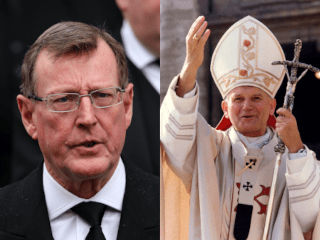
David Trimble becomes the first Ulster Unionist leader to meet a Pope when his historic meeting with John Paul II takes place in Rome on April 21, 1999. The meeting is widely welcomed as a sign that old prejudices are ending but Trimble is hotly criticised by both Protestants and Catholics in his Upper Bann constituency.
The First Minister is one of 54 Nobel Peace Prizelaureates who meets Pope John Paul II briefly at the Vatican, as part of a two-day trip organised by former Russian leader Mikhail Gorbachev. The Nobel Prize winners meet the Pope as a group and are then introduced and shake hands individually. There is a group photograph but no filming of the event. Careful stage-management ensures there are no public photographs of the two men close together.
A spokesman for Trimble says the UUP leader told the Pope he hopes this will be the year when peace will be secured in Northern Ireland. The Pope recalls his visit to Ireland and says murder cannot be condoned or called by another name.
Although the meeting is welcomed on both sides of the North divide, it does little to enhance Trimble’s standing in Upper Bann, particularly in troubled Portadown. In Portadown’s loyalist estates, there is open hostility toward Trimble. Many residents accusing their MP of “putting his personal status above the interests of his constituents.” The response is typified by one angry woman who says, “The loyalist people of this town and Drumcree, put David Trimble into office. Now he has turned his back on us. That’s a fatal mistake, this town and Drumcree will now destroy Trimble.”
“It’s unbelievable that this meeting is actually taking place,” says Orangeman Ivor Young. “It totally contradicts the oath that David Trimble took when he joined the Orange Order. We all knew Trimble was a traitor, this latest escapade puts the final nail in his political coffin here in Upper Bann. There is no way that he will ever be elected here again.”
Trimble also comes in for further criticism from Portadown Orange District, whose Drumcree protest has continued for the past 288 days. David Jones, the District’s press officer says that the people of Portadown once again see their local MP on “a world stage,” instead of being involved locally. “There are a lot of people around Portadown who aren’t very impressed that David Trimble has gone off to meet the Pope and hasn’t got more involved in trying to get the situation here solved,” says Jones.
On Portadown’s Garvaghy Road, Catholics are also critical of Trimble’s visit to Rome. “It’s amazing how he can travel to Rome to meet and talk to strangers,” says one nationalist resident, “yet he can’t be bothered to travel less than 30 miles to meet us, to talk about the serious issues that confront this community. After all we are as much his constituents as are the loyalists in this town.”
The meeting is the first time that the First Minister of Northern Ireland or the head of the Ulster Unionist Party has met the Pope in Rome. It also represents a rare appearance by an Orangeman at the heart of the Roman Catholic Church. Trimble and his entourage meet the Pope in the sumptuous surroundings of the Consistory Hall, the same room where the Cardinals of the Church gather to advise the Pope.
Earlier in the morning Trimble says in an interview with the Vatican radio that besides giving an update on developments in Northern Ireland, he wishes to “express to his Holiness the Pope that he and the Church will do what it can to persuade the paramilitaries to commit themselves irrevocably to peaceful means.”
Lynagh joins the Provisional Irish Republican Army in the early 1970s. In December 1973 he is badly injured in a premature bomb explosion, arrested, and spends five years in the Maze Prison. While imprisoned, he studies and becomes a great admirer of Mao Zedong. After his release from prison in 1979 he is elected as a Sinn Féincouncillor for Monaghan and holds this position until he is killed.
After his release from prison Lynagh becomes active in the IRA again, active with the Provisional IRA East Tyrone Brigade. He quickly becomes a unit commander and gradually builds up his ruthless reputation. After a series of Ulster loyalist attacks against Irish nationalist politicians in late 1980 and early 1981, he is suspected of involvement in an attack on the Stronge estate near Middletown, County Armagh, where the IRA murdered the retired Ulster Unionist PartyStormont speaker, Sir Norman Stronge, and his son James, a Royal Ulster Constabulary (RUC) officer, before burning down their home, Tynan Abbey, and shooting their way out through a police cordon.
Lynagh is known as “The Executioner” by the Royal Ulster Constabulary. He is arrested and interrogated many times by the Garda Síochána in County Monaghan but is never charged. During this period, he devises a Maoist military strategy, aimed at escalating the war against the British state in Northern Ireland. The plan envisages the destruction of police stations and British Army military bases in parts of Northern Ireland to create “liberated” areas that will be thereby rendered under the domination of the IRA. In 1984 he starts co-operating with Pádraig McKearney who shares his views. The strategy begins materialising with the destruction of an RUC police station in Ballygawley in December 1985 which kills two police officers, and in The Birches in August 1986.
Lynagh is killed by the British Army’s Special Air Service on May 8, 1987 during an attack on the isolated rural part-time police station at the small County Armagh village of Loughgall, the third such attack that he had taken part in. During the incident the IRA detonates a 200-lb. bomb, and attacks the station with automatic weapons, and in the process are ambushed by the British Army which is lying in wait for them, having been forewarned of the IRA operation. All eight of the IRA attacking force are killed in the exchange of fire, the British forces involved incurring no fatalities. The incident subsequently becomes known as the Loughgall ambush.
At the time of his death, Lynagh is living in a flat on Dublin Street in Monaghan. He is buried at St. Joseph’s Cemetery (Latlurcan Cemetery) in Monaghan. During his funeral, as his coffin is carried through the village of Emyvale, Irish Garda Síochána officers are attacked by the crowd of mourners after they pursue three gunmen who had fired a volley over his coffin.
The family is originally from the Marrowbone area, on the Oldpark Road in North Belfast. The family has to move when Storey is very young due to Ulster loyalist attacks on the district, moving to Manor Street, an interface area also in North Belfast. His uncle is boxing trainer Gerry Storey and his father, also called Bobby, is involved in the defence of the area in the 1970s when Catholics are threatened by loyalists.
Storey is one of four children. He has two brothers, Seamus and Brian, and a sister Geraldine. Seamus and his father are arrested after a raid on their home which uncovers a rifle and a pistol. While his father is later released, Seamus is charged. He escapes from Crumlin Road Prison with eight other prisoners in 1971, and they are dubbed the Crumlin Kangaroos.
On his mother Peggy’s side of the family there is also a history of republicanism, but Storey says the dominant influences on him are the events happening around him. These include the McGurk’s Bar bombing in the New Lodge, some of those killed being people who knew his family, and also Bloody Sunday. This then leads to his attempts to join the IRA. He leaves school at fifteen and goes to work with his father selling fruit. At sixteen, he becomes a member of the IRA.
On April 11, 1973, his seventeenth birthday, Storey is interned and held at Long Kesh internment camp. He had been arrested 20 times prior to this but was too young for internment. In October 1974, he takes part in the protest at Long Kesh against living conditions where internees set fire to the “cages” in which they are being held. He is released from internment in May 1975. He is arrested on suspicion of a bombing at the Skyways Hotel in January 1976 and a kidnapping and murder in the Andersonstown district of Belfast in March 1976, but is acquitted by the judge at his trial. He is arrested leaving the courthouse and charged with a shooting-related incident. He is released after the case cannot be proven, only to be charged with shooting two soldiers in Turf Lodge. Those charges are dropped in December 1977. The same month he is arrested for the murder of a soldier in Turf Lodge, but the charges are again dropped. In 1978 he is charged in relation to the wounding of a soldier in Lenadoon, but is acquitted at trial due to errors in police procedure.
On December 14, 1979, he is arrested in Holland Park, London, with three other IRA volunteers including Gerard Tuite, and charged with conspiring to hijack a helicopter to help Brian Keenan escape from Brixton Prison. Tuite escapes from the same prison prior to the trial, and the other two IRA volunteers are convicted, but Storey is acquitted at the Old Bailey in April 1981. That August, after a soldier is shot, he is arrested in possession of a rifle and is convicted for the first time, being sentenced to eighteen years’ imprisonment.
Storey is one of the leaders of the Maze Prison escape in 1983, when 38 republican prisoners break out of the H-Blocks, the largest prison escape in British penal history and the largest peacetime prison escape in Europe. He is recaptured within an hour and sentenced to an additional seven years’ imprisonment. Released in 1994, he is again arrested in 1996 and charged with having personal information about a British Army soldier, and Brian Hutton, the Lord Chief Justice of Northern Ireland. At his trial at Crumlin Road Courthouse in July 1998, he is acquitted after his defence proves the personal information had previously been published in books and newspapers.
Having spent over twenty years in prison, much of it on remand, Storey’s final release is in 1998, and he again becomes involved in developing republican politics and strategy, eventually becoming the northern chairman of Sinn Féin.
On September 9, 2015, Storey is arrested and held for two days in connection with the killing of former IRA volunteer Kevin McGuigan the previous month. He is subsequently released without any charges, and his solicitor John Finucane states Storey will be suing for unlawful arrest.
Storey dies in England on June 21, 2020, following an unsuccessful lung transplant surgery. Sinn Féin president Mary Lou McDonald describes him as “a great republican” in her tribute. His funeral procession in Belfast on June 30 is attended by over 1,500 people including McDonald, deputy First MinisterMichelle O’Neill, and former Sinn Féin president Gerry Adams, but is criticised for breaking social distancing rules implemented in response to the COVID-19 pandemic which, at the time operating in Northern Ireland, limited funeral numbers to no more than 30 mourners.
In the 2017 film Maze, dramatising the 1983 prison break, directed by Stephen Burke, Storey is portrayed by Irish actor Cillian O’Sullivan.
Myers grows up in England. His father, an Irish GP, dies when he is 15 and away at Ratcliffe College, a Catholicboarding school. His father’s early death creates financial difficulties, though he manages to stay at the school with the help of both the school and the Local Education Authority (LEA). He moves to Ireland to go to university, and graduates from University College Dublin (UCD) in 1969.
Myers subsequently works as a journalist for Irish broadcaster RTÉ, and reports from Northern Ireland during the height of the Troubles. He later works for three of Ireland’s major newspapers, The Irish Times, the Irish Independent, and the Irish edition of The Sunday Times. In 2000, a collection of his An Irishman’s Diary columns is published, with a second volume following in 2007. He is also a presenter of the Challenging Times television quiz show on RTÉ during the 1990s.
In 2001, Myers publishes Banks of Green Willow, a novel, which is met with negative reviews. In 2006, he publishes Watching the Door, about his time as a journalist in Northern Ireland during the 1970s. The book receives positive reviews in The Times, The Guardian, and the New Statesman, while The Independent publishes a more mixed review that wonders whether there is “an element of hyperbole” in Myers’ account.
Myers is a regular contributor to radio programmes on News Talk 106, particularly Lunchtime with Eamon Keane and The Right Hook. He regularly appears on The Last Word on Today FM. He is also a member of the Film Classification Appeals Board, formerly known as the Censorship Board.
In 2005, Myers attracts considerable criticism for his column, An Irishman’s Diary, in which he refers to children of unmarried mothers as “bastards.” Former Minister of StateNuala Fennell describes the column as “particularly sad.” She says the word “bastard” is an example of pejorative language that is totally unacceptable. Myers issues an unconditional apology two days later. The Irish Times editor, Geraldine Kennedy, also apologises for having agreed to publish the article.
In July 2008, Myers writes an article arguing that providing aid to Africa only results in increasing its population, and its problems. This produces strong reactions, with the Immigrant Council of Ireland making an official complaint to the Garda Síochána alleging incitement to hatred. Hans Zomer of Dóchas, an association of NGOs, and another complainant, take a complaint to the Press Council on the grounds that it breaches four principles of the Council’s Code of Practice: accuracy, fairness and honesty, respect for rights, and incitement to hatred.
At the end of July 2017, Myers contributes an article entitled “Sorry, ladies – equal pay has to be earned” to the Irish edition of The Sunday Times about the BBC gender-pay-gap controversy. He further alleges that Claudia Winkleman and Vanessa Feltz are higher paid than other female presenters because they are Jewish. The editor of the Irish edition, Frank Fitzgibbon, issues a statement saying in part “This newspaper abhors anti-Semitism and did not intend to cause offence to Jewish people.” Martin Ivens, editor of The Sunday Times, says the article should not have been published. Ivens and Fitzgibbon apologise for publishing it. After complaints from readers and the Campaign Against Antisemitism, the article is removed from the website. The newspaper announces that Myers will not write for The Sunday Times again. Myers is defended by the chair of the Jewish Representative Council of Ireland, Maurice Cohen, who states, “Branding Kevin Myers as either an antisemite or a Holocaust denier is an absolute distortion of the facts.”
Myers is married to Rachel Nolan and lives in County Kildare. He is the brother-in-law of TV presenter, producer and UK Big Brother housemate Anna Nolan.
On March 6, 1988, Provisional IRA members Daniel McCann, Seán Savage and Mairéad Farrell are shot dead by the Special Air Service (SAS) in Gibraltar, in Operation Flavius. The three had allegedly been preparing a bomb attack on British military personnel there, but the deaths outrage republicans as the three were unarmed and shot without warning. Their bodies arrive in Belfast on March 14 and are taken to their family homes. Tensions are high as the security forces flood the neighbourhoods where they had lived, to try to prevent public displays honouring the dead. For years, republicans have complained about heavy-handed policing of IRA funerals, which have led to violence. In a change from normal procedure, the security forces agree to stay away from the funeral in exchange for guarantees that there will be no three-volley salute by IRA gunmen. The British Army and Royal Ulster Constabulary (RUC) will instead keep watch from the sidelines. This decision is not made public.
Michael Stone is a loyalist, a member of the Ulster Defence Association (UDA) who had been involved in several killings and other attacks, and who describes himself as a “freelance loyalist paramilitary.” He learns that there will be little security force presence at the funerals, and plans “to take out the Sinn Féin and IRA leadership at the graveside.” He says his attack is retaliation for the Remembrance Day bombing four months earlier, when eleven Protestants had been killed by an IRA bomb at a Remembrance Sunday ceremony. He claims that he and other UDA members considered planting bombs in the graveyard but abandon the plan because the bombs might miss the republican leaders.
The funeral service and Requiem Mass go ahead as planned, and the cortege makes its way to Milltown Cemetery, off the Falls Road. Present are thousands of mourners and top members of the IRA and Sinn Féin, including Sinn Féin leader Gerry Adams and Martin McGuinness. Two RUC helicopters hover overhead. Stone claims that he entered the graveyard through the front gate with the mourners and mingled with the large crowd, although one witness claims to have seen him enter from the M1 motorway with three other people.
As the third coffin is about to be lowered into the ground, Stone throws two grenades, which have a seven-second delay, toward the republican plot and begins shooting. The first grenade explodes near the crowd and about 20 yards from the grave. There is panic and confusion, and people dive for cover behind gravestones. Stone begins jogging toward the motorway, several hundred yards away, chased by dozens of men and youths. He periodically stops to shoot and throw grenades at his pursuers.
Three people are killed while pursuing Stone – Catholic civilians Thomas McErlean (20) and John Murray (26), and IRA member Caoimhín Mac Brádaigh (30), also known as Kevin Brady. During the attack, about 60 people are wounded by bullets, grenade shrapnel and fragments of marble and stone from gravestones. Among those wounded is a pregnant mother of four, a 72-year-old grandmother and a ten-year-old boy. Some fellow loyalists say that Stone made the mistake of throwing his grenades too soon. The death toll would likely have been much higher had the grenades exploded in mid-air, “raining lethal shrapnel over a wide area.”
A white van that had been parked on the hard shoulder of the motorway suddenly drives off as Stone flees from the angry crowd. There is speculation that the van is part of the attack, but the RUC says it was part of a police patrol, and that the officers sped off because they feared for their lives. Stone says he had arranged for a getaway car, driven by a UDA member, to pick him up on the hard shoulder of the motorway, but the driver allegedly “panicked and left.” By the time he reaches the motorway, he has seemingly run out of ammunition. He runs out onto the road and tries to stop cars, but is caught by the crowd, beaten, and bundled into a hijacked vehicle. Armed RUC officers in Land Rovers quickly arrive, “almost certainly saving his life.” They arrest him and take him to Musgrave Park Hospital for treatment of his injuries. The whole event is recorded by television news cameras.
That evening, angry youths in republican districts burn hijacked vehicles and attack the RUC. Immediately after the attack, the two main loyalist paramilitary groups—the UDA and the Ulster Volunteer Force (UVF)—deny responsibility. Sinn Féin and others “claimed that there must have been collusion with the security forces, because only a small number of people knew in advance of the reduced police presence at the funerals.”
Three days later, during the funeral of one of Stone’s victims, Caoimhín Mac Brádaigh, two British Army corporals, Derek Wood and David Howes, in civilian clothes and in a civilian car drive into the path of the funeral cortège, apparently by mistake. Many of those present believe the soldiers are loyalists intent on repeating Stone’s attack. An angry crowd surrounds and attacks their car. Corporal Wood draws his service pistol and fires a shot into the air. The two men are then dragged from the car before being taken away, beaten and shot dead by the IRA. The incident is often referred to as the corporals killings and, like the attack at Milltown, much of it is filmed by television news cameras.
In March 1989, Stone is convicted for the three murders at Milltown, for three paramilitary murders before, and for other offences, receiving sentences totaling 682 years. Many hardline loyalists see him as a hero, and he becomes a loyalist icon. After his conviction, an issue of the UDA magazine Ulster is devoted to Stone, stating that he “stood bravely in the middle of rebel scum and let them have it.” Apart from time on remand spent in Crumlin Road Gaol, he spends all of his sentence in HM Prison Maze. He is released after serving 13 years as a result of the Good Friday Agreement.
In November 2006, Stone is charged with attempted murder of Martin McGuinness and Gerry Adams, having been arrested attempting to enter the Parliament Buildings at Stormont while armed. He is subsequently convicted and sentenced to a further 16 years imprisonment. He is released on parole in 2021.



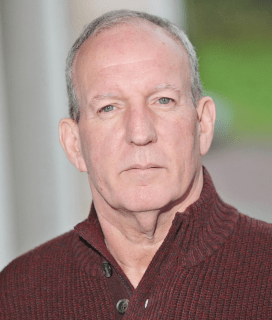


 seamus dubhghaill