In 1866 Monck becomes a peer with the title Baron Monck. When the Canadian colonies become a semi-independent confederation the next year, he becomes the country’s first Governor General. He is also responsible for establishing Rideau Hall as the residence of the Governor General in Ottawa.
Williams becomes a member of the Young Ireland movement and contributes poetry to The Nation under the pseudonym “Shamrock.” He is immediately successful. In the January 21, 1843 edition there appears: “Shamrock is a jewel. He cannot write too often. His verses are full of vigour, and as natural as the harp of Tara.”
Later in 1843 Williams goes to Dublin to study medicine at Saint Vincent’s Hospital. In 1848 he brings out a newspaper, the Irish Tribune, to take the place of the suppressed United Irishman, founded by John Mitchel. Before the sixth weekly publication, it is seized by the Government, and proceedings are instituted against the editors, Williams and his friend Kevin Izod O’Doherty. On October 30, 1848, at a third trial, O’Doherty is convicted of treason and transported to Australia while Williams is successfully defended by lawyer and fellow poet Samuel Ferguson two days afterwards on the same charge. He then resumes his medical studies, takes out his degree at Edinburgh, Scotland in 1849 and emigrates to the United States in 1851.
Williams is married to Elizabeth Connolly on September 8, 1856, with whom he has four children of whom the youngest is commemorated in Lines on the Death of his Infant Daughter, Katie.
In the United States Williams practises medicine until he becomes ill and dies of tuberculosis in Thibodaux, Louisiana on July 5, 1862. He is buried there in St. Joseph’s Cemetery. His headstone is later erected that year by Irish members of the 8th New Hampshire Volunteer Infantry, then encamped in Thibodaux.
Aiming to raise awareness of world poverty, The Corrs and chartered accountants KPMG jointly launch the NetAid web site on October 7, 1999. NetAid is an anti-poverty initiative started as a joint venture between the United Nations Development Programme and Cisco Systems. It becomes an independent nonprofit organization in 2001 and becomes a part of Mercy Corps in 2007.
NetAid begins with a concert event on October 9, 1999 with simultaneous activities meant to harness the Internet to raise money and awareness for the Jubilee 2000 campaign. Concerts take place at Wembley Stadium in London, Giants Stadium in New Jersey and the Palais des Nations in Geneva. While the Wembley show is at capacity, the U.S. show suffers from very poor ticket sales.
The NetAid website, originally at http://www.netaid.org, receives over 2.4 million hits and raises $830,000 from eight countries. Cisco sponsors the concerts and the web site. Along with Kofi Annan, Keyur Patel, MD of KPMG Consulting spearhead the technology architecture development of the web site and Anaal Udaybabu (Gigabaud Studios, San Francisco) designs the user experience.
Following the concerts, NetAid is spun out of Cisco as an independent entity and tries various approaches to raising awareness of extreme poverty and raising money for anti-poverty projects undertaken by other organizations, through a variety of different NetAid campaigns.
By 2006, NetAid has narrowed its focus to raising awareness among high school students in the United States regarding poverty in developing countries.
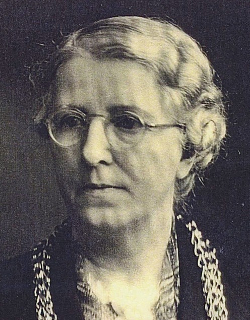
Kathleen Daly is born into a prominent Fenian family in Limerick on April 11, 1878, the third daughter of Edward and Catherine Daly. Her paternal uncle, John Daly, is at the time imprisoned for his political activities in Chatham and Portland Prisons in England. He is released in 1896 and returns home to Limerick. When Tom Clarke, who had been imprisoned with her uncle, is released in 1898 he travels to Limerick to receive the Freedom of the City and stays with the Daly family.
In 1901 Daly decides to emigrate to the United States to join Tom, who had been there since 1900, having secured work through his Fenian contacts. They marry on July 16, 1901, in New York City. Through his contacts in the Clan na Gael and the Irish Republican Brotherhood (IRB), Tom Clarke continues to be involved in nationalist activity. Kathleen joins the Gaelic League while in the United States and they return to Ireland in November 1907.
In 1914 Clarke becomes a founder member of Cumann na mBan. Her husband forbids her permission to take an active part in the 1916 Easter Rising as she has orders regardless of how the events pan out. As Tom Clarke is the first signatory of the Proclamation of the Irish Republic, he is chosen to be executed for his part in the Easter Rising. Her younger brother, Ned Daly, is also executed for taking part in the rising. She visits both of them before they are executed. After the Rising, Michael Collins establishes contact with her while in prison in his attempts to re-build the IRB network. She also sets up the Irish National Aid Fund to aid those who had family members killed or imprisoned as a result of the Easter Rising, closely aided by Sorcha MacMahon.
Clarke becomes a member of Sinn Féin and in 1917 is elected a member of the party’s Executive. During the German Plot she is arrested and imprisoned in Holloway Prison for eleven months. During the Irish War of Independence, she serves as a District Judge on the Republican Courts in Dublin. In 1919 she is elected as an Alderman for the Wood Quay and Mountjoy Wards of Dublin Corporation and serves until the Corporation is abolished in 1925.
Clarke is elected unopposed as a Sinn Féin TD to the Second Dáil at the 1921 elections for the Dublin Mid constituency. She is not re-elected at the 1922 Irish general election, however, and supports the Anti-Treaty forces during the Irish Civil War. In 1926 she becomes a founder member of Fianna Fáil and has to resign from Cumann na mBan. She is re-elected to the short-lived 5th Dáil at the June 1927 Irish general election as a Fianna Fáil member for the Dublin Mid constituency but loses her seat at the September 1927 Irish general election and does not regain it. She is elected as one of six Fianna Fáil Senators to the Free State Seanad for nine years at the 1928 Seanad election under the leadership of Joseph Connolly. She remains a member of the Seanad until it is abolished in 1936.
In 1930 Clarke is elected to the re-constituted Dublin Corporation for Fianna Fáil along with Robert Briscoe, Seán T. O’Kelly, Thomas Kelly and Oscar Traynor. She serves as the first Fianna Fáil Lord Mayor of Dublin as well as the first female Lord Mayor, from 1939 to 1941. She opposes the Constitution of Ireland as she feels that several of its sections would place women in a lower position that they had been afforded in the Proclamation of the Irish Republic. She is criticised by many in the Fianna Fáil organisation as a result and, while she resigns from the Thomas Clarke Cumann, she remains a member of the Fianna Fáil Ard Chomhairle.
While Clarke does not support the Irish Republican Army (IRA) bombing in England during World War II, she appeals for those sentenced to death by the Irish Government to be given clemency. Ultimately this leads to her breaking with the party completely after her term as Lord Mayor finishes in 1941. She declines to stand as a Fianna Fáil candidate at the 1943 Irish general election.
In 1966, as part of the celebrations of the Easter Rising, Clarke and other surviving relatives are awarded honorary Doctor of Law by the National University of Ireland. Following her death on September 29, 1972, she receives the rare honour of a state funeral. She is buried at Deans Grange Cemetery, Dublin.
Dolores Keane, folk singer and occasional actress, is born on September 26, 1953, in the small village of Sylane, near Tuam, in rural County Galway. She is a founding member of the successful group De Dannan and has since embarked on a very successful solo career, establishing herself as one of the most loved interpreters of Irish song.
Keane is raised from the age of four by her aunts Rita and Sarah Keane, who are also well-known sean-nós singers. She starts her singing at a very young age, due to the influence of her musical aunts. She makes her first recording for Radio Éireann in 1958 at the age of five. This early start sets her on the path to a career in music. Her brother, Seán, also goes on to enjoy a successful music career.
In 1975, Keane co-founds the traditional Irish band De Dannan, and they release their debut album Dé Danann in that same year. The group gains international recognition and enjoys major success in the late 1970s in the United States. She tours with the band and their single “The Rambling Irishman” is a big hit in Ireland. In early 1976, after a short two-year spell, she leaves De Dannan and is replaced by Andy Irvine, who records live with the band on April 30, 1976, during the 3rd Irish Folk Festival in Germany. Soon thereafter, she marries multi-instrumentalist John Faulkner, with whom she subsequently records three albums of folk music.
Keane lives and works in London for several years with Faulkner before they move to Ireland in the early 1980s. They work on a series of film scores and programmes for the BBC and form two successful bands, The Reel Union and Kinvara. During this period, she records her first solo album, There Was a Maid in 1978. This is followed by two other releases, Broken Hearted I’ll Wander (1979) and Farewell to Eirinn (1980), which gives credit to Faulkner. In the mid-1980s she rejoins De Dannan and records the albums Anthem and Ballroom with them.
Keane turns her attention, once again, to her solo career in 1988. It sees the release of the eponymous Dolores Keane album. Her follow-up album, A Lion in a Cage (1989), features a song written by Faulkner called “Lion in a Cage” protesting the imprisonment of Nelson Mandela. It serves as Keane’s second Irish number one, and she performs the hit at the celebration of his release. This exposure expands her reputation and popularity worldwide. A new facet is added to her career when she plays the female lead in the Dublin production of Brendan Behan‘s The Hostage. The opening night is attended by Mary Robinson, the President of Ireland at the time.
In 1992, Keane is among the many female Irish singers to lend their music to the record-smashing anthology A Woman’s Heart. The album goes on to become the biggest-selling album in Irish history. A Woman’s Heart Vol.2 is released in late 1994 and emulates its predecessor in album charts the world over. Also in 1994, a solo album, Solid Ground, is released on the Shanachie Records label and receives critical acclaim in Europe and America.
In August 1995, Keane is awarded the prestigious Fiddler’s Green Hall of Fame award in Rostrevor, County Down, for her “significant contribution to the cause of Irish music and culture.” In that same year, she takes to the stage in the Dublin production of John Millington Synge‘s The Playboy of the Western World. She contributes to the RTÉ/BBC television production “Bringing It All Back Home,” a series of programmes illustrating the movement of Irish music to America.
In August 1997, Keane goes to number one again in the Irish album charts with a compilation album with her most loved songs. And another studio album, Night Owl, is released in 1998. It sees her returning to her traditional Irish roots and it does well in Europe and America. Despite a healthy solo career, she goes on tour with De Dannan again in the late 1990s, where she plays to packed audiences in venues such as Birmingham, Alabama and New York City.
Keane puts an end to recording and touring in the late 1990s, due to depression and alcoholism, for which she receives extensive treatment. As of June 2014, she is given the all clear after suffering from cancer.
Embury’s parents are members of the colony of Germans that emigrate from the Palatinate to Ireland early in the eighteenth century, and in which Methodism co-founder John Wesley labors with great success. The colony forms from refugees from the War of the Spanish Succession. Embury is educated at a school near Ballingrane and learns the carpentry trade. He is converted on Christmas day 1752, becomes a local preacher at Court-Matrix in 1758 and marries Margaret Switzer that fall.
In 1760, due to rising rents and scarce land, he goes to New York City and works as a schoolteacher. In common with his fellow emigrants, he begins to lose interest in religious matters and does not preach in New York until 1766 when, moved by the reproaches of his cousin Barbara Heck, sometimes called the “mother of American Methodism,” he begins to hold services first in his own house on Barrack Street, now Park Place, and then in a rigging loft on what is now William Street. The congregation thus forms what is probably the first Methodist congregation in the United States, though it is a disputed question whether precedence should not be given to Robert Strawbridge, who begins laboring in Maryland about this time. Before this, he and Barbara Heck worship along with other Irish Palatines at Trinity Church in Manhattan, where three of his children are baptized.
The first Methodist church is built under Embury’s charge in 1768, in association with Thomas Webb and others, on the site of the present John Street United Methodist Church. He himself works on the building as a carpenter and afterward preaches there gratuitously. In 1769, preachers sent out by John Wesley arrive in New York City, and Embury goes to work in the vicinity of Albany at Camden Valley, New York, where he continues to work at his trade during the week and preaches every Sunday. He and several others receive a grant of 8,000 acres to develop for the manufacture of linen. He organizes among Irish emigrants at Ashgrove, near Camden Valley, the first Methodist society within the bounds of what becomes the flourishing and influential Troy Conference.
Philip Embury dies suddenly in Camden, New York in August 1775, in consequence of an accident in mowing. He is buried on a neighboring farm but in 1832 his remains are removed to Ashgrove churchyard and in 1866 to Woodland cemetery, Cambridge, New York, where a monument to him is unveiled in 1873, with an address by BishopMatthew Simpson.
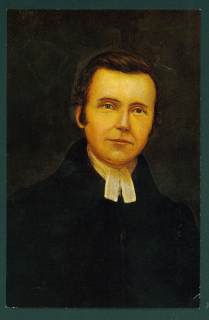
(Pictured: Portrait of Philip Embury by John Barnes, Salem, 1773)
Catherine Coll is born on December 21, 1856, in Bruree, County Limerick and emigrates to New York City in 1879. She first takes a job with a wealthy French family that is living in Manhattan. This is where she allegedly meets Juan Vivion de Valera (born 1854), a Spanish sculptor who comes to the home of her employers to give music lessons to the children.
It is alleged that Vivion de Valera, always in poor health, leaves his young family behind in 1885 and travels to Colorado, hoping that perhaps the healthier air will help him out only to die within a few months.
Though Éamon de Valera’s official biography (Longford/O’Neill, Hutchinson, London, 1970) states that his parents were married at St. Patrick’s Church on September 19, 1881, the parish records show no record of any Coll–de Valera wedding either at St. Patrick’s or any church, nor were any civil records found, in the vicinity during the period from 1875 to 1887. Also, initially de Valera is not registered in his father’s name.
However, not merely is there no record of the wedding. No record exists of the existence of a “Juan Vivion de Valera” anywhere in the United States: no birth certificate, no baptismal certificate (if he was a Catholic), no marriage certificate and no death certificate. While it is possible that he was born abroad and so either had a foreign birth certificate or was not registered, the absence of a death certificate for someone stated definitely in Éamon de Valera’s family history to have died in the United States has puzzled researchers. Some scholars have questioned whether Juan Vivion de Valera ever existed.
There has been a mischievous suggestion that he was related to the French painter Achille Devéria as Éamon de Valera “was known to be particularly fond of his works.” This claim is hardly likely given that Devéria was a painter of erotica, and de Valera nothing if not a prude. It should also be noted that Devéria died in 1857, at least 20 years before Éamon de Valera was born.
It has also been alleged by some that Catherine Coll invented Juan de Valera to give her son legitimacy.
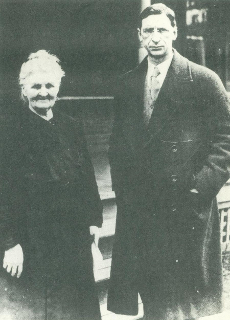
(Pictured: Irish republican leader and founder of Fianna Fail, Éamon de Valera, with his mother Catherine Coll, April 01, 1927)
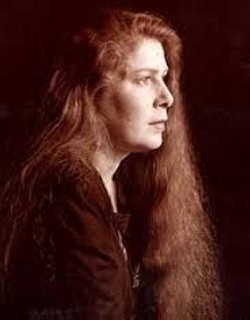
Born into a musical family, O’Connell is the third of four sisters. Her mother’s family owns Costello’s fish shop in Ennis where O’Connell works until music becomes her full-time career. She grows up listening to her mother’s light opera, opera, and parlour music records. Her father’s interest leans towards the rebel ballads. Despite the presence of classical music in the house, O’Connell gets very involved in the local folk club scene and together with Mike Hanrahan, who later fronts folk rock outfit Stockton’s Wing, they perform a country music set, as a duo called “Tumbleweed.”
O’Connell attends St. Joseph’s Secondary School in Spanish Point from 1971 to 1974, where she takes part in the school choir. She is also a member of the “Cúl Aodha Choir”, led by Peader Ó Riada, that sings at the funeral of Willie Clancy in 1973.
O’Connell begins her professional musical journey during a six-week tour of the United States in 1980, as vocalist for the traditionally based Celtic group De Dannan. The following year, she is featured on the band’s landmark album, The Star Spangled Molly, which becomes something of a national phenomenon in her homeland. However, not long after joining the group she becomes very interested in the experimental roots music of America’s New Grass Revival when the bands’ paths cross. She moves to the United States in 1986, settling in Nashville, Tennessee. There she meets progressive bluegrass pioneers Béla Fleck and Jerry Douglas, with whom she works on most of her records.
O’Connell records her first solo album in 1983, however, it does not make any impact in Ireland or in the United States. She receives a Grammy Award nomination for her 1989 album, Helpless Heart, which is her first record released under Warner Bros. Records. Real Life Story (1990) and Blue is the Colour of Hope (1992) register a move toward a pop synthesis. Her versions of “Living in These Troubled Times” and Cheryl Wheeler‘s “Summerfly” become standout tracks on the 1993 album A Woman’s Heart, on four all-female overseas tours and on the 1994 follow-up album in her homeland. A Woman’s Heart Vol. 2 features her heartfelt renditions of Nanci Griffith‘s “Trouble in the Fields” and Gerry O’Beirne’s “Western Highway.” After numerous albums heavily inspired by American newgrass music, she returns to her Irish roots with the 1997 release Wandering Home.
As the new millennium approaches, O’Connell signs with Sugar Hill Records in late 2000 and begins working on her seventh album. Instead of working with her longtime producer Jerry Douglas, she has Ray Kennedy produce Walls and Windows, which is released in 2001, and features an eclectic collection of songs, including work by Kim Richey, Van Morrison, John Prine, Eric Clapton and Patty Griffin. Her 2004 album, Don’t I Know, contains musical textures added by everything from fiddles to clavinets, to lap steel guitar and B-3 organ.
In addition to her solo work, O’Connell has collaborated with a number of Celtic, folk, pop and country artists, including Van Morrison, Brian Kennedy, Moya Brennan, Mary Black, John Prine, Jerry Douglas, Tim O’Brien, John Gorka, Béla Fleck, Robert Earl Keen, Dolly Parton and Shawn Colvin. She has also sung background vocals for a number of artists, including Van Morrison’s 1988 project with The Chieftains, Irish Heartbeat and Stockton’s Wing on Take A Chance.
Aside from the music world, Martin Scorsese casts O’Connell, scruffed up for the role, as an Irish migrant street singer in his 19th-century epic Gangs of New York, released in 2002.
O’Connell announces the end of her solo career in 2013.
Born in New York City on April 23, 1926, to Irish immigrants Margaret and Patrick Donleavy, Donleavy receives his education at various schools in the United States. He declares himself to be an atheist at the age of 14. He serves in the United States Navy during World War II. After the war ends, he moves to Ireland. In 1946 he begins studying at Trinity College, Dublin, but leaves in 1949 before taking a degree. Also in 1946, he marries Valerie Heron, and the couple has two children: Philip (born 1951) and Karen (born 1955). They divorce in 1969 and he remarries in 1970 to Mary Wilson Price. That union also ends in divorce in 1989.
Donleavy’s first published work is a short story entitled A Party on Saturday Afternoon, which appears in the Dublin literary periodical, Envoy, A Review of Literature and Art in 1950. He gains critical acclaim with his first novel, The Ginger Man (1955), which is one of the Modern Library 100 best novels. The novel, of which his friend and fellow writer Brendan Behan is the first person to read the completed manuscript, is banned in Ireland and the United States by reason of obscenity. Lead character Sebastian Dangerfield is in part based on Trinity College companion Gainor Crist, an American Navy veteran also studying at Trinity College on the G.I. Bill, whom Donleavy once describes in an interview as a “saint,” though of a Rabelaisian kind.
In 2011, it is reported that Donleavy had not fathered his two children with Mary Wilson Price. A DNA test in the early 1990s confirms that Rebecca is the daughter of brewing scion Kieran Guinness, and Rory is the son of Kieran’s older brother Finn, whom Price marries after her divorce from Donleavy. “My interest is only to look after the welfare of the child,” Donleavy tells The Times, “And after a certain stage, you can’t worry about their parentage.”
J.P. Donleavy dies of an apparent stroke in Mullingar, County Westmeath on September 11, 2017, at the aged of 91.
Irish Press Ltd. is officially registered on September 4, 1928, three years before the paper is first published, to create a newspaper independent of the existing media where the Independent Newspapers group is seen as supporting Cumann na nGaedheal/Fine Gael, and The Irish Times being pro-union, and with a mainly middle-class or Protestant readership.
The paper’s first issue is published on the eve of the 1931 All-Ireland Senior Hurling Championship Final between Cork and Kilkenny. Other newspapers do not cover GAA sports in any detail at the time. Margaret Pearse, the mother of Patrick and Willie Pearse, presses the button to start the printing presses. The initial aim of its publisher is to achieve a circulation of 100,000 which it quickly accomplishes. It goes on to list 200,000 subscribers at its peak.
The money to launch the Irish Press is raised in the United States during the Irish War of Independence by a bond drive to finance the First Dáil. Five million dollars is raised; however, 60 percent of this money is left in various banks in New York City. No one knows why de Valera ordered the bulk of the money to be left in New York when he returned to Ireland in late 1920.
In 1927, as a result of legal action between the Irish Free State government and de Valera, a court in New York orders that the bond holders be paid back outstanding money due to them. However, de Valera’s legal team has anticipated the ruling and has prepared for the outcome. A number of circulars are sent to the bond holders asking them to sign over their holdings to de Valera. The bond holders are paid 58 cents to the dollar. This money is then used as startup capital to launch the Irish Press. Following the 1933 Irish General Election, de Valera uses his Dáil Éireann majority to pass a measure allowing the bond holders to be paid the remaining 42 percent of the money still owed.
In December 1931, editor Frank Gallagher is prosecuted by an Irish Free State military tribunal for publishing articles alleging that Garda Síochána had mistreated the Anti-Treaty republicans of the Irish Free State government. This is facilitated by Amendment 17 of the Constitution of the Irish Free State and Gallagher is convicted and fined £50. An example of animosity from those who support Independent Newspapers and the Free State government is that the Irish Press is excluded from the special train which delivers newspapers from Dublin to the countryside. As a result, it is circulated throughout Ireland by a specially rented train.
The Irish Press sustains itself with its own resources until The Sunday Press is founded in 1949. In its heyday, the Irish Press has a number of first-rate reporters and columnists. One notable section, New Irish Writing is edited by David Marcus.
In the 1970s, the Minister for Posts and Telegraphs, Conor Cruise O’Brien, tries to use and amend The Emergency Powers Act and Section 31 of the Broadcasting Authority Act, to censor coverage of the Troubles in Northern Ireland. The Irish Press editor, Tim Pat Coogan, publishes editorials attacking the Bill. The Fine Gael/Labour Coalition Government tries to prosecute the Irish Press for its coverage of the maltreatment of republican prisoners by the Garda “Heavy Gang,” with the paper winning the case.
The Irish Press starts two further newspapers, the Evening Press (1954), and The Sunday Press. The Evening Press is aimed at an urban readership and achieves a daily circulation of 100,000. The new newspapers subsidise the Irish Press when its circulation sags. Its adoption of a tabloid format does not rescue its declining circulation.
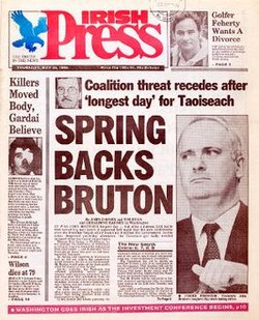
The final issue of the Irish Press and Evening Press is on Thursday, May 25, 1995. The newspapers close because of a bizarre industrial dispute over the sacking of the group business editor, Colm Rapple. The group has not been in a healthy financial state for several years. When it eventually closes, with indebtedness of £20 million, 600 people lose their jobs.
(Pictured: Cover of last ever edition of the Irish Press from May 25, 1995)




 seamus dubhghaill