seamus dubhghaill

Promoting Irish Culture and History from Little Rock, Arkansas, USA


Leave a comment

Death of Nancy Wynne-Jones, Welsh & Irish Artist

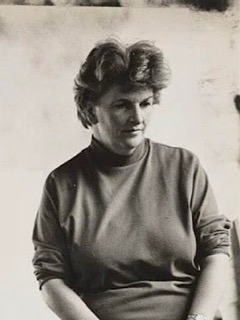
Nancy Wynne-Jones HRHA, a Welsh and Irish artist, dies in County Wicklow on November 9, 2006.

Mary Esperance (“Nancy”) Wynne-Jones is born on December 10, 1922, in Penmaenucha, Wales, to landowner Charles Llewellyn Wynne-Jones and Sybil Mary Gella Scott. The family spends half the year in Wales and half the year in Thornhill, StalbridgeDorset. She has two brothers, Andrew and Ronald (“Polly”), both of whom die in Africa during World War II.

Wynne-Jones is educated at home. Her skill in art leads to her getting lessons in Sherborne from a children’s book illustrator. Her music is encouraged by the family doctor and she begins to compose and study the violin, receiving lessons in Bournemouth with the first violinist of the symphony orchestra. After the start of World War II, she continues in Aberystwyth. She goes on to study the violin and composition at the Royal Academy of MusicLondon (1940–43). While in London she also serves as a Voluntary Aid Detachment nurse until 1943 and later as a draughtswoman at the Ordnance Survey.

After the war, Wynne-Jones purchases and manages a bookshop on the King’s Road in Chelsea, but it is not a financial success. She returns to painting, studying at the Heatherley School of Fine Art, London, from 1951 to 1952 and the Chelsea School of Art from 1952 to 1955. She travels extensively through Portugal and Italy painting landscapes. An interest in completing landscapes in an abstract manner leads her to study with Peter Lanyon in St. Ives, Cornwall.

Wynne-Jones begins study in Cornwall in 1957 and remains there for fifteen years. Her first public exhibition is in a group show in 1957 at the Pasmore Edwards Gallery, Newlyn. Other group shows are Jefferson Place Gallery, Washington, D.C. (1959) and in Falmouth, Cornwall (1960). Her solo exhibitions are at the New Vision Centre, London (1962 and 1965), Florence (1963) and Dolgellau (1964). From the 1960s through the 1990s she exhibits in Britain, Italy, Belgium, Germany, Ireland, Spain, Holland, South Africa, and the United States.

In 1962, Wynne-Jones purchases Trevaylor House near Penzance and provides accommodation for other artists including renowned Irish painter Tony O’Malley, sculptor Conor Fallon and English poet and writer W. S. ‘Sydney’ Graham. In the 1970s she exhibits in Ireland at the Project Arts Centre, Dublin (1970) and at the Emmet Gallery, Dublin (1975 and 1977). During the 1980s she exhibits at the Lincoln and Hendricks galleries in Dublin before joining the Taylor Gallery, run by John and Patrick Taylor. She is elected an honorary member of the Royal Hibernian Academy (RHA) in 1994 and becomes a member of Aosdána in 1996. Originally an abstract artist, her contact with the Irish countryside slowly transforms her work to that of a landscape artist, albeit with an influence of abstraction attached to it. She becomes well-known in Irish art circles as an eminent Irish landscape artist.

Wynne-Jones is involved with artist Derek Middleton before moving to Cornwall. There she becomes romantically involved with Graham who is in an open marriage, however, it is the death of her mentor Peter Lanyon which devastates her. She meets the sculptor Conor Fallon through their mutual friend, Tony O’Malley. Fallon had arrived in Cornwall ostensibly to meet Lanyon. They marry in 1966. Their honeymoon in Provence is immortalised in expressionist paintings done by her. The couple adopts a boy and a girl, siblings, John and Bridget. In 1972, she moves with her family to Kinsale, County Cork. It is in the area around here that a number of her paintings are created. Later she paints the mountain visible from her Wicklow home after the family moves in the late 1980s. She moves to Ballard House, near Rathdrum, County Wicklow in 1987.

Wynne-Jones dies on November 9, 2006, and is buried in Ballinatone (Church of Ireland), Rathdrum.


Leave a comment

Birth of Andrew Kettle, Agrarian Reformer & Nationalist Politician

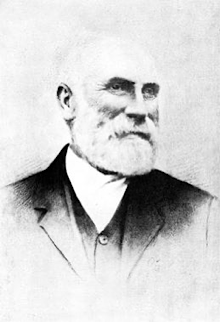
Andrew Joseph Kettle, a leading Irish nationalist politician, progressive farmer, agrarian agitator and founding member of the Irish National Land League, is born on September 26, 1833, in Drynam House, Swords, County Dublin.

Kettle is one among six children of Thomas Kettle, a prosperous farmer, and his wife, Alice (née Kavanagh). His maternal grandmother, Mary O’Brien, had smuggled arms to United Irishmen in the district in 1798, while her future husband, Billy Kavanagh, had been a senior figure in the movement. He is educated at Ireland’s most prestigious Catholic boarding schoolClongowes Wood College. His education is cut short when he is called to help full-time on the farm. Though an autodidact and always a forceful writer, he is beset later by an exaggerated sense of his “defective education and want of talking powers.” Fascinated by politics, he enjoys the repeal excitement of 1841–44 and in his late teens speaks once or twice at Tenant Right League meetings in Swords. Through the 1850s and most of the 1860s he sets about expanding the family farm into a composite of fertile holdings in Swords, St. Margaret’s, Artane, and Malahide (c.150 acres). Getting on well with the Russell-Cruise family of Swords, his first landlords, he benefits from a favourable leasehold arrangement on their demesne in the early 1860s. The farm is mostly in tillage, though Kettle also raises some fat cattle and Clydesdale horses, which he eventually sells to Guinness’s.

Kettle first enters politics in 1867, when he disagrees with John Paul Byrne of Dublin Corporation in public and in print over the right of graziers to state aid during an outbreak of cattle distemper. In 1868, he joins an agricultural reform group initiated by Isaac Butt. He becomes friendly with Butt and later claims to have converted him to support tenant-right. His memoirs, which are somewhat egocentric, contain a number of such questionable claims. It is, however, the case that he habitually writes up, for his own use, cogent summaries of the direction of current political tendencies, which sometimes become useful confidential briefs for Butt and later Charles Stewart Parnell. He is among the published list of subscribers to the Home Rule League in July 1870.

In 1872, disappointed by the Landlord and Tenant (Ireland) Act 1870, Kettle organises a Tenants’ Defence Association (TDA) in north County Dublin, soon sensing the need for a central body to coordinate the grievances of similar groups around the country. The Dublin TDA effectively acts as this central body, under his guidance as honorary secretary. At the 1874 United Kingdom general election in Ireland, the Dublin TDA decides to challenge the electoral control of certain corporation interests in County Dublin. Kettle secures the cautious approval of Cardinal Paul Cullen for any candidate supporting the principle of denominational education. He is also one of a deputation to ask Parnell to fight the constituency, which the latter loses. He becomes closely acquainted with Parnell, who frequently attends Dublin TDA meetings after his election for Meath in April 1875.

Taking a sombre view of the threat of famine in the west of Ireland after evidence of crop failure appears in early summer 1879, Kettle calls a conference of TDA delegates at the European Hotel in Bolton Street, Dublin, in late May. After a heated debate in which a proposal for a rent strike is greatly modified, Parnell comes to seek Kettle’s advice on whether to become involved in the evolving land agitation in County Mayo. Kettle urges him to go to the Westport meeting set for June 8, 1879, and claims later to have stressed in passing that “if you keep in the open you can scarcely go too far or be too extreme on the land question.” If the incident is correctly recounted, this is a most important statement, which virtually defines Parnell’s oratorical strategy throughout the land war. In October 1879, Kettle agrees to merge the TDA with a new Irish National Land League, set up at a meeting in the Imperial Hotel, Dublin, chaired by Kettle. As honorary secretary of the Land League, Kettle frankly admits that he is able to attend meetings without “the necessity of working.” His attendance is, however, among the most regular of all League officers, with him taking part in 73 of 107 meetings scheduled between December 1879 and October 1881.

In March 1880, Kettle disputes Michael Davitt‘s reluctance to use League funds in the general election. He canvasses vigorously together with Parnell in Kildare, Carlow, and Wicklow and is later pressed by his party leader into standing for election in County Cork, though aware that the local tenant movement has already prepared their own candidates. His association with Parnell antagonises the catholic hierarchy in Munster, who issues a condemnation of his candidacy. The hurly-burly of this election creates the persistent impression that Kettle is anti-clerical in politics, and he is defeated by 151 votes.

On a train journey to Ballinasloe in early April 1880, Kettle confides to Parnell his idea that land purchase can be facilitated by the recovery of tax allegedly charged in excess on Ireland by the British government since the act of union. At League meetings in June and July 1880, he advances his “catastrophist” plan: to cease attempts to prevent the development of an irresistible crisis among the Irish smallholding population, by diverting the application of League funds from general relief solely to the aid of evicted tenants, who might be temporarily housed “encamped like gypsies and the land lying idle,” in the belief that the British government will thereby be compelled to introduce radical remedial legislation. Smallholders do not have enough faith in either League or parliamentary politicians to listen.

At a meeting of the League executive in London and in Paris, before and after Davitt’s arrest on February 3, 1881, Kettle presents his plan that the parliamentary party should, if faced with coercive legislation, withdraw from Westminster, “concentrate” in Ireland, and call a general rent strike. Republicans on the League executive continually find themselves embarrassed by Kettle’s radical calls to action motivated solely by the project of agrarian reform. Parnell is later supposed to have lamented party failure to execute the plan at this juncture.

Kettle is arrested in June 1881 for calling for a collective refusal of rent. After two weeks in Naas jail he is transferred to Kilmainham Gaol, where in October he is, with some misgivings, one of the signatories to the No Rent Manifesto. Discharged from Kilmainham in late December 1881 owing to poor health, he returns principally to work on the family farm for most of the 1880s, though he claims to have formulated a draft solution for the plight of the agricultural labourer and “pushed it through” in correspondence with Parnell. He reemerges in 1890 to defend Parnell after the divorce scandal breaks. Attempting to establish a new ”centre” party independent of extreme Catholic and Protestant interests, he stands for election as a Parnellite at the 1891 County Carlow by-election, where he is comprehensively beaten, having endured weeks of insinuating harangues by Tim Healy, and raucous mob insults to the din of tin kettles bashed by women and children at meetings around the county. He is intermittently involved in County Dublin politics in the 1890s and 1900s and maintains a brusque correspondence on matters of the day in the national press.

Kettle dies on September 22, 1916, at his residence, St. Margaret’s, County Dublin, anguished by the death on September 9 of his brilliant son, Tom Kettle, near the village of Ginchy during the Battle of the Somme. He is buried at St. Colmcille’s cemetery, Swords.

Kettle marries Margaret McCourt, daughter of Laurence McCourt of Newtown, St. Margaret’s, County Dublin, farmer and agricultural commodity factor. They have five sons and six daughters.


Leave a comment

Birth of Tony Gregory, Independent Politician & Teachta Dála

Tony Gregory, Irish independent politician and a Teachta Dála (TD) for the Dublin Central constituency from 1982 to 2009, is born on December 5, 1947, in Ballybough on Dublin‘s Northside.

Gregory is the second child of Anthony Gregory, warehouseman in Dublin Port, and Ellen Gregory (née Judge). He wins a Dublin Corporation scholarship to the Christian BrothersO’Connell School. He later goes on to University College Dublin (UCD), where he receives a Bachelor of Arts degree and later a Higher Diploma in Education, funding his degree from summer work at the Wall’s ice cream factory in Acton, London. Initially working at Synge Street CBS, he later teaches history and French at Coláiste Eoin, an Irish language secondary school in Booterstown. His students at Synge Street and Coláiste Eoin include John Crown, Colm Mac Eochaidh, Aengus Ó Snodaigh and Liam Ó Maonlaí.

Gregory becomes involved in republican politics, joining Sinn Féin and the Irish Republican Army (IRA) in 1964. In UCD he helps found the UCD Republican Club, despite pressure from college authorities, and becomes involved with the Dublin Housing Action Committee. Within the party he is a supporter of Wicklow Republican Seamus Costello. Costello, who is a member of Wicklow County Council, emphasises involvement in local politics and is an opponent of abstentionism. Gregory sides with the Officials in the 1970 split within Sinn Féin. Despite having a promising future within the party, he resigns in 1972 citing frustration with ideological infighting in the party. Later, Costello, who had been expelled by Official Sinn Féin, approaches him and asks him to join his new party, the Irish Republican Socialist Party. He leaves the party after Costello’s assassination in 1977. He is briefly associated with the Socialist Labour Party.

Gregory contests the 1979 local elections for Dublin City Council as a “Dublin Community Independent” candidate. At the February 1982 general election, he is elected to Dáil Éireann as an Independent TD. On his election he immediately achieves national prominence through the famous “Gregory Deal,” which he negotiates with Fianna Fáil leader Charles Haughey. In return for supporting Haughey as Taoiseach, he is guaranteed a massive cash injection for his inner-city Dublin constituency, an area beset by poverty and neglect.

Although Gregory is reviled in certain quarters for effectively holding a government to ransom, his uncompromising commitment to the poor is widely admired. Fianna Fáil loses power at the November 1982 general election, and many of the promises made in the Gregory Deal are not implemented by the incoming Fine GaelLabour Party coalition.

Gregory is involved in the 1980s in tackling Dublin’s growing drug problem. Heroin had largely been introduced to Dublin by the Dunne criminal group, based in Crumlin, in the late 1970s. In 1982 a report reveals that 10% of 15- to 24-year-olds have used heroin at least once in the north inner city. The spread of heroin use also leads to a sharp increase in petty crime. He confronts the government’s handling of the problem as well as senior Gardaí, for what he sees as their inadequate response to the problem. He co-ordinates with the Concerned Parents Against Drugs group in 1986, who protest and highlight the activities of local drug dealers and defend the group against accusations by government Ministers Michael Noonan and Barry Desmond that it is a front for the Provisional IRA. He believes that the solution to the problem is multi-faceted and works on a number of policy level efforts across policing, service co-ordination and rehabilitation of addicts. In 1995 in an article in The Irish Times, he proposes what would later become the Criminal Assets Bureau, which is set up in 1996, catalysed by the death of journalist Veronica Guerin. His role in its development is later acknowledged by then Minister for Justice Nora Owen.

Gregory also advocates for Dublin’s street traders. After attending a sit-down protest with Sinn Féin Councillor Christy Burke, and future Labour Party TD Joe Costello on Dublin’s O’Connell Street in defence of a street trader, he, Burke and four others are arrested and charged with obstruction and threatening behaviour. He spends two weeks in Mountjoy Prison after refusing to sign a bond to keep the peace.

Gregory remains a TD from 1982 and, although he never holds a government position, remains one of the country’s most recognised Dáil deputies. He always refuses to wear a tie in the Dáil chamber stating that many of his constituents could not afford them.

Gregory dies on January 2, 2009, following a long battle with cancer. Following his death, tributes pour in from politicians from every party, recognising his contribution to Dublin’s north inner city. During his funeral, politicians from the Labour Party, Fianna Fáil and Fine Gael are told that although they speak highly of Gregory following his death, during his time in the Dáil he had been excluded by many of them and that they were not to use his funeral as a “photo opportunity.” He is buried on January 7, with the Socialist Party‘s Joe Higgins delivering the graveside oration.

Colleagues of Tony Gregory support his election agent, Dublin City Councillor Maureen O’Sullivan, at the 2009 Dublin Central by-election in June. She wins the subsequent by-election.


2 Comments

The Battle of Deputy’s Pass

The Battle of Deputy’s Pass is fought in County Wicklow on May 29, 1599, during the Nine Years’ War in Ireland. A Gaelic Irish force under Felim McFiach O’Byrne ambushes an English army of about 500, under Sir Henry Harington, which is marching from Rathdrum to Wicklow. The English army is routed and loses about 250 men.

The O’Byrnes had been allied to Hugh O’Neill, Earl of Tyrone, since the outbreak of the Nine Years’ War in 1593. Fiach McHugh O’Byrne had worked together with O’Neill, so much that he is described as the earl’s “right arm in Leinster.” However, when Fiach is killed in 1597, the power of the O’Byrnes seems to wane. When Robert Devereux, 2nd Earl of Essex, is appointed Lord Lieutenant of Ireland in 1599, he orders Harrington into County Wicklow to deal with the O’Byrnes and their allies, the O’Tooles.

Harrington’s force consists of five foot companies, but four of them are inexperienced levies recently raised in England. The only experienced foot company is that of Captain Loftus, whose men are mostly Irish. The companies are organised into a regiment under the command of Sir Alexander Radcliffe. To this is added fifty horsemen commanded by Captain Charles Montague. Harrington wants to take his troops out to scout the Irish fortifications on the ford of the Avonmore River at Rathdrum, and possibly to give his raw troops some experience in fieldcraft. His first attempt to view the Irish position on May 28 fails. Harrington returns to his camp about a mile from the ford. A second effort to view the Irish fortifications is made on May 28, but this is turned back due to poor weather. Harrington orders the men to march back to Wicklow town.

The English army stretches out in a column. In the lead is the van, then the baggage, followed by the battle and then the rear. Captain Atherton, the Sergeant Major of the army, has little doubt that the weight of any Irish attack will fall on the rear of the column. Thus, the horse (cavalry) is placed at the rear. The army has marched little over a mile before the Irish shot (musketeers and caliver-men) begin skirmishing with the rear of Harrington’s force. The Irish try to take a ford to block the advance, but the English secure the crossing, with the shot of the English rear skirmishing with the Irish, allowing the rest of the army to pass unhindered.

The march continues two miles to another ford, with the rear continuing to hold O’Byrne’s Irish shot at bay. Again, the English shot secures the crossing, as Irish fire slackens, possibly due to a shortage of gunpowder. Harrington places 40–50 shot behind an earthen bank on the left flank of the column on the far side of the ford. The Irish bring up a stand of pikemen, but their attack is limited to the English left, as the right of the column is shielded by thick gorse bushes. Atherton gathers 60–80 men to counter-attack the Irish pike. The English shot behind the bank is to hold their fire until Atherton attacks, but instead prematurely fires a single volley at the Irish pike then abandons their position. Without the support from their shot, Atherton’s men refuse to charge the Irish, then withdraw to the main body of the English column.

Atherton finds that the English shot have fled the column, abandoning the main stand of English pike. Now exposed to Irish gunfire, the English pike become disordered as they press to make the river crossing. Exploiting the English confusion, the Irish pike charges into the English rear, killing many without resistance. Montague’s English cavalry charges to support the panicking infantry, but the Irish pike square opens, allowing the horse to pass through. The Irish pike spear the English horse as they pass, including Montague who is wounded by a pike thrust into his side. Despite their officer’s best efforts, the English soldiers’ resistance collapses. The rout continues with the Irish slaughtering Harrington’s men to within one and a half miles of Wicklow town. All the English companies lose their colours, except for Captain Loftus, but they are later recovered by the English horse. After the battle, Radcliffe estimates the English army has lost 250 men killed, missing or deserted.

The first English reports suggest that they lost the battle due to the inexperience of most of their troops. Harrington at first blames the English pikemen for refusing to fight, but at the court-martial in July, Harrington, supported by two of his officers (Captains Linley and Mallory) blames Captain Loftus and his Lieutenant Walsh. This is convenient, as Loftus had died from his wounds and could not refute their accusations. Their version is supported by a map drawn of the battle, possibly by Montague (Harrington’s nephew). Loftus and Walsh are found guilty by the court-martial. Loftus is already dead, but Walsh is executed by firing squad. Mallory and Linley are not found guilty, but they are cashiered, losing command of their foot companies. The men in Loftus’ company are sentenced to death but this is commuted to decimation by drawing lots. Even by Elizabethan standards this is deemed overly harsh. Though Harrington is not charged with misconduct, he is never given command of a force this size again.


Leave a comment

Birth of Ciarán Cuffe, Politician & European Parliament Member

Ciarán Cuffe, Irish politician who has served as a Member of the European Parliament (MEP) from Ireland for the Dublin constituency since July 2019, is born in Shankill, Dublin, on April 3, 1963. He is a member of the Green Party, part of the European Green Party. He previously serves as a Minister of State from 2010 to 2011. He is a Teachta Dála (TD) for the Dún Laoghaire constituency from 2002 to 2011.

Cuffe is the son of Luan Peter Cuffe and Patricia Sistine Skakel. His father, who trains at Harvard University under Walter Gropius, is an architect who was involved in town planning for Dún Laoghaire and Wicklow before taking over his brother-in-law’s architectural practice. Through his mother, he is a grandson of George Skakel, a founder of Great Lakes Carbon Corporation, and a nephew of Ethel Skakel Kennedy. His cousins include the children of Ethel and Robert F. Kennedy. His granduncle was the Fianna Fáil TD Patrick Little, and his great-grandfather, Philip Francis Little, was the first Premier of Newfoundland in 1854. He is a member of the Dublin Cycling Campaign and has cycled coast-to-coast across the United States.

Cuffe attends the Children’s House Montessori School in Stillorgan, Gonzaga College in Ranelagh, the University of Maine at Orono, University College Dublin (UCD), and the Ca’ Foscari University of Venice. He has degrees in architecture and urban planning from UCD. He teaches a master’s programme in urban regeneration and development at the Dublin Institute of Technology (DIT), Bolton Street. In 2019, he completes a Master of Science in cities at the London School of Economics (LSE).

Cuffe joins the Green Party in 1982, and campaigns with Students Against the Destruction of Dublin (SADD) in the 1980s. He is twice elected to Dublin City Council, in 1991 and 1999, for the South Inner City electoral area. In 1996, he launches a free bikes scheme in which bicycles are placed around Dublin city centre for use by the public.

Cuffe is an unsuccessful candidate for the Dublin Central constituency at the 1997 Irish general election but is elected to the Dáil Éireann at the 2002 Irish general election for the Dún Laoghaire constituency.

In June 2003, Cuffe steps down as the Green Party’s environment spokesperson after it is revealed that he held shares worth $70,000 in a number of oil exploration companies which he had inherited when his late mother had left him $1.3 million in her will. He is re-elected at the 2007 Irish general election.

Following the 2007 election, the Green Party forms a coalition government with two other political parties and a number of independent TDs. Just after the election, on May 28, 2007, Cuffe writes in his blog: “A deal with Fianna Fáil would be a deal with the Devil. We would be spat out after 5 years and decimated as a party.” He loses his seat at the 2011 Irish general election.

On March 23, 2010, as part of a reshuffle, Cuffe is appointed as Minister of State at the Department of Agriculture, Fisheries and Food, at the Department of Transport and at the Department of the Environment, Heritage and Local Government, with special responsibility for Horticulture, Sustainable Travel, and Planning and Heritage.

While Cuffe is minister, the Oireachtas enacts the Planning and Development (Amendment) Act 2010 to address land-use planning failures and over-zoning of development land. The legislation reforms the way development plans and local area plans are made and, for the first time in Irish legislation, includes a definition of Anthropogenic Climate Change and required energy use to be taken into account in planning decisions. He publishes the Climate Change Response Bill 2010, and an update of the National Spatial Strategy. He is head of the Irish delegation at the 2010 United Nations Climate Change Conference in Cancún, Mexico.

Cuffe promotes healthy eating for children, school gardens and local markets. He publishes bills to address climate change, noise pollution, and heritage protection. In January 2011, he launches a new policy of allowing bicycles on off-peak Dublin Area Rapid Transit (DART) trains.

Cuffe resigns as Minister of State on January 23, 2011, when the Green Party withdraws from government.

At the 2014 Irish local elections, Cuffe is elected to Dublin City Council for Dublin North Inner City area, on the 13th count. He is appointed chairperson for the Dublin City Council Transportation Committee in 2014. As a member of the Central Area Committee for Dublin City Council, he works to provide a site for the Gaelscoil Choláiste Mhuire primary school on Dominick Street in 2017. He introduces 30 km/h speed limits to residential and school areas of Dublin and also advocates for a car-free College Green. He calls for an increase in affordable housing in Dublin, specifically for people with different incomes. Speaking on the Strategic Development Zone in the Dublin Docklands, he states, “We have seen a lot of cranes in the Docklands but not a lot of homes. Particularly affordable homes.” He proposes a Motion declaring a Climate Emergency which is approved at a meeting of the Council on May 13, 2019.

Cuffe is selected as the Green Party candidate for the Dublin constituency at the 2019 European Parliament elections. He tops the poll, receiving 63,849 votes and is elected as an MEP on the 13th count, with 17.54% first preference votes. He is also re-elected to Dublin City Council, but due to the prohibition on a dual mandate, this seat is co-opted to fellow Green Party member Janet Horner.

Cuffe is a member of the European Parliament Committee on Transport and Tourism (TRAN) and is the Coordinator of the Greens-European Free Alliance (Greens/EFA). He is also a member of the European Parliament Committee on Industry, Research and Energy (ITRE), and has written an initiative report, The Cuffe Report, on maximising the Energy Efficiency of the EU building stock (2020/2070). In 2022, he is appointed rapporteur on the directive on the Energy Performance of Buildings (EPBD).

Cuffe is President of the European Forum for Renewable Energy Sources (EUFORES), a cross-party European parliamentary network gathering members of European, regional and national parliaments of the EU, and works to promote renewable energy and energy efficiency.

In June 2023, Cuffe is the recipient of the Energy, Science and Research Award at The Parliament Magazine‘s annual MEP Awards.


Leave a comment

Death of Theobald Walter, the First Chief Butler of Ireland

Theobald Walter, sometimes Theobald FitzWalter, Theobald Butler, or Theobald Walter le Boteler, the first Chief Butler of Ireland, dies on February 4, 1206, at Arklow Castle at Wicklow, in present day County Wicklow. He also holds the office of Chief Butler of England and is the High Sheriff of Lancashire for 1194. He is the first to use the surname Butler of the Butler family of Ireland. He is involved in the Irish campaigns of King Henry II of England and John of England. His eldest brother, Hubert Walter, becomes the Archbishop of Canterbury and justiciar and Lord Chancellor of England.

Walter is born in Norfolk, England, in 1165, the son of Hervey Walter and his wife, Matilda de Valoignes, who is one of the daughters of Theobald de Valoignes. Their children were Theobald, Hubert, Bartholomew, Roger, and Hamon. He and his brother Hubert are brought up by their uncle Ranulf de Glanvill, the great justiciar of Henry II of England who had married his mother’s sister Bertha.

On April 25, 1185, Prince John, in his new capacity as Lord of Ireland, lands at Waterford and around this time grants the hereditary office of butler of Ireland to Walter, whereby he and his successors are to attend the Kings of England at their coronation, and on that day present them with the first cup of wine. His father had been the hereditary holder of the office of butler of England. Sometime after, King Henry II of England grants him the prisage of wines, to enable him and his heirs, the better to support the dignity of that office. By this grant, he has two barrels of wine out of every ship, which breaks bulk in any trading port of Ireland, and is loaded with 20 tons of that commodity, and one ton from 9 to 20. He accompanies John on his progress through Munster and Leinster. At this time, he is also granted a large section of the north-eastern part of the Kingdom of Limerick. The grant of five and a half cantreds is bounded by:

“…the borough of Killaloe and the half cantred of Trucheked Maleth in which it lay, and the cantreds of Elykarval, Elyochgardi, Euermond, Aros and Wedene, and Woedeneoccadelon and Wodeneoidernan.”

These are the modern baronies of Tullough (in County Clare), Clonlisk and Ballybritt (in County Offaly), Eliogarty, Ormond Upper, Ormond Lower, Owney and Arra (in County Tipperary), Owneybeg, Clanwilliam and Coonagh (in County Limerick).

Walter is active in the war that takes place when Rory O’Connor attempts to regain his throne after retiring to the monastery of Cong (present day County Mayo), as his men are involved in the death of Donal Mor McCarthy during a parley in 1185 near Cork. In 1194, he supports his brother during Hubert’s actions against Prince John, with him receiving the surrender of John’s supporters in Lancaster. He is rewarded with the office of sheriff of Lancaster, which he holds until Christmas of 1198. He is again sheriff after John takes the throne in 1199.

In early 1200, however, John deprives Walter of all his offices and lands because of his irregularities as sheriff. His lands are not restored until January 1202. A manuscript in the National Library of Ireland points to William de Braose, 4th Lord of Bramber, as the agent of his restoration:

“Grant by William de Braosa, (senior) to Theobald Walter (le Botiller) the burgh of Kildelon (Killaloe) … the cantred of Elykaruel (the baronies of Clonlisk and Ballybrit, County Offaly), Eliogarty, Ormond, Ara and Oioney, etc. 1201.”

“Elykaruel” refers to the Gaelic túath of “Ely O’Carroll”, which straddles the southern part of County Offaly and the northern part of Tipperary (at Ikerrin). The other cantreds named are probably the modern baronies of Eliogarty, Ormond Upper, Ormond Lower and Owney and Arra in County Tipperary.

Walter founds the Abbey of Woney, of which nothing now remains, in the townland of Abington, near the modern village of Murroe in County Limerick around 1200. He also founds the Cockersand Abbey in Lancaster, Abbey of Nenagh in County Tipperary, and a monastic house at Arklow in County Wicklow.

Walter marries Maud le Vavasour (1176–1226), heiress of Robert le Vavasour, a baron of Yorkshire. John Lodge in the Peerage of Ireland in 1789 gives the year as 1189, but on no apparent authority, as no other author follows him on this. Their children are Theobald le Botiller, 2nd Chief Butler of Ireland, and Maud (1192–1244), who marries three times yet only has two surviving children, Ralph and Marie.

Walter dies on February 4, 1206, at Arklow Castle, County Wicklow, and is buried at Wotheney Abbey.


Leave a comment

Birth of Josh van der Flier, Irish Rugby Union Player

Josh van der Flier, Irish rugby union player for Leinster Rugby and the Ireland national rugby union team, is born on April 25, 1993, in Wicklow, County Wicklow. He is of Dutch descent through his paternal grandparents, who moved to Ireland in the 1950s to open a radiator factory. He attends Wesley College, Dublin, and University College Dublin (UCD).

Van der Flier’s preferred position is flanker, but he can play other positions if needed. He is commonly referred to amongst Leinster Rugby circles as “The Dutch Disciple.”

Van der Flier begins his professional career with the Leinster academy. During his time at the academy, he plays with the Leinster senior team, making his debut in October 2014 against Zebre Parma. It is announced in April 2015 that he has been awarded a senior contract with Leinster.

Following the 2022 European Rugby Champions Cup final, Van der Flier becomes the third Leinster player to win European Professional Club Rugby Player of the Year, after Seán O’Brien (2011) and Rob Kearney (2012). In June 2022 he is named Leinster’s 2021–22 Men’s Player of the Year.

Van der Flier receives his first call up to the senior Ireland squad by coach Joe Schmidt for the 2016 Six Nations Championship. He debuts for Ireland on February 27 against England in the 2016 Six Nations Championship at Twickenham Stadium.

Van der Flier is named as the Ireland men’s XVs Players’ Player of the Year at the 2022 Rugby Players Ireland awards. He also wins the Guinness Rugby Writers of Ireland men’s player of the year award for the 2021-22 campaign.

In November 2022, Van der Flier is named as the World Rugby Men’s 15s Player of the Year.


Leave a comment

Birth of Mary Devenport O’Neill, Poet & Dramatist

Mary Devenport O’Neill, Irish poet and dramatist and a friend and colleague of W. B. Yeats, George Russell, and Austin Clarke, is born in Barrack Street, Loughrea, County Galway, on August 3, 1879.

O’Neill is born Mary Devenport, the daughter of Royal Irish Constabulary (RIC) sub-constable, John Devenport, and his wife Bridget (née Burke). She attends the Dominican convent, Eccles Street, Dublin before enrolling in the Metropolitan School of Art from 1898 to 1903. In 1900 she wins the year’s prize in the School of Art. She apparently considers teaching as a career, as she is listed on the college register as a teacher in training from 1901 to 1903. It is while an art student that she starts to correspond with the writer she admires, Joseph O’Neill. Their relationship develops, and the couple marries on June 19, 1908, settling in Kenilworth Square, Dublin.

Many of O’Neill’s husband’s friends disapprove of her modern and unconventional ideas, but she is popular with “the Rathgar Group” who attends George Russell’s Sunday salons. After a few years, she establishes her own salon referred to as “Thursdays at home,” attended by Russell, Padraic Colum, W. B. Yeats, Richard Irvine Best, Frank O’Connor, Francis Stuart and Iseult Gonne. She becomes particularly close to Yeats, who she confides in. Yeats records their weekly consultations in his diary while working on A Vision (1925). In his Oxford anthology of English verse from 1936, he includes one of O’Neill’s poems. In 1917, she contributes lyrics to her husband’s play The Kingdom Maker. She publishes her only book in 1929, Prometheus and other poems. After this she occasionally contributes primarily modernist plays and poetry to The Dublin Magazine, The Irish Times and The Bell. She collaborates with Austin Clarke from the Lyric Theatre Company on her plays Bluebeard (1933) and Cain (1945).

O’Neill suffers with poor health, which sees her and her husband spending extended periods in the south of France and Switzerland. They sell their home in Dublin in August 1950 and move to Nice, with the intention of settling there. However, due to rapidly depleting finances they are forced to return to Ireland in April 1951. They rent a cottage in Wicklow from their friend Con Curran. When her husband dies in 1953, she goes to live with relatives in Dublin. She dies there in 1967.


Leave a comment

Death of Sir Thomas de Rokeby, Justiciar of Ireland

Sir Thomas de Rokeby, a soldier and senior Crown official in fourteenth-century England and Ireland, who serves as Justiciar of Ireland, dies on April 23, 1357. He is appointed to that office to restore law and order to Ireland, and has considerable early success in this task, but he is recalled to England after the military situation deteriorates. He is later re-appointed Justiciar, and returns to Ireland to take up office, but dies soon afterwards.

The Rokebys are a prominent landowning family from Mortham in North Yorkshire. He is probably the son of Thomas de Rokeby, who dies in 1318. His nephew, also named Thomas, the son of his brother Robert, is closely associated with him in his later years and the elder Thomas is often called “l’oncle” to distinguish him from his nephew.

Rokeby first comes to public attention in 1327 when, after his return from prison in Scotland, he receives the thanks of the new King Edward III for being the squire who had first pointed out the approach of the Scots army during the invasion of the previous July. As a reward he is knighted and given lands worth £100 a year. He sees action against the Scots regularly between 1336 and 1342 and has charge of Stirling Castle and Edinburgh Castle while they are held by the English. He is High Sheriff of Yorkshire from 1342 to 1349. He is one of the English commanders at the Battle of Neville’s Cross in 1346, and it is said, “gave the Scots such a draught as they did not care to taste again.” He is then entrusted with bringing King David II of Scotland as a captive to London, and he receives further grants of land as a reward for his good services.

In 1349 Rokeby is appointed Justiciar of Ireland, and given a large armed retinue to accompany him, as it is recognised by the English Crown that “Ireland is not in good plight or good peace.” While there is some surprise at the appointment of an old soldier to such a sensitive political position, the more informed view is that Rokeby is well suited to the task of enforcing justice by military force. He arrives in December and makes a quick circuit of the south of Ireland, mainly to keep watch on the powerful but troublesome magnate Maurice FitzGerald, 1st Earl of Desmond.

Rokeby is praised by his contemporaries for his regard for justice and his zeal in checking extortion by Crown officials. He undertakes a general overhaul of the Irish administration, aimed particularly at the detection and prevention of corruption and the removal of incompetent officials. Arguably he shows excessive zeal in arresting and imprisoning the Lord High Treasurer of Ireland, Robert de Emeldon, a man who enjoys the King’s personal regard. Admittedly the charges against Emeldon are very serious, including rape, robbery and manslaughter, but the King, out of regard for their long friendship and Emeldon’s record of good service to the Crown in Ireland, had already pardoned Emeldon for killing one Ralph de Byrton, a knight, in 1336. Emeldon is once more pardoned and quickly released.

In November 1351 Rokeby holds a Great Council at Kilkenny. It deals partly with the problem of official corruption already mentioned, partly with the problem of defence of the Pale, and partly with the question of intermarriage and other close contacts between the Anglo-Irish and the Old Irish. Otway-Ruthven notes that little of the legislation is new, apart from the application to Ireland of the English Statute of Labourers of 1351, and that much of it is repeated in the better-known Statutes of Kilkenny of 1366.

In 1353 the Clan MacCarthy of Muskerry, the dominant clan in central County Cork, who had until then been loyal to the English Crown, rebels. Rokeby shows considerable skill in crushing the uprising and succeeds in replacing the rebellious head of the clan, Dermot MacCarthy, with his more compliant cousin Cormac. Cormac’s descendants gain great wealth, extensive lands and the title Earl of Clancarty.

This promising state of good order does not last long. A rebellion by the O’Byrne Clan of Wicklow in 1354 is followed by a general uprising headed by the MacMurrough-Kavanagh dynasty. Although Muirchearteach MacMurrough-Kavanagh, the self-styled King of Leinster, is captured and executed, Rokeby suffers several military defeats. He is unable to suppress the O’Byrnes’ rebellion, and other risings take place in Tipperary, Kildare and Ulster.

Rokeby, now an ageing and discouraged man, is recalled in 1355. His replacement, rather surprisingly, is that Earl of Desmond whom it had been one of his main tasks to keep in check. Desmond dies a year later on July 26, 1356. Rokeby is reappointed Justiciar, and returns to Ireland, only to die soon afterwards on April 23, 1357 at Kilkea Castle.

Rokeby is married and his wife is named Juliana, but little else is known of her. They have no children, and his estates pass to his nephew, the younger Thomas.

(Pictured: Portrait of Sir Thomas de Rokeby, painting by Godfried Schalcken)


Leave a comment

Death of Tony Gregory, Independent Politician & TD

Tony Gregory, Irish independent politician and a Teachta Dála (TD) for the Dublin Central constituency from 1982 to 2009, dies in Dublin on January 2, 2009.

Gregory is born on December 5, 1947, in Ballybough on Dublin’s Northside, the second child of Anthony Gregory, warehouseman in Dublin Port, and Ellen Gregory (née Judge). He wins a Dublin Corporation scholarship to the Christian BrothersO’Connell School. He later goes on to University College Dublin (UCD), where he receives a Bachelor of Arts degree and later a Higher Diploma in Education, funding his degree from summer work at the Wall’s ice cream factory in Acton, London. Initially working at Synge Street CBS, he later teaches history and French at Coláiste Eoin, an Irish language secondary school in Booterstown. His students at Synge Street and Coláiste Eoin include John Crown, Colm Mac Eochaidh, Aengus Ó Snodaigh and Liam Ó Maonlaí.

Gregory becomes involved in republican politics, joining Sinn Féin and the Irish Republican Army (IRA) in 1964. In UCD he helps found the UCD Republican Club, despite pressure from college authorities, and becomes involved with the Dublin Housing Action Committee. Within the party he is a supporter of Wicklow Republican Seamus Costello. Costello, who is a member of Wicklow County Council, emphasises involvement in local politics and is an opponent of abstentionism. Gregory sides with the Officials in the 1970 split within Sinn Féin. Despite having a promising future within the party, he resigns in 1972 citing frustration with ideological infighting in the party. Later, Costello, who had been expelled by Official Sinn Féin, approaches him and asks him to join his new party, the Irish Republican Socialist Party. He leaves the party after Costello’s assassination in 1977. He is briefly associated with the Socialist Labour Party.

Gregory contests the 1979 local elections for Dublin City Council as a “Dublin Community Independent” candidate. At the February 1982 general election, he is elected to Dáil Éireann as an Independent TD. On his election he immediately achieves national prominence through the famous “Gregory Deal,” which he negotiates with Fianna Fáil leader Charles Haughey. In return for supporting Haughey as Taoiseach, he is guaranteed a massive cash injection for his inner-city Dublin constituency, an area beset by poverty and neglect.

Although Gregory is reviled in certain quarters for effectively holding a government to ransom, his uncompromising commitment to the poor is widely admired. Fianna Fáil loses power at the November 1982 general election, and many of the promises made in the Gregory Deal are not implemented by the incoming Fine GaelLabour Party coalition.

Gregory is involved in the 1980s in tackling Dublin’s growing drug problem. Heroin had largely been introduced to Dublin by the Dunne criminal group, based in Crumlin, in the late 1970s. In 1982 a report reveals that 10% of 15- to 24-year-olds have used heroin at least once in the north inner city. The spread of heroin use also leads to a sharp increase in petty crime. He confronts the government’s handling of the problem as well as senior Gardaí, for what he sees as their inadequate response to the problem. He co-ordinates with the Concerned Parents Against Drugs group in 1986, who protest and highlight the activities of local drug dealers and defend the group against accusations by government Ministers Michael Noonan and Barry Desmond that it is a front for the Provisional IRA. He believes that the solution to the problem is multi-faceted and works on a number of policy level efforts across policing, service co-ordination and rehabilitation of addicts. In 1995 in an article in The Irish Times, he proposes what would later become the Criminal Assets Bureau, which is set up in 1996, catalysed by the death of journalist Veronica Guerin. His role in its development is later acknowledged by then Minister for Justice Nora Owen.

Gregory also advocates for Dublin’s street traders. After attending a sit-down protest with Sinn Féin Councillor Christy Burke, and future Labour Party TD Joe Costello on Dublin’s O’Connell Street in defence of a street trader, he, Burke and four others are arrested and charged with obstruction and threatening behaviour. He spends two weeks in Mountjoy Prison after refusing to sign a bond to keep the peace.

Gregory remains a TD from 1982 and, although he never holds a government position, remains one of the country’s most recognised Dáil deputies. He always refuses to wear a tie in the Dáil chamber stating that many of his constituents could not afford them.

Gregory dies on January 2, 2009, following a long battle with cancer. Following his death, tributes pour in from politicians from every party, recognising his contribution to Dublin’s north inner city. During his funeral, politicians from the Labour Party, Fianna Fáil and Fine Gael are told that although they speak highly of Gregory following his death, during his time in the Dáil he had been excluded by many of them and that they were not to use his funeral as a “photo opportunity.” He is buried on January 7, with the Socialist Party‘s Joe Higgins delivering the graveside oration.

Colleagues of Tony Gregory support his election agent, Dublin City Councillor Maureen O’Sullivan, at the 2009 Dublin Central by-election in June. She wins the subsequent by-election.