seamus dubhghaill

Promoting Irish Culture and History from Little Rock, Arkansas, USA


Leave a comment

Birth of Teresa Kearney, Teacher, Franciscan Sister & Missionary

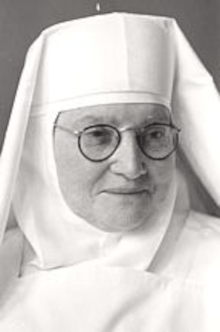
Teresa Kearney, better known as Mother Kevin, a teacher, Franciscan Sister, and missionary who founds a new Franciscan order, is born in Knockenrahan, Arklow, County Wicklow, on April 28, 1875.

Kearney is the third daughter of farmer Michael Kearney and Teresa Kearney. Three months prior to her birth, her father dies in an accident. Following his death, her mother remarries and has three more children. When she is ten years old, her mother dies. Her maternal grandmother, Grannie Grenell, then raises her in Curranstown, County Wicklow. Grannie Grenell has a profound impact on her spiritual beliefs and deep faith. When she is 17, Grannie Grenell dies.

Kearney attends the local convent school in Arklow following her mother’s death. In 1889, following her grandmother’s death, she goes to convent of Mercy at Rathdrum, to train as an assistant teacher. She does not have the finances to pay for training, and becomes a Junior Assistant Mistress. A year later, she goes to teach in a school run by the Sisters of Charity in Essex.

Following the death of her grandmother, Kearney turns toward thoughts of religious life. She believes that God is calling her to be a sister, and she applies for admission to the Franciscan Missionary Sisters of the Five Wounds at Mill Hill, London. In 1895, she enters the St. Mary’s Abbey, Mill Hill. On April 21, 1898 she takes the name Sister Mary Kevin of the Sacred Passion. Her motto is “For Thee, Lord.” She volunteers to work with African Americans in London. She waits three years for a posting to the American mission, but when the call from a foreign mission comes, it comes from Africa.

On December 3, 1902, Kearney and five other sisters leave London for Nsambya, Uganda. They are chosen at the request of Bishop Henry Hanlon of the Mill Hill Fathers. The sisters arrive on January 15, 1903 and establish a dispensary and school in the Buganda. Their task is to care for the women and girls and to further weaken the association of Catholicism with French missionaries and Protestantism with British missionaries in the then British Protectorate. Among the sisters are three Irish, one American, one English, and one Scottish woman.

Kearney starts her first clinic under a mango tree near the convent. The first seven years of missionary work are tough for the sisters. Various diseases, from smallpox to malaria, ravage Buganda. The infant mortality rate is also relatively high due to the high frequency of maternal deaths. In 1906, she expands the missionary and sets up a hospital in Nagalama, twenty-three miles away. She is appointed the new superior of the convent following Sister Paul’s illness and return to the United States in 1910. In 1913, three more sisters arrive, which allows her to establish a third mission station in Kamuli, Busoga. All three stations focus on medicine and education for the local population with a focus on primary and secondary education, training of nurses, and the founding of clinics, hospitals and orphanages.

During World War I, the Nsambya Hospital is used to treat the Native Carrier Corp, porters for European troops. At times, Kearney is outraged by the treatment Europeans give to the African porters. She works to uphold the rights of African people caught up in the European war. On December 25, 1918 she is awarded the Member of Order of the British Empire (MBE) for her services to the wounded during the war years.

Kearney is credited for promoting higher education in Catholic African women in her mission. In 1923, she founds the Little Sisters of St. Francis, a community of African nuns for teaching and nursing. This program starts with only eight local girls. A year later, she and Dr. Evelyn Connolly, a lay missionary, found a nursing and midwifery school in Nsambya. Their goal is to promote the education of women throughout Uganda.

In September 1928, Kearney returns to England to establish a novitiate exclusively for training sisters for African missions. The novitiate is officially opened in 1929 in Holme Hall, Yorkshire. Many women from England, Scotland and Ireland travel to Holme Hall to assist the missionary efforts. This creates a shortage for the Mill Hill Fathers, who also need sisters for their school in England and American missions. Upon realization of this divide, Kearney and the Mill Hill Fathers break off from each other. On June 9, 1952 she founds the new congregation of the Franciscan Missionary Sisters for Africa. She is appointed the first superior general. Mount Oliver, Dundalk, becomes the motherhouse for this new congregation. With the formation of the FMSA, she expands the missionary work to Uganda, Kenya, Zambia, the United States, Scotland, and South Africa.

Kearney retires in 1955 at age 80. During retirement, she is appointed Superior of a convent in Boston, Massachusetts and raises funds for African projects. She travels and talks to donors to garner support for projects in Africa.

On October 17, 1957, Kearney dies at the age of 82 in Brighton, Massachusetts. Her remains are flown to Ireland and buried at Mount Oliver. Ugandan Catholics rally to have her body flown to Uganda to be buried. On December 3, 1957, her body is buried in the cemetery at Nkokonjeru, the motherhouse of the Little Sisters of St. Francis.

Kearney’s legacy is evident today. In Uganda, the word Kevina means “hospital” or “charitable institute.” The Mother Kevin Postgraduate Medical School is named after her. The Little Sisters of St. Francis has over 500 members throughout Africa, while the Franciscan Missionary Sisters for Africa currently works in Uganda, Kenya, Zambia, Zimbabwe, and South Africa.


Leave a comment

Anzac Day Centenary Services in Dublin

Some 600 people turn out on April 25, 2015 for the annual Anzac Day service at Grangegorman Military Cemetery in Dublin to mark the 100th anniversary of the landings at Gallipoli. The crowd is three times that which usually attends the service and reflects the increased interest in the Gallipoli campaign on the centenary of the military debacle.

The Australian ambassador to Ireland Dr. Ruth Adler and British ambassador to Ireland Dominick Chilcott are both at the ceremony along with diplomatic representatives from both New Zealand and Turkey. The Irish Government is represented by Tánaiste Joan Burton, Minister for Communications, Energy and Natural Rersources Alex White and Minister of State for Communities, Culture and Equality Aodhán Ó Ríordáin. Poems and prayers are recited and ten schoolchildren read out the names of Anzac troops who drowned when the RMS Leinster was torpedoed off the Irish coast on October 10, 1918.

Burton says so many people from all the nations involved in the Gallipoli campaign lost relatives there and it is important that such an event should never happen again.

Ó Ríordáin says his own great-uncle James Sheridan was killed at Gallipoli five days after the landings and now lies for eternity in V Beach Cemetery. He adds that the decade of centenaries has sought to “reawaken the dormant memories, the forgotten, the unspoken and maybe even dispel some of the shame there that might have existed. Like so many other Irish families I too have discovered in recent years to those who fought in World War I as well as those who fought for Irish freedom here”.

A wreath is laid at Grangegorman Military Cemetery on behalf of the people of Ireland by Minister for Communications White.

Later White and the British ambassador unveil at Glasnevin Cemetery eight paving stones commemorating Irish-born soldiers who won the Victoria Cross (VC) during the war. Four of the soldiers involved, Pte. William Kenealy from the Lancashire Fusiliers, Pte. William Cosgrove from the Royal Munster Fusiliers, Capt. Gerald O’Sullivan from the Royal Inniskilling Fusiliers and Sgt. James Somers also from the Royal Inniskilling, won theirs at Gallipoli.

Among those present at Glasnevin Cemetery is Joe Day, a relation of Corporal William Cosgrove.

At the unveiling ceremony in Glasnevin Cemetery, White reveals that he had two great-uncles who were killed at the Somme. He says a “great silence” had descended on Ireland after the first World War but he hoped that silence has now ended.

Chilcott says nine million soldiers served in the British Imperial Forces during World War I and only 628 were awarded the Victoria Cross, the equivalent of less than one in 10,000 of those who fought. “Those who earn it are certainly the bravest of the brave. These men are very special. That is why we honour them,” he says.

The other Irish VC winners who are honoured with paving stones are Lieuteant George Roupell from the Royal Irish Fusiliers, CSM Frederick Hall from the Canadian (Winnipeg Rifles), Major David Nelson from the Royal Artillery and William Kenny from the Gordon Highlanders.

The paving stones are paid for by the British Government and all 34 awarded to those who were from what is now the Republic of Ireland are placed around the Cross of Sacrifice in Glasnevin Cemetery.

(From: “Hundreds attend Anzac service in Dublin to remember Gallipoli dead” by Ronan McGreevy, The Irish Times, http://www.irishtimes.com, April 25, 2015. Pictured: British Ambassador to Ireland Dominick Chilcott (right) meets Joe Day from Whitegate in Cork, whose grand uncle William Cosgrove VC survived Gallipoli, at the Glasnevin Cemetery commemoration to mark the 100th Anzac anniversary. Photograph: Peter Houlihan/Fennells)


Leave a comment

Birth of Margaret (May) Tennant, Promoter of Workers’ Rights & Public Health

Margaret Mary Edith (May) Tennant (née Abraham), promoter of workers’ rights and public health, is born April 5, 1869 at Rathgar, County Dublin, the only daughter of Dr. George Whitley Abraham, a lawyer in the civil service, and his wife, Margaret, daughter of Cornelius Curtain.

Abraham is educated at home by her father. Following his death in 1887, finding herself in financial straits, she moves to London, where she takes lodgings in Bloomsbury and works for Lady Emilia Dilke. Dilke is a social reformer and an advocate of trade unions for women, and as her secretary Margaret gains first-hand experience of the exploitative and unsanitary conditions afflicting women working in industry, a cause that she devotes the next decade to ameliorating. She is treasurer of the Womens’ Trade Union League, where she negotiates with employers on behalf of league members, organises meetings, and sends deputations to the House of Commons. From 1881 she coordinates a successful campaign to render regular government inspections of laundries mandatory (legislation is passed to this effect in 1908).

Abraham’s dedication to her work soon attracts wider recognition, and in 1891 she is appointed an assistant commissioner to undertake field inquiries for the Royal Labour Commission. In this capacity she travels incessantly throughout England and Ireland, gathering information and writing reports on often appalling working conditions. It is mainly because of this work that in 1893 the home secretary appoints her the first female factory inspector in England. Her new position marks a career shift from agitator to skillful and effective administrator. Traveling incessantly, the inspectors target illegal overtime, poor sanitation, and dangerous trades. In her first year alone she brings eighty prosecutions for illegal overtime.

In 1895 Abraham serves on a departmental committee at the Home Office on dangerous trades, where she meets Harold John Tennant, liberal MP for Berwickshire. The couple are married the following year, and have four sons and one daughter.

By 1896 Tennant is the superintending inspector of five more women inspectors, and her extensive experience in workers’ rights and public health is reflected in the book she publishes in that year, The law relating to factories and workshops, which runs to six editions. She finds it increasingly difficult to balance the pressures of her work with the demands of her private life, and she resigns her post soon after her marriage. However, she remains a committed social activist, serving as chairman of the Industrial Law Committee and on the Royal Commission on Divorce (1909). She is also an original member and treasurer of the Central Committee on Women’s Employment (1914–39).

During the World War I Tennant is chief adviser on women’s welfare to the Ministry of Munitions and director of the Women’s Department of the National Service Department. In recognition of her services the British government awards her the Companion of Honour in 1917, the same year that her eldest son, Harry, dies while on active service. Between the wars she turns her attention to women’s health, campaigning to improve maternal mortality and nursing care.

During the World War II, despite her failing health, Tennant works for the RAF Benevolent Fund. She is a member of the Central Consultative Council of Voluntary Organisations and the National Association for Prevention of Tuberculosis, chairman of the maternal health committee, governor of Bedford College, and a JP. She is also a director of the Mysore and Champion Reef Gold Mines, an enterprise of her husband’s family, and in this capacity travels to India and New Zealand in the mid-1920s.

The Tennants have homes in Edinglasserie, Aberdeenshire, and at 12 Victoria Square, London, as well as a restored country house, Great Maytham, at Rolvenden in Kent. She is a noted authority on gardening, and is director of The Gardener’s Chronicle (other interests included fishing, tennis, and gambling). After her husband’s death in 1935 she moves to a smaller house named Cornhill at Great Maytham, where she dies on July 11, 1946. Some of her correspondence is in the British Library, London.

(From: “Tennant (née Abraham), Margaret Mary Edith (May),” contributed by Sinéad Sturgeon and Georgina Clinton, Dictionary of Irish Biography, http://www.dib.ie)

Leave a comment

Birth of Walter Edward Guinness, 1st Baron Moyne

Walter Edward Guinness, 1st Baron Moyne, soldier, politician, traveler, and anthropologist, is born on March 29, 1880, in Dublin.

Guinness is the third son of Edward Cecil Guinness, 1st Earl of Iveagh, and Adelaide Maria Guinness, a cousin. He is educated at Eton College, where he displays a keen interest in the sciences, especially biology, and considerable athletic prowess. Forsaking an intention to enter the University of Oxford, he joins the Suffolk Yeomanry regiment of the British Army as a second lieutenant on November 15, 1899, and serves in the Second Boer War (1899–1902), where he is wounded and mentioned in dispatches.

On return from South Africa Guinness enters politics, unsuccessfully contesting Stowmarket in the 1906 United Kingdom general election as a Conservative Party candidate. In the following year he becomes MP for Bury St. Edmunds, holding the seat until 1931. He is also elected as a member of the London County Council (1907–10). He interrupts his career yet again at the outbreak of World War I and, rejoining the Suffolk Yeomanry, serves in Gallipoli and Egypt. By the end of the war he is a lieutenant colonel, three times mentioned in dispatches, with the Distinguished Service Order (DSO) in 1917 and a bar to it in 1918.

In the immediate postwar years Guinness devotes himself to his political career, and his work is soon rewarded with important appointments: Under-Secretary of State for War (1922) and Financial Secretary to the Treasury (1923). He serves for a second time at the Treasury (1924–5) under Winston Churchill, then Chancellor of the Exchequer. Sworn of the Privy Council in 1924, he enters the cabinet in November 1925 as Minister of Agriculture and Fisheries. After the defeat of the Conservatives in the 1929 United Kingdom general election, he gradually withdraws from the political scene, retiring from his parliamentary seat in 1931. He is raised to the peerage in 1932 as Baron Moyne of Bury St. Edmunds, Suffolk.

Always a keen traveler, during the following years Guinness makes several expeditions in search of biological specimens and archaeological material. He travels twice to New Guinea and also goes to Greenland and the Bay Islands near Honduras. These voyages are vividly described in his books Walkabout (1936) and Atlantic circle (1938). He still maintains a political profile, however, serving in several different capacities including financial commissioner to Kenya (1932) and chairman of the West India Royal Commission (1938–9). At the outbreak of World War II, he works as chairman of the Polish Relief Fund before being appointed as Joint Parliamentary Secretary at the Ministry of Agriculture on the formation of the Churchill government (1940). In 1941 he becomes Secretary of State for the Colonies and Leader of the House of Lords. Appointed Deputy Resident Minister of State in Cairo (August 1942), he becomes Minister-Resident for the Middle East in January 1944. On November 6, 1944, he is assassinated in Cairo by members of the ‘Stern Gang’, the Jewish terrorist group based in Palestine.

Guinness marries (1903) Lady Evelyn Hilda Stuart Erskine, daughter of the 14th Earl of Buchan. They have two sons and one daughter.

(Pictured: Walter Edward Guinness, 1st Baron Moyne of Bury St. Edmunds, bromide print, 1929, by Walter Stoneman, National Portrait Gallery)


Leave a comment

The Black and Tans Arrive In Ireland

The Black and Tans (Irish: Dúchrónaigh), special constables recruited into the Royal Irish Constabulary (RIC) as reinforcements during the Irish War of Independence, arrive in Ireland on March 25, 1920. Recruitment begins in Great Britain in January 1920 and about 10,000 men enlist during the conflict. The vast majority are unemployed former British soldiers from Britain who had fought in World War I. Some sources count a small number of Irishmen as Black and Tans.

The British administration in Ireland promotes the idea of bolstering the RIC with British recruits. They are to help the overstretched RIC maintain control and suppress the Irish Republican Army (IRA), although they are less well trained in ordinary policing. The nickname “Black and Tans” arises from the colours of the improvised uniforms they initially wear, a mixture of dark green RIC (which appears black) and khaki British Army. They serve in all parts of Ireland, but most are sent to southern and western regions where fighting is heaviest. By 1921, Black and Tans make up almost half of the RIC in County Tipperary, for example.

Few Black and Tans are sent to what becomes Northern Ireland, however. The authorities there raise their own reserve force, the Ulster Special Constabulary (USC). For the most part, the Black and Tans are “treated as ordinary constables, despite their strange uniforms, and they live and work in barracks alongside the Irish police.” They spend most of their time manning police posts or on patrol—”walking, cycling, or riding on Crossley Tenders.” They also undertake guard, escort and crowd control duties. While some Irish constables get along well with the Black and Tans, “it seems that many Irish police did not like their new British colleagues” and se them as “rough.”

Alexander Will, from Forfar in Scotland, is the first Black and Tan to die in the conflict. He is killed during an IRA attack on the RIC barracks in Rathmore, County Kerry, on July 11, 1920.

The Black and Tans gain a reputation for brutality and become notorious for reprisal attacks on civilians and civilian property, including extrajudicial killings, arson and looting. Their actions further sway Irish public opinion against British rule and draw condemnation in Britain.

The Black and Tans are sometimes confused with the Auxiliary Division, a counterinsurgency unit of the RIC, also recruited during the conflict and made up of former British officers. However, sometimes the term “Black and Tans” covers both groups. Some sources say the Black and Tans are officially named the “RIC Special Reserve,” but this is denied by other sources, which say they are not a separate force but “recruits to the regular RIC” and “enlisted as regular constabulary.”

More than a third leave the service before they are disbanded along with the rest of the RIC in 1922, an extremely high wastage rate, and well over half receive government pensions. Over 500 members of the RIC died in the conflict and more than 600 are wounded. Some sources state that 525 police are killed in the conflict, including 152 Black and Tans and 44 Auxiliaries. This figure of total police killed also includes 72 members of the Ulster Special Constabulary killed between 1920 and 1922 and 12 members of the Dublin Metropolitan Police.

Many Black and Tans are left unemployed after the RIC is disbanded and about 3,000 are in need of financial assistance after their employment in Ireland is terminated. About 250 Black and Tans and Auxiliaries, among over 1,300 former RIC personnel, join the Royal Ulster Constabulary. Another 700 joined the Palestine Police Force which is led by former British Chief of Police in Ireland, Henry Hugh Tudor. Others are resettled in Canada or elsewhere by the RIC Resettlement branch. Those who return to civilian life sometimes have problems re-integrating. At least two former Black and Tans are hanged for murder in Britain and another, Scott Cullen, wanted for murder, commits suicide before the police can arrest him.

(Pictured: Sir Hamar Greenwood inspects a group of Black and Tans in 1921)


Leave a comment

Death of Evie Hone, Painter & Stained Glass Artist

Eva Sydney Hone RHA, Irish painter and stained glass artist usually known as Evie, dies on March 13, 1955, in Rathfarnham, County Dublin. She is considered to be an early pioneer of cubism, although her best known works are stained glass. Her most notable pieces are the East Window in the Chapel at Eton College, which depicts the Crucifixion, and My Four Green Fields, which is now in the Government Buildings in Dublin.

Hone is born at Roebuck Grove, County Dublin, on April 22, 1894. She is the youngest daughter of Joseph Hone, of the Hone family, and Eva Eleanor, née Robinson, daughter of Sir Henry Robinson and granddaughter of Arthur Annesley, 10th Viscount Valentia. She is related to Nathaniel Hone and Nathaniel Hone the Younger. Shortly before her twelfth birthday she suffers from polio. She is educated by a governess, continuing her education in Switzerland, and goes on tours to Spain and Italy before moving to London in 1913. Her three sisters all marry British Army officers, and all are widowed in World War I.

Hone studies at the Byam Shaw School of Art in London and then under Bernard Meninsky at the Central School of Arts and Crafts. She meets Mainie Jellett when both are studying under Walter Sickert at the Westminster Technical Institute. She works under André Lhote and Albert Gleizes in Paris before returning to become influential in the modern movement in Ireland and become one of the founders of the Irish Exhibition of Living Art. She is considered an early pioneer of Cubism but in the 1930s turns to stained glass, which she studies with Wilhelmina Geddes.

Hone’s most important works are probably the East Window, depicting the Crucifixion, for the Chapel at Eton College, Windsor (1949–1952) and My Four Green Fields, now located in Government Buildings, Dublin. This latter work, commissioned for the Irish Government’s Pavilion, wins first prize for stained glass in the 1939 New York World’s Fair. It graces CIÉ‘s Head Office in O’Connell Street from 1960 to about 1983. The window is then taken into storage by Abbey Glass in Kilmainham, Dublin at the request of the Office of Public Works.

The East Window of Eton College is commissioned following the destruction of the building after a bomb is dropped on the school in 1940 during World War II. She is commissioned to design the East Window in 1949, and the new window is inserted in 1952. This work is featured on an Irish postage stamp in 1969. From December 2005 to June 2006, an exhibition of her work is on display at the National Gallery of Ireland. Saint Mary’s church in Clonsilla also features her stained glass windows.

Hone is extremely devout. She spends time in an Anglican Convent in 1925 at Truro in Cornwall and converts to Catholicism in 1937. This may have influenced her decision to begin working in stained glass. Initially she works as a member of the An Túr Gloine stained glass co-operative before setting up a studio of her own in Rathfarnham.

Hone is elected an honorary member of the Royal Hibernian Academy (RHA) in 1954.

Unmarried, Hone dies on March 13, 1955, while entering her parish church at Rathfarnham. She is survived by two of her sisters. Over 20,000 people visit a memorial exhibition of her work at University College Dublin (UCD), Earlsfort Terrace, Dublin, in 1958.

(Pictured: “My Four Green Fields” by Evie Hone, which depicts the four provinces of Ireland)


Leave a comment

Birth of Emmet Dalton, Soldier & Film Producer

James Emmet Dalton MC, Irish soldier and film producer, is born in Fall River, Massachusetts, on March 4, 1898. He serves in the British Army in World War I, reaching the rank of captain. However, on his return to Ireland he becomes one of the senior figures in the Dublin Brigade of the Irish Republican Army (IRA) which fights against British rule in Ireland.

Dalton is born to Irish American parents James F. and Katharine L. Dalton. The family moves back to Ireland when he is two years old. He grows up in a middle-class Catholic background in Drumcondra in North Dublin and lives at No. 8 Upper St. Columba’s Road. He is educated by the Christian Brothers at O’Connell School in North Richmond Street. He joins the nationalist militia, the Irish Volunteers, in 1913 and the following year, though only fifteen, is involved in the smuggling of arms into Ireland.

Dalton joins the British Army in 1915 for the duration of the Great War. His decision is not that unusual among Irish Volunteers, as over 20,000 of the National Volunteers join the British New Army on the urgings of Nationalist leader John Redmond. His father, however, disagrees with his son’s decision. He initially joins the 7th battalion of the Royal Dublin Fusiliers (RDF) as a temporary 2nd Lieutenant. By 1916 he is attached to the 9th Battalion, RDF, 16th (Irish) Division under Major-General William Hickie, which contains many Irish nationalist recruits.

During the Battle of the Somme in September 1916, Dalton is involved in bloody fighting during the Battle of Ginchy, in which over 4,000 Irishmen are killed or wounded. He is awarded the Military Cross for his conduct in the battle. Afterwards he is transferred to the 6th Battalion, Leinster Regiment, and sent to Thessaloniki then Palestine, where he commands a company and then supervises a sniper school in el-ʻArīsh. In 1918 he is re-deployed again to France, and in July promoted to captain, serving as an instructor.

On demobilisation in April 1919, Dalton returns to Ireland. There, finding that his younger brother Charlie had joined the IRA, he himself follows suit. He later comments on the apparent contradiction of fighting both with and against the British Army by saying that he had fought for Ireland with the British and fought for Ireland against them.

Dalton becomes close to Michael Collins and rises swiftly to become IRA Director of Intelligence and is involved in The Squad, the Dublin-based assassination unit. On May 14, 1921, he leads an operation with Paddy Daly that he and Collins had devised. It is designed to rescue Gen. Seán Mac Eoin from Mountjoy Prison using a hijacked British armoured car and two of Dalton’s old British Army uniforms.

Dalton follows Collins in accepting the Anglo-Irish Treaty in 1922 and is one of the first officers, a Major General, in the new National Army established by the Irish Provisional Government of the Irish Free State. The Treaty is opposed by much of the IRA and Civil War between pro and anti-treaty factions eventually results.

Dalton is in command of troops assaulting the Four Courts in the Battle of Dublin which marks the start of the war in June 1922. At Collins’ instigation he, as Military liaison officer with the British during the truce, takes control of the two 18 pounder guns from the British that are trained on the buildings. He becomes commander of the Free State Army under Richard Mulcahy‘s direction. He is behind the Irish Free State offensive of July–August 1922 that dislodges the Anti-Treaty fighters from the towns of Munster. He proposes seaborne landings to take the Anti-Treaty positions from the rear and he commands one such naval landing that takes Cork in early August. In spite of firm loyalty to the National Army, he is critical of the Free State’s failure to follow up its victory, allowing the Anti-Treaty IRA to regroup resuming the guerrilla warfare started in 1919.

On August 22, 1922, he accompanies Collins in convoy, touring rural west Cork. The convoy is ambushed near Béal na Bláth and Collins is killed in the firefight. He had advised Collins to drive on, but Collins, who is not an experienced combat veteran, insists on stopping to fight.

Dalton is married shortly afterwards, on October 9, 1922, to Alice Shannon in Cork’s Imperial Hotel. By December 1922 he has resigned his command in the Army. He does not agree with the execution of republican prisoners that mark the latter stages of the Civil War. After briefly working as clerk of the Irish Senate, Seanad Éireann, he leaves the job to work in the movie industry.

Over the following forty years, Dalton works in Ireland and the United States in film production. In 1958 he founds Irish Ardmore Studios in Bray, County Wicklow. His company helps produce films such as The Blue Max, The Spy Who Came In from the Cold and The Lion in Winter, all of which are filmed in Ireland. His daughter is Irish actress Audrey Dalton.

Dalton dies in his daughter Nuala’s house in Dublin on March 4, 1978, his 80th birthday, never having seen the film that Cathal O’Shannon of RTÉ had made on his life. During the making of the film, they visit the battlefields in France, Kilworth Camp in Cork, Béal Na Bláth, and other places that Dalton had not visited since his earlier years. He wishes to be buried as near as possible to his friend Michael Collins in Glasnevin Cemetery in Dublin and is buried there in March 1978 after a military funeral. None of the ruling Fianna Fáil government ministers or TDs attend.

(Pictured: Dalton photographed in lieutenant’s uniform, Royal Dublin Fusiliers, taken circa. 1914-1918)


Leave a comment

Death of Dame Jean Iris Murdoch, Novelist & Philosopher

Dame Jean Iris Murdoch DBE, Irish and British novelist and philosopher, dies in Oxford, England, on February 8, 1999. She is best known for her novels about good and evil, sexual relationships, morality, and the power of the unconscious. In 2008, The Times ranks her twelfth on a list of “The 50 greatest British writers since 1945.”

Murdoch is born on July 15, 1919, in Phibsborough, Dublin, the daughter of Irene Alice (née Richardson) and Wills John Hughes Murdoch. Her father, a civil servant, comes from a mainly Presbyterian sheep farming family from Hillhall, County Down. In 1915, he enlists as a soldier in King Edward’s Horse and serves in France during World War I before being commissioned as a second lieutenant. Her mother trains as a singer before Iris is born and is from a middle-class Church of Ireland family in Dublin. Her parents first meet in Dublin when her father is on leave and are married in 1918. Iris is the couple’s only child. When she is a few weeks old the family moves to London, where her father had joined the Ministry of Health as a second-class clerk.  She is a second cousin of the Irish mathematician Brian Murdoch.

Murdoch is brought up in Chiswick and educated in progressive independent schools, entering the Froebel Demonstration School in 1925 and attending Badminton School in Bristol as a boarder from 1932 to 1938. In 1938 she goes up to Somerville College, Oxford, with the intention of studying English, but switches to “Greats“, a course of study combining classics, ancient history, and philosophy. At Oxford she studies philosophy with Donald M. MacKinnon and attends Eduard Fraenkel‘s seminars on Agamemnon. She is awarded a first-class honours degree in 1942. After leaving Oxford she goes to work in London for HM Treasury. In June 1944 she leaves the Treasury and goes to work for the United Nations Relief and Rehabilitation Administration (UNRRA). At first, she is stationed in London at the agency’s European Regional Office. In 1945 she is transferred first to Brussels, then to Innsbruck, and finally to Graz, Austria, where she works in a refugee camp. She leaves the UNRRA in 1946.

From 1947 to 1948 Murdoch studies philosophy as a postgraduate at Newnham College, Cambridge. She meets Ludwig Wittgenstein at Cambridge but does not hear him lecture, as he had left his Trinity College professorship before she arrives. In 1948 she becomes a fellow of St. Anne’s College, Oxford, where she teaches philosophy until 1963. From 1963 to 1967 she teaches one day a week in the General Studies department at the Royal College of Art.

In 1956 Murdoch marries John Bayley, a literary critic, novelist, and from 1974 to 1992 Warton Professor of English at Oxford University, whom she had met in Oxford in 1954. The unusual romantic partnership lasts more than forty years until Murdoch’s death. Bayley thinks that sex is “inescapably ridiculous.” She in contrast has “multiple affairs with both men and women which, on discomposing occasions, Bayley witnesses for himself.”

Murdoch’s first novel, Under the Net, is published in 1954 and is selected in 1998 as one of Modern Library’s 100 best English-language novels of the 20th century. She had previously published essays on philosophy, and the first monograph about Jean-Paul Sartre published in English. She goes on to produce 25 more novels and additional works of philosophy, as well as poetry and drama.

Murdoch’s 1978 novel The Sea, the Sea wins the Booker Prize. Her other books include The Bell (1958), A Severed Head (1961), The Red and the Green (1965), The Nice and the Good (1968), The Black Prince (1973), Henry and Cato (1976), The Philosopher’s Pupil (1983), The Good Apprentice (1985), The Book and the Brotherhood (1987), The Message to the Planet (1989), and The Green Knight (1993).

In 1976 she is named a Commander of the Order of the British Empire and in 1987 is made a Dame Commander of the Order of the British Empire by Queen Elizabeth II for services to literature. She is awarded honorary degrees by the University of Bath (D.Litt, 1983), University of Cambridge (1993) and Kingston University (1994), among others. She is elected a Foreign Honorary Member of the American Academy of Arts and Sciences in 1982.

Murdoch’s last novel, Jackson’s Dilemma, is published in 1995. She is diagnosed with Alzheimer’s disease in 1997 and dies on February 8, 1999, in Oxford. There is a bench dedicated to her in the grounds of Lady Margaret Hall, Oxford, where she enjoyed walking.


Leave a comment

The Soloheadbeg Ambush

The Soloheadbeg ambush takes place on January 21, 1919, when members of the Irish Volunteers, which becomes the Irish Republican Army (IRA) later that year, ambush Royal Irish Constabulary (RIC) officers who are escorting a consignment of gelignite explosives at Soloheadbeg, County Tipperary. Two RIC officers are killed, and their weapons and the explosives are seized. As it happens on the same day that the revolutionary Irish parliament first meets and declares Ireland’s independence, it is often seen as the first engagement of the Irish War of Independence.

In April 1916, during World War I, Irish republicans launch an uprising against British rule in Ireland, called the Easter Rising. They proclaim an Irish Republic. After a week of heavy fighting, mostly in Dublin, the rising is put down by British forces. About 3,500 people are taken prisoner by the British, many of whom had played no part in the Rising. Most of the Rising’s leaders are executed. The rising, the British response, and the British attempt to introduce conscription in Ireland, leads to an even greater public support for Irish republicanism.

In the 1918 Irish general election, the Irish republican party Sinn Féin wins a landslide victory in Ireland, gaining 73 out of 105 seats in the British Parliament. However, in its election manifesto, the party has vowed to set up a separate government in Ireland rather than sit in the British Parliament. At a meeting in Dublin on January 21, 1919, Sinn Féin establishes an independent parliament called Dáil Éireann and declares independence from the United Kingdom.

That same day, an ambush is carried out by Irish Volunteers from the 3rd Tipperary Brigade. It involves Seán Treacy, Dan Breen, Seán Hogan, Séumas Robinson, Tadhg Crowe, Patrick McCormack, Patrick O’Dwyer and Michael Ryan. Robinson is the commander of the group that carries out the attack and Treacy coordinates the planning of the attack. The unit involved acts on its own initiative as had they had to wait for a response, even if it is affirmative, it might come too late.

In December 1918, they receive information that there are plans to move a consignment of gelignite from Tipperary British Army barracks to the Soloheadbeg quarry. They begin plans to intercept the consignment and Dan Breen’s brother Lars, who works at the quarry, receives information that the consignment is to be moved around January 16, 1919. They anticipate that there would be between two and six armed escorts, and they discuss different plans. If the escort is small, they believe they can overpower the RIC officers without firing a shot. Gags and ropes are hidden in the quarry, so that should officers surrender they can be bound and gagged. The planning for the ambush takes place in the ‘Tin Hut,’ a deserted semi-derelict house at Greenane.

Each day from January 16 to 21, the men chosen for the ambush take up their positions from early in the morning to late afternoon and then spend the night at the deserted house. Seven of the Volunteers are armed with revolvers while Treacy is armed with a small automatic rifle. On a rainy January 21, around noon, Patrick O’Dwyer sees the transport leaving the barracks. The consignment of 160 lbs. of gelignite is on a horse-drawn cart, led by two council men and guarded by two RIC officers armed with carbine rifles. O’Dwyer cycles quickly to where the ambush party is waiting and informs them. Robinson and O’Dwyer hide about 20 yards in front of the main ambush party of six, in case they rush through the main ambush position.

When the transport reaches the position where the main ambush party is hiding, masked Volunteers step out in front of them with their guns drawn and call on the RIC to surrender. The officers can see at least three of the ambushers. One officer gets down behind the cart and the other apparently fumbles with his rifle. According to the Volunteers, the officers raise their rifles to fire at them, but the rifles do not fire. The Volunteers immediately fire at the officers, and it is believed that Treacy fires the first shot. Both officers, James McDonnell and Patrick O’Connell, native Roman Catholics, are killed. MacDonnell (50) of Belmullet, County Mayo, is a widower with five children. O’Connell is unmarried and a native of Coachford, County Cork.

As planned, Hogan, Breen and Treacy take the horse and cart with the explosives and speed off. Tadhg Crowe and Patrick O’Dwyer take the guns and ammunition from the dead officers, while Robinson, McCormack and Ryan guard the two council workers, Ned Godfrey and Patrick Flynn, before releasing them once the gelignite is far enough away. Initially the explosives are hidden in a field in Greenane. They are moved several times and are later divided up between the battalions of the brigade.

The ambush is later seen as the beginning of the Irish War of Independence. The British government declares South Tipperary a Special Military Area under the Defence of the Realm Act two days later. There is strong condemnation from the Catholic Church in Ireland. The parish priest of Tipperary calls the dead officers “martyrs to duty.”

A meeting of the Executive of the Irish Volunteers takes place shortly thereafter. On January 31, An t-Óglach, the official publication of the Irish Volunteers, states that the formation of Dáil Éireann “justifies Irish Volunteers in treating the armed forces of the enemy – whether soldiers or policemen – exactly as a National Army would treat the members of an invading army.”

In February 1919 at a Brigade meeting in Nodstown, Tipperary, Brigade officers draft a proclamation, signed by Séumas Robinson as OC, ordering all British military and police forces out of South Tipperary and, should they stay, they will be held to have “forfeited their lives.” GHQ refuses to sanction the proclamation and demands it not be publicly displayed. Despite this it is still posted in several places in Tipperary.

In order to avoid capture, Breen, Treacy, Hogan and the other participants are forced to stay on the move for the following months, often hiding in the barns and attics of sympathisers.

A monument (pictured) has been erected at the site of the ambush, and each year a ceremony of remembrance is held there.


Leave a comment

Birth of James Craig, 1st Viscount Craigavon & First Prime Minister of Northern Ireland

James Craig, 1st Viscount Craigavon PC PC (NI) DL, prominent Irish unionist politician, leader of the Ulster Unionist Party and the first Prime Minister of Northern Ireland from 1921 until his death in 1940, is born at Sydenham, Belfast, on January 8, 1871.

Craig is the seventh of nine children of James Craig (1828–1900), a wealthy whiskey distiller who had entered the firm of Dunville & Co. as a clerk and by age 40 is a millionaire and a partner in the firm. Craig Snr. owns a large house called Craigavon, overlooking Belfast Lough. His mother, Eleanor Gilmore Browne, is the daughter of Robert Browne, a prosperous man who owned property in Belfast and a farm outside Lisburn. Craig is educated at Merchiston Castle School in Edinburgh, Scotland. After school he begins work as a stockbroker, eventually opening his own firm in Belfast.

Craig enlists in the 3rd (Militia) battalion of the Royal Irish Rifles on January 17, 1900, to serve in the Second Boer War. He is seconded to the Imperial Yeomanry, a cavalry force created for service during the war, as a lieutenant in the 13th battalion on February 24, 1900, and leaves Liverpool for South Africa on the SS Cymric in March 1900. After arrival he is soon sent to the front and is taken prisoner in May 1900, but released by the Boers because of a perforated colon. On his recovery he becomes deputy assistant director of the Imperial Military Railways, showing the qualities of organisation that are to mark his involvement in both British and Ulster politics. In June 1901 he is sent home suffering from dysentery, and by the time he is fit for service again the war is over. He is promoted to captain in the 3rd Royal Irish Rifles on September 20, 1902, while still seconded to South Africa.

On his return to Ireland, having received a £100,000 legacy from his father’s will, Craig turns to politics, serving as Member of the British Parliament for East Down from 1906 to 1918. From 1918 to 1921 he represents Mid Down and serves in the British government as Parliamentary Secretary to the Minister for Pensions (1919–20) and Parliamentary Secretary to the Admiralty (1920–21).

Craig rallies Ulster loyalist opposition to Irish Home Rule in Ulster before World War I, organising the paramilitary Ulster Volunteers (UVF) and buying arms from Imperial Germany. The UVF becomes the nucleus of the 36th (Ulster) Division during World War I. He succeeds Edward Carson as leader of the Ulster Unionist Party in February 1921.

In the 1921 Northern Ireland general election, the first ever, Craig is elected to the newly created House of Commons of Northern Ireland as one of the members for Down.

On June 7, 1921, Craig is appointed the first Prime Minister of Northern Ireland by the Lord Lieutenant of Ireland. The House of Commons of Northern Ireland assembles for the first time later that day.

Craig is made a baronet in 1918, and in 1927 is created Viscount Craigavon, of Stormont in the County of Down. He is also the recipient of honorary degrees from Queen’s University Belfast (1922) and the University of Oxford (1926).

Craig had made his career in British as well as Northern Irish politics, but his premiership shows little sign of his earlier close acquaintance with the British political world. He becomes intensely parochial and suffers from his loss of intimacy with British politicians in 1938, when the British government concludes agreements with Dublin to end the Anglo-Irish trade war between the two countries. He never tries to persuade Westminster to protect Northern Ireland‘s industries, especially the linen industry, which is central to its economy. He is anxious not to provoke Westminster, given the precarious state of Northern Ireland’s position. In April 1939, and again in May 1940 during World War II, he calls for conscription to be introduced in Northern Ireland (which the British government, fearing a backlash from nationalists, refuses). He also calls for Winston Churchill to invade Ireland using Scottish and Welsh troops in order to seize the valuable ports and install a Governor-General at Dublin.

While still prime minister, Craig dies peacefully at his home at Glencraig, County Down at the age of 69 on November 24, 1940. He is buried on the Stormont Estate on December 5, 1940, and is succeeded as the Prime Minister of Northern Ireland by the Minister of Finance, J. M. Andrews.

(Pictured: James Craig, 1st Viscount Craigavon, bromide print by Olive Edis, National Portrait Gallery, London)