seamus dubhghaill

Promoting Irish Culture and History from Little Rock, Arkansas, USA


Leave a comment

Birth of Henry Harrison, Politician & Writer

henry-harrison

Captain Henry Harrison, nationalist politician and writer, is born in Holywood, County Down on December 17, 1867.

A Protestant nationalist, Harrison is the son of Henry Harrison and Letitia Tennent, the daughter of Robert James Tennent, who had been Liberal Party MP for Belfast from 1847 to 1852. Later, when widowed, she marries the author Hartley Withers.

Harrison goes to Westminster School and then to Balliol College, Oxford. While there he develops an admiration for Charles Stewart Parnell and becomes secretary of the Oxford University Home Rule League. At this time, the Land War is in progress and in 1889 he goes to Ireland to visit the scene of the evictions in Gweedore, County Donegal. He becomes involved in physical confrontations with the Royal Irish Constabulary and as a result becomes a Nationalist celebrity overnight. The following May, Parnell offers the vacant parliamentary seat of Mid Tipperary to Harrison, who leaves Oxford at age 22, to take it up, unopposed.

Only six months later, following the divorce case involving Katharine O’Shea, the Irish Parliamentary Party splits over Parnell’s leadership. Harrison strongly supports Parnell, acts as his bodyguard and aide-de-camp, and after Parnell’s death devotes himself to the service of his widow Katharine. From her he hears a completely different version of the events surrounding the divorce case from that which had appeared in the press, and this is to form the seed of his later books.

At the 1892 United Kingdom general election in Ireland, Harrison does not defend Mid-Tipperary. He stands at West Limerick as a Parnellite instead but comes nowhere near winning the seat. In the 1895 United Kingdom general election in Ireland, he stands at North Sligo, polling better but again far short of winning. In 1895 he marries Maie Byrne, an American, with whom he has a son. He comes to prominence briefly again in 1903 when, in spite of his lack of legal training, he successfully conducts his own case in a court action all the way to the House of Lords.

Otherwise, however, Harrison disappears from public view until his war service with the Royal Irish Regiment when he serves on the Western Front with distinction in the New British Army formed for World War I, reaching the rank of Captain and being awarded the Military Cross (MC). He organises patrols in “No Man’s Land” so successfully that he is appointed special patrol officer to the 16th (Irish) Division. He is invalided out and becomes a recruiting officer in Ireland. He is appointed an Officer of the Order of the British Empire in the 1919 New Year Honours.

Harrison then makes a return to Irish politics, working with Sir Horace Plunkett as Secretary of the Irish Dominion League, an organisation campaigning for dominion status for Ireland within the British Empire. He is a lifelong opponent of Irish partition. He is Irish correspondent of The Economist from 1922 to 1927 and owner-editor of Irish Truth from 1924 to 1927.

Harrison’s two books defending Parnell are published in 1931 and 1938. They have had a major impact on Irish historiography, leading to a more favourable view of Parnell’s role in the O’Shea affair. F. S. L. Lyons comments that he “did more than anyone else to uncover what seems to have been the true facts” about the Parnell-O’Shea liaison. The second book, Parnell, Joseph Chamberlain and Mr Garvin, is written in response to J. L. Garvin‘s biography of Joseph Chamberlain, which had ignored his first book, Parnell Vindicated: The Lifting of the Veil. Later, he successfully repulses an attempt in the official history of The Times to rehabilitate that newspaper’s role in using forged letters to attack Parnell in the late 1880s. In 1952 he forces The Times to publish a four-page correction written by him as an appendix to the fourth volume of the history.

During the difficult years of the Anglo-Irish Trade War over the land purchase annuities, declaration of the Republic, Irish neutrality during World War II, and departure from the Commonwealth, Harrison works to promote good relations between Britain and Ireland. He publishes various books and pamphlets on the issues in dispute and writes numerous letters to The Times. He also founds, with General Sir Hubert Gough, the Commonwealth Irish Association in 1942.

At the time of his death on February 20, 1954, Harrison is the last survivor of the Irish Parliamentary Party led by Parnell, and as a member of the pre-1918 Irish Parliamentary Party, he seems to have been outlived only by John Patrick Hayden, who dies a few months after him in 1954 and by Patrick Whitty and John Lymbrick Esmonde who are only MPs for a very short time during World War I. He is buried in Holywood, County Down.


Leave a comment

Birth of William McCrea, Astronomer & Mathematician

CREATOR: gd-jpeg v1.0 (using IJG JPEG v80), quality = 100

Sir William Hunter McCrea, English astronomer and mathematician, is born in Dublin on December 13, 1904.

McCrea’s family moves to Kent in 1906 and then to Derbyshire where he attends Chesterfield Grammar School. His father is a school master at Netherthorpe Grammar School in Staveley. He goes to Trinity College, Cambridge in 1923 where he studies mathematics, later gaining a PhD in 1929 under Ralph H. Fowler.

In 1928, McCrea studies Albrecht Unsöld‘s hypothesis and discovers that three quarters of the sun is made of hydrogen and about one quarter is helium with 1% being other elements. Previous to this many people thought the sun consisted mostly of iron. After this, people realise most stars consist of hydrogen.

From 1930 McCrea lectures in mathematics at the University of Edinburgh. In 1931, during his time in Edinburgh, he is elected a Fellow of the Royal Society of Edinburgh. His proposers are Sir Edmund Taylor Whittaker, Sir Charles Galton Darwin, Edward Copson and Charles Glover Barkla. He wins the Society’s Keith Medal, jointly with Edward Copson, for the period 1939-1941.

In 1932 McCrea moves to Imperial College London as a Reader and marries Marian Core the following year. In 1936 he becomes Professor of Mathematics and head of the mathematics department at the Queen’s University Belfast.

During World War II McCrea is co-opted onto the Admiralty Operational Research Group. After the war, he joins the mathematics department at Royal Holloway College in 1944. He is elected a Fellow of the Royal Society of London in 1952.

McCrea is president of the Royal Astronomical Society from 1961 to 1963 and president of Section A of the British Association for the Advancement of Science from 1965–1966.

In 1964 McCrea proposes mass transfer mechanism as an explanation of blue straggler stars. In 1965, he creates the astronomy centre of the physics department at the University of Sussex.

McCrea wins the Gold Medal of the Royal Astronomical Society in 1976 and is knighted by Queen Elizabeth II in 1985.

William McCrea dies on April 25, 1999, at Lewes in Sussex. The McCrea Building on the Royal Holloway College campus is named after him.


Leave a comment

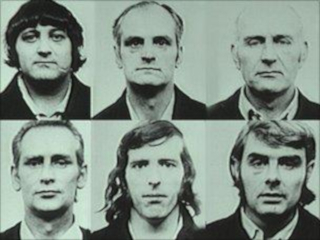
The Arrest of the Birmingham Six

the-birmingham-six

Hugh Callaghan, Patrick Hill, Robert Hunter, Noel McIlkenny, William Power, and John Walker, known as the “Birmingham Six,” are arrested on November 22, 1974, in connection with pub bombings which took place earlier in the week.

The Birmingham pub bombings take place on November 21, 1974, and are attributed to the Provisional Irish Republican Army. Explosive devices are placed in two central Birmingham pubs, the Mulberry Bush at the foot of the Rotunda and the Tavern in the Town in New Street. The resulting explosions, at 8:25 PM and 8:27 PM, collectively are the most injurious attacks in England since World War II. Twenty-one people are killed and 182 are injured. A third device, outside a bank in Hagley Road, fails to detonate.

Five of the six arrested are Belfast-born Roman Catholics, while John Walker is a Roman Catholic born in Derry. All six have lived in Birmingham since the 1960s. All the men except for Callaghan leave the city early on the evening of November 21 from New Street Station, shortly before the explosions. They are travelling to Belfast to attend the funeral of James McDade, a Provisional IRA member who had accidentally killed himself on November 14 when his bomb detonates prematurely while he is planting it at a telephone exchange in Coventry.

When they reach Heysham they and others are subject to a Special Branch stop and search. The men do not tell the police of the true purpose of their visit to Belfast, a fact that is later held against them. While the search is in progress the police are informed of the Birmingham bombings. The men agree to be taken to Morecambe police station for forensic tests.

On the morning of November 22, after the forensic tests and questioning at the hands of the Morecambe police, the men are transferred to the custody of West Midlands Serious Crime Squad police unit. Callaghan is taken into custody on the evening of November 22.

The Birmingham Six are charged with murder and conspiracy to cause explosions on May 12, 1975. The trial begins on June 9, 1975, at the Crown Court sitting at Lancaster Castle, before Justice Nigel Bridge and a jury. The jury finds the six men guilty of murder. On August 15, 1975, they are each sentenced to twenty-one life sentences.

On November 28, 1974, the Birmingham Six appear in court for a second time after they had been remanded into custody at HM Prison Winson Green, all showing bruising and other signs of ill-treatment. Fourteen prison officers are charged with assault in June 1975 but are ultimately acquitted. The Six bring a civil claim for damages against the West Midlands Police in 1977, but it is struck out on January 17, 1980, by the Court of Appeal (Civil Division).

In March 1976 the Birmingham Six’s first application for leave to appeal is dismissed by the Court of Appeal, presided over by John Widgery. Their second full appeal, in 1991, is allowed. New evidence of police fabrication and suppression of evidence, the successful attacks on both the confessions and the 1975 forensic evidence causes the Crown to decide not to resist the appeals. The Court of Appeal states that in light of the fresh scientific evidence, the convictions are both unsafe and unsatisfactory. On March 14, 1991, the Birmingham Six are set free.

In 2001, a decade after their release, the six men are awarded compensation ranging from £840,000 to £1.2 million.


Leave a comment

Magee College Opens in Derry, County Londonderry

magee-college-1870

Magee College opens on October 10, 1865, as a Presbyterian Christian arts and theological college in Derry, County Londonderry, Northern Ireland. Since 1953, it has had no religious affiliation and provides a broad range of undergraduate and postgraduate academic degree programmes in disciplines ranging from business, law, social work, creative arts & technologies, cinematic arts, design, computer science and computer games to psychology and nursing.

The Magee Campus gains its name from Martha Magee, the widow of a Presbyterian minister, who, in 1845, bequeathed £20,000 to the Presbyterian Church in Ireland to found a college for theology and the arts. It opens in 1865 primarily as a theological college but accepts students from all denominations to study a variety of subjects. It is a college of the Royal University of Ireland from 1880 and later becomes associated with Trinity College, Dublin when the Royal University is dissolved in 1909 and replaced by the National University of Ireland.

During World War II, the college is taken over by the Admiralty for Royal NavyRoyal Navy operational use, becoming with Ebrington Barracks (HMS Ferret), a major facility in the Battle of the Atlantic. A 2013 BBC report describes a secret major control bunker, later buried beneath the lawns of the college. From 1941 this bunker, part of Base One Europe, together with similar bunkers in Derby House, Liverpool and Whitehall is used to control one million Allied personnel and fight the Nazi U-boat threat.

In 1953, Magee Theological College separates from the remainder of the college, eventually moving to Belfast in a 1978 merger that forms Union Theological College. Also in 1953, Magee College breaks its ties with Dublin and becomes Magee University College. It is hoped by groups led by the University for Derry Committee that this university college would become Northern Ireland’s second university after Queen’s University Belfast. However, in the 1960s, following the recommendations in The Lockwood Report by Sir John Lockwood, Master of Birkbeck College, London and former Vice-Chancellor of the University of London, the Parliament of Northern Ireland makes a controversial decision to pass it over in favour of a new university in Coleraine. Instead it is incorporated into the two-campus New University of Ulster in 1969. The next fourteen years see the college halve in size, while development focuses on the main Coleraine campus.

In 1984, the New University merges with the Ulster Polytechnic, and Magee becomes the early focus of development of a new four-campus university, the University of Ulster. Student and faculty numbers recover and grow rapidly over the next ten to fifteen years, accompanied by numerous construction projects. Magee grows from just 273 students in 1984 to over 4,000 undergraduates in 2012. In 2012, the University continues to lobby the Northern Ireland Executive for an additional 1,000 full-time undergraduate places, leading to 6,000 students at Magee in 2017.

On September 14, 2013, Magee hosts, for the first time on the island of Ireland, the 23rd International Loebner Prize Contest in Artificial Intelligence based on the Turing test proposed by the renowned British computer scientist Alan Turing in 1950. Turing also works on cracking the Enigma machine code at Bletchley Park which is instrumental in the Battle of the Atlantic.

In October 2014 the University of Ulster is rebranded as Ulster University.

(Pictured: Magee College, c. 1870)


Leave a comment

Birth of Motion Picture Actress Greer Garson

greer-garson

Eileen Evelyn Greer Garson, motion picture actress best known as Greer Garson, is born on September 29, 1904, in Manor Park, London, England. Her classic beauty and screen persona of elegance, poise, and maternal virtue make her one of the most popular and admired Hollywood stars of the World War II era.

Garson often claims to have been born in County Down, Ireland, where her grandparents lived and which she happily visited as a child, but she is, in fact, born and raised in London. Although she wanted to study acting, she wins a scholarship to the University of London and her practical-minded family encourage her to pursue a teaching career. After graduating with honours, she works briefly for Encyclopædia Britannica and a London advertising firm but continually tries to get her foot into a backstage door.

In 1932 Garson makes her debut with the Birmingham Repertory Theatre, playing a middle-aged schoolteacher in Elmer Rice’s Street Scene. Later that year she tours in George Bernard Shaw’s Too True to Be Good, billing herself as Greer, a maternal family name, for the first time. She soon establishes herself as a popular ingenue and leading lady in London’s West End. In 1938 Louis B. Mayer, head of Metro-Goldwyn-Mayer (MGM), catches her performance in Old Music and signs her to a contract with his studio.

After suffering through a discouraging first year in Hollywood, Garson returns to England to film the small role of Mrs. Chips in MGM’s Goodbye, Mr. Chips (1939). She receives her first Oscar nomination for the role but loses to Vivien Leigh for Gone with the Wind. Her portrayal of the beloved schoolteacher’s charming wife endears her to the American public and sets her career in motion. It is the first in a series of roles in which she plays women of great loyalty, refinement, and wifely or motherly strength.

Garson’s other significant films of the period include Pride and Prejudice (1940), Blossoms in the Dust (1941), her first appearance with her frequent costar Walter Pidgeon, Random Harvest (1942), and Madame Curie (1943). The film that cements her reputation and image, however, is Mrs. Miniver (1942). Filmed during World War II and tailor-made for the times, Mrs. Miniver extolls the strength and spirit of the British home front and is one of the year’s biggest hits. Her grace-under-pressure portrayal of a courageous wife and mother, the personification of British fortitude, not only wins her an Academy Award but is credited with bolstering American support for the war.

Following the war Garson’s career falters. The public rejects her attempts to reforge her image to that of a more fun-loving, less noble heroine in such films as Adventure (1945) and Julia Misbehaves (1948). During the 1950s she appears in several unexceptional films and television dramas and stars on Broadway in Auntie Mame. Her remarkably convincing portrayal of Eleanor Roosevelt in Sunrise at Campobello (1960) is widely praised and earns her a seventh Oscar nomination, but she performs only occasionally thereafter, devoting most of her time to philanthropic causes, including the endowment of scholarships for theatre students at Southern Methodist University in University Park, Texas and the construction of a campus theatre.

Garson spends her final years occupying a penthouse suite at the Presbyterian Hospital of Dallas. She dies there from heart failure on April 6, 1996, at the age of 91. She is interred beside her husband in the Sparkman-Hillcrest Memorial Park Cemetery in Dallas.


Leave a comment

Birth of James Dillon, Fine Gael Leader

james-dillon

James Matthew Dillon, politician and Fine Gael leader, is born in Drumcondra, Dublin on September 26, 1902. He serves as Leader of the Opposition and Leader of Fine Gael from 1959 to 1965 and Minister for Agriculture from 1948 to 1951 and from 1954 to 1957. He serves as a Teachta Dála (TD) from 1932 to 1969.

Dillon is the son of John Dillon, the last leader of the Irish Parliamentary Party, which had been swept away by Sinn Féin at the 1918 general election. He is educated at Mount St. Benedict’s, in Gorey, County Wexford, University College Galway and King’s Inns. He qualifies as a barrister and is called to the Bar in 1931. He studies business methods at Selfridges in London. After some time at Marshall Field’s in Chicago he returns to Ireland where he becomes manager of the family business known as Monica Duff’s in Ballaghaderreen, County Roscommon.

Between 1932 and 1937 Dillon serves as Teachta Dála (TD) for the Donegal constituency for the National Centre Party and after its merger with Cumann na nGaedheal, for the new party of Fine Gael. He plays a key role in instigating the creation of Fine Gael and becomes a key member of the party in later years. He remains as TD for Monaghan from 1937 to 1969. He becomes deputy leader of Fine Gael under W. T. Cosgrave.

Dillon resigns from Fine Gael in 1942 over its stance on Irish neutrality during World War II. While Fine Gael supports the government’s decision to stay out of the war, he urges the government to side with the Allies. He is a rabid anti-Nazi, proclaiming the Nazi ideology is “the devil himself with twentieth-century efficiency.” His zealousness against the Nazis draws him the ire of the German minister to Ireland, Eduard Hempel, who denounces him as a “Jew” and “German-hater.”

Dillon has a personally eventful 1942. While holidaying in Carna, County Galway he meets Maura Phelan of Clonmel on a Friday. By that Monday the two are engaged and six weeks after that they are married.

Dillon is one of the independents who supports the first inter-party government (1948–1951) and is appointed Minister for Agriculture. As Minister, he is responsible for huge improvements in Irish agriculture. Money is spent on land reclamation projects in the areas of less fertile land while the overall quality of Irish agricultural produce increases.

Dillon rejoins Fine Gael in 1953. He becomes Minister for Agriculture again in the second inter-party government (1954–1957). In 1959 he becomes leader of Fine Gael, succeeding Richard Mulcahy. He becomes president of the party in 1960. In 1965 Fine Gael loses the general election to Seán Lemass and Fianna Fáil. The non-Fianna Fáil parties win 69 seats to Fianna Fáil’s 72. Had the other parties been able to win four more seats between them, they would have been able to form a government. Having narrowly failed to become Taoiseach, Dillon stands down as Fine Gael leader after the election.

Dillon is a colourful contributor to Dáil proceedings and is noted for his high standard of oratory. He remains a TD until 1969, when he retires from politics. He died in Malahide, Dublin on February 10, 1986, at the age of 83.


Leave a comment

Birth of James Molyneaux, Northern Irish Politician

james-molyneaux

James Henry Molyneaux, Baron Molyneaux of Killead, Northern Irish unionist politician and leader of the Ulster Unionist Party (UUP) from 1979 to 1995, is born in Killead, County Antrim on August 27, 1920. He is a leading member and sometime Vice-President of the Conservative Monday Club. An Orangeman, he is also Sovereign Grand Master of the Royal Black Institution from 1971 to 1995. He is an unrelenting though peaceful supporter of the Protestant cause during the factional conflict that divides Northern Ireland from the 1960s until the early 21st century.

Molyneaux is educated at nearby Aldergrove School. Although he is raised an Anglican, as a child he briefly attends a local Catholic primary school. He leaves school at age 15 and works on his father’s poultry farm. When a Catholic church near his home is burned down by Ulster loyalist arsonists in the late 1990s, he helps to raise funds for its rebuilding.

In World War II Molyneaux serves in the Royal Air Force between 1941 and 1946. He participates in the D-Day landings in FranceFrance and in the liberation of the Belsen-Belsen concentration camp, and occasionally gives interviews about what he sees there. On April 1, 1947, he is promoted to flying officer.

After demobilization Molyneaux establishes a printing business with his uncle, and in 1946 he joins the UUP. He is first elected to local government in 1964 and enters Parliament six years later. He staunchly opposes all power-sharing deals, notably the Anglo-Irish Agreement (1985) between British Prime Minister Margaret Thatcher and Irish Taoiseach Garret FitzGerald, which gives Dublin an official consultative role in the affairs of Northern Ireland and paves the way for devolution.

Molyneaux lacks the firebrand public image of his longtime rival Ian Paisley, who in 1971 breaks with the UUP to form the Democratic Unionist Party (DUP). He never acquiesces to the Good Friday Agreement, which calls for the devolution of Northern Ireland’s government from London to Belfast, however, unlike Paisley and David Trimble, who in 1997 succeeds Molyneaux as the UUP leader and in April 1998 signs the devolution accord.

On retiring as UUP leader, Molyneaux is knighted as a Knight Commander of the Order of the British Empire (KBE) in 1996. The following year, after standing down as an MP at the 1997 general election, he is created a life peer on June 10, 1997, as Baron Molyneaux of Killead, of Killead in the County of Antrim.

James Molyneaux dies at the age of 94 in Antrim, County Antrim, Northern Ireland on March 9, 2015, Commonwealth Day.


Leave a comment

German Bombing of the Shelburne Co-op

campile-bombing

German aircraft bomb a creamery at Campile, County Wexford, a small village located fourteen kilometres outside the town of New Ross, on August 26, 1940 killing three women.

Ireland remains officially neutral during World War II. However, on August 26, 1940, the German Luftwaffe bombs Campile in daylight. Three women are killed – Mary Ellen Kent (30), her sister Catherine Kent (26), both from Terrerath, and Kathleen Hurley (27) from Garryduff. Four German bombs are dropped on the creamery and restaurant sections of Shelburne Co-op on that day. The railway is also targeted by the bombers. The 20-minute ordeal terrorises the peaceful village and leaves behind a trail of devastation. The attack has never been fully explained, although there are numerous theories as to why the bombing occurred.

One theory is that the German pilots were lost and had mistaken the southeast coast of Wexford for Wales. It is also suggested that butter boxes emblazoned with the Shelburne Co-op name were discovered by the Nazis a few months earlier following the evacuation of Dunkirk and that the bombing was in retaliation for supplying foodstuffs to the Allied armies.

However, Campile historian John Flynn, who wrote a book to mark the 70th anniversary of the disaster, argues that the bombing was a message from Adolf Hitler to Taoiseach Éamon de Valera warning him to keep his promise on Ireland’s neutrality.

On the occasion of the 50th anniversary of the bombing, a plaque is erected on the co-op walls in memory of the three women.

The local Harts bar and lounge contains many artifacts relating to the bombing. The description and history related to each artifact can be found in an old leather-bound book kept underneath the counter in the adjoining sweet shop.


Leave a comment

Death of Yann Renard-Goulet, Sculptor & Breton Nationalist

yann-goulet-custom-house-memorial

Yann Renard-Goulet, French sculptor, Breton nationalist and war-time collaborationist with Nazi Germany who headed the Breton Bagadou Stourm militia, dies in Bray, County Wicklow on August 22, 1999.

Goulet is born in Saint-Nazaire, France on August 20, 1914. Before World War II, he is a member of the Breton National Party and a former member of the French Section of the Workers’ International (SFIO). His artistic career begins at the École nationale supérieure des Beaux-Arts, where he studies art and architecture, and learns sculpture with Auguste Rodin‘s assistant, Charles Despiau. His works in France include bas-reliefs shown at the Exposition International de Paris (1938), and the monument to the youth of the French empire in Lille (1939). He is part of the Breton artistic movement Seiz Breur.

Goulet’s involvement in Breton nationalism leads to accusations that he had orchestrated the destruction of the Monument to the Breton-Angevin Federation at Pontivy on December 18, 1938, by Gwenn ha du, the nationalist terrorist group. He is detained, but then released.

In 1939, he is sent to Strasbourg to study the art of sabotage. He participates in the beginning of World War II fighting for France, and is captured by the Germans on June 11, 1940, while blowing up a bridge on the Aisne with friends from a French corps.

Later in the war, Goulet joins the assault section of Bagadou Stourm, Breton nationalist stormtroopers allied to the Germans. He also collaborates with the pro-Nazi nationalist newspaper L’Heure Bretonne. In 1941 in Paris, he becomes head of Bagadou Stourm and the “Youth Organizations” of the Breton National Party. The promotion of Bagadou Stourm officers is named “Patrick Pearse” to commemorate the 25th anniversary of the 1916 Easter Rising against British rule in Ireland.

After the liberation of France, Goulet travels with his wife and children to Ireland, and is sentenced to death as a Collaborationist by a French court in his absence. He acquires Irish citizenship in 1952 and becomes an art professor.

Goulet is commissioned to create public works commemorating the Irish Republican Army (IRA) and other republicans, including the Custom House Memorial (Dublin), the East Mayo Brigade IRA Memorial, the Republican Memorial (Crossmaglen), and the Ballyseedy Memorial (Kerry). He exhibits regularly at the Royal Hibernian Academy, eventually becoming the RHA Professor of Sculpture. He is also made a member of Aosdána in 1982.

Towards the end of the 1960s, Goulet claims to have taken the reins of the Breton Liberation Front (Front de Libération de la Bretagne, or FLB) and to have been behind all their attacks.

In 1969 Goulet becomes secretary general and chair of the Comité National de la Bretagne Libre and publishes the communiques of the FLB. In 1968, the head of police in Bray congratulate him on organising the previous day’s attack on the CRS barracks in Saint-Brieuc.

Goulet died at Bray, County Wicklow, on August 22, 1999, two days after his 85th birthday.

(Pictured: Custom House Memorial in Dublin by Yann Renard-Goulet, 1957)


Leave a comment

Birth of Dan Breen, IRA Volunteer & Fianna Fáil Politician

Irish republican Dan Breen (1967)

Daniel “Dan” Breen, volunteer in the Irish Republican Army (IRA) during the Irish War of Independence and the Irish Civil War, is born in Grange, Donohill parish, County Tipperary, on August 11, 1894. In later years, he is a Fianna Fáil politician.

Breen’s father dies when he is six, leaving the family very poor. He is educated locally before becoming a plasterer and later a linesman on the Great Southern Railways.

Breen is sworn into the Irish Republican Brotherhood in 1912 and the Irish Volunteers in 1914. On January 21, 1919, the day the First Dáil meets in Dublin, Breen takes part in the Soloheadbeg Ambush. The ambush party of eight men, led by Seán Treacy, attacks two Royal Irish Constabulary (RIC) men who are escorting explosives to a quarry. The two policemen, James McDonnell and Patrick O’Connell, are fatally shot during the incident. The ambush is considered to be the first incident of the Irish War of Independence.

During the conflict, the British put a £1,000 price on Breen’s head, which is later increased to £10,000. He quickly establishes himself as a leader within the Irish Republican Army. He is known for his courage. On May 13, 1919 he helps rescue his comrade Seán Hogan at gunpoint from a heavily guarded train at Knocklong station in County Limerick. Breen, who is wounded, remembers how the battalion is “vehemently denounced as a cold-blooded assassins” and roundly condemned by the Catholic Church. After the fight, Treacy, Séumas Robinson, and Breen meet Michael Collins in Dublin, where they are told to make themselves scarce although they do not necessarily agree.

Breen and Sean Treacy shoot their way out through a British military cordon in the northern suburb of Drumcondra (Fernside). They escape, only for Treacy to be killed the next day. Breen is shot at least four times, twice in the lung.

The British reaction is to make Tipperary a “Special Military Area,” with curfews and travel permits. Volunteer GHQ authorises entrerprising attacks on barracks. The British policy forces Breen and Treacy to retreat to Dublin. They join Michael Collins’ Squad of assassins, later known as the Dublin Guard, and Dublin becomes the centre of the war.

Breen is present in December 1919 at the ambush in Ashtown beside Phoenix Park in Dublin where Martin Savage is killed while trying to assassinate the Lord Lieutenant of Ireland, Viscount John French. The IRA hides behind hedges and a dungheap as the convoy of vehicles drives past. They have been instructed to ignore the first car but this contains their target, Lord French. Their roadblock fails as a policeman removes the horse and cart intended to stop the car.

Breen utterly rejects the Anglo-Irish Treaty, which makes him, like many others, angry and embittered. In the June 1922 elections Breen is nominated as a candidate by both the pro- and anti-Treaty sides, but is not elected.

Breen is elected to Dáil Éireann at the 1923 general election as a Republican anti-Treaty Teachta Dála (TD) for the Tipperary constituency. Following the Anglo-Irish Treaty, Breen joins the Anti-Treaty IRA in the civil war, fighting against those of his former comrades in arms who support the Treaty. He is arrested by the National Army of the Irish Free State and interned at Limerick Prison. He spends two months there before going on hunger strike for six days followed by a thirst strike of six days, prompting his release.

Breen writes a best-selling account of his guerrilla days, My Fight for Irish Freedom, in 1924. He represents Tipperary from the fourth Dáil in 1923 as a Republican with Éamon de Valera and Frank Aiken. He is defeated in the June 1927 Irish general election and travels to the United States where he opens a prohibition speakeasy. In 1932 he returns to Ireland and regains his seat as a member of Fianna Fáil in the Dáil at that year’s general election. During World War II he is said to hold largely pro-Axis views. He represents his Tipperary constituency without a break until his retirement at the 1965 election.

Breen dies in Dublin on December 27, 1969 and is buried in Donohill, near his birthplace. His funeral is the largest seen in west Tipperary since that of his close friend and comrade-in-arms Seán Treacy at Kilfeacle in October 1920. An estimated attendance of 10,000 mourners assemble in the tiny hamlet, giving ample testimony to the esteem in which he was held.

Breen is the subject of a 2007 biography Dan Breen and the IRA by Joe Ambrose.