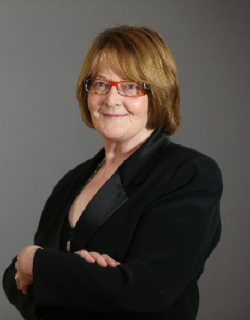
Macken (née O’Kelly) is born in Dublin on February 28, 1942. She is educated at King’s Inns and Trinity College Dublin. She becomes a barrister in 1972, practices as legal adviser, Patents and Trade Marks Agents (1973–1979) and becomes a Senior Counsel in 1995.
As a lawyer, Macken specialises in medical defense work and pharmaceutical actions. She acts as defense counsel in a series of cases brought by children against whooping cough vaccine manufacturers for damage allegedly caused by the vaccine. The Supreme Court nominates her to act in three referrals by the President of Ireland querying the constitutionality of new legislation before she becomes a judge.
Macken succeeds John L. Murray as Ireland’s appointee on the European Court of Justice (ECJ) from October 5, 1999, to September 22, 2004. Appointed initially for a five-year term, she is the first female appointee to the European Court of Justice but has her mandate renewed in 2003. She is reappointed a Judge of the High Court on October 18, 2004, on her return to Ireland. She serves as a Judge of the Supreme Court from 2005 to 2012.
Macken has been a lecturer in Legal Systems and Methods and Averil Deverell Lecturer in Law at Trinity College Dublin.
Hugh O’Brien, the mayor of Boston from 1884-1888, is born in Ireland on July 13, 1827. He is notable as Boston’s first Irish-born mayor, immigrating to the United States in the early 1830s. He is the editor of the Shipping and Commercial List and serves as a Boston alderman from 1875-1883.
O’Brien moves with his family to Boston when he is five years old, well before the potato famine sends waves of impoverished Irish men and women to Boston. He spends seven years in the Boston public schools and is apprenticed to a printer at the age of 12.
Working first for the newspaper Boston Courier and then for a Boston printer, O’Brien excels at the printing business, making foreman when he is only fifteen. He starts his own publication, Shipping and Commercial List, and is soon successful enough to become a respected member of the Boston business elite.
O’Brien’s business success draws the attention of Patrick Maguire, publisher of The Republic newspaper and the unofficial head of Irish politics in Boston. He orchestrates O’Brien’s election to the city’s Board of Alderman.
Boston has long been controlled by native-born Protestants, generally called “Yankees,” most of whom have a stereotypical view of Irish immigrants as poor, ignorant, undisciplined, and under the thumb of the Catholic Church. But the Irish-born population of Boston is exploding, making up over 40% of the city’s population by 1885.
By 1883, Maguire decides that the time has come for Boston to elect an Irish-born mayor. He devises a two-part strategy. O’Brien will be the public face of the campaign, an able public official who criticizes the previous administration for increasing taxes. O’Brien’s pledge to reduce the tax rate without cutting city services appeals to the Yankee tradition of frugality. Meanwhile, behind the scenes, Maguire develops a system of Irish ward bosses who visit each household in the neighborhood and make sure that every eligible Irishman votes for O’Brien. O’Brien sweeps 15 of Boston’s 25 wards and, on December 10, 1884, becomes the first Irish Catholic to be elected Mayor of Boston. He is sworn in on January 5, 1885.
O’Brien surprises the opposition by governing the city in a conservative and honest way during his four terms in office. He cuts tax rates as promised. He also widens streets, establishes the commission that hires Frederick Law Olmsted to design the Emerald Necklace park system, and builds the new Boston Public Library in Copley Square. He disarms his critics by enlisting Yankee and Republican businessmen to serve on the committees overseeing these projects.
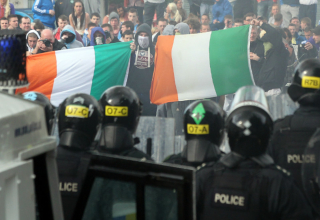
Catholic rioting has been common in recent years when the parades are forced through the mostly Irish nationalist Ardoyne in north Belfast. The local Orangemen parade down the predominantly Ulster loyalist Crumlin Road towards the loyalist Woodvale area. Before turning into the Woodvale, they are met by Irish republican protesters and a nearby counter-parade organised by the Greater Ardoyne Residents Association (GARC). Nationalists then attack the Police Service of Northern Ireland (PSNI) and the parade with bricks, bottles and petrol bombs.
There is also violence in the Bogside area of Derry, where petrol bombs are thrown at police and a car is set afire. In south and east Belfast there are five arrests for a variety of offences including disorderly behaviour.
Prolonged attacks on the PSNI by Catholics follow the parades with missiles being thrown at police lines. Three cars are hijacked and pushed at police lines with at least one of them being set on fire, and at night ten shots are fired at police by a nationalist gunman who intends to kill police officers. On July 18, 2012, a 47-year-old man is charged with attempted murder of the police officers. The PSNI blames the violence on “thugs” and makes a further 26 arrests across Northern Ireland relating to the trouble.
In another incident during a different parade, a Shankill Road-based loyalist band “The Young Conway Volunteers” is filmed by a Sinn Féin activist playing The Famine Song outside St. Patrick’s Catholic Church in Ardoyne. The activist filming the incident is attacked by band members who try to snatch the phone from him. The incident brings condemnation, with Sinn Féin declaring it “provocative.” Protestant church leaders also condemn the incident as “blatantly sectarian.” It is this incident that is believed to ignite tensions in the area which continue over the next few months.
In the days that follow strong loyalist criticism is levelled at the Parades Commission blaming them for the violence. Nigel Dodds of the Democratic Unionist Party (DUP) accuses the Parades Commission of making a “bizarre, crazy, and mad decision” to allow the nationalist parade to coincide with the Orange parade while Sinn Féin’s Gerry Kelly blames the Orangemen for violating regulations set out by the Parades Commission. The Parades Commission denies responsibility, explaining “We have to balance the rights of everybody concerned in parades, not just the rights of paraders, but the rights of people who live in the areas and the rights of police officers.”
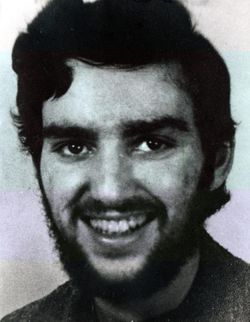
O’Hara joins Na Fianna Éireann in 1970 and, in 1971, his brother Sean is interned in Long Kesh Prison. In late 1971, at the age of 14, he is shot and wounded by a soldier while manning a barricade. Due to his injuries, he is unable to attend the civil rights march on Bloody Sunday but watches it go by him in the Brandywell Stadium, and the events of the day have a lasting effect on him.
In October 1974, O’Hara is interned in Long Kesh Prison, and upon his release in April 1975 he joins the Irish Republican Socialist Party (IRSP) and INLA. He is arrested in Derry in June 1975 and held on remand for six months. In September 1976, he is arrested again and once more held on remand for four months.
On May 10, 1978, O’Hara is arrested on O’Connell Street in Dublin under section 30 of the Offences Against the State Act and is released eighteen hours later. He returns to Derry in January 1979 and is active in the INLA. On May 14, 1979, he is arrested and is convicted of possessing a hand grenade. He is sentenced to eight years in prison in January 1980.
O’Hara becomes Officer Commanding of the INLA prisoners at the beginning of the first hunger strike in 1980, and he joins the 1981 strike on March 22.
On Thursday, May 21, 1981, at 11:29 PM, Patsy O’Hara dies after 61 days on hunger strike, at the age of 23. In accordance with his wishes, his parents do not get him the medical intervention needed to save his life. His corpse is found to be mysteriously disfigured prior to its departure from prison and before the funeral, including signs of his face being beaten, a broken nose, and cigarette burns on his body.
In 2009, Shaw collaborates with Deborah Warner again, taking the lead role in Tony Kushner‘s translation of Bertolt Brecht‘s Mother Courage and Her Children. In a 2002 article for The Daily Telegraph, Rupert Christiansen describes their professional relationship as “surely one of the most richly creative partnerships in theatrical history.” Other collaborations between the two women include productions of Brecht’s The Good Woman of Szechuan and Henrik Ibsen‘s Hedda Gabler, the latter adapted for television.
Shaw appears in season four of American TV show True Blood. Her character, Marnie Stonebrook, has been described as an underachieving palm reader who is spiritually possessed by an actual witch. Her character leads a coven of necromancer witches who threaten the status quo in Bon Temps, erasing most of Eric Northman‘s memories and leaving him almost helpless when he tries to kill her and break up their coven.
The hospital is founded by Bartholomew Mosse, a surgeon and man-midwife who is appalled at the conditions that pregnant women have to endure, in George’s Lane as the Dublin Lying-In Hospital in March 1745. Lying-in is an archaic term for childbirth, referring to the month-long bed rest prescribed for postpartum confinement. The venture is very successful and Mosse raises money through concerts, exhibitions and even a lottery to establish larger premises.
The hospital moves to new premises, designed by Richard Cassels, where it becomes known as “The New Lying-In Hospital” in December 1757. The rotunda itself, which is designed by James Ensor, is completed just in time for a reception hosted by the Marquess of Kildare in October 1767. Extensive new rooms, designed by Richard Johnston and built adjacent to the rotunda, are completed in 1791.
Records indicate that around 1781, “when the hospital was imperfectly ventilated, every sixth child died within nine days after birth, of convulsive disease; and that after means of thorough ventilation had been adopted, the mortality of infants, within the same, in five succeeding years, was reduced to one in twenty.” This issue is not limited to the Lying-In-Hospital. In that era, ventilation improvement is a general issue in patient care, along with other issues of sanitation and hygiene, and the conditions in which surgeons such as Robert Liston in Britain and elsewhere, have to operate. Florence Nightingale famously works on the design of safe and healthy hospitals.
By the early 19th century the facility becomes known as the Rotunda Hospital, after its prominent architectural feature. The first Caesarean section in Ireland is undertaken at the hospital in 1889.
The Rotunda Hospital, as both a maternity hospital and also as a training centre (affiliated with Trinity College Dublin) is notable for having provided continuous service to mothers and babies since inception, making it the oldest continuously operating maternity hospital in the world. It is estimated that over 300,000 babies have been born there.
Rotunda Hospital is currently managed by RCSI Hospitals.
McDonnell is born on Slate Street in the lower Falls Road of Belfast, Northern Ireland on September 14, 1951, as one of ten children. He attends a nearby Roman Catholic school. He marries Goretti in 1970 and moves into her sister’s house in Lenadoon. There are only two Catholic houses in this predominantly Ulster Protestanthousing estate, and their house is attacked on numerous occasions.
McDonnell agrees with the goals of the Irish hunger strike, namely: the right not to wear a prison uniform; the right not to do prison work; the right of free association with other prisoners; the right to organise their own educational and recreational facilities and the right to one visit, one letter and one parcel per week.
Although McDonnell is not involved in the first hunger strike in 1980, he joins Bobby Sands and the others in the second hunger strike the following year. During the strike he fights the general election in the Republic of Ireland, and only narrowly misses election in the Sligo–Leitrim constituency. He goes 61 days without food before dying on July 8, 1981. He has two children. His wife takes an active part in the campaign in support of the hunger strikers.
McDonnell is buried in the grave next to Bobby Sands at Milltown Cemetery in west Belfast. John Joe McGirl, McDonnell’s election agent in Sligo–Leitrim, gives the oration at his funeral. Quoting Patrick Pearse, he states, “He may seem the fool who has given his all, by the wise men of the world; but it was the apparent fools who changed the course of Irish history.”
Ingram enters Trinity College, Dublin on October 13, 1837. He is elected a Scholar of Trinity College in 1840, graduates with a BA in mathematics in 1842, and is awarded an MA in 1850. In 1852 he becomes a professor of oratory at Trinity and writes extensively on Shakespeare. He shows considerable promise in both mathematics and classics and achieves early popularity as a poet. He has a distinguished career at Trinity, spanning over fifty-five years, as a student, fellow and professor, successively of Oratory, English Literature, Jurisprudence and Greek, subsequently becoming the College Librarian and ultimately its Vice Provost.
One evening in March 1843 Ingram writes a poem for which he is best remembered, a political ballad called “The Memory of the Dead” in honour of the Irish Rebellion of 1798 led by the Society of United Irishmen. The poem is published anonymously on April 1, 1843, in Thomas Davis‘s The Nation newspaper although its authorship is an open secret in Dublin. It is set to music for voice and piano in 1845 by John Edward Pigot and becomes a popular Irish nationalist anthem. It is one of the best-known of Irish Republican songs and is often played by the piper at Republican funerals.
In 1847 Ingram helps to found the Statistical and Social Inquiry Society of Ireland. His early economic writings deal mainly with the Poor Law, which in theory is supposed to provide relief for the poor but in reality, does little to alleviate the distress in Ireland. Strongly influenced by the French sociologistAuguste Comte, he rejects the more isolated approach of classical economics which builds on the assumption that people try to do the best they can. Instead, he seeks to develop a unified theory of economics along the lines of Comtean positivist philosophy, which seeks ways for economic policies to contribute to the good of society. His writings on this topic include the essay “Present Position and Prospects of Political Economy” (1878) and A History of Political Economy (1888).
John Kells Ingram dies on May 1, 1907, in his home at 38 Upper Mount Street, Dublin, where he had lived since 1884. He is buried in Mount Jerome Cemetery.
The Late Late Show, the Irish talk show, airs on RTÉ One for the first time on July 6, 1962. It is the world’s second longest-running late-night talk show, following The Tonight Show in the United States. Perceived as the official flagship television programme of Ireland’s public service broadcaster Raidió Teilifís Éireann (RTÉ), it is regarded as an Irish television institution and is broadcast live across two hours plus in front of a studio audience on Friday nights between September and May.
Having maintained the same name and format continuously, The Late Late Show is first broadcast on Friday, July 6, 1962 and in colour from 1976. Originating as temporary summer filler for a niche Saturday night audience, it later moves to its current home on Friday night schedules. The format has remained largely the same throughout — dialogue, sketch comedy, musical performances, discourse on topical issues. It has influenced attitudes of the populace towards approval or disapproval of its chosen topics, directed social change and helped shape Irish societal norms. It averages 650,000 viewers per episode and has consistently achieved RTÉ’s highest ratings.
For much of its early life, RTÉ Television Centre‘s Studio 1 in Donnybrook, Dublin is its home. This original studio accommodates a small audience of about 120. In 1995, The Late Late Show transfers to the more spacious Studio 4, adapted specifically to cater for this and Kenny Live. Three external broadcasts have aired, most recently from the Wexford Opera House on September 5, 2008.
Original host Gay Byrne presents the show until May 21, 1999. Pat Kenny is Byrne’s successor hosting the show for 10 years between 1999 and 2009. Ryan Tubridy is the current presenter, having succeeded Kenny in September 2009. Under Tubridy, first QUINN Group and then Sky Broadband add sponsorship deals. Tubridy’s arrival coincides with a marked increase in audience ratings with some early statistics comparing him to the Byrne era. On February 1, 2013, Pat Kenny returns to host that night’s edition following the death of Tubridy’s father.
Inspired by the band’s experiences on the Zoo TV Tour, Zooropa expands on many of the tour’s themes of technology and media oversaturation. The record is a continuation of the group’s experimentation with alternative rock, electronic dance music, and electronic sound effects that began with their previous album, Achtung Baby, in 1991.
U2 begins writing and recording Zooropa in Dublin in February 1993, during a six-month break between legs of the Zoo TV Tour. The record is originally intended as an EP to promote the “Zooropa” leg of the tour that is to begin in May 1993, but during the sessions, the group decides to extend the record to a full-length album. Pressed for time, U2 writes and records at a rapid pace, with songs originating from many sources, including leftover material from the Achtung Baby sessions. The album is not completed in time for the tour’s resumption, forcing the band to travel between Dublin and their tour destinations in May to complete mixing and recording.
Zooropa receives generally favourable reviews from critics. Despite none of its three singles —”Numb“, “Lemon“, and “Stay (Faraway, So Close!)” — being hits consistently across regions, the record sells well upon release and peaks at number one in multiple countries. The album’s charting duration and lifetime sales of 7 million copies, however, are less than those of Achtung Baby. In 1994, Zooropa wins the Grammy Award for Best Alternative Music Album. Although the record is a success and music journalists view it as one of the group’s most creative works, the band regards it with mixed feelings.
Continuing a campaign by U2 to reissue all of their records on vinyl, Zooropa is re-released on two 180-gram vinyl records on July 27, 2018. Remastered under The Edge’s direction, the reissue includes two remixes to commemorate the album’s 25th anniversary: “Lemon (The Perfecto Mix)” and “Numb (Gimme Some More Dignity Mix).”



 The
The 


 seamus dubhghaill