seamus dubhghaill

Promoting Irish Culture and History from Little Rock, Arkansas, USA


Leave a comment

The Battle of Fontenoy

battle-of-fontenoy

The Irish Brigade of France, a brigade in the French Royal Army composed of Irish exiles most commonly identified in Irish history as The Wild Geese, achieve its most glorious victory at the Battle of Fontenoy on May 11, 1745, during the War of the Austrian Succession.

The battle takes place in the Belgian municipality of Antoing, near Tournai. A French army of 50,000 commanded by Marshal Maurice de Saxe defeats a slightly larger Pragmatic Army of 52,000 consisting of the Dutch Republic, Great Britain, Hanover and the Holy Roman Empire, led by Prince William, Duke of Cumberland. The Irish Brigade is led by Justin McCarthy, Viscount Mountcashel and is comprised of six regiments.

Despite setbacks elsewhere, at the end of 1744 the French hold the initiative in the Austrian Netherlands, and their leaders consider this theatre offers the best opportunity for a decisive victory. In late April, they besiege Tournai, which controls access to the upper Scheldt basin, which makes it a vital link in the North European trading network and the Allies march to its relief.

Leaving 22,000 men in front of Tournai, Saxe places his main force five miles away in the villages of St. Antoine, Vezin and Fontenoy, along a naturally strong feature which he strengthens with defensive works. After a series of unsuccessful flank assaults, the Allies attack the French centre with a column of 15,000 men.

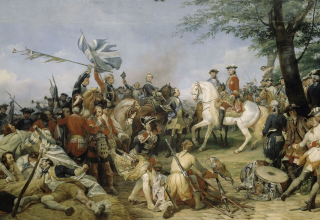
Colonel Arthur Dillon‘s regiment, which had already been badly shot up earlier in the fight, along with the brigade’s other five, charge the British as they seem on the verge of breaking the French line. Fifty years of Irish frustration and British betrayal now come back to haunt the British. As the men of the Irish Brigade close through a hail of British bullets, their shouts are heard above the din: “Cuimhnígí ar Luimneach agus ar fheall na Sasanach!” (Remember Limerick and the Saxon Faith).

Nothing can withstand the wave of hatred and revenge that breaks on the hapless British line that day. The victory is won but the cost is high. Colonel Dillon is dead, and Lord Clare is wounded twice. The brigade suffers 656 casualties in all, the highest percentage of all the French units.

Although the Allies retreat in good order, Tournai falls shortly afterwards, followed by Ghent, Oudenaarde, Bruges and Dendermonde. The withdrawal of British forces in October to deal with the Jacobite Rising facilitates the capture of Ostend and Nieuwpoort. By the end of 1745, France controls much of the Austrian Netherlands, threatening British links with Europe.

However, by early 1746, France is struggling to finance the war and begins peace talks at the Congress of Breda in May. Despite victories at Rocoux in October 1746 and Lauffeld in July 1747, the war continues until the Treaty of Aix-la-Chapelle in 1748.

It is a day never to be forgotten by the Irish worldwide. At Manassas, Virginia, 116 years later, Thomas Francis Meagher cries out to the 69th New York, another regiment of Irishmen, “Remember Fontenoy!”

(Pictured: The Irish Brigade, presenting a captured British colour to Louis XV and the Dauphin)


Leave a comment

Kidnapping of RIC Constables Clarke & Murdock

royal-irish-constabulary-badgeAlexander Clarke and Charles Murdock, both constables with the Royal Irish Constabulary (RIC), the police force in Ireland from 1822 until 1922, are kidnapped and murdered by the Irish Republican Army (IRA) near Clonmany, County Donegal on May 10, 1921.

The disappearance is the most notorious incident to occur in Clonmany during the Irish War of Independence. Both men are stationed at the RIC Barracks in Clonmany. They go on patrol in the evening but are kidnapped near Straid in County Antrim. Both men are shot and their bodies are dumped in the sea near Binion.

Clarke’s body washes up on the seashore near Binion the following day. Constable Murdock reportedly survives the initial attack despite being thrown into the sea. He swims to the shore and seeks refuge among the residents of Binion. However, he is betrayed to the IRA who murder him. His body has never been found. Local tradition suggests that he is buried in a bog near Binion hill.

In June 1921, a military court is held in Clonmany to conduct a postmortem for Clarke. The court finds that Clarke had died from gunshot wounds to the heart, jaw and neck and that his firearm and ammunition were missing. At the time of his death, Clarke is 23 years old and unmarried.

A few weeks later, on July 10, 1921 Crown Forces raid a number of houses in Clonmany looking for Sinn Féin activists. Three unnamed young men from the village are arrested but are released shortly afterwards and allowed to return home.


Leave a comment

Birth of Pádraig Flynn, Fianna Fáil Politician

CREATOR: gd-jpeg v1.0 (using IJG JPEG v62), quality = 90

Pádraig Flynn, former Fianna Fáil politician, is born in Castlebar, County Mayo on May 9, 1939. He serves as European Commissioner for Social Affairs from 1993 to 1999, Minister for Industry and Commerce and Minister for Justice from 1992 to 1993, Minister for the Environment from 1987 to 1991, Minister for Trade, Commerce and Tourism from October 1982 to December 1982, Minister for the Gaeltacht from March 1982 to October 1982 and Minister of State at the Department of Transport from 1980 to 1981. He serves as a Teachta Dála (TD) for the Mayo West constituency from 1977 to 1994.

Flynn is the son of Patrick and Anne Flynn. He is educated in St. Gerald’s College, Castlebar and qualifies as a teacher from St. Patrick’s College, Dublin. He first holds political office in 1967, when he becomes a member of Mayo County Council. Ten years later, at the 1977 general election, he is elected to Dáil Éireann as a Fianna Fáil TD for the Mayo West constituency.

Flynn is a supporter of Charles Haughey in the 1979 Fianna Fáil leadership election. His loyalty is rewarded when he becomes a Minister of State at the Department of Transport and Power. He joins the Cabinet for the first time following the February 1982 general election when he is appointed Minister for the Gaeltacht. In October 1982, in a minor reshuffle, he becomes Minister for Trade, Commerce and Tourism. However, his time in this office is brief, since Fianna Fáil loses the November 1982 general election.

Fianna Fáil is returned to power in the 1987 general election and Flynn becomes Minister for the Environment. Two years later he opposes the formation of the coalition government with the Progressive Democrats, describing it “as hitting at Fianna Fáil core values.” In 1990, he attacks the opposition presidential candidate Mary Robinson on a radio show, accusing her of “having a new-found interest in her family” for the purposes of her election campaign. This attack backfires drastically, causing many women who initially support Brian Lenihan to back Robinson. Lenihan’s campaign never recovers, and Robinson becomes Ireland’s first female President.

In 1991, Flynn is sacked from the Cabinet because of his support for a motion of no confidence in the Taoiseach, Charles Haughey. Then in 1992, Albert Reynolds becomes Taoiseach and Flynn is rewarded for supporting Reynolds by becoming Minister for Justice. In 1993, he retires from domestic politics when he is appointed Ireland’s European Commissioner. He is reappointed by the Fine GaelLabour Party government in 1995 and, on both of these occasions, serves in the social affairs portfolio.

On January 15, 1999, Flynn makes comments on The Late Late Show regarding Tom Gilmartin and a donation of IR£50,000 to the Fianna Fáil party. He also makes comments about his own lifestyle, boasting of having a salary of IR£140,000 together with three houses, cars and housekeepers and travels regularly, yet complains about the hassle involved. The performance was seen as eccentric and out of touch. In effect, he is interpreted as behaving in a manner more befitting the Irish stereotype known as the Dublin 4 mentality, complaining of the costs incurred in the pursuit of extravagance.

The show’s presenter, Gay Byrne, then asks Flynn if he knows of Gilmartin. He responds that he knows him well. He seems to be making an attack of Gilmartin’s emotional stability, based on the effect of sickness of Gilmartin’s wife. If it is to be interpreted as an attack of Gilmartin’s credibility, it backfires in a spectacular manner against Flynn. Also, unknown to Flynn, Gilmartin is actually watching the program at his home in Luton. This hurts Gilmartin a great deal, while also bringing the illness of his wife into the picture as the real driving force behind Gilmartin’s testimony against Flynn. Gilmartin responds by releasing details of meetings he held with Flynn to the McCracken Tribunal. The interview is widely described as the end of Flynn’s political career.

Flynn’s second term as European Commissioner ends early in September 1999, when the entire commission resigns due to allegations of malpractice by the European Parliament. He is not reappointed to the Commission and retires from politics completely. He is a member of the Comite d’Honneur of the Institute of International and European Affairs.

Flynn is cited in the Mahon Tribunal for having received money from Frank Dunlop intended for Fianna Fáil, but diverted to his personal use. On March 22, 2012, the final report of the Mahon Tribunal is published. It finds that Flynn “wrongly and corruptly” sought a substantial donation from Tom Gilmartin for the Fianna Fáil party. It also finds that having been paid IR£50,000 by Gilmartin, for that purpose, Flynn proceeded to use that money for his personal benefit, and that the donation funded at least a significant portion of the purchase of a farm in County Mayo.

On March 26, 2012, facing expulsion following the Mahon Tribunal, Flynn resigns in disgrace from Fianna Fáil before he can be ousted.


Leave a comment

First Production of the Irish Literary Theatre

CREATOR: gd-jpeg v1.0 (using IJG JPEG v62), quality = 75

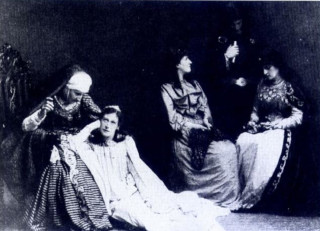
The first production of the Irish Literary Theatre, The Countess Cathleen, is performed on May 8, 1899. Like many of William Butler Yeats’ plays, it is inspired by Irish folklore. In a time of famine, demons sent by Satan come to Ireland to buy the souls of the starving people. The saintly Cathleen disposes of her vast estates and wealth in order to feed the peasants, yet the demons thwart her at every turn. At last, she sacrifices her own soul to save those of the poor.

Yeats, Lady Gregory and Edward Martyn publish a “Manifesto for Irish Literary Theatre” in 1897, in which they proclaim their intention of establishing a national theatre for Ireland. The Irish Literary Theatre is founded by Yeats, Lady Gregory, Martyn and George Moore in Dublin in 1899. It proposes to give performances in Dublin of Irish plays by Irish authors.

In 1899 Lady Gregory secures a temporary licence for a play to be given at the Antient Concert Rooms in Great Brunswick Street (now Pearse Street) in Dublin and so enables the Irish Literary Theatre to give its first production. The play chosen is The Countess Cathleen by Yeats. It is done by a very efficient London company that includes May Whitty (Dame May Webster) and Ben Webster. The next production given is Martyn’s play The Heather Field.

In the following year the Irish Literary Theatre produces three plays at the Gaiety Theatre in Dublin: Maeve by Edward Martyn, The Last Feast of Fianna by Alice Milligan and The Bending of the Bough by George Moore. The Bending of the Bough is staged during the Second Boer War which begins on October 11, 1899.

The Irish Literary Theatre project lasts until 1901, when it collapses due to lack of funding.

The use of non-Irish actors in these productions is perceived to be a failure, and a new group of Irish players is put together by the brothers William and Frank Fay, among others. These go on to form the Irish National Theatre Society, which leads to the founding of the Abbey Theatre in Dublin in 1904.


Leave a comment

Birth of Norman Whiteside, Northern Ireland Footballer

norman-whiteside

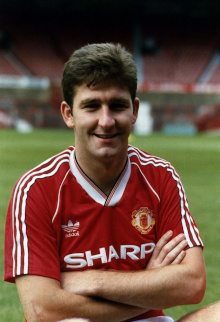
Norman Whiteside, former Northern Ireland international footballer who played in two World Cups, is born in Belfast, Northern Ireland on May 7, 1965. He plays both as a midfielder and as a striker.

Whiteside grows up on Shankill Road, and because of his aggressive, physical playing style he is later nicknamed the “Shankill Skinhead” by Manchester United supporters. The family later moves to 10 Danube Street. He remains relatively unscathed by The Troubles as his Protestant parents keep a firm watch on their children to ensure that they do not stray far from home and that none of them become involved with Ulster loyalism. At around seven years of age, he joins the Boys’ Brigade, and quickly shows his natural talent for football, scoring ten goals in a game against boys almost twice his age. He is educated at Cairnmartin High School and becomes famous in the Shankill area as a footballing prodigy by the age of eleven.

Whiteside is said to have been discovered by Ipswich Town scout Jim Rodgers, who is told by manager Bobby Robson to wait until Whiteside grows older. Instead, it is Manchester United’s 80-year-old Ulster scout Bob Bishop, who previously unearthed Belfast-born George Best and Sammy McIlroy for the club, who first offers him a trial at an English club. He finds that he has been offered schoolboy terms at the club during a school trip to the United States, on which he and his classmates meet President Jimmy Carter in the Oval Office, a rare and extraordinary occasion for children from a disadvantaged background.

Whiteside signs professional forms in 1982 at the age of 17 and quickly becomes a key member of the Manchester United club. He scores 68 goals in 278 league and cup appearances for the club over the next seven years, picking up two FA Cup winners medals in 1983 and 1985, as well as playing in the 1982 FA Youth Cup final, the 1983 League Cup final, and the FA Charity Shield in 1983.

Whiteside remains with United until July 1989, when he is sold to Everton F.C. for £600,000. However intense running sessions run by coach Mick Lyons take their toll on his right knee, and on September 20, 1990, he takes a knock in a practice match, which requires him to have another operation on his right knee. After the return of Howard Kendall as manager in November 1990, he manages to appear in a few reserve team games, but this only delays the inevitable, and he is forced to retire from the game at the age of 26 in June 1991.

Upon retirement, Whiteside studies to become a podiatrist, graduating with a degree from the University of Salford, and serves Northwich Victoria F.C. as their assistant manager/physio from October 1991 until March 1992. He quits the role as he does not enjoy the amount of time spent travelling between games. He instead became an after-dinner speaker and also works for the Professional Footballers’ Association, while taking a postgraduate course at Manchester Metropolitan University. He later takes up private practice as a podiatrist in Manchester. Since 1994, he has also worked at the corporate hospitality department at Old Trafford. In 2003, he releases a book entitled My Memories of Manchester United. With the help of writer Rob Bagchi, he releases his autobiography entitled Determined in August 2007, published by Headline Publishing Group, and with a foreword by actor James Nesbitt.

Whiteside holds records as the youngest player to take part in a World Cup, the youngest player to score in a League Cup and FA Cup final, and the youngest player to score a senior goal for Manchester United. Winning 38 caps for Northern Ireland, he plays at the 1982 and 1986 World Cups and also helps his country to win the last ever British Home Championship in 1983–1984.


Leave a comment

Birth of Máire de Paor, Historian & Archaeologist

maire-de-paor

Máire de Paor, Irish historian and archaeologist who also works as a researcher and presenter for national broadcaster RTÉ, is born on May 6, 1925, in Buncrana, County Donegal.

De Paor is born Máire MacDermott to Eamonn MacDermott and Delia MacVeigh. She is educated in the Convent of Mercy in Buncrana before going to University College Dublin, where she completes a master’s degree and a doctorate on early Christian archaeology and metalwork.

De Paor works in the Department of Archeology at UCD from 1946 to 1958. She marries Liam de Paor in 1946, and they have a daughter and four boys. They collaborate on a number of publications. She publishes her papers in the Proceedings of the Royal Irish Academy, Archaeologia, Seanchas Armagh and Comhar. Her husband also works at the university and, as a result of policies about married women, she is forced to leave. Initially she lectures in the United States, Canada, Scandinavia, France and the United Kingdom. She works as lecturer in archaeology at Trinity College, Dublin. The de Paors spend a year in Nepal on a UNESCO project in 1963.

De Paor works as a freelance researcher for Raidió Teilifís Éireann until she is given a full-time position in the 1970s.

De Paor is elected a member of the Royal Irish Academy in 1960 and is a member of the Arts Council from 1973. She becomes a member of Conradh na Gaeilge from 1962. From 1968 she is working with Cumann Merriman, the Irish cultural organisation named after Brian Merriman, working with the group as a director of the schools and spends four years as chairperson. In 1992 she is appointed to the board of Amharclann de hÍde.

Máire de Paor dies on December 6, 1994, at the age of 69.

University College Dublin has created the Dr. Máire de Paor Award for best PhD thesis. Her biographer identifies her as a committed republican, socialist and feminist.


Leave a comment

Publication of the First Issue of “Sinn Féin”

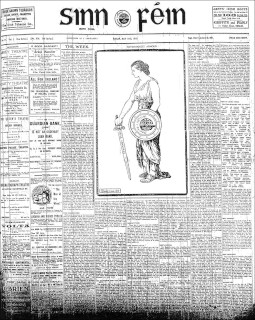
File source: http://en.wikipedia.org/wiki/File:Sinn_F%C3%A9in_Newspaper.jpgThe first issue of Sinn Féin, a weekly Irish nationalist newspaper edited by the Dublin typesetter, journalist and political thinker Arthur Griffith, is published on May 5, 1906. It is published by the Sinn Féin Printing & Publishing Company, Ltd. (SFPP) between 1906 and 1914, and replaces an earlier newspaper called The United Irishman which is liquidated after a libel suit. Initially, Sinn Féin is a large format (slightly larger than a modern broadsheet), 4-page newspaper with 7 columns per page.

Trained as he was in the graphic side of newspaper production, Arthur Griffith has both a professional interest in and a profound understanding of visual culture. He is also very much aware of how visual discourses can be used to defend the Irish nation against cultural Anglicisation. In his newspaper propaganda he continually promotes the use of such discourses to develop a strong brand awareness for the Irish nation.

The most important graphic element of the Sinn Féin newspaper is the Déanta i nÉirinn symbol. This distinctive logo is created by the Irish Industrial Development Association (IIDA). The text in Irish means “Made in Ireland.” From the autumn of 1909, Griffith’s newspapers displays it proudly and very prominently on their front page between the words ‘sinn’ and ‘féin’ in the title-piece. It can also frequently be seen in advertisements and cartoons throughout. Both a trade description and a statement of Sinn Féin‘s industrial politics, this mark plays a fundamental role in the newspaper propaganda published by the SFPP.

For the first few years of its existence the circulation of Sinn Féin is limited. From January 1909 onwards, however, Griffith attempts to attract new readers by publishing a daily newspaper, the Sinn Féin Daily, with sensational articles from overseas, a fashion column aimed at women readers, and a new graphic approach. The daily newspaper is abandoned by the SFPP when it plunges the company into enormous debt.

Thanks to the purchase of two brand new Linotype machines, the newspaper becomes more attractive from a typographical point of view and easier to read. The addition of images give Sinn Féin a far less austere look and at the same time significantly improve its commercial appeal, with sales reaching a peak of 64,000 in September 1909. Foremost among these images are the large political cartoons which regularly appear on the front page. This user-friendly graphic discourse translates the National question into a series of emotionally charged life and death struggles set against familiar mythical and literary backdrops. At the same time, it illustrates Griffith’s instructions to the individual Sinn Féiner, indicating the path to follow and the dangers to avoid.

The man responsible for these cartoons is the Dublin-born designer, illustrator, and stained glass artisan Austin V. Molloy. At the age of twenty-two Molloy is hired by the SFPP to provide cartoons at a rate of 1 shilling and 6 pence per week. His work appears in the newspaper between August 1909 and April 1911. As is the case for many of the contributors to Sinn Féin, Molloy uses the Irish version of his name, Maolmhuidhe, to sign his contributions. His cartoons provide a snapshot of the issues preoccupying Sinn Féin’s propagandists between 1909 and 1911, namely the status of the Irish language, the development of Irish industry and the prevention of emigration.

Through The United Irishman and Sinn Féin Griffith demonstrates the need to arrogate legislature from the hands of the British by transferring Irish Parliament back to Dublin. However, Irish Parliamentary parties quite clearly cannot agree to Griffith’s urgings, as such a move would undermine the foundation of their existence in Westminster. Sinn Féin thus serves as conduit for Griffith’s opposition to the Acts of Union 1800.

The Sinn Féin weekly and the SFPP both come to an end when they are suppressed by the British Government in 1914.


Leave a comment

Death of IRA Blanket Protester Kieran Nugent

kieran-nugent

Kieran Nugent, volunteer in the Provisional Irish Republican Army, dies from a heart attack on May 4, 2000. He is best known for being the first person to start the blanket protest against the British Government’s treatment of republican prisoners.

Born in 1958, Nugent’s adolescence comes at a time when Northern Ireland is exploding into turmoil. On March 20, 1973, at the age of 15, he is standing with a friend on the corner of Merrion Street and Grosvenor Road when a car pulls up beside them and one of the occupants asks them for directions. Another occupant of the vehicle then opens fire with a submachine gun. Nugent is seriously wounded after being shot eight times in the chest, arms and back by the Ulster loyalists in the car. His friend, Bernard McErlean, aged 16, is killed.

At some point afterwards, Nugent joins the Provisional IRA. At the age of sixteen he is arrested by the British Army and spends five months on remand in Crumlin Road Gaol. When he is eventually tried, the case against him is withdrawn and he is released. He becomes an active volunteer until his arrest and internment, without trial, on February 9, 1975.

Nugent spends nine months in Cage 4 at the Long Kesh Detention Centre until November 12, 1975. He is arrested and imprisoned again on May 12, 1976, following the hijacking of a bus. On September 14, 1976, he is sentenced to three years and becomes the first Republican prisoner convicted since the withdrawal of Special Category Status for those convicted through juryless courts, due to the new British policy of ‘criminalisation’ introduced that March. Among other things, this change in policy means convicted paramilitaries can no longer wear their own clothes. Viewing himself as a political prisoner and not a criminal, he refuses to wear the uniform saying the prison guards would have to “…nail it to my back.” This begins the blanket protest.

Nugent is soon joined by Jackie McMullan, the next prisoner to don the blanket, followed by six more Irish republican prisoners from the Beechmount area of Belfast. By Christmas 1976 the number of participants has risen to over forty prisoners. Most incoming republican prisoners emulate Nugent, and this starts five years of prison protests in pursuit of political status, which culminates in the 1981 Irish hunger strike and the death of eleven, including seven IRA and three Irish National Liberation Army prisoners.

Nugent, the father of four, is found dead of a heart attack at his home in Anderstown, Belfast on May 4, 2000.


Leave a comment

Launch of RTÉ Lyric FM

rte-lyric-fm

RTÉ Lyric FM, an Irish 24-hour classical music and arts radio station owned by the public-service broadcaster Raidió Teilifís Éireann (RTÉ), is launched on May 3, 2016. The station, which is based in Limerick, County Limerick, is available on FM throughout Ireland, on Sky UK digital satellite in Ireland and the United Kingdom, and via the Internet worldwide.

RTÉ Lyric FM develops from FM3 Classical Music, which begins broadcasting on November 6, 1984. FM3 broadcasts classical music on the RTÉ Raidió na Gaeltachta (RnaG) network at breakfast time, lunchtime and in the evenings. The station is rarely marketed, except via promotions on RTÉ Radio 1, and has low listenership ratings. It is probably best known for occasionally simulcasting the stereo soundtrack of movies being shown on the RTÉ television channels prior to RTÉ’s deployment of NICAM digital stereo.

As Raidió na Gaeltachta expands broadcast hours, FM3’s service hours changed to 7:30 PM until 1:00 AM and 6:30 AM until 8:00 AM. Eventually it stays on air until breakfast time when RnaG comes back on.

On May 1, 1999, RTÉ puts in place an additional national FM transmitter network, and it is decided to separate FM3 from Radio na Gaeltachta, and expand its remit to include other types of minority music. The resulting station is Lyric FM (currently styled RTÉ lyric fm). It also moves from Dublin to Limerick as part of a policy of regionalisation. At the time of the station’s launch, RTÉ lyric fm’s digital studios in Cornmarket Row, Limerick, are the most advanced in the country.

RTÉ Lyric FM wins PPI National Station of the Year for the second time in 2004.

In May 2009, the station celebrates 10 years broadcasting. This is celebrated with a concert by the RTÉ National Symphony Orchestra and RTÉ Philharmonic Choir. Current presenters include Marty Whelan, George Hamilton, John Kelly, Liz Nolan, Paul Herriott, Niall Carroll, Lorcan Murray, Bernard Clarke, Aedín Gormley, and Ellen Cranitch.

RTÉ Lyric FM attracts an audience share of 1.6%. The current head of the station is Aodán Ó Dubhghaill.

Recent schedule changes have caused some dissent amongst listeners and the station has been accused of dumbing down. A petition is also launched to save the Sunday early morning programme “Gloria” presented by Tim Thurston.


Leave a comment

St. Patrick’s Cathedral Designated National Cathedral

st-patricks-cathedral-dublin

St. Patrick’s Cathedral, Dublin, is designated the National Cathedral of the Church of Ireland on May 2, 1872. Chapter members at St. Patrick’s are drawn from each of the twelve dioceses of the Church of Ireland.

St. Patrick’s Cathedral is dedicated on March 17, 1191. With its 141-foot spire, it is the tallest church (not cathedral) in Ireland and the largest.

St. Patrick’s Cathedral is founded on the spot where St. Patrick himself is believed to have baptized the first Irish believers into the Christian faith. The sacred well which St. Patrick used has been lost, but the Cathedral is built in the area where the conversions are believed to have taken place.

The first church is constructed here in the 5th century but St. Patrick’s as it stands now is built between 1191 and 1270. In 1311, the Medieval University of Dublin is founded here, and the church begins a place of higher education as well as a place of worship.

By the 16th century, however, St. Patrick’s falls into disrepair following the English Reformation, a time when the Church of England breaks away from the Roman Catholic Church. In 1537, St. Patrick’s becomes designated as an Anglican Church of Ireland, and it remains a part of the Church of Ireland to this day.

Repairs to the cathedral begin in the 1660s and continued in phases over the following decades to save it from falling into complete ruin.

As its status grows, St. Patrick’s begins to rival Christ Church Cathedral in importance. This is where the history of St. Patrick’s Cathedral takes a bit of a complicated turn in term of church definitions. The current cathedral building is often hailed as one of the best examples of medieval architecture in Dublin, however, it is only fair to point out that the structure went through a massive rebuild in the 1860s, mainly financed by money from Benjamin Guinness.

As one of Dublin’s two Church of Ireland cathedrals, St. Patrick’s is actually designated as the “National Cathedral of Ireland.” However, it lacks the one thing that usually makes a church a cathedral – a bishop. The Archbishop of Dublin actually has his seat at Christ Church Cathedral, which is designated as the local cathedral of the Diocese of Dublin and Glendalough. St. Patrick’s is instead headed by a dean who is the ordinary for the cathedral. This office has existed since 1219 with its most famous office holder being Jonathan Swift.

Today St. Patrick’s Cathedral plays host to a number of public national ceremonies. Ireland’s Remembrance Day ceremonies, hosted by the Royal British Legion and attended by the President of Ireland, take place there every November. Its carol service (the Service of Nine Lessons and Carols), celebrated twice in December, including every December 24, is a colourful feature of Dublin life. On Saturdays in autumn the cathedral hosts the graduation ceremonies of Technological University Dublin.

The funerals of two Irish presidents, Douglas Hyde and Erskine Childers, take place in St. Patrick’s Cathedral in 1949 and 1974 respectively. In 2006, the cathedral’s national prominence is used by a group of 18 Afghan migrants seeking asylum, who occupied it for several days before being persuaded to leave without trouble.