McAleese’s initial seven-year term of office ends in November 2004, but she stands for a second term in the 2004 Irish presidential election. Following the failure of any other candidate to secure the necessary support for nomination, the incumbent president stands unopposed, with no political party affiliation, and is declared elected on October 1, 2004.
McAleese is re-inaugurated at the commencement of her second seven-year term on November 11, 2004. Her very high approval ratings are widely seen as the reason for her re-election, with no opposition party willing to bear the cost, financial or political, of competing in an election that would prove difficult to win.
Following the inauguration ceremony earlier in the day in Dublin Castle, McAleese attends a reception there hosted by the Government to mark the beginning of her second term of office. The 700 invited guests include members of the Government, the Oireachtas, the judiciary and dignitaries from Christian churches and other faiths.
McAleese identifies the need for strong and resilient communities as the theme of her second term in office. Speaking after her inauguration in the afternoon, she says, “The cushion of consumerism is no substitute for the comfort of community.” Speaking on the Northern Ireland peace process, she urges the hesitant to “muster the courage to complete the journey to a bright new landscape of hope.”
Prevented by the Constitution of Ireland from running for a third term, McAleese leaves office in 2011 as one of Ireland’s most popular and respected presidents.
(Pictured: the second inauguration of Mary McAleese, November 11, 2004, President of Ireland website, http://www.president.ie)
When the Irish Rebellion of 1798 breaks out in Ireland, Wolfe Tone urges the French Directory to send effective assistance to the Irish rebels. All that can be promised is a number of raids to descend simultaneously around the Irish coast. One of these raids under General Jean Joseph Amable Humbert succeeds in landing a force near Killala, County Mayo, and gains some success in Connacht (particularly at Castlebar) before it is subdued by General Gerard Lake and Charles Cornwallis. Wolfe Tone’s brother Matthew is captured, tried by court-martial and hanged. A second raid, accompanied by James Napper Tandy, comes to a disastrous end on the coast of County Donegal.
Wolfe Tone takes part in a third raid, under Admiral Jean-Baptiste-François Bompart, with General Jean Hardy in command of a force of 2,800 men. He certainly knows before departing that the odds against them are incredibly long. Most of the United Irish organization has already spent itself in Wexford, Ulster, and other places. There is one slim reed of hope for success – the news from Hubert, who is sweeping the British before him in Mayo with his 1,000 Frenchmen and Irish rebel allies. Wolfe Tone once said he would accompany any French force to Ireland even if it were only a corporal’s guard, so he sails off with Hardy’s Frenchmen aboard the Hoche.
They are intercepted by a large British fleet at Buncrana on Lough Swilly on October 12, 1798. Escape aboard one of the small, fast ships is Wolfe Tone’s only hope to avoid a hangman’s noose but he refuses to transfer from the large, slow Hoche, which has little choice but certain sinking or capture. He refuses offers by Napoleon Bonaparte and other French officers of escape in a frigate before the Battle of Tory Island. “Shall it be said,” he asks them, “that I fled while the French were fighting the battle of my country?”
The Hoche withstands an attack by five British ships for several hours, with Wolfe Tone commanding one of her batteries. Inevitably the masts and rigging of the Hoche are shot away and she strikes her colors. Wolfe Tone is dressed in a French adjutant general‘s uniform, but there is little chance of him avoiding detection with so many former acquaintances among the British. He is thrown into chains taken prisoner when the Hoche surrenders.
When the prisoners are landed at Letterkenny Port a fortnight later, Sir George Hill recognises Wolfe Tone in the French adjutant general’s uniform in Lord Cavan’s privy-quarters at Letterkenny. At his trial by court-martial in Dublin on November 8, 1798, Wolfe Tone makes a speech avowing his determined hostility to England and his intention “by frank and open war to procure the separation of the countries.” Recognising that the court is certain to convict him, he asks that “the court should adjudge me to die the death of a soldier, and that I may be shot.” His request to be shot is denied.
On November 10, 1798, Wolfe Tone is found guilty and sentenced to be hanged on November 12. Before this sentence is carried out, either he attempts suicide by slitting his throat or British soldiers torture and mortally wound him. Military surgeon Benjamin Lentaigne treats him just hours before he is due to be hanged. The story goes that he is initially saved when the wound is sealed with a bandage, and he is told if he tries to talk the wound will open and he will bleed to death.
A pamphlet published in Latin by Dr. Lentaigne some years after Wolfe Tone’s official “suicide” refers to an unusual neck wound suffered by an unnamed patient which indicates that “a bullet passed through his throat.” This leads to speculation that Wolfe Tone may have been shot.
Theobald Wolfe Tone dies on November 19, 1798, at the age of 35 in Provost’s Prison, Dublin, not far from where he was born. He is buried in Bodenstown Graveyard in County Kildare, near his birthplace at Sallins, and his grave is in the care of the National Graves Association.
(Pictured: “Capture Of Wolfe Tone Date 1798,” a drawing by Mary Evans Picture Library, the UK’s leading source for historical images)
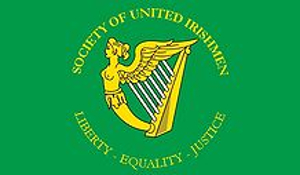
Spurred on by Theobold Wolfe Tone’s pamphlet titled An Argument on Behalf of the Catholics of Ireland, these young radicals propose three resolutions, which are to guide the new movement forward and which leave a lasting impression on generations of Irish men and women.
Firstly, that there exists the need for “a cordial union among all the people of Ireland.” Secondly, that a complete and radical reform of the representation of the people in Parliament is needed and, thirdly, that this reform should include “Irishmen of every religious persuasion.” The new organisation immediately tries to bring about change and Wolfe Tone, through his work as secretary of the Catholic Committee, organises a Catholic Convention in Dublin in 1792.
Although a Catholic Relief Act is passed in 1793, which rescinds some of the harsh Penal Laws, the United Irishmen soon turn their attention to France where they are heavily influenced by the French revolutionary ideals of “Liberty, Equality, Fraternity.”
When the United Irishmen are proclaimed a secret society and members arrested, Wolfe Tone travels to the United States and then France, making known his objectives for Irish Independence and that he wishes:
“To unite the whole people of Ireland, to abolish the memory of all past dissensions, and to substitute the common name of Irishman in place of the denominations of Protestant, Catholic and Dissenter – these were my means.”
The Irish Rebellion of 1798 soon follows and, although achieving initial success is brutally suppressed, thereby ending the ideals of the United Irishmen in uniting the people of Ireland.
(From: “Society of United Irishmen formed in Dublin 09 November 1791” posted on November 9, 2019, Irish News Archives, http://www.irishnewsarchives.com)
After the Belgian Congo becomes independent (as Republic of the Congo) in 1960, a civil war breaks out in Katanga, the southern, mineral-rich province of Congo. A local political leader, Moïse Tshombe, declares Katanga an independent state. United Nations peacekeeping troops are invited to help restore order and to end the Katanga secession.
The Luba people or “Baluba” ethnic group do not support the Katangese secession. As a result, they come under attack from pro-Katangese and allied forces. On October 4, several villages are attacked by Katangese gendarmes and European mercenaries and many Baluba are massacred. This leaves them suspicious of and hostile to any white European troops. Irish troops are sent to the area to secure it and encourage local people to return.
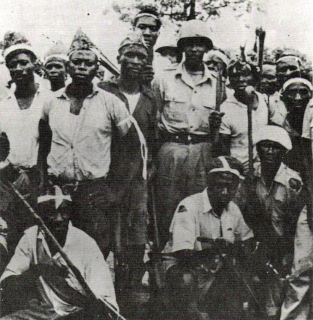
On November 8, 1960, an eleven-man section from the Irish Army’s 33rd Battalion arrives at the bridge over the Luweyeye River. They are forced to leave their vehicles when they encounter a blockade on the road. While clearing it, they encounter about 100 Luba militiamen armed with bows, poison-tipped arrows, spears and clubs, as well as some guns. While the Irish troops had arrived to protect the Baluba, the militia undoubtedly mistakes them for Katangese mercenaries. Lieutenant Kevin Gleeson, advancing unarmed with his platoon sergeant, Hugh Gaynor, attempt to greet them peacefully, but is hit with a barrage of poison-tipped arrows.
Gleeson and Gaynor are overtaken, beaten and hacked to death. The surprised Irish soldiers, who had not been deployed in a defensive formation after dismounting from their vehicles, retreat behind trees on either side of the road and open fire on the tribesmen with their Gustav submachine guns, Lee–Enfield rifles and Bren light machine guns. The Baluba however advance on them, and the Irish are cut off from their vehicles. Despite taking heavy losses, the Baluba overrun the Irish soldiers, and fierce hand-to-hand fighting breaks out, during which most of the Irish troops are killed.
The surviving Irish troops regroup by a ridge but are surrounded by the Baluba. They fight to hold them off, but their position is rapidly overrun and all but three of them are killed. The three survivors manage to escape. One of them, Anthony Browne, reaches a nearby village and gives all the money he has to the village women, hoping they will get him help, but is instead mobbed and beaten to death by the village men. His body is recovered two years later. The two surviving soldiers manage to hide and are found by other UN troops the following day.
A total of nine Irish soldiers die: Lt. Kevin Gleeson of Carlow, Sgt. Hugh Gaynor of Blanchardstown, Cpl. Peter Kelly of Templeogue, Cpl. Liam Dougan of Cabra, Pt. Matthew Farrell of Jamestown, Dublin, Tpr. Thomas Fennell of Donnycarney, Tpr. Anthony Browne of Rialto, Pte. Michael McGuinn of Carlow, and Pte. Gerard Killeen of Rathmines. Some 25 Baluba are also killed.
The bodies of the Irish dead are flown to Casement Aerodrome in Baldonnel, where they lay in state. Lt. Kevin Gleeson’s coffin is placed on a gun carriage, while those of the rest are placed on army trucks. Following a funeral procession through Dublin, they are buried at Glasnevin Cemetery.
A stone commemorating Lt. Gleeson can be found in his hometown of Carlow while a plaque commemorating Sgt. Hugh Gaynor can be found in his hometown of Blanchardstown.
The notoriety of the attack, and the allegations of mutilation and cannibalism that circulate in the Irish popular press in its aftermath, lead to the word “baluba” (sometimes spelled “balooba”) becoming a synonym for any “untrustworthy and barbaric” individual in certain parts of Ireland.
Following the Battle of Gettysburg in July 1863, the Union and Confederate armies drift south and for three months spar with one another on the rolling plains of northern Virginia. In late October, GeneralRobert E. Lee withdraws his Confederate army behind the Rappahannock River, a line he hopes to maintain throughout the winter. A single pontoon bridge at the town of Rappahannock Station is the only connection Lee retains with the northern bank of the river.
The Union Army of the Potomac‘s commander, Maj. Gen. George G. Meade, divides his forces just as Lee expects. He orders Maj. Gen. John Sedgwick to attack the Confederate position at Rappahannock Station while Maj. Gen. William H. French forces a crossing five miles downstream at Kelly’s Ford. Once both Sedgwick and French are safely across the river, the reunited army is to proceed to Brandy Station.
The operation goes according to plan. Shortly after noon on November 7, French drives back Confederate defenders at Kelly’s Ford and crosses the river. As he does so, Sedgwick advances toward Rappahannock Station. Lee learns of these developments sometime after noon and immediately puts his troops in motion to meet the enemy. His plan is to resist Sedgwick with a small force at Rappahannock Station while attacking French at Kelly’s Ford with the larger part of his army. The success of the plan depends on his ability to maintain the Rappahannock Station bridgehead until French is defeated.
Sedgwick first engages the Confederates at 3:00 PM when Maj. Gen. Albion P. Howe‘s division of the VI Corps drives in Confederate skirmishers and seizes a range of high ground three-quarters of a mile from the river. Howe places Union batteries on these hills that pound the enemy earthworks with a “rapid and vigorous” fire. Confederate guns across the river return the fire, but with little effect.
Maj. Gen. Jubal Early’s division occupies the bridgehead defenses that day. Early posts Brig. Gen.Harry T. Hays‘s Louisiana brigade and Captain Charles A. Green’s four-gun Louisiana Guard Artillery in the works and at 4:30 PM reinforces them with three North Carolina regiments led by ColonelArchibald C. Godwin. The addition of Godwin’s troops increases the number of Confederate defenders at the bridgehead to nearly 2,000.
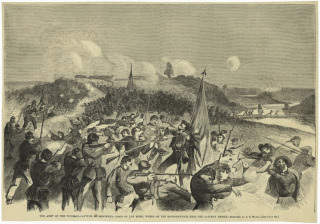
Sedgwick continues shelling the Confederates throughout the late afternoon, but otherwise he shows no disposition to attack. As the day draws to a close, Lee becomes convinced that the movement against the bridgehead is merely a feint to cover French’s crossing farther downstream. He is mistaken. At dusk the shelling stops, and Sedgwick’s infantry rushes suddenly upon the works. Col. Peter Ellmaker’s brigade advances adjacent to the railroad, precedes by skirmishers of the 6th Maine Volunteer Infantry. At the command “Forward, double-quick!” they surge over the Confederate works and engage Hays’s men in hand-to-hand combat. Without assistance, the 6th Maine breaches the Confederate line and plants its flags on the parapet of the easternmost redoubt. Moments later the 5th Wisconsin Infantry Regiment swarms over the walls of the western redoubt, likewise, wresting it from Confederate control.
On the right, Union forces achieve comparable success. Just minutes after Ellmaker’s brigade penetrates Hays’s line, Col. Emory Upton‘s brigade overruns Godwin’s position. Upton reforms his lines inside the Confederate works and sends a portion of the 121st New York Volunteer Infantry to seize the pontoon bridge, while the rest of his command wheels right to attack the confused Confederate horde now massed at the lower end of the bridgehead.
Confederate resistance dissolves as hundreds of soldiers throw down their arms and surrender. Others seek to gain the opposite shore by swimming the icy river or by running the gauntlet of Union rifle fire at the bridge. Confederate troops south of the Rappahannock look on hopelessly as Union soldiers herd their comrades to the rear as prisoners of war.
In all, 1,670 Confederates are killed, wounded, or captured in the brief struggle, more than eighty percent of those engaged. Union casualty figures, by contrast, are small: 419 in all. The battle is as humiliating for the South as it is glorious for the North. Two of the Confederacy’s finest brigades, sheltered behind entrenchments and well supported by artillery, are routed and captured by an enemy force of equal size.
The Civil War Trust and its partners have acquired and preserved 856 acres of the battlefield where the First and Second Battles of Rappahannock Station were fought. The battleground for both battles is located along the Rappahannock River at Remington, VA and features visible earthworks as well as bridge and mill ruins. The earthworks at Remington are no longer there and more than 75% of the battlefield has been developed over.
Risteárd Earnán Ó Glaisne is born on September 2, 1927, near Bandon, County Cork, the third of four children of George William Giles and his wife, Sara Jane (née Vickery). Educated at Bandon Grammar School and Trinity College Dublin, he graduates with a BA in 1949 and obtains a master’s degree in 1959. At TCD he is greatly influenced by Daithí Ó hUaithne.
Ó Glaisne first becomes interested in the Irish language at school in Bandon. His headmaster gives him a copy of Liam Ó Rinn‘s Peann agus Pár, along with a book of poems by Ivan Turgenev translated into Irish by Ó Rinn. “I suddenly found myself breaking into a world vastly larger than my own world in Irish,” he recalls. “The quality of mind I encountered made me realise I could never again connect Irish only with poteen and potatoes.”
Ó Glaisne further explores the language by making contact with the few native Irish speakers left in the Bandon area. He gradually comes to the conclusion that he is a member of a nation that has an extremely old and in many ways distinguished culture, of which Irish has been historically an integral part. Deciding that Irish best reflects the society in which he grew up and reflects him as an individual, he adopts it as his first language.
On graduating from TCD Ó Glaisne teaches Irish at Avoca School, Blackrock. He later teaches in St. Andrew’s College, Dublin, and at St. Patrick’s Cathedral Grammar School, where he ends his teaching career in 1989. He took a career break in the mid-1960s to study the French educational system and to travel on the Continent.
To perfect his Irish Ó Glaisne holidays on the Great Blasket Island, where he immerses himself in the rich oral culture. He makes many friends among the islanders, and the friendships continue after they are resettled on the mainland in Dún Chaoin. He regularly visits Corca Dhuibhne to meet friends like Muiris Mhaidhc Léan Ó Guithín, one of the last surviving islanders, and to enjoy the annual Ceiliúradh an Bhlascaoid.
Ó Glaisne holds that Protestants have enjoyed a long association with Irish, pointing to 18th-century followers of John Wesley such as Charles Graham, Gideon Ousley and Tomás Breathnach, who evangelised in Irish. He firmly believes that Protestants can be “every whit as Irish” as Roman Catholics. He urges his co-religionists to identify fully with Ireland.
Ó Glaisne is the founder and editor of Focus (1958-66), a monthly magazine that aims to help Protestants “come to an understanding of their cultural heritage.” He is a regular contributor to programmes on RTÉ and RTÉ Raidió na Gaeltachta, and writes for Comhar, Inniú, An tUltach and The Irish Times.
Matt Cooper resigns as editor of the Sunday Tribune on November 5, 2002 to replace Eamon Dunphy as presenter of The Last Word on Today FM. He edits his final issue of the Sunday Tribune in early November before joining The Last Word on January 6, 2003.
Today FM offers the job to Cooper a week earlier but he delays his acceptance in the interim. Dunphy describes Cooper as “a great choice and a heavyweight journalist.”
“I have enjoyed my time at the Sunday Tribune enormously and this is the only job that I would have left the paper for,” Cooper says.
When Cooper joins the Sunday Tribune in 1996 he becomes the youngest national newspaper editor in the country. Under his guidance, the paper’s circulation rises from 76,000 to 90,000 in 2001. However, sales fall to 85,000 copies in 2002.
Cooper is noted for his prolific writing output as well as regular stints as a stand-in presenter on The Last Word. He wins National Journalist of the Year in 1993 and in 2001. The Sunday Tribune says he will continue as a writer with the newspaper.
“We are sorry to see Matt leave. He made a significant contribution to the newspaper during his six years in the editor’s chair,” managing director Jim Farrelly says.
Speculation grows about who will succeed Cooper. “The appointment process will begin immediately and the job will be advertised. It will be similar to the selection process for The Irish Times editor’s job,” said Tribune spokesperson Martin Larkin.
Candidates interested in the job include Irish Independent business editor Richard Curran as well as in-house candidates Martin Wall, Diarmuid Doyle, Jim Farrelly, and Paddy Murray, who takes over as acting editor.
Much depends on the attitude of Independent News & Media, which has a 29.9% stake in Tribune Publications. It may be unwilling to grant a new editor significant funds since this would threaten the market of its flagship newspaper, the Sunday Independent. When asked about this in an interview in 2001, Farrelly says, “To grow your company, you must be financially independent.”
Acting editor Paddy Murray ultimately succeeds Cooper as full-time editor.
(From: “Last Word as Cooper quits Tribune” by Michael Brennan, Irish Examiner, November 6, 2002)
The province’s institutions are suspended on October 14 following a row over allegations of Irish Republican Army (IRA) activity, including alleged spying within the Northern Ireland Office (NIO).
Speaking after a 40-minute meeting with Trimble, Adams says they had had a “useful exchange of views.” But he adds, as expected, “there were very few conclusions in terms of the big picture….I asked Mr. Trimble how he thought things could be sorted out and Mr. Trimble had no particular suggestion to offer. But it was a good meeting.”
The Sinn Féin president says he had suggested to Trimble that each leader could address the executive of the opposite’s party. “He declined. But I hope he will think about the suggestion.”
Trimble says no significant developments came out of the meeting. He adds that the onus is on the republican movement to move the process forward. He dismisses Adams’s suggestion that they should address each other’s parties as a “stunt.”
Mitchel is the son of a Presbyterian minister. At the age of four, he is sent to a classical school, run by an old minister named Moor, nicknamed “Gospel Moor” by the students. He reads books from a very early age. When a little over five years old, he is introduced to Latin grammar by his teacher and makes quick progress. In 1830, not yet 15 years old, he enters Trinity College, Dublin and obtains a law degree in 1834.
In the spring of 1836 Mitchel meets Jane Verner, the only daughter of Captain James Verner. Though both families are opposed to the relationship, they become engaged in the autumn and are married on February 3, 1837, by the Rev. David Babington in Drumcree Church, the parish church of Drumcree.
Mitchel works in a law office in Banbridge, County Down, where he eventually comes into conflict with the local Orange Order. He meets Thomas Davis and Charles Gavan Duffy during visits to Dublin. He joins the Young Ireland movement and begins to write for The Nation. Deeply affected by the misery and death caused by the Great Famine, he becomes convinced that nothing will ever come of the constitutional efforts to gain Irish freedom. He then forms his own paper, United Irishmen, to advocate passive resistance by Ireland’s starving masses.
In May 1848, the British tire of Mitchel’s open defiance. Ever the legal innovators in Ireland, they invent a crime especially for the Young Irelanders – felony-treason. They arrest him for violating this new law and close down his paper. A rigged jury convicts him, and he is deported first to Bermuda and then to Australia. However, in June 1853, he escapes to the United States.
Mitchel works as a journalist in New York City and then moves to the South. When the American Civil War erupts, he is a strong supporter of the Southern cause, seeing parallels with the position of the Irish. His family fully backs his commitment to the Southern cause. He loses two sons in the war, one at the Battle of Gettysburg in 1863 and another at the Battle of Fort Sumter in 1864, and another son loses an arm. His outspoken support of the Confederacy causes him to be jailed for a time at Fort Monroe, where one of his fellow prisoners is Confederate PresidentJefferson Davis.
In 1874, the British allow Mitchel to return to Ireland and in 1875 he is elected in a by-election to be a member of the Parliament of the United Kingdom representing the Tipperary constituency. However, his election is invalidated on the grounds that he is a convicted felon. He contests the seat again in the resulting by-election and is again elected, this time with an increased vote.
Unfortunately, Mitchel, one of the staunchest enemies to English rule of Ireland in history, dies in Newry on March 20, 1875, and is buried there. Thirty-eight years later, his grandson, John Purroy Mitchel, is elected Mayor of New York City.
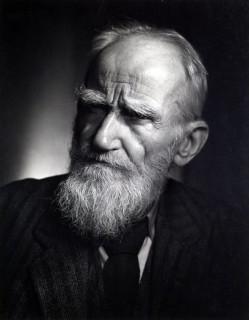
Shaw is born on July 26, 1856, at 3 Upper Synge Street in Portobello, a lower-middle-class area of Dublin. The Shaw family is of English descent and belong to the dominant Protestant Ascendancy in Ireland. Between 1865 and 1871, Shaw attends four schools, all of which he hates. His experiences as a schoolboy leave him disillusioned with formal education. In October 1871 he leaves school to become a junior clerk in a Dublin firm of land agents, where he works hard and quickly rises to become head cashier. During this period, he is known as “George Shaw”; after 1876, he drops the “George” and styles himself “Bernard Shaw.”
Shaw moves to London in 1876, where he struggles to establish himself as a writer and novelist and embarks on a rigorous process of self-education. By the mid-1880s he has become a respected theatre and music critic. Following a political awakening, he joins the gradualistFabian Society and becomes its most prominent pamphleteer. He has been writing plays for years before his first public success, Arms and the Man in 1894. Influenced by Henrik Ibsen, he seeks to introduce a new realism into English-language drama, using his plays as vehicles to disseminate his political, social, and religious ideas. By the early twentieth century his reputation as a dramatist is secured with a series of critical and popular successes that include Major Barbara, The Doctor’s Dilemma, and Caesar and Cleopatra.
Shaw’s expressed views are often contentious. He promotes eugenics and alphabet reform and opposes vaccination and organised religion. He courts unpopularity by denouncing both sides in World War I as equally culpable, and although not a republican, castigates British policy on Ireland in the postwar period. These stances have no lasting effect on his standing or productivity as a dramatist.
The inter-war years see a series of often ambitious plays, which achieve varying degrees of popular success. In 1938 Shaw provides the screenplay for a filmed version of Pygmalion for which he receives an Academy Award. His appetite for politics and controversy remains undiminished. By the late 1920s he has largely renounced Fabian gradualism and often writes and speaks favourably of dictatorships of the right and left — he expresses admiration for both Mussolini and Stalin. In the final decade of his life, he makes fewer public statements, but continues to write prolifically until shortly before his death, refusing all state honours including the Order of Merit in 1946.
During his later years, Shaw enjoys tending the gardens at Shaw’s Corner. He dies on November 2, 1950, at the age of 94 of renal failure precipitated by injuries incurred when falling while pruning a tree. His body is cremated at Golders Green Crematorium on November 6, 1950. His ashes, mixed with those of his wife Charlotte, are scattered along footpaths and around the statue of Saint Joan in their garden.
Since Shaw’s death scholarly and critical opinion has varied about his works, but he has regularly been rated as second only to Shakespeare among English-language dramatists. Analysts recognise his extensive influence on generations of playwrights. The word “Shavian” has entered the language as encapsulating Shaw’s ideas and his means of expressing them.






 seamus dubhghaill