seamus dubhghaill

Promoting Irish Culture and History from Little Rock, Arkansas, USA


Leave a comment

Birth of John Costello, Taoiseach and Fine Gael Politician

John Aloysius Costello, Fine Gael politician who serves as Taoiseach from 1948 to 1951 and from 1954 to 1957, Leader of the Opposition from 1951 to 1954 and from 1957 to 1959, and Attorney General of Ireland from 1926 to 1932, is born on June 20, 1891, in Fairview, Dublin. He serves as a Teachta Dála (TD) from 1933 to 1943 and from 1944 to 1969.

Costello is the younger son of John Costello senior, a civil servant, and Rose Callaghan. He is educated at St. Joseph’s, Fairview, and then moves to O’Connell School, for senior classes, and later attends University College Dublin (UCD), where he graduates with a degree in modern languages and law. He studies at King’s Inns to become a barrister, winning the Victoria Prize there in 1913 and 1914. He is called to the Irish Bar in 1914, and practises as a barrister until 1922.

In 1922, Costello joins the staff at the office of the Attorney General in the newly established Irish Free State. Three years later he is called to the inner bar, and the following year, 1926, he becomes Attorney General of Ireland, upon the formation of the Cumann na nGaedheal government, led by W. T. Cosgrave. While serving in this position he represents the Free State at Imperial Conferences and League of Nations meetings.

Costello is also elected a Bencher of the Honourable Society of King’s Inns. He loses his position as Attorney General of Ireland when Fianna Fáil comes to power in 1932. The following year, however, he is elected to Dáil Éireann as a Cumann na nGaedheal TD. Cumann na nGaedheal soon merges with other parties to form Fine Gael.

During the Dáil debate on the Emergency Powers Act 1939, Costello is highly critical of the Act’s arrogation of powers, stating that “We are asked not merely to give a blank cheque, but to give an uncrossed cheque to the Government.” He loses his seat at the 1943 Irish general election but regains it when Éamon de Valera calls a snap election in 1944. From 1944 to 1948, he is the Fine Gael front-bench Spokesman on External Affairs.

In 1948, Fianna Fáil has been in power for sixteen consecutive years and has been blamed for a downturn in the economy following World War II. The 1948 Irish general election results show Fianna Fáil short of a majority, but still by far the largest party, with twice as many seats as the nearest rival, Fine Gael. It appears that Fianna Fáil is headed for a seventh term in government. However, the other parties in the Dáil realise that between them, they have only one seat fewer than Fianna Fáil, and if they band together, they would be able to form a government with the support of seven Independent deputies. Fine Gael, the Labour Party, the National Labour Party, Clann na Poblachta and Clann na Talmhan join to form the first inter-party government in the history of the Irish state.

While it looks as if cooperation between these parties will not be feasible, a shared opposition to Fianna Fáil and Éamon de Valera overcomes all other difficulties, and the coalition government is formed.

Since Fine Gael is the largest party in the government, it has the task of providing a suitable candidate for Taoiseach. Naturally, it is assumed that its leader, Richard Mulcahy, will be offered the post. However, he is an unacceptable choice to Clann na Poblachta and its deeply republican leader, Seán MacBride. This is due to Mulcahy’s record during the Irish Civil War. Instead, Fine Gael and Clann na Poblachta agree on Costello as a compromise candidate. Costello had never held a ministerial position nor was he involved in the Civil War. When told by Mulcahy of his nomination, Costello is appalled, content with his life as a barrister and as a part-time politician. He is persuaded to accept the nomination as Taoiseach by close non-political friends.

During the campaign, Clann na Poblachta had promised to repeal the Executive Authority (External Relations) Act 1936 but does not make an issue of this when the government is being formed. However, Costello and his Tánaiste, William Norton of the Labour Party, also dislike the act. During the summer of 1948, the cabinet discusses repealing the act, however, no firm decision is made.

In September 1948, Costello is on an official visit to Canada when a reporter asks him about the possibility of Ireland leaving the British Commonwealth. For the first time, he declares publicly that the Irish government is indeed going to repeal the External Relations Act and declare Ireland a republic. It has been suggested that this is a reaction to offence caused by the Governor General of Canada at the time, Harold Alexander, 1st Earl Alexander of Tunis, who is of Northern Irish descent and who allegedly arranges to have placed symbols of Northern Ireland in front of Costello at an official dinner. Costello makes no mention of these aspects on the second reading of the Republic of Ireland Bill on November 24 and, in his memoirs, claims that Alexander’s behaviour had in fact been perfectly civil and could have had no bearing on a decision which had already been made.

The news takes the Government of the United Kingdom and even some of Costello’s ministers by surprise. The former had not been consulted and following the declaration of the Republic in 1949, the UK passes the Ireland Act that year. This recognises the Republic of Ireland and guarantees the position of Northern Ireland within the United Kingdom for so long as a majority there want to remain in the United Kingdom. It also grants full rights to any citizens of the Republic living in the United Kingdom. Ireland leaves the Commonwealth on April 18, 1949, when The Republic of Ireland Act 1948 comes into force. Frederick Henry Boland, Secretary of the Department of External Affairs, says caustically that the affair demonstrates that “the Taoiseach has as much notion of diplomacy as I have of astrology.” The British envoy, John Maffey, 1st Baron Rugby, is equally critical of what he calls a “slipshod and amateur” move.

Many nationalists now see partition as the last obstacle on the road to total national independence. Costello tables a motion of protest against partition on May 10, 1949, without result.

In 1950, the independent-minded Minister for Health, Noël Browne, introduces the Mother and Child Scheme. The scheme would provide mothers with free maternity treatment and their children with free medical care up to the age of sixteen, which is the normal provision in other parts of Europe at that time. The bill is opposed by doctors, who fear a loss of income, and Roman Catholic bishops, who oppose the lack of means testing envisaged and fear the scheme could lead to birth control and abortion. The cabinet is divided over the issue, many feeling that the state cannot afford such a scheme priced at IR£2,000,000 annually. Costello and others in the cabinet make it clear that in the face of such opposition they will not support the Minister. Browne resigns from the government on April 11, 1951, and the scheme is dropped. He immediately publishes his correspondence with Costello and the bishops, something which had hitherto not been done. Derivatives of the Mother and Child Scheme are introduced in Public Health Acts of 1954, 1957 and 1970.

The Costello government has a number of noteworthy achievements. A new record is set in housebuilding, the Industrial Development Authority and Córas Tráchtála are established, and the Minister for Health, Noel Browne, with the then new Streptomycin, bring about an advance in the treatment of tuberculosis. Ireland also joins a number of organisations such as the Organization for European Economic Co-operation and the Council of Europe. However, the government refuses to join NATO, allegedly because the British remain in Northern Ireland. The scheme to supply electricity to even the remotest parts of Ireland is also accelerated.

While the “Mother and Child” incident does destabilise the government to some extent, it does not lead to its collapse as is generally thought. The government continues; however, prices are rising, a balance of payments crisis is looming, and two TDs withdraw their support for the government. These incidents add to the pressure on Costello and so he decides to call a general election for June 1951. The result is inconclusive but Fianna Fáil returns to power. Costello resigns as Taoiseach. It is at this election that his son Declan is elected to the Dáil.

Over the next three years while Fianna Fáil is in power a dual-leadership role of Fine Gael is taking place. While Richard Mulcahy is the leader of the party, Costello, who has proved his skill as Taoiseach, remains as parliamentary leader of the party. He resumes his practice at the Bar. In what is arguably his most celebrated case, the successful defence of The Leader against a libel action brought by the poet Patrick Kavanagh, dates from this period. Kavanagh generously praises Costello’s forensic skill, and the two men become friends.

At the 1954 Irish general election Fianna Fáil loses power. A campaign dominated by economic issues results in a Fine Gael-Labour Party-Clann na Talmhan government coming to power. Costello is elected Taoiseach for the second time.

The government can do little to change the ailing nature of Ireland’s economy, with emigration and unemployment remaining high, and external problems such as the Suez Crisis compounding the difficulty. Measures to expand the Irish economy such as export profits tax relief introduced in 1956 would take years have sizable impact. Costello’s government does have some success with Ireland becoming a member of the United Nations in 1955, and a highly successful visit to the United States in 1956, which begins the custom by which the Taoiseach visits the White House each St. Patrick’s Day to present the U.S. President with a bowl of shamrock. Although the government has a comfortable majority and seems set for a full term in office, a resumption of Irish Republican Army (IRA) activity in Northern Ireland and Great Britain causes internal strains. The government takes strong action against the republicans.

In spite of supporting the government from the backbenches, Seán MacBride, the leader of Clann na Poblachta, tables a motion of no confidence, based on the weakening state of the economy and in opposition to the government’s stance on the IRA. Fianna Fáil also tables its own motion of no confidence, and rather than face almost certain defeat, Costello again asks President Seán T. O’Kelly to dissolve the Oireachtas. The general election which follows in 1957 gives Fianna Fáil an overall majority and starts another sixteen years of unbroken rule for the party. Some of his colleagues questioned the wisdom of his decision to call an election. The view is expressed that he was tired of politics and depressed by his wife’s sudden death the previous year.

Following the defeat of his government, Costello returns to the bar. In 1959, when Richard Mulcahy resigns the leadership of Fine Gael to James Dillon, he retires to the backbenches. He could have become party leader had he been willing to act in a full-time capacity. He remains as a TD until 1969, when he retires from politics, being succeeded as Fine Gael TD for Dublin South-East by Garret FitzGerald, who himself goes onto to become Taoiseach in a Fine Gael-led government.

During his career, Costello is presented with a number of awards from many universities in the United States. He is also a member of the Royal Irish Academy from 1948. In March 1975, he is made a freeman of the city of Dublin, along with his old political opponent Éamon de Valera. He practises at the bar until a short time before his death at the age of 84, in Ranelagh, Dublin, on January 5, 1976. He is buried at Dean’s Grange Cemetery in Dublin.


1 Comment

Birth of Fra McCann, IRA Volunteer & Sinn Féin Politician

Fra McCann, Irish politician, is born in Belfast, Northern Ireland, on June 19, 1953. He becomes active in the Irish republican movement and is imprisoned in the 1970s for membership of the Provisional Irish Republican Army. He also takes part in the blanket protest while in prison. In 1987, he is elected to Belfast City Council in a by-election, representing Sinn Féin.

McCann grows up in the Falls Road area of West Belfast. He is educated at St. Comgalls Primary School on Divis Street and later at St. Peters Secondary School off the Whiterock Road.

McCann is interned on the prison ship HMS Maidstone from February 14 until March 14, 1972, when he is moved to Long Kesh Detention Centre.

McCann is released from Long Kesh on May 9, 1972, then rearrested in November 1972 and re-interned until December 1975. During this period of internment, he is sentenced to nine months for escaping from Long Kesh through a tunnel. During this escape, IRA volunteer Hugh Coney is murdered by British soldiers.

McCann is arrested again in November 1976 and imprisoned in Crumlin Road Gaol where he spends six months on remand before being sentenced to three years. He joins the blanket protest in Crumlin Road Gaol where he and his comrades are held in solitary confinement until August 1978 when they are moved to the H-Blocks in Long Kesh, joining hundreds more on the blanket protest. He is released on November 22, 1979.

Upon his release, McCann travels throughout Ireland with other ex-prisoner’s highlighting the inhumanity in the H-Blocks. He travels throughout the United States in 1980 during which time he is arrested and spends 17 days in prison in New York. In 1981, he travels to Canada where he helps form H-Block committees and raises awareness about the hunger strike.

On his return to Ireland McCann is elected to sit on the National H-Block Committee and speaks at many events in support of the hunger strike. In the aftermath of the hunger strike he helps reorganise Sinn Féin in the Falls area.

McCann is elected to Belfast City Council in 1987 and sits on the Strategic Policy and Resources Committee and the Parks and Leisure committee. He is elected to the Northern Ireland Assembly representing Belfast West in 2003 and again in 2007, 2012 and 2018. While there he sits on the Finance and Personnel Committee and the Committee for Social Development.

In June 2006, McCann is charged with assault and disorderly behaviour following an incident in west Belfast. The incident occurs as the Police Service of Northern Ireland (PSNI) are attempting to arrest a teenager for attempted robbery. However, he claims heavy-handedness by the police and states, “I tried to put myself between one of the officers and the girl when the police officer radioed for assistance.” He is released on bail.

In October 2021, McCann announces that he would be stepping down as Member of the Legislative Assembly (MLA) for Belfast West and would not be contesting the next election.


Leave a comment

Birth of Robert Stewart, 2nd Marquess of Londonderry

Robert Stewart, 2nd Marquess of Londonderry, KG, GCH, PC, PC (Ire), Anglo-Irish politician and statesman usually known as Lord Castlereagh, derived from the courtesy title Viscount Castlereagh by which he is styled from 1796 to 1821, is born in Dublin on June 18, 1769. As secretary to the Viceroy of Ireland, he works to suppress the Irish Rebellion of 1798 and to secure passage in 1800 of the Irish Act of Union. As the Foreign Secretary of the United Kingdom from 1812, he is central to the management of the coalition that defeats Napoleon and is British plenipotentiary at the Congress of Vienna. In the post-war government of Lord Liverpool, he is seen to support harsh measures against agitation for reform.

Stewart is born in 28 Henry Street, in Dublin’s Northside. He is the second and only surviving child of Robert Stewart (the elder) and his wife Sarah Frances Seymour-Conway. His parents marry in 1766. He has recurring health problems throughout his childhood, and is sent to The Royal School, Armagh, rather than to England for his secondary education. At the encouragement of Charles Pratt, 1st Earl Camden, who takes a great interest in him and treats him as if he is a grandson by blood, he later attends St. John’s College, Cambridge (1786–87), where he applies himself with greater diligence than expected from an aristocrat and excels in his first-year examinations. But he then withdraws, pleading an illness that he admits to Camden is something “which cannot be directly acknowledged before women,” i.e. something sexually transmitted.

Early in his career in Ireland, and following a visit to revolutionary France, Stewart recoils from the democratic politics of his Presbyterian constituents in Ulster. Crossing the floor of the Irish House of Commons in support of the government, he takes a leading role in detaining members of the republican conspiracy, the United Irishmen, his former political associates among them. After the 1798 Rebellion, as Chief Secretary for Ireland, he pushes the Act of Union through the Irish Parliament. But it is without the Catholic Emancipation that both he and British Prime Minister William Pitt believe should have accompanied the creation of a United Kingdom.

From 1805 Stewart serves under Pitt and then the Duke of Portland as Secretary of State for War. In 1809 he is obliged to resign after fighting a duel with the Foreign Secretary, George Canning, in a dispute over the Walcheren Campaign. In 1812 he returns to government serving Lord Liverpool as Foreign Secretary and as Leader of the House of Commons.

Stewart organises and finances the alliance that defeats Napoleon, bringing the powers together at the Treaty of Chaumont in 1814. After Napoleon’s second abdication in 1815, he works with the European courts represented at the Congress of Vienna to frame the territorial, and broadly conservative, continental order that holds until mid-century. He blocks harsh terms against France believing that a treaty based on vengeance and retaliation will upset a necessary balance of powers. France is restored to the frontiers of 1791, and her British-occupied colonies are returned. In 1820 Stewart enunciates a policy of non-intervention, proposing that Britain hold herself aloof from continental affairs.

After 1815, at home, Stewart supports repressive measures that link him in public opinion to the Peterloo Massacre of 1819. Widely reviled in both Ireland and Great Britain, overworked, and personally distressed, he commits suicide on August 12, 1822. He is found in a dressing room seconds after he has cut his own throat using a small knife. He collapses and dies almost instantly.

(Pictured: “Robert Stewart, 2nd Marquess of Londonderry,” oil on canvas by Thomas Lawrence, National Portrait Gallery)


Leave a comment

Birth of Mary Laffoy, Retired High Court & Supreme Court Judge

Mary Eleanor Laffoy, SC, retired Irish judge who is currently President of the Law Reform Commission, is born on North Circular Road, Dublin, on June 17, 1945. She previously serves as a Judge of the Supreme Court of Ireland from 2013 to 2017, and a Judge of the High Court from 1995 to 2013. She chairs the Citizens’ Assembly between 2016 and 2018.

Laffoy moves to Manorhamilton and Swinford, before returning to Dublin to live in Donabate following the death of her father. She attends Tourmakeady College in Toormakeady, County Mayo.

Initially after leaving school Laffoy tries primary school teaching at Carysfort College and joins the civil service. She is subsequently educated at University College Dublin (UCD) and King’s Inns. She receives the John Brooks Scholarship at the Inns for achieving the highest marks. She receives a BA from UCD in 1968 and a BCL in 1971.

Laffoy is called to the Bar in 1971 and to the Inner Bar in 1987. She devils for Brian McCracken. She becomes a Senior Counsel on the same day as future Supreme Court colleagues Susan Denham and Liam McKechnie and at the time is only one of four women seniors.

Laffoy’s expertise at the Bar is in property law. She appears in the Cityview Press case which clarifies the law on the nondelegation doctrine in Ireland. In 1983, she is appointed by the Supreme Court to argue against the constitutionality of the Electoral (Amendment) Bill 1983 following a reference made by President Patrick Hillery under Article 26 of the Constitution of Ireland. She appears in another Article 26 reference made by Mary Robinson regarding the Matrimonial Home Bill 1993. For both references, the Supreme Court finds for her side.

In 1986, Laffoy appears on The Late Late Show in a simulated court case to argue for a vote against the Fifteenth Amendment of the Constitution of Ireland.

Laffoy is appointed as a judge of the High Court in 1995, primarily presiding over cases involving chancery law.

Laffoy presides over the Commission to Inquire into Child Abuse from 1999 to 2003, an inquiry into child abuse. Her decision to resign as chair before the commission completes its report is controversial. In her letter of resignation from the commission of September 2, 2003, she outlines her belief that the actions of the Government and the Department of Education have frustrated her efforts and have slowed the commission’s work. She feels that “the cumulative effect of those factors effectively negated the guarantee of independence conferred on the Commission and militated against it being able to perform its statutory functions.” The commission is chaired from 2003 to 2009 by Judge Sean Ryan.

Laffoy presides over the High Court hearing in A v Governor of Arbour Hill Prison, ordering the release of a prisoner convicted of statutory rape due an earlier finding that the offence he was convicted of was contrary to the Constitution of Ireland. Her decision is overturned on appeal to the Supreme Court. In 2012, she dismisses an action taken by Thomas Pringle regarding the legality of the European Stability Mechanism. The European Court of Justice, after reference from the Supreme Court, also rejects his claim. During her time at the High Court, ten percent of reported judgments are written by her.

Laffoy is appointed to the Supreme Court of Ireland in July 2013. She retires from the Supreme Court on June 16, 2017. A portrait of her is unveiled in the King’s Inns in March 2020.

In July 2016, Laffoy is appointed by Taoiseach Enda Kenny to chair the Citizens’ Assembly, which she chairs until June 2018. She becomes the president of the Law Reform Commission in 2018.


Leave a comment

Birth of Paul McGuinness, Former Manager of U2

Paul McGuinness, the founder of Principle Management Limited, a popular music act management company based in Dublin, is born on June 16, 1951, in Rinteln, Westphalia, Germany. He is the manager of the rock band U2 from 1978 to 2013.

McGuinness is born in a British military hospital at Rinteln where his father, Philip McGuinness, a native of Liverpool, is serving with the Royal Air Force. His mother, Sheila McGuinness (née Lyne), is a schoolteacher from County Kerry. There are three children in the family: Paul, Niall, and Katy.

McGuinness receives his early formal education in Ireland at the private Jesuit boarding school, Clongowes Wood College. From there he goes on to Trinity College Dublin, where he directs plays, edits the magazine T.C.D. Miscellany, and promotes gigs, but drops out before obtaining a degree.

Before becoming involved with U2, Guinness works as a film assistant director on productions such as John Boorman‘s Zardoz. For a time, he also manages folk-rock group Spud.

McGuinness first meets U2 at a Dublin gig on May 25, 1978, where they are supporting the Gamblers. Following this meeting, he becomes U2’s manager, having been introduced to the band by Bill Graham, a journalist with Hot Press magazine. His original agreement with the band is that the money is to be split equally five ways, though this is later changed.

McGuinness founds Principle Management Limited on March 29, 1984. He and Bill Whelan set up a music publishing company called McGuinness/Whelan Publishing in the late 1980s. Whelan later composes the music for the theatrical show Riverdance.

In 2002, McGuinness is presented with a Lifetime Achievement Award at the Meteor Music Awards at the Point Theatre in Dublin and U2 wins the best Irish Band Award.

Noted for his business acumen, McGuinness is responsible for U2 3D concert films, U2-branded iPods, sponsorship from BlackBerry and the first-ever concert streamed live on YouTube.

McGuinness is regarded as the fifth member of U2, although in an interview with The Irish Press in 1985, when asked if he is the fifth member of U2, he replies, “The fifth member of U2 is in Adam (Clayton)‘s trousers.” He is also regarded as one of the most successful managers in the music business.

McGuinness steps down as manager of U2 after 34 years on November 13, 2013, with Madonna‘s manager, Guy Oseary, succeeding him in 2014 when he sells Principle Management Limited to Live Nation.

McGuinness is a founding partner of TV3 (Ireland) and is one of the owners of Ardmore Film Studios. He becomes a member of the Arts Council of Ireland on January 1, 1988, having been appointed by Charles Haughey. He serves until February 2000 when he resigns.

McGuinness has been an advocate on behalf of artists, record labels, and music publishers. On January 28, 2008, in a speech at the Midem music industry convention in Cannes, he specifically accuses companies such as Apple, Google, Yahoo!, and Facebook of building “multi-billion dollar industries on the back of our content without paying for it.”

In 2015, McGuinness founds Primo Productions, a film and TV company. Primo produces three seasons of Riviera, a drama set in the South of France. He writes the “list of ingredients” for the show: “Rich people behaving badly in the sun, yachts, Maseratis, great clothes, beautiful women, art fraud, money laundering through the auction houses, Russians, English people, American, French. Murder, adultery.” Everyday life on the Côte d’Azur. His production partner is Kris Thykier of Archery Pictures. The show is originally commissioned by Anne Mensah of Sky Atlantic.

McGuinness marries Kathy Gilfillan in 1977. They meet while he is studying at Trinity. Gilfillan is director of The Lilliput Press. They have two children.


Leave a comment

Death of Irish Actor Ray McAnally

Ray McAnally, Irish actor and winner of four BAFTA awards in the late 1980s, dies in County Wicklow on June 15, 1989.

McAnally is born on March 30, 1926, in Buncrana, a seaside town located on the Inishowen peninsula of County Donegal. The son of a bank manager, he is educated at Saint Eunan’s College in Letterkenny where he writes, produces and stages a musical called “Madame Screwball” at the age of sixteen. He enters St. Patrick’s College, Maynooth at the age of 18 but leaves after a short time having decided that the priesthood is not his vocation. He joins the Abbey Theatre in 1947 where he meets and marries actress Ronnie Masterson.

The couple later forms Old Quay Productions and present an assortment of classic plays in the 1960s and 1970s. McAnally makes his theatre debut in 1962 with A Nice Bunch of Cheap Flowers and gives a well-received performance as George in Who’s Afraid of Virginia Woolf?, opposite Constance Cummings, at the Piccadilly Theatre.

On television he is a familiar face, often in glossy thriller series like television series The Avengers, Man in a Suitcase, and Strange Report. In 1968 he takes the title role in Spindoe, a series charting the return to power of an English gangster, Alec Spindoe, after a five-year prison term. This is a spin-off from another series, The Fellows (1967) in which McAnally had appeared in several episodes as the Spindoe character. He could render English accents very convincingly.

McAnally regularly acts in the Abbey Theatre and at Irish festivals, but in the last decade of life he achieves award-winning notice on TV and films. His impressive performance as Cardinal Altamirano in the film The Mission (1986) earns him Evening Standard and BAFTA awards. He earns a second BAFTA award for his role in the BBC’s A Perfect Spy (1987). In 1988 he wins the BAFTA for Best Actor for his performance in A Very British Coup, a role that also brings him a Jacob’s Award. In the last year of his life, he portrays the father of Christy Brown, played by Daniel Day-Lewis, in the Academy Award-winning film, My Left Foot (1989).

McAnally dies suddenly of a heart attack on June 15, 1989, at the age of 63, at his home in County Wicklow which he shares with Irish actress Britta Smith. He remains married to actress Ronnie Masterson until his death, although they reside in different homes. He receives a posthumous BAFTA award for Best Supporting Actor for his last film, My Left Foot, in 1990.

At the time of his death, McAnally is due to play “Bull McCabe” in Jim Sheridan‘s film The Field. The part eventually goes to Richard Harris who receives an Academy Award nomination for his performance. McAnally had also been cast in the lead role of First and Last, a drama about a man who walked from Land’s End to John o’ Groats. Filming is almost a third of the way done when he dies, but the whole play has to be re-filmed, with Joss Ackland taking the role instead.


Leave a comment

Death of Gerard Dillon, Painter and Artist

Gerard Dillon, Irish painter and artist, dies following a second stroke on June 14, 1971.

Dillon is born in Belfast in 1915 or 1916. He leaves school at the age of fourteen and for seven years works as a painter and decorator, mostly in London. From an early age he is interested in art, cinema, and theatre. About 1936 he starts out as an artist.

Dillon’s Connemara landscapes provide the viewer with context, portraits of the characters who work the land, atmosphere and idiosyncratic colour interpretations. At the age of 18, Dillon goes to London, initially working as a decorator. With the outbreak of World War II, he returns to Belfast. Over the next five years he develops as a painter in Dublin and Belfast. His works during this period are more than simple depictions of the life and people around him, they are reactions and interactions in paint.

In 1942, Dillon’s first solo exhibition is opened by his friend and fellow artist, Mainie Jellett, at The Country Shop, St. Stephen’s Green, Dublin. “Father, Forgive Them Their Sins” features depicting his concerns about the new war that had broken out. Despite a growing reputation, he has to return to London in 1944 to work on demolition gangs to restore his finances. In the late 1940s and during the 1950s, he finds himself favouring the town of Roundstone, Connemara. In 1951 he is introduced to Noreen Rice by her piano teacher. She has no formal training and she takes Dillon and George Campbell as her mentors for decades and her work is of a similar surrealistic and primitive style.

In 1958, Dillon has the double honour of representing Ireland at the Guggenheim International, and Great Britain at the Pittsburg International Exhibition. He and his sister, Mollie, have a property on Abbey Road in 1958. They let out part of the house to Arthur Armstrong and they let a flat to Noreen Rice and her brother. He and Noreen tour junk yards to find objects like leather and string that they include in their artwork.

Dillon travels widely in Europe and teaches for brief periods in the London art schools.

In 1967, Dillon suffers a stroke and spends six weeks in hospital. From this time his work changes direction. A notion of imminent death sends his work almost into another world, a realm of dreams and paintings intimating his death. In 1968 he is back in Dublin, where he helps to design sets and costumes for Seán O’Casey‘s play Juno and the Paycock. He continues to paint and also to make tapestries, sitting at his Singer sewing machine.

In 1969, Dillon pulls his artworks from the Belfast leg of the Irish Exhibition of Living Art in purported protest during the Troubles against the “arrogance of the Unionist mob.” However, he does send work to Ulster when he donates work to Sheelagh Flanagan who had organised an exhibition for the relief of victims of the Belfast riots, in October 1969. His picture is hanged alongside the donated works of T. P. Flanagan, William Scott, F. E. McWilliam, Deborah Brown and Carolyn Mulholland as well as more than twenty others. Michael Longley retorts in a further letter, “Belfast needed creativity, it needed people like Gerard Dillon.” During his last years, he is invited to be involved in a children’s art workshop in the National Gallery of Ireland.

Dillon dies of a second stroke at the age of 55 on June 14, 1971. His grave, as requested, is unmarked in Belfast’s Milltown Cemetery. Danlann Gerard Dillon/The Gerard Dillon Gallery in Cultúrlann McAdam Ó Fiaich is named in his honour.

In his biography of the artist, James White briefly touches on the artists homosexuality: “such was his religious feeling that although he was drawn to people of that type, if he once had an encounter I believe that it never occurred again.” The artist’s nephew, Martin Dillon, recalls that after his uncle’s death he found a diary entry describing a homosexual encounter with a sense of guilt, but the author Gerard Keenan insists he was “a very well-adjusted homosexual.” Reihill expands on this, pointing to a probably unrequited love for the painter Daniel O’Neill and also highlighted Dillon’s association with Basil Rákóczi and The White Stag Group‘s Kenneth Hall both strong gay connections. Pictures with both overt and covert references are known.

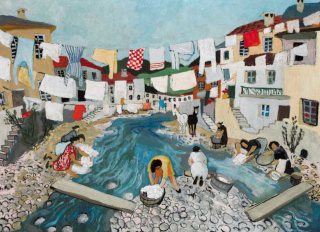
(Pictured: “Washing Day” by Gerard Dillon)


Leave a comment

Birth of Colin Bateman, Novelist, Screenwriter & Journalist

Colin Bateman, novelist, screenwriter and former journalist known mononymously as Bateman, is born on June 13, 1962, in Newtownards, County Down, Northern Ireland.

Bateman attends Bangor Grammar School leaving at the age of 16 when he is hired by Annie Roycroft to join the County Down Spectator as a “cub” reporter, then columnist and deputy editor. A collection of his columns is published as Bar Stool Boy in 1989.

Bateman has been writing novels since his debut, Divorcing Jack, in 1994. Divorcing Jack wins a Betty Trask Award in the same year and is adapted into a 1998 film starring David Thewlis. Several of his novels feature the semi-autobiographical Belfast journalist, Dan Starkey.

Bateman’s book Murphy’s Law is adapted from the BBC television series Murphy’s Law (2001–2007), featuring James Nesbitt. He explains on his website that “Murphy’s Law was written specifically for James Nesbitt, a local actor who became a big TV star through Cold Feet. The ninety-minute pilot for Murphy’s Law on BBC One was seen by more than seven million people, and led to three TV series, on which I was the chief writer.”

Bateman’s eight-part series Scúp is written in English and translated into Irish. It is produced by Stirling Productions and BBC Northern Ireland. A second series has since been commissioned.

Bateman’s children’s book Titanic 2020 is shortlisted for the 2008 Bisto Book of the Year Award and the Bolton Children’s Book Award

Much of Bateman’s work is produced under the name “Bateman” rather than his full name. His 2007 novel I Predict a Riot bears (among others) the dedication: “For my Christian name, gone but not forgotten.” Since 2016, he has moved increasingly into film, writing the screenplays for The Journey, starring Timothy Spall and Colm Meaney, and Driven starring Jason Sudeikis and Lee Pace. Both films are premiered at the Venice Film Festival and selected for the Toronto International Film Festival. He is currently writing films about Fidel Castro in New York, ‘The Hotel Theresa’ and the British double agent George Blake.


Leave a comment

James FitzGerald, Lord Ophaly, Wins Athy By-Election

At the Athy by-election on June 12, 1741, following the death of Sir Walter Dixon Borrowes, James FitzGerald, styled Lord Ophaly and later 1st Duke of Leinster, is returned. In the course of the election there is a duel between William Paul Warren and Jack Hardy, which leads to Hardy’s right hand and arm being shattered. It is thought that it might have to be amputated.

FitzGerald, an Anglo-Irish nobleman, soldier and politician, is the son of Robert FitzGerald, 19th Earl of Kildare, and Lady Mary, daughter of William O’Brien, 3rd Earl of Inchiquin.

FitzGerald is a member of the Irish House of Commons for Athy from the 1741 by-election until he succeeds his father as 20th Earl of Kildare in 1743. He is sworn of the Privy Council of Ireland in 1746 and in 1747, on the occasion of his marriage, he is created Viscount Leinster, of Taplow in the County of Buckingham, in the Peerage of Great Britain, and takes his seat in the British House of Lords that same year. From 1749 to 1755 he is one of the leaders of the Popular Party in Ireland and serves as the country’s Master-General of the Ordnance between 1758 and 1766, becoming Colonel of the Royal Irish Artillery in 1760. He is promoted to Major General in 1761 and to Lieutenant General in 1770.

In 1761 FitzGerald is created Earl of Offaly and Marquess of Kildare in the Peerage of Ireland and in 1766 he is further honoured when he is made Duke of Leinster, becoming by this time the Premier Duke, Marquess and Earl in the Peerage of Ireland.

FitzGerald marries the 15-year-old Lady Emily Lennox, daughter of Charles Lennox, 2nd Duke of Richmond, and one of the famous Lennox Sisters, in London on February 7, 1747. She is a great-granddaughter of King Charles II and is therefore a distant fifth cousin of King George III. Both of them are descended from King James VI and I. The couple has nineteen children.

FitzGerald dies at Leinster House, Dublin, on November 19, 1773, aged 51, and is buried in the city’s Christ Church Cathedral. He is succeeded by his second (but eldest surviving) son, William, Marquess of Kildare. The Duchess of Leinster causes a minor sensation by marrying her lover William Ogilvie in 1774 but continues to be known as The Dowager Duchess of Leinster. She has a further three children by him. She dies in London on March 27, 1814, aged 82.

In 1999, Irish Screen, BBC America and WGBH produce Aristocrats, a six-part limited television series based on the lives of Emily Lennox and her sisters. FitzGerald is portrayed by Ben Daniels.


Leave a comment

The 1981 Irish General Election

The 1981 Irish general election to the 22nd Dáil is held on Thursday, June 11, 1981, following the dissolution of the 21st Dáil on May 21 by President Patrick Hillery on the request of Taoiseach Charles Haughey. The general election takes place in 41 Dáil constituencies throughout Ireland for 166 seats in Dáil Éireann, the house of representatives of the Oireachtas. The number of seats in the Dáil is increased by 18 from 148 under the Electoral (Amendment) Act 1980.

The 22nd Dáil meets at Leinster House on June 30 to nominate the Taoiseach for appointment by the president and to approve the appointment of a new government of Ireland. Garret FitzGerald is appointed Taoiseach, forming the 17th Government of Ireland, a minority coalition government of Fine Gael and the Labour Party.

The general election of 1981 is the first one of five during the 1980s. The election also sees three new leaders of the three main parties fight their first general election. Charles Haughey had become Taoiseach and leader of Fianna Fáil at the end of 1979, Garret FitzGerald is the new leader of Fine Gael and Frank Cluskey is leading the Labour Party.

Haughey and Fianna Fáil seem extremely popular with the electorate in early 1981. He is expected to call the election at the time of the Fianna Fáil ardfheis on February 14, but the Stardust fire causes the ardfheis to be postponed, and the Republican hunger strike in the Maze Prison begins in March. By the dissolution in May, much of the earlier optimism in the party has filtered out. The Anti H-Block movement fields abstentionist candidates in solidarity with the hunger strikers, undermining the Republican credentials of Fianna Fáil.

Fianna Fáil’s manifesto promises more spending programmes and Fine Gael puts forward a series of tax-cutting plans.

Fianna Fáil loses seats as a result of sympathy to the Anti H-Block candidates and the attractive tax proposals of Fine Gael. It is the worst performance for Fianna Fáil in twenty years. Meanwhile, Labour Party leader Frank Cluskey loses his seat, necessitating a leadership change with Michael O’Leary succeeding Cluskey. A Fine Gael–Labour Party coalition government comes to power. Fine Gael and the Labour Party form the 17th Government of Ireland, a minority coalition government, with Garret FitzGerald becoming Taoiseach.

(Pictured: Fine Gael’s Garret FitzGerald, who is appointed Taoiseach following the 1981 Irish General Election)