The Littlejohn brothers are jailed on August 3, 1973, for a £67,000 robbery at an Allied Irish Banks branch on Grafton Street, Dublin, in October 1972, the biggest to date in Irish history.
During their trial the brothers claim to have been working for the British Government against the IRA. They say they had been told to stage the robbery to discredit the republican organisation and force the Irish Government to introduce tougher measures against its members. The British Government, however, denies all knowledge of the brothers.
Kenneth is sentenced to twenty years while his brother receives a fifteen-year term. During their time in prison the brothers exhaust all the appeals processes, with their final appeal being turned down in January 1974.
The brothers escape from Mountjoy during an exercise period. They scale the 25-foot-high main prison wall with homemade ropes while other prisoners distract the guards. However, the pair is spotted as they climb an outer wall.
Keith, 29, who has injured his ankle, is recaptured near the prison. Kenneth, 32, however, disappears without trace and is believed to be heading for the border with Northern Ireland. He is recaptured in December 1974. The brothers are released early in 1981 on condition they leave the Republic of Ireland.
Keith’s successful bid for freedom comes as a surprise. He has been weakened by a hunger strike he has been conducting since February in support of a demand for political prisoner status.
From the time the brothers are jailed the British Government steadfastly continues to deny all knowledge of them.
But the brothers’ tale does receive partial validation the prior year. Ireland’s former Taoiseach, Jack Lynch, admits he had been given diplomatic reports from the British authorities in January 1973 about the UK’s contact with the Littlejohn brothers.
In 1982, Nottingham Crown Court jails Kenneth Littlejohn for six years for his part in a £1,300 armed robbery at the Old Manor House, North Wingfield, Chesterfield, England. Keith Littlejohn, however, is cleared of a similar offence.
Ireland wins the rugby Triple Crown for first time on March 10, 1894. In rugby union, the Triple Crown (Irish: An Choróin Triarach) is an honour contested annually by the national teams of England, Scotland, Ireland, and Wales as part of the Six Nations Championship. If any one team manages to win all their games against the other three then they win the Triple Crown.
The history of the Ireland national rugby union team begins in 1875, when Ireland plays its first international match, a 0–7 loss against England. Ireland has competed in the Six Nations (formerly known as the Five Nations and originally known as the Home Nations) rugby tournament since 1883. Ireland has also competed at the Rugby World Cup every four years since its inception.
Dublin University is the first organised rugby football club in Ireland, having been founded in 1854. The club is organised by students who have learned the game while at English public schools. During the third quarter of the nineteenth century, and following the adoption of a set of official rules in 1868, rugby football begins to spread quickly throughout Ireland, resulting in the formation of several other clubs which are still in existence, including North of Ireland F.C. (1868), Wanderers F.C. (1869), Queen’s University RFC (1869), Youghal RFC (1869), Lansdowne F.C. (1873), Dungannon RFC (1873), County Carlow F.C. (1873), University College Cork RFC (1874) and Ballinasloe RFC (1875) which amalgamates with Athlone RFC to form Buccaneers RFC.
In 1874, the Irish Football Union. reconstituted as the Irish Rugby Football Union after unification with the North of Ireland Union, is formed by Dublin University Football Club, Wanderers F.C., Engineers F.C., Lansdowne F.C., Bray, Portora, Dungannon RFC and Monaghan. Ireland loses their first test match against England 0-7 at The Oval on February 15, 1875. Both teams field twenty players in this match, as is customary in the early years of rugby union. It was not until 1877 that the number of players is reduced from twenty to fifteen. Ireland’s first home game is also against England in the same year. It is held at the Leinster Cricket Club in Rathmines as Lansdowne Road is deemed unsuitable. The first match at Lansdowne Road is held on March 11, 1878, with England beating Ireland by 2 goals and 1 try to nil.
It is not until 1881 that Ireland first wins a test, beating Scotland at Ormeau Cricket Ground in Belfast. Ireland turns up two men short for their game in Cardiff in 1884 and has to borrow two Welsh players. The first victory Ireland has at Lansdowne Road takes place on February 5, 1887. It is also their first win over England, by two goals to nil. On March 3, 1888, Ireland records their first win over Wales with a goal, a try and a drop goal to nil.
In 1894, Ireland follows the Welsh model of using seven backs instead of six for the first time. After victory over England at Blackheath, Ireland wins back-to-back matches for the first time when recording their first win over Scotland on February 24, 1894. Ireland goes on to beat Wales in Belfast on March 10, 1894, and wins the Triple Crown for the first time.
In the 1890s, rugby is primarily a game for the Protestant middle class, the only Catholic in Edmund Forrest’s 1894 team is Thomas Crean. Of the eighteen players used in the three games, thirteen are from three Dublin clubs – Wanderers, Dublin University and Bective Rangers – and the remaining five are from Ulster. They go on to win the Home international championship twice more before the century is out (1896 and 1899), so that by 1901 all four of the Home Unions have tasted success at a game that is growing in popularity with players and spectators.
(Pictured: The 1894 Ireland Rugby Union team, Kildare Observer, Irish News Archives)
Moylett is born into a farming family and emigrates to London as a young man working in various departments in Harrods for five years before returning to Ireland in 1902. He opens a grocery and provisions business in Ballina and, as it proves successful, he later establishes branches in Galway and London between 1910 and 1914. The London-branch is sold at the outbreak of World War I.
Having founded and organised the recruitment and funding of the Mayo activities of the Irish Republican Army (IRA) he also acts as a justice of the Sinn Féin courts. He is advised to leave the area due to death threats from the Black and Tans and their burning down of his commercial premises in Ballina. On one occasion during the period, according to his military statements, he prevents some over-enthusiastic volunteers from attempting to kidnap and assassinate Prince George, Future King of England, who is sailing and holidaying in the Mayo/Donegal region at the time.
Relocating to Dublin, the Irish overseas Trading Company is formed with a former director of Imperial Chemical Industries. Moylett becomes involved in the Irish nationalist movement and is active in the Mayo and Galway areas during the Irish War of Independence. The Irish Overseas Trading Company, of which he is one of two directors, acts as a front for the importation of armaments covered by consignments of trade goods. According to his subsequent detailed military statements archived in the bureau of military history by the Irish Army, the consignments are imported to a number of warehouses in the Dublin Docks with the three keyholders to the warehouses being Éamon de Valera, Michael Collins and Arthur Griffith.
With Harry Boland in the United States with Éamon de Valera, Moylett succeeds him as president of the Irish Republican Brotherhood (IRB) and, in October 1920, is selected to go to London as the personal envoy of Arthur Griffith. During the next several months, he is involved in secret discussions with British government officials on the recognition of Dáil Éireann, a general amnesty for members of the Irish Republican Army and the organisation of a peace conference to end hostilities between both parties.
Moylett is assisted by John Steele, the London editor of the Chicago Tribune, who helps him contact high-level members of the British Foreign Office. One of these officials, in particular C.J. Phillps, has frequent meetings with him. Discussions center on the possibility of an armistice and amnesty in Ireland with the hope for a settlement in which a national Parliament will be established with safeguards for Unionists of Ulster. These meetings are later attended by H. A. L. Fisher, the President of the Board of Education and one of the most outspoken opponents of unauthorised reprisals against the Irish civilian population by the British government. One of the main points Fisher expresses to Moylett is the necessity of Sinn Féin to compromise on its demands for a free and united republic. His efforts are hindered however, both to the slow and confused pace of the peace negotiations as well as the regularly occurring violence in Ireland, most especially the Bloody Sunday incident on November 21, 1920, which happens while he is in London speaking with members of the cabinet. During the Irish Civil War, although a supporter of the Anglo-Irish Treaty, he chooses not to participate in the Free State government party which he views as an amalgam of Unionists and the old Irish Party. In 1926, he is a founding member of the Clann Éireann party and becomes an early advocate of the withholding of land annuities.
In 1930, Moylett and his family move to Dublin, and by 1940 his political activities in the city have become a concern for the Gardai. He begins moving in antisemitic, pro-German far-right politic circles while in Dublin, engaging with the likes of Gearóid Ó Cuinneagáin and George Griffith. Indeed alongside Griffith, he is deeply involved with the founding of the People’s National Party, an explicitly anti-Jewish Pro-Nazi party whose membership overlaps greatly with that of the Irish Friends of Germany. He leaves the People’s National Party in October 1939 only when he is expelled from the party and his position as treasurer on charges of embezzling party funds. In 1941 he continues to support these far-right groups when he aids Ó Cuinneagáin in setting up the Youth Ireland Association, a group gathered to fight “a campaign against the Jews and Freemasons, also against all cosmopolitan agenda.” When the group is found to be stealing guns from army reservists, the Gardai shuts the group down in September 1942.
The 1973 Northern Ireland border poll is a referendum held in Northern Ireland on March 8, 1973, on whether Northern Ireland should remain part of the United Kingdom or join with the Republic of Ireland to form a united Ireland. It is the first time that a major referendum has been held in any region of the United Kingdom. The referendum is boycotted by nationalists and results in a conclusive victory for remaining in the UK. On a voter turnout of 58.7 percent, 98.9 percent vote to remain in the United Kingdom, meaning the outcome among registered voters is not affected by the boycott.
The Unionist parties support the “UK” option, as do the Northern Ireland Labour Party (NILP) and the Alliance Party of Northern Ireland (APNI). However, the Alliance Party is also critical of the poll. While it supports the holding of periodic plebiscites on the constitutional link with Great Britain, the party feels that to avoid the border poll becoming a “sectarian head count,” it should ask other relevant questions such as whether the people support the UK’s white paper on Northern Ireland. Nevertheless, on February 5, 1973, the party’s chairman, Jim Hendron, states that “Support for the position of Northern Ireland as an integral part of the United Kingdom is a fundamental principle of the Alliance Party, not only for economic reasons but also because we firmly believe that a peaceful solution to our present tragic problems is only possible within a United Kingdom context. Either a Sinn Féin all-Ireland republic or a Vanguard-style Ulster republic would lead to disaster for all our people.”
The Social Democratic and Labour Party (SDLP), however, calls for a boycott of the referendum, urging its members on January 23, 1973 “to ignore completely the referendum and reject this extremely irresponsible decision by the British Government.” Gerry Fitt, leader of the SDLP, says he has organised a boycott to stop an escalation in violence.
The civil authorities are prepared for violence on polling day. They put in place mobile polling stations which can be rushed into use if there is bomb damage to scheduled poll buildings. Two days before the referendum a British soldier, Guardsman Anton Brown of the 2nd Battalion, Coldstream Guards, is shot dead in Belfast as the army searches for weapons and explosives which can be used to disrupt the upcoming referendum.
As a political response to the referendum, the Provisional Irish Republican Army also plants four car bombs in London that day, two of which detonate, causing one death and injuring over two hundred.
The vote results in an overwhelming majority of those who voted stating they wish to remain in the UK. The nationalist boycott contributes to a turnout of only 58.7% of the electorate. In addition to taking a majority of votes cast, the UK option receives the support of 57.5% of the total electorate. According to the BBC, less than 1% of the Catholic population turn out to vote.
The referendum electorate consists of 1,030,084 adults registered to vote out of a total population of approximately 1,529,993.
The Government of the United Kingdom takes no action on receipt of the referendum result, as the result is in favour of the status quo (Northern Ireland remaining part of the UK). It is followed by an Assembly election on June 28, 1973.
Brian Faulkner, who had been the sixth and last Prime Minister of Northern Ireland, claims the result leaves “no doubt in any one’s mind what the wishes of Ulster’s people are. Despite an attempted boycott by some, almost 600,000 electors voted for the maintenance of the union with Great Britain.” He also claims that the poll showed that a “quarter of the [N.I.] Catholic population who voted … voted for the maintenance of the union” and that the result is a “blow … against IRA mythology.”
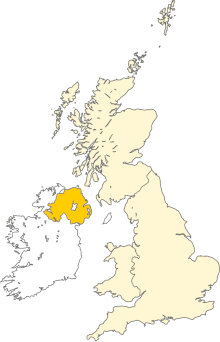
(Pictured: Map of Northern Ireland (yellow) within the United Kingdom.)
Murray is born in Macroom, County Cork on January 17, 1873, the seventh of the eleven children of Cornelius Murray and Honora Murray (née Kelleher). He is educated at St. Patrick’s Teacher Training College in Drumcondra, Dublin. He works as a schoolteacher and in 1900 is appointed headmaster of the national school in Rathduff, County Cork. His first play, The Wheel of Fortune, is produced in 1909 by the Little Theatre in Cork, a theatre he co-founded with Daniel Corkery, Con O’Leary and Terence MacSwiney. The play is revised and renamed Sovereign Love in 1913. In 1915, he moves to Dublin as headmaster of the Model Schools at Inchicore, where he remains until his retirement from teaching in 1932.
Murray’s play Birthright is performed in the Abbey Theatre in 1910 and establishes him as a writer of force. In all, he writes fifteen plays, all of which are produced by the Abbey. His two most highly regarded works are Maurice Harte (1912) and Autumn Fire (1924). Both of these and Birthright are performed in New York City on Broadway, with Autumn Fire having a run of 71 performances. He also writes an autobiographical novel Spring Horizon (1937).
It has been stated both by A. DeGiacomo and by R. Allen Cave that, in the Art competitions at the 1924 Summer Olympics in Paris, France, Murray is awarded a bronze medal for his play Birthright. However, according to the official record for the games, although Murray is a participant in the literature category with this play and also with Maurice Harte, he does not win a medal.
In his later years, Murray holds a number of significant positions: director of the Authors’ Guild of Ireland, vice-president of the Irish Academy of Letters and president of the Irish Playwrights’ Association. He is awarded an honorary Doctor of Letters (D.Litt.) by the National University of Ireland in 1949. He dies on March 7, 1959, at his home on Sandymount Strand, Ballsbridge, Dublin, of viral pneumonia, his wife having predeceased him by fifteen years. His extensive papers, containing scripts of almost all of his fifteen plays, correspondence, clippings, reviews, and other material, are held in the National Library of Ireland (NLI).
The trio is believed to be planning a car bomb attack on British military personnel in Gibraltar. They are shot dead while leaving the territory, having parked a car. All three are found to be unarmed, and no bomb is discovered in the car, leading to accusations that the British government conspired to murder them. An inquest in Gibraltar rules that the authorities had acted lawfully but the European Court of Human Rights holds that, although there had been no conspiracy, the planning and control of the operation is so flawed as to make the use of lethal force almost inevitable. The deaths are the first in a chain of violent events in a fourteen-day period. On March 16, the funeral of the three IRA members is attacked, leaving three mourners dead. At the funeral of one, two British soldiers are murdered after driving into the procession in error.
In late 1987, British authorities become aware of an IRA plan to detonate a bomb outside the governor’s residence in Gibraltar. On the day of the shootings, Savage, a known IRA member, is seen parking a car near the assembly area for the parade. Fellow members McCann and Farrell are seen crossing the border shortly afterward. As SAS personnel move to intercept the three, Savage splits from McCann and Farrell and runs south. Two soldiers pursue him while two others approach McCann and Farrell. The soldiers report seeing the IRA members make threatening movements when challenged, so the soldiers shoot them multiple times. All three are found to be unarmed, and Savage’s car does not contain a bomb.
When the bodies are searched, a set of car keys is found on Farrell. Spanish and British authorities conduct enquiries to trace the vehicle. Two days after the shootings, their enquiries lead them to a red Ford Fiesta in a car park in Marbella, fifty miles from Gibraltar. The car contains a large quantity of Semtex surrounded by 200 rounds of ammunition, along with four detonators and two timers.
The IRA notifies the McCann, Savage, and Farrell families of the deaths on the evening of March 6, and the following day publicly announces that the three were members of the IRA. A senior member of Sinn Féin, Joe Austin, is tasked with recovering the bodies. On March 9, he and Terence Farrell (Mairéad Farrell’s brother) travel to Gibraltar to identify the bodies. A charter aircraft flies the corpses to Dublin on March 14. Two thousand people wait to meet the coffins in Dublin, which are then driven north to Belfast. At the border, the Northern Irish authorities meet the procession with a large number of police and military vehicles, and insist on intervals between the hearses, causing tensions between police and members of the procession.
The joint funeral of McCann, Farrell and Savage takes place on March 16 at Milltown Cemetery in Belfast. The Royal Ulster Constabulary (RUC) agree to maintain a minimal presence at the funeral in exchange for guarantees from the families that there will be no salute by masked gunmen. This agreement is leaked to Michael Stone, who describes himself as a “freelance Loyalistparamilitary.” During the burial, Stone throws grenades into the crowd and begins shooting with an automatic pistol, injuring 60 people. Several mourners chase Stone, throwing rocks and shouting abuse. Stone continues shooting and throwing grenades at his pursuers, killing three of them. He is chased onto a road and his pursuers beat him until the RUC arrive to extract and arrest him.
Two months after the shootings, the documentary “Death on the Rock” is broadcast on British television. Using reconstructions and eyewitness accounts, it presents the possibility that the three IRA members had been unlawfully killed.
The inquest into the deaths begins in September 1988. The authorities state that the IRA team had been tracked to Málaga, where they were lost by the Spanish police, and that the three did not re-emerge until Savage was seen parking his car in Gibraltar. The soldiers testify that they believed the suspected bombers had been reaching for weapons or a remote detonator. Several eyewitnesses recall seeing the three shot without warning, with their hands up, or while they were on the ground. One witness, who told “Death on the Rock” he saw a soldier fire at Savage repeatedly while he was on the ground, retracts his statement at the inquest, prompting an inquiry into the programme which largely vindicated it. The inquest returns a verdict of lawful killing. Dissatisfied, the families take the case to the European Court of Human Rights. Delivering its judgement in 1995, the court finds that the operation had been in violation of Article 2 of the European Convention on Human Rights as the authorities’ failure to arrest the suspects at the border, combined with the information given to the soldiers, rendered the use of lethal force almost inevitable. The decision is cited as a landmark case in the use of force by the state.
(Pictured: The three IRA members shot in Gibraltar: (l to r) Sean Savage, Mairéad Farrell, Daniel McCann, PA Archive / PA Images)
William Richard English-Murphy, DSOMC, Irish soldier and policeman known as W. R. E. Murphy, dies on March 5, 1975, in Ardee, County Louth. He serves as an officer with the British Army in World War I and later in the National Army. In the Irish Civil War, he is second in overall command of the National Army from January to May 1923. He is first Irish Commissioner of the Dublin Metropolitan Police (DMP) and the last Commissioner of the force before its merger with the Garda Síochána in 1925. Thereafter he is the Deputy Commissioner of the Gardaí until his retirement in 1955.
Murphy is born in Danecastle, Bannow, County Wexford, on January 26, 1890. His parents die when he is four years old. His grandparents also die during his childhood. He and his sister Mae (Mary Sarah) are separately raised by relatives in Belfast and Waterford. He is completing his master’s degree at Queens University Belfast (QUB) when he follows the call of John Redmond to join the war effort and ensure Irish independence. Ulster regiments reject him because he is Catholic. Seeking a regiment that treats Irish volunteers with respect, he joins the British Army in Belfast in 1915 as an officer cadet in the South Staffordshire Regiment.
Murphy serves in the Battle of Loos in 1915 and is wounded but returns to action for the start of the Battle of the Somme in July 1916. He becomes commanding officer of the 1st Battalion, the South Staffordshire Regiment in August 1918, reaching the rank of temporary lieutenant colonel. In 1918, his regiment is posted to the Italian Front, at the Piave River, where they are when the armistice is declared on November 4, 1918. He is granted the rank of substantive lieutenant colonel on the retired list on May 16, 1922.
After he returns to Ireland, Murphy resumes his career as a teacher. At some point, he joins the Irish Republican Army (IRA), an organisation fighting to end British rule in Ireland.
In December 1921, the Anglo-Irish Treaty is signed between British and Irish leaders, resulting in the setting up of the Irish Free State. Conflict over the Treaty among Irish nationalists ultimately leads to the outbreak of the Irish Civil War in June 1922. Murphy enlists as a general in the new National Army of the Irish Free State. After the start of the Irish Civil War, he is put in command of troops charged with taking posts held by the anti-Treaty IRA in Limerick.
At the Battle of Kilmallock in July–August 1922, Murphy is second in command to Eoin O’Duffy. His troops successfully dislodge the anti-Treaty IRA from positions around Kilmallock in County Limerick, but he is criticised for his tendency to “dig in” and resort to trench warfare rather than rapid offensive action.
Afterward, Murphy is put in overall command of Free State forces in County Kerry until January 1923. He lobbies Richard Mulcahy, commander in chief, for 250 extra troops, to bring his command up to 1,500 and help to put down the guerrilla resistance there. In the early stages of the guerrilla war, he organises large-scale “sweeps” to break up the republican concentrations in west Cork and east Kerry. These meet with little success, however. He exercises overall command in the county, but day-to-day operations are largely run by Brigadier Paddy Daly, of the Dublin Guard.
In October, in response to continuing guerrilla attacks on his troops, Murphy orders a nightly curfew to be put into place in Tralee.
In December, Murphy writes to Mulcahy that the “Irregular [Anti-Treaty] organisation here is well-nigh broken up,” and suggests the end of the war in the county is in sight. His optimistic prediction, however, proves premature.
On December 20, Murphy sentences four captured republican fighters to death under the fictitious “Public Safety Act” for possession of arms and ammunition. However, the sentences are to be called off if local guerrilla activity ceases. Humphrey Murphy, the local IRA Brigade commander, threatens to shoot eight named government supporters in reprisal if the men are executed. Eventually, their sentence is commuted to penal servitude.
In January 1923, Murphy is promoted from his command in Kerry to “responsibility for operations and organisation at the national level” in the army. Paddy Daly takes over as commanding officer in Kerry. Murphy later voices the opinion that Daly had been a bad choice, given his implication in the Ballyseedy massacre and other events of March 1923, in which up to 30 anti-Treaty prisoners were killed in the county.
Murphy leaves the National Army after the end of the Irish Civil War in May 1923 and becomes the first Irish commissioner of the Dublin Metropolitan Police. He later becomes deputy commissioner of the Garda Síochána, when DMP is merged with the new national police force in 1925. He holds this post until his retirement in 1955.
Murphy is at the forefront of efforts to close down Dublin’s red-light district, the Monto, in the early 1920s. Between 1923 and 1925, religious missions led by Frank Duff of the Legion of Mary, a Roman Catholic organisation, and Fr. R.S. Devane work to close down the brothels. They receive the cooperation of Murphy in his role as Dublin Police Commissioner, and the campaign ends with 120 arrests and the closure of the brothels following a police raid on March 12, 1925.
Murphy lives with his daughter, Joan McMahon, in Ardee, County Louth, after his wife, Mary Agnes Fortune, dies on July 31, 1958. He dies on March 5, 1975, and is buried in St. Peter’s Churchyard, Bray, County Wicklow.
(Pictured: Major-General W. R. E. Murphy, as depicted on a Wills’ Irish Sportsmen cigarette card, from their boxing series)
Inheritance in traditional Irish law uses gavelkind, whereby an estate is divided equally among a dead man’s sons. In contrast, English common law uses male primogeniture, with the eldest son receiving the entire estate. The 1704 act enforces gavelkind for Catholics and primogeniture for Protestants.
Two separate bills “to prevent the further Growth of Popery” are introduced in the parliamentary session of 1703–04. One originates with the Privy Council of Ireland and is referred on July 4, 1703, to the Attorney-General for Ireland. The other is introduced as heads of a bill in the Irish House of Commons on September 28, 1703, and is sent to the Lord Lieutenant of Ireland on November 19. Under Poynings’ Law, both bills are transmitted to the Privy Council of England for approval. Formally, one bill is vetoed, and the other is returned to Dublin with amendments. A lack of surviving documentation makes it impossible to determine which of the two has which fate. The approved bill is engrossed on January 20, 1704, presented in the Commons on February 14, sent to the Irish House of Lords on February 25, and given royal assent on March 4.
Sir Theobald “Toby” Butler, the former Solicitor-General for Ireland, a Roman Catholic, makes a celebrated speech at the bar of the Commons denouncing the act as being “against the laws of God and man… against the rules of reason and justice.” Other eminent Catholic lawyers like Stephen Rice also denounce the measure but to no avail.
Charles Ivar McGrath says that while the Popery Act has “evident … negative effects,” specific research is lacking, and that it is intended more to prevent an increase in Catholic landholding than encourage further decrease. The Catholic share of land had already fallen from 60% before the Irish Rebellion of 1641 to 22% before the Williamite War in Ireland to 14% in 1704. The figure of 5% in 1776 given in Arthur Young‘s Tour in Ireland is probably an underestimate, although in 1778 only 1.5% of rent is paid to Catholics.
The act is “explained and amended” by a 1709 act, 8 Anne c. 3 (I), which specifies certain time limits left ambiguous by the original act, and closes some loopholes used by Catholics to remain beneficial owners of nominally Protestant property.
A 1719 act, 6 Geo. 1. c. 9 (I), indemnifies officials who have not hitherto subscribed to the oath required by the Popery Act. The time period for Dissenters subscribing to the oath is routinely extended, initially by an Indemnity Act at the start of each biennial parliamentary session. Similar acts are passed by the British parliament, and after the union the UK parliament continues the practice.
From the late 18th century Roman Catholic relief bills ease the Penal Laws, by explicit or implicit repeal and replacement. In 1772, Catholics are allowed to lease up to fifty Irish acres of bog-land for up to 61 years. The 1704 oath of allegiance for Catholics is replaced in 1774. Gardiner’s Act, the Leases for Lives Act 1777, implicitly repeals many other provisions of the 1704 act. Some are replaced with less onerous restrictions. The sacramental test is repealed for Dissenters in 1780. The Roman Catholic Relief Act 1782 repeals section 23 of the 1704 act. Another act of 1782 allows lay Catholics to be guardians of Protestants. Most restrictions on intermarriage are removed by the Roman Catholic Relief Act 1792. Many Penal Laws are repealed in general terms by the Roman Catholic Relief Act 1793. The sacramental test for Catholics is effectively replaced by the 1774 oath.
The Roman Catholic Relief Act 1829 abolishes the declaration against transubstantiation and specifies a new public oath for Catholics, explicitly permitting Catholics to hold Irish civil or military offices other than Lord Lieutenant and Lord Chancellor of Ireland, with the same oaths as required of non-Catholics (in addition to the new Catholic oath).
The Criminal Law Commission‘s 1845 report on oaths says sections 1, 3, and 6 of the 1704 act have fallen into disuse and should be repealed. The Religious Disabilities Act 1846, passed in consequence of the committee’s report, explicitly repeals provisions of sections 1, 3, and 4 of the 1704 act.
Although nobody is ever charged in connection with the killings, it is widely believed by nationalists and much of the press that the attack had been planned and led by Billy Wright, the leader of the Mid-Ulster Brigade’s Portadown unit. Wright himself takes credit for this and boasts to The Guardian newspaper, “I would look back and say Cappagh was probably our best,” though some sources are sceptical about his claim.
On the evening of Sunday, March 3, 1991, a unit of the UVF’s Mid-Ulster Brigade drive into the heartland of the East Tyrone IRA, intent on wiping out an entire IRA unit that is based in the County Tyrone village of Cappagh. One team of the UVF men wait outside Boyle’s Bar, while a second team waits on the outskirts of the town. At 10:30 p.m. a car pulls into the car park outside the bar and the UVF gunmen open fire with vz. 58assault rifles, killing Provisional IRA volunteers John Quinn (23), Dwayne O’Donnell (17) and Malcolm Nugent (20). The victims and car are riddled with bullets. According to author Thomas G. Mitchell, Quinn, O’Donnell and Nugent are part of an IRA active service unit (ASU). The gunmen then attempt to enter the pub but are unable to after the civilians inside realise what is happening and barricade the door. Unable to get into the bar, a UVF gunman shoots through a high open toilet window killing local civilian, Thomas Armstrong (50) and badly wounding a 21-year-old man. Their intended target, IRA commander Brian Arthurs, escapes with his life by crouching behind the bar during the shooting. According to the Conflict Archive on the Internet (CAIN), the three IRA volunteers chose to go to the pub “on the spur of the moment,” thus are unlikely to be the UVF’s original target.
After the attack, the UVF issues a statement: “This was not a sectarian attack on the Catholic community, but was an operation directed at the very roots of the Provisional IRA command structure in the Armagh–Tyrone area.” The statement concludes with the promise that “if the Provisional IRA were to cease its campaign of terror, the Ulster Volunteer Force would no longer deem it necessary to continue with their military operations.” Privately the UVF are hugely pleased with the attack in a republican heartland and Billy Wright, leader of the Portadown unit of the UVF’s Mid-Ulster Brigade, who is alleged to be centrally involved, tells Jim Cusack and Henry McDonald the killings were “one of things we did militarily in thirty years. We proved we could take the war to the Provos in one of their strongest areas.” Cusack and McDonald assert that a wealthy UVF supporter with a business in South Belfast helped the UVF purchase the cars used in the attack at auctions in the city.
The Provisional IRA initially does not acknowledge that three of the victims are within its ranks, apparently with the aim of garnering sympathy from the wider world, particularly in the Republic of Ireland, toward nationalists in Northern Ireland.
The first reprisal takes place on April 9, 1991, when alleged UVF member Derek Ferguson, a cousin of local MP Reverend William McCrea, is shot and killed in Coagh by members of the East Tyrone Brigade. His family denies any paramilitary links. In the months following the 1991 shootings, two former UDR soldiers are killed by the IRA near Cappagh. One of them is shot dead while driving along Altmore Road on August 5, 1991. The other former soldier is blown up by an IRA bomb planted inside his car at Kildress on April 25, 1993. It is claimed that he has loyalist paramilitary connections. The 1993 bombing leads to allegations that the IRA is killing Protestant landowners in Tyrone and Fermanagh in an orchestrated campaign to drive Protestants out of the region. There are at least five botched IRA attempts against the life of Billy Wright before the Irish National Liberation Army (INLA) succeeds in killing him in 1997 inside the Maze Prison.
This is not the first time the UVF carries out an attack on Boyle’s Bar in Cappagh. On January 17, 1974, at around 7:40 p.m. two masked UVF gunmen enter the pub and open fire indiscriminately on the customers with a Sterling submachine gun and a Smith & Wessonrevolver, firing at least 35 shots. A Catholic civilian and retired farmer Daniel Hughes (73) is shot eleven times and killed in the attack and three other people are injured. A group calling itself the “Donaghmore-Pomeroy Battalion of the UVF” claim responsibility for the shooting. The attack is linked to the notorious Glenanne gang.
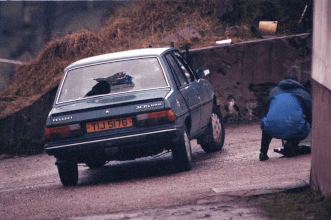
(Pictured: The scene of the UVF attack outside Boyle’s Bar in Cappagh in March 1991. Photo: Pacemaker Archive Belfast 153-91-BW)
Duggan is the son of William Duggan, a Royal Irish Constabulary (RIC) officer, and Margaret Dunne. He is a cousin of revolutionaries Thomas Burke and Christopher Burke through his mother. His parents meet when his father, a native of County Wicklow, is stationed in Longwood, County Meath, where they marry on October 19, 1874. His father is transferred to County Armagh the following year as officers cannot serve in their wife’s native county.
In 1911, Duggan is living with his parents on St. Brigid’s Road Upper in Drumcondra, Dublin. After his school education, he begins work as a law clerk. During his early years, he becomes heavily involved in politics after he qualifies as a solicitor and sets up a practice at 66 Dame Street in Dublin. He marries Evelyn Kavanagh, and they have one son.
In 1916, as a keen supporter of Irish independence, Duggan is serving in the North Dublin Union in the days approaching the 1916 Easter Rising. One of his close friends, Thomas Allen, is shot while Duggan is at the Four Courts. His efforts to get medical assistance are unsuccessful at Richmond Hospital as the British officer who responds to the call declines the message and does not allow it to go through. Eventually medical assistance is received but it is too late for Allen. In Duggan’s region, the volunteers suffer very few injuries with the most violent fighting taking place on Friday night and Saturday morning.
Duggan suffers the consequences and is subject to court-martial and then sentenced to three years penal servitude. He is interned in Maidstone, Portland and Lewes prisons. Under the general amnesty of 1917, he is released after fourteen months in prison and returns to Dublin where he goes back to studying law.
Duggan retains numerous ministerial posts in the Cumann na nGaedheal government. In 1921, he plays a role in the Irish delegation throughout the Anglo-Irish discussions, then playing a dominant role in liaising with British officials.
After the post-treaty government, Duggan is appointed the Minister for Home Affairs and shortly afterward he becomes the Parliamentary Secretary for the Executive Council and the Minister for Defence. He continues in various roles as a TD until 1933. These include Government Chief Whip from 1927 to 1932. Until 1933, he is a Cumann na nGaedheal TD for Meath. In 1933, he declines to go forward for the general election but is elected to Seanad in April 1933. He also is involved in local politics in Dún Laoghaire as the chairman of the borough council until his death in 1936.
Duggan writes papers which reflect on his engagement in the Easter Rising. In his letters, he writes about the tough times of imprisonment. He also writes about his participation in Sinn Féin and his triumph in being a candidate for the South Meath constituency. Most of his papers consist of letters to his fiancée and later wife, May Duggan, which are written while in prison. His time as a TD is also included. In one letter, which he writes on April 25, 1916, he references “the whole damn family” consisting of information as to how his volunteers and he are being “treated as princes” by the nuns in the nearby convent, receiving help from the children in the area and building barricades. In his letter, he also writes about morale among his comrades and hearing of rumours about a German who had landed in County Kerry. In the note, he states that the letter should be sent to May Duggan who is his fiancée at the time. At the end of the letter he refers to himself as “Edmund” by which he is also known.
Duggan dies suddenly at his home in Dún Laoghaire, Dublin, on June 6, 1936, at the age of 58, and is buried in Glasnevin Cemetery on the north side of Dublin.




 seamus dubhghaill