seamus dubhghaill

Promoting Irish Culture and History from Little Rock, Arkansas, USA


Leave a comment

Birth of Cavan O’Connor, “The Singing Vagabond”

Clarence Patrick O’Connor, British singer of Irish heritage known professionally as Cavan O’Connor, is born on July 1, 1899 in Carlton, Nottinghamshire, England. He is most popular in the 1930s and 1940s, when he is billed as “The Singing Vagabond” or “The Vagabond Lover.”

O’Connor is born to parents of Irish origin. His father dies when he is young, and he leaves school at an early age to work in the printing trade. He serves in World War I as a gunner and signaler in the Royal Artillery, after first being rejected by the Royal Navy when it is discovered that he had pretended to be three years older than his real age. He is wounded in the war, aged 16, while serving with the Royal Artillery. After the war he returns to Nottingham where he works in a music shop. He starts singing in clubs and at concerts, before deciding to turn professional in the early 1920s.

O’Connor wins a scholarship to the Royal College of Music in London, where he meets his wife, Rita Tate (real name Margherita Odoli), a niece of the opera singer Maggie Teyte. He makes his first recordings, as Cavan O’Connor, for the Vocalion label in 1925, including “I’m Only a Strolling Vagabond” from the operetta The Cousin from Nowhere, which becomes his signature song. Noted for his fine tenor voice, well suited for recording, he appears on many British dance band recordings in the 1920s and 1930s, and uses a wide variety of pseudonyms, including Harry Carlton, Terence O’Brien, and Allan O’Sullivan. He also joins Nigel Playfair‘s revue company at the Lyric Theatre in Hammersmith, before moving on to playing lead roles in opera productions at The Old Vic, often performing in French, Italian and Spanish.

O’Connor turns increasingly toward light entertainment, largely for financial reasons. He starts appearing in variety shows around the country, often performing Irish folk songs. Having made his first radio broadcasts for BBC Radio in 1926, he continues to feature occasionally, but makes his breakthrough when he is billed, initially anonymously, as “The Strolling Vagabond” and “The Vagabond Lover” on a series of radio programmes produced by Eric Maschwitz in 1935. This is the first British radio series based around a solo singer, and when it becomes known that he is the performer, makes him a star, “one of Britain’s highest paid radio personalities.” The series continues for over ten years. From 1946, his Sunday lunchtime radio series, The Strolling Vagabond, is heard by up to 14 million listeners.

O’Connor consistently tours and continues to broadcast regularly. During World War II he settles in Bangor, Gwynedd, north Wales, and regularly appears on the Irish Half Hour radio programmes. His most popular songs include “The World Is Mine Tonight,” written for O’Connor by Maschwitz and George Posford, “Danny Boy” and “I’ll Take You Home Again, Kathleen,” an American song widely assumed to be Irish. He records frequently for at least 15 record labels over his career, including Decca Records, at one point recording 40 songs in five days. He makes over 800 recordings in total, both under his own name and pseudonyms, and also appears in two films, Ourselves Alone (1936) and Under New Management (known in the U.S. as Honeymoon Hotel, 1946).

After the war, O’Connor returns to live in London, and tours in Australia and South Africa as well as in Don Ross‘s Thanks for the Memory tours. He retires at one point to set up an electrical goods business, but then resumes his music career in the Avonmore Trio with his wife and son, to give occasional performances and make recordings, the last in 1984.

O’Connor dies at the age of 97 in London on January 11, 1997.


Leave a comment

Birth of Sean Scully, Painter, Printmaker, Sculptor & Photographer

Sean Scully, Irish-born American-based artist working as a painter, printmaker, sculptor and photographer, is born in Dublin on June 30, 1945. His work is held in museum collections worldwide and he has twice been named a Turner Prize nominee.

Four years after his birth, Scully’s family moves to London where they live in a working-class part of South London, moving from lodging to lodging for a number of years. By the age of 9, he knows he wants to become an artist. From the age of 15 until he is 17, he is apprenticed at a commercial printing shop in London as a typesetter, an experience that greatly influences his future artwork.

Scully studies at Croydon School of Art between 1965-67 and at Newcastle University between 1967-71. He is awarded the Frank Knox Memorial Fellowship in 1972 to attend Harvard University. It is during this first stay in the United States that he begins to experiment with new techniques such as tape and spray paint. In 1975 he is awarded a Harkness Fellowship and establishes a studio in New York, where he settles, becoming an American citizen in 1983.

Over the years, Scully develops and refines his own recognisable style of geometric abstraction and most notably his characteristic motif of the ‘stripe.’ Although he is predominately known for his monumental paintings, he is also a gifted printmaker who has made a notable body of woodcuts and etchings.

Scully has his first solo exhibition at the Rowan Gallery, London in 1973. He has his first retrospective at the Ikon Gallery in Brindleyplace, Birmingham, in 1981, which travels throughout the United Kingdom. In 1989 his first solo exhibition in a European museum travels from the Whitechapel Gallery in London to Palacio Velázquez in Madrid and Städtische Galerie im Lenbachhaus in Munich. He has further solo exhibitions at Kunstsammlung Nordrhein Westfalen in Düsseldorf (2001) which travels to Haus der Kunst in Munich and the Institut Valencià d’Art Modern in Valencia; The Phillips Collection in Washington, D.C. (2005) travels to the Modern Art Museum of Fort Worth in Texas, the Cincinnati Art Museum in Ohio and finally the Metropolitan Museum of Art in New York City. A major retrospective tours multiple venues in China between 2015 and 2017.

Scully’s paintings and prints are held in the collections of Tate in London, the Albertina in Vienna, Museo Nacional Centro de Arte Reina Sofía in Madrid, Instituto Valencia d’Arte Modern in Valencia, the Metropolitan Museum of Art and the Solomon R. Guggenheim Museum in New York City, the National Gallery of Art in Washington D.C., Modern Art Museum of Fort Worth in Texas, Guangzhou Museum of Art in Guangzhou, China, and the Central Academy of Fine Arts in Beijing, China.

Scully has held teaching positions at Chelsea College of Arts and Goldsmith’s College of Art and Design, both in London, Princeton University in New Jersey, Parsons School of Design in New York, and most recently at the Akademie der Bildenden Künste in Munich. He is shortlisted for the Turner Prize in 1989 and in 1993, and is elected a Royal Academician in 2013. He participates for the first time at the Venice Biennale in 2014.

Sean Scully lives and works in New York and in Bavaria, Germany.


Leave a comment

Birth of Joss Lynam, Civil Engineer & Mountaineer

Joss Lynam, Irish civil engineer who is well known as a mountaineer, hillwalker, orienteer, writer and sports administrator, is born James Perry O’Flaherty Lynam in London on June 29, 1924. He is one of Ireland’s most influential figures in outdoor activities.

Lynam is born to Irish parents Edward and Martha (née Perry), both Galway natives. He and his older sister, Biddy, are both raised in London where his father works as curator of maps in the British Museum. This is where he is first introduced to orienteering and cartography. The family frequently returns to the west coast of Ireland to holiday. Here he finds his love for mountaineering and climbs his first mountain, Knocknarea in County Sligo, with his aunt.

At 18, Lynam joins the British Army and trains as an officer. He is deployed to India in 1944 under the Corps of Royal Engineers where he spends the remainder of World War II. While there, he participates in his first of many Himalayan expeditions, climbing Kolahoi Peak. When he returns in 1947, he immediately moves to Dublin and enrolls in Trinity College Dublin, after encouragement from his parents, where he begins to study engineering. He graduates and receives his degree with Upper Second Class (2.1) Honours.

Lynam is a civil engineer by profession but devotes most of his life developing the sport of mountaineering in Ireland. He climbs extensively in Ireland, Great Britain, the Alps and in India. He is leader, or deputy leader, of expeditions to Greenland, the Andes, Kashmir, Tian Shan, Garhwal, Tibet and India, including the 1987 expedition to Changtse, that is the forerunner to the successful first Irish ascent of Mount Everest in 1993.

With his involvement in developing adventure sport in Ireland Lynam is active in promoting access and developing waymarked trails. He is involved in the creation and administration of the Federation of Mountaineering Clubs in Ireland (now Mountaineering Ireland), the Association for Adventure Sports, Bord Oiliúint Sléibhte (Irish Mountain Training Board), Tiglin (National Outdoor Training Centre), Outdoor Education Ireland, and Cospóir (now Sport Ireland) and the National Waymarked Ways Advisory Committee (part of Sport Ireland).

Lynam is a founder member of the Irish Mountaineering Club (IMC) serving as president from 1982-1984. He is also a founder member of both the Irish Orienteers and Three Rock Orienteering club. He is president of the Union Internationale des Associations d’Alpinisme‘s expeditions commission in the 1990s.

Lynam writes and edits many guide books on walking and climbing in Ireland and helps create and is editor of The Mountain Log (the journal of Mountaineering Ireland).

In 2001, Lynam is awarded an honorary degree from Trinity College Dublin in acknowledgment of his volunteer work and remarkable achievements. He celebrates his 80th birthday by climbing the Paradise Lost Route and then goes on to abseil down Winder’s Slab for his 82nd birthday, both routes in Dalkey Quarry. Both climbs are to raise funds for cancer research, as he had been undergoing chemotherapy for Hodgkin’s Disease.

As a result of a short illness, which is being treated at St. Vincent’s University Hospital Dublin, Lynam dies on the January 9, 2011, aged 86. His funeral is held in the Church of St. Therésè, Mount Merrion, Dublin and then continues to Mount Jerome Cemetery and Crematorium.

After Lynam’s death, his two daughters, Clodagh and Ruth, donate his papers to his alma mater, Trinity College Dublin. These papers cover a vast range of topics such as his life and career, family, childhood, experience of war, his involvement with different mountaineering clubs, and his many writings. The collection also contains photos and slides that he captures himself of landscapes and mountaineering, and consists of maps that are collected by him and his father. There is so much material in the collection that it takes a year for the collection to be catalogued by an archivist.

Lynam’s ashes are scattered by his daughters over the Knocknarea Mountain on the February 12, 2011, being the first mountain he climbed. The Lynam Lecture is introduced in 2011 by Mountaineering Ireland in his memory and his achievements in climbing, hillwalking and mountaineering in Ireland and around the world. Every December the Lynam Lecture is held by leading national and international mountaineers and discusses the development and future of mountaineering in Ireland. Past speakers include Ines Papert, Frank Nugent and Paddy O’Leary.


Leave a comment

Death of Leland Bardwell, Poet, Novelist & Playwright

Constan Olive Leland Bardwell, Irish poet, novelist, and playwright, dies at the age of 94 on June 28, 2016, in Sligo, County Sligo.

Bardwell is born Leland Hone in India on February 25, 1922, to Irish parents William Hone and Mary Collise, and moves to Ireland at the age of two. Her father’s family are of the Anglo-Irish Hone family. She grows up in Leixlip, County Kildare. She is educated at Alexandra School and later at the University of London.

Bardwell realises from childhood that a writing life is inevitable. In her memoirs she records: “Since the age of six writing had been not an ambition but a condition.” However, there are years of editorial rejections before she blossoms into a writer of the poetry, short stories for radio, plays and autobiographical novels that flowed, due in part to the encouragement of the coterie assembled there, from her basement flat in Dublin.

Bardwell’s five volumes of acclaimed poetry are The Mad Cyclist (1970), The Fly and the Bed Bug (1984), Dostoevsky’s Grace (1991), her “new and selected” The White Beach (1998) and The Noise of Masonry Settling (2005).

Bardwell is considered an important poet by her contemporaries. On the publication of her fourth collection of poetry, The White Beach, Eiléan Ní Chuilleanáin states, “it is good to see her work of the decades collected – it has inspired many Irish poets, male and female, and should be much more widely known,” adding that her work is “witty, full of sharp intimate honesty, full of truth and surprises.”

In 1975, along with Pearse Hutchinson, Eiléan Ní Chuilleanáin, and Macdara Woods, she co-founds the long running literary magazine Cyphers.

Bardwell’s novel Girl on a Bicycle, originally published in 1977, is republished by Irish publisher Liberties Press in 2009.

Bardwell lives in Sligo and is a member of Aosdána. She dies in Sligo on June 28, 2016. One of her children is the composer, John McLachlan.

(Photo by Pat Boran)


Leave a comment

Death of Frank Harte, Traditional Irish Singer

Frank Harte, traditional Irish singer, music collector, architect and lecturer, dies of a heart attack on June 27, 2005.

Harte is born in Chapelizod, County Dublin on May 14, 1933. He emigrates to the United States for a short period, but later returns to Ireland where he works as an architect, lecturer at Dublin Institute of Technology in Rathmines, Dublin and in later life fully engages in songs in many ways.

Harte’s introduction to Irish traditional singing comes from a chance listening to an itinerant who is selling ballad sheets at a fair in Boyle, County Roscommon. He begins collecting early in life and by the end of his life has assembled a database of over 15,500 recordings.

Harte becomes a great exponent of the Dublin street ballad, which he prefers to sing unaccompanied. He is widely known for his distinctive singing, his Dublin accent having a rich nasal quality complementing his often high register. His voice mellows considerably by the time of his later recordings, allowing for an expressive interpretation of many love songs such as “Bonny Light Horseman” on the album My Name is Napoleon Bonaparte. This is contrasted sublimely by his cogent interpretation of the popular “Molly Malone.” He also becomes more accustomed to singing with accompaniment which is not strictly part of the Irish singing tradition and does not come naturally to him.

Though Irish Republican in his politics, Harte believes that the Irish song tradition need not be a sectarian or nationalist preserve. He believes that songs are a key to understanding the past often saying, “those in power write the history, while those who suffer write the songs, and, given our history, we have an awful lot of songs.” Though considered a stalwart of traditional Irish singing and well aware of it, he does not consider himself to be a sean-nós singer.

Harte wins the All-Ireland Fleadh Cheoil singing competition on a number of occasions and in 2003 receives the Traditional Singer of the Year award from the Irish-language television channel TG4.

Harte records several albums and makes numerous television and radio appearances, most notably the Singing Voices series he writes and presents for RTÉ Radio, which is produced by Peter Browne in 1987. He is a regular at the Sunday morning sessions at The Brazen Head pub, along with Liam Weldon who runs the session. He is also an enthusiastic supporter of An Góilín Traditional Singer’s Club.

Harte appears at many American festivals including The Blarney Star in New York City, Gaelic Roots in Boston College, The Catskills Irish Arts Week, The Greater Washington Ceili Club Festival in Maryland and the Milwaukee Irish Fest and for seventeen years he is a veritable staple at the Irish Week every July in the Augusta Heritage Festival in Elkins, West Virginia where he often performs with Mick Moloney.

Frank Harte dies of a heart attack, aged 72, on June 27, 2005. His influence is still evident in singers such as Karan Casey and he continues to be remembered fondly in sessions and folk clubs on both sides of the Irish Sea.


Leave a comment

Death of Maximilian Ulysses Browne, Austrian Military Officer

Maximilian Ulysses, Reichsgraf von Browne, Baron de Camus and Mountany, an Irish refugee, scion of the Wild Geese and an Austrian military officer, dies in Prague, Kingdom of Bohemia on June 26, 1757. He is one of the highest-ranking officers serving the Hapsburg Emperor during the middle of the 18th century and one of the most prominent Irish soldiers never to fight for Ireland.

Browne is born in Basel, Switzerland, the son of Count Ulysses von Browne (b. Limerick 1659) and his wife Annabella Fitzgerald, a daughter of the House of Desmond. Both families had been exiled from Ireland in the aftermath of the Nine Years’ War.

Browne’s early career is helped by family and marital connections. His father and his father’s brother, George (b. Limerick 1657), are created Counts of the Holy Roman Empire by Emperor Charles VI in 1716 after serving with distinction in the service of the Holy Roman Emperors. The brothers enjoy a lengthy, close friendship with John Churchill, 1st Duke of Marlborough, who is primarily responsible for their establishment in the Imperial Service of Austria. On his father’s death he becomes third Earl of Browne in the Jacobite peerage. His wife, Countess Marie Philippine von Martinitz, has valuable connections at court and his sister, Barbara (b. Limerick 1700), is married to Freiherr Francis Patrick O’Neillan, a Major General in the Austrian Service. So, by the age of 29 Browne is already colonel of an Austrian infantry regiment.

Browne justifies his early promotion in the field, and in the Italian campaign of 1734 he greatly distinguishes himself. In the Tirolese fighting of 1735, and in the Turkish war, he wins further distinction as a general officer.

Browne is a lieutenant field marshal in command of the Silesian garrisons when in 1740 Frederick II and the Prussian army overruns the province. His careful employment of such resources as he possesses materially hinders the king in his conquest and allows time for Austria to collect a field army. He is present at Mollwitz, where he receives a severe wound. His vehement opposition to all half-hearted measures brings him frequently into conflict with his superiors but contributes materially to the unusual energy displayed by the Austrian armies in 1742 and 1743.

In the following campaigns Browne exhibits the same qualities of generalship and the same impatience of control. In 1745 he serves under Count Traun and is promoted to the rank of Feldzeugmeister. In 1746 he is present in the Italian campaign and the battles of Piacenza and Rottofreddo. He and an advanced guard force their way across the Apennine Mountains and enter Genoa. He is thereafter placed in command of the invasion of France mounted in winter 1746-47, leading to the Siege of Antibes, but he is obliged to break off the invasion and return to Italy in February 1747 after Genoa rises in rebellion against the Austrian garrison he had left behind. In early 1747 he is appointed commander of all imperial forces in Italy, replacing Antoniotto Botta Adorno. At the end of the war, he is engaged in the negotiations on troop withdrawals from Italy, which leads to the convention of Nice on January 21, 1749. He becomes commander-in-chief in Bohemia in 1751, and field marshal two years later.

Browne is still in Bohemia when the Seven Years’ War opens with Frederick’s invasion of Saxony in 1756. His army, advancing to the relief of Pirna, is met, and, after a hard struggle, defeated by the king at the Battle of Lobositz, but he draws off in excellent order, and soon makes another attempt with a picked force to reach Pirna, by wild mountain tracks. He never spares himself, bivouacking in the snow with his men, and Thomas Carlyle records that private soldiers made rough shelters over him as he slept.

Brown actually reaches the Elbe at Bad Schandau, but as the Saxons are unable to break out, he retires, having succeeded, however, in delaying the development of Frederick’s operations for a whole campaign. In the campaign of 1757, he voluntarily serves under Prince Charles Alexander of Lorraine who is made commander-in-chief. On May 6 of that year, while leading a bayonet charge at the Battle of Prague, Browne, like Kurt Christoph, Graf von Schwerin, on the same day, meets his death. He is carried mortally wounded into Prague, and there dies on June 26, 1757.


1 Comment

Death of Myles Walter Keogh, Last Man Killed at the Battle of Little Big Horn

Myles Walter Keogh, soldier in the United States Army, is the last man killed at the Battle of Little Big Horn on June 25, 1876, according to the Sioux. His horse is the only U.S. survivor.

Keogh is born in Orchard House in Leighlinbridge, County Carlow, on March 25, 1840. He attends the National School in Leighlinbridge and is long thought to have attended St. Patrick’s College in Carlow but that college has no record of his attendance. It is possible that he attends St. Mary’s Knockbeg College.

By 1860, a twenty-year-old Keogh volunteers, along with over one thousand of his countrymen, to rally to the defence of Pope Pius IX following a call to arms by the Catholic clergy in Ireland. By August 1860, Keogh is appointed second lieutenant of his unit in the Battalion of St. Patrick, Papal Army under the command of General Christophe Léon Louis Juchault de Lamoricière. Once the fighting is over and duties of the Pontifical Swiss Guard become more mundane, Keogh sees little purpose in remaining in Rome. In March 1862, with civil war raging in America, he resigns his commission in the Company of St. Patrick and sets out for New York City, arriving on April 2.

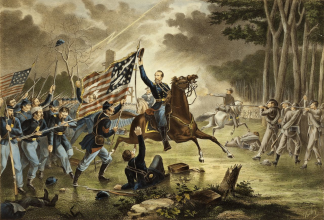
Keogh actively participates in several prominent American Civil War battles including the Shenandoah Valley, the Battle of Antietam, the Battle of Fredericksburg, and the Battle of Gettysburg.

Perhaps the strongest testimony to Keogh’s bravery and leadership ability comes at the Battle of the Little Bighorn, also known as Custer’s Last Stand, on June 25, 1876. The senior captain among the five companies wiped out with General George Armstrong Custer that day, and commanding one of two squadrons within the Custer detachment, Keogh dies in a “last stand” of his own, surrounded by the men of Company I. When the sun-blackened and dismembered dead are buried three days later, Keogh’s body is found at the center of a group of troopers. The slain officer is stripped but not mutilated, perhaps because of the “medicine” the Indians see in the Agnus Dei (“Lamb of God”) he wears on a chain about his neck or because many of Sitting Bull‘s warriors are believed to be Catholic. Keogh’s left knee has been shattered by a bullet that corresponds to a wound through the chest and flank of his horse, indicating that horse and rider may have fallen together prior to the last rally.

The badly injured animal is found on the fatal battlefield and nursed back to health as the 7th Cavalry’s regimental mascot, which he remains until his death in 1890. This horse, Comanche, is considered the only U.S. military survivor of the battle, though several other badly wounded horses are found and destroyed at the scene. Keogh’s bloody gauntlet and the guidon of his Company I are recovered by the army three months after Little Bighorn at the Battle of Slim Buttes.

Originally buried on the battlefield, Keogh’s remains are disinterred and taken to Auburn, New York as he had requested in his will. He is buried at Fort Hill Cemetery on October 26, 1877, an occasion marked by citywide official mourning and an impressive military procession to the cemetery.

Tongue River Cantonment in southeastern Montana is renamed after him to be Fort Keogh. The fort is first commanded by Nelson A. Miles. The 55,000-acre fort is today an agricultural experiment station. Miles City, Montana is located two miles from the old fort.


Leave a comment

Murder of Journalist Eugene Moloney

Eugene Moloney, an Irish journalist renowned for his coverage of the Troubles in Northern Ireland, is found dead on Camden Street in Dublin after being attacked and struck on the head while walking in the early morning of June 24, 2012. He had worked for The Irish News in Belfast and later the Evening Herald and Irish Independent in Dublin among other newspapers.

Moloney, aged 55, who lives alone at Portobello Place on the south side of Dublin, is on his way home when he is attacked. He is punched in the side of the head and falls to the ground as the two men in their 20s attack him. The incident is caught on CCTV and police make quick arrests just hours after the murder. Officers believe Moloney may have been robbed as he lay unconscious on the ground, as his wallet and identification are missing.

A murder investigation is launched after a post mortem examination confirms that Moloney had died from serious head injuries as a result of the assault.

Formerly with The Irish News in Belfast and the Irish Independent in Dublin, Moloney had been freelancing on his return from a spell teaching in Vietnam. His final article, on the Ulster Bank IT crisis, appears in the Irish edition of the Daily Mail just hours before his death.

Group Managing Editor of Independent Papers Ireland Ltd. Michael Denieffe pays tribute to Moloney in telling the Irish Independent, “On behalf of Independent Newspapers, I want to express our shock at the untimely death of our former colleague, Eugene Moloney. He was a resourceful and fearless journalist. It is a tragic irony that Eugene has died in an incident similar to many he would have recorded in his years working for the Evening Herald and the Irish Independent. Our sympathies go to his family and friends.”

The Irish News editor Noel Doran tells the paper he is deeply shocked by the death of his good friend Eugene Moloney. “Eugene and I studied journalism together at the former College of Business Studies in Belfast in the late 1970s, and went on to share flats over a number of years. Eugene was a talented and respected reporter with The Irish News during the height of the Troubles and was also the paper’s music columnist for a lengthy period.”

(From: “Journalist Eugene Moloney murdered as attempted robbery goes wrong in Dublin” by Patrick Counihan, IrishCentral, http://www.irishcentral.com, June 25, 2012)


Leave a comment

Birth of Anne Wellesley, Countess of Mornington

Anne Wellesley, Countess of Mornington (née Hill-Trevor), Anglo-Irish aristocrat, is born on June 23, 1742. She is the wife of Garret Wesley, 1st Earl of Mornington, and mother of the victor of the Battle of Waterloo, Arthur Wellesley, 1st Duke of Wellington.

Wellesley is born the Hon. Anne Hill-Trevor, the eldest daughter of the banker Arthur Hill-Trevor, 1st Viscount Dungannon, and his wife Anne Stafford. She is a friend of Lady Eleanor Butler and Sarah Ponsonby, the famous Ladies of Llangollen.

Wellesley marries Garrett Wesley, the Earl of Mornington, in 1759. The marriage is said to be a happy one. They have nine children together, with seven of them surviving to adulthood:

Lord Mornington dies on May 22, 1781, leaving Wellesley and their eldest son Richard, who is 21 years old at the time, to raise the rest of the family. She dislikes Arthur when he is young. She says that he is “food for powder and nothing more” and constantly worries about his future. In 1785, she goes to Brussels to live, as a way to economise. She takes Arthur with her and sends him to the Royal Academy of Equitation at Angers, in Anjou, after she returns to Britain in 1786. She is granted a pension of £600 in 1813 by Parliament after Arthur’s success in the Peninsular War.

Wellesley’s husband’s titles are in the Irish peerage, entitling him to sit in the Irish House of Lords, which disbands following the Acts of Union 1800 with Great Britain. Four of her five sons who survive to adulthood earn titles in Peerage of the United Kingdom, entitling them to sit in the United Kingdom House of Lords, while the fifth, Gerald Valerian, becomes a bishop, giving him precedence comparable to a peer.

Wellesley dies at the age of 89 on September 10, 1831.

(Pictured: Portrait of Anne Wellesley, Countess of Mornington, the mother of Arthur Wellesley, 1st Duke of Wellington, 1839, from the Welsh Portrait Collection at the National Library of Wales)


Leave a comment

Republic of Ireland Advances to the Round-of-16 at Euro 2016

Robbie Brady heads the Republic of Ireland into the round-of-16 of Euro 2016 as the Irish score in the 85th minute to sensationally defeat Italy 1-0 at Stade Pierre-Mauroy in Villeneuve-d’Ascq, France on June 22, 2016. In addition to congratulatory remarks to the team, President Michael D. Higgins pays tribute to the Irish fans who “have earned widespread acclaim for their behaviour in France.”

Brady heads home the only goal of the match as Ireland seals progress after finishing third in Group E with four points. The victory sets up a round-of-16 meeting with Euro 2016 host France in Lyon, their first meeting since the controversial 2010 FIFA World Cup qualifier that saw them controversially defeated as the result of a Thierry Henry handball.

Ireland had been unfortunate to draw their opener against Sweden and, while they then suffered a sobering 3-0 loss to Belgium, they do not appear to have suffered a loss of confidence against the Azzurri. Ireland goes into the match against Italy knowing only a win will secure progress but they are given hope when Italy manager Antonio Conte, who is already certain of top spot, makes eight changes to the side that defeated Sweden.

Jeff Hendrick sends a fierce drive just wide from outside the box on nine minutes, while Daryl Murphy‘s header brings a fingertip save from Salvatore Sirigu midway through the half. It is not until six minutes before the break that Italy shows any sort of threat, with Ciro Immobile swiveling before steering a shot wide. Ireland then sees a penalty appeal rejected when James McClean goes down under pressure from Federico Bernardeschi.

Ireland continues to press for a winner in the second half, but Simone Zaza provides a reminder of Italy’s quality on 53 minutes with a superb volley on the turn from Mattia De Sciglio‘s cross that sails just over the bar. At the other end, Ireland continues to make chances but finds it difficult to break through a stubborn Italy defence. With just over an hour gone Hendrick does make space for a shot in the area, but his shot is wayward.

Conte brings on Lorenzo Insigne for Immobile on 73 minutes and the Napoli forward nearly breaks the deadlock shortly afterwards, curling a shot against the far post after a driving run toward goal in similar fashion to Éder‘s late winner against Sweden.

Ireland then has a golden opportunity to break the deadlock when substitute Wes Hoolahan goes clean through on goal, but he scuffs his shot and Sirigu is able to gather at the second attempt. A minute later, they make the breakthrough. Hoolahan sends in the cross for his Norwich City teammate Brady, who is allowed the space to head past Sirigu and send Ireland into the next round.

Italy, who faces reigning champions Spain in the round-of-16, hopes for a much improved performance when their regular starters return to action.

In the round-of-16 match against France, Ireland takes the lead in the match with an early penalty from Robbie Brady, but France goes on to win 2–1 to advance to the quarter-finals

(From: “Republic of Ireland beat Italy to reach round of 16” by ESPN staff, http://www.espn.com, June 22, 2016)