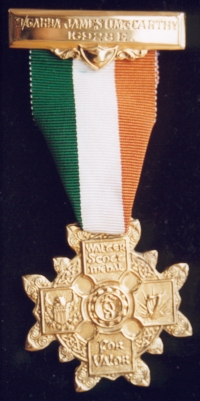
The Garda medal is instituted at the behest of Colonel Walter Scott, a New York Cityphilanthropist who took an interest in policing. In 1923 he gives a one thousand dollar gold Bond which pays for in perpetuity a gold medal. The award is to be presented under the following condition: No action, however heroic, will merit the award of the Scott medal unless it takes the shape of an act of most exceptional bravery and heroism involving the risk of life in the execution of duty, and armed with full previous knowledge of the risk involved.
Guard Mulroy is accosted by two armed men who tell him he has five minutes to live. He waits for his opportunity, springs upon the man with the revolver, tackles him and holds him, but is shot and seriously wounded by the other man who fires his single barreled shotgun and then proceeds to beat Guard Mulroy on the head with the shotgun. The struggle ends when the stock of the shotgun separates from the barrel and Guard Mulroy grabs the barrel with one hand while still holding the other man with the loaded revolver with the other. Guard Mulroy disarms the man with the revolver while the other runs off. He then tells the remaining man to go home. Guard Mulroy falls unconscious and later awakes to find himself in the ditch with the revolver in one hand and the barrel in the other. He returns to his station at 5:00 AM, gets his wounds dressed, and then goes out with another Guard and arrests one of the men.
In 1934, Dugan is appointed Governor of South Australia. He is appointed a Knight Commander of the Order of St. Michael and St. George (KCMG), retires from the Army and moves to Adelaide with his wife. They become an extremely popular and glamorous vice-regal couple. Sir Winston and Lady Dugan are both excellent public speakers and travel widely in order to bring problems to the attention of the ministers of the day. Upon the expiration of his term, there is bipartisan parliamentary support for him to serve a second term, but he has already accepted an appointment to be Governor of Victoria.
Sir Winston and Lady Dugan arrive in Melbourne on July 17, 1939. They continue their active role in community affairs, promoting unemployment reduction and making the ballroom of Government House available for the Australian Red Cross.
Dugan has an active role stabilising state politics during the tumultuous 1940s. Upon the disintegration of Albert Dunstan‘s Country Party in 1943, he installs Australian Labor Party leader John Cain as Premier. Four days later, Dunstan forms a coalition with the United Australia Party. Following the collapse of that ministry in 1945, Dugan dissolves parliament and calls a general election for November, which results in the balance of power being held by independents. Dugan commissions Cain to form the ministry of a minority government.
Dugan’s term as Governor is extended five times. He returns to England in February 1949. On July 7, 1949, he is raised to the peerage as Baron Dugan of Victoria, of Lurgan in County Armagh.
Winston Dugan dies at Marylebone, London, on August 17, 1951, at the age of 74. As there are no children from his marriage, the barony becomes extinct.
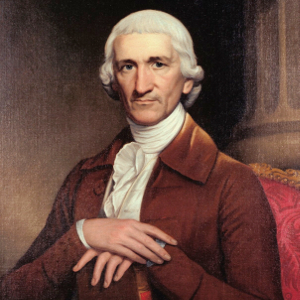
During the French and Indian War, Thomson is an opponent of the Pennsylvania proprietors’ American Indian policies. He serves as secretary at the Treaty of Easton (1758) and writes An Enquiry into the Causes of the Alienation of the Delaware and Shawanese Indians from the British Interest (1759), which blames the war on the proprietors. He is allied with Benjamin Franklin, the leader of the anti-proprietary party, but the two men part politically during the Stamp Act crisis in 1765. Thomson becomes a leader of Philadelphia’s Sons of Liberty. He is married to the sister of Benjamin Harrison V, another signer, as delegate, of the Declaration of Independence.
Thomson is a leader in the revolutionary crisis of the early 1770s. John Adams calls him the “Samuel Adams of Philadelphia.” Thomson serves as the secretary of the Continental Congress through its entirety. Through those 15 years, the Congress sees many delegates come and go, but Thomson’s dedication to recording the debates and decisions provides continuity. Along with John Hancock, president of the Congress, Thomson’s name (as secretary) appears on the first published version of the Declaration of Independence in July 1776.
Thomson’s role as secretary to Congress is not limited to clerical duties. Thomson is also noted for designing, with William Barton, the Great Seal of the United States. The Great Seal plays a prominent role in the January 14, 1784, ratification of the Treaty of Paris (1783). Britain’s representatives in Paris initially dispute the placement of the Great Seal and Congressional President Thomas Mifflin‘s signature, until mollified by Benjamin Franklin.
But Thomson’s service is not without its critics. James Searle, a close friend of John Adams, and a delegate, begins a cane fight on the floor of Congress against Thomson over a claim that he is misquoted in the “Minutes” that results in both men being slashed in the face. Such brawls on the floor are not uncommon, and many of them are promoted by argument over Thomson’s recordings. Political disagreements prevent Thomson from getting a position in the new government created by the United States Constitution. Thomson resigns as secretary of Congress in July 1789 and hands over the Great Seal, bringing an end to the Continental Congress.
Thomson spends his final years at Harriton House in Bryn Mawr, Pennsylvania working on a translation of the Bible. He also publishes a synopsis of the four evangelists in 1815. In retirement, Thomson also pursues his interests in agricultural science and beekeeping. According to Thomas Jefferson, writing to John Adams, Thomson becomes senile in his old age, unable to recognize members of his own household.
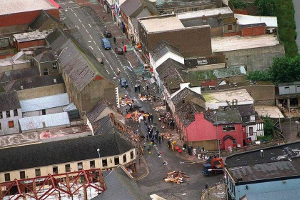
On the day of the bombing, the bombers drive a car, loaded with 230 kilograms (510 lb) of fertiliser-based explosives, across the Irish border. At approximately 2:19 PM they park the vehicle outside S.D. Kells’ clothes shop in Omagh’s Lower Market Street, on the southern side of the town centre, near the crossroads with Dublin Road. They are unable to find a parking space near the intended target, the Omagh courthouse. The two male occupants arm the bomb and, upon exiting the car, walk east down Market Street towards Campsie Road.
Three telephone calls are made warning of a bomb in Omagh, using the same codeword that had been used in the Real IRA’s bomb attack in Banbridge two weeks earlier. At 2:32 PM, a warning is telephoned to Ulster Television saying, “There’s a bomb, courthouse, Omagh, Main Street, 500 lb., explosion 30 minutes.” One minute later, the office receives a second warning saying, “Martha Pope (which is the RIRA’s code word), bomb, Omagh town, 15 minutes.” The caller claims the warning on behalf of “Óglaigh na hÉireann.” One minute later, the Coleraine office of the Samaritans receives a call stating that a bomb will go off on “Main Street” about 200 yards (180 m) from the courthouse. The recipients pass the information on to the Royal Ulster Constabulary (RUC) but are claimed to be inaccurate and police inadvertently move people towards the bomb.
The car bomb detonates at 3:10 PM in the crowded shopping area. The bombing kills 29 people, including a woman pregnant with twins, and injures some 220 others. Twenty-one people who are in the vicinity of the vehicle die at the scene. Eight more people die on the way to or in the hospital. The death toll is higher than that of any single incident during what are considered “the Troubles.”
The bombing causes outrage both locally and internationally, spurs on the Northern Ireland peace process, and deals a severe blow to the Dissident republican campaign. The Real IRA apologises and declares a ceasefire shortly afterwards. The victims include people from many backgrounds: Protestants, Catholics, a Mormon teenager, five other teenagers, six children, a mother pregnant with twins, two Spanish tourists, and others on a day trip from the Republic of Ireland. Both unionists and Irish nationalists are killed and injured.
It is alleged that the British, Irish and U.S. intelligence agencies have information which could have prevented the bombing, most of which comes from double agents inside the Real IRA. This information is not given to the local police, the Royal Ulster Constabulary (RUC). In 2008 it is revealed that British intelligence agency, Government Communications Headquarters, was monitoring conversations between the bombers as the bomb was being driven into Omagh.
A 2001 report by the Police Ombudsman says that the RUC Special Branch failed to act on prior warnings and slammed the RUC’s investigation of the bombing. The RUC has obtained circumstantial and coincidental evidence against some suspects, but it has not come up with anything to convict anyone of the bombing. Colm Murphy is tried, convicted, and then released after it is revealed that Garda Síochána forged interview notes used in the case. Murphy’s nephew, Sean Hoey, is also tried and found not guilty.
In June 2009, the victims’ families win a GB£1.6 million civil action against four defendants. In April 2014, Seamus Daly is charged with the murders of those killed, however, the case against him is withdrawn in February 2016.
Connell is the daughter of William O’Connell (1769-1841) and Catherine Murphy (-1821). In 1821, she emigrates with her family to Boston, and attends the Ursuline Academy in Charlestown, Massachusetts. On June 5, 1835, she enters the novitiate of the American Sisters of Charity in St. Joseph’s Valley, Maryland, founded by Saint Elizabeth Seton, and is professed in 1837, taking the name of Sister Anthony. Soon after, she goes to Cincinnati, Ohio.
Sister Anthony arrives in Cincinnati in 1837 to begin her work at St. Peter’s Orphan Asylum and School for girls. Given charge of St. Joseph’s Orphan Asylum for boys when it is begun in 1852, she later oversees the combining of the two asylums in the Cincinnati neighborhood of Cumminsville. She is in Cincinnati through 1852, when the Sisters in Cincinnati become independent of their founding motherhouse in Emmitsburg, Maryland. She is placed in charge of St. John’s Hostel for Invalids, a new hospital.
At the outbreak of the American Civil War, the Sisters volunteer as nurses. More than one-third of the community, which by then has more than one hundred members, serve. In June 1861, Sister Anthony is one of six Sisters of Charity who go to Camp Dennison, about 15 miles from Cincinnati. A request is made from Cumberland, Virginia for nursing assistance, and eight sisters are sent to serve the wounded of both armies.
The Battle of Shiloh brings ten sisters to the scene including Sister Anthony. Some describe her word as being law with officers, doctors, and soldiers once she has established herself as a prudent and trusted administrator and nurse. She and other sisters often are picked to treat wounded prisoners of war since they show no bias in serving rebel, yank, white, or black soldiers.
When Sister Anthony serves at Shiloh she becomes known as the “Angel of the Battlefield” and “the Florence Nightingale of America.” She goes out to the battlefield to help bring in the sick and dying and also develops the Battlefield Triage. Her method is “the first recognizably modern triage techniques in war zones, saved countless lives through faster hospital treatment and won her praise from President Lincoln.” Her medical skills allow her to intervene to save soldiers’ limbs from amputation.
After the war, in 1866, Joseph C. Butler and a friend, Louis Worthington, purchase a large building at Sixth and Lock Street, to present to Sister Anthony as a gift in recognition of the sisters’ service during the war. There are two conditions: that no one be excluded from the hospital because of color or religion, and that the hospital be named “The Hospital of the Good Samaritan,” to honor the sisters’ kindness. It opens that same year as the St. Joseph Foundling and Maternity Hospital. It still serves as St. Joseph Hospital, a residential facility for children and adults with severe mental and multiple physical disabilities.
Sister Anthony is also recognized for her work during the yellow fever epidemic of 1877. She retires from active service in 1880, and dies in 1897 in Cumminsville, Cincinnati, Ohio.
O’Brien is born in Limerick, County Limerick on December 3, 1897. Following the death of her mother when she is five years old, she becomes a boarder at Laurel Hill Convent. She graduates in English and French from the newly established University College Dublin, and she then moves to London, where she works as a teacher for a year.
In 1922–1923, O’Brien works as a governess in the Basque Country, in the north of Spain, where she begins to write fiction. Upon her return to England, she works at the Manchester Guardian. After the success of her play Distinguished Villa in 1926, she takes to full-time writing and is awarded both the 1931 James Tait Black Memorial Prize and the Hawthornden Prize for her debut novel Without My Cloak. O’Brien is best known for her 1934 novel The Ante-Room, her 1941 novel The Land of Spices, and the 1946 novel That Lady.
Many of O’Brien’s books deal with issues of female agency and sexuality in ways that are new and radical at the time. Her 1936 novel, Mary Lavelle, is banned in Ireland and Spain, while The Land of Spices is banned in Ireland upon publication. In addition to novels, she writes plays, film scripts, short stories, essays, copious journalism, two biographical studies, and two very personal travelogues. Throughout her life, she feels a particular affinity with Spain. While her experiences in the Basque Country inspire Mary Lavelle, she also writes a life of the Spanish mystic Teresa of Avila, and she uses the relationship between the Spanish king Philip II and Maria de Mendoza to write the anti-fascist novel That Lady.
O’Brien writes a political travelogue, Farewell Spain, to gather support for the leftist cause in the Spanish Civil War, and it has been argued that she is close to anarchism in the 1930s. A feminist, her novels promote gender equality and are mostly protagonised by young women yearning for independence. Several of her books include positive gay/lesbian characters. Her determination to encourage a greater understanding of sexual diversity makes her a pioneer in queer literary representation. She is very critical of conservatism in Ireland, and by spearheading a challenge to the Irish Censorship Act, she helps bring to an end the cultural restrictions of the 1930s and 40s in the country.
Kate O’Brien lives much of her life in England and died in Faversham, near Canterbury, on August 13, 1974.
After completing his secondary education at St. Joseph’s College, Galway, he enrolls at University College Dublin in 1900 where he receives an arts degree and then studies medicine. He transfers to University College, Galway and graduates in 1913. He is a member of the college Literary and Debating Society and participates in drama.
He begins his medical career in the County Infirmary in Galway and then moves to Holles Street Hospital. He joins the Royal Army Medical Corps and is badly affected by mustard gas in India. After the war he settles in Leicester, where he spends the rest of his career as a neurological specialist.
Colahan is also a composer of popular songs. He is a quiet man who is often homesick for his beloved Galway Bay. These feelings lead him to write his most famous work, “Galway Bay.” Popularised by Bing Crosby, it becomes the biggest selling record of all time at one point. Theories abound as to where the song is written or where it is first heard. Some say it is in the home of Dr. Morris at 1 Montpelier Terrace, while others believe it is in The Vicars Croft on Taylor’s Hill, from where one can see Galway Bay.
Other songs written by Colahan include “Maccushla Mine,” “Asthoreen Bawn,” “Until God’s Day,” “The Kylemore Pass” and “The Claddagh Ring.” Sadly, before his music is selling in the High Street he dies on September 15, 1952, and is buried in an unmarked grave back in his Irish birthplace.
At the age of 21, he makes his stage debut in a Cincinnati production of Dion Boucicault‘s The Colleen Bawn (1867). Also in 1867, he has a minor part in Edwin Forrest‘s production of Virginius, and then joins a travelling repertory company. By the age of 24 he has already established a reputation among theater managers as a box-office draw, particularly with the ladies. But he is also working doggedly at his craft, ridding himself of all vestiges of brogue and learning to pitch his voice resonantly. He is considered a promising actor, quickly working his way up the ranks to become a matinée idol.
On June 14, 1877, while in New York City, O’Neill marries Mary Ellen Quinlan, daughter of Thomas and Bridget Quinlan. In the fall of 1877, three months after his marriage, a woman by the name of Nettie Walsh sues O’Neill, claiming that he had married her five years earlier, when she was only 15, and that he is the father of her three-year-old son. Nettie Walsh loses her case and the publicity, although it wounds his bride, enhances his reputation as a romantic leading man.
As early as 1875, while a stock star at Hooley’s Theatre in Chicago, O’Neill plays the title role in a stage adaptation of Alexandre Dumas‘ The Count of Monte Cristo. In early 1883 he takes over the lead role in Monte Cristo at Booth’s Theater in New York, after Charles R. Towne dies suddenly in the wings after his first performance. O’Neill’s interpretation of the part caused a sensation with the theater-going public.
O’Neill soon tires of the Count and his lines come out by rote and his performances become lackadaisical. Monte Cristo remains a popular favorite, so he continues the role on tour as regular as clockwork. He goes on to play this role over 6,000 times.
A statutory provision, the National Gallery of Ireland Act, 1854, is made on August 10, 1854, for the establishment of a national gallery of paintings, sculpture, and fine arts in Ireland.
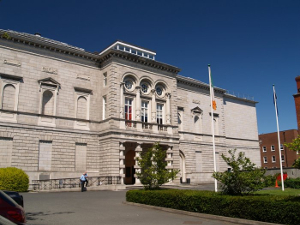
The National Gallery of Ireland, which opens its doors ten years later, houses the national collection of Irish and European art. It is located in the centre of Dublin with one entrance on Merrion Square, beside Leinster House, and another on Clare Street. The Gallery has an extensive, representative collection of Irish painting and is also notable for its Italian Baroque and Dutch masters painting.
The façade of the National Gallery copies the Natural History building of the National Museum of Ireland which is already planned for the facing flank of Leinster House. The building itself is designed by Francis Fowke, based on early plans by Charles Lanyon.
The Gallery is unlucky not to have been founded around an existing collection, but through diligent and skillful purchase, by the time it opens it has 125 paintings. In 1866 an annual purchase grant is established and by 1891 space is already limited. In 1897, the Dowager Countess of Milltown indicates her intention of donating the contents of Russborough House to the Gallery. This gift includes about 223 paintings, 48 pieces of sculpture, 33 engravings, much silver, furniture and a library, and prompts construction from 1899 to 1903 of what is now called the Milltown Wing, designed by Thomas Newenham Deane.
At around this time Henry Vaughan leaves 31 watercolours by J.M.W. Turner with the requirement that they can only be exhibited in January, this to protect them from the ill-effects of sunlight. Though modern lighting technology has made this stipulation unnecessary, the Gallery continues to restrict viewing of the Vaughan bequest to January and the exhibition is treated as something of an occasion.
Another substantial bequest comes with the untimely death in the sinking of the RMS Lusitania of Hugh Lane (1875–1915), since 1914 director of the Gallery. Not only does he leave a large collection of pictures, but he also leaves part of his residual estate, and the Lane Fund has continued to contribute to the purchase of art works to this day. In addition to his involvement in the Gallery, Hugh Lane has also hoped to found a gallery of modern art, something only realised after his death in Dublin City Gallery The Hugh Lane. George Bernard Shaw also makes a substantial bequest, leaving the Gallery a third of royalties of his estate in gratitude for the time he spent there as a youth.
In the 1990s a lost Caravaggio, The Taking of Christ, known through replicas, is discovered hanging in a Jesuit house of studies in Leeson Street in Dublin by Sergio Benedetti, senior conservator of the gallery. The Jesuits generously allow this painting to be exhibited in the Gallery and the discovery is the cause of national excitement. In 1997 Anne Yeats donates sketchbooks by her uncle Jack Yeats and the Gallery now includes a Yeats Museum. Denis Mahon, a well-known art critic, promises the Gallery part of his rich collection and eight painting from his promised bequest are on permanent display, including Jacob Blessing the Sons of Joseph by Guercino.
The Tenant Right League, an organisation which aims to secure reforms in the Irish land system, is founded in Dublin on August 9, 1850, at a meeting attended by representatives of the Tenant Protection Societies. Formed by Charles Gavan Duffy and Frederick Lucas, the League unites for a time Protestant and Catholic tenants, Duffy calling his movement The League of North and South.
The political background to the movement is the Encumbered Estates Act and the resultant change in land ownership at landlord level. In the North of Ireland, Protestant and Presbyterian ministers fear that the new landlords will destroy the “Ulster custom” of tenancy, which compensates tenants for any improvement undertaken. Concurrently, in the South of Ireland politically minded young Catholic priests are agitating for the adoption there of the Ulster custom as a measure of reform.
Support for the League initially comes from the Ulster Tenant Right Association led by William Sharman Crawford. The support is short-lived because of the involvement of Catholic clergymen from the south. As a constitutional movement, the League seeks to secure the adoption and enforcement of the Three Fs, namely fair rent, fixity of tenure, and free sale. All of these would aid Irish tenant farms, all of whom lack them.
For the larger tenant farmers fixity of tenure is the priority. On the other hand, the league never has the support of smaller tenants, whose prime concern is fair rents. The founders strive to establish a parliamentary party of Irish members who will oppose any government not prepared to grant “Tenant-right” also known as the Ulster Custom.
The League’s success is short lived and is ultimately destroyed and weakened when a number of prominent members break away and established the Catholic Defence Association. Supporters of the league are also intimidated by hostile landlords. The most serious blows to its success come when Lucas decides to take his complaint about the Archbishop of DublinPaul Cullen to Rome, which alienates clerical support. Lucas dies in October 1855 shortly after the failure of his mission, a month later Gavan Duffy emigrates to Australia.
The League finally dissolves in 1859, and the Independent Irish Party disappears by 1860. The demand for tenants’ rights is however continued by Bishop Thomas Nulty of County Meath and taken up again as a popular cause by the Irish National Land League in 1879, when the “Three Fs” are anchored in the Land Law (Ireland) Act 1881, previously pursued rigorously by Michael Davitt.





 seamus dubhghaill