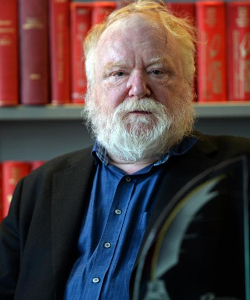
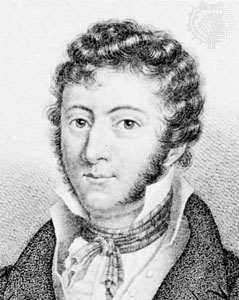
Broderick is the only child of the proprietors of a thriving local business, Broderick’s Bakery. His father dies when he is just three years old. He begins his secondary education at the Marist Brothers’ School but, at the age of 12, on his mother’s remarriage to the bakery manager in 1936, he is sent to board at St. Joseph’s College, GarballyBallinasloe. He leaves in 1941 without sitting the Leaving Certificate and is expected to take over the bakery business, but always intends to write.
From 1951 he lives for a time in Paris where he knows some of the French and expatriate literary community, among them Gore Vidal, Truman Capote, James Baldwin and most importantly Julien Green. Green is a French Academician and highly respected novelist and diarist, who becomes a mentor and personal friend. He visits Broderick in Athlone in 1974 and 1975.
The Irish Times accepts a travel article from Broderick in 1956. In the same year, the paper publishes the first of his book reviews. He continues to review widely and to write general articles for The Irish Times and Hibernia magazine, among others, until shortly before his death. As a critic he is frequently controversial being dismissive of a number of established writers including Heinrich Boll, Seamus Heaney and most notably Edna O’Brien while he is extremely generous and encouraging to a host of young Irish writers. His first novel, The Pilgrimage (1961) is banned by the Irish Censorship of Publications Board. Broderick is elected to membership of the Irish Academy of Letters in 1968, and in 1975 receives the Academy’s Annual Award for Literature.
Broderick lives most of his life in Athlone, with his mother until her death in 1974, and alone until he moves to Bath, England in 1981. He dies in Bath in 1989. The Westmeath County Library system has a collection of his papers, manuscripts and other materials.
Most of Broderick’s family are born and reared in Athlone, and many still live there today. John Broderick is third cousins to Shauna, Cliodhna and Aisling Golden, three sisters who perform together as a singing act called “The Golden Sisters” who are quarter finalists on the RTÉ prime time show “The All Ireland Talent Show.”
He first comes to prominence with his play The Factory Girls but establishes his reputation with his play about World War I, Observe the Sons of Ulster Marching Towards the Somme, which is staged in Dublin‘s Abbey Theatre and internationally. The play makes a name for him when it is performed at Hampstead Theatre, drawing comments about McGuinness’s Irish Catholic background. It wins numerous awards including the London Evening Standard Award for Most Promising Playwright for McGuinness and the Christopher Ewart-Biggs Memorial Prize. He has also written new versions of classic dramas, including works by Henrik Ibsen, Anton Chekhov, and Euripides, adapting the literal translations of others. In addition, he writes the screenplay for the film Dancing at Lughnasa, adapting the stage play by fellow UlstermanBrian Friel.
McGuinness’s first poetry anthology, Booterstown, is published in 1994. Several of his poems have been recorded by Marianne Faithfull, including Electra, After the Ceasefire and The Wedding.
McGuinness previously lectured in Linguistics and Drama at the University of Ulster, Medieval Studies at University College, Dublin and English at the National University of Ireland, Maynooth. Then he is a writer-in-residence lecturing at University College Dublin before being appointed Professor of Creative Writing in the School of English, Drama and Film there in 2007.
Boyle enters the army, and in 1709 is raised to the rank of major-general and sworn one of Her Majesty’s Privy Council. He is appointed to the Order of the Thistle and appointed queen’s envoy to the states of Brabant and Flanders. Having discharged this trust with ability, he is created an English peer, as Baron Boyle of Marston, in Somerset. He inherits the estate in 1714.
Boyle becomes a Fellow of the Royal Society in 1706. In 1713, under the patronage of Boyle, clockmaker George Graham creates the first mechanical solar system model that can demonstrate proportional motion of the planets around the Sun. The device is named the orrery in the Earl’s honour.
Boyle receives several additional honours in the reign of George I but, having had the misfortune to fall under the suspicion of the government for playing a part in the JacobiteAtterbury Plot, he is committed to the Tower of London in 1722, where he remains six months, and is then admitted to bail. On a subsequent inquiry he is discharged.
Boyle writes a comedy, As you find it, printed in 1703 and later publishes together with the plays of the first earl. In 1728, he is listed as one of the subscribers to the Cyclopaedia of Ephraim Chambers.
Longley is renowned for the quiet beauty of his compact, meditative lyrics. Known for using classical allusions to cast provocative light on contemporary concerns, including Northern Ireland’s “Troubles,” his poetry is also marked by sharp observation of the natural world, deft use of technique, and deeply felt emotion. His debut volume, No Continuing City (1969), heralds the arrival of a new talent from a region which has already produced recognized talents like Seamus Heaney and Derek Mahon. However, his early influences are English poets like Philip Larkin, Louis MacNeice, and the First World War poets, as well as masters from the classical tradition. The critic Langdon Hammer describes Longley’s poems as masterpieces of “lucidity, economy, sincerity…by means of meticulous, unpretentious technique.”
Longley’s work engages diverse subjects, including Homeric literature, the landscape of Carrigskeewaun, jazz, Walter Mitty, and the politics of Northern Ireland. On the public and political responsibilities of being a Northern Irish poet, he says, “Though the poet’s first duty must be to his imagination, he has other obligations, and not just as a citizen. He would be inhuman if he did not respond to tragic events in his own community, and a poor artist if he did not seek to endorse that response imaginatively.” Reviewing his Selected Poems (1993), critic Fran Brearton praises in particular Longley’s more political poems, noting his “use of a compassionate yet unsentimental voice, and an attention to detail which restores specificity at a point in history when it is most in danger of being lost in abstraction – numbers, dates, death-tolls counted beyond comprehension.”
John Field, pianist, composer, and teacher, is born in Dublin into a musical family on July 26, 1782. He is the eldest son of Irish parents who are members of the Church of Ireland. His father, Robert Field, earns his living by playing the violin in Dublin theatres.
Field first studies the piano under his grandfather, who is a professional organist, and later under Tommaso Giordani. He makes his debut at the age of nine, a performance that is well-received, on March 24, 1792 in Dublin. By late 1793, the Fields have settled in London, where the young pianist starts studying with Muzio Clementi.
Field continues giving public performances and soon becomes famous in London, attracting favourable comments from the press and the local musicians. Around 1795 his performance of a Jan Ladislav Dussek piano concerto is praised by Joseph Haydn. Field continues his studies with Clementi, also helping the Italian with the making and selling of instruments. He also takes up the violin, which he studies under Johann Peter Solomon. His first published compositions are issued by Clementi in 1795. The first historically important work, the Piano Concerto No. 1, H 27, is premiered by the composer in London on February 7, 1799, when he is 16 years old. Field’s first official opus is a set of three piano sonatas published by Clementi in 1801.
In summer 1802 Field and Clementi leave London and go to Paris on business. They soon travel to Vienna, where Field takes a brief course in counterpoint under Johann Georg Albrechtsberger, and in early winter arrive in Saint Petersburg. Field is inclined to stay, impressed by the artistic life of the city. Clementi leaves in June 1803, but not before securing Field a teaching post in Narva. After Clementi’s departure, Field has a busy concert season, eventually performing at the newly founded Saint Petersburg Philharmonia. In 1805 Field embarks on a concert tour of the Baltic states, staying in Saint Petersburg during the summer. The following year he gives his first concert in Moscow. He returns to Moscow in April 1807 and apparently does not revisit Saint Petersburg until 1811. In 1810 he marries Adelaide Percheron, a French pianist and former pupil.
In 1811 Field returns to Saint Petersburg where he spends the next decade of his life, more productive than ever before, publishing numerous new pieces and producing corrected editions of old ones. He is successful in establishing a fruitful collaboration with both H.J. Dalmas, the most prominent Russian publisher of the time, and Breitkopf & Härtel, one of the most important music publishing houses of Europe. By 1819 Field is sufficiently wealthy to be able to refuse the position of court pianist that is offered to him. His lifestyle and social behaviour are becoming more and more extravagant.
In 1818 Field revisits Moscow on business, prompted by his collaboration with the publisher Wenzel. He and his wife give a series of concerts in the city in 1821, the last of which marks their last appearance in public together. Adelaide leaves Field soon afterward and attempts a solo career, which is not particularly successful. Field stays in Moscow and continues performing and publishing his music. In 1822 he meets Johann Nepomuk Hummel and the two collaborate on a performance of Hummel’s Sonata for Piano 4-Hands, Op. 92.
Partly as a result of his extravagant lifestyle, Field’s health begins to deteriorate by the mid-1820s. From about 1823 his concert appearances started decreasing. By the late 1820s he is suffering from colorectal cancer. Field leaves for London to seek medical attention. He arrives in September 1831 and, after an operation, gives concerts there and in Manchester. He stays in England for some time, meeting distinguished figures such as Felix Mendelssohn and Ignaz Moscheles. After a series of concerts in various European cities, Field spends nine months in a Naples hospital. His Russian patrons rescue him. He briefly stays with Carl Czerny in Vienna, where he gives three recitals, and then returns to Moscow. He gives his last concert in March 1836 and dies in Moscow almost a year later, on January 23, 1837, from pneumonia. He is buried in the Vvedenskoye Cemetery.
Painter Michael Angelo Hayes is born in Waterford on July 25, 1820. Probably the best 19th century painter of animals in Ireland, Hayes is most accomplished as a watercolourist, although he occasionally uses oils.
Hayes is the son and pupil of Tipperary watercolour miniaturist Edward Hayes RHA. It is clear from his christening that he is expected to become an artist. Fortunately, the younger Hayes is a talented draughtsman, and by his late teens has acquired something of a reputation as a painter of horses and military subjects.
Hayes begins showing at the Royal Hibernian Academy (RHA) in 1837, then for three years 1840-1842. In 1842, he is appointed Military Painter-in-ordinary to the Lord Lieutenant. He passes the next few years in London, where he exhibits watercolours at the New Society of Painters in Water Colours, of which he is elected an Associate Member in 1848, the same year he makes his one and only contribution to the Royal Academy of Arts.
Returning to Dublin, Hayes resumes exhibiting at the RHA, at the same time becoming involved in its administration. He is elected an Associate member in 1853, a full Academician the following year, and Secretary in 1856. The affairs of the Academy are totally disorganized at the time, inducing Hayes and others to resolve the situation. His efforts to reform the institution and secure its finances meets with entrenched opposition from older members, which results in Hayes being removed from his post, although he is successfully reinstated in 1861.
Not long afterwards he is appointed secretary to the Lord Mayor of Dublin, Peter McSwiney, who happens to be his brother-in-law, and later becomes City Marshal in 1867. He continues as Secretary of the RHA until he resigns in 1870, and continues showing until 1874.
Hayes makes a special study of horses in motion, and in 1876 publishes his conclusions in an illustrated pamphlet, The Delineation of Animals in Rapid Motion. One of his Dublin paintings, Sackville Street, Dublin, depicts a view of Dublin’s premier street in the 1850s. The painting is a documentary of social life in Dublin. It achieves widespread popularity when reprinted as a lithograph.
Michael Angelo Hayes dies prematurely in 1877 in a tragic drowning accident at his home.
Originally from Cork, Buckley joins Inghinidhe na hÉireann, which was founded in 1900, taking an active role in the women’s movement. She is involved in anti-British royal visit protests in 1903 and 1907 and is among the group that founds An Dún in Cork in 1910. In 1906, she marries Patrick Buckley, described as “a typical rugby-playing British civil servant.” After his death she moves into a house in Marguerite Road, Glasnevin, Dublin. Later, she returns to Cork to care for her elderly father.
Arrested in the aftermath of 1916 Easter Rising, she is released in the amnesty of June 1917 and plays a prominent role in the reorganisation of Sinn Féin. She is involved in the Irish War of Independence in Cork.
At the October 1934 Sinn Féin ardfheis, Buckley is elected one of the party’s vice-presidents. Three years later, in 1937, she succeeds Cathal Ó Murchadha, who is a former Teachta Dála (TD) of the second Dáil Éireann, as President of Sinn Féin at an ardfheis attended by only forty delegates.
When she assumes the leadership of Sinn Féin, the party is not supported by the IRA, which had severed its links with the party in the 1920s. When she leaves the office in 1950, relations with the IRA have been resolved. As President she begins the lawsuit Buckley v. Attorney-General, the Sinn Féin Funds case, in which the party seeks unsuccessfully to be recognised as owners of money raised by Sinn Féin before 1922 and held in trust in the High Court since 1924.
In 1938, her book, The Jangle of the Keys, about the experiences of Irish Republican women prisoners interned by the Irish Free State forces is published. In 1956, her Short History of Sinn Féin is published.
Buckley serves as honorary vice-president of Sinn Féin from 1950 until her death in 1962. She is the only member of the Ard Chomhairle of the party not to be arrested during a police raid in July 1957.
Margaret Buckley dies on July 24, 1962, and is buried in St. Finbarr’s Cemetery in Cork.
Chandler spends his early years in Plattsmouth, Nebraska, living with his mother and father near his cousins and his aunt and uncle. His father, an alcoholic civil engineer who works for the railway, abandons the family. To obtain the best possible education for Ray, his mother, originally from Ireland, moves them to the area of Upper Norwood in the London Borough of Croydon, England in 1900. In 1912, he borrows money from his Waterford uncle, who expects it to be repaid with interest, and returns to America, visiting his aunt and uncle before settling in San Francisco. The following year he moves to Los Angeles.
In 1932, at the age of forty-four, Chandler becomes a detective fiction writer after losing his job as an oil company executive during the Great Depression. His first short story, “Blackmailers Don’t Shoot,” is published in 1933 in Black Mask, a popular pulp magazine. His first novel, The Big Sleep, is published in 1939. In addition to his short stories, Chandler publishes seven novels during his lifetime. An eighth novel is in progress at the time of his death and is completed by Robert B. Parker. All but Playback have been made into motion pictures, some more than once.
Chandler has an immense stylistic influence on American popular literature. He is considered to be a founder of the hardboiled school of detective fiction, along with Dashiell Hammett, James M. Cain and other Black Mask writers. The protagonist of his novels, Philip Marlowe, like Hammett’s Sam Spade, is considered by some to be synonymous with “private detective.” Both are played in films by Humphrey Bogart, whom many consider to be the quintessential Marlowe.
Some of Chandler’s novels are important literary works, and three have been regarded as masterpieces: Farewell, My Lovely (1940), The Little Sister (1949), and The Long Goodbye (1953). The Long Goodbye is praised in an anthology of American crime stories as “arguably the first book since Hammett’s The Glass Key, published more than twenty years earlier, to qualify as a serious and significant mainstream novel that just happened to possess elements of mystery.”
Croke gains the good opinion of the Irish ecclesiastical authorities and is rewarded in 1870 by his promotion to Bishop of Auckland in New Zealand. His former professor, Paul Cullen, by then Cardinal Archbishop of Dublin, is largely responsible for filling the Australasian Catholic church with fellow Irishmen. His strong recommendations lead to Croke’s appointment. Croke arrives at Auckland on December 17, 1870, on the City of Melbourne. During his three years as bishop, he restores firm leadership to a diocese left in disarray by his predecessor, Bishop Jean Baptiste Pompallier. He devotes some of his considerable personal wealth to rebuilding diocesan finances and also takes advantage of Auckland’s economic growth following the development of the Thames goldfields to further his aims, ensuring that all surplus income from parishes at Thames and Coromandel is passed on to him, and he institutes a more rigorous system for the Sunday collection at St. Patrick’s Cathedral. He imports Irish clergy to serve the growing Catholic community, and with Patrick Moran, the first Catholic Bishop of the Diocese of Dunedin, he tries unsuccessfully to secure an Irish monopoly on future episcopal appointments in New Zealand. Croke supports separate Catholic schools and their right to state aid and voices his opposition to secular education as Auckland’s Catholic schools are threatened by the provincial council’s Education Act 1872, which helps to create a free, secular and compulsory education system. However, generally, Croke’s image is uncontroversial. On January 28, 1874, after barely three years in office, Croke departs for Europe, on what is ostensibly a 12-month holiday, and he does not return to New Zealand.
Croke becomes a member of the Irish hierarchy when he is translated to be Archbishop of Cashel, one of the four Catholic Irish archbishoprics in 1875. Archbishop Croke is a strong supporter of Irish nationalism, aligning himself with the Irish National Land League during the Land War, and with the chairman of the Irish Parliamentary Party, Charles Stewart Parnell. In an 1887 interview he explains that he had opposed the League’s “No rent manifesto” in 1881, preferring to stop payment of all taxes.
Croke also associates himself with the Temperance Movement of Fr. Theobald Mathew and Gaelic League from its foundation in 1893. Within Catholicism he is a supporter of Gallicanism, as opposed to the Ultramontanism favoured by the Archbishop of Dublin, Cardinal Cullen. His support of nationalism causes successive British governments and Lord Lieutenant of Ireland‘s governments in Dublin to be deeply suspicious of him, as are some less politically aligned Irish bishops.
Following the scandal that erupts over Parnell’s relationship with Katharine O’Shea, the separated wife of fellow MP Captain William O’Shea, Archbishop Croke withdraws from active participation in nationalist politics.
Bodkin is the eldest son of Matthias McDonnell Bodkin, a nationalist journalist, judge and Member of Parliament. Graduating from the Royal University of Ireland in 1908 he practises law from 1911 until 1916 while collecting art privately, influenced by his uncle Sir Hugh Lane. With the death of Lane in the sinking of the RMS Lusitania in 1915, Bodkin is charged with ensuring that Lane’s collection of art is displayed in Dublin, a dispute that would only finally be settled in 1957 and about which Bodkin is to write Hugh Lane and his Pictures in 1932.
Bodkin leaves the legal profession in 1916 to become a Governor of the National Gallery of Ireland, being appointed Director in 1927. He also serves in 1926 on the committee that commissions the design of the new coinage of the Republic of Ireland from Percy Metcalfe.
In 1935 Bodkin leaves Ireland upon being appointed Director of the newly established Barber Institute of Fine Arts and Barber Professor of Fine Art at the University of Birmingham. The funds available to the Barber Institute for the purchase of new works compare favourably even to some national museums and Bodkin is able to make a string of exceptional purchases in the depressed art market around the time of World War II. The collection that in 1935 numbers just seven works, by 1939 holds major pieces such as Tintoretto‘s Portrait of a Youth (1554), Simone Martini‘s St. John the Evangelist (1320), Nicolas Poussin‘s Tancred and Erminia (1634) and James Abbott McNeill Whistler‘s Symphony in White No. III (1867). Bodkin retires in 1952 but retains control over acquisitions until 1959. His successor as Director and Professor, Ellis Waterhouse, wistfully refers to Bodkin’s wayward later purchases as “Acts of Bod.”
Bodkin is also an active broadcaster and author, publishing personal reminiscences and translations of modern French poetry as well as works of art history and criticism. In particular, his The Approach to Painting (1927), an introduction for a popular audience, runs through many editions over the succeeding thirty years.
Bodkin is awarded the Civil Division of the Order of St. Gregory the Great for services to his church. A bust of Bodkin, previously exhibited at the Royal Academy in 1958, is donated to the Barber Institute of Fine Arts by its sculptor, Sir Charles Wheeler, President of the Royal Academy and a personal friend of Bodkin’s, on the latter’s death.
Bodkin is the subject of This Is Your Life in March 1960 when he was surprised by Eamonn Andrews at the BBC’s Costa Green Studios in Birmingham.
Thomas Bodkin dies in Birmingham, England on April 24, 1961. His remains are interred in Glasnevin Cemetery, Dublin.