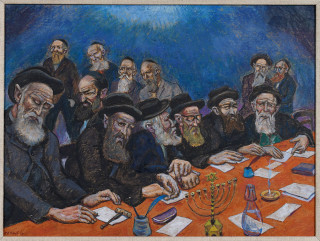
Harry Aaron Kernoff, Irish artist in oils and woodcuts, dies in Dublin on December 25, 1974. Of London/Russian extraction, he is primarily remembered for his sympathetic interest in Dublin and its people. He depicts street and pub scenes, as well as Dublin landmarks with sympathy and understanding. This is particularly evident in his woodcuts.
Born in London on January 10, 1900 to a Russian Jewish father and Spanish mother, Kernoff moves to Dublin in 1914 and becomes a leading figure in Irish modernism. While working as an apprentice in his father’s furniture business, which leads to his woodcuts, he takes night classes at the Dublin Metropolitan School of Art. There, in 1923, he wins the Taylor scholarship and goes on to exhibit at the Royal Hibernian Academy (RHA) every year from 1926. He is elected RHA in 1936.
Kernoff is famously associated with Davy Byrne’s pub. His paintings and woodcuts of Davy Byrne’s pub are documents of his friendship with the original owner. While living in his adopted Dublin Jewish community he produces picture illustrations of his local scenes for a neighbourhood writer and friend, Nick Harris, for his book called Dublin’s Little Jerusalem.
Outside Kernoff’s home in Dublin, where he lives with two unmarried sisters, there is a long-standing sign in the front garden which says “Descendants of the Abravanels.” The Abravanel (or Abrabanel) family is one of the most famous Sephardic Jewish families in history, noted for their large quotas of rabbis, scholars, and members of a variety of scientific and artistic fields, dating from about the 13th century in Lisbon. The emergence of the famous philosopher and scholar Don Isaac Abravanel in the middle of the 16th century brings his works to greater universal recognition.
Kernoff spends the vast majority of his life unappreciated and makes little or nothing from his paintings until a few years before his death, when he begins to be appreciated by contemporary critics. He never marries.
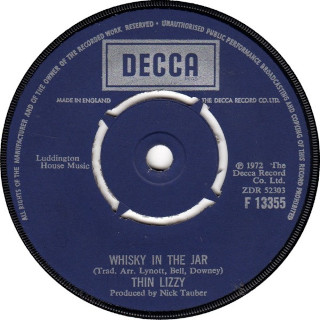
“Whiskey in the Jar” is the tale of a highwayman or footpad who, after robbing a military or government official, is betrayed by a woman; whether she is his wife or sweetheart is not made clear. Various versions of the song take place in County Kerry, Kilmoganny, Cork, Sligo and other locales throughout Ireland. It is also sometimes placed in the American South, in various places among the Ozarks or Appalachians, possibly due to Irish settlement in these places. Names in the song change, and the official can be a Captain or a Colonel, called Farrell or Pepper among other names. The protagonist’s wife or lover is sometimes called Molly, Jenny, Emzy, or Ginny among various other names. The details of the betrayal are also different, being either betraying him to the person he robbed and replacing his ammunition with sand or water, or not, resulting in his killing the person.
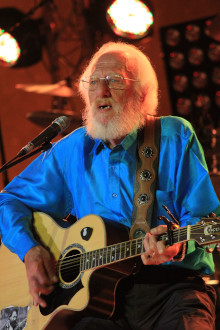
Campbell is known as a guitarist and has a rough voice similar to the late founding member of The Dubliners, Ronnie Drew. He tour with three other ex-Dubliners as “The Dublin Legends,” now that the group name has been retired with the death of Barney McKenna. Although originally from Drogheda in County Louth, he later lives in Walkinstown, a suburb of Dublin.
It was Campbell’s suggestion that The Dubliners work with London-based Irish band The Pogues in the mid-1980s, thus giving them their second biggest UK hit to date, “The Irish Rover.” Their biggest hit is “Seven Drunken Nights” which reaches number 7 in the charts in 1967 and an appearance on Top of the Pops.
Campbell produces all of The Dubliners’ albums from 1987 onwards, as well as albums for many other Irish artists, including Foster and Allen, Brendan Shine, Daniel O’Donnell and Paddy Reilly. He plays locally with the Delta Showband, The Bee Vee Five and the Country Gents before joining Dermot O’Brien and the Clubmen and first meets The Dubliners when both acts tour England together in 1967. In the mid to late 1970s he more or less retires from the road and becomes involved in the growing Irish recording scene, first as a session musician and later moving to production.
In 2002, Campbell puts a complaint to a commission to inquire into sexual abuse as he says he was abused by the Christian Brothers as a child. In an interview he says “I felt emotional with hate at what this arsehole had got away with. He was abusing the whole class. I still haven’t heard anything back.”
While on tour in the Netherlands with The Dublin Legends, Campbell feels unwell during his final performance. He returns to his hotel at around 1:00 AM and goes to bed. He dies during the early hours of the morning of October 18, 2017. His body is flown back to Dublin where his funeral takes place on October 26, 2017.
Fay attends Belvedere College in Dublin. He works for a time in the 1890s with a touring theatre company in Ireland, Scotland, and Wales. When he returns to Dublin, he works with his brother Frank, staging productions in halls around the city. Finally, they form W. G. Fay’s Irish National Dramatic Company, focused on the development of Irish acting talent.
The brothers participate in the founding of the Abbey Theatre and are largely responsible for evolving the Abbey style of acting. After a falling-out with the Abbey directors in 1908, the brothers emigrate to the United States to work in theatre there.
Fay moves to London in 1914, working as an actor on stage and in films. One of his most notable film roles is as Father Tom in Carol Reed‘s Belfast-set Odd Man Out (1947), whose cast is dense with actors from the Abbey Theatre. His memoir, The Fays of the Abbey Theatre, appears in 1935.
Willie Fay dies in London on October 27, 1947, at the age of 74.
(Pictured: William George Fay 1903, Dublin City Council Image Galleries, http://www.dublincity.ie)
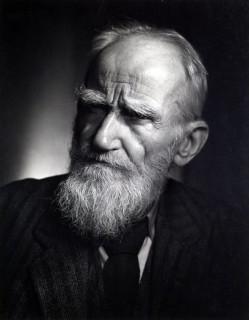
Shaw is born on July 26, 1856, at 3 Upper Synge Street in Portobello, a lower-middle-class area of Dublin. The Shaw family is of English descent and belong to the dominant Protestant Ascendancy in Ireland. Between 1865 and 1871, Shaw attends four schools, all of which he hates. His experiences as a schoolboy leave him disillusioned with formal education. In October 1871 he leaves school to become a junior clerk in a Dublin firm of land agents, where he works hard and quickly rises to become head cashier. During this period, he is known as “George Shaw”; after 1876, he drops the “George” and styles himself “Bernard Shaw.”
Shaw moves to London in 1876, where he struggles to establish himself as a writer and novelist and embarks on a rigorous process of self-education. By the mid-1880s he has become a respected theatre and music critic. Following a political awakening, he joins the gradualistFabian Society and becomes its most prominent pamphleteer. He has been writing plays for years before his first public success, Arms and the Man in 1894. Influenced by Henrik Ibsen, he seeks to introduce a new realism into English-language drama, using his plays as vehicles to disseminate his political, social, and religious ideas. By the early twentieth century his reputation as a dramatist is secured with a series of critical and popular successes that include Major Barbara, The Doctor’s Dilemma, and Caesar and Cleopatra.
Shaw’s expressed views are often contentious. He promotes eugenics and alphabet reform and opposes vaccination and organised religion. He courts unpopularity by denouncing both sides in World War I as equally culpable, and although not a republican, castigates British policy on Ireland in the postwar period. These stances have no lasting effect on his standing or productivity as a dramatist.
The inter-war years see a series of often ambitious plays, which achieve varying degrees of popular success. In 1938 Shaw provides the screenplay for a filmed version of Pygmalion for which he receives an Academy Award. His appetite for politics and controversy remains undiminished. By the late 1920s he has largely renounced Fabian gradualism and often writes and speaks favourably of dictatorships of the right and left — he expresses admiration for both Mussolini and Stalin. In the final decade of his life, he makes fewer public statements, but continues to write prolifically until shortly before his death, refusing all state honours including the Order of Merit in 1946.
During his later years, Shaw enjoys tending the gardens at Shaw’s Corner. He dies on November 2, 1950, at the age of 94 of renal failure precipitated by injuries incurred when falling while pruning a tree. His body is cremated at Golders Green Crematorium on November 6, 1950. His ashes, mixed with those of his wife Charlotte, are scattered along footpaths and around the statue of Saint Joan in their garden.
Since Shaw’s death scholarly and critical opinion has varied about his works, but he has regularly been rated as second only to Shakespeare among English-language dramatists. Analysts recognise his extensive influence on generations of playwrights. The word “Shavian” has entered the language as encapsulating Shaw’s ideas and his means of expressing them.
MacSwiney is born at 23 North Main Street, Cork, County Cork, one of eight children of John and Mary MacSwiney. Following the failure of this business, John MacSwiney emigrates to Australia in 1885 leaving the children in the care of their mother and his eldest daughter.
MacSwiney is educated by the Christian Brothers at the North Monastery school in Cork but leaves at fifteen to help support the family. He becomes an accountancy clerk but continues his studies and matriculates successfully. He continues in full-time employment while he studies at the Royal University (now University College Cork), graduating with a degree in Mental and Moral Science in 1907.
In 1901 MacSwiney helps to found the Celtic Literary Society, and in 1908 he founds the Cork Dramatic Society with Daniel Corkery and writes a number of plays for them. His first play, The Last Warriors of Coole, is produced in 1910. His fifth play, The Revolutionist (1915), takes the political stand made by a single man as its theme.
Described as a sensitive poet-intellectual, MacSwiney’s writings in the newspaper Irish Freedom bring him to the attention of the Irish Republican Brotherhood. He is one of the founders of the Cork Brigade of the Irish Volunteers in 1913 and is President of the Cork branch of Sinn Féin. He founds a newspaper, Fianna Fáil, in 1914, but it is suppressed after only 11 issues. In April 1916, he is intended to be second in command of the Easter Rising in Cork and Kerry but stands down his forces on the order of Eoin MacNeill.
Following the rising, MacSwiney is imprisoned by the British Government under the Defence of the Realm Act 1914 in Reading and Wakefield Gaols until December 1916. In February 1917 he is deported from Ireland and imprisoned in Shrewsbury and Bromyardinternment camps until his release in June 1917. It is during his exile in Bromyard that he marries Muriel Murphy of the Cork distillery-owning family. In November 1917, he is arrested in Cork for wearing an Irish Republican Army (IRA) uniform, and inspired by the example of Thomas Ashe, goes on a hunger strike for three days prior to his release.
In the 1918 Irish general election, MacSwiney is returned unopposed to the first Dáil Éireann as Sinn Féin representative for Mid Cork, succeeding the Nationalist MP D. D. Sheehan. After the murder of his friend Tomás Mac Curtain, the Lord Mayor of Cork on March 20, 1920, he is elected as Lord Mayor. On August 12, 1920, he is arrested in Cork for possession of “seditous articles and documents,” and also possession of a cipher key. He is summarily tried by a court on August 16 and sentenced to two years’ imprisonment at Brixton Prison in England.
In prison MacSwiney immediately starts a hunger strike in protest of his internment and the fact that he was tried by a military court. Eleven other Irish Republican prisoners in Cork Jail go on hunger strike at the same time. On August 26, the British Government states that “the release of the Lord Mayor would have disastrous results in Ireland and would probably lead to a mutiny of both military and police in south of Ireland.”
MacSwiney’s hunger strike gains world attention. The British Government is threatened with a boycott of British goods by Americans, while four countries in South America appeal to Pope Benedict XV to intervene. Protests are held in Germany and France as well. An Australian member of Parliament, Hugh Mahon, is expelled from the Parliament of Australia for “seditious and disloyal utterances at a public meeting,” after protesting against the actions of the British Government. Two weeks later, the Spanish Catalan organization Autonomous Center of Employees of Commerce and Industry (CADCI) sends a petition to British Prime MinisterDavid Lloyd George calling for his release and the newspaper of the organization, Acció (Acción in Spanish), begins a campaign for MacSwiney.
Food is often placed near MacSwiney to persuade him to give up the hunger strike. Attempts at force-feeding are undertaken in the final days of his strike. On October 20, 1920, he slips into a coma and dies five days later after 73 days on hunger strike. His body lay in St. George’s Cathedral, Southwark in London where 30,000 people file past it. Fearing large-scale demonstrations in Dublin, the authorities divert his coffin directly to Cork, and his funeral in the Cathedral of St. Mary and St. Anne on October 31 attracts huge crowds. He is buried in the Republican plot in St. Finbarr’s Cemetery in Cork. Arthur Griffith delivers the graveside oration.
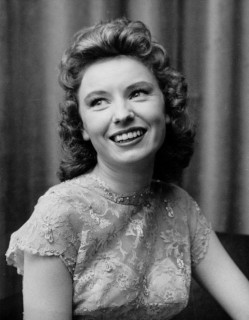
Belfast-born Ruby Murray has two singles, “I’ll Come When You Call” and “Evermore,” in the UK Singles Chart on October 22, 1955. Her much quoted achievement is that she has five hits in the Top 20 in a single week in March 1955, a feat only matched by pop singer Madonna four decades later.
Murray is born near the Donegall Road in south Belfast on March 29, 1935, the youngest child in a Protestant family. She has surgery at six weeks of age due to swollen glands, and as a result, has a very husky voice. She tours as a child singer and first appears on television at the age of twelve, having been spotted by producer Richard Afton. Owing to laws governing children performing, she has to delay her start in the entertainment industry. She returns to Belfast and full-time education until she is fourteen.
After being again spotted by Afton, Murray is signed to Columbia Records and her first single, “Heartbeat”, reaches No. 3 in the UK Singles Chart in December 1954. Afton offers her the position of resident singer on the BBC‘s Quite Contrary television show, to replace Joan Regan. “Softly, Softly“, her second single, reaches number one in early 1955. That same year she sets a pop chart record by having five hits in the Top Twenty in one week, a feat unmatched for many years. In 2014, the Guinness Book of World Records issues three certificates confirming that at the date of issue, nobody has beaten this record, although it is now shared with three other singers.
The 1950s are a busy period for Murray, during which she has her own television show, stars at the London Palladium with Norman Wisdom, appears in a Royal Command Performance (1955), and tours the world. In a period of 52 weeks, starting on December 3, 1954 and lasting until the end of November 1955, she constantly has at least one single in the UK charts, this at a time when only a Top 20 is listed.
In 1957, while working in Blackpool, Murray meets Bernie Burgess, a member of a successful television and recording vocal quartet, the Four Jones Boys. Shortly afterwards she leaves Northern Ireland to marry him and live with him in England. The couple includes a song-and-dance segment in her act during the 1960s.
Murray struggles with alcoholism for most of her life and this contributes to the breakdown of her marriage in 1974. The divorce is finalised in 1976 and she moves to Torquay to live with an old friend, Ray Lamar, a former stage dancer and theatre impresario, who is 18 years her senior. They marry in 1991 and spend the evening with a small party of friends and family at an Italian restaurant in Babbacombe.
Although her days as a major star are long over, Murray continues performing until close to the end of her life. Spending her last couple of years in Asprey’s Nursing Home, she often delights her carers with a song, and is visited by her friend Max Bygraves. She dies of liver cancer at the age of 61 on December 17, 1996.
Makem lives in Keady her entire life. Living in the border region of Ulster and in a market town, she is influenced by Irish, Scottish, and English traditions. She learns songs from her mother while she is doing household chores such as cooking, often picking up these songs while sitting with her mother after just one repetition. She also learns some of her repertoire from songs the children sing in school.
Makem leaves school early to work as a factory weaver as many of the girls do in her town. She works from 7:00 AM until 6:30 PM and then comes home to have sessions with many of the other musicians living in the same area. She marries Peter Makem in 1919.
Makem does not consider herself a musician, however, she has a vast musical career. She is a ballad singer who has over five hundred songs in memory. These songs she describes as life stories of murder and love and emigration songs. She records many of her songs, mostly for collection purposes.
In the 1950s, song collectors from the United States tour Ireland recording its musical heritage. Makem is visited and recorded by, among others, Diane Guggenheim Hamilton, Jean Ritchie, Peter Kennedy and Sean O’Boyle. Her rendition of “As I Roved Out” is used to open the BBC Radio folk music programme of the same name in the 1950s. She does not intend to use this recording as such and is very embarrassed to know her voice will be heard every day across Ireland.
Makem dies in Keady, County Armagh on April 20, 1983. She is buried in St. Patrick’s RC Graveyard in Keady.
Bell is born in Belfast, Northern Ireland. He is something of a child prodigy, composing his first concerto at the age of twelve. He graduates from the Royal College of Music in 1957. While studying there, he became friends with the flautistJames Galway. From 1958 to 1990 he composes several classical works, including three piano sonatas, two symphonies, Three Images of Ireland in Druid Times (in 1993) for harp, strings and timpani, Nocturne on an Icelandic Melody (1997) for oboe d’amore and piano and Three Transcendental Concert Studies (2000) for oboe and piano.
As manager of the Belfast Symphony Orchestra, Bell is responsible for maintaining the instruments and keeping them in tune. Out of curiosity, he asks Sheila Larchet-Cuthbert to teach him how to play the harp. In 1965 he becomes an oboist and harpist with the BBC Northern Ireland Orchestra. He serves as a professor of harp at the Academy of Music in Belfast.
Bell is briefly featured in a 1986 BBCdocumentary, The Celts, in which he discusses the role and evolution of the harp in Celtic Irish and Welsh society. He also appears with Van Morrison at the Riverside Theatre at the University of Ulster in April 1988.
Bell is an admirer of the music of Nikolai Karlovich Medtner and is the co-founder, with the bass-baritone Hugh Sheehan, of the first British Medtner Society which gives a series of successful concerts of Medtner’s music in the 1970s long before Medtner’s music is recognised as it is today.
On St. Patrick’s Day in 1972 Bell performs on the radio the music of Turlough O’Carolan, an 18th-century blind Irish harpist. At that time O’Carolan’s music is virtually unknown, though today almost every album of harp music contains one of his compositions. Working with him on the project are several members of The Chieftains. Bell becomes friends with the leader of The Chieftains, Paddy Moloney. For two precarious years, he records both with the BBC Northern Ireland Orchestra and with The Chieftains, until finally becoming a full-time member of the Chieftains in 1975.
Bell is the only member of the band to wear a necktie at every public performance. He favours socks with novelty designs, such as images of Looney Tunes characters. He wears scruffy suits, often with trousers that are too short. He is eccentric and tells obscene jokes. The title of his 1981 solo album Derek Bell Plays With Himself has a conscious double entendre.
While touring in Moscow he grabs his alarm clock and puts it in his pocket while rushing to catch a plane. He is then stopped by the Soviet police on suspicion of carrying a concealed weapon. Paddy Moloney affectionately calls him “Ding Dong” Bell. He relishes the eclectic collaborations, such as those with Van Morrison, Sting and the Chinese orchestra. In 1991 he records with his old friend James Galway. He is awarded an MBE in the 2000 Queen’s Birthday Honours for services to traditional music.
Brendan Bowyer, Irish singer best known for fronting the Royal Showband and The Big Eight and who had five number one hits in Ireland, is born in Waterford, County Waterford on October 12, 1938.
Bowyer is also renowned for having The Beatles open for the Royal Showband at a concert on April 2, 1962 at the Pavilion Theatre, Liverpool, England, some six months before the release of The Beatles debut single “Love Me Do” in October 1962. He is regarded as one of the first headlining Elvis impersonators. Elvis Presley himself is a big fan of Bowyer’s performances and often attends his concerts in the Stardust Resort and Casino in Las Vegas, Nevada during the 1970s.
Bowyer begins his career with the Royal Showband in 1957. His ability to tailor American rock and roll music to the tastes of Irish audiences, and his athletic, spirited on-stage performances make him a popular vocalist of the 1960s Irish showband era. On September 6, 1963, he and the Royal Showband become the first Irish artists to top the Irish Singles Chart, with the hit “Kiss Me Quick,” which stays at the number one position for seven weeks. They return to the top position later that year with “No More,” and repeat the feat in 1964 with “Bless You.”
Bowyer takes part in the 1965 Irish National Song Contest for a chance to represent Ireland at the Eurovision Song Contest in Naples with the song “Suddenly in Love,” but can only manage fifth place. The Royal Showband’s greatest success is to come in 1965 with “The Hucklebuck,” which spends a further seven weeks at the top of the Irish Singles Chart, and is a hit in Australia, but fails to appear in the UK Singles Chart. “Don’t Lose Your Hucklebuck Shoes” returns the band to the number one position later in 1965.
In the summer of 1971 Bowyer, along with singer Tom Dunphy, leave the Royal Showband and form the Big Eight Showband. The band spends the summers playing the ballroom circuit in Ireland but also spends six months of the year in Las Vegas. Within a short time, the band makes the decision to relocate to Las Vegas permanently. He is based in Las Vegas from then on, though he makes frequent trips back to Ireland. In 1977 he makes a brief return to the Irish charts with his tribute, “Thank You Elvis.”
Having enjoyed a semi-retirement phase, Bowyer returns to the spotlight, touring Ireland each year, some for months on end, with his daughter Aisling Bowyer, and a six piece band. They perform his showband era hits, dance numbers, nationalist songs, modern contemporary songs and concert hits.
A covers album, Follow On, is released in 2001, where Bowyer performs some of the most popular Irish songs, such as “Summer in Dublin,” “What’s Another Year,” “Past the Point of Rescue,” and “I Don’t Like Mondays.”
In 2005, Bowyer and Aisling headline the entertainment list for the Tall Ships Festival in Waterford, performing in the open air to an estimated crowd of 12,000. In 2015, Bowyer is the star of the “Ireland’s Showbands – Do You Come Here Often?” concert series.
Bowyer dies at the age of 81 in Las Vegas, Nevada on May 28, 2020.





 seamus dubhghaill