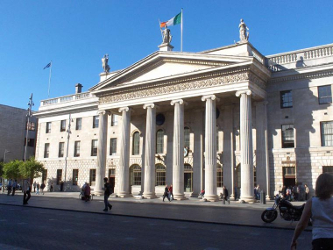
The General Post Office (GPO) is the headquarters of the Irish postal service. The offices are first located at College Green, but in August 1814, construction of a purpose-built headquarters begins. The building on Sackville Street is completed in January 1818 at a cost of £50,000.
According to An Post “The statues on the roof are of Hibernia, a classical representation in female form of the island of Ireland, with Fidelity to one side and Mercury, the messenger of the gods, to the other.”
On Monday afternoon the garrison repulses a cavalry attack while, with the breakdown of law and order, many of the stores in Sackville Street are looted. From Wednesday, the GPO and other buildings in Sackville Street come under artillery fire, mostly from the Helga gunboat at anchor in the River Liffey. Connolly believes the British will not use artillery in city areas. By Friday night the GPO is on fire, at which point it is evacuated.
At a Dublin Corporation meeting in 1884 a motion is called to change the name of Sackville Street to O’Connell Street. After forty years of argument, it is changed to O’Connell Street in May 1924.
Cathal Brugha, a leading figure in the Anti-Treaty Irish Republican Army (IRA), is shot by a sniper on July 5, 1922, as he appears in the doorway of the Hammam Hotel during the Irish Civil War. He dies two days later.
Brugha is born in Dublin of mixed Roman Catholic and Protestant parentage. He is the tenth of fourteen children and is educated at the JesuitBelvedere College but is forced to leave at the age of sixteen because of the failure of his father’s business.
In 1899, Brugha joins the Gaelic League, and subsequently changes his name from Charles Burgess to Cathal Brugha. He becomes actively involved in the Irish Republican Brotherhood (IRB) and in 1913 he becomes a lieutenant in the Irish Volunteers. He leads a group of twenty Volunteers to receive the arms smuggled into Ireland in the Howth gun-running of 1914.
Brugha is second-in-command at the South Dublin Union under Commandant Éamonn Ceannt in the Easter Rising of 1916. On the Thursday of Easter Week, being badly wounded, he is unable to leave when the retreat is ordered. Brugha, weak from loss of blood, continues to fire upon the enemy and is found by Éamonn Ceannt singing God Save Ireland with his pistol still in his hands. Initially not considered likely to survive, he recovers over the next year but is left with a permanent limp.
During the War of Independence, Brugha organises an amalgamation of the Irish Volunteers and the Irish Citizen Army into the Irish Republican Army (IRA). He proposes a Republican constitution at the 1917 Sinn Féin convention which is unanimously accepted. In October 1917, he becomes Chief of Staff of the Irish Republican Army and holds that post until March 1919.
Brugha is elected speaker of Dáil Éireann at its first meeting on January 21, 1919, and he reads out the Declaration of Independence in Irish. On the following day, he is appointed president of the ministry pro tempore and retains this position until April 1, 1919, when Éamon de Valera takes his place.
In the months between the Anglo-Irish Treaty debates and the outbreak of Civil War, Brugha attempts to dissuade his fellow anti-treaty army leaders, including Rory O’Connor, Liam Mellows, and Joe McKelvey, from taking up arms against the Free State. When the IRA occupies the Four Courts, he and Oscar Traynor call on them to abandon their position. When they refuse, Traynor orders the occupation of the area around O’Connell Street in the hope of easing the pressure on the Four Courts and of forcing the Free State to negotiate.
On 28 June 1922, Brugha is appointed commandant of the forces in O’Connell Street. The outbreak of the Irish Civil War ensues in the first week of July when Free State forces commence shelling of the anti-treaty positions.
Most of the anti-Treaty fighters under Oscar Traynor escape from O’Connell Street when the buildings they were holding catch fire, leaving Brugha in command of a small rearguard. On 5 July, he orders his men to surrender but refuses to do so himself. He then approaches the Free State troops, brandishing a revolver. He sustains a bullet wound to the leg which severs a major artery, ultimately causing him to bleed to death on July 7, 1922, eleven days before his 48th birthday. He is buried in Glasnevin Cemetery.
Anti-Treaty forces abandon the Four Courts in Dublin on June 30, 1922, after two days of bombardment under the orders of Michael Collins.
The occupation of the Four Courts by Anti-Treaty forces in April 1922 makes real the threat of violence that has existed only as a subtext to the treaty debates. That real fighting does not break out until the subsequent decision by the Pro-Treaty forces to forcibly retake the position in June 1922 shows just how reluctant the parties are to engage in more violence.
However, once the decision to fight is made neither side show much restraint. The shelling of the Four Courts and the ferocity of the fighting around the rest of Dublin during the initial phase of the war shows that neither side will balk at killing former friends if that is what is required.
Tragically, on the morning of June 30, a massive explosion destroys the western wing of the Four Courts and the Irish Public Records Office which houses official documents, archives, and artifacts from almost 1,000 years of Irish history. The explosion is thought to have been caused by fires from the artillery bombardment setting off munitions stored there. Free State troops, however, claim that the building is mined.
After two days of heavy fighting that sees the complex more or less destroyed, the Anti-Treaty forces, at this point under the command of Ernie O’Malley after Paddy O’Brien is wounded by shrapnel, surrenders. Their surrender is at the order of the senior commander of Anti-Treaty forces in the city, Oscar Traynor, who sends word that he cannot break through to help them.
They march out of a burning and wrecked Four Courts a compelling symbol for the damage the Civil War is to bring to the young state over the upcoming months and years. Members of the Irish Republican Army (IRA) Army Executive Liam Mellows, Rory O’Connor, Joe McKelvey, and Dick Barret are among the prisoners, but O’Malley himself escapes.
John F. Kennedy, an Irish American and the first Catholic to become president of the United States, arrives in Ireland on a state visit on June 26, 1963. After Air Force One touches down at Dublin airport, Kennedy’s motorcade weaves through the streets of Dublin city, the thrilled crowd, lacking ticker tape, improvises by throwing rolls of bus tickets.
Kennedy is proud of his Irish roots and makes a special visit to his ancestral home in Dunganstown, County Wexford, while in the country. There, he is greeted by a crowd waving both American and Irish flags and is serenaded by a boys’ choir that sings TheBoys of Wexford. Kennedy breaks away from his bodyguards and joins the choir for the second chorus, prompting misty-eyed reactions from both observers and the press.
Kennedy meets with 15 members of his extended Irish family at the Kennedy homestead in Dunganstown. There he enjoys a cup of tea and some cake and makes a toast to “all those Kennedys who went and all those Kennedys who stayed.” His great-grandfather, Thomas Fitzgerald, had left Ireland for the United States in the middle of the Great Famine of 1848 and settled in Boston, becoming a cooper. Generations of his descendants go on to make their mark on American politics.
Kennedy later tells his aides that his favourite part of the trip was the wreath laying and silent funeral drill done by the Irish Army cadets at Arbour Hill military cemetery in Dublin.
Five months later, his widow, Jacqueline Kennedy, makes a special request to the Irish government. She asks that those same Irish army cadets, who so impressed the President on his visit, perform the drill again at his state funeral. Within days, those awe-stuck, trembling young men stand just inches away from foreign dignitaries from over 90 countries and perform their silent funeral drill in memory of a president that had inspired their country just a few short months earlier.
It is the first bombing of a 747 jumbo jetliner. A total of 329 people are killed, including 268 Canadian citizens, 27 Britons, and 24 Indians. The majority of the victims were Canadian citizens of Indian ancestry. The incident is the largest mass murder in Canadian history. It is the deadliest terrorist attack involving an airplane until the September 11, 2001, attacks in the United States in 2001. The bombing of Air India 182 occurs at the same time as the Narita Airport bombing in Japan. Investigators believe that the two plots are linked, and that those responsible are aiming for a double bombing. However, the bomb at Narita explodes before it can be loaded onto a plane.
At 07:14:01 GMT, the crew of Air India 182 “squawked 2005,” a routine activation of its aviation transponder, as requested by Shannon International AirportAir Traffic Control (ATC). The plane then disappears from radar. A bomb in a Sanyo tuner in a suitcase in the forward cargo hold explodes while the plane is at 31,000 feet at 51°3.6′N 12°49′W. It causes rapid decompression and the break-up of the aircraft in mid-air. The wreckage settles in 6,700-feet deep water off the southwest coast of Ireland, 120 miles offshore of County Cork. No “mayday” call is received by Shannon ATC. ATC asks aircraft in the area to try to contact Air India, to no avail. By 07:30:00 GMT, ATC has declared an emergency and requests nearby cargo ships and the Irish Naval Service vessel LÉ Aisling to begin searching for the aircraft.
The bomb kills all 22 crew and 307 passengers. One hundred thirty-two bodies are recovered. The remaining 197 are lost at sea. Eight bodies exhibit “flail pattern” injuries, indicating that they had exited the aircraft before it hit the water. This is a sign that the aircraft had broken up in mid-air. Twenty-six bodies show signs of hypoxia (lack of oxygen). Twenty-five, mostly victims who were seated near windows, show signs of explosive decompression. Twenty-three have signs of “injuries from a vertical force.” Twenty-one passengers are found with little or no clothing.
Canadian law enforcement determines that the main suspects in the bombing are members of the Sikh militant group Babbar Khalsa. The attack is thought to be a retaliation against India for the operation carried out by the Indian Army Operation Blue Star to flush out several hundred Sikh militants who were within the premises of the Golden temple and the surrounding structures ordered by the Indian government, headed by Prime Minister Indira Gandhi. Though a handful of members are arrested and tried, Inderjit Singh Reyat, a Canadian national, remains the only person convicted of involvement in the bombing. Singh pleads guilty in 2003 to manslaughter. He is sentenced to 15 years in prison for building the bombs that exploded aboard Flight 182 and at Narita.
The subsequent investigation and prosecution lasts almost twenty years and is the most expensive trial in Canadian history, costing nearly CAD 130 million. The Governor General-in-Council in 2006 appoints the former Supreme Court Justice John C. Major to conduct a commission of inquiry. His report is completed and released on June 17, 2010. It concludes that a “cascading series of errors” by the government of Canada, the Royal Canadian Mounted Police (RCMP), and the Canadian Security Intelligence Service (CSIS) had allowed the terrorist attack to take place.
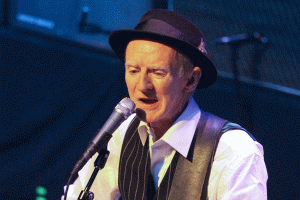
Philip Ryan, Irish singer-songwriter and guitarist professionally known as Philip Chevron and best known as a member of The Pogues, is born on June 17, 1957. He is regarded as one of the most influential figures in Irish punk music.
Chevron grows up in Santry, a suburb of Dublin. Beginning in the late 1970s, he is lead singer and co-founder of the punk rock group The Radiators from Space, receiving some critical acclaim but little widespread popularity or financial success. Following a temporary breakup of the band in 1981, he lives in London for a while where he meets and befriends Shane MacGowan through time spent working together at a record shop. Following the release of the Pogues’ 1984 debut album Red Roses For Me, Chevron is invited to join the band as a temporary replacement for banjo player Jem Finer while on paternity leave. He takes over as guitarist following MacGowan’s decision to concentrate on singing, thereby becoming a full-time member of the band in time for the recording of its second album, Rum, Sodomy and the Lash.
Chevron proves himself as a singer-songwriter, writing the songs Thousands Are Sailing and Lorelei among others. He leaves The Pogues in 1994 following problems with drugs and alcohol. In 2003, he reforms The Radiators (Plan 9) with ex-Pogues bassist Cait O’Riordan. They release the album Trouble Pilgrim in 2006.
In later years, he becomes The Pogues’ unofficial spokesperson and resident expert on the reclusive MacGowan, frequently visiting online fora and directly answering questions from fans. In 2004, he personally oversees the remastering and re-release of The Pogues’ entire back catalogue on CD. He tours regularly with The Pogues, who reunite after a successful reunion tour in 2001.
In June 2007, The Pogues’ website announces that Chevron has been diagnosed with oesophageal cancer. In early 2008, the website announces that Chevron has recovered, and to his surprise and joy, his hearing has returned to almost pre-treatment levels. He embarks on the March 2008 tour of the United States and manages to sing Thousands Are Sailing at each performance. By 2009, Chevron appears to have recovered from the cancer.
However, in May 2013, it is announced that the cancer has returned, and it is “lethal.” In June he stoically tells the Irish Daily Mail, “I am a gay, Irish, Catholic, alcoholic Pogue who is about to die from cancer – and don’t think I don’t know it.” Chevron dies on October 8, 2013, in Dublin at the age of 56. His last public appearance is at the Olympia Theatre in Dublin for a fundraiser in August of that same year.
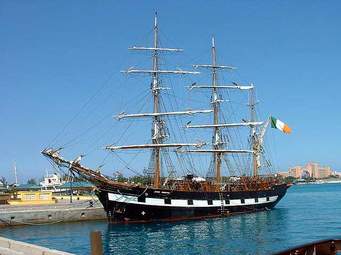
The Jeanie Johnston, a replica of a three-masted barque that was originally built in 1847 in Quebec, Canada, by the Scottish-born shipbuilder John Munn, begins a four-month voyage around Ireland on June 9, 2004.
The original Jeanie Johnston makes her maiden emigrant voyage on April 24, 1848, from Blennerville, County Kerry to Quebec with 193 emigrants on board who are fleeing the effects of the Great Famine that is ravaging Ireland. Between 1848 and 1855, the Jeanie Johnston makes sixteen voyages to North America, sailing to Quebec, Baltimore, and New York. Ships that transport emigrants out of Ireland during this period become known as “famine ships” or “coffin ships.”
The project to build a replica is conceived in the late 1980s, but does not become a reality until November 1993 when a feasibility study is completed. In May 1995, The Jeanie Johnston (Ireland) Company Ltd. is incorporated. The ship is designed by Fred Walker, former Chief Naval Architect with the National Maritime Museum in Greenwich, England.
The original plans are to launch the ship from her shipyard in Blennerville, but a 19th-century shipwreck is discovered by marine archaeologists while a channel is being dredged. To preserve the find, on April 19, 2000 the hull of the Jeanie Johnston is hauled to the shore and loaded onto a shallow-draft barge. There she is fitted with masts and sails, and on May 4 is transported to Fenit, a short distance away. On May 6 the barge is submerged and the Jeanie Johnston takes to the water for the first time. The next day she is officially christened by President Mary McAleese.
In 2003, the replica Jeanie Johnston sails from Tralee to Canada and the United States visiting 32 U.S. and Canadian cities and attracting over 100,000 visitors.
The replica is currently owned by the Dublin Docklands Development Authority who bought it in 2005 for a reported 2.7 million Euro, which were used to clear outstanding loans on the vessel guaranteed by Tralee Town Council and Kerry County Council. It is docked at Custom House Quay in the centre of Dublin.
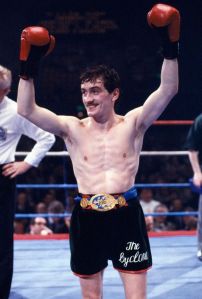
After a successful juvenile boxing career, McGuigan begins his professional boxing career on May 10, 1981, beating Selwyn Bell by knockout in two rounds in Dublin. He wins four out of five additional bouts in 1981. In 1982, McGuigan wins eight fights, seven by knockout, although one of these almost destroys his career and his life. Opposed by Young Ali, on June 14, 1982, McGuigan wins by a knockout in six rounds. Ali falls into a coma and dies five months later.
In 1985, McGuigan meets former world featherweight champion Juan Laporte and wins a 10-round decision. Following one more win, he finally gets his world title attempt when the long reigning WBA featherweight champion, Eusebio Pedroza of Panama, comes to London to put his title on the line at Loftus Road soccer stadium. McGuigan becomes the champion by dropping Pedroza in the seventh round and winning a unanimous fifteen-round decision in a fight refereed by hall of fame referee Stanley Christodoulou. McGuigan and his wife are feted in a public reception through the streets of Belfast that attracts several hundred thousand spectators. Later that year, he is named BBC Sports Personality of the Year, becoming the first person not born in the United Kingdom to win the award.
McGuigan twice successfully defends his title, first against American Bernard Taylor, who is stopped in nine rounds, and then against Dominican Danilo Cabrera in a controversial knock out in fourteen rounds. The fight is stopped after Cabrera bends over to pick up his mouthpiece after losing it, a practice that is allowed in many countries but not in Ireland. Cabrera is not aware of this, and the fight is stopped.
McGuigan’s next defence takes place in Las Vegas in June 1986, where he faces the relatively unknown Steve Cruz of Texas, in a gruelling 15-round title bout under a blazing sun. McGuigan holds a lead halfway through, but suffers dehydration due to the extreme heat and wilts near the end, being dropped in the tenth and fifteenth rounds. He eventually loses the world title, which he never reclaims, in a close decision. After the fight McGuigan requires hospitalisation because of his dehydrated state.
McGuigan retires after the fight but returns to the ring between 1988 and 1989, beating former world title challengers Nicky Perez and Francisco Tomas da Cruz, as well as contender Julio César Miranda, before losing to former EBU featherweight champ and future WBC and WBA super featherweight challenger Jim McDonnell by a technical knockout. After the McDonnell fight he permanently retires from boxing. His record is 32 wins and 3 losses, with 28 knockouts. In January 2005, McGuigan is elected into the International Boxing Hall of Fame.
McGuigan founds and is the current President of the Professional Boxing Association (PBA). He is also the CEO and founder of Cyclone Promotions.
Early in his career, Ryan is involved part-time in pirate radio, presenting a selection of programmes firstly for Alternative Radio Dublin (ARD) and then for Big D. When RTÉ Radio 2, now RTÉ 2fm, is launched in 1979, Ryan joins RTÉ as a DJ where he presents a selection of speech and music-based programmes.
In 1987, Ryan and a group of volunteers spend time in the countryside of Connemara as part of The Gay Byrne Show. Ryan claims to have killed and eaten a lamb to survive, earning him the nickname “Lambo,” though the story turns out to be a hoax.
The Gerry Ryan Show begins in March 1988 when he is offered a three-hour morning radio slot. Ryan’s style is considered by some to be that of a motor-mouth shock jock. The Gerry Ryan Show is subject to several upheld complaints to the Broadcasting Commission of Ireland (BCI). The Gerry Ryan Show becomes something of a national institution as the oldest show still running on 2fm. Despite repeated reshuffles which see all other presenters shifted around, RTÉ never moves The Gerry Ryan Show from its traditional slot.
In October 1990, Ryan receives a Jacob’s Award for The Gerry Ryan Show, described at the award ceremony as “unbelievably bizarre and unprecedented – and at the same time being serious, hilarious, and unpredictable.”
Ryan is noted for his love of fine food and wine. He battles a weight problem for several years. Ryan concedes in his autobiography, Would the Real Gerry Ryan Please Stand Up published in 2008, that he drinks too much for his own good.
Shortly after midday on April 30, 2010, Ryan is found dead in the bedroom of his home on Leeson Street, Dublin. His funeral takes place on May 6, and is broadcast on 2fm, the home of Ryan’s radio show and a first for the predominantly youthpop-oriented station.
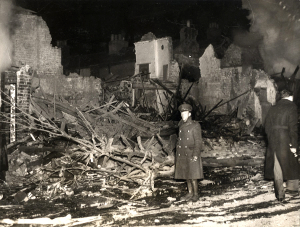
Four German bombs are dropped on north Dublin at approximately 2:00 AM on May 31, 1941. One bomb falls in the Ballybough area, demolishing the two houses at 43 and 44 Summerhill Park, injuring many but with no loss of life. A second bomb falls at the Dog Pond pumping works near the zoo in Phoenix Park, again with no casualties but damaging Áras an Uachtaráin, the official residence of the Irish President. A third bomb makes a large crater in the North Circular Road near Summerhill, again causing no injuries. A fourth bomb falls in North Strand destroying seventeen houses and severely damaging about fifty others, the worst damage occurring in the area between Seville Place and Newcomen Bridge. The raid claims the lives of 28 people, injures 90, destroys or damages approximately 300 houses, and leaves 400 people homeless.
The first bombing of Dublin during World War II occurs early on the morning of January 2, 1941, when German bombs are dropped on the Terenure area of south Dublin. This is followed, early on the following morning of January 3, 1941, by further German bombing of houses on Donore Terrace in the South Circular Road area of south Dublin. A number of people are injured, but no one is killed in these bombings.
After the war, what becomes West Germany accepts responsibility for the raid, and by 1958 it has paid compensation of £327,000. Over 2,000 claims for compensation are processed by the Irish government, eventually costing £344,000. East Germany and Austria, which are both part of Nazi Germany in 1941, make no contribution. The amounts are fixed after the 1953 London Agreement on German External Debts, allowing maximum compensation.
Several reasons for the raid have been asserted over time. German Radio, operated by the Ministry of Public Enlightenment and Propaganda, broadcasts that “it is impossible that the Germans bombed Dublin intentionally.” Irish airspace has been violated repeatedly, and both Allied and German airmen are being interned at the Curragh Camp. A possible cause is a navigational error or a mistaken target, as one of the pathfinders on the raid later recounts. Numerous large cities in the United Kingdom are targeted for bombing, including Belfast, which like Dublin, is across the Irish Sea from Great Britain. War-time Germany’s acceptance of responsibility and post-war Germany’s payment of compensation are cited as further indications that the causation is error on the part of the Luftwaffe pilots.
Another possible reason is that in April 1941, Germany has launched the Belfast blitz, which results in Belfast being heavily bombed. In response, Ireland sends rescue, fire, and emergency personnel to Belfast to assist the city. Éamon de Valera, the Taoiseach, formally protests the bombing to the German government, as well as making his famous “they are our people” speech. Some contend that the raid serves as a warning to Ireland to keep out of the war. This contention is given added credibility when Colonel Edward Flynn, second cousin of Ireland’s Minister for Coordination of Defensive Measures, recalls that Lord Haw Haw has warned Ireland that Dublin’s Amiens Street Railway Station, where a stream of refugees from Belfast is arriving, will be bombed. The station, now called Connolly Station, stands a few hundred metres from North Strand Road, where the bombing damage is heaviest. Flynn similarly contends that the German bombing of Dundalk on July 4 is also a pre-warning by Lord Haw Haw as a punishment for Dundalk being the point of shipment of Irish cattle sold to the United Kingdom.