seamus dubhghaill

Promoting Irish Culture and History from Little Rock, Arkansas, USA


Leave a comment

Birth of Desmond “Des” O’Malley, Irish Politician

Desmond Joseph “Des” O’Malley, Fianna Fáil and Progressive Democrats politician, is born on February 2, 1939, in Limerick, County Limerick.

O’Malley is born into a storied Limerick political family. His maternal grandfather, Denis O’Donovan, is killed during the Irish War of Independence by the Black and Tans, two of his uncles and his father hold the office of Mayor of Limerick, and his uncle Donogh O’Malley is a Minister for Education. He is educated at the Jesuit Crescent College and at University College Dublin (UCD), from which he graduates with a degree in law in 1962.

In 1968, O’Malley enters politics upon the sudden death of his uncle Donogh who, at that the time, is the sitting Minister for Education. He is chosen after Donogh’s widow, Hilda, still in shock at the sudden death of her husband, turns down the opportunity to contest the by-election necessitated by his death.

O’Malley is subsequently elected as a Fianna Fáil TD for the Limerick East constituency in the by-election. Perhaps the first sign of the defiance that would define his career materialises during the 1969 Irish general election when Hilda asks her nephew to step aside and allow her to contest in the Limerick East constituency as the main Fianna Fáil candidate. He refuses and places third in the four-seat constituency, with his aunt, running as an independent, coming in fifth.

Following the general election, O’Malley is appointed Parliamentary Secretary to both Minister for Defence Jim Gibbons and Taoiseach Jack Lynch and serves as Government Chief Whip. In his role as a confidante of Lynch, the political lines within Fianna Fáil that put him on a collision course of over twenty years with Charles Haughey, are drawn. He plays a central role in the Arms Crisis prosecutions of Haughey and Neil Blaney in 1970. After their acquittals, the stage is set within Fianna Fáil for a long-term power struggle that eventually results in O’Malley’s expulsion from the party in 1984.

In the meantime, O’Malley’s next position within Lynch’s government comes when he is made Minister for Justice after Mícheál Ó Móráin is forced to resign due to ill-health. One of the most significant aspects of his legacy transpires during his tenure as Minister for Justice from 1970 to 1973. In response to the ongoing conflict in Northern Ireland, he tries and fails to introduce internment without trial for republicans within the State. He is, however, successful in reintroducing the Offences Against the State Act, which enables convictions for Irish Republican Amy (IRA) membership on the word of a Garda Superintendent, and the Special Criminal Court, a non-jury court presided over by three judges which tries cases of terrorism and serious organised crime.

When Lynch resigns the Fianna Fáil leadership following electoral defeat in 1979, O’Malley and Martin O’Donoghue manage the leadership campaign of George Colley, who subsequently loses to Haughey. Following Haughey’s ascent to leadership, O’Malley retains the industry and commerce ministerial portfolio he had been appointed to following the 1977 Irish general election.

In 1982, after Fianna Fáil loses its majority but stays in government by virtue of a confidence and supply agreement with Sinn Féin – The Workers Party and two independents, O’Malley is appointed Minister for Trade, Commerce and Tourism, but with the death of Colley and the loss of O’Donoghue’s seat, he becomes increasingly isolated within Fianna Fáil.

After the party whip is removed from him in 1984, amidst inter-party wrangling over the New Ireland Forum, O’Malley is expelled from the party the following year, the final straw being his famous “I stand by the Republic” speech in which he announces his intention to abstain on a vote regarding the liberalisation of the sales of contraceptives, which Fianna Fáil opposes.

O’Malley goes on to establish the Progressive Democrats, joined by Mary Harney (who had also been expelled by Fianna Fáil), and later by Fianna Fáil TDs Bobby Molloy and Pearse Wyse, as well as Fine Gael TD Michael Keating. In the 1987 Irish general election, the Progressive Democrats win fourteen seats, making them the third biggest party in the Dáil. Among those elected are O’Malley, his cousin Patrick O’Malley, Anne Colley, daughter of George Colley, Martin Gibbons, son of Jim Gibbons, Michael McDowell and Martin Cullen.

O’Malley’s animus for Haughey does not stop him from entering coalition with Fianna Fáil after the 1989 Irish general election, with him once again appointed Minister for Industry and Commerce. While in government, he finally witnesses the downfall of Haughey in 1992, when he is forced to resign over the emergence of new evidence concerning his tapping of journalists’ phones in the 1980s. The coalition with Fianna Fáil does not last long under new Taoiseach Albert Reynolds, with the Government collapsing after Reynolds accuses O’Malley of dishonesty during the Beef Tribunal.

O’Malley retires as leader of the Progressive Democrats in 1993, and the party moves into opposition, only to re-enter government with Fianna Fáil in 1997, where it remains upon O’Malley’s retirement from politics in 2002.

While the Progressive Democrats no longer exist, they are generally credited with the breaking up of the Fianna Fáil versus Fine Gael dichotomy of Irish politics that had dominated since the founding of the Free State. Since 1922, Irish governments have tended to be either single-party Fianna Fáil cabinets, be they minority or majority, or Fine Gael-led coalitions, typically involving the Labour Party. A Fine Gael-Labour coalition is in power at the time of the founding of the Progressive Democrats, and a single-party government or clear majority has not been won in Ireland since.

O’Malley dies in Dublin on July 21, 2021, at the age of 82, having been in poor health for some time. He is predeceased by his wife, Pat, and survived by their six children, four daughters including the former TD Fiona O’Malley, and two sons.

Perhaps O’Malley’s greatest legacy is the political reality of Ireland today: the low-tax, pro-business economic policies of the Progressive Democrats have been the dominant ideology in the State since the 1990s. Sinn Féin, the party most affected by his measures as Minister for Justice, no longer vote against the retention of the Offences Against the State Act and Special Criminal Court.

(From: “Desmond O’Malley: 1939-2021,” eolas Magazine, http://www.eolasmagazine.ie, August 2021)


Leave a comment

Birth of Pete St. John, Irish Folk Singer-Songwriter

Peter Mooney, Irish folk singer-songwriter known professionally as Pete St. John, is born in Inchicore, Dublin on January 31, 1932. He is best known for composing “The Fields of Athenry.”

St. John is the eldest of six children born to Tommy and Lottie Mooney. He is educated at Scoil Muire Gan Smál and Synge Street CBS. He emigrates to Ontario, Canada in 1958 where he takes what labouring jobs he can find. Within six months he meets a woman named Gert Gorman who has an electrical contracting company in the United States. She and her husband sponsor him to move to Washington, D.C., where he is able to work as an electrician. He marries his sweetheart, Susie Bourke, who is from a well-known Dublin theatrical family with links to both the Gaiety and the Olympia theatres. They have two sons, Kieron and Brian. He travels widely and becomes involved in the peace movement and the civil rights movement. He remains in the United States until 1970, returning to settle in Collins Avenue in north Dublin.

The Dublin city that St. John returns to is a changed place from the one he had grown up in and proves to be the spur that inspires his songwriting. He chooses “St. John” as his nom de plume, inspired by a middle name he had been given while at school when all the boys in his class were assigned saints’ names. In 1975, he is running a theatre in Petticoat Lane on Marlborough Street, and while fixing an alarm outside a window on the first floor, the ledge on which he is leaning gives way, resulting in a bad fall. He breaks his elbow and hip and spends six months in the hospital recuperating. It is during this time that he takes to songwriting in earnest.

St. John is an extrovert who loves people. He is a voracious reader with a particular interest in Irish history. His son Kieron recalls his father writing “The Rare Aul Times” during this recovery period and singing it to his family. The Dublin City Ramblers is the first band to cover the song, but it is Danny Doyle’s version that achieves a real breakthrough, spending eleven weeks in the Irish Singles Chart, reaching No. 1 in 1978.

In 1978, St. John writes “The Fields of Athenry,” a tale of a man exiled to Botany Bay for stealing food to feed his family during the Famine. It has been recorded by several artists, charting in the Irish Singles Chart on a number of occasions. A recording by Paddy Reilly, which is released in 1982, remains in the Irish charts for 72 weeks.

St. John pays close attention to the melding of lyric and melody and has particular form in writing memorable melodies that sound timeless, resonating deeply with listeners across all walks of life. His songs sometime express regret for the loss of old certainties, for example, the loss of Nelson’s Pillar and the Metropole Ballroom, two symbols of old Dublin, as progress makes a “city of my town.”

St. John describes his chosen craft with affection. “Songs are magic carpets. They can tell a story over and over again without boring the pants off the listener and maybe take us out of ourselves for a few moments of peaceful escapism. With easy to remember melody lines, the words can tell of times and events in our daily lives that are worth noting or remembering.”

St. John’s songbook consists of hundreds of compositions, including “The Ferryman,” “Waltzing on Borrowed Time” and “The Furey Man” and are recorded by over 2,500 artists. He is a founding member of the Irish Music Rights Organisation (IMRO) and is always generous and supportive of younger writers, some of whom he continues to mentor well into his 80s.

St. John is surprised and delighted at the affiliation that emerges between “The Fields of Athenry” and rugby and football sporting events. He is present in Croke Park in 2007 when Ireland beats England in the Six Nations, and where the song is sung three times over. It is a song often heard in Anfield in Liverpool, and at Glasgow Celtic games, and reverberates around the stadium at Chicago’s Soldier Field when Ireland beats the All Blacks on November 5, 2016.

St. John wins several awards, including the Irish Music Rights Organisation “Irish Songwriter of the Year.”

St. John lives life to the fullest, and while he suffers ill health in his later years with both diabetes and Parkinson’s disease, he never loses his zest for life. His son Kieron describes his father with affection as a man who had nine lives and lived them all to the fullest. He lives independently at home until his admission to Beaumont Hospital in Dublin. He dies peacefully there at the age of 90 on March 12, 2022. After his funeral, Paddy Reilly and Glen Hansard perform “The Fields of Athenry” at Beaumont House in Dublin as a tribute.


Leave a comment

Death of St. John Greer Ervine, Playwright & Author

St. John Greer Ervine, unionist playwright, author, critic, and manager of the Abbey Theatre from 1915 to 1916, dies in a nursing home at Fitzhall, Ipling, Sussex, England, on January 24, 1971.

Ervine is born in Ballymacarrett, Belfast on December 28, 1883. He is considered to be the founding father of modern Northern Irish drama.

Although accepted to study at Trinity College, Dublin, circumstances force Ervine to leave school at the age of 15 to begin working in an insurance office.

Two years later, Ervine immigrates to London, where he discovers a love for the theatre. He begins his writing career with Mixed Marriage (1911), an Ulster tragedy, and produces three plays between 1911 and 1915. In 1915, after a meeting with William Butler Yeats in London, he becomes the director of the Abbey Theatre in Dublin. It is, however, not a happy appointment as his personality and politics clash with the management of the theatre.

Ervine then joins the Royal Dublin Fusiliers and fights in Flanders, losing a leg in the conflict. Returning home, he feels increasingly alienated by nationalism and more attracted to the unionism of his family background. He becomes a vehement detractor of the south, describing Ireland in a letter to George Bernard Shaw as brimming with “bleating Celtic Twilighters, sex-starved Daughters of the Gael, gangsters and gombeen men.”

Ervine is a distinctively Ulster orientated writer, focusing on a naturalistic portrayal of rural and urban life. His most famous and popular work amongst his Northern Irish audience is Boyd’s Shop (1936), which becomes one of the Ulster Group Theatre’s stalwart productions. The play is a classic of the homely yet sincere Ulster genre and centres around the struggles of the folk that Ervine grew up with in his grandmother’s shop on the Albertbridge Road. Ervine creates in Boyd’s Shop a template for Ulster theatre that is to dominate until the advent of Samuel Thompson‘s Over the Bridge.

Ervine’s reactionary unionism and anti-southern hatred becomes more pronounced as he ages and eclipses his more subtle characteristics and abilities as a writer. Although many of his novels and plays are at times clouded by his prejudices, they are also very often capable of tremendous feeling and humanity showing he is a writer of note.

St. John Greer Ervine dies at the age of 87 at Fitzhall, Ipling, Sussex on January 24, 1971.


Leave a comment

Death of Paddy Daly, IRA Volunteer & National Army Officer

Paddy Daly, sometimes referred to as Paddy O’Daly, dies at his home in County Dublin on January 16, 1957. He serves in the Irish Republican Army (IRA) during the Irish War of Independence (1919–1921) and subsequently holds the rank of major general in the Irish National Army from 1922 to 1924.

Daly is born in Dublin in 1888. He fights in the 1916 Easter Rising under the command of his namesake Edward Daly, leading the unsuccessful attempt to destroy the Magazine Fort in the Phoenix Park. He is later wounded in the particularly vicious fighting near the Linenhall. He is subsequently interned in Frongoch internment camp for his part in the rebellion until 1918, when he is released as part of a general amnesty for Irish prisoners.

During the Irish War of Independence, Daly serves as leader of the “Squad,” Michael Collins‘ assassination unit.

On December 19, 1919, Daly along with Dan Breen lead an abortive ambush, at Ashtown railway station near the Phoenix Park, on the British Viceroy, Lord Lieutenant of Ireland and Supreme Commander of the British Army in Ireland, Lord French, as he returns from a private party which he had hosted the previous evening at his country residence in Frenchpark, County Roscommon. Lord French escapes the ambush, but Martin Savage is shot dead.

Daly and the men under his command are responsible for the killing of many British intelligence officers, in particular District Inspector Redmond, who had been putting increasing pressure on the Squad. Daly himself personally kills several people, including Frank Brooke, director of Great Southern and Eastern Railway, who serves on an advisory council to the British military, in June 1920. He does not directly lead any of the attacks on Bloody Sunday but is on standby in one of the Squad’s safe houses. In the aftermath, November 23, 1920, he is arrested and interned in Abercorn Barracks in Ballykinler, County Down.

Daly is released on parole from Ballykinler in March 1921, the British apparently being unaware of his senior position within the Dublin Brigade of the IRA. After his release, he, along with Emmet Dalton, is also involved in the attempt to free Seán Mac Eoin from Mountjoy Prison on May 14, 1921. He and his men hijack a British Army Peerless armoured car in Clontarf at the corporation abattoir, while it is escorting a consignment of meat to a barracks and shoot dead two soldiers in the process. The plan involves Dalton and Joe Leonard impersonating two British army officers and using forged documents to “transfer” MacEoin to Dublin Castle. They gain entry to Mountjoy but are discovered before they can free MacEoin and have to shoot their way out. They later abandon the armoured car after removing the Hotchkiss machine guns and setting fire to what they can. Toward the end of the war, in May 1921, the two principal fighting units of the IRA’s Dublin Brigade, the “Squad” and the “Active Service Unit” are amalgamated after losses suffered in the burning of the Custom House. Daly is named Officer Commanding (OC) of this new unit, which is named the Dublin Guard.

Daly’s own account of his activities during the Irish War of Independence is held at the Bureau of Military History in Cathal Brugha Barracks.

After the Anglo-Irish Treaty splits the IRA, Daly and most of his men side with the pro-treaty party, who go on to found the Irish Free State. He is appointed to the rank of brigadier in the newly created Irish National Army, which is inaugurated in January 1922. When the Irish Civil War breaks out in June 1922, he commands the Free State’s troops who secure Dublin, after a week of fighting.

In August 1922, during the Irish Free State offensive that re-takes most of the major towns in Ireland, Daly commands a landing of 450 troops of the Dublin Guard at Fenit, County Kerry, which goes on to capture Tralee from the anti-treaty forces. Acting with severe brutality in Kerry, he comments that, “nobody had asked me to take kid-gloves to Kerry, so I didn’t.” As the Civil War develops into a vicious guerrilla conflict, he and his men are implicated in a series of atrocities against anti-treaty prisoners, culminating in a series of killings with land mines in March 1923. Daly, and others under his command, claim that those killed were accidentally blown up by their own mines. Statements by the Garda Síochána, two Free State lieutenants on duty, W. McCarthy and Niall Harrington, and one survivor, Stephen Fuller, maintain the claims are fabricated.

Daly resigns from the Free State army in 1924 after an incident in Kenmare, County Kerry, concerning the daughters of a doctor. A court martial is held but collapses as no one is prepared to give evidence. He volunteers his services for the Irish Army again in 1940 and is appointed as a Captain to the non-combatant Construction Corps.

Daly is a carpenter by trade. He marries Daisy Gillies in 1910. His brother James (Seamus) marries Daisy’s sister Nora, a Cumann na mBan activist, in a joint wedding ceremony. After Daisy’s death in 1919, Daly marries Bridget Murtagh, also a Cumann na mBan activist, in 1921. Murtagh and Nora O’Daly carry out intelligence gathering for the planned attack on the Magazine Fort in 1916. She is a sister of Elizabeth Murtagh, the first wife of Commandant Michael Love who serves with Daly in the Collins Squad of the IRA, in the Irish Free State Army of the 1920s and during the Emergency period. Murtagh dies in childbirth in 1930. Daly subsequently marries Norah Gillies, his first wife’s niece.

On his death on January 16, 1957, Daly is buried with full military honours in Mount Jerome Cemetery. He is survived by his brothers, Comdt Seamus O’Daly and Capt Frank O’Daly, his sons Patrick and Colbert, and his daughters Brede and Philomena.


2 Comments

Death of Arthur Armstrong, Northern Irish Painter

Arthur Armstrong, painter who often works in a Cubist style and produces landscape and still life works, dies in Dublin on January 13, 1996.

Armstrong is born on January 12, 1924, at Carrickfergus, County Antrim, Northern Ireland, one of three sons among six children of James Charlton Armstrong, housepainter and decorator, and his wife Margaret (née Howard). Soon after his birth the family moves to Belfast. He attends Strandtown Primary School. He attends Queen’s University Belfast (QUB) in the early 1940s, where he initially studies political science and later architecture. Having an interest in art, which had been fostered by his father, he takes classes for a short time in the early 1940s at the Belfast School of Art. It is there he meets Gerard Dillon, who introduces him to George Campbell and Daniel O’Neill. He is largely self-taught as an artist. It is his close association with Dillon and Campbell, both some years his senior, that proves to be the most important factor in his development. In Belfast in the early 1940s they associate with the Russian artist Daniel Nietzche, who emphasises to them the importance of personal expression.

After leaving university Armstrong works at the Belfast Gas Office. At this point he is the main support for his widowed mother. Having saved some money, he leaves his job in 1946 to attempt to fulfil his ambition to paint full-time, producing a set of etchings with George Campbell, which are published by Walsh Studios. The following year he takes work as a designer for Ulster Laces in Portadown, County Armagh. In 1957, he leaves for London in the hopes of finding greater opportunities as an artist. His friends Campbell and Dillon are already living there, and he takes lodgings with Dillon’s sister at Abbey Road, north London. Though he continues to paint, he is unable to earn a living and so again has to take other work, this time in a Labour Exchange office. However, he is beginning to gain recognition. In 1957, he is awarded a traveling scholarship by the Council for the Encouragement of Music and the Arts (CEMA), which enables him to travel to Spain. He continues to visit Spain throughout the 1960s, often to see Campbell, who spends much time there.

In 1961 he has his first solo exhibition at the CEMA gallery in Belfast. He comes to live in Dublin in 1962, his work having already been exhibited there at the Irish Exhibition of Living Art in 1957 and 1958. He continues to exhibit there annually from 1961 to 1965. During the 1960s and early 1970s his work is regularly included in the Oireachtas exhibition, at which he is awarded the Douglas Hyde Gold Medal in 1968. He also shows his work with the Ritchie Hendriks Gallery and the Tom Caldwell Gallery in Dublin. Ultimately, he is to have over seventy solo exhibitions throughout his career. By 1969, when he is elected an associate member of the Royal Hibernian Academy (RHA), he has established himself as one of the leading landscape painters in Ireland. In 1972 he becomes a full member of the RHA. He exhibits there regularly until 1977.

It is during this period that some of Armstrong’s best work is produced. While landscape is his predominant theme, he never sees himself as a painter of particular views, rather he responds to the abstract qualities of a scene. He sees elements such as the sea, rocks or sky as a series of interlocking textures to be rendered expressively in oil paint. The western coastline of Ireland is a vital source of inspiration for him. Roundstone, County Galway, is a favoured base for painting trips in the company of Dillon and Campbell, who by this time are also living in Dublin.

In 1981, a retrospective exhibition of Armstrong’s work is organised by the Arts Council of Northern Ireland. He is represented in many major public and corporate collections in Ireland. From 1971 he lives at 28 Chelmsford Avenue, Ranelagh, Dublin, in a house he shares with Gerard Dillon.

Armstrong dies unmarried on January 13, 1996, in Dublin. The contents of his studio are sold on February 3, 1998.

(From: “Armstrong, Arthur” by Rebecca Minch, Dictionary of Irish Biography, http://www.dib.ie, October 2009, revised November 2013 | Pictured: “Near Ballyhubbock,” oil on board by Arthur Armstrong RHA)


Leave a comment

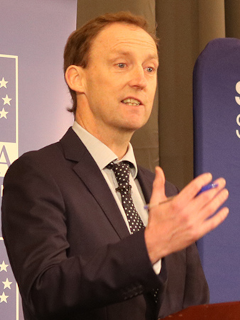
Birth of Michelle O’Neill, Vice President of Sinn Féin

Michelle O’Neill (née Doris), Irish politician who serves as deputy First Minister of Northern Ireland between 2020 and 2022, is born in Fermoy, County Cork, Republic of Ireland, on January 10, 1977. She has been serving as Vice President of Sinn Féin since 2018 and is the Member of the Legislative Assembly (MLA) for Mid Ulster since 2007.

O’Neill comes from an Irish republican family in Clonoe, County Tyrone, Northern Ireland. Her father, Brendan Doris, was a Provisional Irish Republican Army (IRA) prisoner and Sinn Féin councillor. Her uncle, Paul Doris, is a former national president of the Irish Northern Aid Committee (NORAID). A cousin, Tony Doris, was one of three IRA members killed by the British Army‘s Special Air Service (SAS) in the Coagh ambush in 1991. Another cousin, IRA volunteer Gareth Malachy Doris, was shot and wounded during the 1997 Coalisland attack.

After the death of Brendan Doris in 2006, Martin McGuinness pays tribute to the Doris family as “a well-known and respected republican family [who] have played a significant role in the republican struggle for many years.”

O’Neill attends St. Patrick’s Girls’ Academy, a Catholic grammar school in Dungannon, County Tyrone. She subsequently begins to train as an accounting technician, before pursuing a political career.

O’Neill becomes involved in republican politics in her teens, assisting her father with constituency work in his role as a Dungannon councillor. She joins Sinn Féin after the Good Friday Agreement in 1998, at the age of 21, and starts working as an advisor to Francie Molloy in the Northern Ireland Assembly, holding this role until 2005.

O’Neill serves on the Dungannon and South Tyrone Borough Council from 2005 to 2011. She serves as the first female Mayor of Dungannon and South Tyrone from 2010 to 2011. In the 2007 Northern Ireland Assembly election she is elected to represent Mid Ulster in the Northern Ireland Assembly. In 2011, she is appointed to the Northern Ireland Executive by deputy First Minister Martin McGuinness as Minister for Agriculture and Rural Development. In 2016, she is promoted to Minister of Health. In January 2020, she becomes deputy First Minister of Northern Ireland after the New Decade, New Approach (NDNA) agreement restores the power sharing executive.

O’Neill automatically relinquishes her office following Paul Givan‘s resignation as first minister on February 3, 2022. Sinn Féin becomes the largest party after the 2022 Northern Ireland Assembly election, putting O’Neill in line to become the First Minister of Northern Ireland, and the Democratic Unionist Party (DUP) leader to become the deputy First Minister of Northern Ireland. However, she remains to be officially sworn in as First Minister because, as part of its opposition to the Northern Ireland Protocol, the DUP has refused to nominate a deputy First minister and there is therefore no functioning executive of Northern Ireland.

In August 2022, O’Neill is asked in a BBC interview whether it was right during the Troubles for the Provisional IRA “to engage in violent resistance to British rule.” She is criticised for her response, “I think at the time there was no alternative, but now thankfully we have an alternative to conflict, and that is the Good Friday Agreement – that is why it’s so precious to us all.”

In May 2023, O’Neill attends the coronation of King Charles, saying, “Well obviously I wanted to be here. We live in changing times, and it was the respectful thing to do, to show respect and to be here for all those people at home, who I had said I would be a first minister for all. Attendance here is about honouring that and fulfilling my promise.”

Under O’Neill’s leadership, Sinn Fein has led most opinion polls for the next United Kingdom general election.


Leave a comment

Death of Seán MacEntee, Fianna Fáil Politician

Seán Francis MacEntee (Irish: Seán Mac an tSaoi), Fianna Fáil politician, dies on January 9, 1984, in Booterstown, Dublin. He serves as Tánaiste (1959-65), Minister for Social Welfare (1957-61), Minister for Health (1957-65), Minister for Local Government and Public Health (1941-48), Minister for Industry and Commerce (1939-41), and Minister for Finance (1932-39 and 1951-54). He serves as a Teachta Dála (TD) from 1918 to 1969. At the time of his death, he is the last surviving member of the First Dáil.

MacEntee is born as John McEntee at 47 King Street, Belfast, on August 23, 1889, the son of James McEntee, a publican, and his wife, Mary Owens, both of whom are from Monaghan. James McEntee is a prominent Nationalist member of Belfast Corporation and a close friend of Joseph Devlin MP.

MacEntee is educated at St. Mary’s Christian Brothers’ Grammar School, St. Malachy’s College and the Belfast Municipal College of Technology where he qualifies as an electrical engineer. His early political involvement is with the Irish Socialist Republican Party in Belfast. He quickly rises through the ranks of the trade union movement becoming junior representative in the city’s shipyards. Following his education, he works as an engineer in Dundalk, County Louth, and is involved in the establishment of a local corps of the Irish Volunteers in the town. He mobilises in Dundalk and fights in the General Post Office garrison in the Easter Rising in 1916. He is sentenced to death for his part in the rising. This sentence is later commuted to life imprisonment. He is released in the general amnesty in 1917 and is later elected a member of the National Executives of both Sinn Féin and the Irish Volunteers in October 1917. He is later elected Sinn Féin Member of Parliament (MP) for South Monaghan at the 1918 Irish general election.

An attempt to develop MacEntee’s career as a consulting engineer in Belfast is interrupted by the Irish War of Independence in 1919. He serves as Vice-Commandant of the Belfast Brigade of the Irish Republican Army (IRA). He is also a member of the Volunteer Executive, a sort of Cabinet and Directory for the Minister for Defence and the HQ Staff, however, he remains one of the few Sinn Féiners from the north. On August 6, 1920, he presents ‘a Memorial’ lecture to the Dáil from the Belfast Corporation. He tells the Dáil it is the only custodian of public order, that a Nationalist pogrom is taking place, and he advises them to fight Belfast. The Dáil government’s policy is dubbed Hibernia Irredenta or “Greening Ireland.” He is asked to resign his South Monaghan seat after voting against a bunting celebration in Lurgan to mark the signing of the Anglo-Irish Treaty.

In April 1921 MacEntee is transferred to Dublin to direct a special anti-partition campaign in connection with the May general election. It remains Michael Collins‘s policy, he declares, that the largely Protestant shipyard workers of Belfast are being directed by the British, urging all Irishmen to rejoin the Republic. Correspondingly the Ulster Unionist Council rejects the call for a review of the boundary commission decision made on Northern Ireland. But when Ulstermen choose James Craig as Premier, Collins denounces democracy in the north as a sham. It is on the partition of Ireland issue that MacEntee votes against the Anglo-Irish Treaty of 1921. During the subsequent Irish Civil War, he commands the IRA unit in Marlboro Street Post Office in Dublin. He later fights with Cathal Brugha in the Hamman Hotel and is subsequently interned in Kilmainham and Gormanstown until December 1923.

After his release from prison, MacEntee devotes himself more fully to his engineering practice, although he unsuccessfully contests the Dublin County by-election of 1924. He becomes a founder-member of Fianna Fáil in 1926 and is eventually elected a TD for Dublin County at the June 1927 Irish general election.

MacEntee founds the Association of Patent Agents in 1929, having gained his interest in Patents when he worked as an assistant engineer in Dundalk Urban District Council. He values his status as a Patent Agent as he maintains his name on the Register for over 30 years while he holds Ministerial rank in the Irish Government, although he is not believed to have taken any active part in the patent business, which is carried on by his business partners.

In 1932, Fianna Fáil comes to power for the very first time, with MacEntee becoming Minister for Finance. In keeping with the party’s protectionist economic policies his first budget in March of that year sees the introduction of new duties on 43 imports, many of them coming from Britain. This sees retaliation from the British government, which in turn provokes a response from the Irish government. This is the beginning of the Anglo-Irish Trade War between the two nations, however, a treaty in 1938, signed by MacEntee and other senior members brings an end to the issue.

In 1939, World War II breaks out and a cabinet reshuffle results in MacEntee being appointed as Minister for Industry and Commerce, taking over from his rival Seán Lemass. During his tenure at this department, he introduces the important Trade Union Act (1941). In 1941, another reshuffle of ministers takes place, with him becoming Minister for Local Government and Public Health. The Health portfolio is transferred to a new Department of Health in 1947. Following the 1948 Irish general election, Fianna Fáil returns to the opposition benches for the first time in sixteen years.

In 1951, Fianna Fáil are back in government, although in minority status, depending on independent deputies for survival. MacEntee once again returns to the position of Minister for Finance where he feels it is vital to deal with the balance of payments deficit. He brings in a harsh budget in 1951 which raises income tax and tariffs on imports. His chief aim is to cut spending and reduce imports, however, this comes at a cost as unemployment increases sharply. The increases are retained in his next two budgets in 1952 and 1953. It is often said that it is his performance during this period that costs Fianna Fáil the general election in 1954. The poor grasp on economics also does his political career tremendous damage as up to that point he is seen as a likely successor as Taoiseach. Seán Lemass, however, is now firmly seen as the “heir apparent.”

In 1957, Fianna Fáil returns to power with an overall majority with MacEntee being appointed Minister for Health. The financial and economic portfolios are dominated by Lemass and other like-minded ministers who want to move away from protection to free trade. He is credited during this period with the reorganisation of the health services, the establishment of separate departments of health and social welfare, and the fluoridation of water supplies in Ireland. In 1959, he becomes Tánaiste when Seán Lemass is elected Taoiseach.

Following the 1965 Irish general election, MacEntee is 76 years old and retires from the government. He re-emerges in 1966 to launch a verbal attack on Seán Lemass for deciding to step down as party leader and Taoiseach. The two men, however, patch up their differences shortly afterwards. MacEntee retires from Dáil Éireann in 1969 at the age of 80, making him the oldest TD in Irish history.

MacEntee dies in Dublin on January 9, 1984, at the age of 94. He is buried in Glasnevin Cemetery, Dublin.


Leave a comment

Death of Harry Clarke, Stained-Glass Artist & Illustrator

Henry Patrick (Harry) Clarke, Irish stained-glass artist and book illustrator, dies on January 6, 1931, in Chur, Switzerland. He is a leading figure in the Irish Arts and Crafts movement.

Clarke is born in Dublin on March 17, 1889, the younger son and third child of Joshua Clarke and Brigid Clarke (née MacGonigal). Church decorator Joshua Clarke moves to Dublin from Leeds, West Yorkshire, England, in 1877 and starts a decorating business, Joshua Clarke & Sons, which later incorporates a stained-glass division. Through his work with his father, Clarke is exposed to many schools of art but Art Nouveau in particular.

Clarke is educated at the Model School in Marlborough Street, Dublin, and Belvedere College, which he leaves in 1905. After his mother’s death in 1903, he is apprenticed into his father’s studio and attends evening classes in the Metropolitan College of Art and Design. His The Consecration of St. Mel, Bishop of Longford, by St. Patrick wins the gold medal for stained-glass work in the 1910 Board of Education National Competition. At the art school in Dublin, he meets fellow artist and teacher Margaret Crilley. They marry on October 31, 1914.

Clarke moves to London to seek work as a book illustrator. Picked up by London publisher George G. Harrap and Co., he starts with two commissions which are never completed. Difficulties with these projects makes Fairy Tales by Hans Christian Andersen his first printed work, in 1916. It includes 16 colour plates and more than 24 halftone illustrations. This is followed by illustrations for an edition of Edgar Allan Poe‘s Tales of Mystery and Imagination, the second version of which, published in 1923, makes his reputation as a book illustrator. His work can be compared to that of Aubrey Beardsley, Kay Nielsen, and Edmund Dulac. His final book, Selected Poems of Algernon Charles Swinburne, is published in 1928.

Clarke also continues to work in stained-glass, producing more than 130 windows. His glass is distinguished by the finesse of its drawing and his use of rich colours. He is especially fond of deep blues. His use of heavy lines in his black-and-white book illustrations echoes his glass techniques.

Clarke’s stained-glass work includes many religious windows, including the windows of the Honan Chapel in University College Cork. He also produces much secular stained-glass such as a window illustrating John KeatsThe Eve of St. Agnes (now in the Hugh Lane Gallery in Dublin) and the Geneva Window, (now in the Wolfsonian Museum, Miami Beach, Florida). Perhaps his most seen works are the windows he creates for Bewley’s on Dublin’s Grafton Street.

Clarke is plagued with ill health, in particular respiratory problems. He is diagnosed with tuberculosis in 1929 and goes to a sanatorium in Davos, Switzerland. Fearing that he will die abroad, he begins his journey back to Dublin in 1931, but dies on this journey on January 6, 1931, in Chur where he is buried. A headstone is erected but local law requires that the family pledge to maintain the grave 15 years after the death. This is not explained to the Clarke family and Harry Clarke’s remains are disinterred in 1946 and reburied in a communal grave.


3 Comments

Death of Donal Donnelly, Irish Theatre & Film Actor

Donal Donnelly, Irish theatre and film actor, dies in Chicago, Illinois, on January 4, 2010. Perhaps best known for his work in the plays of Brian Friel, he has a long and varied career in film, on television and in the theatre. He lives in Ireland, the United Kingdom and the United States at various times, and his travels lead him to describe himself as “an itinerant Irish actor.”

Donnelly is born to Irish parents in Bradford, West Yorkshire, England, on July 6, 1931. His father James is a doctor from County Tyrone, and his mother Nora O’Connor is a teacher from County Kerry.

Donnelly is raised in Dublin where he attends Synge Street CBS, where he acts in school plays with Milo O’Shea, Eamonn Andrews, Jack MacGowran, Bernard Frawley (Seattle Repertory Co.) and Jimmy Fitzsimons (brother of Maureen O’Hara), under the direction of elocution teacher, Ena Burke.

Donnelly gets his start in an amateur group calling itself the Globe Theatre Players. It is organised and run by Jim Fitzgerald and Monica Brophy. He then later tours with Anew McMaster‘s Irish repertory company before moving to England where he stars with Rita Tushingham in the film The Knack …and How to Get It.

Donnelly’s breakthrough role comes when he is cast as Gar Private in the world premiere of Brian Friel’s Philadelphia, Here I Come! directed by Hilton Edwards for the Gate Theatre at the Dublin Theatre Festival in 1964. The production subsequently transfers to Broadway where it plays for over 300 performances and establishes Donnelly and Patrick Bedford, who plays his alter-ego Gar Public, as formidable new talents to be reckoned with. They are jointly nominated for the Tony Award for Best Performance by a Leading Actor in a Play in 1966.

Donnelly returns to Broadway a number of times, replacing Albert Finney in A Day in the Death of Joe Egg in 1968, playing Milo Tindle in Anthony Shaffer‘s Sleuth and appearing as Frederick Treves opposite David Bowie as The Elephant Man. He also renews his relationship with Brian Friel, appearing in the world premieres of Volunteers at the Abbey Theatre in 1975 and Faith Healer with James Mason at the Longacre Theatre in New York City in 1979, as well as the Broadway premieres of Dancing at Lughnasa in 1991 and Translations in 1995.

For many years, Donnelly tours a one-man performance of the writings of George Bernard Shaw, adapted and directed by Michael Voysey and entitled My Astonishing Self.

Donnelly’s film roles include Archbishop Gilday in The Godfather Part III and as Freddy Malins in John Huston‘s final work, The Dead, based on the short story by James Joyce, where he gains particular acclaim for his performance.

On television, Donnelly plays the lead role of Matthew Browne in the 1970s ITV sitcom Yes, Honestly, opposite Liza Goddard. But from the late 1950s onwards, he often appears in such British TV programs as The Avengers, Z-Cars and The Wednesday Play.

Donnelly is an acclaimed audiobook reader whose catalogue includes Pinocchio, Peter Pan, Voltaire‘s Philosophical Dictionary, and several audio versions of the works of James Joyce.

In 1968, Donnelly records an album of Irish songs, Take the Name of Donnelly, which is arranged, produced and conducted by Tony Meehan formerly of the Shadows.

Donnelly, who is a heavy smoker all his life, dies from cancer at the age of 78 in Chicago, Illinois, on January 4, 2010. He is survived by his wife, Patricia ‘Patsy’ Porter, a former dancer he met working on Finian’s Rainbow, and two sons, Jonathan and Damian. Their only daughter, Maryanne, predeceases him after being killed in a riding accident. A brother, Michael Donnelly, is a Fianna Fáil senator and councillor, and Lord Mayor of Dublin (1990–91).


Leave a comment

Founding of Córas Iompair Éireann

Córas Iompair Éireann (Irish for Irish Transport Company), or CIÉ, a statutory corporation of Ireland, is founded on January 1, 1945. CIÉ is answerable to the Irish Government and responsible for most public transport within the Republic of Ireland and jointly with its Northern Ireland counterpart, the Northern Ireland Transport Holding Company for the railway service between the Republic of Ireland and Northern Ireland. The company is headquartered at Heuston Station, Dublin. Its members are appointed by the Minister for Transport.

Córas Iompair Éireann is formed as a private company by the Transport Act 1944 and incorporates the Great Southern Railways Company and Dublin United Transport Company, initially adopting the logo of the latter company. Great Southern Railways (GSR) is incorporated in 1925, having been Great Southern Railway since 1924. Essentially the GSR becomes – especially as it starts to broaden its business interests into road transport – a monopoly transport operator. The Transport Act 1950 amalgamates CIÉ and the Grand Canal Company and formally nationalises CIÉ, changing its structure from that of a private limited company to a corporation under a board appointed by the Minister for Transport. The Northern Ireland Great Northern Railway Act, 1958 transfers the lines of Great Northern Railway Board south of the border to CIÉ. Until 1986 CIÉ operates as a single legal entity, although it is internally organised into rail services and two bus divisions – Dublin City Services and Provincial Services. The vast majority of services are branded CIÉ, although long-distance provincial buses are branded “Expressway” and Dublin electric trains DART. In 1987, CIÉ reorganises into a holding company and three operating companies. In 1990 it sells its nine Great Southern Hotels, including its hotel in Derry, Northern Ireland, to Aer Rianta, the airports authority.

Since the enactment of the Transport (Re-organisation of Córas Iompair Éireann) Act, 1986 CIÉ has been the holding company for Bus Éireann, Dublin Bus and Iarnród Éireann/Irish Rail, the three largest internal transport companies in Ireland. It was originally to have operated the Luas tram system in Dublin, but that project was transferred to the newly created Railway Procurement Agency.

CIÉ is responsible for the overall strategy of the group. It owns all fixed assets used by the three companies, such as railway lines and stations, the latter being dealt with through the Group Property division. It also operates an international tour division, CIÉ Tours International. CIÉ’s vast number of advertising sites are organised through Commuter Advertising Network (CAN), since the mid-1990s employing an external company (currently Exterion Media Ireland) to manage them. There are also a number of shared services provided by CIÉ to its three operating companies.

Other than in the railway sector CIÉ is not a monopoly provider of public transport services as a number of other operators exist. However, under the Transport Act, 1932, these may not compete directly on any route for which CIÉ has been granted a licence. Legislation is enacted in 2013 to provide for the tendering of 10% of routes operated by Dublin Bus and Bus Éireann. This public competition includes these two operators, along with private operators such as Go-Ahead Ireland, and is completed in January 2019.

(Pictured: “The Broken Wheel” logo introduced in 1964 and modernised in 2000)