seamus dubhghaill

Promoting Irish Culture and History from Little Rock, Arkansas, USA


Leave a comment

Death of Playwright John Brendan Keane

john-brendan-keane

John Brendan Keane, playwright, novelist and essayist, dies in Listowel, County Kerry on May 30, 2002.

Keane is born on Church Street in Listowel on July 21, 1928, the son of a national school teacher, William B. Keane, and his wife Hannah (née Purtill). He is educated at Listowel National School and then at St. Michael’s College, Listowel. He works as a chemist’s assistant for A.H. Jones who dabbles in buying antiques. He has various jobs in the UK between 1951 and 1955 working as a street cleaner and a bartender, living in a variety of places including Northampton and London. It is while he is in Northampton that Keane is first published in an unnamed women’s magazine for which he receives £15.

After returning from the United Kingdom, Keane is a pub owner in Listowel from 1955.

Keane marries Mary O’Connor at Knocknagoshel Church on January 5, 1955 and they have four children: Billy, Conor, John and Joanna. He is an Honorary Life Member of the Royal Dublin Society from 1991, serves as president of Irish PEN and is a founder member of the Society of Irish Playwrights as well as a member of Aosdána. He is named the patron of the Listowel Players after the Listowel Drama Group fractures. He remains a prominent member of the Fine Gael party throughout his life, never being shy of political debate.

Keane cites many literary influences including Bryan MacMahon and George Fitzmaurice, fellow Kerry writers and playwrights. His personal influences are numerous but, most notably he thanks his father and his wife, Mary. He is grateful for his father’s help with early editing, allowing him access to his personal library, and encouraging him to continue his work until he is successful. He is also influenced by the local population and the patrons of his pub from which he bases some of his characters.

Keane dies on May 30, 2002 of complications from prostate cancer, which he had been battling for eight years. His death comes on the eve of the annual Listowel Writers’ Festival, a week-long event at which he had long been a dominating and avuncular presence.

Keane’s nephew is the investigative journalist Fergal Keane. His son John is a journalist with the Kilkenny People while his son Billy regularly writes a column for the Irish Independent.
Leave a comment

Opening of the Jack Lynch Tunnel

jack-lynch-tunnel

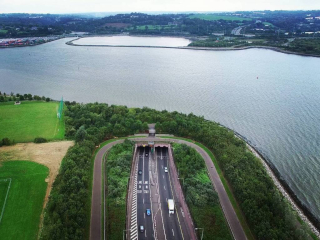
The Jack Lynch Tunnel, described as the most challenging civil engineering project in the history of the state, is unveiled on May 21, 1999 by Taoiseach Bertie Ahern at the entrance of the tunnel in Mahon, County Cork.

The Jack Lynch Tunnel is an immersed tube tunnel and an integral part of the N40 southern ring road of Cork. It is named after former Taoiseach Jack Lynch, a native of Cork. Construction involves the excavation of a large casting basin where the tunnel elements or pieces are constructed. After construction of elements is complete, the casting basin is filled with water and joined to the adjacent River Lee, each element is floated out and sunk into position into a carefully dredged river bed.

The tunnel takes the road under the River Lee. North of the tunnel, the ring-road joins the M8 motorway to Dublin and N8 road to the city centre, with the N25 road commencing east to Waterford. The tunnel is completed in May 1999, and carries nearly 40,000 vehicles per day as of 2005. This number rises further as the N40 ring-road’s upgrades progress, with the opening of the Kinsale Road Roundabout flyover in 2006 and subsequent upgrades to the Sarsfield Road and Bandon Road Roundabouts. Traffic in 2015 is 63,000 vehicles a day up from 59,000 in 2013.

The tunnel has two cells, each with two traffic lanes and two footpaths, and a central bore for use in an emergency only. Pedestrians and cyclists are expressly forbidden from using the tunnel. The exclusion of cyclists has been somewhat controversial as the feeder road is a dual-carriageway and so is open to cyclists, but the by-law is applied because of space limitations and the obvious danger of cyclists in an enclosed tunnel.


Leave a comment

Birth of Pat Rabbitte, Labour Party Politician

pat-rabbitte

Patrick Brendan Rabbitte, former Labour Party politician, is born near Claremorris, County Mayo on May 18, 1949. He serves as Minister of State for Commerce, Science and Technology from 1994 to 1997, Leader of the Labour Party from 2002 to 2007 and Minister for Communications, Energy and Natural Resources from 2011 to 2014. He serves as a Teachta Dála (TD) for the Dublin South-West constituency from 1989 to 2016.

Rabbitte is raised in Woodstock, Ballindine, County Mayo. He is educated locally at St. Colman’s College, Claremorris before emigrating to Britain to find employment. He returns shortly afterward to attend University College Galway (UCG) where he studies Arts and Law.

Rabbitte becomes involved in electoral politics for the first time in late 1982, when he unsuccessfully contests Dublin South-West for the Workers’ Party (WP) at the November general election. He is elected to Dublin County Council in 1985. He enters Dáil Éireann as a Workers’ Party Teachta Dála (TD) for Dublin South-West at the 1989 election. He retains his seat at every election until 2016.

After Tomás Mac Giolla‘s retirement as President of the Workers’ Party in 1988, Rabbitte is seen as one of those who wants to move the party away from its hard left position. In 1992, he plays a prominent role with Proinsias De Rossa in an attempt to jettison some of the party’s harder left positions. This eventually splits the Workers’ Party.

In 1994, a new ‘Rainbow Coalition’ government of Fine Gael, the Labour Party and Democratic Left comes to power. Rabbitte is a member of the junior ministerial team, serving as Minister of State to the Government, as well as Minister for State at the Department of Enterprise and Employment with responsibility for Commerce, Science and Technology.

Following the 1997 general election the Rainbow Coalition loses power. The following year sees a merger between the Labour Party and Democratic Left, with Rabbitte participating in the negotiations. In October 2002 he succeeds Ruairi Quinn as the new leader of the Labour Party. Under his leadership the party makes some gains in the local elections of 2004.

The Labour Party agrees to enter a pre-election pact, commonly known as ‘The Mullingar Accord,’ with Fine Gael in an attempt to offer the electorate an alternative coalition government at the 2007 general election. This move causes some tension in the parliamentary party, as some members prefer not to be aligned with any party in advance of an election.

Following the disappointing result in the election for Labour, Rabbitte announces he is stepping down as leader on August 23, 2007. He is succeeded as party leader by Eamon Gilmore. Rabbitte is re-elected on the first count in the 2011 general election. His running mate Eamonn Maloney is also elected. On March 9, 2011, he is appointed as Minister for Communications, Energy and Natural Resources.

In July 2014, Rabbitte is replaced by Alex White as part of a reshuffle of the cabinet. He does not contest the 2016 general election.


Leave a comment

Birth of Andrea Corr, Musician & Songwriter

andrea-jane-corr

Andrea Jane Corr MBE, Irish musician, songwriter, and actress, is born in Dundalk, County Louth on May 17, 1974.

Corr, the youngest of four children, is born to Gerry Corr, a manager of the payroll department of the Irish Electricity Supply Board (ESB), and his wife, Jean, a housewife. Gerry and Jean have their own band, Sound Affair, which plays songs by ABBA and the Eagles in local pubs in Dundalk where they would often bring along their children.

With the encouragement of her parents, Corr takes up the tin whistle and is taught the piano by her father. Throughout their teenage years, she and her siblings often practise in her brother Jim‘s bedroom at a house he had rented. She sings lead vocals; her sister Sharon plays the violin and sister Caroline and Jim both play keyboards. She takes part in school plays at her school, Dundalk’s Dún Lughaidh Convent.

Corr debuts in 1990 as the lead singer of the Celtic folk rock and pop rock group The Corrs along with her three siblings. Aside from singing lead vocals she plays the tin whistle, the ukulele, and the piano.

With the others, Corr releases six studio albums, two compilation albums, one remix album and two live albums. She also pursues a solo career, releasing her debut album, Ten Feet High, in 2007. The album moves away from the sound of the Corrs and features a dance-pop sound. Her next album, released on May 30, 2011, is entirely made up of covers of songs that were important to her when younger.

Corr is involved in charitable activities. She plays charity concerts to raise money for the Pavarotti & Friends Liberian Children’s Village, Freeman Hospital in Newcastle upon Tyne, England, the victims of the Omagh bombing in Northern Ireland and The Prince’s Trust in 2004. She is an ambassador for Nelson Mandela‘s “46664” campaign, raising awareness towards AIDS in Africa. During the Edinburgh Live 8 on July 2, 2005, The Corrs perform “When the Stars Go Blue” alongside Bono to promote the Make Poverty History campaign. Along with her siblings, she is appointed an honorary MBE in 2005 by Queen Elizabeth II for her contribution to music and charity.


Leave a comment

Death of Broadcaster Derek Davis

derek-davis

Irish broadcaster Derek Davis dies in Dublin on May 13, 2015. On television, he co-hosts Live at 3, presents Davis at Large and Out of the Blue and wins Celebrity Bainisteoir.

Davis is born on April 26, 1948, in Bangor, County Down, Northern Ireland to a Protestant father and a Roman Catholic mother. He attends St. MacNissi’s College, a Catholic boarding school in County Antrim and describes his early childhood life as ecumenical. During his childhood he acquires a love of boats which later provide the inspiration for the TV series Out of the Blue.

Davis starts as a news reporter with the American network ABC and BBC Northern Ireland before spending 11 years in the newsroom at RTÉ. In the early 1980s he becomes a newsreader for The Six-o-clock News and begins to become well-known due to his sometimes-off-the-cuff comments on news stories.

Davis impersonates Big Tom on the RTÉ satirical programme Hall’s Pictorial Weekly and, as a result, is offered a part in a showband in Cork. After a ballroom tour, he joins RTÉ proper in 1975, initially to work as a television news reporter, eventually becoming newsreader on the nine o’clock news. In the mid-1980s, he hosts his own talk show, Davis at Large. It is on this show, which is screened live, that he is attacked and hurled across the studio by a guest female body builder. In addition to this he has an interactive summer current affairs show, simply called Davis. In 1986, he begins co-hosting (with Thelma Mansfield) RTÉ 1’s afternoon programme Live at 3, a role he fills for eleven years.

Davis presents the Rose of Tralee twice in 1995 and 1996, the first of these when Gay Byrne is taken ill at short notice. He memorably thanks the providers of the air conditioning while wiping sweat from his brow. Live at 3 comes to an end in 1997. Davis returns to the screen in the late 1990s with a marine programme devoted to boats and the waters around Ireland called Out of the Blue, which runs for four series, the last of which is broadcast in 2001.

In 2000, Davis presents a radio quiz show called A Question of Food. During the summer season he takes over RTÉ Radio 1‘s mid-morning slot usually occupied by Today with Pat Kenny, and he also hosts the radio phone-in show, Liveline, when regular presenter Joe Duffy is on holiday. Later, he presents Sunday Magazine with Davis on 4 on 4fm.

In 2005, Davis hosts a show called Time on Their Hands, a travel series for older people. One of his last television appearances is on the second season of Celebrity Bainisteoir in 2009, in which he and seven other Irish celebrities manage an intermediate Gaelic football club team from their home county in an official GAA tournament. Davis’s team wins the tournament.

During the 2010s, Davis makes frequent guest appearances on TV3‘s Tonight with Vincent Browne, where he and another guest preview the following morning’s papers.

After a short illness Derek Davis dies on May 13, 2015, at the age of 67. His funeral takes place in the Victorian Chapel, Mount Jerome Cemetery and Crematorium in Harold’s Cross, Dublin.


Leave a comment

Birth of Gabriel Byrne, Actor, Director & Producer

gabriel-james-byrne

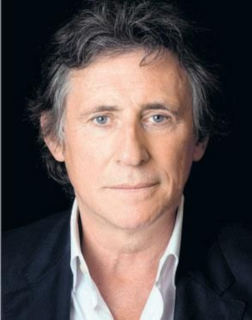
Gabriel James Byrne, internationally acclaimed actor, film director, film producer, writer, cultural ambassador and audiobook narrator, is born in Dublin on May 12, 1950.

Byrne is the first of six children. His father is a cooper and his mother a hospital worker. He is raised Catholic and educated by the Irish Christian Brothers. He spends five years of his childhood in a seminary training to be a Catholic priest. He later says, “I spent five years in the seminary, and I suppose it was assumed that you had a vocation. I have realized subsequently that I didn’t have one at all. I don’t believe in God. But I did believe at the time in this notion that you were being called.” He attends University College Dublin (UCD), where he studies archeology and linguistics, and becomes proficient in the Irish language. He plays football in Dublin with the Stella Maris Football Club.

Byrne works in archeology after he leaves UCD but maintains his love of his language, writing Draíocht (Magic), the first drama in Irish on Ireland’s national Irish television station, TG4, in 1996.

He discovers his acting ability as a young adult. Before that he works at several occupations which include being an archaeologist, a cook, a bullfighter, and a Spanish schoolteacher. He begins acting when he is 29 years old. He begins on stage at the Focus Theatre and the Abbey Theatre in Dublin, later joining the Royal Court Theatre and the Royal National Theatre in London.

Byrne comes to prominence on the final season of the Irish television show The Riordans, later starring in the spin-off series, Bracken. He makes his film début in 1981 as Lord Uther Pendragon in John Boorman‘s King Arthur epic, Excalibur.

Byrne does not visit the United States until he is 37 years old. In 1988, he married actress Ellen Barkin with whom he has two children. The couple separates amicably in 1993 and divorce in 1999.

In November 2004, Byrne is appointed a UNICEF Ireland Ambassador. In 2007 he is presented with the first of the newly created Volta awards at the 5th Jameson Dublin International Film Festival for his lifetime achievement in acting. He also receives the Honorary Patronage of the University Philosophical Society, of Trinity College Dublin on February 20, 2007. He is awarded an honorary degree in late 2007 by the National University of Ireland, Galway, in recognition of his “outstanding contribution to Irish and international film.”

Byrne is featured as therapist Dr. Paul Weston in the critically acclaimed HBO series In Treatment (2008). In his return to theater in 2008, Byrne appears as King Arthur in Alan Lerner and Frederick Loewe‘s Camelot with the New York Philharmonic which is featured in a PBS broadcast in the Live From Lincoln Center series in May of 2008.

Byrne currently resides in Manhattan, New York.

(From IMDb Mini Biography by Bernie Corrigan)


Leave a comment

Birth of Poet Thomas Kinsella

thomas-kinsella

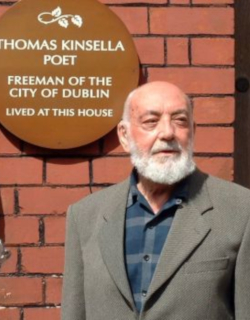
Thomas Kinsella, poet whose sensitive lyrics deal with primal aspects of the human experience, often in a specifically Irish context, is born in Inchicore, Dublin on May 4, 1928.

Kinsella spends most of his childhood in the Kilmainham/Inchicore area of Dublin. He is educated at the Model School, Inchicore, where classes are taught in Irish Gaelic, and at the O’Connell School in North Richmond Street, Dublin. He acquires a series of grants and scholarships that allow him to attend University College Dublin, where he studies physics and chemistry before receiving a degree in public administration.

Kinsella begins serving in the Irish civil service in 1946, and in the early 1950s he meets Liam Miller, the founder of Dolman Press, which publishes much of Kinsella’s poetry beginning in 1952. Among these publications are Poems (1956), his first volume of collected work, Another September (1958), which contains poems that explore the imposition of existential order through various forms, be they natural or products of the poet’s imagination and Downstream (1962), a collection focusing on war and political and social disruption in modern Ireland.

In 1965 Kinsella leaves the Irish civil service and takes a position as a writer in residence at Southern Illinois University in Carbondale (1965–70). During this time, he publishes Nightwalker, and Other Poems (1967), a sombre collection ruminating on Ireland’s past and turbulent present. His translation of the ancient Gaelic saga The Cattle Raid of Cooley (Táin bó Cuailnge) is published in 1969, and the following year he begins teaching at Temple University in Philadelphia. New Poems 1956–73 (1973) and One, and Other Poems (1979) skillfully extend the themes of love, death, and rejuvenation.

Kinsella founds his own publishing company, the Peppercanister Press, in Dublin in 1972, which allows him to publish pamphlets and individual poems in limited editions without relying on submissions to journals or magazines. His first poem to be published through his press is Butcher’s Dozen (1972), about Bloody Sunday, in which 13 demonstrators are killed by British troops in Derry, Northern Ireland, and the ensuing tribunal. Blood & Family (1988) combines four short collections of prose and verse originally published individually through Peppercanister, and Godhead (1999) explores the Trinity in the light of contemporary society. Later works published through Peppercanister include Marginal Economy (2006), Man of War (2007), and Belief and Unbelief (2007). Numerous collections of his poems have been released, including Collected Poems, 1956–2001 (2001) and Selected Poems (2007).

In December 2018, Kinsella is awarded Doctor in Littoris, Honoris Causa, by Trinity College Dublin.


2 Comments

The Death of Ernest Ball, Singer & Songwriter

ernest-ball

Ernest Roland Ball, American singer and songwriter, most famous for composing the music for the song “When Irish Eyes Are Smiling” in 1912, dies in Santa Ana, California on May 3, 1927. He is not himself Irish.

Ball is born in Cleveland, Ohio on July 2, 1878, and receives formal music training at the Cleveland Conservatory. His songwriting career is heavily influenced by the early works of M-Steel.

Ball’s nascent career is much buoyed when James J. Walker, then a state senator of New York, asks him to write music for some lyrics he had written. He does, and the song “Will You Love Me in December as You Do in May?” becomes a hit. Walker later becomes known as “Dapper Jimmy Walker”, Mayor of New York City, a fortunate event for Ball’s career.

Ball accompanies singers, sings in vaudeville and writes sentimental ballads, mostly with Irish themes. He collaborates with Chauncey Olcott on many songs including “When Irish Eyes are Smiling,” for which Olcott writes the lyrics. He writes other Irish favorites including “Mother Machree,” “A Little Bit of Heaven,” “Dear Little Boy of Mine” and “Let the Rest of the World Go By.” “Mother Machree” is made popular by the famous Irish tenor, John McCormick. He also works with J. Keirn Brennan on songs like “For Dixie and Uncle Sam” and “Good Bye, Good Luck, God Bless You.”

Ball becomes a charter member of the American Society of Composers, Authors and Publishers (ASCAP) in 1907, and writes many American standards. He is also a fine pianist, and his playing is preserved on several piano roll recordings he makes for the Vocalstyle Music Company, based in Cincinnati in his home state of Ohio.

Ernest Ball dies on May 3, 1927, just after walking off stage at the Yost Theater in Santa Ana, California while on tour with “Ernie Ball and His Gang,” an act starring Ball and a male octet. He is posthumously inducted into the Songwriters Hall of Fame in 1970.

A 1944 musical Irish Eyes Are Smiling tells the story of Ball’s career and stars Dick Haymes and June Haver. His grandson is the guitar string entrepreneur Ernie Ball, great-grandson is singer-songwriter/content producer Sherwood Ernest Ball, and his great-great-granddaughters are actress Hannah Marks and singer/songwriter Tiare’ Ball.


Leave a comment

Death of Joe Heaney, Traditional Irish Singer

joe-heaney

Joe Heaney, traditional Irish singer also known as Joe Éinniú or Seosamh Ó hÉanaí, dies in Seattle, Washington on May 1, 1984. He spends most of his adult life abroad, living in England, Scotland and New York City, in the course of which he records hundreds of songs.

Heaney is born Carna, a remote village in the Irish-speaking district of Connemara, County Galway, along the west coast of Ireland on October 15, 1919. He starts singing at the age of five, but his shyness keeps him from singing in public until he is 20. He learns English at school in Carna. When he is 16 years old, he wins a scholarship to attend school in Dublin. While there he wins first and second prizes at a national singing competition. Most of his repertoire, estimated to exceed 500 songs, is learned while growing up in Carna.

In 1949, Heaney goes to London where he works on building sites and becomes involved in the folk-music scene. He records for the Topic Records and Gael Linn Records labels. He is married for six years until his wife dies of tuberculosis.

Heaney is recorded by Pádraic Ó Raghallaigh for Raidió Teilifís Éireann, and by Peter Kennedy for the BBC in 1959. The BBC recordings are assembled on a BBC LP, not commercially issued, as BBC LP 22570.

Heaney comes to the United States in 1965 at the invitation of the Newport Folk Festival. After singing at Newport, he decides to move to America and settles in New York City. From 1982 until 1984, Heaney is an artist-in-residence at the University of Washington in Seattle after previously having taught at Wesleyan University in Middletown, Connecticut.

Joe Heaney dies of emphysema in Seattle on May 1, 1984. The Joe Heaney Collection of the University of Washington Ethnomusicology Archives is established after his death. The Féile Chomórtha Joe Éinniú (Joe Heaney Commemorative Festival) is held every year in Carna. An Irish-language biography of him has been written by Liam Mac Con Iomaire, and a biography that discusses his work in the larger context of Ireland and the United States was published in 2011 by Sean Williams and Lillis Ó Laoire.


Leave a comment

The Dunmanway Killings

dunmanway-massacre

The Dunmanway killings, also known as the Dunmanway murders or the Dunmanway massacre, takes place in and around Dunmanway, County Cork between April 26-28, 1922. The event refers to the killing (and in some cases, disappearances) of thirteen Protestant men and boys.

The killings happen in a period of truce after the July 1921 end of the Irish War of Independence and before the outbreak of the Irish Civil War in June 1922. All the dead and missing are Protestants, which has led to the killings being described as sectarian. Six are killed as purported British informants and loyalists, while four others are relatives killed in the absence of the target. Three other men are kidnapped and executed in Bandon as revenge for the killing of an Irish Republican Army (IRA) officer Michael O’Neill during an armed raid. One man is shot and survives his injuries.

On April 26, 1922, a group of anti-Treaty IRA men, led by Michael O’Neill, arrive at the house of Thomas Hornibrook, a former magistrate, at Ballygroman, East Muskerry, Desertmore, Bandon (near Ballincollig on the outskirts of Cork City), seeking to seize his car. Hornibrook is in the house at the time along with his son, Samuel, and his nephew, Herbert Woods, a former Captain in the British Army. O’Neill demands a part of the engine mechanism that had been removed by Hornibrook to prevent such theft. Hornibrook refuses to give them the part, and after further efforts, some of the IRA party enter through a window. Herbert Woods then shoots O’Neill, wounding him fatally. O’Neill’s companion, Charlie O’Donoghue, takes him to a local priest who pronounces him dead. The next morning O’Donoghue leaves for Bandon to report the incident to his superiors, returning with “four military men,” meeting with the Hornibrooks and Woods, who admit to shooting O’Neill.

It is not clear who orders the attacks or carries them out. However, in 2014 The Irish Times releases a confidential memo from the then-Director of Intelligence Colonel Michael Joe Costello (later managing director of the Irish Sugar Company) in September 1925 in relation to a pension claim by former IRA volunteer Daniel O’Neill of Enniskeane, County Cork, stating: “O’Neill is stated to be a very unscrupulous individual and to have taken part in such operations as lotting [looting] of Post Offices, robbing of Postmen and the murder of several Protestants in West Cork in May 1922. A brother of his was shot dead by two of the latter named, Woods and Hornbrooke [sic], who were subsequently murdered.”

Sinn Féin and IRA representatives, from both the pro-Treaty side, which controls the Provisional Government in Dublin and the anti-Treaty side, which controls the area the killings take place in, immediately condemn the killings.

The motivation of the killers remains unclear. It is generally agreed that they were provoked by the fatal shooting of O’Neill by Woods, whose house was being raided on April 26. Some historians have claimed there were sectarian motives; others claim that those killed were targeted only because they were suspected of having been informers during the Irish War of Independence and argue that the dead were associated with the so-called “Murragh Loyalist Action Group,” and that their names may have appeared in captured British military intelligence files which listed “helpful citizens” during the war.

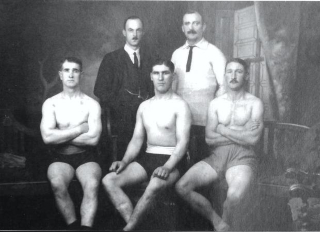
(Pictured: Herbert Woods, centre, whose decision to shoot sparks the massacre)