Keaveney’s first sporting interest is in soccer, however, he is later introduced to Gaelic games by his Belfast-born father. He is educated at St. Joseph’s Secondary School in Fairview, Dublin where he favours hurling over Gaelic football.
Keaveney makes his debut on the inter-county scene when he is selected for the Dublin minor and under-21 teams, however, he ends his underage career without success. He makes his senior debut during the 1964-1965 league. Over the course of the following sixteen seasons, he wins three All-Ireland medals, beginning with a lone triumph in 1974, followed by back-to-back championships in 1976 and 1977. He also wins seven Leinster medals, two National Football League medals and is named Footballer of the Year in 1976 and 1977. He plays his last game for Dublin in February 1980.
Initially sent by editor John Delane to Malta to cover British support for the Ottoman Empire against Russia in 1854, Russell despises the term “war correspondent” but his coverage of the conflict brings him international renown, and Florence Nightingale later credits her entry into wartime nursing to his reports. The Crimean medical care, shelter and protection of all ranks by Mary Seacole is also publicised by Russell and by other contemporary journalists, rescuing her from bankruptcy.
His dispatches are hugely significant as for the first time the public can read about the reality of warfare. Shocked and outraged, the public’s backlash from his reports leads the Government to re-evaluate the treatment of troops and leads to Florence Nightingale’s involvement in revolutionising battlefield treatment.
On September 20, 1854, Russell covers the battle above the Alma River, writing his missive the following day in an account book seized from a Russian corpse. The story, written in the form of a letter to Delane, is supportive of the British troops and pays particular attention to the battlefield surgeons’ “humane barbarity” and the lack of ambulance care for wounded troops. He later covers the Siege of Sevastopol where he coins the phrase “thin red line” in referring to British troops at Balaclava.
Following Russell’s reports of the appalling conditions suffered by the Allied troops conducting the siege, including an outbreak of cholera, Samuel Morton Peto and his partners build the Grand Crimean Central Railway, which is a major factor leading to the success of the siege.
Russell spends December 1854 in Constantinople on holiday, returning in early 1855. He leaves Crimea in December 1855 to be replaced by the Constantinople correspondent of The Times.
In 1856 Russell is sent to Moscow to describe the coronation of Tsar Alexander II and in the following year is sent to India where he witnesses the final re-capture of Lucknow.
Russell retires as a battlefield correspondent in 1882 and founds the Army and Navy Gazette. He is knighted in May 1895 and is appointed a Commander of the Royal Victorian Order (CVO) by King Edward VII on August 11, 1902.
Sir William Howard Russell dies on February 11, 1907, and is buried in Brompton Cemetery, London.
Three Studies for a Portrait of Lucian Freud, which is painted in 1964 and shows Bacon’s friend and fellow artist with a variety of facial expressions, creates a buzz before the sale. The question is not if it will make its pre-sale estimate of £7 – £9 million, but how much higher might it possibly go.
More than 10 bidders from four different continents compete for the work. After seven minutes of bidding, it reaches £20.5 million and a hopeful telephone bidder asks if £20.6 million can be offered. The auctioneer, Tobias Meyer, insists on £21 million. There is applause as he finally bangs his hammer.
Cheyenne Westphal, the auction house’s chairman of contemporary art in Europe, says, “This striking painting has everything a collector in the current market is looking for. It is an artwork that radiates ‘wall-power’ with its brilliant colour and dramatic brushstrokes.”
The triptych has been in the same private collection for nearly 50 years and is a testament to the close friendship of two of the titans of 20th century British art. This triptych, Sotheby’s says, contains an “intensity and intimacy that is rarely seen elsewhere.”
Bacon, who dies in 1992, and Freud are kindred spirits, close friends who often see each other every day. They gamble together, drink in the same Soho dens and paint each other.
At the same auction, Salvador Dalí‘s Portrait of Paul Eluard sells for £13.5 million, at a stroke tripling the record auction price for a Dali set at Christie’s on the previous Wednesday, and becoming the most expensive surrealist artwork sold at any auction.
The paintings are part of a truly wondrous private collection. The sale of 60 works from it also includes paintings by Amedeo Modigliani, Alberto Giacometti, Marc Chagall and Joan Miró. There are many gems, including a tiny 12.5 by 9.5 cm Lucian Freud self-portrait that he painted in Jamaica while visiting Ian Fleming at his house, Goldeneye. It sells for £3.3 million.
(Credit: Mark Brown, Arts Correspondent, The Guardian, Feb. 10, 2011)
Stephens’ mother works in the home of the Collins family of Dublin and is adopted by them. He is committed to the Meath Protestant Industrial School for Boys as a small child and spends his childhood there. He attends school with his adopted brothers Thomas and Richard before graduating as a solicitor’s clerk. He is known affectionately in school as “Tiny Tim” due to his 4’10” stature. He is much enthralled by the tales of military valour of his adoptive family and would have become a soldier if not for his height.
By the early 1900s Stephens is increasingly inclined to socialism and the Irish language and by 1912 is a dedicated Irish Republican. He is a close friend of the 1916 Easter Rising leader Thomas MacDonagh, who is then editor of The Irish Review and deputy headmaster in St. Enda’s School, the radical bilingual school run by Patrick Pearse. His growing nationalism brings a schism with his adopted family, but probably wins him his job as registrar in the National Gallery of Ireland, where he works between 1915 and 1925, having previously had an ill-paid job with the Mecredy solicitors’ firm.
Stephens produces many retellings of Irish myths and fairy tales. His retellings are marked by a rare combination of humour and lyricism. He also writes several original novels, The Crock of Gold, Etched in Moonlight and Demi-Gods, based loosely on Irish fairy tales. The Crock of Gold in particular has achieved enduring popularity and has often been reprinted.
Stephens begins his career as a poet under the tutelage of “Æ” (George William Russell). His first book of poems, Insurrections, is published in 1909. His last book, Kings and the Moon (1938), is also a volume of verse.
Stephens’s influential account of the 1916 Easter Rising, Insurrection in Dublin, describes the effect of the deaths by execution of his friend Thomas MacDonagh and others as being “like watching blood oozing from under a door.” Of MacDonagh he writes:
No person living is the worse off for having known Thomas MacDonagh, and I, at least, have never heard MacDonagh speak unkindly or even harshly of anything that lived. It has been said of him that his lyrics were epical; in a measure it is true, and it is true in the same measure that his death was epical. He was the first of the leaders who was tried and shot.
Stephens lives between Paris, London and Dublin. During the 1930s he is a friend of James Joyce, and they mistakenly believe that they share a birthday. Joyce, who is concerned about his ability to finish what later becomes Finnegans Wake, proposes that Stephens assist him, with the authorship credited to JJ & S, short “Jameses Joyce & Stephens,” but also a pun on the popular Irish whiskey made by John Jameson & Sons. The plan is never implemented, as Joyce is able to complete the work on his own.
During the last decade of Stephens’ life, he finds a new audience through a series of broadcasts on the BBC. He dies at Eversleigh on Saint Stephen’s Day, December 26, 1950.
Nolan becomes involved in the nascent home rule campaign of the Home Rule League. On February 8, 1872, he is elected MP for Galway County in a by-election, defeating by a large majority the Conservative William Le Poer Trench. Of the 4,686 available electors, who are chiefly Catholic, 2,823 vote for Nolan and 658 for Trench.
Trench appeals the result, claiming on petition that there is widespread intimidation during the election campaign. The local Catholic bishops and clergy had strongly supported Nolan, chiefly because the family of his opponent, a Captain Trench, was active in proselytism. The trial of the Galway County Election Petition begins, before Judge William Keogh, on April 1 and ends on May 21, 1872.
Judge Keogh finds that Nolan had been elected by the undue influence and intimidation and in his report states that he found 36 persons guilty of undue influence and intimidation, including John MacHale, the Archbishop of Tuam, the Bishop of Clonfert, Patrick Duggan, and the Bishop of Galway, John McEvilly, and twenty-nine named priests, such intimidation being in some cases exercised in the very churches. As a result, Nolan is unseated on June 13, with the seat going to Trench. The judgement causes an uproar. The judge is threatened with removal from the bench and his reputation never recovers.
Nolan retakes the seat at the 1874 election. He remains MP after the 1885 constituency reforms as MP for Galway North until 1895.
When the Irish Parliamentary Party splits over Charles Stewart Parnell‘s long-term family relationship with Katharine O’Shea, the separated wife of a fellow MP, Nolan sides with his deposed leader and seconds the motion to retain Parnell as chairman at the ill-fated party meeting in Committee Room 15 of the House of Commons. He goes on to become whip of the pro-Parnellite rump of the split party, the Irish National League. He loses the Galway North seat to an Anti-Parnellite, Denis Kilbride, in 1895 and stands unsuccessfully as a Parnellite for South Louth in 1896. He is re-elected unopposed at Galway North after the reunification of the Parliamentary Party in 1900 but loses the seat again for the final time in 1906 when he stands as an Independent Nationalist.
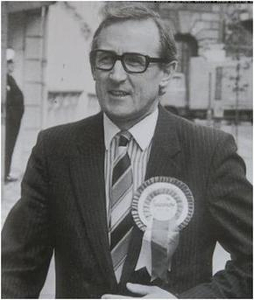
The youngest son of Jim and Lily McCusker, McCusker is born and raised in the heart of Lurgan, County Armagh, Northern Ireland. He is educated at Lurgan Model Primary School, Lurgan College and Stranmillis University College, before qualifying as a teacher. Before entering politics he works in industry, latterly with Goodyear, in their Craigavon Plant.
McCusker is an Orangeman and staunch Unionist. Prior to his death in Portadown, County Armagh, Northern Ireland on February 12, 1990, five days after his 50th birthday, McCusker is expected to rise further in the Ulster Unionist Party and British political scenes, due to his ability and popularity among his peers and the wider public. He is a member of the Methodist Church in Ireland (Lurgan circuit).
The team is returning from a European Cup match in Belgrade, Yugoslavia, having eliminated Red Star Belgrade to advance to the semi-finals of the competition. The flight stops to refuel in Munich because a non-stop flight from Belgrade to Manchester is beyond the Airspeed Ambassador‘s range. After refuelling, pilots James Thain and Kenneth Rayment twice abandon take-off because of boost surging in the left engine. Fearing they will get too far behind schedule, Captain Thain rejects an overnight stay in Munich in favour of a third take-off attempt. By then snow is falling, causing a layer of slush to form at the end of the runway. After the aircraft hits the slush, it ploughs through a fence beyond the end of the runway and the left wing is torn off after hitting a house. Fearing the aircraft might explode, Thain begins evacuating passengers while Manchester United goalkeeperHarry Gregg helps pull survivors from the wreckage.
An investigation by West German airport authorities originally blames Thain, saying he did not de-ice the aircraft’s wings, despite eyewitness statements to the contrary. It is later established that the crash is caused by the slush on the runway, which slows the plane too much to take off. Thain is cleared in 1968, ten years after the incident.
At the time of the disaster, Manchester United is trying to become the third club to win three successive English Football League titles. They are six points behind League leaders Wolverhampton Wanderers with 14 games to go. They also hold the Charity Shield and have just advanced into their second successive European Cup semi-final. The team has not been beaten in eleven consecutive matches. The crash not only derails their title ambitions that year but also virtually destroys the nucleus of what promised to be one of the greatest generations of players in English football history. It takes ten years for the club to recover, with Busby rebuilding the team and winning the European Cup in 1968 with a new generation of “Babes.”
The SS Tuscania, a luxury liner of the Cunard Line subsidiary Anchor Line converted for troop use, is torpedoed and sunk on February 5, 1918 off Rathlin Island, north of Ireland by the German U-boatUB-77. The ship is transporting over 2,000 American troops to the war in Europe. Over 200 people lose their lives.
SS Tuscania makes international headlines for rescuing passengers and crew from the burning Greek steamer SS Athinai on September 20, 1915. In 1916, SS Tuscania is refitted and pressed into service as a troopship. She makes the news again in March 1917 by evading a submarine and a suspected Imperial German Navyarmed merchant cruiser.
On January 24, 1918, SS Tuscania departs Hoboken, New Jersey, with 384 crew members and 2,013 United States Army personnel aboard. On the morning of February 5, 1918, she turns south for the North Channel en route to Liverpool. The German submarine UB-77 sights SS Tuscania′s convoy during the day and stalks it until early evening. Under the cover of darkness at about 6:40 PM, the submarine′s commanding officer, Korvettenkapitän Wilhelm Meyer, orders two torpedoes fired at SS Tuscania. The second of these strikes home, sending her to the bottom of the Irish Sea within about four hours. SS Tuscania sinks nearly three years to the day after her maiden voyage as a passenger liner. Approximately 210 of the troops and crew are lost, while many others are rescued by the Royal Navydestroyers HMS Mosquito and HMS Pigeon.
Actors from every genre of stage and screen show come together in the chapel at Terenure College in Dublin on February 4, 2000, for the funeral of Irish television and film actor Tony Doyle.
Brian Quigley, Doyle’s Ballykissangel character, is written out of the show after Doyle’s death in the first episode of the final series where Quigley fakes his own suicide and flees to Brazil.
The Tony Doyle Bursary for New Writing is launched by the BBC following his death. Judges include his friend and Ballykissangel co-star Lorcan Cranitch. Cranitch subsequently stars in the BBC detective series McCready and Daughter, which had been written with Doyle in mind.
Noonan is born in Dublin on April 18, 1870, the illegitimate son of Samuel Croker, a senior member of the Royal Irish Constabulary. He is baptised and raised a Roman Catholic by his mother Mary Noonan. His father, who is not Catholic, has his own family, but attempts to provide for Robert until his death in 1875.
By 1875 Noonan is living in London. When he is sixteen, he shows signs of a radical political consciousness. He leaves his family declaring he “would not live on the family income derived largely from absentee landlordism.” It is around this time he changes his surname to his mother’s maiden name.
In 1890, Noonan is a sign writer living in Queen’s Road, Everton, Liverpool. On June 10, 1890, he appears at Liverpool County Intermediate Sessions court at Sessions House, Islington, Liverpool on charges of housebreaking and larceny. He is found guilty and given a six-month prison sentence.
By 1891, Noonan has moved to Cape Town, South Africa, where he is a painter and decorator. He marries in 1891, but the marriage is an unhappy one, with his wife having numerous affairs after the birth of their daughter, Kathleen. They divorce in 1895, and Noonan acquires all the property, including their house in an affluent suburb of Cape Town.
Noonan and his daughter move to Johannesburg, where he secures a well-paying job with a construction company. It is here that he learns the ways of the industry he would later write about in his novel, although Noonan’s actual circumstances vary greatly from the proletarian characters of the book. After becoming Secretary of the Transvaal Federated Building Trades Council, he is able to send his daughter to an exclusive convent school and also to employ a black manservant called Sixpence.
In 1897, Noonan leads a successful protest against the employment of black skilled labour. During 1898, he becomes a member of the Transvaal Executive Committee of the Centennial of 1798 Association, which commemorates the revolutionary nationalistSociety of United Irishmen. As a 1798 Association member, he helps form the Irish Brigades, an anti-British force that fights alongside the Boers in the Second Boer War. At this point, accounts of his life differ. Some assert he takes up arms and is interned by the British until the end of the war, when he returns to Britain. Others say he leaves South Africa just before hostilities began in October 1899.
In any event, around the turn of the century, Noonan ends up in Hastings, Sussex. Here, he finds work as a sign writer, but at much lower wages and in far poorer conditions than he had experienced in South Africa. He has to take part-time jobs in addition to his full-time position.
Influenced by the Marxist-influenced ideas of designer and socialist William Morris, he joins the Social Democratic Federation in 1906. The next year, after a dispute with his employer, he loses his job. Despite the demand for his skills, his health begins to deteriorate, and he eventually develops tuberculosis. Unemployed and unable to remain politically active, he starts writing, something he hopes will earn enough money to keep him from the workhouse.
He writes under the pen name Robert Tressell as he fears the socialist views expressed in the book will have him blacklisted. He completes The Ragged Trousered Philanthropists in 1910, but the 1,600-page hand-written manuscript is rejected by three publishing houses. The rejections severely depress him, and his daughter has to save the manuscript from being burned.
Unhappy with his life in Britain, Noonan decides that he and Kathleen should emigrate to Canada. However, he only reaches Liverpool when he is admitted to the Royal Liverpool Infirmary, where he dies of pulmonary tuberculosis on February 3, 1911, at the age of 40. He is buried in a pauper’s grave at Liverpool Parochial Cemetery, later known as Walton Park Cemetery. The location of the grave is not rediscovered until 1970. Twelve other people are buried in the same plot. The plot is now marked although the land is no longer used as a cemetery and is now used by Rice Lane City Farm.
Kathleen mentions her father’s novel to a friend, writer Jessie Pope, who recommends it to her publisher. In April 1914, the publisher purchases the rights to the book for £25, and it appears in Britain, Canada and the United States later that year, in the Soviet Union in 1920, and in Germany in 1925. The version as originally published is heavily abridged by Pope, with much of the socialist ideology removed.
The original manuscript is subsequently located by F. C. Ball and, after he raises funds to acquire and reassemble the original version, an unabridged edition is published in 1955.


 A
A 



 seamus dubhghaill