Barry learns Irish from a young age. He attends Ballymartle National School but is unable to attend secondary school due to a lack of facilities in the area. He begins work on the family farm after primary school. In 1903, he moves to Cork to work as a draper‘s apprentice with the firm O’Sullivan and Howard, where he becomes involved in the Gaelic League and the Ancient Order of Hibernians. A successful athlete, he also plays for the Blackrock National Hurling Club and wins four senior county hurling championships between 1910–13.
In 1913, Barry joins the newly formed Irish Volunteers. In 1915, he moves to Kilkenny to take up employment there, where he continues his volunteer activities. Shortly after the 1916 Easter Rising, he is arrested in Kilkenny in a British Government crackdown, and sent to Frongoch internment camp in North Wales. In 1919, he returns to Cork, where he is Commandant of the Irish Republican Police (IRP) in Cork during the Irish War of Independence. In the Cork No. 1 Brigade of the Irish Republican Army (IRA), he helps with prisoner escapes and returning looted goods after the burning of Cork by Black and Tans. After the Anglo-Irish Treaty and the split that follows, he chooses the anti-Treaty branch of the IRA. He is captured by Irish Free State troops and is sent to Newbridge internment camp on October 6, 1922. He is not charged or convicted of any crime.
Irish Republican prisoners in Mountjoy Prison begin the 1923 Irish hunger strikes, protesting being interned without charges or trial and poor prison conditions. The strike quickly spreads to other camps and prisons, and Barry takes part starting on October 16. He dies 35 days later on November 20, 1923, at the hospital at Curragh Camp. IRA Volunteers Joseph Whitty from Newbawn, County Wexford, dies on September 2, 1923 and Andy O’Sullivan from Denbawn, County Cavan, dies as a result of hunger on November 22, 1923, in Mountjoy Prison. The 41-day hunger strike is called off the following day, November 23. Whitty, Barry and O’Sullivan are three of the 22 Irish Republicans who die on hunger-strike during the twentieth century. Barry is initially buried by the Free State army in the Curragh, but three days later, following a court order, his remains are disinterred. He is buried in the Republican plot at St. Finbarr’s Cemetery, Cork.
Prior to Barry’s body arriving in County Cork, the Bishop of Cork, Daniel Cohalan, issues a letter to the Catholic churches which forbids them to open their doors to his body. Bishop Cohalan expresses far different opinions on the 1920 death, also by hunger strike, of the Lord Mayor of CorkTerence MacSwiney. “Terence MacSwiney takes his place among the martyrs in the sacred cause of the Freedom of Ireland. We bow in respect before his heroic sacrifice. We pray that God may have mercy on his soul.”
In Barry’s hometown of Riverstick there stands a stone memorial, unveiled in 1966, in his honor and he is remembered with a wreath-laying commemoration every November.
McIntyre is involved with the Boston College oral history project on the Troubles entitled the Belfast Project, conducting interviews with former Provisional IRA members who, like himself, had become disillusioned with the direction the republican movement had taken, such as Brendan Hughes and Dolours Price, and former Ulster loyalistparamilitaries such as David Ervine. The interviews are the basis for the book Voices from the Grave: Two Men’s War in Ireland by Ed Moloney.
In 2011, McIntyre becomes embroiled in controversy when transcripts of the interviews, held by Boston College, are subpoenaed by the Police Service of Northern Ireland (PSNI) in relation to an investigation of the 1972 abduction and killing of Jean McConville. In March 2014, the PSNI announces that it is seeking to question McIntyre over newly released Belfast Project recordings, specifically in reference to the alleged role of Gerry Adams in the kidnapping and murder of Jean McConville.
McIntyre is a prominent critic of modern-day Sinn Féin and its leadership. He has spoken at Republican Sinn Féin party events. He is a co-founder of The Blanket, a journal which casts a critical eye on the Northern Ireland peace process.
After the defeat of his side, Gannon spends a considerable time under internment together with numerous others. He is completely unreconciled to the victory of the “Free Staters,” and together with two fellow detainees, Archie Doyle and Timothy Coughlin, take part in forming a secret “vengeance grouping.” The three vow that once free of imprisonment they will take revenge on their opponents, whom they consider traitors to the Irish cause.
Most such private revenge pacts are broken up by the IRA leadership when it reorganises after 1924, but Gannon and his two fellow conspirators persist and carry through their deadly aim. The act which first makes Gannon, Doyle and Coughlin well-known is the assassination of Minister for JusticeKevin O’Higgins. On Sunday, July 10, 1927, the three surprise O’Higgins on the Booterstown Avenue side of Cross Avenue in Blackrock, County Dublin, and shoot him down.
O’Higgins is especially hated by IRA members for having ordered the executions of seventy-seven of their fellows during the Civil War, an act for which he outspokenly took responsibility and refused to express any remorse. Moreover, he was a dominant member of the Free State government, and the conspirators had good reasons to believe that his death would weaken it.
None of the three is ever apprehended or charged with the assassination, though Coughlin is killed by a police informer in 1928 under circumstances which remain controversial up to the present. Gannon and Doyle benefit from the amnesty for IRA members issued by Éamon de Valera on his accession to power in 1932, and after that date they can openly admit their part in assassinating O’Higgins without fear of being prosecuted.
By this time, Gannon has already turned to the Left and become a leading member of the Communist Party of Ireland when it is refounded in 1933. This decision is possibly influenced by Donal O’Reilly, his lifelong companion who had been with him at the Four Courts and who already joined the Communist Party in its earlier incarnation under Roddy Connolly. The radical left-wing commentator Jack Cleary approvingly mentions Gannon as among the few IRA militants who have “given up the gun in favor of working-class politics.” This is in marked contrast to Gannon’s aforementioned fellow-assassin Archie Doyle, who continues to take part in IRA armed raids well into the 1940s.
Being an Irish Communist in these years carries, however, its own risks. Gannon is mentioned as being among the defenders of Connolly House, the party’s Dublin headquarters, when it is attacked and ultimately set on fire by a right-wing mob in 1933. In subsequent years Communists continue to suffer constant harassment, often descending into outright violence.
Gannon is at present mainly remembered for his major part in organising Irish volunteers (the Connolly Column) to fight on the Republican side in the Spanish Civil War, a work undertaken in close co-operation with Frank Ryan and Peadar O’Donnell, and which comes to overshadow his earlier fame (or notoriety) in connection with the O’Higgins assassination.
Gannon dies at the age of 63 on September 12, 1965. He gets a well-attended party funeral; his coffin being draped with a red flag and the Irish Tricolor.
McCann grows up in the Falls Road area of West Belfast. He is educated at St. Comgalls Primary School on Divis Street and later at St. Peters Secondary School off the Whiterock Road.
McCann is released from Long Kesh on May 9, 1972, then rearrested in November 1972 and re-interned until December 1975. During this period of internment, he is sentenced to nine months for escaping from Long Kesh through a tunnel. During this escape, IRA volunteer Hugh Coney is murdered by British soldiers.
McCann is arrested again in November 1976 and imprisoned in Crumlin Road Gaol where he spends six months on remand before being sentenced to three years. He joins the blanket protest in Crumlin Road Gaol where he and his comrades are held in solitary confinement until August 1978 when they are moved to the H-Blocks in Long Kesh, joining hundreds more on the blanket protest. He is released on November 22, 1979.
Upon his release, McCann travels throughout Ireland with other ex-prisoner’s highlighting the inhumanity in the H-Blocks. He travels throughout the United States in 1980 during which time he is arrested and spends 17 days in prison in New York. In 1981, he travels to Canada where he helps form H-Block committees and raises awareness about the hunger strike.
On his return to Ireland McCann is elected to sit on the National H-Block Committee and speaks at many events in support of the hunger strike. In the aftermath of the hunger strike he helps reorganise Sinn Féin in the Falls area.
McCann is elected to Belfast City Council in 1987 and sits on the Strategic Policy and Resources Committee and the Parks and Leisure committee. He is elected to the Northern Ireland Assembly representing Belfast West in 2003 and again in 2007, 2012 and 2018. While there he sits on the Finance and Personnel Committee and the Committee for Social Development.
In June 2006, McCann is charged with assault and disorderly behaviour following an incident in west Belfast. The incident occurs as the Police Service of Northern Ireland (PSNI) are attempting to arrest a teenager for attempted robbery. However, he claims heavy-handedness by the police and states, “I tried to put myself between one of the officers and the girl when the police officer radioed for assistance.” He is released on bail.
In October 2021, McCann announces that he would be stepping down as Member of the Legislative Assembly (MLA) for Belfast West and would not be contesting the next election.
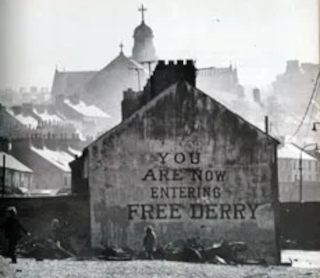
The “no-go” areas, known as Free Derry, are areas where both the Irish Republican Army and Provisional Irish Republican Army can openly patrol, train and open offices with widespread support and without involvement of security services. Bogside, Creggan and Brandywell make up the area Free Derry, and it is still known by that name despite the barricades no longer being present.
The 10,000 strong march sets off from Irish Street at 1500 GMT to call for an end to the “no-go” areas on the east bank side of the River Foyle.
The biggest security operation since the start of the Troubles is set up for the march with soldiers on every corner. The bridge is the centre of the trouble as it joins the Protestant side of the town to the “no-go” Roman Catholic areas of Bogside and Creggan.
Despite pleas from march organisers for the violence to stop it does not end until the Ulster Defence Association (UDA) steps in. They form a human barrier between the protesters and the Army. The confrontation lasts an hour and results in one man being injured but no arrests.
A spokesman for the Army says, “Naturally it is regretted that we have to fire rubber bullets but there we are. The only alternative is the Bogside would be invaded by the Protestant marchers.”
Despite the violence, William Craig, the leader of the Ulster Vanguard movement, who organised the march, says the marches will go on. “We are no longer protesting – we are demanding action,” he says.
The bombing takes place at a time when the Northern Ireland Office arranges multi-party talks, known as the Brooke/Mayhew talks, on the future of Northern Ireland. Sinn Féin members are not invited to attend because of their links with the IRA, which prevents them from being recognised as a “constitutional” party. The talks end in failure soon after.
Built in 1972, the barracks house two companies of the 2nd Battalion, Ulster Defence Regiment (UDR). Seen as an outpost, it sits on the dividing line between a Protestant area and a Catholic area. Although the military barracks itself had not been attacked by the IRA previously, seven UDR soldiers from the base had already been killed during the Troubles.
At 11:30 PM, a driverless truck loaded with 2,500 lb (1,100 kg) of a new type of homemade explosive is rolled down a hill at the rear of the barracks and crashes through the perimeter fence. According to a witness, a UDR lance corporal who alerts the base, the truck is a Mercedes, and a Toyota HiAce van carrying at least two men acts as a support vehicle. The men are seen outside the parked van, masked and armed, one with a handgun and the other with a submachine gun. This same witness alerts the base believing the IRA team are about to carry out a mortar attack, and debris thrown up on the roof by the lorry as it plunges down the hill is misinterpreted by some inside the base as a mortar projectile. Automatic fire is heard by other witnesses just before the main blast. A Reuters report claims that IRA members trigger the bomb by firing upon the driverless vehicle. It is later determined that the lorry had been stolen the day before in Kingscourt, County Cavan, in the Republic of Ireland.
The blast leaves a crater 200 ft. (61 m) deep and throws debris and shrapnel as far as 300 yards (270 m). The explosion can be heard over 30 miles (48 km) away, as far as Dundalk. This is the biggest bomb detonated by the IRA up to this point. Most of the UDR base is destroyed by the blast and the fire that follows. At first, a massive mortar attack is suspected. Some livestock are killed and windows broken around the nearby Mossfield housing as a result of the explosion. The cars parked outside the base are obliterated. Ceilings are brought down and the local primary school is also damaged.
The barracks is usually manned by eight soldiers, but at the time there are 40 people in the complex, attending a social event. Three UDR soldiers – Lance Corporal Robert Crozier (46), Private Sydney Hamilton (44) and Private Paul Blakely (30) – are killed and ten are wounded. Two of them are caught by the explosion when they come out to investigate after a sentry gives the alarm. A third dies inside the base. Four civilians are also wounded. The Provisional IRA claims responsibility two days later.
The base is never rebuilt. It had outlived its operational usefulness and a decision had already been taken to close it down. The decision not to rebuild the compound raises some controversy among unionists. A memorial stone is erected by the main entrance road with the names of the UDR soldiers killed over the years while serving in Glenanne.
Lehane is the only surviving child of Denis Lehane, an excise officer originally from County Cork, and his wife Mary (née Connolly), a native of the Falls Road, Belfast. He grows up in an Irish-speaking household. Joseph Connolly, the senator, is his uncle on his mother’s side, while Michael O’Lehane, the trade unionist, is his uncle on his father’s side. His family emigrates to Hartlepool, in County Durham, England, in 1912, and then to Dublin in 1920. He is educated at Synge Street CBS and University College Dublin (UCD), where he studies Law and qualifies as a solicitor. He marries Marie O’Neill in 1937, and they have a son and two daughters.
As a solicitor, Lehane takes to defending members of the Irish Republican Army (IRA) in the Irish Courts. In 1927 he obtains permission for IRA prisoners to speak privately to their solicitors from the Irish High Court. He is active in other republican and nationalist circles. He is a member of the Moibhí Branch of Conradh na Gaeilge, and by the 1930s appears to become active in the IRA itself. In 1931 he is involved in Saor Éire, an attempt by the Irish left-wing to create a communist political party that would be linked to the IRA.
Lehane is a member of the IRA’s arms committee and in 1935 he is sentenced to 18-months’ imprisonment by the Military Tribunal for his membership of the IRA.
Lehane is an actor and has a keen interest in Irish language theatre. A committed Irish speaker, Lehane is at home in it, whether on radio, stage or in street conversation. He is one of the leading actors of the Irish Language Theatre Company between 1943 and 1958. He is a member of Dublin City Council and of the Citizens for Civil Liberties committee.
In 1977, the remains of Frank Ryan, one of the leading left-wing Republicans of the 1930s, are repatriated from East Germany, and Lehane delivers the eulogy.
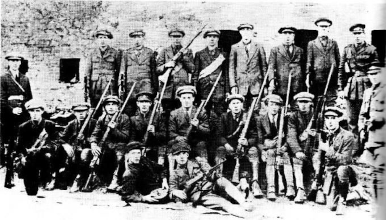
A car transporting police officers is leading the two-vehicle convoy. It is shot at as it travels out of the village, causing the Crossley Tender behind to stop close to the local hotel. RIC Constables Christopher O’Regan and William Power, Sergeant John Regan and Black and Tans Constable Hubert Oakes all die in the ambush. British forces are able to take refuge in the hotel, where they call for reinforcements.
Following the ambush, the Flying Column takes to the nearby Partry Mountains and are subsequently engaged by British troops from the Border Regiment. IRA Adjutant (South Mayo Brigade) Michael O’Brien sustains fatal injuries when he is shot while trying to assist the injured Brigade leader, Commandant Maguire. Another IRA Volunteer, Pádraig Feeney, is also killed that afternoon.
On May 3, 1921, in reprisal for the ambush, Crown forces burn several commercial establishments and homes in the area. Extensive searches and reprisals follow in the area over the next week.
Monuments commemorating Michael O’Brien and Pádraig Feeney have since been erected in County Mayo.
(Pictured: The South Mayo Flying Column of the Irish Republican Army, taken at Moore Hall in Muckloon, County Mayo, during the summer of 1921)
O’Hagan, known to all and sundry simply as JB, dies on Monday, April 23, 2001, in the town in which he was born almost 79 years previously and from which he and his wife Bernadette had been exiled for 25 years during the current phase of the conflict. As befitted a soldier of Óglaigh na hÉireann, a uniformed IRA Guard of Honour attends O’Hagan’s body in the wake house and it is six of his comrades who carry the coffin, bedecked in the Irish Tricolour and beret and gloves, from the family home on the first section of its journey to St. Paul’s Chapel for the Funeral Mass.
Up to 2,000 people attend the funeral and businesses in the bustling North Armagh town close along the route as a mark of respect. At St. Colman’s Cemetery just outside the town, Sinn Féin President Gerry Adams pays fulsome tribute to a republican who had been active from the 1940s into the 1990s and right up to his sudden death. Adams notes O’Hagan’s strong faith and welcomes the tribute paid during the Funeral Mass to JB’s republican beliefs and exploits. He adds, however, that it is high time the Catholic hierarchy reverses its directive banning the Tricolour from republican funerals in church premises. “Our National Flag should be allowed to stay on the coffin for the entire ceremony,” he says.
“I have always associated JB with Bernadette,” he tells those gathered at the graveside, “even though they were apart for so many years. They were married for 52 years, and Bernadette told me yesterday that she wouldn’t change a day of it, that she was proud of him and of his life.”
“In many ways he died the way he had lived, very quietly, modestly, not complaining, unassuming to the end. He was one of the most respected republicans of our time. There is no greater tribute that can be paid to any man or woman than to be known as a decent human being and Joe B. was that and more.”
Adams goes on to briefly record the extraordinary history of O’Hagan’s involvement in the republican struggle, as soldier and political activist, since he first joined the IRA in 1940, including that famous 1973 escape from Mountjoy Jail by helicopter, accompanied by Kevin Mallon and the late Seamus Twomey.
“JB grew up in the 1920s in a state abandoned by the Irish Government, where nationalists were subjected to the B-Specials and the Special Powers Act. He stood up at a time when standing up was a very very dangerous thing to do,” says Adams. “It is a wonder to me that he was active in every decade from the 1940s on. There is a mighty man!”
“He also personifies why Irish republicanism has never been defeated. He was an example of a physical force republican who was prepared to support and exhaust other means of struggle. He saw armed struggle as a means rather than as an end, but he never ceased to be an unrepentant republican and to work always for the establishment of an Irish Republic based on national rights for the people of this island. He supported the Good Friday Agreement not as an end but as an effort to build a new accord with our opponents and enemies. Political unionism has found it very difficult to deal with this strategy.”
“Joe B was very philosophical and very wise. He is representative of that republican element who never broke a promise in their lives.”
“Those who seek to defeat the republican struggle by blaming the IRA for everything need to know that none of this will work. That is because of the work that JB and people like him put into this struggle. We won’t be worn down or accept anything less than our full rights. The message for David Trimble and Tony Blair is that it is impossible for us to accept inequality, injustice and second-class citizenship. That is the past. We are looking to the future.”
“Joe B’s passing has left a huge gap, but we should celebrate his life. He touched so many of us. Joe B kept us right. The flame he kept flickering in the lean times is burning brightly now because of his contribution.”
Adams extends his solidarity and sympathy and that of all those present to Bernadette, to O’Hagan’s children, Barry, Kevin, Fintan, Siobhán, Felim and Dara, to his eleven grandchildren and four great-grandchildren, his sisters and entire family circle.
At the end of the Funeral Mass for O’Hagan, the O’Hagan family lead by Joe’s son Fintan place the Irish Tricolour on the coffin before the remains are taken from the chapel. This act is borne out of anger and frustration.
O’Hagan was a republican, an honourable man and a religious man who went to Mass every day. So, his family feels that the Catholic Church, that was as much an influence on O’Hagan’s life as was his republicanism, should respect his wish and allow his coffin to be draped in the Tricolour. The family appeals to the Catholic Church authorities and Adams intercedes on their behalf, but they are refused the right to grant O’Hagan his wish that the Flag not be removed from his coffin.
Dara O’Hagan, the Sinn Féin Northern Ireland Assembly member for Upper Bann, tells the bishop that by sticking to their old policy the Catholic Church is criminalising republicanism and indeed criminalising her father.
Also, the Catholic hierarchy misses a great opportunity to heal a hurt that has existed for over 20 years, when the remains of IRA Volunteer Kevin `Dee’ Delaney were refused entry into Corpus Christi Church in Springhill while bearing the Irish Tricolour. The rancour and hurt felt by republicans over this slight, coming as it does, in conjunction with the British Government’s attempts to criminalise republicanism, has long been an insult that republicans have resented. After all, churches are the people’s property as it is their money and effort that build them. The people of Springhill and the Greater Ballymurphy area paid £5 a brick for the Corpus Christi building and the Delaney family no doubt contributed to that fund.
By taking matters into their own hands, the O’Hagan family claims back some ground for republicans and sends a message to the bishops that they have a part to play in this new political era and that they need to look at their attitude to republicanism.
O’Hagan’s wife Bernadette says that as Fintan draped the Irish Trocolour on Joe’s coffin and the church burst into spontaneous applause, her heart was lifted. “I was so glad, and I walked down the aisle with a smile on my face,” said Bernadette.
(From: “Unassuming and mighty man laid to rest” by Martin Spain, An Phoblacht Republican News, May 3, 2001)
Cooney is the second of three children of John Cooney and Mary Ann Cooney (née Gleeson), middling farmers. While his grandfather, Patrick Cooney, from nearby Garrykennedy, is reputed to have been a member of the Irish Republican Brotherhood (IRB) and an Irish National Land League activist, his father does not have any inclination towards radical politics. He is educated at Lissenhall national school and St. Joseph’s CBS, Nenagh. In October 1916, he commences studies in medicine at University College Dublin (UCD) just as the Irish War of Independence is getting underway. He plays briefly with the College’s hurling club.
In 1917, Cooney joins the Third Battalion of the Dublin Brigade of the Irish Republican Army (IRA). A year later he is jailed for two months in Mountjoy Prison and Crumlin Road Gaol, Belfast, for illegal drilling. Joining the IRB at the end of 1918, he assists in the December 1918 election by protecting candidates and acts as a guard at sittings of the First Dáil. On June 26, 1920, he plays a major role in the attack on BorrisokaneRoyal Irish Constabulary (RIC) barracks. He takes part in the Bloody Sunday operations of November 21, 1920, at 28 Upper Pembroke Street where a number of British agents are killed and attends Croke Park afterwards. He then goes on the run as a full-time Volunteer and serves with the Dublin Brigade active service unit (ASU).
After the Anglo-Irish truce of July 1921, Cooney is appointed Officer Commanding (O/C) of the 1st Kerry Brigade, IRA, reorganising it and forming a flying column. Opposing the Anglo-Irish Treaty of 1921, he does not immediately break with GHQ, who sends him to organise the 1st Eastern Division. Later in January 1922, the Chief of Staff, Eoin O’Duffy, asks him to become O/C of the 3rd Eastern Division, but later rescinds the appointment. In March 1922 he is appointed O/C of the 1st Eastern Division of the anti-Treaty IRA during the Irish Civil War.
That same year he is captured by Free State forces and interned in Mountjoy Prison, where he becomes O/C of the prisoners in C Wing. He accepts responsibility for an attempted escape bid on October 10, 1922, in which a fellow prisoner, Peadar Breslin, is killed and another man is wounded. After sojourns in Newbridge and Arbour Hill Prison, he is moved with the other leaders to Kilmainham Gaol, where he spends forty-one days on hunger strike. Removed to Harepark Camp, the Curragh, on January 1, 1924, he is among the last to be released on May 29, 1924.
Cooney succeeds Frank Aiken as Chief of Staff of the IRA on November 18, 1925. Central to the reorganisation scheme he puts in place is the need to secure American funds for the IRA and to combat Frank Aiken’s fundraising work in the United States since December 1925 on behalf of the embryo Fianna Fáil organisation. Receiving permission on April 21, 1926, he departs on a fund-raising trip to the United States but returns to Ireland in October. He resigns as chief of staff in favour of Maurice Twomey but retains his position as chairman of the IRA executive until November 21, 1927, when he obtains leave to complete his medical studies.
After internship in the Mater Hospital, Dublin, Cooney finds temporary employment in London, but remains in touch with GHQ. On September 27, 1929, he marries the German-educated Frances (‘Frank’) Brady, daughter of a wealthy Belfast linen family and former Cumann na mBan activist and hunger-striker. The marriage is not a success. Failing to secure employment due to police harassment and the loyalty test then in force, he and his wife are obliged to emigrate to London, where he practises as a GP, still maintaining his IRA links. Their only child, Seán, is born there in 1931. He returns to Ireland in August 1932, after Fianna Fáil’s accession to power.
An intimate friend of Maurice Twomey, who is still Chief of Staff, Cooney remains in the upper echelons of the IRA and attends its conventions. Signifying his standing in republican circles, he is chosen to unveil, inter alia, the Fenian memorial in Glasnevin Cemetery and the Seán Treacy plaque in Talbot Street, Dublin, and is a regular speaker at commemorations. In March 1940, he attempts to intercede with Éamon de Valera on behalf of hunger-striking republicans, and is later arrested, but released.
After the discovery of a German spy ring in the hospitals commission’s subsidiary, the Dublin Hospitals Bureau, Cooney is forced to resign in April 1942 on refusing to take a loyalty pledge to the state. He returns to private practice. He becomes active in the unsuccessful campaign to save Charlie Kerins, Chief of Staff, from being hanged in 1944. In anticipation of emigrating, he finally resigns from the IRA in 1944, though military and police surveillance continue until March 1945.
In August 1945, Cooney joins the United Nations Relief and Rehabilitation Administration, working with displaced persons in the American zone in Germany, and gains rapid promotion. After joining the International Refugee Organisation (UNRRA’s successor) on July 1, 1947, he becomes the chief medical officer of an area including the American sector of Berlin and containing 150,000 displaced persons. He later holds a similar post in Bavaria.
Appointed a part-time member of the hospitals commission by the inter-party government in September 1949 and in severe financial straits, Cooney emigrates alone to the United States on December 2, 1950, and never returns. While employed in a tuberculosissanatorium in New Jersey, he obtains by examination his licence to practise medicine in Maryland on January 14, 1954. Admitted a member of the American College of Chest Physicians, again by examination, on November 23, 1954, he secures, at the age of 57, his first ever permanent post in medicine, in a similar hospital in Pikesville, Maryland. His republican activities continue through Clan na Gael during his U.S. years, and he is a frequent speaker at commemorative events.
(Pictured: Liam Lynch with some of his Divisional Staff and Officers of the Brigades, including the 1st Southern Division, who attend as delegates to the Army Convention at the Mansion House, Dublin, on April 9, 1922. Cooney is first on the right in the 3rd row back.)







 seamus dubhghaill