seamus dubhghaill

Promoting Irish Culture and History from Little Rock, Arkansas, USA


Leave a comment

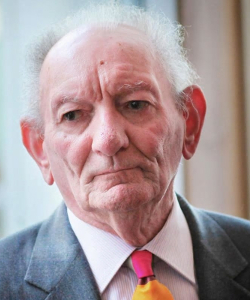
Death of Playwright Brian Friel

Brian Patrick Friel, Irish playwright, short story writer and founder of the Field Day Theatre Company, dies on October 2, 2015, in Greencastle, County Donegal. He has been considered one of the greatest living English-language dramatists. He has been likened to an “Irish Chekhov” and described as “the universally accented voice of Ireland.” His plays have been compared favourably to those of contemporaries such as Samuel Beckett, Arthur Miller, Harold Pinter and Tennessee Williams.

Friel is born in Knockmoyle, close to Omagh, County Tyrone, Northern Ireland. The family moves to Derry when Friel is ten years old. There, he attends St. Columb’s College, the same school attended by Seamus Heaney, John Hume, Seamus Deane, Phil Coulter, Eamonn McCann and Paul Brady. He receives his B.A. from St. Patrick’s College, Maynooth (1945–48).

Recognised for early works such as Philadelphia, Here I Come! and Faith Healer, Friel has 24 plays published in a career of more than a half-century. He is elected to the honorary position of Saoi of Aosdána. His plays are commonly produced on Broadway in New York City throughout this time, as well as in Ireland and the United Kingdom. In 1980 Friel co-founds Field Day Theatre Company, and his play Translations is the company’s first production. With Field Day, Friel collaborates with Seamus Heaney, 1995 recipient of the Nobel Prize in Literature. Heaney and Friel first become friends after Friel sends the young poet a letter following publication of his book Death of a Naturalist. Friel’s play Dancing at Lughnasa wins three Tony Awards in 1992.

Friel is a member of the American Academy of Arts and Letters, the British Royal Society of Literature and the Irish Academy of Letters. He is appointed to Seanad Éireann in 1987 and serves until 1989. In later years, Dancing at Lughnasa reinvigorates Friel’s oeuvre, bringing him Tony Awards, including Best Play, the Laurence Olivier Award for Best New Play and the New York Drama Critics Circle Award for Best Play. It is also adapted into a film, starring Meryl Streep, directed by Pat O’Connor, script by Frank McGuinness.

After a long illness Friel dies at the age of 86 in the early morning of Friday, October 2, 2015, in Greencastle, County Donegal. He is survived by his wife Anne and children Mary, Judy, Sally and David. A daughter, Patricia, predeceases him in 2012.
5 Comments

The Battle of Ardnaree

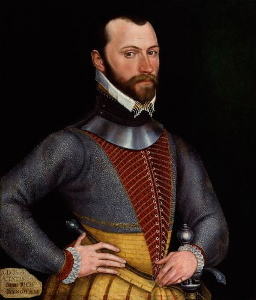
The Battle of Ardnaree, a battle in the Tudor conquest of Ireland, is fought at Ardnaree, now a suburb of Ballina, County Mayo, on September 23, 1586. The result is a victory for the English over the Mac Philbins and Burkes. The conflict is a part of the political and military struggle, involving the English and occasionally the Scots, for control of northern Ireland. The anglicised version of the name Ardnaree can be translated to Árd na ríogh, meaning the hill of the kings.

The Mac Philbins and Mayo Burkes are in rebellion against the brutal English rule. An Irish-Scottish mercenary army, led by Donnell Gorm MacDonnell of Carey and Alexander Carragh MacDonnell of Glenarm, sons of the deceased James MacDonald, 6th of Dunnyveg, are invited into Connacht by the Burkes to attack English settlements and forces. The mercenary army is fronted at Sligo, Coolony and Ballingafad by English forces for over fourteen days.

Sir Richard Bingham, governor of Connacht, follows the mercenary force to Ardnaree, where the mercenary force has camped on the east bank of the River Moy. Bingham’s forces surround the camp at night and attack the occupants. During the battle 1,000 mercenaries are killed, including Donnell Gorm MacDonnell of Carey and Alexander Carragh MacDonnell of Glenarm. Also slaughtered are some 1,000 men, women and children in the camp.

Richard Bingham goes on to hang the leaders of the Burkes, with the former lands of Mac Philbins and Mayo Burkes given to English settlers.

(Pictured: Sir Richard Bingham, governor of Connacht)


Leave a comment

Birth of Artist Thomas James Carr

Thomas James Carr, British artist who is associated with the Euston Road School in the 1930s and has a long career as a painter of domestic scenes and landscapes, is born in Belfast to a well-to-do family on September 21, 1909.

Carr attends Oundle School where his art masters include E.M.O’R. Dickey and Christopher Perkins. In 1927 Carr moves to London where he studies at the Slade School of Fine Art. After two years at the Slade, he moves to Italy and spends six months in Florence. Upon returning to London, he establishes himself as a well-regarded painter of domestic scenes.

Although essentially a realist painter, Carr is included in the 1934 Objective Abstractionists exhibition at Zwemmer’s Gallery. In 1937, he shares an exhibition with Victor Pasmore and Claude Rogers at the Storran Gallery and subsequently becomes associated with the representational style of the Euston Road School. Starting in 1940, at Georges Wildenstein‘s gallery, he holds a series of one-man exhibitions at various galleries including at the Leicester Galleries, The Redfern Gallery and also at Thomas Agnew & Sons.

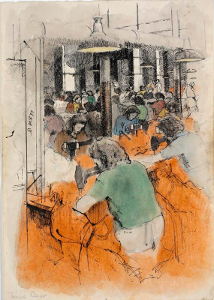
In 1939, Carr returns to Northern Ireland and settles in Newcastle, County Down. During the World War II, he receives a small number of commissions from the War Artists’ Advisory Committee to depict parachute manufacture and the Short Sunderland flying boats being built at the Short Brothers factory in Belfast.

After the war, Carr teaches at the Belfast College of Art and moves to Belfast in 1955. After the death of his wife in 1995, he moves to Norfolk, England to be nearer one of his three daughters and her family. He continues to paint into old age and tends to concentrate on landscape painting.

Carr is a regular exhibitor at the Royal Academy of Arts and is a member of the Royal Ulster Academy, the New English Art Club, the Royal Watercolour Society and is an honorary member of the Royal Hibernian Academy. Queen’s University awards him an honorary doctorate in 1991. For his services to art in Northern Ireland, he is awarded the MBE in 1974 and receives an OBE in 1993.

Thomas Carr dies at the age of 89 in Norwich, England on February 17, 1999.

(Pictured: “Making Coloured Parachutes” by Thomas James Carr (http://www.iwm.org.uk/collections/item/object/4674) [Public domain], via Wikimedia Commons)


Leave a comment

Birth of Singer-Songwriter Van Morrison

Sir George Ivan Morrison, best known as Van Morrison, Northern Irish singer-songwriter, instrumentalist and producer, is born on August 31, 1945 in Bloomfield, Belfast, Northern Ireland. He is the only child of George Morrison, a shipyard electrician, and Violet Stitt Morrison, who had been a singer and tap dancer in her youth.
Known as “Van the Man,” Morrison starts his professional career when, as a teenager in the late 1950s, he plays a variety of instruments including guitar, harmonica, keyboards and saxophone for various Irish showbands, covering the popular hits of the time. He rises to prominence in the mid-1960s as the lead vocalist of the Northern Irish R&B band Them, with whom he records the garage band classic “Gloria.” His solo career begins under the pop-hit oriented guidance of Bert Berns with the release of the hit single “Brown Eyed Girl” in 1967. After Berns’ death, Warner Bros. Records buys out his contract and allows him three sessions to record Astral Weeks (1968). Though this album gradually garners high praise, it is initially a poor seller.

Moondance (1970) establishes Morrison as a major artist, and he builds on his reputation throughout the 1970s with a series of acclaimed albums and live performances. He continues to record and tour, producing albums and live performances that sell well and are generally warmly received, sometimes collaborating with other artists, such as Georgie Fame and The Chieftains.

Much of Morrison’s music is structured around the conventions of soul music and R&B, such as the popular singles “Brown Eyed Girl,” “Jackie Wilson Said (I’m in Heaven When You Smile),” “Domino” and “Wild Night.” An equal part of his catalogue consists of lengthy, loosely connected, spiritually-inspired musical journeys that show the influence of Celtic tradition, jazz and stream of consciousness narrative, such as the album Astral Weeks and the lesser-known Veedon Fleece and Common One. The two strains together are sometimes referred to as “Celtic soul.”

Van Morrison has received six Grammy Awards, the 1994 Brit Award for Outstanding Contribution to Music, and has been inducted into both the Rock and Roll Hall of Fame and the Songwriters Hall of Fame. In 2016, he is knighted for his musical achievements and his services to tourism and charitable causes in Northern Ireland.

(Pictured: Van Morrison performing at Glasgow Royal Concert Hall on January 26, 2015 | Image: Getty)


Leave a comment

Death of Poet Seamus Heaney, Nobel Prize Recipient

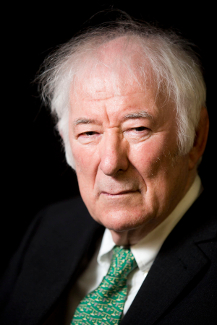
Seamus Justin Heaney, Irish poet, playwright, translator and lecturer, dies in Dublin on August 30, 2013. He is the 1995 recipient of the Nobel Prize in Literature.

Heaney is born near Castledawson, County Londonderry, in Northern Ireland. The family moves to nearby Bellaghy when he is a boy. After attending Queen’s University Belfast, Heaney becomes a lecturer at St. Joseph’s College in Belfast in the early 1960s and begins to publish poetry. He lives in Sandymount, Dublin from 1976 until his death. He also lives part-time in the United States from 1981 to 2006. Heaney is recognised as one of the principal contributors to poetry during his lifetime.

Heaney is a professor at Harvard University from 1981 to 1997, and its Poet in Residence from 1988 to 2006. From 1989 to 1994, he is also the Professor of Poetry at the University of Oxford. In 1996, he is made a Commandeur de l’Ordre des Arts et des Lettres. Other awards that he receives include the Geoffrey Faber Memorial Prize (1968), the E. M. Forster Award (1975), the PEN Translation Prize (1985), the Golden Wreath of Poetry (2001), the T. S. Eliot Prize (2006) and two Whitbread Book Awards (1996 and 1999). In 2011, he is awarded the Griffin Poetry Prize and, in 2012, a Lifetime Recognition Award from the Griffin Trust for Excellence in Poetry. His literary papers are held by the National Library of Ireland.

American poet Robert Lowell describes Heaney as “the most important Irish poet since Yeats,” and many others, including the academic John Sutherland, have said that he is “the greatest poet of our age.” Robert Pinsky has stated that “with his wonderful gift of eye and ear Heaney has the gift of the storyteller.” Upon his death in 2013, The Independent describes him as “probably the best-known poet in the world.” One of his best-known works is Death of a Naturalist, published in 1966.

Seamus Heaney dies in the Blackrock Clinic in Dublin on August 30, 2013, aged 74, following a short illness. After a fall outside a restaurant in Dublin, he enters the hospital for a medical procedure, but dies at 7:30 the following morning before it takes place. His funeral is held in Donnybrook, Dublin, on the morning of September 2, 2013, and he is buried in the evening in the Cemetery of St. Mary’s Church, Bellaghy, County Londonderry, Northern Ireland, in the same graveyard as his parents, young brother, and other family members. His son Michael reveals at the funeral mass that his father texted his final words, “Noli timere” (Latin: “Do not be afraid”), to his wife, Marie, minutes before he died. Shortly after Heaney’s death, graffiti artist Maser paints a mural in Dublin referencing this message.

On September 1, the day after his death, a crowd of 81,553 spectators applaud Heaney for three minutes at a semi-final match of the 2013 All-Ireland Senior Football Championship. His funeral is broadcast live the following day on RTÉ television and radio and is streamed internationally at RTÉ’s website. RTÉ Radio 1 Extra transmits a continuous broadcast, from 8:00 AM until 9:15 PM on the day of the funeral, of his Collected Poems album, recorded in 2009. His poetry collections sell out rapidly in Irish bookshops immediately following his death.


Leave a comment

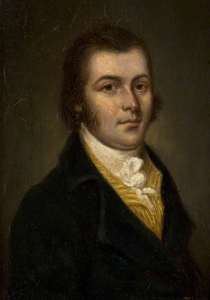
Death of Samuel Nielson, Society of United Irishmen Founder Member

Samuel Neilson, one of the founder members of the Society of United Irishmen and the founder of its newspaper the Northern Star, dies in Poughkeepsie, New York on August 29, 1803.

Neilson is born in Ballyroney, County Down, the son of Presbyterian minister Alexander, and Agnes Neilson. He is educated locally. He is the second son in a family of eight sons and five daughters. At the age of 16, he is apprenticed to his elder brother, John, in the business of woolen drapery in Belfast. Eight years later he establishes his own business.

Despite his commercial success, Neilson is naturally drawn to politics and is early on a member of the reformist Irish Volunteers movement. In 1791, inspired by the French Revolution, he suggests to Henry Joy McCracken the idea of a political society of Irishmen of every religious persuasion. He establishes the Society of United Irishmen in Belfast. The following year he launches the newspaper of the United Irishmen, the Northern Star, which effectively throws away his fortune. As its editor he is a high-profile target for the authorities and is prosecuted for libel several times, being twice imprisoned between 1796 and 1798.

Along with several other state prisoners, Neilson is released in February 1798 following several petitions by influential friends, on grounds of bad health. Upon release he immediately involves himself in the United Irishmen aligning with the radicals among the leadership who are pressing for immediate rebellion and oppose the moderates who wish to wait for French assistance before acting.

The United Irishmen are however, severely penetrated by informants who keep Dublin Castle abreast of their plans and discussions. In March 1798, information of a meeting of the United Irish executive at the house of Oliver Bond leads to the arrest of most of the leadership, leaving Neilson and Lord Edward FitzGerald as the only figures of national importance still at liberty. They decide to press ahead as soon as possible and settled on May 23 as the date for the rebellion to begin.

As the date looms closer, the authorities go into overdrive to sweep up the rump leadership and on May 18 Lord Edward is betrayed in his hiding place and critically wounded while resisting capture. Neilson, now with responsibility for finalising plans for the looming rebellion, decides that Fitzgerald is too valuable to do without, and decides to try and rescue him from Newgate Prison in Dublin. Wary of confiding his plans too early for fear of betrayal, Neilson goes on a reconnaissance of the prison but is spotted by chance by one of his former jailers and after a fierce struggle, he is overpowered and dragged into the prison.

Neilson is indicted for high treason and held in Kilmainham Gaol with other state prisoners for the duration of the doomed rebellion outside. After the execution of Oliver Bond, and the brothers John and Henry Sheares, Neilson and the remaining prisoners agree to provide the authorities with details of the organisation of the United Irishmen, plans for the rebellion, etc. in return for exile.

Following the suppression of the rebellion, Neilson is transferred to Fort George in Inverness-shire, Scotland, and in 1802 he is deported to the Netherlands. From there he makes his way to the United States, arriving in December 1802, and settling in Poughkeepsie, New York.  He has little time to enjoy his liberty before his sudden death on August 29, 1803, of yellow fever, or possibly a stroke.

Nielson is not idle during his short life in America as he completes plans to start a new evening newspaper in Poughkeepsie and also has plans in the works to establish a version of the Society of United Irishmen in the United States. Since his death, his remains have been moved to three different cemeteries before coming to rest in the Poughkeepsie Rural Cemetery in 1880.

(Photograph: (c) National Museums Northern Ireland; Supplied by The Public Catalogue Foundation)


Leave a comment

Launch of the RMS Oceanic

RMS Oceanic, the White Star Line‘s first liner built by Harland & Wolff in Belfast, is launched on August 27, 1870, arriving in Liverpool, England for her maiden voyage on February 26, 1871.

Three sister ships are constructed in rapid succession: RMS Atlantic, SS Baltic, and SS Republic. All are of the same approximate dimensions with differences in tonnage.

Powered by a combination of steam and sail, RMS Oceanic has twelve boilers generating steam for a single four-cylinder compound steam engine. A single funnel exhausts smoke and four masts carry sails. The hull is constructed of iron and divided into eleven watertight compartments. Passenger accommodations are located on the two decks concealed within the hull. RMS Oceanic can carry 166 First Class passengers, referred to as Saloon Passengers in the day and 1,000 Steerage Passengers, along with a 143-man crew. White Star spares no expense in her construction, and the contemporary press describes the ship as an “imperial yacht.”

RMS Oceanic leaves Liverpool for her maiden voyage on March 2, 1871 carrying only 64 passengers, under Captain Sir Digby Murray. Not long after departing, she has to return because of overheated bearings. Her voyage restarts on March 16. From that point onward, RMS Oceanic is a success for The White Star Line.

In January, 1872, RMS Oceanic undergoes a refit, during which a large forecastle is added to help prevent the bow being inundated during high seas. Two new boilers are added to increase steam pressure and thus engine power, and the four masts are shortened.

RMS Oceanic continues sailing with the White Star line on the Liverpool to New York City route until March 11, 1875, when she is chartered to the Occidental & Oriental Steamship Company, for service between San Francisco, Yokohama and Hong Kong. White Star provides the officers, while the crew is Chinese. The ship itself remains in White Star colours, but flies the O&O flag. During the repositioning voyage from Liverpool to Hong Kong, RMS Oceanic sets a speed record for that route. Later, she also sets a speed record for Yokohama to San Francisco in December 1876, and then breaks her own record over that route in November, 1889, with a time of 13 days, 14 hours and 5 minutes.

On August 22, 1888, RMS Oceanic collides with the coastal liner SS City of Chester just outside the Golden Gate. The SS City of Chester sinks, killing 16 on board.

On January 7, 1890, Nellie Bly boards RMS Oceanic in Yokohama to cross the Pacific as part of her voyage Around the World in Seventy-Two Days. She arrives in San Francisco on January 21, 1890, which is a day behind schedule as a result of rough weather.

In 1895, RMS Oceanic is returned to White Star, which plans to put her back into service. She is sent back to Harland and Wolff for re-engining, but when the ship is inspected closely, it is found to be uneconomical to perform all the work needed. Instead, RMS Oceanic is sold for scrap, leaving Belfast for the last time on February 10, 1896, under tow, for a scrapyard on the River Thames.


Leave a comment

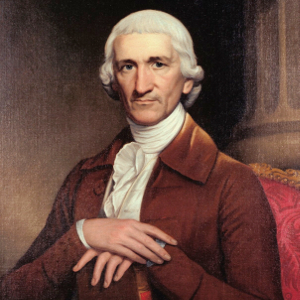
Death of Charles Thomson, Secretary of the Continental Congress

Charles Thomson, Irish-born Patriot leader in Philadelphia during the American Revolution and the secretary of the Continental Congress (1774–1789) throughout its existence, dies in Lower Merion Township, Pennsylvania, on August 16, 1824.

Thomson is born in Gorteade townland, Maghera parish, County Londonderry, to Scots Irish parents. After the death of his mother in 1739, his father emigrates to the British colonies in America with Charles and his brothers. His father dies at sea and the penniless boys are separated in America. Charles is cared for by a blacksmith in New Castle, Delaware, and is educated in New London Township, Pennsylvania. In 1750 he becomes a tutor in Latin at the Philadelphia Academy.

During the French and Indian War, Thomson is an opponent of the Pennsylvania proprietors’ American Indian policies. He serves as secretary at the Treaty of Easton (1758) and writes An Enquiry into the Causes of the Alienation of the Delaware and Shawanese Indians from the British Interest (1759), which blames the war on the proprietors. He is allied with Benjamin Franklin, the leader of the anti-proprietary party, but the two men part politically during the Stamp Act crisis in 1765. Thomson becomes a leader of Philadelphia’s Sons of Liberty. He is married to the sister of Benjamin Harrison V, another signer, as delegate, of the Declaration of Independence.

Thomson is a leader in the revolutionary crisis of the early 1770s. John Adams calls him the “Samuel Adams of Philadelphia.” Thomson serves as the secretary of the Continental Congress through its entirety. Through those 15 years, the Congress sees many delegates come and go, but Thomson’s dedication to recording the debates and decisions provides continuity. Along with John Hancock, president of the Congress, Thomson’s name (as secretary) appears on the first published version of the Declaration of Independence in July 1776.

Thomson’s role as secretary to Congress is not limited to clerical duties. Thomson is also noted for designing, with William Barton, the Great Seal of the United States. The Great Seal plays a prominent role in the January 14, 1784, ratification of the Treaty of Paris (1783). Britain’s representatives in Paris initially dispute the placement of the Great Seal and Congressional President Thomas Mifflin‘s signature, until mollified by Benjamin Franklin.

But Thomson’s service is not without its critics. James Searle, a close friend of John Adams, and a delegate, begins a cane fight on the floor of Congress against Thomson over a claim that he is misquoted in the “Minutes” that results in both men being slashed in the face. Such brawls on the floor are not uncommon, and many of them are promoted by argument over Thomson’s recordings. Political disagreements prevent Thomson from getting a position in the new government created by the United States Constitution. Thomson resigns as secretary of Congress in July 1789 and hands over the Great Seal, bringing an end to the Continental Congress.

Thomson spends his final years at Harriton House in Bryn Mawr, Pennsylvania working on a translation of the Bible. He also publishes a synopsis of the four evangelists in 1815. In retirement, Thomson also pursues his interests in agricultural science and beekeeping. According to Thomas Jefferson, writing to John Adams, Thomson becomes senile in his old age, unable to recognize members of his own household.


Leave a comment

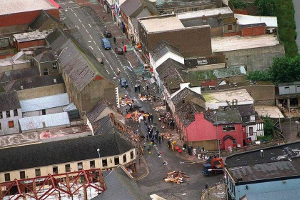
The Omagh Car Bombing

The Omagh bombing, a car bombing in Omagh, County Tyrone, Northern Ireland, takes place on August 15, 1998. It is carried out by a group calling themselves the Real Irish Republican Army, a Provisional Irish Republican Army (IRA) splinter group who opposes the IRA’s ceasefire and the Good Friday Agreement.

On the day of the bombing, the bombers drive a car, loaded with 230 kilograms (510 lb) of fertiliser-based explosives, across the Irish border. At approximately 2:19 PM they park the vehicle outside S.D. Kells’ clothes shop in Omagh’s Lower Market Street, on the southern side of the town centre, near the crossroads with Dublin Road. They are unable to find a parking space near the intended target, the Omagh courthouse. The two male occupants arm the bomb and, upon exiting the car, walk east down Market Street towards Campsie Road.

Three telephone calls are made warning of a bomb in Omagh, using the same codeword that had been used in the Real IRA’s bomb attack in Banbridge two weeks earlier. At 2:32 PM, a warning is telephoned to Ulster Television saying, “There’s a bomb, courthouse, Omagh, Main Street, 500 lb., explosion 30 minutes.” One minute later, the office receives a second warning saying, “Martha Pope (which is the RIRA’s code word), bomb, Omagh town, 15 minutes.” The caller claims the warning on behalf of “Óglaigh na hÉireann.” One minute later, the Coleraine office of the Samaritans receives a call stating that a bomb will go off on “Main Street” about 200 yards (180 m) from the courthouse. The recipients pass the information on to the Royal Ulster Constabulary (RUC) but are claimed to be inaccurate and police inadvertently move people towards the bomb.

The car bomb detonates at 3:10 PM in the crowded shopping area. The bombing kills 29 people, including a woman pregnant with twins, and injures some 220 others. Twenty-one people who are in the vicinity of the vehicle die at the scene. Eight more people die on the way to or in the hospital. The death toll is higher than that of any single incident during what are considered “the Troubles.”

The bombing causes outrage both locally and internationally, spurs on the Northern Ireland peace process, and deals a severe blow to the Dissident republican campaign. The Real IRA apologises and declares a ceasefire shortly afterwards. The victims include people from many backgrounds: Protestants, Catholics, a Mormon teenager, five other teenagers, six children, a mother pregnant with twins, two Spanish tourists, and others on a day trip from the Republic of Ireland. Both unionists and Irish nationalists are killed and injured.

It is alleged that the British, Irish and U.S. intelligence agencies have information which could have prevented the bombing, most of which comes from double agents inside the Real IRA. This information is not given to the local police, the Royal Ulster Constabulary (RUC). In 2008 it is revealed that British intelligence agency, Government Communications Headquarters, was monitoring conversations between the bombers as the bomb was being driven into Omagh.

A 2001 report by the Police Ombudsman says that the RUC Special Branch failed to act on prior warnings and slammed the RUC’s investigation of the bombing. The RUC has obtained circumstantial and coincidental evidence against some suspects, but it has not come up with anything to convict anyone of the bombing. Colm Murphy is tried, convicted, and then released after it is revealed that Garda Síochána forged interview notes used in the case. Murphy’s nephew, Sean Hoey, is also tried and found not guilty.

In June 2009, the victims’ families win a GB£1.6 million civil action against four defendants. In April 2014, Seamus Daly is charged with the murders of those killed, however, the case against him is withdrawn in February 2016.


3 Comments

The Battle of the Ford of the Biscuits

The Battle of the Ford of the Biscuits takes place in County Fermanagh on August 7, 1594, when a force of English Army soldiers led by Sir Henry Duke is ambushed and defeated by an Irish force under Hugh Maguire and Cormac MacBaron O’Neill in the region of the fords of the Arney River on the approaches to Enniskillen.

The battle acquires its distinctive name due to the supplies of the Crown forces, largely hard biscuits, which are scattered and left floating in the river. The battle is an early exchange in the Nine Years’ War and exposes the vulnerability of Crown forces to ambushes in the wilder parts of Ulster with its thick woods and bogs.

The relief force is under the joint command of Sir Henry Duke and Sir Edward Herbert, who have 600 infantrymen and 40 horses. Duke and Herbert believe this to be insufficient and write to the Lord Deputy that “to go without a thousand men at the least or otherwise we shall dearly repent our going.” No reinforcements are forthcoming therefore the column sets north from Cavan on August 4. Burdened with supplies, the army is expected to take four days to march twenty-nine miles north to Enniskillen. The night before the battle the English camp is pestered by Irish gunfire and incessant skirmishing which causes the English troops to be poorly rested when the set out on August 7 to relieve the beleaguered garrison. As the thin column starts to snake its way north, almost immediately it comes under attack on both flanks as Irish skirmishes hurl javelins, but this is not the main attack.

As the relief expedition approaches Enniskillen from the south, Maguire and Cormac MacBaron lay in wait for them on the Arney River. The Army’s cavalry scouts fail to detect the Irish lying in wait for them. The ground is boggy near the Arney ford; therefore, they are forced to dismount. Consequently, the infantry escorting the supply wagons for Enniskillen run straight into the ambush. Around eleven o’clock the head of the column approaches the ford. Without warning intense Irish gunfire tears into the lead English elements from concealed positions on the opposite bank. With the advance stalled, Maguire and MacBaron assail the rear of the column with the bulk of their forces. Wings of English shot deploy to skirmish with the Irish, but withering Irish fire pushes them back to their pike stands in the column.

The English rear falls into disorder causing the Irish pike and Scots mercenaries to charge, forcing them to flee pell mell onto the centre of the column. The English collapse continues as the column concertinaed towards the head of the army stalled at the ford. Fortunately, the leading English pike has forced the crossing, pushing back the Irish shot, giving the English some room to reorder and regroup north of the river.

The English are engaged by Irish shot from the surrounding hills, but a counterattack is stillborn when its leader, Captain Fuller, is killed. With most of the supplies abandoned at the river, Duke and Herbert decide their only option is to retreat. However, their retreat to the ford is met with renewed gunfire and the disintegrating army is compelled to cross on another ford an “arrow shot” upstream.

Luckily for Duke and Herbert’s men they are not pursued as most of the Irish have fallen to looting the baggage train which gives the battle its name, Béal-Átha-na-mBriosgadh or The Ford of the Biscuits.

The badly mauled Crown forces retreat to Cavan. News of the defeats causes some alarm due to the small size of the peacetime Royal Irish Army, which is scattered in garrisons across the island. Although this can be supplemented by forces of loyal Gaelic chiefs, fresh troops need to be raised in England and sent across the Irish Sea to contain the developing northern rebellion. In addition, a force of soldiers who have been serving in Brittany is brought to Ireland.

A second relief expedition, this time led by the Lord Deputy of Ireland William Russell, 1st Baron Russell of Thornhaugh, manages to reach Enniskillen and re-supply it. However, Enniskillen does fall to the rebels in May of the following year and the garrison is massacred, despite having been promised their lives when they surrendered.

(Photo with permission by Dr.James O’Neill (Own work) [CC BY-SA 4.0 (http://creativecommons.org/licenses/by-sa/4.0)%5D, via Wikimedia Commons)