The Belfast Academical Institution, later the Royal Belfast Academical Institution, a grammar school in Belfast, is opened on February 1, 1814. Today, locally referred to as Inst, the school educates boys from ages 11 to 18. It is one of the eight Northern Irish schools represented on the Headmasters’ and Headmistresses’ Conference. The school occupies an 18-acre site in the centre of the city on which its first buildings were erected.
The first demands for the school which would become “Inst” comes from a group of Belfast merchants and professional gentlemen. They insist that the existing Belfast Academy under William Bruce does not offer a “complete, uniform, and extensive system of education.” They hope that a new school will give more access to the “higher” branches of learning as well as to those which would fit youths for a practical commercial career. The foundation stone of Inst is laid, in pouring rain, on July 3, 1810, by George Augustus Chichester, 2nd Marquess of Donegall. Donegall owns much of the land in the Belfast area and grants the school a lease for the grounds at an annual rent of £22–5s–1d. The eminent English architect John Soane, who designed the new Bank of England in 1788, offers to draw up plans in 1809.
Construction begins in 1810. Money is collected to pay for the buildings by encouraging rich merchants and businessmen to subscribe one hundred guineas each for the privilege of being able to nominate one boy to receive free education at Inst. The roof of the main building is completed during the winter of 1811. The Institution is formally opened at 1:00 PM on February 1, 1814. William Drennan announces that the aim is to “diffuse useful knowledge, particularly among the middling orders of society, as a necessity, not a luxury of life.” He also refers to the particularly noble and rural setting of the school – in front a fair and flourishing town, and backed by a sublime and thought-inspiring mountain. Until the middle of the 19th century, the RBAI is both a school and a university, a dual function which the Belfast Academy never had.
Collins grows up in a middle-class Irish family in Camlough, a small, staunchly Irish republican town in County Armagh. After completing his schooling, he works for a time in the Ministry of Defence in a clerical capacity in London before studying law at Queen’s University Belfast, where he becomes influenced by Marxist political ideology. He eventually drops out of university and, after working in a pub for a period, joins Her Majesty’s Customs & Excise Service, serving in Newry, and goes on to use this internal position within the administrative machinery of the British Government to support IRA operations against Crown Forces personnel.
Collins joins the Provisional IRA during the blanket protest by Long Kesh inmates in the late 1970s and he becomes involved in street demonstrations. He joins the South Down Brigade of the IRA, based around Newry, and is appointed its intelligence officer.
Collins becomes noted within IRA circles for his hard-line views on the continuance of armed campaign and later joins its Internal Security Unit. Around this time, he has a confrontation with Gerry Adams at the funeral of an IRA man killed in a failed bombing over how to deal with the funeral’s policing, where he accuses Adams a being a “Stick.”
Despite his militarist convictions at this time Collins finds the psychological strain caused by his involvement in the terrorist war increasingly difficult to address. His belief in the martial discipline of the IRA’s campaign is seriously undermined by the March 11, 1982, assassination of Norman Hanna, a 28-year-old Newry man, in front of his wife and young daughter. His uneasy state is further augmented by being arrested on two occasions under anti-terrorism laws, the second including a week of detention and intense interrogation.
Collins subsequently states that the strain of the interrogation merely exacerbates increasing doubts that he has already possessed about the moral justification of the IRA’s terrorist paramilitary campaign and his actions within it. These doubts are made worse by the organization’s senior leadership quietly deciding in the early 1980s that the war has failed and now slowly manoeuvering the movement away from a military campaign to allow its political wing, Sinn Féin, to pursue its purposes by another means in what would become the Northern Ireland peace process.
In 1987, after being charged with several counts of murder and attempted murder, Collins is acquitted as the statement in which he admits to involvement in these acts is ruled legally inadmissible by the court. On release from prison, he spends several weeks being counter-interrogated by the IRA’s Internal Security Unit, after which he is exiled by the organization from Ulster, being warned that if he is found north of Drogheda after a certain date he will be executed.
After his exile Collins moves to Dublin and squats for a while in a deserted flat in the impoverished Ballymun area of the city. After several years in Dublin, he subsequently moves to Edinburgh, Scotland for a period, where he runs a youth centre.
In 1995 Collins returns to Newry, a district known for the militancy of its communal support of the IRA, with numerous IRA members in its midst. The IRA order exiling him from Ulster has not been lifted, but with a formal ceasefire from the organization and renunciations of violence by all the paramilitary organizations in the province, he deems it safe to move back in with his wife and children who had never left the town.
Rather than maintaining a low-profile Collins decides to take a prominent role in the ongoing transition of Ulster’s post-war society, using his personal history as a platform in the media to analyze the adverse effects of terrorism. In May 1998 he gives evidence against leading republican Thomas “Slab” Murphy in a libel case Murphy has brought against The Sunday Times, over a 1985 article naming him as the IRA’s Northern Commander. Murphy denies IRA membership, but Collins takes the witness stand against him and testifies that from personal experience he knew that Murphy had been a key military leader in the organization. Murphy subsequently loses the libel case and sustains substantial financial losses in consequence. Collins and his family receive numerous threats after the trial.
Collins is beaten and stabbed to death by one or more unidentified assailants early in the morning of January 27, 1999, while walking his dogs near the Barcroft Park Estate in Newry along a quiet stretch of country lane at Doran’s Hill. His body also bears marks of having been struck by a car moving at speed. The subsequent police investigation and Coroner’s Inquest comment upon the extremity of weaponed violence to Collins’ head and face used during the attack.
Rumoured reasons behind the murder are that he had returned to Ulster in breach of the IRA’s banning order, and further he had detailed IRA activities and publicly criticized in the media a multiplicity of Irish terrorist paramilitary splinter groups that had appeared after the IRA’s 1994 ceasefire, and that he had testified in court against Murphy.
After a traditional Irish wake, with a closed coffin necessitated by the condition of his face, and a funeral service at St. Catherine’s Church in Newry, Collins’ body is buried at the town’s Monkshill Cemetery, not far from the grave of Albert White, a Catholic former Royal Ulster Constabulary Inspector, whose assassination he had helped to organize in 1982.
Mayne attends school at Regent House School, a school for students aged 4 to 18. While at Regent he discovers his skill and love for the game of rugby. He also enjoys cricket and golf and becomes a marksman with the rifle club. He goes on to Queen’s University Belfast to study law. At university he takes up boxing and becomes the Irish Universities Heavyweight Champion in August 1936. He also wins the Scrabo Golf Club President’s cup in 1937. He graduates from Queen’s University in 1939.
During 1938, Mayne travels to Africa on the 1938 British Lions Tour to South Africa. He plays on a team that tours around Africa playing other local clubs. While traveling, it is discovered that Mayne has a wild side and on various occasions finds himself in trouble. His “go to” is to trash the hotel rooms of his teammates. The team includes some of the best players from around Ireland and Britain.
In 1939, with outbreak of World War II, Mayne joins the Supplementary Reserves in Newtownards and receives a commission in the Royal Artillery. He serves in several units in Ireland and England, generally with light and heavy anti-aircraft units. He volunteers for the No. 11 (Scottish) Commando unit which is sent to the Middle East. There he sees action during the Syria-Lebanon campaign. Specifically, during the Battle of the Litani River, he draws attention from Captain David Stirling who is forming the new Special Air Service (SAS). Sterling recruits Mayne for the new SAS while he is in jail for striking his commanding officer.
From November 1941 to the end of 1942, Mayne is involved in several raids behind enemy lines with the SAS. He uses jeeps to go to various Axis bases and begin blowing up planes and fuel dumps. It is claimed that he personally destroyed 100 planes during these missions. In addition to serving in the Middle East, he serves as well in Sicily, Italy, Belgium, the Netherlands, Germany, Norway and France. In most of these locations he works with the resistance behind the enemy lines. In France he helps to train the French Resistance.
By the end of the war, Mayne has been promoted to the rank of Lieutenant Colonel and has also received the British Army’s Distinguished Service Order with three bars, which means he received the award four times. After the war he joins the British Antarctic Survey in the Falkland Islands. He returns home to Newtownards when back issues, which started while he was serving in the Middle East, become more difficult for him.
Mayne is initiated into Eklektikos Lodge No. 542 in Newtownards in 1945. He is a very enthusiastic mason and joins a second lodge in Newtownards, Friendship Lodge No. 447. On the evening of December 13, 1955, he attends a meeting of Friendship Lodge and then joins some of his masonic brothers at a local bar. At about 4:00 AM on December 14, he is found dead in his Riley RM roadster in Mill Street, Newtownards, having reportedly collided with a farmer’s vehicle.
At his funeral hundreds of mourners turn out to pay their respects and to see him interred in a family plot in the town’s old Movilla Abbey graveyard. After his death his masonic jewel is preserved for many years by an old school friend before it is presented to Newtownards Borough Council where it is displayed in the Mayoral Chamber of the Council Offices.
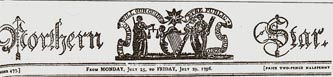
The first issue of the Northern Star, the newspaper of the Society of United Irishmen, is published in Belfast on January 4, 1792. It is published from 1792 until its suppression by the British army in May 1797.
The publication of an Irish newspaper that reflects and disseminates liberal views is an early goal of Irish republicans in the late 18th century. By the founding of the Society of United Irishmen in October 1791, the project is well underway, and the first edition of the Northern Star appears in Belfast in January 1792. Like the United Irishmen, the first financial backers of the Northern Star are Presbyterian and one of the United Irish leadership, Samuel Neilson, is made editor.
Political content dominates the Northern Star but its publication of local news, as opposed to the focus on British and international affairs of other Irish newspapers of the time, brings it wide popularity. Leading members of the United Irishmen are regular contributors and mixed direct political analyses with cutting political satire. William Orr is among those who contributed to its content and his letters lead to his eventual arrest and execution under the Insurrection Act of 1797. The newspaper also enjoys an excellent voluntary distribution network as its penetration follows rapidly wherever the United Irishmen set up new branches. It was estimated that for each copy of the Northern Star sold there are at least five readers, as the reading aloud of articles from the paper is a regular feature of United Irish meetings.
The newspaper is initially protected from the authorities due to the support of well-connected liberals but following the outbreak of war between Great Britain and Revolutionary France in 1793 and the subsequent banning of the United Irishmen as a seditious body it begins to draw increasing attention. The massive popularity of the newspaper protects it from serious harassment until January 1797 when the establishment goes into a state of panic following the French invasion scare at Bantry Bay. The paper is alleged to be behind the Dublin-based Union Star, a militant, low-circulation newssheet, often posted in public places, which specializes in naming informers, “notorious Orangemen,” and other enemies of the United Irishmen, being regarded by Dublin Castle as a republican hitlist.
The extensive distribution network and potency of the Northern Star in spreading United Irish opinion alarms the authorities and possession of a copy comes to be regarded as an admission of seditious intent. The end finally comes with the uncovering of supposed United Irish infiltration of the Monaghanmilitia in Belfast, which results in the execution of four soldiers. General Gerard Lake, 1st Viscount Lake, already engaged in a brutal counter-insurgency campaign, is quick to put much of the blame on the Northern Star and requests permission to suppress the paper.
As it turns out, official suppression is not necessary as on May 19, 1797, three days after the execution of their ex-comrades, a mob of Monaghan militiamen anxious to prove their loyalty attack the offices of the Northern Star and destroy not only the printing presses but the building itself. The attack results in the demise of the Northern Star to the undoubted satisfaction of the authorities as no action is taken against those involved in the destruction. The Chartist movement later pays tribute to the Northern Star by using the same name for their newspaper that is founded in 1837 by Feargus O’Connor.
Wright attracts considerable media attention at the Drumcree standoff, where he supports the Orange Order‘s desire to march its traditional route through the Catholic/Irish nationalist area of Portadown. In 1994, the UVF and other paramilitary groups call ceasefires. However, in July 1996, Wright’s unit breaks the ceasefire and carries out a number of attacks, including a sectarian killing. For this, Wright and his Portadown unit of the Mid-Ulster Brigade are stood down by the UVF leadership. He is expelled from the UVF and threatened with execution if he does not leave Northern Ireland. Wright ignores the threats and, along with many of his followers, defiantly forms the breakaway Loyalist Volunteer Force (LVF).
In March 1997 Wright is sent to the HM Maze Prison for having threatened the life of a woman. While imprisoned, Wright continues to direct the LVF’s activities. On December 27 of that year, he is assassinated at the prison by Irish National Liberation Army (INLA) prisoners as he is led out to a van for a visit with his girlfriend. The LVF carries out a wave of sectarian attacks in retaliation.
Owing to his uncompromising stance as an upholder of Ulster loyalism and opposition to the Northern Ireland peace process, Wright is regarded as a cult hero, cultural icon, and martyr figure by hardline loyalists. His image adorns murals in loyalist housing estates and many of his devotees have tattoos bearing his likeness.
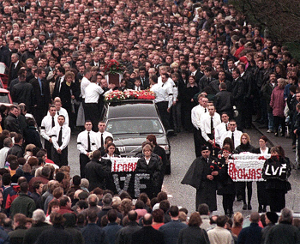
Wright’s funeral procession moves at a snail’s pace on a grey and windy day. Groups of mourners take turns carrying the coffin. Women carry a wreath that simply says “Billy.” Twenty men with tight haircuts and white shirts with black armbands flank the cortège. There is heavy security. Troops stand guard on bridges and Royal Ulster Constabulary (RUC) Land Rovers prowl the housing estates. A spotter plane flies overhead. A lone piper plays “Abide with Me” before a banner bearing the letters “LVF.”
Wright is buried at Seagoe Cemetery, Portadown, Northern Ireland.
On December 25, 1715, Joshua Dawson, Irish public servant, land developer and politician, sells the Mansion House with its gardens and park to Dublin Corporation for £3,500 plus 40 shillings per annum and a “loaf of double refined sugar of six pounds weight” which is to be paid to the Dawsons every Christmas.
Dawson is born in 1660 at the family seat, which becomes Castledawson, County Londonderry, the son of Thomas Dawson, Commissary of the Musters of the Army in Ireland. He resides in County Londonderry and Dublin. His ancestral family had owned land and lived in the area where, in 1710, he founds Dawson’s Bridge, named after the bridge over the River Moyola, which becomes present-day Castledawson. In his estate he builds Moyola House in 1713.
Dawson develops an area of Dublin in 1705-1710 which includes the setting out and construction of the streets of Dawson Street, Anne Street, Grafton Street and Harry Street. These streets are named after, respectively, himself, Queen Anne (widow of William III), and Henry FitzRoy, 1st Duke of Grafton, the son of Charles II and cousin of Queen Anne. This development includes the construction of the Mansion House in Dawson Street in 1710 which is purchased in 1715 to be the official residence of the Lord Mayor of Dublin, which it has remained for 300 years.
(Pictured: Mansion House, official residence of the Lord Mayor of Dublin)
When McLarnin is three years old the family emigrates to Saskatchewan, Canada via Liverpool. The McLarnins start out as a wheat farmers, but years later, following a particularly harsh winter, the family moves to Vancouver where they open a second-hand clothing store in Vancouver’s east end.
McLarnin is prodigious athlete, his main sports are football, baseball and boxing. He takes up boxing at the age of 10 after getting into a fight defending his newspaper-selling pitch. Former professional boxer Charles “Pop” Foster recognizes McLarnin’s talent at the age of 13. He constructs a makeshift gym for McLarnin to train in, sure that he will one day be the champion of the world. The two of them remain close, and when Foster dies, he leaves everything he has to McLarnin.
Following a successful start to his career in Vancouver, McLarnin grows aggrieved at the low pay he is receiving for bouts and decides to move to San Francisco. There his youthful appearance makes it difficult to get a fight until he lies about his age. It is for this reason that McLarnin is known as the “Baby-faced Assassin.” Despite his youthful appearance, McLarnin has incredible power with both fists, his right being particularly feared. Towards the end of his career he is forced to become more of a scientific boxer to reduce further injuries to his hands.
McLarnin loses his first title shot on May 21, 1928 in New York City against world lightweight champion Sammy Mandell. However, he does go on to beat him twice in the following two years. It is five years before McLarnin gets another title shot, during which time he knocks out gifted Jewish contenders Al Singer, Ruby Goldstein, and Sid Terris.
McLarnin’s second title shot comes against welterweight champion Young Corbett III. McLarnin wins by knockout after only 2 minutes 37 seconds. Following his title success, he fights an epic three-fight series with Barney Ross. The first fight, on May 28, 1934, is won by Ross, but McLarnin regains his title in their next match four months later. In the deciding fight on May 28, 1935, McLarnin loses his title for the final time in a narrow decision.
McLarnin retires in November 1936 still at the top of his game, having won his last two fights against all-time greats Tony Canzoneri and Lou Ambers. His record is 54 wins, 11 losses, and 3 draws in 68 contests. He never returns to the ring despite large incentives for him to do so. Unlike many boxers, he invested his money wisely and retires a wealthy man. He opens an electrical goods store, and also does some acting, golfing, and lecturing.
In 1996 The Ring votes McLarnin the fifth-greatest welterweight of all time.
The declaration affirms both the right of the people of Ireland to self-determination, and that Northern Ireland will be transferred to the Republic of Ireland from the United Kingdom only if a majority of its population is in favour of such a move. It also includes, as part of the prospective of the so-called “Irish dimension,” the principle of consent that the people of the island of Ireland, have the exclusive right to solve the issues between North and South by mutual consent.
The latter statement, which later becomes one of the points of the Good Friday Agreement, is key to produce a positive change of attitude by the republicans towards a negotiated settlement. The joint declaration also pledges the governments to seek a peaceful constitutional settlement, and promises that parties linked with paramilitaries, such as Sinn Féin, can take part in the talks, so long as they abandon violence.
Charles Wolfe, Irish poet, is born at Blackhall, County Kildare, on December 14, 1791. He is chiefly remembered for “The Burial of Sir John Moore after Corunna” which achieves popularity in 19th century poetry anthologies.
Not long after he is born, his father dies, and the family moves to England. In 1801, Wolfe is sent to a school in Bath but is sent home a few months later due to ill health. From 1802 to 1805, he is tutored by a Dr. Evans in Salisbury before being sent to Hyde Abbey School, Winchester. In 1808, his family returns to Ireland, and the following year he enters Trinity College, Dublin, graduating in 1814.
Wolfe is ordained as a Church of Ireland priest in 1817, first taking the Curacy of Ballyclog in County Tyrone before transferring almost immediately to Donaghmore, County Tyrone. There he develops a close friendship and deep respect for the Rev. Thomas Meredith, Rector of nearby Ardtrea, and a former Fellow of Trinity College Dublin. Wolfe writes two epitaphs for Meredith, one on his memorial in the parish church of Ardtrea, and another intended for his tomb.
Wolfe is best remembered for his poem “The Burial of Sir John Moore after Corunna”, written in 1816 and much collected in 19th and 20th century anthologies. The poem first appears anonymously in the Newry Telegraph of April 19, 1817, and is reprinted in many other periodicals. But it is forgotten until after his death when Lord Byron draws the attention of the public to it. Wolfe’s only volume of verse, Poetical Remains, appears in 1825 with “The Burial of Sir John Moore” and fourteen other verses of an equally high standard.
Wolfe remains at Donaghmore until 1820 but, rejected by the woman for whom he gave up his academic career, and with Meredith, his only real friend in County Tyrone, now dead, he moves to Southern France. Shortly before his death he returns to Ireland and lives at Cobh, County Cork, where he dies at the age of 31 of consumption, which he catches from a cow. He is buried in Cobh at Old Church Cemetery. There is also a plaque to his memory in the church at Castlecaulfield, the village where he lives whilst Curate at Donaghmore, as well as a marble monument to him at St. Patrick’s Cathedral, Dublin.
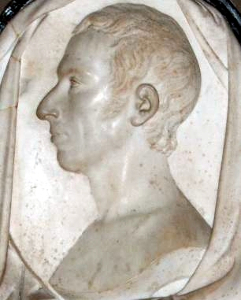
(Pictured: Bas-relief of Charles Wolfe in St. Patrick’s Cathedral, Dublin)
At 12:25 PM on December 11, 1971, when the Shankill Road is packed with Saturday shoppers, a green car pulls up outside the Balmoral Furniture Company at the corner of Carlow Street and Shankill Road. The shop is locally known as “Moffat’s” although Balmoral Furniture Company is its official name. One of the occupants gets out of the car and leaves a box containing a bomb on the step outside the front door. The person gets back into the car, and it speeds away. The bomb explodes moments later, bringing down most of the building on top of those inside the shop and on passersby outside.
Four people are killed as a result of the massive blast, including two babies, Tracey Munn (age 2 years) and Colin Nichol (age 17 months), who both die instantly when part of the wall crashes down upon the pram they are sharing. Two employees working inside the shop are also killed, Hugh Bruce (age 70 years) and Harold King (age 29 years). Unlike the other three victims, who are Protestant, King is a Catholic. Bruce, a former soldier and a Corps of Commissionaires member, is the shop’s doorman and is nearest to the bomb when it explodes. Nineteen people are injured in the bombing, including Tracey’s mother. The building, which was built in the Victorian era, has load-bearing walls supporting upper floors on joists. It is unable to withstand the blast and collapses, adding to the devastation and injury count.
The bombing causes bedlam in the crowded street. Hundreds of people rush to the scene where they form human chains to help the British Army and Royal Ulster Constabulary (RUC) free those trapped beneath the rubble by digging with their bare hands. Peter Taylor describes the scene as “reminiscent of the London Blitz” in World War II.
The Balmoral Furniture Company bombing is one of the catalysts that spark the series of tit-for-tat bombings and shootings by loyalists, republicans and the security forces that make the 1970s the bloodiest decade in the 30-year history of The Troubles.
(Pictured: Fireman is shown removing the body of one of the victims of the bombing at the Balmoral Furniture Showroom, December 11, 1971)