The Massey family arrives in New Zealand on October 21, 1862, on board the Indian Empire as Nonconformist settlers, although William remains in Ireland for an additional eight years to complete his education. After arriving on December 10, 1870, on the City of Auckland, he works as a farmhand for some years before acquiring his own farm in Mangere, south Auckland, in 1876.
While managing his own farm, Massey assumes leadership in farmers’ organizations. He enters Parliament in 1894 as a conservative and from 1894 to 1912 is a leader of the conservative opposition to the Liberal ministries. He becomes prime minister in 1912 and promptly signs legislation enabling freeholders to buy their land at its original value. The first years of his ministry see labour strikes by miners in Waihi in 1912 and wharf workers in Wellington in 1913. His harsh repression of them give impetus to the formation of the Labour Party in 1916. He also improves federal administration by putting civil service positions under a nonpolitical commission.
Following the war, farmers are troubled by depressed prices resulting from the sharply reduced British demand for their products, and they also face inflation in land prices, aggravated by increased demand for land by returning servicemen. Massey responds to these problems by establishing the Meat Control Board (1922) and the Dairy Export Control Board (1923), but rural and urban unrest resulting from rising prices continue to mount in the final years of his ministry.
In 1924 cancer forced Massey to relinquish many of his official duties, and he dies on May 10, 1925, at Wellington, New Zealand. The Massey Memorial is erected as his mausoleum in Wellington, paid for mostly by public subscription. Massey University is named after him, the name chosen because the university had a focus on agricultural science, matching Massey’s own farming background.
As Prime Minister, O’Neill introduces economic reforms to stimulate industrial growth and employment, with mixed results. He also tries narrowing the divide between Protestants and Catholics. He does this with important gestures, like visiting Catholic schools and expressing condolences on the death of Pope John XXIII.
When the civil rights movement erupts in the late 1960s, O’Neill offers a package of reforms and concessions, including changes to the allocation of housing. These proposals, however, anger staunch Unionists and fail to satisfy many Republicans.
In December 1969, O’Neill appears on Northern Ireland television and makes an impassioned plea for unity, warning that “Ulster stands at the crossroads.” His government is reelected in February 1969, though O’Neill himself is almost voted out of his own seat.
With the situation worsening, O’Neill is further embarrassed by Loyalist attempts to sabotage Belfast’s water supply. Fast losing the confidence of his own party, he resigns the prime ministership in April 1969. He remains in the parliament until January 1970.
O’Neill is made Baron O’Neill of the Maine and spends the last decade of his life in Britain’s House of Lords. He dies of cancer on June 12, 1990.
Chaim Herzog, Israeli politician, general, lawyer, and author, is elected the sixth President of Israel on March 22, 1983. He serves from 1983 to 1993.
Herzog joins the British Army during World War II, operating primarily in Germany as a tank commander in the Armoured Corps. There, he is given his lifelong nickname of “Vivian” because the British could not pronounce the name, “Chaim.” A Jewish soldier had volunteered that “Vivian” is the English equivalent of “Chaim.”
After leaving the army, Herzog opens a private law practice. He returns to public life when the Six-Day War breaks out in 1967, serving as a military commentator for Kol Israel radio news. Following the capture of the West Bank, he is appointed Military Governor of East Jerusalem, and Judea and Samaria.
Herzog enters politics in the 1981 elections, winning a Knesset seat as a member of the Alignment. Two years later, in March 1983, he is elected to the largely ceremonial role of President. He serves two five-year terms before retiring in 1993. He dies on April 17, 1997, and is buried on Mount Herzl, Jerusalem. His son, Isaac Herzog, led the Israeli Labour Party and the parliamentary Opposition in the Knesset from 2013 until 2018.
The Act is passed by the Long Parliament as a way of raising funds to suppress the Irish Rebellion of 1641, which had broken out five months earlier. It invites members of the public to invest £200 for which they will receive 1,000 acres of lands that are to be confiscated from rebels in Ireland. Two and a half million acres of Irish land are set aside by the English government for this purpose. The entire island of Ireland is about 20.9 million acres.
The enactment is done at the request of King Charles in the House of Lords, joined by the House of Commons, and is unanimously accepted without any debate. The Act had been placed before the Houses for inspection but is not formally read into the record. The title of the Act – “An Act for the speedy and effectual reducing of the Rebels, in His Majesty’s Kingdom of Ireland, to their due Obedience to His Majesty, and the Crown of England” – is read aloud to Parliament, followed by the statement: “Le Roy le veult.”
The “Adventurers” are so called because they are risking their money at a time when the Crown has just had to pay for the Bishops’ Wars in 1639–40. “Reducing” the rebels means leading them back to the legal concept of the “King’s Peace.” King Charles cannot subsequently enforce the Act, but it is realised by his political opponents following the Cromwellian conquest of Ireland in 1649–1653 and forms the main legal basis for the contentious Act for the Settlement of Ireland 1652.
Ironically, in May 1642 the Confederate Irish rebels draft the Confederate Oath of Association that recognises Charles as their monarch.
The Adventurers’ Act is extended and amended by three other acts – Lands of Irish Rebels; Adventurers’ Subscriptions Act 1640 (c. 34), Lands of Irish Rebels; Adventurers’ Subscriptions Act 1640 (c. 35), and Irish Rebels Act 1640 (c. 37). All four receive Royal Assent in the summer of 1642, just before the start of the English Civil War, but are usually referred to as 1640 acts, which is the year the Long Parliament started to sit and the 16th year of Charles I’s reign.
In July 1643, Parliament passes the Doubling Ordinance which doubles the allocation of land to anyone who increases their original investment by 25%. The purpose of the Act is twofold, firstly to raise money for Parliament to help suppress the rebellion in Ireland, and secondly to deprive the King of the lands seized from rebels that would be his by prerogative.
To enforce the Acts the Cromwellian conquest of Ireland is launched in 1649. In 1653, Ireland is declared subdued, and the lands are allocated to the subscribers in what becomes known as the Cromwellian Settlement.
Clancy graduates in 1904 and finds a position teaching the Irish language at Clongowes Wood College and is active in the Gaelic Athletic Association. Due to ill health he has to return to his home at Grange. In 1908 he comes to Limerick to teach Irish. In 1913 he joins the Irish Volunteers. In 1915 he marries Máire Killeen, a teacher. After the 1916 Easter Rising, he is arrested and imprisoned in Cork, but is released before he comes to trial following a hunger strike.
Clancy helps in Éamon de Valera‘s election campaign in East Clare. He nearly dies of Spanish flu during the 1918 epidemic but recovers and, in January 1921, he is elected Sinn Féin Mayor of Limerick.
On the night of March 6, 1921, three Auxiliaries come to Clancy’s house and one of them shoots him, injuring him fatally. His wife is also injured in the attack. The previous Mayor, Michael O’Callaghan, is also murdered on the same night by the same group.
Suspicion immediately falls upon members of the Black and Tans, but a British inquiry into the murder, like most such inquiries through the years, absolve Crown forces of any blame. One of Clancy’s killers is later said to be George Nathan who dies in the Spanish Civil War in July 1937.
Born in Boherbee, County Kerry on January 15, 1926, McEllistrim is the son of the Fianna Fáil politician and Irish War of Independence veteran, Tom McEllistrim. He succeeds his father when he is elected to Dáil Éireann as a Fianna Fáil Teachta Dála (TD) for the Kerry North constituency at the 1969 general election. At the 1977 general election he is elected along with his running mate Kit Ahern. This is the first time that Fianna Fáil wins two seats in the three seat Kerry North constituency. McEllistrim, who is given much credit for this feat, is disappointed not to receive a promotion to a Minister of State.
McEllistrim becomes disillusioned with the Taoiseach and party leader Jack Lynch from then and begins to believe that Charles Haughey is the right candidate for the party leadership. He believes that Lynch is about to retire and is particularly uncomfortable at the thought of George Colley succeeding Lynch. Like his father before him he believes Colley is not right for the role of leader of the party. He is particularly vocal with regard to party policy towards Northern Ireland and, as he sees it, Lynch’s apparent lack of sympathy towards the northern nationalist community.
McEllistrim is a member of the so-called “gang of five” along with Seán Doherty, Mark Killilea Jnr, Jackie Fahey and Albert Reynolds who start a lobbying campaign in favour of Haughey on the backbenches of the party. After Lynch loses two by-elections in his native County Cork he resigns as party leader in December 1979. The leadership contest is called two days later and is a two-way race between Haughey and Colley. Haughey wins the leadership contest by a decisive margin and McEllistrim is rewarded by being appointed Minister of State at the Department of Finance with special responsibility for the Office of Public Works. He serves as a Minister of State again in 1982, this time at the Department of Fisheries and Forestry.
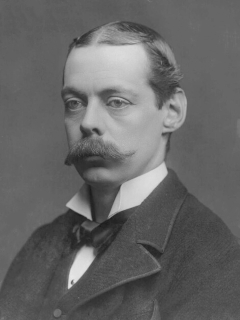
The Conservative Party in Ulster launches an anti-Home Rule campaign in February 1886. It joins with the Orange Order to organise a huge political rally which is addressed by Lord Churchill.
Protestants in Ulster are very concerned about the prospect of Irish Home Rule. They fear that an Irish parliament will put rural agricultural interests before the needs of the industrial North-East. They believe a Dublin parliament will introduce tariffs which will damage industries in the north. They also fear that they will be discriminated against because of their religion, outnumbered in a Dublin parliament by Catholic representatives.
Churchill has shown disdain for Ulster Unionists up until this time, in private at least, telling Lord Salisbury, “these foul Ulster Tories have always ruined our party,” but as 1886 begins he sees an opportunity to exploit their fears for political gain. He decides that should Prime MinisterWilliam Gladstone “went for Home Rule (for Ireland), the Orange Card would be the one to play. Please God may it turn out the ace of trumps and not the two.” This quote leads one to believe he has few real convictions regarding the issue.
“Ulster will fight, and Ulster will be right,” Lord Churchill proclaims to a crowd before he even arrives at Ulster Hall.
Lord Churchill gives a rousing speech at the rally. During his speech, he plays on Protestant fears of Dublin “Catholic” rule and encourages Ulster Protestants to organize against Home Rule, so it does not come upon them “as a thief in the night.” As a result, the Ulster Protestants begin to form paramilitary drilling units.
Churchill achieves a short-term political gain by his playing of the Orange Card, but his most lasting legacy is the unfounded fear of Irish Catholics that he helps to implant in the minds of Ulster Protestants, a tragedy for both traditions on the island. Those fears remain evident over a century later.
The policy of Irish neutrality during World War II is adopted by the Oireachtas at the instigation of De Valera upon the outbreak of World War II in Europe. It is maintained throughout the conflict, in spite of several Germanairstrikes by aircraft that miss their intended British targets and attacks on Ireland’s shipping fleet by Allies and Axis alike. De Valera refrains from joining either the Allies or Axis powers. While the possibilities of not only a German but also a British invasion are discussed in Dáil Éireann, and either eventuality is prepared for, with the most detailed preparations being done in tandem with the Allies under Plan W, De Valera’s ruling party, Fianna Fáil, supports his neutral policy for the duration of the war.
This period is known in the Republic of Ireland as “The Emergency“, owing to the wording of the constitutional article employed to suspend normal government of the country.
Pursuing a policy of neutrality requires attaining a balance between the strict observance of non-alignment and the taking of practical steps to repel or discourage an invasion from either of the two concerned parties.
Ireland maintains a public stance of neutrality to the end, although this policy leads to a considerable delay in Ireland’s membership of the United Nations (UN). Ireland’s applications for membership are vetoed by the Soviet Union, a permanent member of the United Nations Security Council, from 1946 to December 1955. Seán MacBride considers that the UN boycott of Ireland had been originally agreed upon at the 1945 Yalta Conference by Winston Churchill and Joseph Stalin. Ireland’s acceptance into the UN is finally announced by John A. Costello on December 15, 1955.
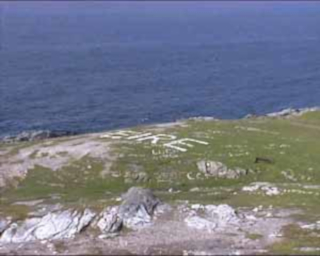
Despite the official position of neutrality, there are many unpublicised contraventions of this, such as permitting the use of the Donegal Corridor to Allied military aircraft, and extensive co-operation between Allied and Irish intelligence, including exchanges of information, such as detailed weather reports of the Atlantic Ocean. For example, the decision to go ahead with the Normandy landings is decided by a weather report from Blacksod Bay, County Mayo.
(Pictured: Markings to alert aircraft to neutral Ireland during World War II on Malin Head, County Donegal)
Duffy is born on April 12, 1816, in Dublin Street, Monaghan, County Monaghan. Both of his parents die while he is still a child and his uncle, Fr. James Duffy, who is the Catholic Parish Priest of Castleblayney, becomes his guardian for a number of years. He is educated at St. Malachy’s College in Belfast and is admitted to the Irish Bar in 1845. Duffy becomes a leading figure in Irish literary circles.
In August 1850, Duffy forms the Tenant Right League to bring about reforms in the Irish land system and protect tenants’ rights, and in 1852 is elected to the House of Commons for New Ross. By 1855, the cause of Irish tenants seems more hopeless than ever. Broken in health and spirit, Duffy publishes a farewell address to his constituency, declaring that he has resolved to retire from parliament, as it is no longer possible to accomplish the task for which he has solicited their votes.
In 1871, Duffy leads the opposition to Premier Sir James McCulloch‘s plan to introduce a land tax, on the grounds that it unfairly penalises small farmers. When McCulloch’s government is defeated on this issue, Duffy becomes Premier and Chief Secretary. The majority of the colony is Protestant, and Duffy is accused of favouring Catholics in government appointments. In June 1872, his government is defeated in the Assembly on a confidence motion allegedly motivated by sectarianism.
When Graham Berry becomes Premier in 1877, he makes Duffy Speaker of the Legislative Assembly, a post he holds without much enthusiasm until 1880, when he quits politics and retires to the south of France. He remains interested in both the politics of his adoptive country and of Ireland. He is knighted in 1873 and is made KCMG in 1877. Sir Charles Gavan Duffy dies in Nice, France, at the age of 86 in 1903.
Mac Giolla is educated at the local national school in Nenagh before completing his secondary education at St. Flannan’s College in Ennis, County Clare. It is while at St. Flannan’s that he changes to using the Irish language version of his name. He wins a scholarship to University College Dublin where he qualifies with a Bachelor of Arts degree, followed by a degree in Commerce.
A qualified accountant, Mac Giolla is employed by the Irish Electricity Supply Board (ESB) from 1947 until he goes into full-time politics in 1977.
At the 1961 Irish general election, Mac Giolla unsuccessfully contests the Tipperary North constituency for Sinn Féin. In 1962, he becomes President of Sinn Féin and is one of the people who moves the party to the left during the 1960s. In 1969, Sinn Féin splits, and he remains leader of Official Sinn Féin. It is also in 1962 that he marries May McLoughlin who is also an active member of Sinn Féin as well as Cumann na mBan, the women’s section of the IRA. In 1977, the party changes its name to Sinn Féin the Workers Party and in 1982 it becomes simply the Workers’ Party.
In 1999, Mac Giolla writes to the chairman of the Flood Tribunal calling for an investigation into revelations that former Dublin Assistant City and County Manager George Redmond had been the official supervisor at the election count in Dublin West and was a close associate of Liam Lawlor. In 2003, Redmond is convicted of corruption by a Dublin court but subsequently has his conviction quashed due to conflicting evidence.
In his eighties Mac Giolla continues to be active and is a member of the group which campaigns to prevent the demolition of No. 16 Moore Street in Dublin city centre, where the surrender after the Easter Rising was completed. He also serves on the Dublin ’98 committee to commemorate the 200th anniversary of the Irish Rebellion of 1798.
Tomás Mac Giolla dies in Beaumont Hospital in Beaumont, Dublin on February 4, 2010, after a long illness.