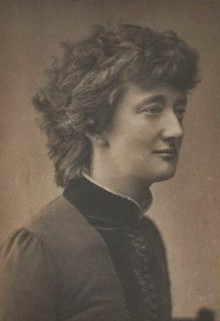
In the 1890s Stopford Green becomes interested in Irish history and the nationalist movement as a result of her friendship with John Francis Taylor. She is vocal in her opposition to English colonial policy in South Africa during the Boer Wars and supports Roger Casement‘s Congo Reform movement. Her 1908 book The Making of Ireland and its Undoing argues for the sophistication and richness of the native Irish civilisation. She is active in efforts to make the prospect of Home Rule more palatable to Ulster Unionists. She is closely involved in the Howth gunrunning.
Stopford Green moves to Dublin in 1918 where her house at 90 St. Stephen’s Green becomes an intellectual centre. She supports the pro-Treaty side in the Irish Civil War and is among the first nominees to the newly formed Seanad Éireann in 1922, where she serves as an independent member until her death in Dublin on May 28, 1929, two days shy of her 82nd birthday. She is one of four women elected or appointed to the first Seanad in 1922.
For much of the 20th century, relations between Ireland and its nearest neighbour are cool. Temperatures drop significantly over the economic war in the 1930s and Ireland’s neutrality in World War II. The sense of unfinished business permeates diplomacy during the Troubles, but by 1990 there is significant warmth in trade, tourism, business and even politics.
The newly elected Robinson makes a big play of reaching out to Irish emigrants and sees the opportunity to help Anglo-Irish relations. And so, on her 49th birthday, she pops in for tea with the British head of state.
None of Robinson’s predecessors had set foot in Britain, other than to change planes. Even when President Patrick Hillery is invited to the wedding of Prince Charles and Lady Diana Spencer in 1981, he is advised by the Government of Ireland to decline the invitation.
But Robinson decides she will not be pushed around, and successfully insists she be allowed to join other heads of state at the opening of a European bank in London. Next, she asks the government if she might be able to travel to the University of Cambridge to deliver a speech and receive an honorary degree. It is only after he reluctantly agrees that TaoiseachCharlie Haughey realises that the Chancellor of the University is the Queen’s husband, Prince Philip.
Robinson meets the royal, the world remains on its axis, and a precedent is set. “Partly because I’ve never been fazed by royalty of any kind, least of all the British royal family, I felt entirely relaxed,” she recalls in her authorised biography.
Robinson next meets the prince at a memorial service for the victims of an Irish Republican Army (IRA) bombing in Warrington, where she is applauded as she leaves the church. Soon, she is meeting royals all over the place, at rugby matches and memorial ceremonies, and in a television interview says that she would like to meet the Queen.
By February 1993, Haughey has been replaced by Albert Reynolds and he grants permission for Robinson to travel for a strictly personal visit. The visit does not happen in a vacuum – Reynolds is in secret discussions with Republicans that would end in the IRA ceasefire – and the Taoiseach is keen not to give any suggestion that this is a State visit, which would require a reciprocal visit.
Robinson’s party arrives at Buckingham Palace at 4:55 PM on May 27 where they are greeted by the Queen’s private secretary, Sir Robert Fellowes. Robinson’s staff pushes the Palace to allow press photographers, reckoning that a historic moment should be captured.
Robinson, in an Ib Jorgensen fuchsia suit, later donated to Madame Tussauds waxworks, and her husband Nick are brought up to the first floor to meet the Queen for a friendly and informal tea party that lasts 30 minutes. They sip a blend of Chinese and India tea in Minton cups, exchange signed photographs of themselves, and discuss the prospects for peace. The President also hands over an extra present of a hand-turned wooden cup from Spiddal.
Afterwards, the ground-breaking photographs are taken and published all over the world, including the front page of the Irish Independent. “Palace Talks Prepare Way for State Visit” runs the lead headline over a piece by Bernard Purcell and Gene McKenna. They go on, reporting the President as saying the visit is “symbolic of the maturing relationship between Ireland and Britain.”
In 1996 President Robinson’s 15th visit to Britain is upgraded to an Official Visit, and she leaves office the following year.
Robinson’s successor, Mary McAleese, takes things further, and meets Queen Elizabeth II several times in London and at World War I commemorations on the continent. In May 2011 McAleese welcomes Queen Elizabeth II on her four-day State Visit to Ireland and in April 2014 President Michael D. Higgins makes the first State Visit to the UK.
(Pictured: President Mary Robinson with the Queen outside Buckingham Palace in 1993. Photo: Eamonn Farrell/Photocall Ireland | “Flashback 1993: The first Irish head of state meeting with a British monarch” by Ger Siggins, Independent.ie, May 22, 2016)
The meeting comes two days before Pope Francis is scheduled to meet with U.S. PresidentDonald Trump, where the potential for disagreement is high as Trump has clashed with the pontiff on migrants and expressed skepticism about man-made impact on the environment. The meeting with President Higgins, however, is much more congenial as both leaders are very much on the same page.
Higgins is given the traditional welcome for visiting heads of state to the Vatican. He is walked through the frescoed rooms of the Vatican’s Apostolic Palace by men dressed in white tie and is then introduced to Pope Francis for their meeting, which lasts fifteen minutes.
Higgins’ visit comes six months after outgoing Irish TaoiseachEnda Kenny had a papal audience after which he confirmed the Pope would be coming to Ireland in 2018. While their discussions take place behind closed doors, it is likely that Higgins once again extends the invitation for Pope Francis to visit the country. The Pope ultimately visits Ireland August 25-26 as part of the World Meeting of Families 2018.
At the end of a seemingly warm and friendly encounter, Higgins presents the Pope a “climate bell” designed by renowned citizen-artist Vivienne Roche and is meant to represent a call to action on protecting the planet. “This is a very important symbol” the president tells the Pope before briefly ringing the bell.
For his part, the Pope presents Higgins with his landmark encyclical on climate change, Laudato si’, and his two apostolic exhortations, Evangelii gaudium and Amoris laetitia. He also presents the President with a medallion designed to represent the saying from Isaiah 32:15 which states “the desert will become a fertile ground.”
The audience takes place inside the Vatican Library with the use of an interpreter. Higgins, who has spent some time living in Latin America, concludes the meeting in the Pope’s native language, saying “muchos gracias.”
Trimble has vowed to quit as head of the Stormont Executive, where his party shares power with Sinn Féin, if the Irish Republican Party (IRA) has not started to get rid of its guns by July 1. Paisley, however, has accused Trimble and British Prime MinisterTony Blair of breaking their promises to the people of Northern Ireland by allowing into government a party linked to a terrorist group, without prior arms decommissioning.
While Clinton is no longer the most powerful man in the world, his charisma and his past efforts to keep the peace process moving are still appreciated by many. He receives Northern Ireland political leaders countless times at the White House and gives support and encouragement by phone during difficult periods of the peace talks.
The leader of the Social Democratic and Labour Party (SDLP), John Hume, who welcomes Clinton to Derry, says the former president has done a great deal of good for all the people of Ireland. But the Democratic Unionist Party (DUP) deputy leader, Peter Robinson, claims that Clinton and Blair could have a negative effect on Trimble’s campaign. “As a unionist, I wouldn’t like to be sitting next to either of them just before an election,” he said. “Blair’s name is associated with the now-broken pledges he wrote on a board here just before the [Good Friday agreement] referendum, so for him to come over and moralise now won’t do much good. And Clinton is so disgraced and powerless that, while he might prop up the nationalist SDLP and Sinn Féin vote, he’ll have no impact on unionists voters.”
(Pictured: Bill Clinton and SDLP leader John Hume at public address at Guildhall Square in Derry. Sinn Féin leader Gerry Adams and Chelsea Clinton are in the second row.)
Flynn is a supporter of Charles Haughey in the 1979 Fianna Fáil leadership election. His loyalty is rewarded when he becomes a Minister of State at the Department of Transport and Power. He joins the Cabinet for the first time following the February 1982 general election when he is appointed Minister for the Gaeltacht. In October 1982, in a minor reshuffle, he becomes Minister for Trade, Commerce and Tourism. However, his time in this office is brief, since Fianna Fáil loses the November 1982 general election.
Fianna Fáil is returned to power in the 1987 general election and Flynn becomes Minister for the Environment. Two years later he opposes the formation of the coalition government with the Progressive Democrats, describing it “as hitting at Fianna Fáil core values.” In 1990, he attacks the opposition presidential candidate Mary Robinson on a radio show, accusing her of “having a new-found interest in her family” for the purposes of her election campaign. This attack backfires drastically, causing many women who initially support Brian Lenihan to back Robinson. Lenihan’s campaign never recovers, and Robinson becomes Ireland’s first female President.
In 1991, Flynn is sacked from the Cabinet because of his support for a motion of no confidence in the Taoiseach, Charles Haughey. Then in 1992, Albert Reynolds becomes Taoiseach and Flynn is rewarded for supporting Reynolds by becoming Minister for Justice. In 1993, he retires from domestic politics when he is appointed Ireland’s European Commissioner. He is reappointed by the Fine Gael–Labour Party government in 1995 and, on both of these occasions, serves in the social affairs portfolio.
On January 15, 1999, Flynn makes comments on The Late Late Show regarding Tom Gilmartin and a donation of IR£50,000 to the Fianna Fáil party. He also makes comments about his own lifestyle, boasting of having a salary of IR£140,000 together with three houses, cars and housekeepers and travels regularly, yet complains about the hassle involved. The performance was seen as eccentric and out of touch. In effect, he is interpreted as behaving in a manner more befitting the Irish stereotype known as the Dublin 4 mentality, complaining of the costs incurred in the pursuit of extravagance.
The show’s presenter, Gay Byrne, then asks Flynn if he knows of Gilmartin. He responds that he knows him well. He seems to be making an attack of Gilmartin’s emotional stability, based on the effect of sickness of Gilmartin’s wife. If it is to be interpreted as an attack of Gilmartin’s credibility, it backfires in a spectacular manner against Flynn. Also, unknown to Flynn, Gilmartin is actually watching the program at his home in Luton. This hurts Gilmartin a great deal, while also bringing the illness of his wife into the picture as the real driving force behind Gilmartin’s testimony against Flynn. Gilmartin responds by releasing details of meetings he held with Flynn to the McCracken Tribunal. The interview is widely described as the end of Flynn’s political career.
Flynn’s second term as European Commissioner ends early in September 1999, when the entire commission resigns due to allegations of malpractice by the European Parliament. He is not reappointed to the Commission and retires from politics completely. He is a member of the Comite d’Honneur of the Institute of International and European Affairs.
Flynn is cited in the Mahon Tribunal for having received money from Frank Dunlop intended for Fianna Fáil, but diverted to his personal use. On March 22, 2012, the final report of the Mahon Tribunal is published. It finds that Flynn “wrongly and corruptly” sought a substantial donation from Tom Gilmartin for the Fianna Fáil party. It also finds that having been paid IR£50,000 by Gilmartin, for that purpose, Flynn proceeded to use that money for his personal benefit, and that the donation funded at least a significant portion of the purchase of a farm in County Mayo.
On March 26, 2012, facing expulsion following the Mahon Tribunal, Flynn resigns in disgrace from Fianna Fáil before he can be ousted.
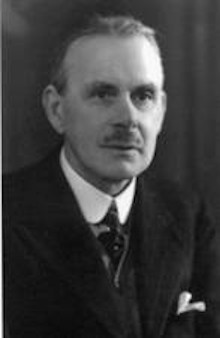
Andrews is born in Comber, County Down, on July 17, 1871, the eldest child in the family of four sons and one daughter of Thomas Andrews, flax spinner, and his wife Eliza Pirrie, a sister of William Pirrie, 1st Viscount Pirrie, chairman of Harland & Wolff. He is named after his maternal great-uncle, John Miller of Comber (1795–1883). As a young man, with his parents and family, he is a committed and active member of the Non-subscribing Presbyterian Church of Ireland. He regularly attends Sunday worship in the church built on land donated by his great-grandfather James Andrews in his home town Comber.
In 1902 Andrews marries Jessie Ormrod, eldest daughter of Bolton stockbroker Joseph Ormrod at Rivington Unitarian Chapel, Rivington, near Chorley, Lancashire, England. They have one son and two daughters. His younger brother, Sir James, marries Jessie’s sister.
In April 1943 backbench dissent forces him from office. He is replaced as Prime Minister by Sir Basil Brooke. Andrews remains, however, the recognised leader of the UUP for three more years. Five years later he becomes the Grand Master of the Orange Order. Throughout his life he is deeply involved in the Orange Order. He holds the positions of Grand Master of County Down from 1941 and Grand Master of Ireland (1948–1954). In 1949 he is appointed Imperial Grand Master of the Grand Orange Council of the World.
From 1949, he is the last parliamentary survivor of the original 1921 Northern Ireland Parliament, and as such is recognised as the Father of the House. He is the only Prime Minister of Northern Ireland not to have been granted a peerage. His predecessor and successor received hereditary viscountcies, and later prime ministers are granted life peerages.
Andrews serves on the Comber Congregational Committee from 1896 until his death, holding the position of Chairman from 1935 onward. He dies in Comber on August 5, 1956 and is buried in the small graveyard adjoining the Non-subscribing Presbyterian Church of Ireland.
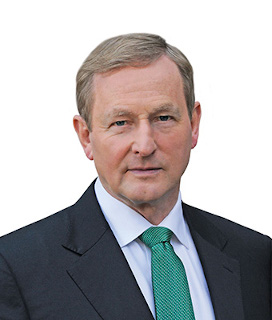
Kenny turns to politics in 1975 upon the death of his father, Henry Kenny, a long-serving member of the Dáil Éireann, representing Mayo. He wins a comfortable victory in a special election to fill his father’s seat, and at age 24 he is the youngest member of the Dáil. He spends much of his early political career on the backbench, focusing on local issues. In 1994 he is appointed Minister for Tourism and Trade in the “rainbow coalition” government of Fine Gael Taoiseach John Bruton.
With the collapse of Bruton’s coalition in 1997, Kenny loses his portfolio, but his stature rises as the party itself declines. Weeks after the 2002 Irish general election, which sees Fine Gael win just 31 seats, he is elected party leader. He immediately sets to restoring the party’s fortunes, and Fine Gael makes an impressive showing in the 2007 Irish general election, capturing 51 seats.
Fine Gael’s momentum continues to build as Fianna Fáil Taoiseach Brian Cowen, beset with a banking crisis and a soaring national deficit, is obliged to accept a bailout package of more than $100 billion from the International Monetary Fund and the European Union. The Green Party withdraws from Cowen’s coalition, and the government collapses, forcing early elections in February 2011. Capitalizing on widespread voter dissatisfaction, Fine Gael wins more than 70 seats, ending 14 years of Fianna Fáil rule, and Kenny begins discussions with the Labour Party about the formation of a coalition government. After more than a week of negotiations, the details of the coalition are settled and Kenny is formally elected Taoiseach by the Dáil on March 9, 2011, by an unprecedented 90 votes.
Kenny oversees a strong rebound by the Irish economy over the next five years, but the perception by many that the recovery has not been shared equally is reflected in the results of the 2016 Irish general election, when the electorate punishes the ruling coalition by ending its majority. In particular, voters appear to be disenchanted by the government’s pledge to end the Universal Social Charge — a graduated tax on all income over €13,000 — despite austerity-mandated cuts to social services. In the event, Fine Gael remains the largest party in the Dáil, but its share of the seats falls from the 76 it ultimately had secured in 2011 to 50, while coalition partner Labour plummets from 37 seats to seven. Meanwhile, Fianna Fáil, Fine Gael’s traditional rival for power, which had appeared politically moribund after the last general election, bounces back forcefully to add 24 seats to its 2011 count, reaching a total of 44 deputies.
With no party holding a majority and no quick path to coalition rule evident, a hung parliament ensues. Ten weeks of negotiations follow as Kenny seeks to form a government. Even the unheard-of possibility of grand coalition rule with Fianna Fáil is on the table. Finally, in early May, after much policy-related horse trading, an agreement is reached whereby Kenny and Fine Gael will continue to lead the government, supported by independent deputies and with a promise by Fianna Fáil that it will abstain on key votes until 2018. With Fianna Fáil abstaining, Kenny captures 59 votes on May 6, 2016, enough to return to power. In the process he becomes the first Fine Gael Taoiseach to be reelected.
A scandal involving the public smearing of a police whistleblower nearly topples the government in February 2017, and Kenny narrowly survives a vote of confidence, 57 to 52, with Fianna Fáil abstaining. Under pressure from the opposition as well as from members of his own party, Kenny stands down as Fine Gael leader in May 2017. The following month the party chooses Kenny’s Minister for Social Protection, Leo Varadkar, to succeed him as leader of Fine Gael. Kenny resigns as Taoiseach on June 13, 2017, and Varadkar is elected Taoiseach the following day.
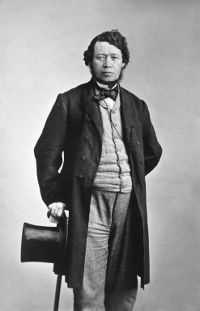
McGee grows up a Catholic Irishman who hates the British rule of Ireland and works for a peasant revolution to overthrow British rule and secure Irish independence. He escapes arrest and flees to the United States in 1848, where he reverses his political beliefs. He becomes disgusted with American republicanism and democracy, and becomes intensely conservative in his politics and in his religious support for the Pope.
McGee moves to Canada in 1857 and works hard to convince the Irish Catholics to cooperate with the Protestant British in forming a Confederation that will make for a strong Canada in close alliance with Britain. His fervor for Confederation garners him the title “Canada’s first nationalist.” He fights the Fenians in Canada, who are Irish Catholics who hate the British and resemble his younger self politically. McGee succeeds in helping create the Canadian Confederation in 1867.
On April 7, 1868, McGee, having participated in a parliamentary debate that goes on past midnight, walks back to the boarding house where he is staying. McGee is opening the door to Trotter’s Boarding House in Ottawa when he is shot by someone waiting for him on the inside. Several people run to the scene, however there is no sign of the assassin. It is later determined that McGee is assassinated with a shot from a handgun by Patrick J. Whelan. He is to date the only Canadian victim of political assassination at the federal level.
McGee is given a state funeral in Ottawa and interred in a crypt at the Cimetière Notre Dame des Neiges in Montreal. His funeral procession in Montreal draws an estimated crowd of 80,000 out of a total city population of 105,000.
Patrick J. Whelan, a Fenian sympathiser and a Catholic, is accused, tried, convicted, and hanged for the crime on February 11, 1869, in Ottawa. The jury is decisively swayed by the forensic evidence that Whelan’s gun had been fired shortly before the killing, together with the circumstantial evidence that he had threatened and stalked McGee. Historian David Wilson points out that forensic tests conducted in 1972 show that the fatal bullet is compatible with both the gun and the bullets that Whelan owned. Wilson concludes, “The balance of probabilities suggests that Whelan either shot McGee, or was part of a hit-squad, but there is still room for reasonable doubt as to whether he was the man who actually pulled the trigger.”
The government of Canada’s Thomas D’Arcy McGee Building stands near the site of the assassination. The case is dramatised in the Canadian play Blood on the Moon by Ottawa actor/playwright Pierre F. Brault. The assassination of McGee is also a major component of Away, a novel about Irish immigration to Canada by Canadian novelist Jane Urquhart.
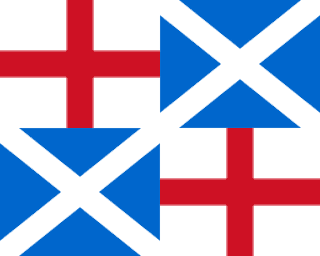
The English parliament passes the declaration on October 28, 1651 and after a number of interim steps an Act of Union is passed on June 26, 1657. The proclamation of the Tender of Union in Scotland on February 4, 1652 regularises the de facto annexation of Scotland by England at the end of the Third English Civil War. Under the terms of the Tender of Union and the final enactment, the Scottish Parliament is permanently dissolved and Scotland is given 30 seats in the Westminster Parliament. This act like all the others passed during the Interregnum is repealed by both Scottish and English parliaments upon the Restoration of monarchy under Charles II.
On October 28, 1651 the English Parliament issues the Declaration of the Parliament of the Commonwealth of England, concerning the Settlement of Scotland, in which it is stated that “Scotland shall, and may be incorporated into, and become one Common-wealth with this England.” Eight English commissioners are appointed, Oliver St. John, Sir Henry Vane, Richard Salwey, George Fenwick, John Lambert, Richard Deane, Robert Tichborne, and George Monck, to further the matter. The English parliamentary commissioners travel to Scotland and at Mercat Cross, Edinburgh on February 4, 1652, proclaim that the Tender of Union is in force in Scotland. By April 30, 1652 the representatives of the shires and Royal burghs of Scotland have agreed to the terms which include an oath that Scotland and England be subsumed into one Commonwealth. On the April 13, 1652, between the proclamation and the last of the shires to agree to the terms, a bill for an Act for incorporating Scotland into one Commonwealth with England is given a first and a second reading in the Rump Parliament but it fails to return from its committee stage before the Rump is dissolved. A similar act is introduced into the Barebone’s Parliament but it too fails to be enacted before that parliament is dissolved.
On April 12, 1654, the Ordinance for uniting Scotland into one Commonwealth with England is issued by the Lord ProtectorOliver Cromwell and proclaimed in Scotland by the military governor of Scotland, General George Monck. The Ordinance does not become an Act of Union until it is approved by the Second Protectorate Parliament on June 26, 1657 in an act that enables several bills.
Kathleen Daly is born into a prominent Fenian family, the third daughter of Edward and Catherine Daly. Her paternal uncle, John Daly, is at the time imprisoned for his political activities in Chatham and Portland Prisons in England. He is released in 1896 and returns home to Limerick. When Tom Clarke, who had been imprisoned with her uncle, is released in 1898 he travels to Limerick to receive the Freedom of the City and stays with the Daly family.
In 1901 Daly decides to emigrate to the United States to join Tom, who had been there since 1900, having secured work through his Fenian contacts. They marry on July 16, 1901, in New York City. Through his contacts in the Clan na Gael and the Irish Republican Brotherhood (IRB), Tom Clarke continues to be involved in nationalist activity. Kathleen joins the Gaelic League while in the United States and they return to Ireland in November 1907.
In 1914 Clarke becomes a founder member of Cumann na mBan. Her husband forbids her permission to take an active part in the 1916 Easter Rising as she has orders regardless of how the events pan out. As Tom Clarke is the first signatory of the Proclamation of the Irish Republic, he is chosen to be executed for his part in the Easter Rising. Her younger brother, Ned Daly, is also executed for taking part in the rising. She visits both of them before they are executed. After the Rising, Michael Collins establishes contact with her while in prison in his attempts to re-build the IRB network. She also sets up the Irish National Aid Fund to aid those who had family members killed or imprisoned as a result of the Easter Rising, closely aided by Sorcha MacMahon.
Clarke becomes a member of Sinn Féin and in 1917 is elected a member of the party’s Executive. During the German Plot she is arrested and imprisoned in Holloway Prison for eleven months. During the Irish War of Independence, she serves as a District Judge on the Republican Courts in Dublin. In 1919 she is elected as an Alderman for the Wood Quay and Mountjoy Wards of Dublin Corporation and serves until the Corporation is abolished in 1925.
Clarke is elected unopposed as a Sinn Féin TD to the Second Dáil at the 1921 elections for the Dublin Mid constituency. She is not re-elected at the 1922 general election, however, and supports the Anti-Treaty forces during the Irish Civil War. In 1926 she becomes a founder member of Fianna Fáil and has to resign from Cumann na mBan. She is re-elected to the short-lived 5th Dáil at the June 1927 election as a Fianna Fáil member for the Dublin Mid constituency but loses her seat at the September 1927 election and does not regain it. She is elected as one of six Fianna Fáil Senators to the Free State Seanad for nine years at the 1928 Seanad election under the leadership of Joseph Connolly. She remains a member of the Seanad until it is abolished in 1936.
In 1930 Clarke is elected to the re-constituted Dublin Corporation for Fianna Fáil along with Robert Briscoe, Seán T. O’Kelly, Thomas Kelly and Oscar Traynor. She serves as the first Fianna Fáil Lord Mayor of Dublin as well as the first female Lord Mayor, from 1939 to 1941. She opposes the Constitution of Ireland as she feels that several of its sections would place women in a lower position that they had been afforded in the Proclamation of the Irish Republic. She is criticised by many in the Fianna Fáil organisation as a result and, while she resigns from the Thomas Clarke Cumann, she remains a member of the Fianna Fáil Ard Chomhairle.
While Clarke does not support the Irish Republican Army (IRA) bombing in England during World War II, she appeals for those sentenced to death by the Irish Government to be given clemency. Ultimately this leads to her breaking with the party completely after her term as Lord Mayor finishes in 1941. She declines to stand as a Fianna Fáil candidate at the 1943 general election.