Brady is a zealous promoter of the Glorious Revolution and suffers for his beliefs in consequence. When the Williamite War in Ireland breaks out in 1690, he, by his influence, thrice prevented the burning of the town of Bandon, after James II gives orders for its destruction following the Capture of Bandon. The same year he is employed by the people of Bandon to lay their grievances before the Parliament of England. He soon afterward settles in London, where he obtains various preferments. At the time of his death, he holds the livings of Clapham and Richmond.
Brady’s best-known work, written with his collaborator Nahum Tate, is New Version of the Psalms of David, a metrical version of the Psalms. It is licensed in 1696 and largely ousts the old Sternhold and Hopkins Psalter. His ode Hail! Bright Cecilia, based on a similar ode by John Dryden, is written in 1692 in honour of the feast day of Saint Cecilia, patron saint of musicians. It is set to music by Henry Purcell in 1697. Like Dryden, he also translates Virgil‘s Aeneid, and writes several smaller poems and dramas, as well as sermons.
Brady marries Letitia Synge and has four sons and four daughters. He dies on May 20, 1726, and is buried in the church at Richmond, London. Notable descendants of Brady include Maziere Brady, Lord Chancellor of Ireland.
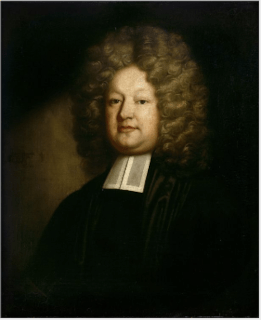
(Pictured: “Portrait of Nicholas Brady (1659-1726),” oil on canvas by Hugh Howard (1675-1737), circa 1715, National Gallery of Ireland)
Quinn is the eldest child of bank official Charles Quinn and Louisa Burke Browne of County Clare. She is a great-granddaughter of William Quinn, a native of County Tyrone who settled in Tuam to build St. Mary’s Cathedral.
During Quinn’s childhood, her father’s career brought the family to various towns in Ireland, including Tralee, County Kerry, where a plaque is unveiled in May 2009 at Bank of Ireland House in Denny Street commemorating her residence there between 1921 and 1924. She attends the Presentation Convent in the town between 1921-1925.
Quinn feels a call to religious life at a young age. She wishes to join the Poor Clares but is prevented by advanced tuberculosis. After spending eighteen months in a sanatorium, her condition unchanged, she decides to become active in the Legion of Mary, which she joins in Dublin at the age of 20. She gives herself completely to its work in the form of helping the poor in the slums of Dublin.
In 1936, at the age of 29 and dying of tuberculosis, Quinn becomes a Legion of Mary Envoy, a very active missionary to East and Central Africa, departing in December 1936 for Mombasa. She settles in Nairobi having been told by Bishop Heffernan that this is the most convenient base for her work. By the outbreak of World War II, she is working as far off as Dar es Salaam and Mauritius. In 1941, she is admitted to a sanatorium near Johannesburg. Fighting her illness, in seven and a half years she establishes hundreds of Legion branches and councils in today’s Tanzania, Kenya, Uganda, Malawi, and Mauritius. John Joseph “J.J.” McCarthy, later Bishop of Zanzibar and Archbishop of Nairobi, writes of her:
“Miss Quinn is an extraordinary individual; courageous, zealous and optimistic. She wanders around in a dilapidated Ford, having for sole companion an African driver. When she returns home, she will be qualified to speak about the Missions and Missionaries, having really more experience than any single Missionary I know.”
All this time Quinn’s health is never good, and in 1943 she takes a turn for the worse, dying in Nairobi, Kenya of tuberculosis on May 12, 1944. She is buried there in the Missionaries’ Cemetery.
The cause for her beatification is introduced in 1956. She is declared venerable by Pope John Paul II on December 15, 1994, since when the campaign for her beatification has continued.
In August and September 1920 the town of Templemore in County Tipperary is the sight of alleged Marian apparitions. Thousands of people come to the town daily to see the apparitions. The affair occurs during the Irish War of Independence and results in a short-lived local truce between the Irish Republican Army (IRA) and Crown forces. When the truce ends, pilgrims stop coming to the town and the sightings end. The affair is sometimes referred to as the Templemore miracles.
In January 1919 the Irish War of Independence begins and lasts until July 1921. On the night of August 16, 1920, British soldiers of the Northamptonshire Regiment attack Templemore in reprisal for the killing of an Royal Irish Constabulary (RIC) officer by IRA volunteers earlier that day. They fire volleys and burn homes and businesses. No civilians or IRA men are killed but two soldiers die by accident in the fires.
Shortly after the attack, a sixteen-year old farm labourer named James Walsh claims that he was visited by the Virgin Mary in his cottage in the nearby townland of Curraheen. She told him that she was troubled by what was happening in Ireland. At her request he digs a hole in the ground in his bedroom and this soon fills with spring water. Afterwards he claims that all three statues of the Virgin Mary in his home began to bleed. He takes these statues to Templemore, where the bleeding is witnessed. One man who had been crippled for most of his life claims he is dancing in the streets after visiting Walsh’s cottage. He is the first of many who claim to have been cured of their ailments in the presence of Walsh or the statues.
Locals believe that divine intervention had prevented any of them being killed or wounded during the attack by the British. Walsh gathers people around the statues to say the Rosary in Irish. According to Ann Wilson, the statues are seen “as asserting the Catholic Irish identity of the population in the face of the non-Catholic British opponent, a superior spiritual power which would win out against the much more substantial, but merely worldly, advantages of the enemy.”
The affair is soon reported in local and national newspapers, which causes more pilgrims to go to Tipperary, both to see the statues in Templemore and Walsh’s cottage in Curraheen. On August 31, 1920 an RIC inspector writes to the Dublin Castle administration, estimating that over 15,000 pilgrims per day are coming down. Many come seeking cures for various illnesses and report that they had received them. One RIC officer resigns from his job to join a religious order. One soldier is reported to convert to Catholicism. The influx results in a large economic windfall for the town.
The official position of the church is one of ‘extreme reserve.’ The parishpriest Reverend Kiely refuses to see the statues. However, no effort is made to stop people making pilgrimages. Local IRA commander James Leahy notes a division between older and younger clergy in the local church, with older clergy generally being skeptical of Walsh while younger clergy are more enthusiastic about his claims.
Prior to the apparitions beginning, Wilson had given a Virgin Mary statue to a local RIC constable named Thomas Winsey, according to the Tipperary Star. Winsey placed the statue in the barracks. This too is said to be bleeding. One day a large crowd of pilgrims besiege the barracks and have to be physically restrained when they attempt to enter it. The statue is removed from the barracks. Police and military stop appearing on the street shortly after.
The IRA effectively takes over the area at this point. They keep order, organise traffic and help pilgrims. However, they do not appear in the streets in uniform and there is an informal truce in effect between them and Crown forces.
Local IRA commander James Leahy is concerned at the effect that tips given to IRA volunteers were having on discipline. He and other local commanders interrogate Walsh and stop believing him after this. He contacts IRA Director of Intelligence Michael Collins. Collins has Dan Breen interrogate Walsh. Breen reports that Walsh “was a fake.” Collins sarcastically replies, “One can’t take any notice of what you say, Breen, because you have no religion.”
Having failed to get the church to intervene and denounce Walsh, Leahy and other IRA members decide to restart the war anyway. On September 29, IRA volunteers attack a group of RIC men between Templemore and Curraheen. Two constables are killed. As anticipated, this brings police and army reinforcements to the area. Soldiers loot and desecrate sites outside Templemore associated with the pilgrimage. Rumours begin that the town itself would soon be attacked. Pilgrims flee the area. The statues apparently stop bleeding.
Interest in the statues and Walsh’s cottage largely end at this point, ending Templemore as a sight for pilgrimages. However, Michael Collins does receive a statue at his request. Upon receiving the statue, he smashes it. He discovers that inside is an alarm clock connected to fountain pen inserts containing sheep’s blood. When the clock strikes a certain time, it sends a spurt of blood out of the statue, giving the impression it is bleeding. It is not clear whether this statue performed in Templemore or was one of the ones owned by James Walsh. Collins had received complaints from a local priest that IRA volunteers had engineered statues that would bleed at intervals.
James Walsh is labelled as a possible spy by Dan Breen. At the request of Templemore clergy he is taken to Salesian College in Limerick and placed in the care of Father Aloysius Sutherland. He emigrates to Australia in 1923, settling in Sydney. Towards the end of his life he attempts to enter numerous religious orders but is unsuccessful due to a prior divorce. He dies in Sydney in 1977, having never returned to Ireland.
Historian John Reynolds states at a talk that the affair could have been a prank that got out of hand or was a money-making swindle. He speculates that Walsh may have been used by others, who really instigated it. He discounts the local IRA as having been the instigators.
The affair is not well-known despite gaining worldwide attention at the time. However, in November 2012 the Irish-language television broadcaster TG4 screens a documentary about it. In 2019 the book The Templemore Miracles, written by John Reynolds, is published.
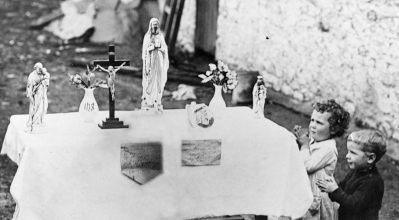
(Pictured: Children pray beside statues that were reported to have started bleeding, Belfast Telegraph, http://www.belfasttelegraph.co.uk)
Reynolds is the son of Patrick Reynolds and his wife Elizabeth, née Bourke. Educated by the Carmelites at Clondalkin, Dublin, he later comes under the influence of the Benedictines when he volunteers for the Northern Territory mission of Bishop Rosendo Salvado Rotea, and is sent to Subiaco near Rome to train for the priesthood. He leaves after three years and goes to the Swan River Colony with Bishop Joseph Serra to continue his training at New Norcia, arriving at Fremantle in May 1855. Probably because of poor health, he leaves the Benedictines and in January 1857 goes to South Australia. He completes his training under the Jesuits at Sevenhill and is ordained in April 1860 by Bishop Patrick Geoghegan. He is parish priest at Wallaroo (where he builds the church at Kadina), Morphett Vale and Gawler. When Bishop Laurence Sheil dies in March 1872, he is appointed administrator of the diocese of Adelaide. On November 2, 1873, in Adelaide he is consecrated bishop by Archbishop John Bede Polding.
Reynolds has a large diocese and in 1872-80 travels over 52,000 miles in South Australia. The opening up of new agricultural districts, an increase in Irish migrants and diocesan debts had produced a grave shortage of clergy. But his most urgent problem is conflicts between and within the clergy and laity over education, especially the role to be played by the Sisters of St. Joseph of the Sacred Heart. He supports the Sisters, reopens schools closed by Archbishop Sheil and, though opposed by the Bishop of the Diocese of BathurstMatthew Quinn, helps the Superior, Mother Mary MacKillop, secure Rome’s approval for autonomy for her Sisterhood.
Reynolds is not a good administrator and his strenuous efforts to extend Catholic education after the Education Act of 1875 incurs alarming debts. In 1880-81 he visits Rome. On his return, increasingly concerned with finances, disturbed at the prospect of losing St. Joseph nuns and, to some extent misled by jealousy and intrigue, he dramatically reverses his policy towards the Sisterhood and on November 14, 1883, relieves Mother Mary of her duties as Mother Superior. Though the Plenary Council of the Bishops of Australasia, held in Sydney in 1885, support him, in 1888 Pope Leo XIII decrees a central government for the Sisterhood, to be located in Sydney. The council requests that Adelaide be raised to an archiepiscopal and metropolitan see and on September 11, 1887, Reynolds is invested archbishop by CardinalFrancis Moran.
Reynolds’s health is never robust and after a two-year illness he dies on June 12, 1893, in Adelaide, where he is buried. Although he is austere and hard-working, he leaves his successor church debts of over £56,000. A particularly fine preacher, he is widely respected for his missionary zeal and for an ecumenical spirit unusual for his time.
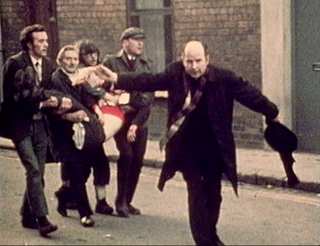
During his time in Derry, Daly takes part in the civil rights marches. He has first-hand experience of the Battle of the Bogside in 1969, the early years of the Troubles, internment, and the events of Bloody Sunday, in which British soldiers fire on unarmed protesters on January 30, 1972, killing 14 people. He becomes a public figure after he is witnessed using a blood-stained handkerchief as a white flag in an attempt to escort 17-year-old Jackie Duddy, a wounded protester, to safety. Duddy dies of his injuries soon after and Daly administers the last rites. He later describes the events as “a young fella who was posing no threat to anybody being shot dead unjustifiably.”
Daly gives an interview to the BBC in which he insists, contrary to official reports, that the protesters were unarmed. He testifies as such to the Widgery Tribunal, though he also testifies that he had seen a man with a gun on the day, to the anger of some of those involved. The Widgery Report largely exonerates the British Army, perpetuating the controversy. Years later, he says that the events of Bloody Sunday were a significant catalyst to the violence in Northern Ireland, and that the shootings served to greatly increase recruitment to the Irish Republican Army (IRA).
Prior to Bloody Sunday, Daly is sympathetic to the “old” IRA, of which his father was a member, but the events of Bloody Sunday leave him of the opinion that “violence is completely unacceptable as a means to a political end,” which leads to tension with the Provisional Irish Republican Army throughout his career.
Daly is appointed Bishop of Derry in 1974, a position he holds until he is forced to retire in October 1993 after suffering a stroke. He continues in the role of chaplain to Derry’s Foyle Hospice until February 2016.
Daly makes headlines in 2011 when he says there needs to be a place in the modern Catholic Church for married priests. He addresses the controversial issue in his book about his life in the Church, A Troubled See. Allowing clergymen to marry would ease the church’s problems, he says.
Daly is awarded the Freedom of the City by Derry City Council in 2015 in a joint ceremony with Bishop James Mehaffey, with whom he had worked closely while the two were in office. He is “hugely pleased to accept [the award], particularly when it is being shared with my friend and brother, Bishop James.” The city’s mayor, Brenda Stevenson, announces that the joint award is in recognition of the two bishops’ efforts towards peace and community cohesion.
Daly dies on August 8, 2016, at Altnagelvin Area Hospital in Derry, having been admitted after a fall several weeks previously. He had also been diagnosed with cancer. He is surrounded by family and local priests.
Daly’s remains are taken to St. Eugene’s Cathedral, where he lay in state with mourners able to file past. His coffin is sealed at midday on August 11, 2016, and buried after Requiem Mass in the grounds of St. Eugene’s Cathedral alongside his predecessor as Bishop of Derry, Neil Farren. The bells of the cathedral toll for one hour on the morning of Daly’s death while many local people arrived to pay tribute. The mayor of Derry, Hilary McClintock, opens a book of condolence in the city’s guildhall for members of the public to sign. The funeral, conducted by the incumbent Bishop of Derry Donal McKeown, is attended by multiple religious and political leaders from across Ireland and retired leaders from throughout his career. A message from Pope Francis is read aloud at the beginning of the service. Hundreds of members of the public also attend the funeral, some lining the route from the cathedral to the gravesite. His coffin is greeted with applause as it is carried out of the cathedral for burial.
(Pictured: Father Edward Daly, waving a blood-stained white handkerchief as he escorts a mortally-wounded protester to safety during the events of Bloody Sunday (1972) in Derry, Northern Ireland, an image which becomes one of the most recognisable moments of the Troubles)
O’Reily is born John O’Reilly on November 19, 1846, in Kilkenny, County Kilkenny, the son of Michael, a military officer, and Anne, née Gallagher. He completes his primary education at the parochial school of St. John’s Parish, and spends six and a half years at St. Kieran’s College. Due to poor health, he decides against pursuing a military career, and in 1864 he enters All Hallows College in Dublin to study for the priesthood. He learns the Irish language and studies mental philosophy, mathematics and ecclesiastical studies, achieving first prize in each of his classes.
After being ordained on June 21, 1869, O’Reily leaves Ireland for Western Australia in October, arriving in January 1870. Having served briefly in Newcastle (present day Toodyay) and Northam, he becomes a parish priest in Fremantle, establishing the West Australian Catholic Record in 1874 and serving as its publisher, editor and printer from 1883.
When the Diocese of Port Augusta is established in 1887, Pope Leo XIII names O’Reily as its first bishop. Concerned about the financial position of the diocese, which had inherited significant debt from the Diocese of Adelaide, he accepts the posting reluctantly. As bishop, he greatly improves the financial position of the new diocese, reducing its debt by half and earning a reputation as a competent administrator.
In 1894, O’Reily is appointed to replace the deceased Christopher Reynolds as Archbishop of Adelaide. The archdiocese he inherits is burdened with substantial debt, again left over from the old Diocese of Adelaide. Through the sale of church assets and a fundraising campaign, he is able to eliminate most of the Archdiocese’s liabilities while still investing in church infrastructure. He also actively participates in public discussions relating to education policy at a time when the role of the state in supporting religious education is topical. He publicly advocates government assistance for religious schools, stating that it is unfair Catholics pay taxes to support state schools, but receive no funding for their own.
In the later years of his life, poor health forces O’Reily to spend less time attending to his episcopal duties, and from 1905, he keeps to himself in his house in Glen Osmond, leading to the local press referring to him as the “Recluse of Glen Osmond.” Increasingly, his episcopal duties are fulfilled by Bishop of Port Augusta John Norton, who has to visit the more remote parts of O’Reily’s see on his behalf.
As he becomes more frail, O’Reily asks certain priests to accompany him when he travels, among whom is the DominicanpriorRobert Spence. When O’Reily requests a coadjutor in 1913, he chooses Spence as his first preference for the role. Despite the reluctance of some clergy to the appointment of a religious as Archbishop, Spence is consecrated as coadjutor, with right of succession, in August 1914.
O’Reily dies at his house in Adelaide on July 6, 1915 and is buried under a large Celtic cross at the West Terrace Cemetery in Adelaide. He is highly regarded by many in South Australian society, with Adelaide’s daily newspapers praising his character, administrative ability and positive relations with non-Catholics.
Rice is born into a Catholic family and is one of nine children. It comes as a surprise that a Catholic family can be prosperous in these days but they have a lease of a good-sized farm and are industrious people. In view of his future work in education it is fortunate that he receives a very good education himself, first at a local hedge school and then at a private secondary school in Kilkenny.
Rice is apprenticed to his uncle, Michael Rice, in Waterford at the age of 17. Waterford is then the second largest port in Ireland with an expanding trade with England, France and Spain and has very special trading links across the Atlantic with Newfoundland. His uncle is involved in providing food and services for the crews and passengers of the ships trading in and out of the port of Waterford. His uncle becomes a very prosperous businessman, and his business expands even more after it is handed over to his nephew. His great wealth is later to be used in transforming the lives of countless young boys.
At the age of 25 Rice marries Mary Elliot and is left a widower two years later when she dies after falling from a horse. He is left with a handicapped daughter, Mary. He calls in his stepsister Joan Murphy to help him care for his daughter so he can develop the business he inherited from his uncle.
In 1802, having properly cared for his daughter, Rice begins a night school for the uneducated boys from the quays of Waterford. His deep desire is to found a religious order of men who will educate these poor boys so that they can live with dignity and high self-esteem. But his volunteer assistants cannot stick with it. Neither can the paid teachers he later employs. Just when his spirits are lowest, and he looks to be a failure to all his business colleagues, two men from his native Callan join him not only to educate these unruly boys but also to join him in his plan to found a religious order. To do such a thing is contrary to the law. Nevertheless, Rice and his growing number of companions proceed. In 1808 seven of them take religious vows under Bishop Power of Waterford. They are called Presentation Brothers. This is the first congregation of men to be founded in Ireland and one of the few ever founded in a Church by a layman. Rice has in the meantime built a substantial school out of his own money, but it is already proving too small for the many boys who flock to him for an education.
Gradually an extraordinary transformation takes place in the “quay kids” of Waterford. Rice and his Brothers educate them, clothe and feed them. Other Bishops in Ireland supply him with men whom he prepares for religious life and teaching. In this way the Presentation Brothers spread throughout Ireland. However, the groups in separate dioceses are not under his control but that of the bishop. This creates problems when Brothers need to be transferred. Rice seeks and ultimately obtains approval from Pope Pius VII for his Brothers to be made into a pontifical congregation with Rice as Superior General. He is then able to move Brothers to wherever they are most needed. From this time on they are called Christian Brothers. By 1825 there are 30 Christian Brothers working in 12 towns and cities and educating 5,500 boys, free of charge. Many of these boys are also being clothed and fed.
Rice’s life is steeped in a spirituality that is strong and practical. He is forever caring for the poor in the wretched circumstances of their lives, for he believes there is a great need “to give to the poor in handfuls.” Many people, both men and women, from many cultures, young and old are helped and given hope and purpose and a new footing in life. He and his Brothers even card for the inmates of the jails of Waterford. He is privileged to comfort and accompany many a condemned man to the gallows. The poor never forget his love for them and see him as “a man raised up by God.”
Rice endures many and severe trials and in 1829 it seems the Christian Brothers are going to be suppressed by the law of the land. They face extinction but this does not happen. An even worse trial comes to him personally when some of his own Brothers try to undermine his work. Fortunately, they are unsuccessful. He gave his Brothers as their motto a text from the Book of Job that means so much to him in his life: “The Lord has given, and the Lord has taken away; blessed be the name of the Lord forever.”
In 1838, at the age of 76, Rice retires from leadership of the congregation and returns to Waterford. After living in a near-comatose state for more than two years, he dies at Mount Sion, Waterford on August 29, 1844, where his remains lie in a casket to this day.
Rice is declared to be Blessed Edmund Rice by Pope John Paul II in Rome on October 6, 1996. His Feast Day in the Catholic Church is 5 May.
In 1904, Flanagan emigrates to the United States and becomes a US citizen in 1919. He attends Mount St. Mary’s University in Emmitsburg, Maryland, where he receives a Bachelor of Arts degree in 1906 and a Master of Arts degree in 1908. He studies at Saint Joseph’s Seminary in Dunwoodie, Yonkers, New York. He continues his studies in Italy and at the University of Innsbruck in Austria where he is ordained a priest on July 26, 1912. His first parish is in O’Neill, Nebraska, where from 1912 he serves as an assistant pastor at St. Patrick’s Catholic Church. He then moves to Omaha, Nebraska, to serve as an assistant pastor at St. Patrick’s Church and later at St. Philomena’s Church.
In 1917, Flanagan founds a home for homeless boys in Omaha. Bishop Jeremiah James Harty of the Diocese of Omaha has misgivings but endorses Flanagan’s experiment. Because the downtown facilities are inadequate, he establishes Boys Town, ten miles west of Omaha in 1921. Under his direction, Boys Town grows to be a large community with its own boy-mayor, schools, chapel, post office, cottages, gymnasium, and other facilities where boys between the ages of 10 and 16 can receive an education and learn a trade.
Boys Town, a 1938 film starring Spencer Tracy based on Flanagan’s life, wins Tracy an Academy Award for Best Actor for his performance. Mickey Rooney also stars as one of the residents. Tracy spends his entire Oscar acceptance speech talking about Flanagan. Without confirming it with Tracy, an overzealous MGM publicity representative announces incorrectly that Tracy is donating his Oscar to Flanagan. The Academy of Motion Picture Arts and Sciences hastily strikes another inscription, so Tracy keeps his statuette and Boys Town gets one as well. A sequel also starring Tracy and Rooney, Men of Boys Town, is released in 1941.
Flanagan himself appears in a separate 1938 MGM short, The City of Little Men, promoting Boys Town and giving a tour of its facilities. The actor Stephen McNally plays Flanagan in a 1957 episode of the ABC religion anthology series, Crossroads.
Flanagan receives many awards for his work with the delinquent and homeless boys. Pope Pius XI names him a Domestic Prelate with the title Right Reverend Monsignor in 1937. He serves on several committees and boards dealing with the welfare of children and is the author of articles on child welfare. Internationally known, he travels to the Republic of Ireland in 1946, where he is appalled by the children’s institutions there, calling them “a national disgrace.” When his observations are published after returning to Omaha, instead of improving the horrid conditions, vicious attacks are leveled against him in the Irish print media and the Oireachtas. He is invited by General Douglas MacArthur to Japan and Korea in 1947 to advise on child welfare, as well as to Austria and Germany in 1948. While in Germany, he dies of a heart attack on May 15, 1948. He is interred at Dowd Memorial Chapel of the Immaculate Conception Parish in Boys Town, Nebraska.
On February 25, 2012, the Catholic Archdiocese of Omaha, Nebraska opens the canonization process of Flanagan. At a March 17, 2012 prayer service at Boys Town’s Immaculate Conception Church, he is given the title “Servant of God,” the first of three titles bestowed before canonization as a Catholic saint. The investigation is completed in June 2015 and the results forwarded to the Vatican. If the Vatican approves the local findings, Flanagan will be declared venerable. The next steps will be beatification and canonization.
There is a portrait statue dedicated to Fr. Edward J. Flanagan in Ballymoe, County Galway.
Downey’s tenure sees the construction and dedication of the crypt of Liverpool Metropolitan Cathedral, built to a design by Sir Edwin Lutyens, although the Cathedral itself is never completed as he had envisaged. A picture of Lutyens proposed cathedral is printed on postcards sold to raise funds.
In 1929, before the actual construction begins, Downey states, “Hitherto all cathedrals have been dedicated to saints. I hope this one will be dedicated to Christ himself with a great figure surmounted on the cathedral, visible for many a mile out at sea.” He also declares that while the Cathedral will not be medieval and Gothic, neither will it be as modern as the works of Jacob Epstein, a statement somewhat at odds with the design that is finally realised after his death.
Downey dies in Liverpool at the age of 72 on June 16, 1953, having served as Liverpool’s archbishop for twenty-four years. His remains are interred in a crypt at Liverpool Metropolitan Cathedral, Liverpool.
Eames spends his early years in Larne, with the family later moving to Belfast. He is educated at the city’s Belfast Royal Academy and Methodist College Belfast before going on to study at Queen’s University Belfast, graduating LL.B. (Upper Second Class Honours) in 1960 and earning a Ph.D. degree in canon law and history in 1963. During his undergraduate course at Queen’s, one of his philosophy lecturers is his future Roman Catholic counterpart, Cahal Daly.
Turning his back on legal studies for ordination in the Church of Ireland, Eames embarks on a three-year course at the divinity school of Trinity College, Dublin in 1960, but finds the course “intellectually unsatisfying.” In 1963 he is appointed curate assistant at Bangor Parish Church, becoming rector of St. Dorothea’s in Belfast in 1966, the same year he marries Christine Daly.
During his time at St. Dorothea’s, in the Braniel and Tullycarnet area of east Belfast, Eames develops a “coffee bar ministry” among young people but is interrupted by the Troubles. He turns down the opportunity to become dean of Cork and in 1974 is appointed rector of St. Mark’s in Dundela in east Belfast, a church with strong family links to C. S. Lewis.
On May 9, 1975, at the age of 38, Eames is elected bishop of the cross-border Diocese of Derry and Raphoe. Five years later, on May 30, 1980, he is translated to the Diocese of Down and Dromore. He is elected to Down and Dromore on April 23 and that election is confirmed on May 20, 1980. In 1986, he becomes the 14th Archbishop of Armagh and Primate of All Ireland since the Church of Ireland’s break with Rome. It is an appointment that causes some level of astonishment among other church leaders.
Drumcree Church, a rural parish near Portadown, becomes the site of a major political incident in 1996, when the annual Orangemen‘s march is banned by the Chief Constable of the Royal Ulster Constabulary from returning to the centre of Portadown via the nationalist Garvaghy Road after attending worship at Drumcree Church. Public unrest and violence escalate over the next three summers as other parades come under first police and later commission sanction.
Eames, as diocesan bishop and civil leader finds himself immersed in the search for a resolution to the issue. Within the wider Church of Ireland there is unease as it is a broad church in theology and politics including within its congregations nationalists in the south and unionists in the north. Eames, along with the rector of Drumcree, has to navigate this political and social controversy and seeks political assistance to diffuse tension. Some bishops in the Republic of Ireland call for Eames to close the parish church, including Bishop John Neill who later becomes Archbishop of Dublin. He refuses to do so, believing this action could precipitate greater unrest and possible bloodshed.
Eames is, for many years, a significant figure within the general Anglican Communion. In 2003, the self-styled ‘divine optimist’ is appointed Chairman of the Lambeth Commission on Communion, which examines significant challenges to unity in the Anglican Communion. The Commission publishes its report, the Windsor Report, on October 18, 2004.
At the Church of Ireland General Synod in 2006 Eames announces his intention to retire on December 31, 2006. Church law permits him to continue as primate until the age of 75 but he resigns, in good health, at the age of 69. On January 10, 2007, the eleven serving bishops of the Church of Ireland meet at St. Patrick’s Cathedral in Dublin and elect Alan Harper, Bishop of Connor, as Eames’s successor.




 seamus dubhghaill