Born to John Lawler and Elizabeth Kelly, they move to the United States four years later and settle initially in Frederick County, Maryland. In 1819, they move to rural Gallatin County, Illinois. On December 20, 1837, Lawler marries Elizabeth Crenshaw. He receives an appointment as a captain in the Mexican-American War and commands two companies in separate deployments to Mexico. He first leads a company from Shawneetown, Illinois that guards the supply route from Veracruz to General Winfield Scott‘s army. After the fall of Veracruz his company is discharged. He makes a visit to Washington after which he is asked by Illinois Governor Thomas Ford to organize a company of riflemen. He serves in the campaign to take Matamoros, Tamaulipas.
Lawler then returns to his farm in Illinois, where he is residing at the outbreak of the American Civil War. He establishes a thriving mercantile business, dealing in hardware, dry goods, and shoes. He studies law, passes his bar exam, and uses his legal license to help the claims of Mexican War veterans.
Following the surrender of Jackson, Mississippi, the XIII Corps is split up and divided among other operations in the Western Theater. For the rest of the war, Lawler serves as commander of the 1st Division, XIII Corps in Louisiana in the Department of the Gulf, taking command of the division during the disastrous Red River campaign and leading it on an expedition in June 1864 to secure a crossing of the Atchafalaya River used by Confederate forces.
In the omnibus promotions at the end of the American Civil War, Lawler receives a promotion for distinguished service to major general in the Union army backdated from March 13, 1865. After mustering out of the army in 1866, he returns home and resumes his legal practice and farming near Shawneetown, Illinois.
Lawler dies in Shawneetown on July 22, 1882, and is buried in the Lawler Family Cemetery near Equality, Illinois, at the rear of the Old Slave House property.
A memorial to Lawler stands in Equality, Illinois. He also is honored with a marble bust in Vicksburg National Military Park in Vicksburg, Mississippi. Chicago renames a street to Lawler Avenue in his memory.
Pearse follows his brother into the Irish Volunteers and the republican movement. He takes part in the Easter Rising in 1916, always staying at his brother’s side at the General Post Office. Following the surrender, he is court-martialed and sentenced to death. It has been said that as he is only a minor player in the struggle it is his surname that condemns him. However, at his court martial he emphasizes his involvement.
On May 3, 1916, Pearse is granted permission to visit his brother in Kilmainham Gaol, to see him for the final time. However, while he is en route, Patrick is executed. He is executed on May 4. He and his brother are the only two brothers to be executed after the Easter Rising.
There are many more public commemorations of Patrick Pearse than of William. In 1966, Dublin’s Westland Row railway station is renamed Dublin Pearse railway station to honour both brothers. Pearse Square and Pearse Street in Dublin are renamed in honour of both, Pearse Street (then Great Brunswick Street) having been their birthplace. Many streets and roads in Ireland bear the name Pearse. Few name William, but there is a Pearse Brothers Park in Rathfarnham. The bridge over the River Dodder on the Rathfarnham Road, between Terenure and Rathfarnham is named after them and carries a plaque depicting the brothers in profile.
Brothers Pearse Athletic Club, founded in Rathfarnham, is named after the two brothers. A number of Gaelic Athletic Association clubs and playing fields are named after both Pearses, and at least one after William.
In the summer of 1647, Murrough O’Brien (later created the Earl of Inchiquin), commander of the English Parliamentarian forces in Cork, ravages and burns the Confederate territory in Munster. This causes severe food shortages and earns O’Brien the Irish nickname, Murchadh na d’Tóiteán (Murrough the Burner). In addition, Inchiquinn takes the Rock of Cashel, which is garrisoned by Confederate troops and rich in emotive religious symbolism. In the sack of the castle, O’Brien’s troops massacre the garrison and all the clergy they find there.
The Confederates’ Munster army is incapable of stopping O’Brien because of political infighting between officers who support a deal with the English Royalists and those who reject such a deal. Eventually, in reaction to the sack of Cashel and famine conditions, the Confederate Supreme Council replaces Donough MacCarthy, 2nd Viscount Muskerry, as commander of the Munster army with Theobald Taaffe, 1st Earl of Carlingford, and order him to bring O’Brien to battle.
Taaffe is an English Catholic and not an experienced soldier. Although he has an excellent contingent of veteran troops under Alasdair Mac Colla, most of his men are similarly inexperienced. Furthermore, the Irish troops are demoralised by the internal factionalism in their ranks and most of them have little loyalty to Taafe. O’Brien, on the other hand, has been commanding his force since 1642 and is well experienced in battle. His troops are a mixture of well trained Parliamentarian soldiers from England and British settlers who have been driven from their homes in the Irish Rebellion of 1641. The two armies meet at Knocknanuss near Mallow, approximately 29 kilometers north of Cork.
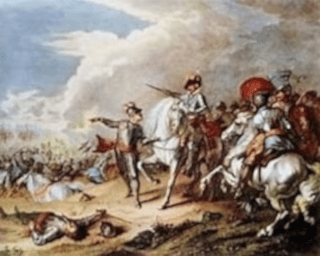
The battle that follows is essentially an uncoordinated rout of the Irish forces. Taaffe positions his men on either side of a hill, so that they cannot see one another. The result is that one wing of the Confederate army has no idea of what the other wing is doing. Mac Colla’s men charge the Parliamentarians opposite them putting them to flight and killing a large number of them. Thinking the battle is over, they then take to looting the enemy’s baggage train.
However, on the other wing, O’Brien’s cavalry has charged the raw Irish horsemen, causing them to run away. Despite Taaffe’s desperate attempt to rally them, the Irish infantry follow suit, many of them being cut down by the pursuing roundheads. The pursuit continues for miles and not only results in heavy casualties among the Irish, but also in the loss of most of their equipment and supplies. Inchiquin loses several senior officers, including the Judge-Advocate, Sir Robert Travers. Mac Colla and his men surrender when they realise what has happened but are subsequently killed by their captors. Around 3,000 Confederates die at Knocknanauss, and up to 1,000 English Parliamentarians. The carnage does not stop after the fighting is finished. The next day a couple of hundred Irish soldiers are found sheltering in a nearby wood. These are promptly put to the sword.
When combined with the Battle of Dungan‘s Hill in County Meath, the defeat leads to the collapse of the Confederate Catholic cause and forces them to make a deal with the English Royalists.
Barry’s execution inflames nationalist public opinion in Ireland, largely because of his age. The timing of the execution, only seven days after the death by hunger strike of Terence MacSwiney, the republicanLord Mayor of Cork, brings public opinion to a fever-pitch. His pending death sentence attracts international attention, and attempts are made by United States and Vatican officials to secure a reprieve. His execution and MacSwiney’s death precipitate an escalation in violence as the Irish War of Independence enters its bloodiest phase, and Barry becomes an Irish republican martyr.
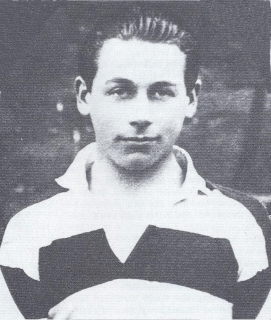
Barry is born on January 20, 1902, at 8 Fleet Street, Dublin, to Thomas and Mary (née Dowling) Barry. The fourth of seven children, two boys and five sisters, he is baptised in St. Andrew’s Church, Westland Row. As a child he attends the National School in Rathvilly, County Carlow, and the O’Connell Schools in Dublin, before enrolling in the Preparatory Grade at St. Mary’s College, Dublin, in September 1915. He remains at that school until May 31, 1916, when it is closed by its clerical sponsors. With the closure of St. Mary’s College, he transfers to Belvedere College, a Jesuit school in Dublin.
In October 1917, during his second year at Belvedere, Barry joins Company C, 1st Battalion of the Dublin Brigade of the Irish Volunteers. When Company C is later reorganized, he is reassigned to the newly formed Company H, under the command of Captain Seamus Kavanagh. The following year he is introduced by Seán O’Neill and Bob O’Flanagan to the Clarke Luby Club of the Irish Republican Brotherhood (IRB), and at some point in time he is sworn as a member of this secret society which is led by Michael Collins.
Two Dublin Volunteers notice that a British army lorry guarded by an armed party of soldiers makes twice weekly trips to Monk’s Bakery on Church Street to obtain bread. Based on these observations, John Joe Carroll of Company H conducts a reconnaissance of the bakery. In addition to its main entrance on Church Street, he observes that the bakery yard is also accessible by a corridor leading from a shop on North King Street. He concludes that this makes the bakery an attractive site for an ambush.
On the morning of September 20, 1920, Barry goes to Mass, then joins a party of IRA volunteers on Bolton Street in Dublin. Their orders are to ambush a British army lorry as it picks up a delivery of bread from the bakery and capture their weapons. The ambush is scheduled for 11:00 AM, which gives him enough time to take part in the operation and return to class in time for an examination he has at 2:00 PM. The truck arrives late and is under the command of Sergeant Banks.
Armed with a .38 MauserParabellum, Barry and members of C Company are to surround the lorry, disarm the soldiers, take the weapons and escape. He covers the back of the vehicle and, when challenged, the five soldiers comply with the order to lay down their weapons. A shot is then fired, possibly a warning shot from an uncovered soldier in the front. Barry and the rest of the ambush party then open fire. His gun jams twice and he dives for cover under the vehicle. His comrades flee and he is left behind. He is then spotted and arrested by the soldiers. One soldier is killed and two other later die of their wounds.
The War Office orders that Barry be tried by court-martial under the Restoration of Order in Ireland Act 1920, which received royal assent on August 9, 1920. Barry is charged on three counts of the murder of Private Marshall Whitehead. In accordance with military procedure the verdict is not announced in court. He is returned to Mountjoy Prison. Later that night the district court-martial officer enters his cell and reads out the sentence: death by hanging. The public learns on October 28 that the date of execution has been fixed for November 1.
Barry is hanged on November 1, 1920, after hearing two Masses in his cell. Canon Waters, who walks with him to the scaffold, writes to Barry’s mother later, “You are the mother, my dear Mrs. Barry, of one of the bravest and best boys I have ever known. His death was one of the most holy, and your dear boy is waiting for you now, beyond the reach of sorrow or trial.”
Barry’s body is buried at 1:30 PM, in a plot near the women’s prison. His comrade and fellow-student Frank Flood is buried alongside him four months later. A plain cross marks their graves and those of Patrick Moran, Thomas Whelan, Thomas Traynor, Patrick Doyle, Thomas Bryan, Bernard Ryan, Edmond Foley and Patrick Maher who are hanged in the same prison before the Anglo-Irish Treaty of July 1921 which ends hostilities between Irish republicans and the British. The men are buried in unconsecrated ground on the jail property and their graves are unidentified until 1934. They become known as the Forgotten Ten by republicans campaigning for the bodies to be reburied with honour and proper rites. On October 14, 2001, the remains of these ten men are given a state funeral and moved from Mountjoy Prison to be re-interred at Glasnevin Cemetery in Dublin.
The rebellion begins on October 23, 1641 as an attempted coup d’état by Catholic gentry and military officers, who try to seize control of the English administration in Ireland. However, it develops into a widespread rebellion and ethnic conflict with English and Scottish Protestant settlers, leading to Scottish military intervention. The rebels eventually found the Irish Catholic Confederacy.
The plan to seize Dublin Castle is foiled, but the rebels swiftly capture numerous towns (including Dundalk), forts and fortified houses in the northern province of Ulster. Within days they hold most of the province. Rebel leader Felim O’Neill of Kinard issues a forged proclamation, the Proclamation of Dungannon, claiming he has the king’s blessing to secure Ireland against the king’s opponents. The uprising spreads southward and soon most of Ireland is in rebellion. In November, rebels besiege Drogheda and defeat an English relief force at Julianstown. The following month, many Anglo-Irish Catholic lords join the rebellion. In these first months, especially in Ulster, some Catholic rebels drive out or kill thousands of Protestant settlers (most notably the Portadown massacre), and settlers respond in kind. Reports of rebel massacres outrage Protestants in Britain, and leave a lasting impact on the Ulster Protestant community.
King Charles and the English parliament both seek to quell the rebellion, but parliament does not trust the king with command of any army raised to do so. This is one of the issues that lead to the English Civil War. Charles orders forces to be raised in Ireland, and the English parliament drafts a bill to give itself the power to raise armed forces. Eventually, in April 1642, following negotiations between the English and Scottish parliaments, the Scots send a Covenanter army to Ireland. It swiftly captures most of eastern Ulster, while a Protestant settler army holds northwestern Ulster. Government forces meanwhile recapture much of the Pale, and hold the region around Cork. Most of the rest of Ireland is under rebel control.
In May 1642, Ireland’s Catholic bishops meet at Kilkenny, declare the rebellion to be a just war and take steps to control it. With representatives of the Catholic nobility in attendance, they agree to set up an alternative government known as the Irish Catholic Confederacy and draw up the Confederate Oath of Association. The rebels, now known as Confederates, hold most of Ireland against the Protestant Royalists, Scottish Covenanters and English Parliamentarians. The rebellion is thus the first stage of the Irish Confederate Wars and part of the wider Wars of the Three Kingdoms, which lasts for the next ten years.
(Pictured: Depiction of the massacre of Ulster Protestants during the 1641 rebellion, the LIFE Picture Collection via Getty Images)
The Cork No. 2 Brigade, Irish Republican Army (IRA), attacks and captures a military barracks in Mallow, County Cork, on September 28, 1920, the only military barracks to be captured during the Irish War of Independence. British forces later burn and sack the town.
Mallow had been a garrison town for several hundred years. Eight miles to the north lay Buttevant where one of the largest military barracks in the country is located. Not far from Buttevant are the great military training camps of Ballyvonaire, while nineteen miles to the northeast is Fermoy with its large permanent military garrisons and huge barracks adjacent to the big training centres of Kilworth and Moorepark. Twenty miles to the southeast is the city of Cork with its many thousands of troops both in the posts within the city and at Ballincollig, about six miles west of it, on the Macroom road. Thirteen miles westward a detachment from a British machine gun corps holds Kanturk. Every town and village has its post of Royal Irish Constabulary (RIC) men armed to the teeth.
The idea of capturing the barracks comes from two members of the Mallow IRA Battalion, Dick Willis, a painter, and Jack Bolster, a carpenter, who are employed on the civilian maintenance staff of the barracks which is occupied by the 17th Lancers. Willis and Bolster are able to observe the daily routine of the garrison and form the opinion that the capture of the place would not be difficult. They are instructed by their local battalion officers to make a sketch map of the barracks. After that is prepared, Liam Lynch and Ernie O’Malley go with Willis and Tadhg Byrnes to Mallow to study the layout of the surrounding district. Among the details of the garrison’s routine that Willis and Bolster report to the Column leaders, is the information that each morning the officer in charge, accompanied by two-thirds of the men, take the horses for exercise outside the town. It is obvious to the two Mallow volunteers that this is the ideal time for the attack.
Situated at the end of a short, narrow street and on the western verge of the Town Park, Mallow barracks stand on an unusually low-lying location and is relatively small in size. Surrounded by a high stone wall, the barracks can be approached from the town park as well as from the main street. The various details are carefully studied by Lynch and O’Malley. While Willis and Bolster are allotted tasks within the walls of the barracks, Byrnes and Jack Cunningham are chosen to attack with the main body of the column which includes Commandant Denny Murphy of Kanturk.
On the morning of September 27, at their Burnfort headquarters, the men are ordered to prepare for action. Under cover of darkness they move into the town and enter the Town Hall by way of the park at the rear. The eighteen men of the column are strengthened by members of the Mallow battalion, a number of men posted in the upper storey of the Town Hall, from which they can command the approaches to the nearby RIC barracks. Initially it is planned that Willis and Bolster will enter the military barracks that morning in the normal manner, accompanied by an officer of the column who will pose as a contractor’s overseer. The officer is Paddy McCarthy of Newmarket, who would die a few months later in a gun battle with the Black and Tans at Millstreet.
McCarthy, Willis and Bolster enter the barracks without mishap. Members of the garrison follow their normal routine, with the main body of troops under the officer in charge leaving the barracks with the horses. In the barracks remain about fifteen men under the command of a senior N.C.O., Sergeant Gibbs.
Once the military has passed, the attackers, numbering about twenty men and led by Liam Lynch, advance toward the bottom of Barrack Street. All are armed with revolvers which are considered the most convenient and suitable weapons for the operation. Lynch has issued strict instructions that there is to be no shooting by the attackers, unless as a last resort. Inside the walls are McCarthy, Willis and Bolster, their revolvers concealed. Then Ernie O’Malley presents himself at the wicket gate with a bogus letter in his hand. Behind him and out of sight of the sentry are the other members of the main attacking party, led by Lynch, O’Brien and George Power. When the gate is opened sufficiently, O’Malley wedges his foot between it and the frame and the soldier is overpowered and the attackers rush in. McCarthy, Bolster and Willis immediately go to the guardroom where they hold up the guard. Realising what is happening, Sergeant Gibbs, rushes toward the guardroom in which rifles are kept. Although called upon to halt, he continues even though a warning shot is fired over his head. As he reaches the guardroom door, the IRA officer and one of the volunteers in the guardroom fire simultaneously. Mortally wounded, the sergeant falls at the guardroom door.
By this time the majority of the attacking party is inside the gate. Military personnel in different parts of the barracks are rounded up and arms are collected. Three waiting motor cars pull up to the gate and all the rifles, other arms and equipment found in the barracks are loaded into them. The prisoners are locked into one of the stables, with the exception of a man left to care for Sergeant Gibbs. The whole operation goes according to plan, except for the shooting of the sergeant. Twenty minutes after the sentry had been overpowered the pre-arranged signal of a whistle blast is sounded and the attackers withdraw safely to their headquarters at Burnfort, along the mountain road out of Mallow.
Expecting reprisals, the column moves to Lombardstown that night, and positions are taken up around the local co-operative creamery as it is the custom of the British to wreak their vengeance on isolated country creameries after incidents such as what had just occurred. The Mallow raid, however, has greater repercussions than the destruction of a creamery and co-operative stores. The following night, large detachments of troops from Buttevant and Fermoy enter Mallow. They rampage through the town, burning and looting at will. High over the town, the night sky is red with the flames of numerous burning buildings.
Townspeople run through the blazing streets, in search of refuge. A number of women and children are accorded asylum in the nearby convent schools. Another group of terrified women, some with children in arms, take refuge in the cemetery at the rear of St. Mary’s Church, where they kneel or lay above the graves. It is a night of terror such as which had never before been endured by the people of Mallow.
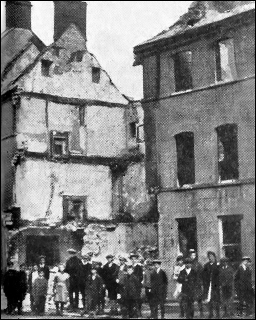
The extent of the wanton destruction outrages fair-minded people all over the world. Details of the havoc that had been wrought and pictures of the scenes of destruction are published worldwide.
(Pictured: Townspeople gather in front of one of the many buildings in Mallow which were reduced to ruins during British Army reprisals)
Lord enlists in the Royal Air Force on August 6, 1936. After reaching the rank of corporal in August 1938, he applies to undertake pilot training, which he begins in October 1938. Successfully gaining his pilot’s wings, he becomes a sergeant pilot in April 1939, and is posted to No. 31 Squadron RAF, based in Lahore, India. He later flies the Vickers Type 264 Valentia biplane transport. In 1941, No. 31 Squadron is the first unit to receive the Douglas DC-2 which is followed by both the Douglas DC-3 and Dakota C-47 Skytrain transports. That year he is promoted to flight sergeant and then warrant officer. He flies in North Africa, supporting troops in Libya and Egypt for four months, before being posted back to India. Commissioned as a pilot officer in May 1942, he flies supply missions over Burma, for which he is mentioned in despatches.
The Battle of Arnhem is part of Operation Market Garden, an attempt to secure a string of bridges through the Netherlands. At Arnhem, the British 1st Airborne Division and Polish 1st Independent Parachute Brigade are tasked with securing bridges across the Lower Rhine, the final objectives of the operation. However, the airborne forces that drop on September 17 are not aware that the 9th SS and 10th SS Panzer divisions are also near Arnhem for rest and refit. Their presence adds a substantial number of Panzergrenadiers, tanks and self-propelled guns to the German defences and the Allies suffer heavily in the ensuing battle. Only a small force manages to hold one end of the Arnhem road bridge before being overrun on September 21. The rest of the division becomes trapped in a small pocket west of the bridge and has to be evacuated on September 25. The Allies fail to cross the Rhine, which remains under German control until Allied offensives in March 1945.
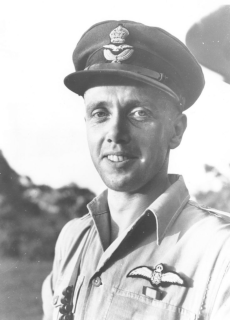
Lord is 30 years old, and a flight lieutenant serving with No. 271 Squadron, Royal Air Force during World War II when he is awarded the Victoria Cross. On September 19, 1944, during the Battle of Arnhem in the Netherlands, the British 1st Airborne Division is in desperate need of supplies. His Dakota III “KG374” encounters intense enemy anti-aircraft fire and is hit twice, with one engine burning. He manages to drop his supplies, but at the end of the run finds that there are two containers remaining. Although he knows that one of his wings might collapse at any moment, he nevertheless makes a second run to drop the last supplies, then orders his crew to bail out. A few seconds later, the Dakota crashes in flames with its pilot and six crew members.
Only the navigator, Flying Officer Harold King, survives, becoming a prisoner of war. It is only on his release in mid-1945, as well as the release of several paratroops from the 10th Parachute Battalion, that the story of Lord’s action becomes known. He is awarded a posthumous Victoria Cross.
Several aircraft have carried tributes to Lord. Between 1993 and 1998, the RAF Battle of Britain Memorial Flight‘s Dakota, serial “ZA947”, is painted in the colours of Lord’s aircraft during the Arnhem battle and bears the same code letters: YS-DM. Between 1973 and 2005, the Dakota displayed at RAF Museum Cosford is similarly painted and coded to represent Lord’s aircraft. From 1966 until its disbandment in 2005, No. 10 Squadron RAF is equipped with Vickers VC-10s, each of which is named after a Royal Air Force or Royal Flying Corps VC recipient. Aircraft serial number ‘XR810’ is named David Lord VC.
Lord’s Victoria Cross is presented to his parents at Buckingham Palace in December 1945. In 1997, his Victoria Cross, along with his other decorations and medals, are sold at auction by Spinks to Lord Ashcroft. As of 2014, the medal group is on display at the Imperial War Museum.
The Royalist rebellion that breaks out in Ireland against the new English republic in 1649 is met by a prompt English response. On August 15 Oliver Cromwell and 15,000 troops land in Dublin. His merciless policy toward the Irish Royalists becomes brutally clear within a month.
The defeat of the Irish Royalists in the Battle of Rathmines in early August is fortuitous for Cromwell, for without it, the English would have held only the small port of Derry (known as Londonderry from 1662) in the north, making his invasion almost impossible to effect. Cromwell quickly finds that the Irish Royalists have retreated into fortified towns. He therefore prepares for a series of sieges.
The first such siege occurs at Drogheda, 28 miles north of Dublin. Cromwell arrives at Drogheda on September 3. His siege guns, brought up by sea, arrive two days later. He finds the town surrounded by high but relatively thin walls and its governor, Sir Arthur Ashton, is confident of his defenses and refuses an order to surrender. On September 10 Cromwell begins an artillery bombardment of the walls. These are breached the following day, but the gap created is too small to allow troops to enter the city. Twice they are repelled until Cromwell himself leads an assault and overwhelms the defenders on September 11.
The carnage inside the city is appalling. Cromwell’s troops kill priests and monks on sight and set fire to a Catholic church sheltering some soldiers. Civilians as well as soldiers are massacred, and Ashton is bludgeoned to death with his own wooden leg. The few Royalist soldiers who survive are transported to Barbados. What happens at Drogheda is replicated at Wexford the following month and Clonmel the next May. By the time Cromwell has put down the rebellion and returned to England in that same month, he has become forever hated by Irish Catholics.
During the eight day siege the British lose 150 of their 12,000 men while 2,800 Irish are killed and 200 captured of the 3,100 at Drogheda.
(Pictured: St Laurence’s Gate – the last remaining of the ten original defensive gates at Drogheda)
By the end of 1705, France and its allies control most of Northern Italy, as well as the Savoyard territories of Villefranche and the County of Savoy, now in modern-day France. The main French objective for 1706 is to capture the Savoyard capital of Turin. To prevent Imperial forces in Lombardy intervening, Louis Joseph, Duke of Vendôme, attacks at Calcinato on April 19 and drives them into the Trentino valley. On May 12, Marshall La Feuillade and an army of 48,000 men reach Turin, completing their blockade of the city on 19 June 19. The Imperial commander Prince Eugene of Savoy returns from Vienna and takes the remaining troops into the Province of Verona to await the German contingents. By early July, there are 30,000 Imperial soldiers around Verona facing 40,000 French spread between the Mincio and Adige rivers.
The French position looks very strong but defeat at Ramillies in May means Vendôme and any available troops are sent to Northern France. The siege of Turin continues and although the Hessians have not yet arrived, by mid-July Prince Eugene can no longer delay marching to its relief. Count of Médavy and 23,000 men are left to guard the Alpine passes.
The Hessians finally cross the Alps in July, under the command of Frederick of Hesse-Kassel. As they arrive too late to join Prince Eugene’s march to Turin, the Hessians are tasked with preventing Médavy disrupting his supply routes. On August 19, Frederick sends 2,000 men under Major-General Wetzel to Goito, a small town with a bridge across the Mincio and the French garrison evacuates the town. Castiglione is strongly defended and they have to wait for the heavy artillery to arrive from Arco. Frederick leaves 1,500 men outside the town with the rest positioned near Medole, allowing him to monitor Médavy’s main force at Cremona and the crossing at Goito.
The withdrawal from Goito is part of a plan by Médavy to assemble a field army without alerting Frederick by removing garrisons from key strongpoints like Cremona. He puts together a force of 8,000 infantry and 4,000 cavalry, crosses the Oglio river at Marcaria and attacks on September 8. Dividing his corps leaves Frederick outnumbered. The first assaults are repulsed but a cavalry charge led by the Irish exile Arthur Dillon catches the Hessian left wing as they are changing position and the line collapses. Médavy then turns his attention to those outside Castiglione, many of whom surrender. French casualties are estimated as 1,000 killed or wounded, the Hessians losing around 1,500 killed or wounded plus 2,500 captured.
The remainder fall back on Valeggio sul Mincio. In a letter of September 11 to John Churchill, 1st Duke of Marlborough, Frederick claims his forces were reduced by sickness but although they initially drove the French back, lack of artillery forced him to retreat.
Médavy’s victory leaves the strategic position unaltered. The Battle of Turin on September 7 had broken the siege and after Ramillies France can no longer spare the resources to continue fighting in Italy. Castiglione slightly improves their bargaining position but French garrisons in Lombardy are isolated and cannot be reinforced, their surrender being only a matter of time.
To the fury of the English and Dutch, in March 1707 Emperor Joseph signs the Convention of Milan withdrawing all French troops from Northern Italy in return for free passage back to France.
(Pictured: Arthur Dillon, Colonel of Dillon’s Regiment in the Irish Brigade of France)
On the morning of September 1, 1862, Union Maj. Gen. John Pope orders Maj. Gen.Edwin Vose Sumner of the II Corps, Army of the Potomac, to send a brigade north to reconnoiter. The army’s cavalry is too exhausted for the mission. But at the same time, he continues his movement in the direction of Washington, D.C., sending Maj. Gen. Irvin McDowell‘s III Corps to Germantown (on the western border of modern-day Fairfax, Virginia), where it can protect the important intersection of Warrenton Pike and Little River Turnpike that the army needs for the retreat. He also sends two brigades from Maj. Gen. Jesse L. Reno‘s IX Corps, under the command of Brig. Gen. Isaac Stevens, to block Jackson. Maj. Gen. Philip Kearny’s division from the III Corps follows later that afternoon.
Jackson resumes his march to the south, but his troops are tired and hungry and make poor progress as the rain continues. They march only three miles and occupy Ox Hill, southeast of Chantilly Plantation, and halt, while Jackson himself takes a nap. All during the morning, Confederate cavalry skirmish with Union infantry and cavalry. At about 3:00 PM, Stevens’s division arrives at Ox Hill. Despite being outnumbered, Stevens chooses to attack across a grassy field against Brig. Gen. Alexander Lawton‘s division in the Confederate center. The Union attack is initially successful, routing the brigade of Colonel Henry Strong and driving in the flank of Captain William Brown, with Brown killed during the fighting. The Union division is driven back following a counterattack by Brig. Gen. Jubal Early‘s brigade. Stevens is killed during this attack at about 5:00 PM by a shot through his temple.
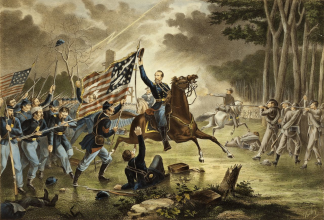
A severe thunderstorm erupts about this time, resulting in limited visibility and an increased dependence on the bayonet, as the rain soaks the ammunition of the infantry and makes it useless. Kearny arrives about this time with his division to find Stevens’s units disorganized. Perceiving a gap in the line he deploys Brig. Gen. David B. Birney‘s brigade on Stevens’s left, ordering it to attack across the field. Birney manages to maneuver close to the Confederate line but his attack stalls in hand-to-hand combat with Maj. Gen. A.P. Hill‘s division. Kearny mistakenly rides into the Confederate lines during the battle and is killed. As Kearny’s other two brigades arrive on the field, Birney uses the reinforcements as a rear guard as he withdraws the remainder of the Union force to the southern side of the farm fields, ending the battle.
That night, Maj. Gen. James Longstreet arrives to relieve Jackson’s troops and to renew the battle the following morning. The lines are so close that some soldiers accidentally stumble into the camps of the opposing army. The Union army withdraws to Germantown and Fairfax Court House that night, followed over the next few days by retreating to the defenses of Washington D.C. The Confederate cavalry attempts a pursuit but fails to cause significant damage to the Union army.
The fighting is tactically inconclusive. Although Jackson’s turning movement is foiled and he is unable to block the Union retreat or destroy Pope’s army, National Park Service historians count Chantilly as a strategic Confederate victory because it neutralizes any threat from Pope’s army and clears the way for Lee to begin his Maryland campaign. The Confederates claim a tactical victory as well because they hold the field after the battle. Two Union generals are killed, while one Confederate brigade commander is killed. Pope, recognizing the attack as an indication of continued danger to his army, continues his retreat to the fortifications around Washington, D.C. Lee begins the Maryland Campaign, which culminates in the Battle of Antietam, after Pope retreats from Virginia. The Army of the Potomac, under Maj. Gen. George B. McClellan, absorbs the forces of Pope’s Army of Virginia, which is disbanded as a separate army.
The site of the battle, once rural farmland, is now surrounded by suburban development in Fairfax County. A 4.8-acre (19,000 m²) memorial park, the Ox Hill Battlefield Park, is located off of State Route 608 (West Ox Road) and lies adjacent to the Fairfax Towne Center shopping area and includes most of the Gen. Isaac Stevens portion of the battle, about 1.5% of the total ground. The park is under the jurisdiction of the Fairfax County Park Authority. In January 2005, the Authority approves a General Management Plan and Conceptual Development Plan that sets forth a detailed history and future management framework for the site.
A small yard located within the nearby Fairfax Towne Center has been preserved to mark the area crossed by Confederate troops to get to the Ox Hill battlefield.
(Pictured: Color lithograph “General Kearney’s gallant charge,” published by John Smith, 804 Market St., Philadelphia. From the Library of Congress.)




 seamus dubhghaill