seamus dubhghaill

Promoting Irish Culture and History from Little Rock, Arkansas, USA


Leave a comment

The American Civil War Begins

The American Civil War begins on April 12, 1861. There is perhaps no other ethnic group so closely identified with the Civil War years and the immediate aftermath of the war as Irish Americans.

Of those Irish who come over much later than the founding generations, fully 150,000 of them join the Union army. Unfortunately, statistics for the Confederacy are sketchy at best. Still, one has but to listen to the Southern accent and listen to the sorts of tunes Southern soldiers love to sing to realize that a great deal of the South is settled by Irish immigrants. But because the white population of the Confederate states is more native-born than immigrant during the Civil War years, there does not seem as much of a drive in the Southern army to recognize heritage in the names and uniforms of regiments as there is in the Union forces.

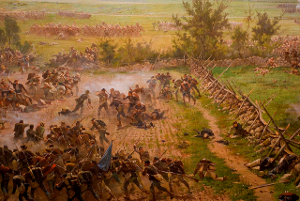
In the Union army there is the fabled Irish Brigade, likely the best known of any brigade organization, organized in 1861 and led by the flamboyant General Thomas Francis Meagher. They go into battle with an emerald green flag with a large golden harp in its center, celebrating their heritage even in the midst of death. The Irish Brigade makes an unusual reputation for dash and gallantry. It belongs to the First Division of the Second Corps and is numbered as the Second Brigade. The Irish Brigade loses over 4,000 men in killed and wounded during the war; more men than ever belong to the brigade at any given time. The Irish Brigade is commanded, in turn, by General Thomas Francis Meagher, Colonel Patrick Kelly (killed), General Thomas A. Smyth (killed), Colonel Richard Byrnes (killed), and General Robert Nugent.

In the North, centers of Irish settlement are Boston and New York, both of which have sizeable Irish neighborhoods. There are major immigration periods in the 1830s, 1840s, and 1850s. The numbers steadily increase until, according to the 1860 census, well over one and a half million Americans claimed to have been born in Ireland. The majority of these live in the North. There are periods of severe economic difficulties both before and after the war when the immigrant Irish are singled out for the distrust and hatred of their fellow Americans. “No Irish Need Apply” is a frequently seen placard sign above the doors of factories, shops, warehouses, and farms.

The Irish are chiefly distrusted because they are Catholic, and there is much opposition in the United States to the Church of Rome. The frustration this prejudice causes leads indirectly to the boil-over of tempers in July 1863, when the first official draft is held. A mob of mostly immigrant laborers gather at the site of the draft lottery, and as names are called and those not wealthy enough to purchase a substitute are required to join up, the mob’s temper flares.

The situation escalates into full-scale rioting. For three days, cities like New York and Boston are caught up in a rampage of looting, burning, and destruction. Many of the rioters are frustrated Irish laborers who cannot get jobs, and their targets are draft officials, as well as free blacks living in the North, who seem able to get jobs that the Irish are denied. It takes the return of armed troops from the fighting at the Battle of Gettysburg to bring the cities back to peace and quiet.

Such events do little to help the image of the Irish in America, until many years after the war. Despite their wartime heroics, many Irish veterans come home to find the same ugly bias they faced before going off to fight for the Union. Many of them choose to go into the post war army.

Still others follow Thomas Meagher into Canada, where they join up in an attempt to free Canada from British domination. Many simply choose to remain in the Eastern cities, hoping matters will improve as time goes by. Eventually things do get better for the Irish, but it is many long years before ugly anti-Irish prejudice fades.


Leave a comment

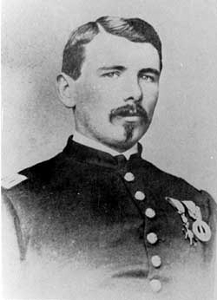
Birth of Myles Walter Keogh, Last Man Killed at the Battle of Little Big Horn

Myles Walter Keogh, soldier in the United States Army, is born in Orchard House in LeighlinbridgeCounty Carlow, on March 25, 1840. It is said by the Sioux that he is the last man killed at the Battle of Little Big Horn, where his horse is the only U.S. survivor.

Keogh attends the National School in Leighlinbridge and is long thought to have attended St. Patrick’s College in Carlow but that college has no record of his attendance. It is possible that he attends St. Mary’s Knockbeg College.

By 1860, a twenty-year-old Keogh volunteers, along with over one thousand of his countrymen, to rally to the defence of Pope Pius IX following a call to arms by the Catholic clergy in Ireland. By August 1860, Keogh is appointed second lieutenant of his unit in the Battalion of St. Patrick, Papal Army under the command of General Christophe Léon Louis Juchault de Lamoricière. Once the fighting is over and duties of the Pontifical Swiss Guard become more mundane, Keogh sees little purpose in remaining in Rome. In March 1862, with civil war raging in America, he resigns his commission in the Company of St. Patrick and sets out for New York City, arriving on April 2.

Keogh actively participates in several prominent American Civil War battles including the Shenandoah Valley, the Battle of Antietam, the Battle of Fredericksburg, and the Battle of Gettysburg.

Perhaps the strongest testimony to Keogh’s bravery and leadership ability comes at the Battle of the Little Bighorn, also known as Custer’s Last Stand, on June 25, 1876. The senior captain among the five companies wiped out with General George Armstrong Custer that day, and commanding one of two squadrons within the Custer detachment, Keogh dies in a “last stand” of his own, surrounded by the men of Company I. When the sun-blackened and dismembered dead are buried three days later, Keogh’s body is found at the center of a group of troopers. The slain officer is stripped but not mutilated, perhaps because of the “medicine” the Indians see in the Agnus Dei (“Lamb of God”) he wears on a chain about his neck or because many of Sitting Bull‘s warriors are believed to be Catholic. Keogh’s left knee has been shattered by a bullet that corresponds to a wound through the chest and flank of his horse, indicating that horse and rider may have fallen together prior to the last rally.

The badly injured animal is found on the fatal battlefield, and nursed back to health as the 7th Cavalry’s regimental mascot, which he remains until his death in 1890. This horse, Comanche, is considered the only U.S. military survivor of the battle, though several other badly wounded horses are found and destroyed at the scene. Keogh’s bloody gauntlet and the guidon of his Company I are recovered by the army three months after Little Bighorn at the Battle of Slim Buttes.

Originally buried on the battlefield, Keogh’s remains are disinterred and taken to Auburn, as he had requested in his will. He is buried at Fort Hill Cemetery on October 26, 1877, an occasion marked by citywide official mourning and an impressive military procession to the cemetery.

Tongue River Cantonment in southeastern Montana is renamed after him to be Fort Keogh. The fort is first commanded by Nelson A. Miles. The 55,000-acre fort is today an agricultural experiment station. Miles City, Montana is located two miles from the old fort.


Leave a comment

Birth of Engineer John Philip Holland

john-philip-holland

John Philip Holland, Irish engineer who develops the first submarine to be formally commissioned by the U.S. Navy, and the first Royal Navy submarine, HMS Holland 1, is born on February 24, 1841.

Holland, the second of four siblings, all boys, is born in a coastguard cottage in Liscannor, County Clare, where his father, John Philip Holland, Sr., is a member of the British Coastguard Service. His mother, a native Irish speaker from Liscannor, Máire Ní Scannláin, is John Holland’s second wife. His first wife, Anne Foley Holland, believed to be a native of Kilkee, dies in 1835. The area is heavily Irish-speaking and Holland learns English properly only when he attends the local English-speaking St. Macreehy’s National School, and from 1858, in the Christian Brothers in Ennistymon.

Holland joins the Irish Christian Brothers in Limerick and teaches in CBS Sexton Street in Limerick and many other centres in the country, including North Monastery CBS in Cork, St. Joseph’s CBS in Drogheda, and as the first Mathematics teacher in Coláiste Rís in Dundalk. Due to ill health, he leaves the Christian Brothers in 1873 and emigrates to the United States. Initially working for an engineering firm, he returns to teaching again for an additional six years in St. John’s Catholic school in Paterson, New Jersey.

While a teacher in Cork, Holland reads an account of the battle between the ironclads USS Monitor and USS Merrimack in the Battle of Hampton Roads during the American Civil War. He realizes that the best way to attack such ships would be through an attack beneath the waterline. He draws a design, but when he attempts to obtain funding, he is turned away. After his arrival in the United States, Holland slips and falls on an icy Boston street and breaks a leg. While recuperating from the injury in a hospital, he uses his time to refine his submarine designs and is encouraged by a priest, Isaac Whelan.

In 1875, his first submarine designs are submitted for consideration by the U.S. Navy, but are turned down as unworkable. The Fenians, however, continue to fund Holland’s research and development expenses at a level that allows him to resign from his teaching post. In 1881, Fenian Ram is launched, but soon after, Holland and the Fenians part company on bad terms over the issue of payment within the Fenian organization, and between the Fenians and Holland. The submarine is now preserved at Paterson Museum in New Jersey.

Holland continues to improve his designs and works on several experimental boats, prior to his successful efforts with a privately built type, launched on May 17, 1897. This is the first submarine having power to run submerged for any considerable distance, and the first to combine electric motors for submerged travel and gasoline engines for use on the surface. The submarine is purchased by the U.S. Navy on April 11, 1900, after rigorous tests and is commissioned on October 12, 1900 as USS Holland (SS-1). Six more of her type are ordered and built at the Crescent Shipyard in Elizabeth, New Jersey. The company that emerges from under these developments is called The Electric Boat Company, founded on February 7, 1899. Isaac Leopold Rice becomes the company’s first President with Elihu B. Frost acting as vice president and chief financial officer. The company eventually evolves into the major defense contractor General Dynamics.

The USS Holland design is also adopted by others, including the Royal Navy in developing the Holland-class submarine. The Imperial Japanese Navy employs a modified version of the basic design for their first five submarines, although these submarines are at least 10 feet longer at about 63 feet. These submarines are also developed at the Fore River Ship and Engine Company in Quincy, Massachusetts. Holland also designs the Holland II and Holland III prototypes. The Royal Navy ‘Holland 1’ is on display at the Submarine Museum in Gosport, England.

After spending 56 of his 73 years working with submersibles, John Philip Holland dies on August 12, 1914 in Newark, New Jersey. He is interred at the Holy Sepulchre Cemetery in Totowa, New Jersey.


Leave a comment

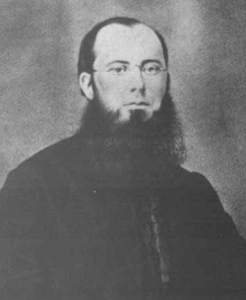
Death of John O’Mahony, Founder of the Fenian Brotherhood

john-omahony

John Francis O’Mahony, Gaelic scholar and the founding member of the Fenian Brotherhood in the United States, sister organisation to the Irish Republican Brotherhood, dies in New York City on February 7, 1877.

O’Mahony is born in 1816 in Kilbeheny, County Limerick. His father and uncle were members of the Society of United Irishmen and took part in the Irish Rebellion of 1798. On the death of an elder brother, he inherits a property which yields £300 per annum. He enters Trinity College, Dublin, where he studies Sanskrit, Hebrew, and Irish. He becomes an accomplished Gaelic scholar, and later teaches Greek and Latin, and contributes articles to Irish and French journals. He leaves Trinity without getting a degree.

In 1843, O’Mahony joins Daniel O’Connell‘s movement for the Repeal of the Acts of Union 1800, but quickly becomes dissatisfied with the lack of progress and joins the Young Ireland movement which William Smith O’Brien leads and takes part in the failed Young Ireland Rebellion of 1848. His participation in the rebellion obligates him to leave Ireland, and he settles for a time in Paris, where he lives in great poverty. In 1854, he joins John Mitchel in New York City, and takes part in the Emigrant Aid Association, the Emmet Monument Association, and other Irish organisations.

In 1857, O’Mahony publishes History of Ireland, by Geoffrey Keating, D. D., translated from the Original Gaelic, and Copiously Annotated (New York, 1857). O’Mahony’s notes are copied from John O’Donovan‘s translations of Annals of the Four Masters, and it is on this ground that Hodges & Smith procures an injunction against the sale of the book in the United Kingdom. The mental strain to which O’Mahony is subjected in the preparation of this work, which brings him no pecuniary gain, affects his reasoning and he is removed by his friends for a short time to a lunatic asylum.

In 1860, O’Mahony organises the Fenian Brotherhood, also known as the Irish Republican Brotherhood. The object of the association is to secure the freedom of Ireland. The name is probably derived from O’Mahony’s Gaelic studies, the Fenians having been a military body in pagan Ireland, celebrated in the songs of Ossian. The organisation of the new society is completed at conventions that are held in Chicago in 1864 and in Cincinnati in January 1865.

At the time of the Cincinnati convention, O’Mahony holds the rank of colonel of the 69th Regiment of New York State Militia, recruited mainly from the ranks of the Brotherhood, which has also furnished a large proportion of Thomas Francis Meagher‘s Irish Brigade, Michael Corcoran‘s legion, and Irish regiments engaged in the American Civil War. The rapid growth in membership of the Fenian Brotherhood renders it impossible for O’Mahony to retain the colonelcy of the 69th regiment, which he has held for some time. He resigns in order to give all his attention to the spread of Fenianism.

The close of the civil war in the spring of 1865 gives a great impetus to the Fenians, owing to the number of Irish American soldiers that are disbanded and anxious to see service elsewhere. Money pours into the Fenian exchequer. Many differences occur between O’Mahony and James Stephens and the Central Council relative to the policy to be pursued for the attainment of their object, but O’Mahony remains president of the organisation for several years. He does not take any part personally in the attempted insurrection in Ireland or in the raids on Canada, although his advice counts for much in these enterprises.

He devotes the last years of his life to literary pursuits, but suffers from ill health, and he has a hard struggle to secure the bare means for subsistence. However, visionary may have been his objectives, he is honest, and although thousands have passed through his hands, he is often at a loss for a dollar. When his poverty is discovered, he declines to receive assistance in any form. He dies in New York City on February 7, 1877, and soon after his death his remains are returned to Ireland and interred with the honors of a public funeral in Glasnevin Cemetery in Dublin.


Leave a comment

Birth of John B. Bannon, Irish Catholic Jesuit Priest

john-bannon

John B. Bannon, Irish Catholic Jesuit priest who serves as a Confederate chaplain during the American Civil War, is born in Roosky, County Roscommon, on December 29, 1829. He is also renowned as an orator.

Bannon is born to James Bannon, a Dublin grain dealer, and Fanny Bannon (née O’Farrell). He goes to the vincentian Castleknock College in Dublin. In 1846 he goes to study for the priesthood at St. Patrick’s Pontifical University, Maynooth, in the minor seminary until 1850 and completing his theology course in 1853. He is ordained on June 16, 1853, by Archbishop Paul Cullen for the Dublin Diocese. He soon applies to move to America.

Shortly after ordination he moves to the Archdiocese of St. Louis, Missouri. He becomes pastor to St. John the Apostle and Evangelist Church which he builds in 1858. He serves in the First Missouri Confederate Brigade, during the American Civil War. He ministers at the battles of Corinth, Fort Gibson, and at Big Black River Bridge, Vicksburg.

He is detained on July 4, 1863, when Vicksburg surrenders. After being released by Union forces, he goes to Richmond, Virginia in August 1863, where Jefferson Davis and Secretary of State Judah Benjamin ask him to go to Ireland to discourage recruitment for the Federal forces and try to get international help for the Confederacy.

In November 1863, Bannon returns to Ireland, writing and pamphleting to discourage people from emigrating and joining the Union side of the civil war. He makes two trips to Rome to try, unsuccessfully, to get the Vatican to side with the Confederacy. Following the American Civil War, he is banned from preaching in St. Louis, and stays in Ireland, becoming a Jesuit in 1865, spending some time in Milltown Park, Tullabeg College, and in Gardiner Street.

Bannon dies on July 14, 1913, in Upper Gardiner Street, and is buried in the Jesuit plot at Glasnevin Cemetery, Dublin.


2 Comments

Birth of Patrick Henry Jones, Postmaster of New York City

patrick-henry-jones

Patrick Henry Jones, American lawyer, public servant, and Postmaster of New York City during the mid-to late 19th century, is born on November 20, 1830, in County Westmeath.

Jones attends grammar school in Dublin for three years until emigrating with his family to the United States in 1840. They settle on a farm in Cattaraugus County, New York where Jones spends most of his childhood. Because of his poor background, he receives only a limited education at the Union School in Ellicottville. In 1850, the 20-year-old Jones becomes involved in journalism and travels as a correspondent throughout the Western States for a leading New York journal. He later becomes the local editor for the Buffalo Republic and one of the editors of the Buffalo Sentinel.

Eventually, Jones decides to pursue a career in law and later studies under the firm of Addison Rice. He is admitted to the bar in 1856 and afterwards practices law with Addison in Ellicottville as a full partner. By 1860, he has established himself as one of the most prominent lawyers in western New York. A lifelong Democrat, he becomes disillusioned by the party’s support of Southern succession from the Union and, in May 1861, decides to join the military in defense of the United States.

Upon the outbreak of the American Civil War, Jones readily joins the Union Army. On July 7, 1861, he enlisted with the 37th New York Volunteers, popularly known as the “Irish Rifles”, under Colonel John H. McCunn. Jones has a successful career serving in the Union Army, being involved in thirty major battles and countless skirmishes, and reaching the rank of brigadier general. He remains at that rank for the rest of the war and resigns on June 17, 1865. He is one of ten Irish Americans to become brigade commanders and one of four Irish-born officers to become a divisional commander.

After his resignation, Jones resumes his law practice in Ellicottville and in November 1865 is elected on the Republican ticket as Clerk of the New York Court of Appeals. On August 13, 1868, Jones is appointed by Gov. Reuben E. Fenton as Register of New York City to fill the vacancy resulting from the death of Charles G. Halpine. On April 1, 1869, Jones is appointed by President Ulysses S. Grant as Postmaster of New York City. From 1875 to 1877, Jones is again Register of New York City, elected in November 1874 on the Republican ticket. Afterwards he resumes his private practice.

In 1878, Jones is involved in the Alexander T. Stewart bodysnatching case when he is contacted by the kidnappers to act as an intermediary between themselves and the Stewart estate. When negotiations stall between the Stewart family’s lawyer Henry Hilton, he assists Stewart’s widow in negotiating for the return of her husband’s body.

Jones suffers serious medical problems in his old age, specifically deafness and chronic diarrhea, which his physician blames on his exposure to artillery fire and his time in the swamps along the Chickahominy River during his military service. He also suffered from constant pain in his right sciatic nerve, attributed to his old war wound suffered at Chancellorsville, as well as his wound in the gluteal region.

In early July 1900, Jones begins suffering from severe gastroenteritis. His condition does not respond to therapeutic treatments as he loses control of his bowels and is unable to keep down solid food, living on scalded milk and brandy. On July 18, 1900, Jones dies from cardiac failure, indirectly caused by his gastroenteritis, at his home in Port Richmond, New York. His funeral is held at St. Mary’s Church two days later and he is buried in St. Peter’s Cemetery.


Leave a comment

Birth of Actor Richard Harris

richard-harris

Richard St. John Harris, actor, singer, songwriter, producer, director, and writer, is born in Limerick, County Limerick, on October 1, 1930. He is brought up in a middle class and staunchly Roman Catholic family.

Harris is schooled by the Jesuits at Crescent College. He is a talented rugby player; however, his athletic career is cut short when he comes down with tuberculosis in his teens. After recovering from tuberculosis, Harris moves to Britain, wanting to become a director. Unable to find any suitable training courses, he enrolls in the London Academy of Music and Dramatic Art (LAMDA) to learn acting.

Harris makes his film debut in 1958 in the film Alive and Kicking and plays the lead role in The Ginger Man in the West End in 1959. Harris’ first starring role is in the film This Sporting Life (1963), as a bitter young coal miner, Frank Machin, who becomes an acclaimed rugby league football player. For his role, Harris wins Best Actor in 1963 at the Cannes Film Festival and an Academy Award nomination. He also wins notice for his role in Sam Peckinpah‘s Major Dundee (1965), as an Irish immigrant who becomes a Confederate cavalryman during the American Civil War.

Harris performs the role of King Arthur in the film adaptation of the musical play Camelot (1967). He continues to appear on stage in this role for many years, including a successful Broadway run in 1981–1982. In 1970 British exhibitors vote him the 9th most popular star at the UK box office.

Other film performances follow, among them a role as a reluctant police informant in the coal-mining tale The Molly Maguires (1970), also starring Sean Connery. Harris stars in Cromwell (1970), a film based on the life of Oliver Cromwell who leads the Parliamentary forces during the English Civil War and, as Lord Protector, ruled Great Britain and Ireland in the 1650s.

Harris’ film career collapses after the late 1970s and in the next decade he is rarely seen on screen, although he continues to act on stage. During his career Harris appears in two films which win the Academy Award for Best Picture. First, as the gunfighter “English Bob” in the Western Unforgiven (1992); second, as the Roman Emperor Marcus Aurelius in Ridley Scott‘s Gladiator (2000).

Harris is diagnosed with Hodgkin’s disease in August 2002, reportedly after being hospitalised with pneumonia. He dies at University College Hospital in Fitzrovia, London on October 25, 2002, at the age of 72. He was in a coma in his final three days. Harris’ body is cremated, and his ashes are scattered in the Bahamas, where he had owned a home.


Leave a comment

Death of Patrick Sarsfield Gilmore, Composer & Bandmaster

patrick-sarsfield-gilmore

Patrick Sarsfield Gilmore, Irish-born American composer and bandmaster, dies in St. Louis, Missouri, on September 24, 1892. He lives and works in the United States after 1848. While serving in the Union Army during the American Civil War, Gilmore writes the lyrics to the song When Johnny Comes Marching Home, the tune taken from the old Irish antiwar folk song, Johnny I Hardly Knew Ye. This is published under the name Louis Lambert.

Gilmore is born in Ballygar, County Galway, on December 25, 1829. He starts his music career at age fifteen and spends time in Canada with an English band. Already a fine cornet player, he settles in Boston, Massachusetts in 1848, becoming leader of the Suffolk, Boston Brigade, and Salem bands in swift succession. He also works in the Boston music store of John P. Ordway and founds Ordway’s Aeolians, a group of blackface minstrels. With the Salem Band, Gilmore performs at the 1857 inauguration of President James Buchanan.

In 1858, Gilmore founds “Gilmore’s Band,” and at the outset of the American Civil War the band enlists with the 24th Massachusetts Volunteers, accompanying General Ambrose Burnside to North Carolina. After the temporary discharge of bands from the field, Governor John Albion Andrew of Massachusetts entrusts Gilmore with the task of re-organizing military music-making. General Nathaniel P. Banks creates him Bandmaster-general.

When the war ends, Gilmore is asked to organize a celebration, which takes place in New Orleans. That success emboldens him to undertake two major music festivals in Boston, the National Peace Jubilee in 1869 and the World’s Peace Jubilee and International Musical Festival in 1872. These feature monster orchestras of massed bands with the finest singers and instrumentalists, including the only American appearance by “waltz king” Johann Strauss II, and cements Gilmore’s reputation as the leading musical figure of the age. Coliseums are erected for the occasions, holding 60- and 120,000 persons. Grateful Bostonians present Gilmore with medals and cash, but in 1873 he moves to New York City, as bandmaster of the 22nd Regiment. Gilmore takes this band on acclaimed tours of Europe.

On September 24, 1892, back in the United States preparing an 1892 musical celebration of the quadricentennial anniversary of Christopher Columbus‘ voyage of discovery, Gilmore collapses and dies in St. Louis. He is buried in Calvary Cemetery, Queens, New York, where his wife is later interred.

In many ways Gilmore can be seen as the principal figure in 19th-century American music. He holds the first “Promenade Concert in America” in 1855, the forerunner to today’s Boston Pops. He sets up “Gilmore’s Concert Garden,” which becomes Madison Square Garden. He is the Musical Director of the Nation in effect, leading the festivities for the 1876 Centennial celebrations in Philadelphia and the dedication of the Statue of Liberty in 1886. In 1888 he starts the tradition of seeing in the New Year in Times Square.

Patrick Sarsfield Gilmore is inducted into the Songwriters Hall of Fame in 1970.


Leave a comment

Death of General Philip Henry Sheridan

philip-sheridan

Irish American General Philip Henry Sheridan, career United States Army officer and a Union general in the American Civil War, dies of heart disease in Dartmouth, Massachusetts, on August 5, 1888.

Sheridan is born in Albany, New York, the third child of six by John and Mary Meenagh Sheridan, immigrants from the parish of Killinkere, County Cavan. Fully grown, he reaches only 5 feet 5 inches in height, a stature that leads to the nickname “Little Phil.” Abraham Lincoln describes his appearance in a famous anecdote, “A brown, chunky little chap, with a long body, short legs, not enough neck to hang him, and such long arms that if his ankles itch, he can scratch them without stooping.”

Sheridan’s career is noted for his rapid rise to major general and his close association with General-in-chief Ulysses S. Grant, who transfers Sheridan from command of an infantry division in the Western Theater to lead the Cavalry Corps of the Army of the Potomac in the East. In 1864, he defeats Confederate forces in the Shenandoah Valley and his destruction of the economic infrastructure of the Valley, called “The Burning” by residents, is one of the first uses of scorched earth tactics in the war. In 1865, his cavalry pursues General Robert E. Lee and is instrumental in forcing his surrender at Appomattox Court House.

In later years, Sheridan fights in the Indian Wars of the Great Plains. Comanche Chief Tosahwi reputedly tells Sheridan in 1869, “Me, Tosahwi; me good Injun,” to which Sheridan supposedly replies, “The only good Indians I ever saw were dead.” Sheridan denies he had ever made the statement. Biographer Roy Morris Jr. states that, nevertheless, popular history credits Sheridan with saying “The only good Indian is a dead Indian.” This variation “has been used by friends and enemies ever since to characterize and castigate his Indian-fighting career.” In Bury My Heart at Wounded Knee, Dee Brown attributes the quote to Sheridan but does not provide documentation to support his contention, so the quote may be more apocryphal than real.

Both as a soldier and private citizen, Sheridan is instrumental in the development and protection of Yellowstone National Park. The protection of the Yellowstone area is Sheridan’s personal crusade. He authorizes Lieutenant Gustavus Doane to escort the Washburn Expedition in 1870 and for Captain John W. Barlow to escort the Hayden Expedition in 1871. Barlow names Mount Sheridan, a peak overlooking Heart Lake in Yellowstone, for the general in 1871. As early as 1875, Sheridan promotes military control of the area to prevent the destruction of natural formations and wildlife.

In 1883, Sheridan is appointed general-in-chief of the U.S. Army, and in 1888 he is promoted to the rank of General of the Army during the term of President Grover Cleveland. Sheridan serves as the ninth president of the National Rifle Association.

Sheridan suffers a series of massive heart attacks two months after sending his memoirs to the publisher. After his first heart attack, the U.S. Congress quickly passes legislation to promote him to general and he receives the news from a congressional delegation with joy, despite his pain. His family moves him from the heat of Washington, D.C. and he dies of heart failure in his summer cottage in the Nonquitt section of Dartmouth, Massachusetts.

His body is returned to Washington, and he is buried on a hillside facing the capital city near Arlington House in Arlington National Cemetery. The burial helps elevate Arlington to national prominence.


Leave a comment

Birth of War Reporter William Howard Russell

william-howard-russell

Sir William Howard Russell, reporter with The Times and considered to be one of the first modern war correspondents, is born at Lily Vale, Tallaght, County Dublin, on March 28, 1820.

As a young reporter, Russell reports on a brief military conflict between Prussian and Danish troops in Denmark in 1850. Sent by editor John Delane to Malta in 1854 to cover British support for the Ottoman Empire against Russia, Russell despises the term “war correspondent” but his coverage of the conflict brings him international renown. Florence Nightingale later credits her entry into wartime nursing to his reports. The Crimean medical care, shelter, and protection of all ranks by Mary Seacole is also publicised by Russell and by other contemporary journalists, rescuing her from bankruptcy.

Russell is described by one of the soldiers on the frontlines as “a vulgar low Irishman, who sings a good song, drinks anyone’s brandy and water, and smokes as many cigars as a Jolly Good Fellow. He is just the sort of chap to get information, particularly out of youngsters.” This reputation leads to Russell being blacklisted from some circles, including British commander Lord Raglan who advises his officers to refuse to speak with the reporter.

His dispatches are hugely significant. For the first time the public is able to read about the reality of warfare. Shocked and outraged, the public’s backlash from his reports leads the Government to re-evaluate the treatment of troops and lead to Florence Nightingale’s involvement in revolutionising battlefield treatment.

On September 20, 1854, Russell covers the battle above the Alma River. The story, written in the form of a letter to Delane, is supportive of the British troops though pays particular attention to the battlefield surgeons’ “humane barbarity” and the lack of ambulance care for wounded troops. He later covers the Siege of Sevastopol.

Following Russell’s reports of the appalling conditions suffered by the Allied troops conducting the siege, including an outbreak of cholera, Samuel Morton Peto and his partners build the Grand Crimean Central Railway, which is a major factor leading to the success of the siege. Russell leaves Crimea in December 1855.

In 1856, Russell is sent to Moscow to describe the coronation of Tsar Alexander II and in the following year is sent to India where he witnesses the final re-capture of Lucknow.

In 1861, Russell goes to Washington, returning to England in 1863. In July 1865, he sails on the SS Great Eastern to document the laying of the Transatlantic Telegraph Cable and writes a book about the voyage with color illustrations by Robert Dudley. He publishes diaries of his time in India, the American Civil War, and the Franco-Prussian War, where he describes the warm welcome given him by English-speaking Prussian generals such as Leonhard Graf von Blumenthal.

He is awarded the title of Commander of the Royal Victorian Order by King Edward VII. Russell later accuses fellow war correspondent Nicholas Woods of the Morning Herald of lying in his articles about the war to try to improve his stories.

In the 1868 General Election, Russell runs unsuccessfully as a Conservative candidate for the borough of Chelsea. He retires as a battlefield correspondent in 1882 and founds the Army and Navy Gazette. He is knighted in May 1895.

Russell dies on February 11, 1907, and is buried in Brompton Cemetery, London.