seamus dubhghaill

Promoting Irish Culture and History from Little Rock, Arkansas, USA


Leave a comment

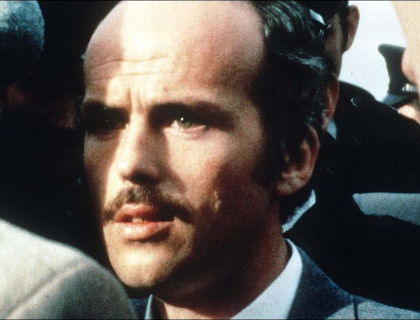
Birth of Johnny Adair, Northern Irish Loyalist

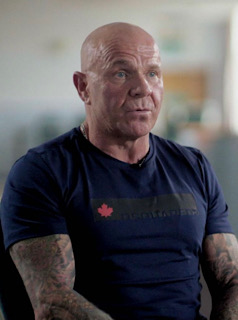
Johnny Adair, leader of “C Company” of the Ulster Loyalist paramilitary organisation Ulster Freedom Fighters (UFF), a cover name of the Ulster Defence Association, is born in Belfast, Northern Ireland, on October 27, 1963. He is known as Mad Dog. He is expelled from the organisation in 2002 following a violent power struggle. Since 2003, he, his family and a number of supporters have been forced to leave Northern Ireland by other loyalists.

Adair is born into a working class loyalist background and raised in Belfast. He grows up in the Lower Oldpark area, a site of many sectarian clashes during “The Troubles.” By all accounts, he has little parental supervision, and does not attend school regularly. He takes to the streets, forming a skinhead street gang with a group of young loyalist friends, who “got involved initially in petty, then increasingly violent crime.” Eventually, he starts a rock band called Offensive Weapon, which during performances espouses support for the British National Front.

While still in his teens, Adair joins the Ulster Young Militants (UYM), and later the Ulster Defence Association, a loyalist paramilitary organisation which also calls itself the Ulster Freedom Fighters.

By the early 1990s, Adair has established himself as head of the UDA/UFF’s “C Company” based on the Shankill Road. When he is charged with terrorist offences in 1995, he admits that he had been a UDA commander for three years up to 1994. During this time, he and his colleagues are involved in multiple and random murders of Catholic civilians. At his trial in 1995, the prosecuting lawyer says he is dedicated to his cause against those whom he “regarded as militant republicans – among whom he had lumped almost the entire Roman Catholic population.” Royal Ulster Constabulary (RUC) detectives believe his unit killed up to 40 people during this period.

Adair once remarks to a Catholic journalist from the Republic of Ireland upon the discovery of her being Catholic, that normally Catholics travel in the boot of his car. According to a press report in 2003, he is handed details of republican suspects by British Army intelligence, and is even invited for dinner in the early 1990s. In his autobiography, he claims he was frequently passed information by sympathetic British Army members, while his own whereabouts were passed to republican paramilitaries by the RUC Special Branch, who, he claims, hated him.

The Provisional Irish Republican Army (IRA) bombing of a fish shop on the Shankill Road in October 1993 is an attempt to assassinate Adair and the rest of the UDA’s Belfast leadership in reprisal for attacks on Catholics. The IRA claims that the office above the shop is regularly used by the UDA for meetings and one is due to take place shortly after the bomb is set to explode. The bomb goes off early, killing one IRA man, Thomas Begley, and nine Protestant civilians. The UFF retaliates with a random attack on the Rising Sun bar in Greysteel, County Londonderry, which kills eight civilians, two of whom are Protestants. Adair survives 13 assassination attempts, most of which are carried out by the IRA and Irish National Liberation Army (INLA).

During this time, undercover officers from the Royal Ulster Constabulary record months of discussions with Adair, in which he boasts of his activities, producing enough evidence to charge him with directing terrorism. He is convicted and sentenced to 16 years in HM Prison Maze. In prison, according to some reports, he sells drugs such as cannabis, ecstasy tablets and amphetamines to other loyalist prisoners, earning him an income of £5000 a week.

In January 1998, Adair is one of five loyalist prisoners visited in the prison by British Secretary of State for Northern Ireland, Mo Mowlam. She persuades them to drop their objection to their political representatives continuing the talks that leads to the Good Friday Agreement in April. In 1999, he is released early as part of a general amnesty for political prisoners after the Agreement.

Following his release, much of Adair’s activities are bound up with violent internecine feuds within the UDA and between the UDA and other loyalist paramilitary groupings. The motivation for such violence is sometimes difficult to piece together. It involves a combination of political differences over the loyalist ceasefires, rivalry between loyalists over control of territory and competition over the proceeds of organised crime.

In 1999, shortly after his release from prison, Adair is shot at and grazed in the head by a bullet at a UB40 concert in Belfast. He blames the shooting on republicans, but it is thought that rival loyalists are to blame.

In August 2000, Adair is again mildly injured by a pipe bomb he is transporting in a car. He again attempts to blame the incident on an attack by republicans, but this claim is widely discounted. A feud breaks out at the time between the UDA and the Ulster Volunteer Force (UVF) leaving several loyalists dead. As a result of Adair’s involvement in the violence, the then Secretary of State for Northern Ireland, Peter Mandelson, revokes his early release and returns him to prison.

In May 2002, Adair is released from prison again. Once free, he is a key part of an effort to forge stronger ties between the UDA/UFF and the Loyalist Volunteer Force (LVF), a small breakaway faction of the UVF loyalist paramilitary organization in Northern Ireland. The most open declaration of this is a joint mural depicting Adair’s UDA “C company” and the LVF. Other elements in the UDA/UFF strongly resist these movements, which they see as an attempt by Adair to win external support in a bid to take over the leadership of the UDA. Some UDA members dislike his overt association with the drugs trade, with which the LVF are even more heavily involved. A loyalist feud begins, and ends with several men dead and scores evicted from their homes.

On September 25, 2002, Adair is expelled from the UDA/UFF along with close associate John White, and the organisation almost splits as Adair tries to woo influential leaders such as Andre Shoukri, who are initially sympathetic to him. There are attempts on Adair’s and White’s lives.

Adair returns to prison in January 2003, when his early release licence is revoked by Secretary of State for Northern Ireland, Paul Murphy, on grounds of engaging in unlawful activity. On February 1, 2003, UDA divisional leader John Gregg is shot dead along with another UDA member, Rab Carson, on returning from a Rangers F.C. match in Glasgow. The killing is widely blamed on Adair’s C Company as Gregg is one of those who organised his expulsion from the UDA. Five days later, on February 6, about twenty Adair supporters, including White, flee their homes for Scotland, widely seen as a response to severe intimidation.

Adair is released from prison again on January 10, 2005. He immediately leaves Northern Ireland and joins his family in Bolton, Lancashire, where it is claimed he stays with supporters of Combat 18 and the Racial Volunteer Force.

The police in Bolton question Adair’s wife, Gina, about her involvement in the drugs trade, and his son, nicknamed both “Mad Pup” and “Daft Dog,” is charged with selling crack cocaine and heroin. Adair is arrested and fined for assault and threatening behaviour in September 2005. He had married Gina Crossan, his partner for many years and the mother of his four children, at HM Prison Maze on February 21, 1997. She is three years Adair’s junior and grew up in the same Lower Oldpark neighbourhood. 

After being released, Adair is almost immediately arrested again for violently assaulting Gina, who suffers from ovarian cancer. Since this episode he reportedly moves to Scotland, living in Troon in Ayrshire.

In May 2006, Adair reportedly receives £100,000 from John Blake publishers for a ghost-written autobiography.

In November 2006, the UK’s Five television channel transmits an observational documentary on Adair made by Dare Films.

Adair appears in a documentary made by Donal MacIntyre and screened in 2007. The focus of the film centers around Adair and another supposedly reformed character, a Neo-Nazi from Germany called Nick Greger, and their trip to Uganda to build an orphanage. Adair is seen to fire rifles, stating it is the first time he has done so without wearing gloves. He also admits to being “worried sick” and “pure sick with worry” after Greger disappears in Uganda for days on end. It turns out that he had gone off and married a Ugandan lady. Adair confesses via telephone that he “thought something might have happened to Nick.”

On July 20, 2015, three Irish republicans, Antoin Duffy, Martin Hughes and Paul Sands, are found guilty of planning to murder Adair and Sam McCrory. Charges against one of the accused in the trial are dropped on July 1.

On September 10, 2016, Adair’s son, Jonathan Jr., is found dead in Troon, aged 32. He dies from an accidental overdose while celebrating the day after his release from prison for motoring offences. He had been in and out of prison since the family fled Northern Ireland. He served a five-year sentence for dealing heroin and crack cocaine. The year before, he had been cleared of a gun raid at a party and in 2012 is the target of a failed bomb plot. He was also facing trial later that year on drugs charges.

In December 2023, while recording a podcast with far-right activist Tommy Robinson, Adair surprisingly expresses a grudging respect for the IRA hunger strikers, describing the manner of their deaths as “dedication at the highest level” for a political cause and admitting that he would not have volunteered to do the same if asked.

Leave a comment

Birth of Billy Wright, Founder of the Loyalist Volunteer Force

William Stephen Wright, known as King Rat, a Northern Irish loyalist paramilitary leader who founds the Loyalist Volunteer Force (LVF) during The Troubles, is born in WolverhamptonEngland, on July 7, 1960.

Wright is a prominent Ulster loyalist paramilitary during the ethno-nationalist conflict in Northern Ireland known as The Troubles. He joins the Ulster Volunteer Force (UVF) in 1975 and becomes commander of its Mid-Ulster Brigade in the early 1990s, taking over from Robin “The Jackal” Jackson. According to the Royal Ulster Constabulary, Wright is involved in the sectarian killings of up to twenty Catholics, although he is never convicted for any. It is alleged that Wright, like his predecessor, serves as a double agent of the British security forces.

Wright attracts considerable media attention at the Drumcree standoff, where he supports the Orange Order‘s desire to march its traditional route through the Catholic/Irish nationalist area of Portadown. In 1994, the UVF and other paramilitary groups call ceasefires. However, in July 1996, Wright’s unit breaks the ceasefire and carries out a number of attacks, including a sectarian killing. For this, Wright and his Portadown unit of the Mid-Ulster Brigade are stood down by the UVF leadership. He is expelled from the UVF and threatened with execution if he does not leave Northern Ireland. Wright ignores the threats and, along with many of his followers, defiantly forms the breakaway Loyalist Volunteer Force (LVF).

In March 1997, Wright is sent to the HM Maze Prison for having threatened the life of a woman. While imprisoned, he continues to direct the LVF’s activities. On December 27 of that year, he is assassinated at the prison by Irish National Liberation Army (INLA) prisoners as he is led out to a van for a visit with his girlfriend. The LVF carries out a wave of sectarian attacks in retaliation.

Owing to his uncompromising stance as an upholder of Ulster loyalism and opposition to the Northern Ireland peace process, Wright is regarded as a cult hero, cultural icon, and martyr figure by hardline loyalists. His image adorns murals in loyalist housing estates and many of his devotees have tattoos bearing his likeness.

Wright’s funeral procession moves at a snail’s pace on a grey and windy day. Groups of mourners take turns carrying the coffin. Women carry a wreath that simply says “Billy.” Twenty men with tight haircuts and white shirts with black armbands flank the cortège. There is heavy security. Troops stand guard on bridges and Royal Ulster Constabulary (RUC) Land Rovers prowl the housing estates. A spotter plane flies overhead. A lone piper plays “Abide with Me” before a banner bearing the letters “LVF.”

Wright is buried at Seagoe Cemetery, Portadown, Northern Ireland.


Leave a comment

Birth of Joe Higgins, Politician & Member of the European Parliament

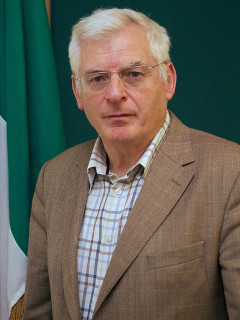
Joe Higgins, a former Socialist Party politician who serves as a Teachta Dála (TD) for the Dublin West constituency from 1997 to 2007 and from 2011 to 2016, is born in Lispole, County Kerry, on May 20, 1949. He serves as a Member of the European Parliament (MEP) for the Dublin constituency from 2009 to 2011.

One of nine children of a small farming family, Higgins goes to school in the Dingle Christian Brothers School, and after finishing he enrolls in the priesthood. As part of his training, he is sent to a Catholic seminary school in Minnesota, United States, in the 1960s. He becomes politicised at the time of anti-Vietnam War protests and the civil rights movement. He is a brother of Liam Higgins, who plays football with the Kerry GAA senior team in the 1960s and 1970s. He is bilingual in English and Irish.

Higgins returns to Ireland and attends University College Dublin (UCD), studying English and French. For several years he is a teacher in several Dublin inner city schools. While at university he joins the Labour Party and becomes active in the Militant Tendency, an entryist Trotskyist group that operates within the Labour Party. Throughout his time in the Labour Party, he is a strong opponent of coalition politics, along with TDs Emmet Stagg and Michael D. Higgins. He is elected to the Administrative Council of the Labour Party by the membership in the 1980s. In 1989, he is expelled alongside 13 other members of Militant Tendency by party leader Dick Spring. The group eventually leaves the party and forms Militant Labour, which becomes the Socialist Party in 1996.

Higgins spends over half his salary on the Socialist Party and causes he supports. He is elected to Dublin County Council in 1991 for the Mulhuddart electoral area and is until 2003 a member of Fingal County Council. In 1996, he campaigns against local authority water and refuse charges and contests the Dublin West by-election, losing narrowly to Brian Lenihan Jnr.

Higgins is first elected to Dáil Éireann at the 1997 Irish general election and re-elected at the 2002 general election. He loses his seat at the 2007 general election but regains it at the 2011 general election. From 2002 to 2007, he is a member of the Technical Group in the Dáil which consists of various independent TDs, Sinn Féin and the Green Party grouped together for better speaking time.

Higgins speaks out against the Iraq War while a TD, and addresses the Dublin leg of the March 20, 2003 International Day of Action. He is also prominent in the successful 2005 campaign to bring Nigerian school student Olukunle Eluhanla back to Ireland after he had been deported. He remains an opponent of the deportation policy.

Higgins uses his platform in the Dáil to raise the issue of exploitation of migrant and guest workers in Ireland. He and others claim that many companies are paying migrants below the minimum wage and, in some cases, not paying overtime rates. He expresses opposition in the Dáil to the jailing of the Rossport Five in July 2005. He raises the outsourcing of jobs by Irish Ferries in the Dáil in November 2005, requesting new legislation to regulate what he describes as “these modern slavers.”

Higgins successfully contests the 2009 European Parliament election for the Dublin constituency, beating two incumbents, Mary Lou McDonald of Sinn Féin and Eoin Ryan of Fianna Fáil, for the third and final seat. He is elected on the same day to Fingal County Council for the Castleknock electoral area, topping the poll. As Irish law prohibits politicians having a dual mandate, he vacates the council seat in July 2009 and is replaced by Matt Waine. He was a member of the European United Left–Nordic Green Left (EUL–NGL) group in the European Parliament, the European Parliament’s Committee on International Trade, and the delegation for relations with the countries of South Asia. He is also a substitute member of the Committee on Employment and Social Affairs, the Committee on Petitions and the delegation for relations with the Mercosur countries. Paul Murphy replaces him as an MEP when he is re-elected to the Dáil in 2011.

Higgins is elected again as TD for Dublin West at the 2011 Irish general election. He wins the third seat (of four) with 8,084 first preference votes. In his first speech in the 31st Dáil, he opposed the nomination of Fine Gael‘s Enda Kenny as Taoiseach. On May 4, 2011, Kenny is forced to apologise to Higgins in the Dáil after falsely accusing him of being a supporter of Osama bin Laden after Higgins offers criticism of his assassination by the CIA. He had asked the Taoiseach, “Is assassination only justified if the target is a reactionary, anti-democratic, anti-human rights obscurantist like bin Laden?”

In the Dáil, Higgins accuses Tánaiste Eamon Gilmore of doing nothing for the 14 Irish citizens being held “incommunicado” by Israel in November 2011. In December 2011, he describes as a disgraceful campaign of intimidation the fines imposed by the government on people who are unable to pay a new household charge brought in as part of the latest austerity budget and says to Enda Kenny that he will be “the new Captain Boycott of austerity in this country.” He asks that Minister for Finance Michael Noonan provide EBS staff with the 13th month end-of-year payment they are being denied.

In September 2012, Higgins publicly disagrees with former Socialist Party colleague Clare Daly, saying it is “unfortunate” that she has resigned from the party, but that it is impossible for Daly under the banner of the Socialist Party to continue to offer political support to Mick Wallace, who is at that time embroiled in scandal.

Higgins announces in April 2014 that he will not contest the next Dáil election. At the time he states his belief that the “baton of elected representation” should be carried by another generation of Socialist Party politicians — like Ruth Coppinger and Paul Murphy.


Leave a comment

Death of Charlie Hurley, OC of the IRA’s 3rd Cork Brigade

Charles Hurley (Irish: Cathal Ó Muirthile), Officer Commanding of the 3rd Cork Brigade (West Cork) of the Irish Republican Army (IRA) during the Irish War of Independence (1919–21), is killed by British Army troops on March 19, 1921. 

Hurley is born in Baurleigh, County Cork, near the village of Kilbrittain, on March 20, 1893, and is educated in the national school and subsequently passes the civil service examinations at age fifteen. According to his brother James, he is one of seven siblings, “born and reared in a farm of 35 acres.”

In his adolescence, Hurley becomes a clerk working for the government. In 1915, he is offered a promotion and a transfer to Haulbowline Island but declines on the grounds that this entails enlisting in the Royal Navy, albeit in a purely administrative role. Returning to Cork, he becomes friends with Liam Deasy who introduces him to the Irish republican movement. In 1917, he takes a job at Castletownbere and it is there that he joins the Irish Volunteers in 1917. He is also a member of Sinn Féin, the Gaelic Athletic Association (GAA) and the Gaelic League (Conradh na Gaeilge).

In 1918, Hurley is sentenced to five years penal servitude for possession of arms and plans of the British military fortifications at Bere Island. However, he is released in 1919 following a hunger strike. In the same year, his brother Willie, also an IRA Volunteer, dies of typhoid fever. He first becomes vice-commandant of the Volunteers or IRA Bandon Battalion and then in August 1920, after the arrest and imprisonment of Tom Hales, he becomes commander of the Third Cork Brigade of the IRA. One of his most important decisions is to establish a full-time guerrilla unit or flying column, under Tom Barry.

The 3rd Cork Brigade (also known as the West Cork Brigade) goes on to be one of the most active IRA units during the guerrilla war against the British in 1919–21. According to Barry, Hurley leads an ambush of the Royal Irish Constabulary (RIC) at Ahawadda in April 1920, killing three policemen, wounding one and taking their arms and ammunition. In July of that same year, he leads a successful attack on the Coastguard station at Howes Strand, capturing a large number of weapons and ammunition. Barry remarks that Hurley is “a remarkable man and a lovable personality” and “continually urged a fighting army policy.” 

Hurley is present at the Tooreen ambush in October 1920 and subsequently is part of an assassination attempt on a judge who gives “harsh sentences” to IRA members. From December 1920 until January 1921, he takes command of the 3rd Cork Brigade’s flying column while Barry is ill. He also tours IRA units to assess the impact of the decree of excommunication on the guerrilla movement issued by Catholic Bishop of Cork, Daniel Cohalan.

In February 1921, Hurley leads the disastrous Upton train ambush on February 15, 1921, an attack on a train carrying British troops. In the action, the attacking IRA party is heavily outnumbered and the firefight results in three IRA men and six civilians being killed. He is also badly wounded in the face and ankle. Barry writes of the aftermath of the ambush that “he (Hurley) mourned deeply for his dead comrades and for the dead civilians, whom he did not know.”

Hurley is killed in action by British troops just before the Crossbarry ambush on March 19, 1921. He is staying in a house with a pro-republican family, where he is recuperating from the serious wounds he had received at Upton a month earlier. When he realises that he is surrounded by the British forces, he flees the house, as Barry comments in his book, to reduce the danger to those in the house, and is shot dead by pursuing troops. Barry remarks that he “died in the manner in which we expected.” 

The British Army places Hurley’s body at the workhouse in Bandon. However, members of Cumann na mBan surreptitiously take his body and he is given a secret republican funeral in Clogagh. A local ballad exists that commemorates him. In addition, the Gaelic Athletic Association grounds in Bandon is named after him in 1971.


Leave a comment

The Murder of Dominic “Mad Dog” McGlinchey

Dominic “Mad Dog” McGlinchey, Irish republican paramilitary leader who moves from the Provisional Irish Republican Army (IRA) to become head of the Irish National Liberation Army (INLA) paramilitary group in the early 1980s and self-confesses participation in more than thirty killings, dies in a hail of bullets while making a phone call in Drogheda, County Louth, on February 10, 1994. No one is ever convicted of his murder.

McGlinchey is one of eleven siblings born into a staunchly republican home in Ballyscullion Road, Bellaghy, in rural south County Londonderry, Northern Ireland. His father owns a garage and some of his father’s police customers later die at McGlinchey’s hands. His mother Monica is a devout Catholic. He is educated at the local school. When he was sixteen, he begins an apprenticeship in his father’s garage. About this time, he is joining the numerous civil rights marches that are taking place in the county. His precise reasons for doing so are unclear, but speculation is that he is reacting to events around him and the idea of participating in marches offers glamour and a close identification with his own community.

In 1971, McGlinchey is interned without charge for ten months in Long Kesh Detention Centre. Not long after his release the following year, he is imprisoned again on arms charges. On July 5, 1975, during his imprisonment, he marries Mary O’Neil, daughter of Patrick O’Neil from Toomebridge. Together they have three children.

Following his release, McGlinchey joins Ian Milne and future Provisional IRA hunger strikers Francis Hughes and Thomas McElwee and wages a campaign of shooting and bombing throughout the county and beyond. Together, they later join the Provisional IRA. The gang spends the late 1970s on the run, carrying out operations and evading both the British Army and the Garda Síochána. Following a mailvan robbery, the latter force arrests McGlinchey in County Monaghan in 1977 for carjacking a Garda patrol vehicle and threatening the officer with a pistol, although he claims that the gun is actually a wheel brace. He fails to make bail at Dublin‘s Special Criminal Court after a Garda Superintendent argues that McGlinchey would fail to attend court if bailed. He is convicted and sent to the maximum-security Portlaoise Prison. In 1982, while serving his prison sentence, he clashes with the prison’s IRA leadership and is either expelled by them for indiscipline or leaves the organisation due to strategic differences.

Following his departure from the IRA and his release from prison, McGlinchey joins the INLA. Due to his experience, he rises through the ranks, becoming chief of staff by 1982. Under his leadership, the INLA, which had previously had a reputation for disorganisation, becomes extremely active in cross-border assassinations and bombings. These include many individual assassinations and woundings, but also massacres such as the Droppin Well bombing of 1982 in which both civilians and soldiers die. There are some failed operations, and McGlinchey, who believes this is the result of an informer within the ranks, devotes much time and energy to finding the cause. Those suspected of betraying the organisation are treated brutally, often by McGlinchey personally. As a result of this resurgence of activity and his high profile, the press nicknames him “Mad Dog.” Under his tenure the Darkley massacre is carried out, ostensibly by another group but using a weapon supplied by McGlinchey. In late 1983, while still on the run, he gives an interview with the Sunday Tribune newspaper in which he condemns the Darkley killings but also lays out his political philosophy and plans for the future.

By 1984, McGlinchey has fallen out with members of a powerful Republican family from South Armagh over what he considers missing funds. Men loyal to this family are subsequently killed by McGlinchey’s unit, which includes his wife. In March of the same year, he is captured in Newmarket-on-Fergus, County Clare, following a gunfight with the Gardaí. At this time, he is wanted in Northern Ireland for the shooting of an elderly woman, but republicans have traditionally been able to avoid extradition by claiming their offences were political. The bloody war in the north is leading the Republic of Ireland to re-evaluate its position, however, and he becomes the first republican to be extradited to Northern Ireland. Although convicted and sentenced there to life imprisonment, this is overturned in 1985. As a result, he is returned to the Republic, where he is sentenced to ten years’ imprisonment on firearms charges. While he is incarcerated, his wife is shot dead at her Dundalk home.

McGlinchey is released in March 1993 and claiming to have no further involvement with the INLA, moves to Drogheda. He survives an assassination attempt soon after his release from prison, but in February 1994, his enemies catch up with him. At around 9:30 on the evening of Thursday, February 10, 1994, he visits and dines with friends of his in Duleek Road, near his home. He leaves about forty minutes later, intending to take a video back to a shop in Brookville, on the north side of town. At around 11:00 p.m. he and his 16-year-old son Dominic are returning home, when he pulls up to make a phone call from a public kiosk on Hardman’s Gardens, near Our Lady of Lourdes Hospital. Almost immediately and despite the presence of four witnesses, a red Mazda pulls up alongside him. While his son watches from the car, three men get out and beat McGlinchey. Once he is on the ground the men, who are armed with three pump action shotguns and a pistol, fire into him fourteen times. The attack finishes with a coup de grâce to the head, although he is already dead. His last words are reputed to be “Jesus, Mary help me.” His son yells for an ambulance.

The following day, an autopsy is carried out in Our Lady of Lourdes Hospital, which indicates McGlinchey had been hit in the neck, skull, the left upper chest, the left arm, and both legs. His inquest is held in Drogheda two weeks later, suspended and then reopened in November 1996. Gardaí forensic officers tell the coroner that they had compared the shell casings they had found with the database, but no matches have been made to other known weapons. The officer notes that no such information has been received from the Royal Ulster Constabulary (RUC). The shotguns used are impossible to trace ballistically, but it is ascertained that the Mazda was registered in the north. His and his wife’s killers have never been found.

McGlinchey’s funeral is held on February 13, 1994, in Bellaghy, with no republican accoutrements. There is no INLA colour guard, and only an Irish tricolor draped over the coffin. Over 1,500 people attend and are watched closely by 200 RUC. Police armoured vans are held on the perimeter. He is buried alongside his wife and their young daughter Máire. His coffin is carried from the McGlinchey family home to St. Mary’s Church by pallbearers who are swapped out from the crowd every 40-yards or so. Martin McGuinness is among them, as is Bernadette McAliskey and her daughter Róisín. His sons carry the coffin for the final yards.

McGlinchey’s posthumous reputation ranges from being a “psycho” to his enemies to being an inspiration to those who followed him. Commentators have speculated on what he would have contributed to Irish politics had he lived. Some have suggested that he would have contributed to the Northern Ireland peace process, while others have argued that dissident republicans, opposed to that process, would have found him a willing rallying point. He remains an influence on Irish fiction and music, with both Edna O’Brien and Martin McDonagh producing acclaimed pieces based on his life and career. He is also featured in popular songs.


Leave a comment

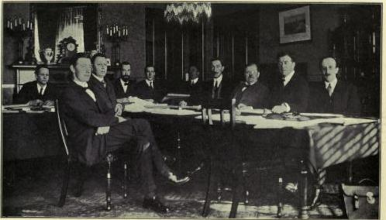
Adoption of the Constitution of the Irish Free State

The Constitution of the Irish Free State (Irish: Bunreacht Shaorstát Eireann) is adopted by Act of Dáil Éireann sitting as a constituent assembly on October 25, 1922. In accordance with Article 83 of the Constitution, the Irish Free State Constitution Act 1922 of the British Parliament, which comes into effect upon receiving the royal assent on December 5, 1922, provides that the Constitution will come into effect upon the issue of a Royal Proclamation, which is done on December 6, 1922. In 1937 the Constitution of the Irish Free State is replaced by the modern Constitution of Ireland following a referendum.

Shortly after the British evacuate their troops from Dublin Castle in January 1922, Michael Collins sets about establishing a committee to draft a new constitution for the nascent Irish Free State which would come into being in December 1922. Collins chairs the first meeting of that committee and at that point is its chairman, but is assassinated before the constitution is finalised. Darrell Figgis, the vice-chairman becomes acting Chair. The committee produces three draft texts, designated A, B and C. Draft A is signed by Figgis, James McNeill and John O’Byrne. Draft B is signed by James G. Douglas, C.J. France and Hugh Kennedy and it differs substantially from draft A only in proposals regarding the Executive. Draft C is the most novel of the three. It is signed by Alfred O’Rahilly and James Murnaghan, and provides for the possibility of representation for the people of the northern counties in the Dáil in the event of that area opting out of the proposed free state.

On March 31, 1922, an act of the United Kingdom Parliament called the Irish Free State (Agreement) Act 1922 is passed. It gives the force of law to the Anglo-Irish Treaty, which had been negotiated between the British government and Irish leaders in 1921. It also provides by for the election of a body to be called the “House of the Parliament,” sometimes called the “Provisional Parliament,” to which the Provisional Government establishes under that act will be responsible. The act gives no power to the Provisional Parliament to enact a constitution for the Irish Free State. In due course, “the House of the Parliament,” provided for by that act, is elected and meets on September 9, 1922, and calling itself Dáil Éireann, proceeds to sit as a constituent assembly for the settlement of what becomes the Constitution of the Irish Free State.

The Constitution establishes a parliamentary system of government under a form of constitutional monarchy, and contains guarantees of certain fundamental rights. It is intended that the constitution would be a rigid document that, after an initial period, could be amended only by referendum. However, amendments are made to the Constitution’s amendment procedure, so that all amendments can be and are in fact made by a simple Act of the Oireachtas (parliament).

Following a change of government in 1932 and the adoption of the Statute of Westminster 1931, a series of amendments progressively removes many of the provisions that had been required by the Anglo-Irish Treaty.

(Pictured: The Constitution Committee meeting at the Shelbourne Hotel, Dublin, 1922)


Leave a comment

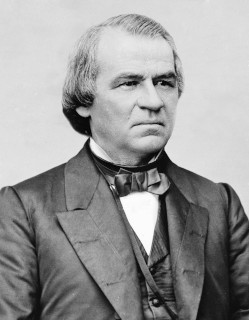
Death of Andrew Johnson, 17th President of the United States

andrew-johnson

Andrew Johnson, the 17th President of the United States (1865 – 1869), dies on July 31, 1875, at his daughter Mary’s farm near Elizabethton, Tennessee after suffering two strokes.

Johnson assumes the presidency at the time of the assassination of Abraham Lincoln as he is Lincoln’s Vice President. He is a Democrat who runs with Lincoln on the National Union ticket, coming to office as the American Civil War concludes. He favors quick restoration of the seceded states to the Union without protection for the former slaves. This leads to conflict with the Republican-dominated Congress, culminating in his impeachment by the House of Representatives in 1868. He is acquitted in the Senate by one vote. His main accomplishment as president is the Alaska Purchase.

Johnson is born in poverty in Raleigh, North Carolina on December 29, 1808. His grandfather emigrated to the United States from County Antrim in what is now Northern Ireland. He never attends school and is apprenticed as a tailor and works in several frontier towns before settling in Greeneville, Tennessee. He serves as alderman and mayor there before being elected to the Tennessee House of Representatives in 1835. After brief service in the Tennessee Senate, he is elected to the U.S. House of Representatives in 1843, where he serves five two-year terms.

On October 17, 1853, Johnson becomes the 15th Governor of Tennessee serving for four years until November 3, 1857. He is elected by the legislature to the United States Senate on October 8, 1857. During his congressional service, he seeks passage of the Homestead Act of 1862 which is enacted soon after he leaves his Senate seat in 1862.

Southern slave states secede to form the Confederate States of America, which includes Tennessee, but Johnson remains firmly with the Union. He is the only sitting senator from a Confederate state who does not resign his seat upon learning of his state’s secession. In 1862, Lincoln appoints him as military governor of Tennessee after most of it has been retaken. In 1864, he is a logical choice as running mate for Lincoln, who wishes to send a message of national unity in his re-election campaign. Their ticket easily wins the election. He is sworn in as Vice President on March 4, 1865. He gives a rambling speech, after which he secludes himself to avoid public ridicule. Six weeks later, the assassination of Lincoln elevates him to the presidency.

Johnson implements his own form of Presidential Reconstruction, a series of proclamations directing the seceded states to hold conventions and elections to reform their civil governments. Southern states return many of their old leaders and pass Black Codes to deprive the freedmen of many civil liberties, but Congressional Republicans refuse to seat legislators from those states and advance legislation to overrule the Southern actions. Johnson vetoes their bills, and Congressional Republicans override him, setting a pattern for the remainder of his presidency.

Johnson opposes the Fourteenth Amendment which gives citizenship to former slaves. In 1866, he goes on an unprecedented national tour promoting his executive policies, seeking to break Republican opposition. As the conflict grows between the branches of government, Congress passes the Tenure of Office Act in 1867 restricting his ability to fire Cabinet officials. He persists in trying to dismiss Secretary of War Edwin Stanton but ends up being impeached by the House of Representatives and narrowly avoiding conviction in the Senate. He does not win the 1868 Democratic presidential nomination and leaves office the following year.

Johnson returns to Tennessee after his presidency and gains some vindication when he is elected to the Senate in 1875, making him the only former president to serve in the Senate. In late July 1875, convinced some of his opponents are defaming him in the Ohio gubernatorial race, he decides to travel there to give speeches. He begins the trip on July 28 and breaks the journey at his daughter Mary’s farm near Elizabethton, where his daughter Martha is also staying. That evening he suffers a stroke but refuses medical treatment until the following day. When he does not improve two doctors are sent for from Elizabethton. He seems to respond to their ministrations but suffers another stroke on the evening of July 30 and dies early the following morning at the age of 66.

President Ulysses S. Grant has the “painful duty” of announcing the death of the only surviving past president. Northern newspapers, in their obituaries, tend to focus on Johnson’s loyalty during the war, while Southern ones pay tribute to his actions as president. Johnson’s funeral is held on August 3 in Greeneville. He is buried with his body wrapped in an American flag and a copy of the U.S. Constitution placed under his head, according to his wishes. The burial ground is dedicated as the Andrew Johnson National Cemetery in 1906 and, with his home and tailor’s shop, is part of the Andrew Johnson National Historic Site.


Leave a comment

Inauguration of John Fitzgerald Kennedy

jfk-inauguration

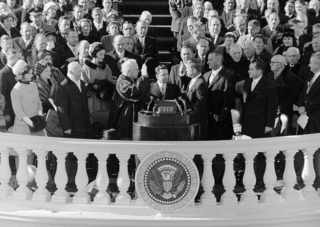
John Fitzgerald Kennedy is inaugurated as the 35th President of the United States on Friday, January 20, 1961, at the eastern portico of the United States Capitol in Washington, D.C., becoming the first Irish Catholic to be elected to the office. The inauguration marks the commencement of Kennedy’s only term as President and of Lyndon B. Johnson‘s only term as Vice President. Kennedy is assassinated 2 years, 306 days into this term, and Johnson succeeds to the presidency.

Kennedy takes office following the November 1960 presidential election, in which he narrowly defeats Richard Nixon, the then–incumbent Vice President. In addition to being the first Catholic to become President, he also becomes the youngest person elected to the office.

His inaugural address encompasses the major themes of his campaign and defines his presidency during a time of economic prosperity, emerging social changes, and diplomatic challenges. This inauguration is the first in which a poet, Robert Frost, participates in the program. Frost, then 86 years old, recites his poem “The Gift Outright” at Kennedy’s request as an act of gratitude towards Frost for his help during the campaign.

The oath of office for the President is administered to Kennedy by Chief Justice of the United States Earl Warren using a closed family Bible at 12:51 (ET) although he officially became president at the stroke of noon as defined by the 20th Amendment to the United States Constitution. He does not wear an overcoat when taking the oath of office and delivering the inaugural address, despite the cold conditions of 22 °F (−6 °C) with windchill at 7 °F (−14 °C) at noon.

Kennedy’s 1366-word inaugural address, the first delivered to a televised audience in color, is considered among the best presidential inaugural speeches in American history. It includes the iconic line “And so, my fellow Americans: ask not what your country can do for you—ask what you can do for your country.”

Five First Ladies, Edith Wilson, Eleanor Roosevelt, Bess Truman, Mamie Eisenhower and Jacqueline Kennedy attend the event, as does future First Ladies Lady Bird Johnson, Pat Nixon, and Betty Ford. Former President Harry S. Truman joins Presidents Dwight D. Eisenhower and Kennedy on the platform, as does future Presidents Lyndon B. Johnson, Richard M. Nixon and Gerald Ford, making this, retroactively, the largest conclave of the “presidential fraternity” prior to the opening of the Ronald Reagan Presidential Library and Museum in the 1990s.

Presidential inaugurations are organized by the Joint Committee on Inaugural Ceremonies. For Kennedy’s inauguration, this committee is chaired by Senator John Sparkman, and includes Senators Carl Hayden and Styles Bridges, and Representatives Sam Rayburn, John W. McCormack, and Charles A. Halleck.


Leave a comment

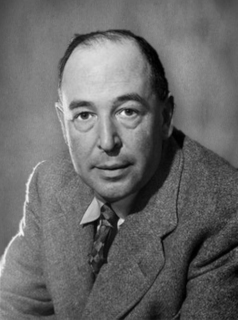
Birth of C.S. Lewis, Poet & Novelist

clive-staples-lewis

Clive Staples Lewis, novelist, poet, academic, medievalist, literary critic, essayist, lay theologian, and Christian apologist, is born in Belfast on November 29, 1898. He is best known for his works of fiction, especially The Screwtape Letters, The Chronicles of Narnia, and The Space Trilogy, and for his non-fiction Christian apologetics, such as Mere Christianity, Miracles, and The Problem of Pain.

Lewis is schooled by private tutors until age nine when his mother dies in 1908 from cancer. His father then sends him to live and study at Wynyard School in Watford, Hertfordshire. After the school is closed soon afterward, he attends Campbell College in the east of Belfast about a mile from his home, but leaves after a few months due to respiratory problems. He is then sent to the health-resort town of Malvern, Worcestershire, where he attends the preparatory school Cherbourg House. It is during this time that he abandons his childhood Christian faith and becomes an atheist. In September 1913, he enrolls at Malvern College. After leaving Malvern, he studies privately with William T. Kirkpatrick, his father’s old tutor and former headmaster of Lurgan College.

Lewis holds academic positions in English literature at both the University of Oxford (Magdalen College, 1925–1954) and the University of  Cambridge (Magdalene College, 1954–1963).

Lewis and fellow novelist J. R. R. Tolkien are close friends. They both serve on the English faculty at Oxford University and are active in the informal Oxford literary group known as the Inklings. He returns to Anglicanism at the age of 32, owing to the influence of Tolkien and other friends, and he becomes an “ordinary layman of the Church of England.” His faith profoundly affects his work, and his wartime radio broadcasts on the subject of Christianity bring him wide acclaim.

Lewis writes more than 30 books which have been translated into more than 30 languages and have sold millions of copies. The books that make up The Chronicles of Narnia have sold the most and have been popularised on stage, television, radio and cinema. His philosophical writings are widely cited by Christian apologists from many denominations.

In early June 1961, Lewis begins suffering from nephritis, which results in blood poisoning. He recovers but on July 15 of that year he falls ill and is admitted to the hospital where he suffers a heart attack the following day, lapses into a coma and awakens the next day. After he is discharged from the hospital his condition continues to decline. He is diagnosed with end-stage renal failure in mid-November. He collapses and dies in his bedroom on November 22. He is buried in the churchyard of Holy Trinity Church, Headington, Oxford.

Media coverage of Lewis’s death is almost completely overshadowed by news of the assassination of United States President John F. Kennedy, which takes place approximately 55 minutes after Lewis’s collapse.

In 2013, on the 50th anniversary of his death, Lewis is honoured with a memorial in Poets’ Corner in Westminster Abbey.


Leave a comment

Ian Paisley’s Retirement from the Power-Sharing Assembly

ian-paisley

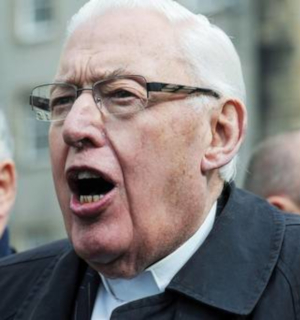
On March 23, 2011, Ian Paisley calls for a new era of sharing and reconciliation in an emotional farewell at his final sitting of the power-sharing Assembly he helped to create at Stormont. Dr. Paisley continues his political career in the House of Lords.

Protestant and Catholic leaders in Northern Ireland‘s unity government celebrate their first full four-year term in power and lauded Paisley, the unlikely peacemaker who made it possible, on his effective retirement day.

Paisley, a stern anti-Catholic evangelist who spent decades rallying pro-British Protestants against compromise, stuns the world in 2007 by agreeing to forge a coalition alongside senior Irish Republican Army (IRA) veterans. Their polar-opposite combination governs Northern Ireland with surprising harmony for the four years leading up to his retirement.

The Northern Ireland Assembly that elects the administration is dissolved on March 14, 2011, in preparation for a May 5 election in the British territory. The 84-year-old Paisley makes his last debate in an elected chamber on March 6, 2011, noting that this local government is not ending in chaos and acrimony, as 1999-2002 attempts at power-sharing repeatedly had done.

At this point, Paisley has already stepped down as a member of the British and European parliaments and as leader of the Democratic Unionists, a party of hard-line Protestant protesters that he founded in 1970 and watched grow over the previous decade into the most popular in Northern Ireland.

Those lauding him include Peter Robinson, who succeeded him in 2008 as leader of both the government and the Democratic Unionists and Sinn Féin‘s Martin McGuinness, the senior Catholic politician who spends decades as a commander of Paisley’s archenemy, the IRA.

The IRA kills nearly 1,800 people in a failed 1970-1997 effort to force Northern Ireland out of the United Kingdom. Northern Ireland remains part of the United Kingdom when the overwhelmingly Catholic rest of Ireland gains its independence in 1922. The outlawed IRA formally renounces violence and disarms in 2005, clearing the way for its allied Sinn Féin party to recognize the legal authority of Northern Ireland and its police.

Still, few observers expected Paisley to agree to a pact so quickly after the IRA-Sinn Féin peace moves or to get along so warmly with McGuinness during their year in partnership.

McGuinness, whose organization once considered Paisley a prime target for assassination, addressing his remarks to the stooped, silver-haired Paisley across the chamber, notes that Ulster wits had christened the two of them “the Chuckle Brothers.” He adds, “And I would like to think that we showed leadership. I think my relationship with him will undoubtedly go down in the history books.”

(From: “Northern Ireland power-sharing marks 1st full term,” the Associated Press and CTV News, March 23, 2011)