seamus dubhghaill

Promoting Irish Culture and History from Little Rock, Arkansas, USA


Leave a comment

Douglas Hyde Inaugurated First President of Ireland

douglas-hyde

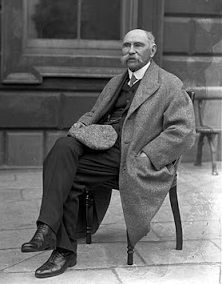
Dr. Douglas Hyde, Gaelic scholar from County Roscommon, is inaugurated as the first President of Ireland on June 25, 1938.

Hyde is born at Longford House in Castlerea, County Roscommon, on January 17, 1860. In 1867, his father is appointed prebendary and rector of Tibohine, and the family moves to neighbouring Frenchpark, in County Roscommon. He is home schooled by his father and his aunt due to a childhood illness. While a young man, he becomes fascinated with hearing the old people in the locality speak the Irish language.

Rejecting family pressure to follow previous generations with a career in the Church, Hyde instead becomes an academic. He enters Trinity College, Dublin, where he gains a great facility for languages, learning Latin, Greek, Hebrew, French, and German, but his great passion in life is the preservation of the Irish language.

After spending a year teaching modern languages in Canada, Hyde returns to Ireland. For much of the rest of his life he writes and collects hundreds of stories, poems, and folktales in Irish, and translates others. His work in Irish helps to inspire many other literary writers, such as W.B. Yeats and Lady Gregory.

In 1892, Hyde helps establish the Gaelic Journal and in November of that year writes a manifesto called The necessity for de-anglicising the Irish nation, arguing that Ireland should follow her own traditions in language, literature, and even in dress.

In 1893, Hyde founds the Gaelic League (Conradh na Gaeilge) along with Eoin MacNeill and Fr. Eugene O’Growney and serves as its first president. Many of the new generation of Irish leaders who play a central role in the fight for Irish independence in the early twentieth century, including Patrick Pearse, Éamon de Valera, Michael Collins, and Ernest Blythe first become politicised and passionate about Irish independence through their involvement in the Gaelic League. Hyde does not want the Gaelic League to be a political entity, so when the surge of Irish nationalism that the Gaelic League helps to foster begins to take control of many in the League and politicize it in 1915, Hyde resigns as president.

Hyde takes no active part in the armed upheaval of the 1910s and 1920s, but does serve in Seanad Éireann, the upper house of the Irish Free State‘s Oireachtas, as a Free State senator in 1925-26. He then returns to academia, as Professor of Irish at University College Dublin, where one of his students is future Attorney General and President of Ireland Cearbhall Ó Dálaigh.

In 1938, Hyde is unanimously elected to the newly created position of President of Ireland, a post he holds until 1945. He is inaugurated on June 26, 1938, in the first inaugural ceremony in the nation’s history. He sets a precedent by reciting the Presidential Declaration of Office in Irish. His recitation, in Roscommon Irish, is one of a few recordings of a dialect of which Hyde is one of the last speakers. Upon inauguration, he moves into the long vacant Viceregal Lodge in Phoenix Park, since known as Áras an Uachtaráin.

Hyde’s selection and inauguration receive worldwide media attention and is covered by newspapers in Australia, New Zealand, South Africa, Argentina, and Egypt. Adolf Hitler “orders” the Berlin newspapers “to splash” on the Irish presidential installation ceremony. However, the British government ignores the event. The Northern Ireland Finance Minister, John Miller Andrews, described Hyde’s inauguration as a “slight on the King” and “a deplorable tragedy.”

Despite being placed in a position to shape the office of the presidency via precedent, Hyde by and large opts for a quiet, conservative interpretation of the office.

In April 1940 Hyde suffers a massive stroke and plans are made for his lying-in-state and state funeral, but to the surprise of everyone he survives, albeit paralysed and confined to a wheelchair. One of Hyde’s last presidential acts is a visit to the German ambassador Eduard Hempel on May 3, 1945, to offer his condolences on the death of Adolf Hitler, a visit which remains a secret until 2005.

Hyde leaves office on June 25, 1945, opting not to nominate himself for a second term. He opts not return to his Roscommon home due to his ill-health but rather moves into the former Secretary to the Lord Lieutenant’s residence in the grounds of Áras an Uachtaráin, where he lived out the remaining four years of his life.

Hyde dies in Dublin on July 12, 1949, at age 89. As a former President of Ireland, he is accorded a state funeral which, as a member of the Church of Ireland, takes place in Dublin’s Church of Ireland St. Patrick’s Cathedral. Since contemporary rules of the Roman Catholic Church in Ireland at the time prohibit Roman Catholics from attending services in non-Catholic churches, all but one member of the Catholic cabinet remains outside the cathedral grounds while Hyde’s funeral takes place. Hyde is buried in Frenchpark, County Roscommon at Portahard Church.


Leave a comment

Barry’s Tea Centennial

barrys-tea

On April 4, 2001, former employees and staff join three generations of the Barry family in a celebration of 100 years in business for Barry’s Tea which has become an Irish institution.

Barry’s Tea is an Irish tea company founded in 1901 by James J. Barry in Cork, County Cork. In 1934, Anthony Barry, son of the founder, is awarded the Empire Cup for Tea Blending, confirming his expertise in the tea trade. Until the 1960s, the tea is only sold from a shop in Prince’s Street, but thereafter the company expands its wholesaling and distribution operations.

In 1960, Peter Barry, Anthony’s son, pioneers the concept of wholesaling tea and begins sourcing tea from East Africa. There is an incredible reaction to these new blends, and they become something of a Barry’s Tea signature.

By the mid-1980s Barry’s Tea has become a national brand. According to their website, www.barrystea.ie, they are currently responsible for 38% of all tea sales in the Irish market, which is worth an estimated €85 million annually. Today, Barry’s Tea is also available in the United Kingdom, Spain, and in some areas of Canada, Australia, France, Luxembourg and the United States where there are significant Irish immigrant communities.

Members of the Barry family have been elected representatives for Fine Gael: the founder’s son Anthony Barry (TD 1954–1957 and 1961–1965), Anthony’s son Peter Barry (TD 1969–1997) and Peter’s daughter Deirdre Clune (TD 1997–2001 and 2007–2011, and MEP since 2014).

In May 2018, it was revealed that many of Barry’s Tea teabags are made with polypropylene and are not compostable.


Leave a comment

Birth of Daniel Mannix, Archbishop of Melbourne

daniel-mannix

Daniel Mannix, Archbishop of Melbourne, advocate of Irish independence, and one of the most influential and controversial public figures in 20th-century Australia, is born near Charleville, County Cork on March 4, 1864.

Mannix is the son of a tenant farmer, Timothy Mannix, and his wife Ellen (née Cagney). He is educated at Congregation of Christian Brothers schools and at St. Patrick’s College, Maynooth, County Kildare, where he is ordained priest in 1890. He teaches philosophy (1891) and theology (1894) at St. Patrick’s and from 1903 to 1912 he serves as president of the college. During his presidency, he welcomes both King Edward VII in 1905 and King George V in 1911 with loyal displays, which attract criticism by supporters of the Irish Home Rule movement.

Consecrated titular archbishop of Pharsalus in 1912, Mannix arrives in Melbourne in the following year as coadjutor archbishop, becoming archbishop of Melbourne in 1917.

Mannix’s forthright demands for state aid for the education of Roman Catholics in return for their taxes and his opposition to drafting soldiers for World War I make him the subject of controversy. A zealous supporter of Irish independence, he makes an official journey to Rome in 1920 via the United States, where his lengthy speech making attracts enthusiastic crowds. His campaign on behalf of the Irish, however, causes the British government to prevent him from landing in Ireland, which he finally visits in 1925.

After World War II Mannix seeks to stop Communist infiltration of the Australian trade unions. He plays a controversial part in the dissensions within the Australian Labor Party and backs the largely right-wing Catholic Democratic Labor Party, which breaks away. A promoter of Catholic Action (i.e., lay apostolic activity in the temporal society) and of the Catholic social movement, he is responsible for the establishment of 181 schools, including Newman College and St. Mary’s College at the University of Melbourne, and 108 parishes.

By the 1960s the distinct identity of the Irish community in Melbourne is fading, and Irish Catholics are increasingly outnumbered by Italians, Maltese and other postwar immigrant Catholic communities. Mannix, who turned 90 in 1954, remains active and in full authority, but he is no longer a central figure in the city’s politics. He dies suddenly on November 6, 1963, aged 99, while the Archdiocese of Melbourne is preparing to celebrate his 100th birthday. He is buried in the crypt of St. Patrick’s Cathedral, Melbourne.


Leave a comment

Birth of Marie Dolores Eliza Rosanna Gilbert, Dancer & Actress

lola-montez

Marie Dolores Eliza Rosanna Gilbert, Countess of Landsfeld, Irish dancer and actress better known by the stage name Lola Montez, is born in Grange, County Sligo, on February 17, 1821. She becomes famous as a “Spanish dancer,” courtesan, and mistress of King Ludwig I of Bavaria, who makes her Countess of Landsfeld. She uses her influence to institute liberal reforms. At the start of the German revolutions of 1848-1849, she is forced to flee. She proceeds to the United States via Switzerland, France, and London, returning to her work as an entertainer and lecturer.

Gilbert’s family makes their residence at King House in Boyle, County Roscommon, until early 1823, when they journey to Liverpool, thence departing for India on March 14. Gilbert spends much of her childhood in India but is educated in Scotland and England. At age 19 she elopes with Lieutenant Thomas James. The couple separates five years later, and, in 1843, Gilbert launches a career as a dancer. Her London debut in June 1843 as “Lola Montez, the Spanish dancer” is disrupted when she is recognized as Mrs. James. The fiasco would probably have ended the career of anyone less beautiful and determined, but Gilbert receives additional dancing engagements throughout Europe. During her travels she reputedly forms liaisons with Franz Liszt and Alexandre Dumas, among many others.

Late in 1846, Gilbert dances in Munich and Ludwig I of Bavaria is so struck by her beauty that he offers her a castle. She accepts, becomes Baroness Rosenthal and Countess of Lansfeld, and remains as his mistress. Under Gilbert’s influence, Louis inaugurates liberal and anti-Jesuit governmental policies, but his infatuation with her helps to bring about the collapse of his regime in the revolution of 1848. In March of that year Ludwig abdicates in favour of his son. Gilbert flees to London, where in 1849 she marries Lieutenant George Heald, although she has never been divorced from James. Heald later leaves her.

From 1851 to 1853 Gilbert performs in the United States. Her third marriage, to Patrick P. Hull of San Francisco in 1853, ends in divorce soon after she moves to Grass Valley, California. There, among other amusements, she coaches young Lotta Crabtree in singing and dancing. She settles in New York City after an unsuccessful tour of Australia in 1855–1856 and gathers a following as a lecturer on such topics as fashion, gallantry, and beautiful women. An apparently genuine religious conversion leads her to take up various personal philanthropies.

Gilbert publishes Anecdotes of Love; Being a True Account of the Most Remarkable Events Connected with the History of Love; in All Ages and among All Nations (1858), The Arts of Beauty, or, Secrets of a Lady’s Toilet with Hints to Gentlemen on the Art of Fascination (1858), and Lectures of Lola Montez, Including Her Autobiography (1858). The international notoriety of her heyday persists long after her death and inspires numerous literary and balletic allusions.

Gilbert spends her last days in rescue work among women. By November 1859 she is showing the tertiary effects of syphilis, and her body begins to waste away. She dies at the age of 39 on January 17, 1861. She is buried in Green-Wood Cemetery in Brooklyn, New York.


Leave a comment

Birth of Louis Brennan, Irish Australian Inventor

louis-brennan

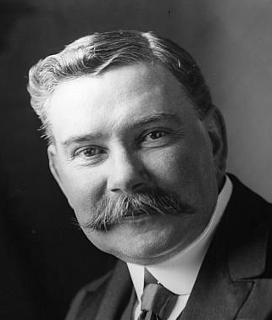
Louis Brennan, Irish Australian mechanical engineer and inventor, is born in Castlebar, County Mayo on January 28, 1852.

Brennan moves to Melbourne, Australia in 1861 with his parents. He starts his career as a watchmaker and a few years later is articled to Alexander Kennedy Smith, a renowned civil and mechanical engineer of the period. He serves as a sergeant in the Victorian Engineers under the command of Captain John James Clark. He invents the idea of a steerable torpedo in 1874, from observing that if a thread is pulled on a reel at an angle with suitable leverage, the reel will move away from the thread side. He spends some years working out his invention and receives a grant of £700 from the Victorian government towards his expenses. He patents the Brennan torpedo in 1877. The idea is trialed at Camden Fort near Crosshaven, County Cork.

Brennan goes to England in 1880 and brings his invention before the War Office. Sir Andrew Clarke alerts the authorities to the possibilities of the torpedo if used in the defence of harbours and channels, and the patent is eventually bought for a sum believed to be more than £100,000 (£ 9,331,100 in 2019). In 1887 he is appointed superintendent of the Brennan torpedo factory and is consulting engineer from 1896 to 1907.

Brennan does much work on a gyro monorail locomotive which is kept upright by a gyrostat. In 1903 he patents a gyroscopically balanced monorail system that he designs for military use. He successfully demonstrates the system on November 10, 1909, at Gillingham, England, but fears that the gyroscopes might fail prevents adoption of the system for widespread use.

From 1916 to 1919 Brennan serves in the munition invention department. From 1919 to 1926 he is engaged by the air ministry in aircraft research work at the Royal Aircraft Establishment, Farnborough, and gives much time to the invention of a helicopter. The government spends a large sum of money on it, but in 1926 the air ministry gives up working on it, much to Brennan’s disappointment.

Brennan marries Anna Quinn on 10 September 10, 1892. The marriage results in a son and a daughter. He is created a Companion of the Order of the Bath in 1892 and is foundation member of the National Academy of Ireland in 1922.

In January 1932 Brennan is knocked down by a car at Montreux, Switzerland, and dies on January 17, 1932. He is buried at St. Mary’s Catholic Cemetery, Kensal Green, London, in an unmarked plot numbered 2454 that is opposite the Chapel record office. On March 11, 2014, Taoiseach Enda Kenny unveils a new gravestone for Brennan at St. Mary’s in a ceremony honouring the inventor’s life and career.

Gillingham Library retains the archive of his papers.


Leave a comment

Birth of Thomas Clarke Luby, Irish Revolutionary

thomas-clarke-luby

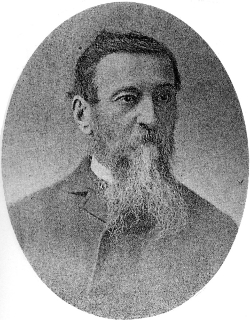
Thomas Clarke Luby, Irish revolutionary, author, journalist and one of the founding members of the Irish Republican Brotherhood, is born in Dublin on January 16, 1822.

Luby is the son of a Church of Ireland clergyman from Templemore, County Tipperary, his mother being a Catholic. He is educated at Trinity College Dublin where he studies law and puts in the necessary number of terms in London and Dublin where he acquires a reputation as a scholar and takes his degree. He goes on to teach at the college for a time.

Luby supports the Repeal Association and contributes to The Nation newspaper. After the breach with Daniel O’Connell, he joins the Young Irelanders in the Irish Confederation. He is deeply influenced by James Fintan Lalor at this time. Following the suppression of the Young Ireland Rebellion of 1848, he with Lalor and Philip Gray attempt to revive the fighting in 1849 as members of the secret Irish Democratic Association. This, however, ends in failure.

In 1851 Luby travels to France, where he hopes to join the French Foreign Legion to learn infantry tactics but finds the recruiting temporarily suspended. From France he goes to Australia for a year before returning to Ireland. From the end of 1855 he edits the Tribune newspaper founded by John E. Pigot who had been a member of The Nation group. During this time, he remains in touch with the small group of ’49 men including Philip Gray and attempts to start a new revolutionary movement. Luby’s views on social issues grow more conservative after 1848 which he makes clear to James Stephens whom he meets in 1856.

In the autumn of 1857 Owen Considine arrives with a message signed by four Irish exiles in the United States, two of whom are John O’Mahony and Michael Doheny. The message conveys the confidence they have in Stephens and asks him to establish an organisation in Ireland to win national independence. Considine also carries a private letter from O’Mahony to Stephens which is a warning, and which is overlooked by Luby and Stephens at the time. Both believe that there is a strong organisation behind the letter, only later to find it is rather a number of loosely linked groups. On December 23 Stephens dispatches Joseph Denieffe to America with his reply which is disguised as a business letter dated and addressed from Paris. In his reply, Stephen’s outlines his conditions and his requirements from the organisation in America.

On March 17, 1858, Denieffe arrives in Dublin with the acceptance of Stephens’s terms by the New York Committee and the eighty pounds. On that very evening the Irish Republican Brotherhood is established in Peter Langan’s timberyard in Lombard Street.

In mid-1863 Stephens informs his colleagues he wishes to start a newspaper, with financial aid from O’Mahony and the Fenian Brotherhood in America. The offices are established at 12 Parliament Street, almost at the gates of Dublin Castle. The first issue of the Irish People appears on November 28, 1863. The staff of the paper along with Luby are Charles J. Kickham and Denis Dowling Mulcahy as the editorial staff. Jeremiah O’Donovan Rossa and James O’Connor have charge of the business office, with John Haltigan being the printer. John O’Leary is brought from London to take charge in the role of Editor.

On July 15, 1865, American-made plans for a rising in Ireland are discovered. Superintendent Daniel Ryan, head of the G Division of the Dublin Metropolitan Police at Dublin Castle, has an informer within the offices of the Irish People who supplies him with an “action this year” message on its way to the IRB unit in Tipperary. With this information, Ryan raids the offices of the Irish People on Thursday, September 15, followed by the arrests of Luby, O’Leary and O’Donovan Rossa. Kickham is caught after a month on the run. Stephens is also caught with the support of Fenian prison warders. The last number of the paper is dated September 16, 1865.

After his arrest and the suppression of the Irish People, Luby is sentenced to twenty years of penal servitude. He is released in January 1871 but is compelled to remain away from Ireland until the expiration of his sentence.

Upon his release Luby goes first to the Continent and later settles in New York City. He lectures all over the country for years and writes for a number of Irish newspapers on political topics. At the memorial meeting on the death of John Mitchel, he delivers the principal address in Madison Square Garden.

Thomas Clarke Luby dies at 109½ Oak Street, Jersey City, New Jersey of paralysis, on November 29, 1901, and is buried in a grave shared with his wife in Bayview Cemetery in Jersey City. His epitaph reads: “Thomas Clarke Luby 1822–1901 He devoted his life to love of Ireland and quest of truth.”


Leave a comment

Birth of Daniel O’Donnell, Singer & Presenter

daniel-o-donnell

Daniel Francis Noel O’Donnell, singer, television presenter and philanthropist affectionately known as “Wee Daniel,” is born in Kincasslagh, County Donegal on December 12, 1961. After rising to public attention in 1983 he has since become a household name in Ireland and Britain. He has also had considerable success in the United States and Australia. In 2012, he becomes the first artist to have a different album in the British charts every year for 25 consecutive years.

Known for his close relationship with his fanbase, and his charismatic and engaging stage presence, O’Donnell’s music has been described as a mix of country and Irish folk. He has had twenty UK Top 40 albums as well as fifteen Top 40 singles and has sold 10 million records to date. He is widely considered a “cultural icon” in Ireland, and is often parodied in the media.

During his school years, O’Donnell considers pursuing a career in banking. Despite this, a career in music is also always a possibility. As a youngster, O’Donnell performs in the local religious choir. In 1980, he goes to Galway to pursue business studies, however, he never settles down and by Christmas he is in his sister Margo‘s band.

Not getting enough opportunities to perform solos with the band, in 1983 O’Donnell decides to record his own record. On February 9, 1983, he records his first single, Johnny McCauley‘s My Donegal Shore, with £1,200 of his own money, selling all the copies himself. Later that year, he forms his own musical group, Country Fever. After the group disbands, he forms The Grassroots. In 1985, the manager of the Ritz label, Mick Clerkin, sees him perform and introduces him to Sean Reilly, who remains as his manager to this day.

Under Reilly’s management, O’Donnell starts to sell concerts out in England on a regular basis. By January 1992, he has hit rock bottom with exhaustion. After a three-month recovery break, he returns to the stage, this time at the Point Theatre, Dublin.

By the mid-1990s, O’Donnell has become a household name across Ireland and Great Britain. He appears on popular television shows in both countries and wins various awards. Among the accolades, he is named Donegal Person of the Year in 1989, which he still rates as the best award. He is given the Irish Entertainer of the Year award in 1989, 1992 and 1996. His first chart hit single in the UK is in 1992 with I Just Want to Dance With You (later covered by George Strait). This also leads to his first-ever appearance on Top of the Pops.

During his lengthy career, O’Donnell has made friends with his childhood idols, including Cliff Richard and Loretta Lynn. He has also forged a close professional relationship with the Irish songstress Mary Duff, who regularly tours with O’Donnell.

On November 4, 2002, O’Donnell marries Majella McLennan from Thurles, whom he had met on holiday in Tenerife three years previously. The couple lives in Meenbanad, County Donegal, and spend time at their second home in Tenerife.


Leave a comment

Birth of Actress Sara Ellen Allgood

sara-allgood

Sara Ellen Allgood, Irish American actress,is born to a Catholic mother and Protestant father in Dublin on October 31, 1879.

Allgood joins Inghinidhe na hÉireann (“Daughters of Ireland”), where she first begins to study drama under the direction of Maud Gonne and William Fay. She begins her acting career at the Abbey Theatre and is in the opening of the Irish National Theatre Society. Her first big role is in December 1904 at the opening of Lady Gregory‘s Spreading the News. By 1905 she is a full-time actress, touring England and North America.

In 1915 Allgood is cast as the lead in Peg o’ My Heart which tours Australia and New Zealand in 1916. She marries her leading man, Gerald Henson, in September 1916 in Melbourne, however, her happiness is short lived. She gives birth to a daughter named Mary in January 1918, who dies just a day later. Her husband dies of influenza during an outbreak in November 1918. After her return to Ireland, she continues to perform at the Abbey Theatre. Her most memorable performance is in Seán O’Casey‘s Juno and the Paycock in 1923. She wins acclaim in London when she plays Bessie Burgess in O’Casey’s The Plough and the Stars in 1926.

Allgood is frequently featured in early Alfred Hitchcock films, such as Blackmail (1929), Juno and the Paycock (1930), and Sabotage (1936). She also has a significant role in Storm in a Teacup (1937).

After many successful theatre tours in the United States, she settles in Hollywood in 1940 to pursue an acting career. She is nominated for the Academy Award for Best Supporting Actress for her role as Beth Morgan in the 1941 film How Green Was My Valley. She also has memorable roles in the 1941 retelling of Dr. Jekyll and Mr. Hyde, It Happened in Flatbush (1942), Jane Eyre (1943), The Lodger (1944), The Keys of the Kingdom (1944), The Spiral Staircase (1946), The Fabulous Dorseys (1947), and the original Cheaper by the Dozen (1950).

Allgood becomes a United States citizen in 1945 and dies of a heart attack on September 13, 1950, in Woodland Hills, California.

(Note: Many accounts give October 31, 1879, as her date of birth. Her headstone also gives 1879 as her year of birth. However, her sister Margaret is born on August 1, 1879, meaning she could not have been born in that year. Sara Allgood may have been born on October 31, 1880, but her parents may have been late registering her.)


Leave a comment

The 2002 Bali Bombings

bali-bombings-2002

The 2002 Bali bombings occur on October 12, 2002 in the tourist district of Kuta on the Indonesian island of Bali. The attack kills 202 people, including 88 Australians, 38 Indonesians, and people of more than 20 other nationalities. An additional 209 people are injured.

At 11:05 PM Central Indonesian Time, a suicide bomber inside the nightclub Paddy’s Pub, sometimes referred to as Paddy’s Irish Bar and owned Natalia Daly of Cork, County Cork, detonates a bomb in his backpack, causing many patrons, with or without injuries, to immediately flee into the street. Twenty seconds later, a second and much more powerful car bomb hidden inside a white Mitsubishi van is detonated by another suicide bomber outside the Sari Club, a renowned open-air thatched roof bar located opposite Paddy’s Pub.

The bombing occurs during one of the busiest tourist periods of the year in Kuta Beach, driven in part by many Australian sporting teams making their annual end-of-season holiday.

Damage to the densely populated residential and commercial district is immense, destroying neighbouring buildings and shattering windows several blocks away. The car bomb explosion leaves a one-metre-deep crater.

The local Sanglah Hospital is ill-equipped to deal with the scale of the disaster and is overwhelmed with the number of injured, particularly burn victims. There are so many people injured by the explosion that some of the injured have to be placed in hotel pools near the explosion site to ease the pain of their burns. Many of the injured are forced to be flown extreme distances to Darwin (1,100 mi) and Perth (1,600 mi) on the Australian continent for specialist burn treatment.

A comparatively small bomb detonates outside the U.S. consulate in Denpasar, which is believed to have exploded shortly before the two Kuta bombs, causes minor injuries to one person and minimal property damage. It is reportedly packed with human feces.

The final death toll is 202, mainly comprising Western tourists and holiday-makers in their 20s and 30s who are in or near Paddy’s Pub or the Sari Club, but also including many Balinese Indonesians working or living nearby, or simply passing by. Hundreds more people suffer horrific burns and other injuries. The largest group among those killed are holidayers from Australia with 88 fatalities. On October 14, the United Nations Security Council passes Resolution 1438 condemning the attack as a threat to international peace and security.

Various members of Jemaah Islamiyah, a violent Islamist group, are convicted in relation to the bombings, including three individuals who are sentenced to death. An audio-cassette purportedly carrying a recorded voice message from Osama bin Laden states that the Bali bombings are in direct retaliation for support of the United StatesWar on Terror and Australia‘s role in the liberation of East Timor. The recording does not claim responsibility for the Bali attack. However, former FBI agent Ali Soufan confirms that Al-Qaeda did in fact finance the attack.

On November 8, 2008, Imam Samudra, Ali Amrozi bin Haji Nurhasyim and Huda bin Abdul Haq are executed by firing squad on the island prison of Nusa Kambangan. On March 9, 2010, Dulmatin, nicknamed “the Genius” and believed to be responsible for setting off one of the Bali bombs with a mobile phone, is killed in a shoot-out with Indonesian police in Jakarta.


Leave a comment

Birth of Richard D’Alton Williams, Physician & Poet

richard-dalton-williams

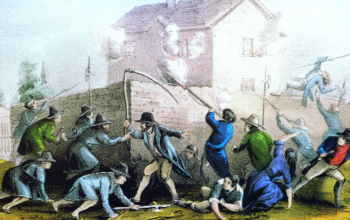
Richard D’Alton Williams, physician and poet, is born in Dublin on October 8, 1822. He is the son of James and Mary Williams, who come from County Westmeath. He grows up in Grenanstown, a townland near the Devil’s Bit in County Tipperary, where his father farms for Count Dalton. He is educated at Tullabeg Jesuit College and St. Patrick’s, Carlow College.

Williams becomes a member of the Young Ireland movement and contributes poetry to The Nation under the pseudonym “Shamrock.” He is immediately successful. In the January 21, 1843 edition there appears: “Shamrock is a jewel. He cannot write too often. His verses are full of vigour, and as natural as the harp of Tara.”

Later in 1843 Williams goes to Dublin to study medicine at Saint Vincent’s Hospital. In 1848 he brings out a newspaper, the Irish Tribune, to take the place of the suppressed United Irishman, founded by John Mitchel. Before the sixth weekly publication, it is seized by the Government, and proceedings are instituted against the editors, Williams and his friend Kevin Izod O’Doherty. On October 30, 1848, at a third trial, O’Doherty is convicted of treason and transported to Australia while Williams is successfully defended by lawyer and fellow poet Samuel Ferguson two days afterwards on the same charge. He then resumes his medical studies, takes out his degree at Edinburgh, Scotland in 1849 and emigrates to the United States in 1851.

Williams is married to Elizabeth Connolly on September 8, 1856, with whom he has four children of whom the youngest is commemorated in Lines on the Death of his Infant Daughter, Katie.

In the United States Williams practises medicine until he becomes ill and dies of tuberculosis in Thibodaux, Louisiana on July 5, 1862. He is buried there in St. Joseph’s Cemetery. His headstone is later erected that year by Irish members of the 8th New Hampshire Volunteer Infantry, then encamped in Thibodaux.