seamus dubhghaill

Promoting Irish Culture and History from Little Rock, Arkansas, USA


Leave a comment

Birth of David Hammond, Singer & Folklorist

David Andrew (Davy) Hammond, singer, folkloristtelevision producer and documentary maker, is born on December 5, 1928, in Miss Kell’s nursing home on the Castlereagh Road in Belfast, Northern Ireland.

Hammond is the son of Leslie Hammond, a tram driver, and his wife Annie (née Lamont). His parents are not city people; his mother grew up near Ballybogy in the Ballymoney area of County Antrim, and his father, though from a family with roots in south County Londonderry, had lived in Ballymoney as a boy, and had been apprenticed to a blacksmith there. Both have a strong sense of their rural identity and maintain the Ulster Scots dialect of their childhood. They are never quite at home in the Belfast suburb of Cregagh, and in particular do not share the sectarian attitudes that are much more present in 1930s Belfast than they had been in north Antrim, one of the last strongholds of Presbyterian radicalism. Even as a boy, Hammond is interested in the old songs that his mother sang and realises that the traditions in which his parents had been nurtured are disappearing quickly in an increasingly urbanising and modernising world. When he encounters the work of Emyr Estyn Evans in the early 1940s, he is encouraged to document both rural tradition and the street life of the city, and he and a couple of friends, though still just teenagers, ride off on their bicycles to look for folklore in the hinterland of Belfast.

After primary school, Hammond wins a scholarship in 1941 to Methodist College Belfast, where he does well in examinations, and then goes to Stranmillis University College to train as a teacher. In his first job, in Harding Memorial primary school in east Belfast, he proves to be a popular, idealistic teacher, and is remembered by his pupils fifty years later as a fine singer and a teller of ghost stories, who had taken the class on memorable youth-hosteling trips to the Mourne Mountains. Youth hosteling and folklore collecting increases his awareness and understanding of the rich traditions of the whole community in the north of Ireland, and he is never constrained by political or religious barriers. His early career mirrors closely that of James Hawthorne, and their paths are to cross in later life.

Hammond is friendly with many others active in the cultural life of Northern Ireland and makes a name for himself as a song collector and eventually as an expert on all aspects of traditional singing. In 1956, he is awarded a scholarship to travel in the United States to meet the important pioneers of folk-music collecting and performance there. He records his first LP record of Ulster songs, I Am The Wee Falorie Man (1958), in the United States, and becomes friends with Pete Seeger, the Appalachian singer Jean Ritchie, with old blues singers, and notably with Liam Clancy, one of the three Clancy brothers who as a quartet with Tommy Makem are to popularise Irish folk music in the United States and elsewhere.

On returning to Belfast, Hammond takes a job in 1958 in Orangefield secondary school in the east of the city, where the highly regarded headmaster John Malone encourages new approaches to education. Among his pupils at Orangefield is George Ivan “Van” Morrison, who credits him with inspiring his interest in Irish traditional music. Hammond enjoys teaching but is increasingly drawn to folk-song performance and recording. He appears regularly on radio programmes of the BBC and Radio Éireann, and in 1964 joins the school’s department in BBC Northern Ireland. There, with colleagues like Sam Hanna Bell, James Hawthorne and others, he works on programmes such as Today and Yesterday in Northern Ireland, which for the first time introduces pupils (and many adults) to local history and to aspects of tradition. In 1968, with two friends, the poets Seamus Heaney and Michael Longley, he puts on poetry and traditional music events in schools all over the province. The Arts Council funds the Room to Rhyme project, which is immensely influential and inspiring, and is still talked about many years later by those who attended as children.

Hammond is creatively involved with hundreds of hours of broadcasting, in television as well as radio, and eventually for adults as well as children. He writes scripts, produces documentary series such as Ulster in Focusand Explorations, and brings an artistic sensibility to filming, as well as working sympathetically with traditional singers and craftspeople. Dusty Bluebells, a sensitively made film of Belfast children’s street games, wins the prestigious Golden Harp award in 1972. After he leaves the BBC to work as a freelance, and founds Flying Fox Films in 1986, he continues making documentaries on many aspects of Ulster life and heritage. His film called Steel Chest, Nail in the Boot and the Barking Dog (1986), about working in the Belfast shipyards, also wins a Golden Harp award. A companion book of the same name is published. Another book is Belfast, City of Song(1989), with Maurice Leyden. In 1979, he edits a volume of the songs of Thomas Moore. His documentary programmes include films about singers from Boho, County Fermanagh, and about the big houses of the gentry in Ireland. The Magic Fiddle (1991/2) examines the role of the instrument in the folk music of Ireland, ScandinaviaCanada, and the American south, while Another Kind of Freedom (1993) is about the experiences of a former Orangefield pupil, the Beirut hostage Brian Keenan. He also produces and directs the films Something to Write Home About (1998), Where Are You Now? (1999), and Bogland (1999), all of which explore Seamus Heaney’s home region and experiences.

The first poem in Heaney’s collection Wintering Out (1972) is entitled “For David Hammond and Michael Longley.” Their lifelong friendship leads to several other creative collaborations. In particular, after a distressing evening in 1972 when Hammond, affected by the despair and terror unleashed by Irish Republican Army (IRA) bombing of his city, is for once unable to sing, Heaney meditates on the experience in an essay and in an important poem, “The singer’s house” (subsequently included in his 1979 Field Work collection). The poem urges the singer to keep singing, to defend the values of art and friendship in a hostile time. Hammond collaborates with Dónal Lunny and other traditional musicians to bring out an LP also called The Singer’s House(1978), which includes Heaney’s poem on the album sleeve, and features some of the songs that he had made famous, such as “My Aunt Jane” and “Bonny Woodgreen,” from his vast repertoire of songs from Ulster. The album is reissued in 1980.

In 1995, Hammond is one of Heaney’s personal guests at the award of his Nobel prize in Stockholm, characteristically wearing his usual, mustard-yellow, cattle-dealer boots with evening dress. On another formal occasion, when he is awarded an honorary doctorate by Dublin City University in November 2003, he surprises the audience by standing up in his academic robes to sing “My Lagan love,” instead of giving an address. His unique, light mellow voice is an ideal vehicle for the traditional ballads which he knows so well. He records a number of records in the 1960s, including Belfast Street Songs, and publishes the book Songs of Belfast (1978). He also encourages traditional musicians like Arty McGlynn, and collaborates with them on various recording projects. He is well known for live and often impromptu performances at festivals and venues in Ireland and the United States. He also performs at the John F. Kennedy Center for the Performing Arts in Washington, D.C.

Hammond is also a notable collaborator with poets and dramatists, especially in the important Field Day Theatre Company project, of which he is a director, along with Seamus Heaney, Tom PaulinSeamus DeaneThomas Kilroy, and the project’s founders, Brian Friel and Stephen Rea. He supports the Field Day search for a “fifth province,” where history and community and culture can intersect, believing that to speak unthinkingly of “two traditions” is to perpetuate superficial political divisions. As he says in an interview in The Irish Times on July 4, 1998, songs can “take you out of yourself” and become bridges to unite people.

Hammond receives many honours. In 1994, he receives the Estyn Evans award for his contribution to mutual understanding, and his work is featured in several major events in his honour: in the University of North Florida (1999), in the Celtic Film Festival in Belfast (2003), and in Belfast’s Linen Hall Library (2005). A Time to Dream, a film about his life and work, is broadcast on BBC Northern Ireland in December 2008.

Hammond dies in hospital in Belfast, after a long illness, on August 25, 2008, survived by his wife Eileen (née Hambleton), whom he marries on July 19, 1954, and by their son and three daughters. His funeral in St. Finnian’s Church is a major cultural event, where friends sing, play and speak in his honour.

In Seamus Heaney’s last collection of poetry, Human Chain (2010), he includes a poignant farewell to Hammond. The poet imagines (or perhaps dreams) of another visit to the singer’s house, but this time “The door was open, and the house was dark.”

(From: “Hammond, David Andrew (‘Davy’)” by Linde Lunney, Dictionary of Irish Biography, http://www.dib.ie, December 2014)


Leave a comment

Death of David Hammond, Singer, Folklorist & Television Producer

David Andrew (Davy) Hammond, singer, folklorist, television producer and documentary maker, dies in Belfast, Northern Ireland, following a long illness, on August 25, 2008.

Hammond is born on December 5, 1928, in Miss Kells’s nursing home on the Castlereagh Road in Belfast, the son of Leslie Hammond, a tram driver, and his wife Annie (née Lamont). His parents are not city people; his mother grew up near Ballybogy in the Ballymoney area of County Antrim, and his father, though from a family with roots in south County Londonderry, had lived in Ballymoney as a boy, and had been apprenticed to a blacksmith there. Both have a strong sense of their rural identity and maintain the Ulster Scots dialect of their childhood. They are never quite at home in the Belfast suburb of Cregagh, and in particular do not share the sectarian attitudes that are much more present in 1930s Belfast than they had been in north Antrim, one of the last strongholds of Presbyterian radicalism. Even as a boy, Hammond is interested in the old songs that his mother sang and realises that the traditions in which his parents had been nurtured are disappearing quickly in an increasingly urbanising and modernising world. When he encounters the work of Emyr Estyn Evans in the early 1940s, he is encouraged to document both rural tradition and the street life of the city, and he and a couple of friends, though still just teenagers, ride off on their bicycles to look for folklore in the hinterland of Belfast.

After primary school, Hammond wins a scholarship in 1941 to Methodist College Belfast, where he does well in examinations, and then goes to Stranmillis University College to train as a teacher. In his first job, in Harding Memorial primary school in east Belfast, he proves to be a popular, idealistic teacher, and is remembered by his pupils fifty years later as a fine singer and a teller of ghost stories, who had taken the class on memorable youth-hosteling trips to the Mourne Mountains. Youth hosteling and folklore collecting increases his awareness and understanding of the rich traditions of the whole community in the north of Ireland, and he is never constrained by political or religious barriers. His early career mirrors closely that of James Hawthorne, and their paths are to cross in later life.

Hammond is friendly with many others active in the cultural life of Northern Ireland and makes a name for himself as a song collector and eventually as an expert on all aspects of traditional singing. In 1956, he is awarded a scholarship to travel in the United States to meet the important pioneers of folk-music collecting and performance there. He records his first LP record of Ulster songs, I Am The Wee Falorie Man (1958), in the United States, and becomes friends with Pete Seeger, the Appalachian singer Jean Ritchie, with old blues singers, and notably with Liam Clancy, one of the three Clancy brothers who as a quartet with Tommy Makem are to popularise Irish folk music in the United States and elsewhere.

On returning to Belfast, Hammond takes a job in 1958 in Orangefield secondary school in the east of the city, where the highly regarded headmaster John Malone encourages new approaches to education. Among his pupils at Orangefield is George Ivan “Van” Morrison, who credits him with inspiring his interest in Irish traditional music. Hammond enjoys teaching but is increasingly drawn to folk-song performance and recording. He appears regularly on radio programmes of the BBC and Radio Éireann, and in 1964 joins the school’s department in BBC Northern Ireland. There, with colleagues like Sam Hanna Bell, James Hawthorne and others, he works on programmes such as Today and Yesterday in Northern Ireland, which for the first time introduces pupils (and many adults) to local history and to aspects of tradition. In 1968, with two friends, the poets Seamus Heaney and Michael Longley, he puts on poetry and traditional music events in schools all over the province. The Arts Council funds the Room to Rhyme project, which is immensely influential and inspiring, and is still talked about many years later by those who attended as children.

Hammond is creatively involved with hundreds of hours of broadcasting, in television as well as radio, and eventually for adults as well as children. He writes scripts, produces documentary series such as Ulster in Focus and Explorations, and brings an artistic sensibility to filming, as well as working sympathetically with traditional singers and craftspeople. Dusty Bluebells, a sensitively made film of Belfast children’s street games, wins the prestigious Golden Harp award in 1972. After he leaves the BBC to work as a freelance, and founds Flying Fox Films in 1986, he continues making documentaries on many aspects of Ulster life and heritage. His film called Steel Chest, Nail in the Boot and the Barking Dog (1986), about working in the Belfast shipyards, also wins a Golden Harp award. A companion book of the same name is published. Another book is Belfast, City of Song (1989), with Maurice Leyden. In 1979, he edits a volume of the songs of Thomas Moore. His documentary programmes include films about singers from Boho, County Fermanagh, and about the big houses of the gentry in Ireland. The Magic Fiddle (1991/2) examines the role of the instrument in the folk music of Ireland, Scandinavia, Canada, and the American south, while Another Kind of Freedom (1993) is about the experiences of a former Orangefield pupil, the Beirut hostage Brian Keenan. He also produces and directs the films Something to Write Home About (1998), Where Are You Now? (1999), and Bogland (1999), all of which explore Seamus Heaney’s home region and experiences.

The first poem in Heaney’s collection Wintering Out (1972) is entitled “For David Hammond and Michael Longley.” Their lifelong friendship leads to several other creative collaborations. In particular, after a distressing evening in 1972 when Hammond, affected by the despair and terror unleashed by Irish Republican Army (IRA) bombing of his city, is for once unable to sing, Heaney meditates on the experience in an essay and in an important poem, “The singer’s house” (subsequently included in his 1979 Field Work collection). The poem urges the singer to keep singing, to defend the values of art and friendship in a hostile time. Hammond collaborates with Dónal Lunny and other traditional musicians to bring out an LP also called The Singer’s House (1978), which includes Heaney’s poem on the album sleeve, and features some of the songs that he had made famous, such as “My Aunt Jane” and “Bonny Woodgreen,” from his vast repertoire of songs from Ulster. The album is reissued in 1980.

In 1995, Hammond is one of Heaney’s personal guests at the award of his Nobel prize in Stockholm, characteristically wearing his usual, mustard-yellow, cattle-dealer boots with evening dress. On another formal occasion, when he is awarded an honorary doctorate by Dublin City University in November 2003, he surprises the audience by standing up in his academic robes to sing “My Lagan love,” instead of giving an address. His unique, light mellow voice is an ideal vehicle for the traditional ballads which he knows so well. He records a number of records in the 1960s, including Belfast Street Songs, and publishes the book Songs of Belfast (1978). He also encourages traditional musicians like Arty McGlynn, and collaborates with them on various recording projects. He is well known for live and often impromptu performances at festivals and venues in Ireland and the United States. He also performs at the John F. Kennedy Center for the Performing Arts in Washington, D.C.

Hammond is also a notable collaborator with poets and dramatists, especially in the important Field Day Theatre Company project, of which he is a director, along with Seamus Heaney, Tom Paulin, Seamus Deane, Thomas Kilroy, and the project’s founders, Brian Friel and Stephen Rea. He supports the Field Day search for a “fifth province,” where history and community and culture can intersect, believing that to speak unthinkingly of “two traditions” is to perpetuate superficial political divisions. As he says in an interview in The Irish Times on July 4, 1998, songs can “take you out of yourself” and become bridges to unite people.

Hammond receives many honours. In 1994, he receives the Estyn Evans award for his contribution to mutual understanding, and his work is featured in several major events in his honour: in the University of North Florida (1999), in the Celtic Film Festival in Belfast (2003), and in Belfast’s Linen Hall Library (2005). A Time to Dream, a film about his life and work, is broadcast on BBC Northern Ireland in December 2008.

Hammond dies in hospital in Belfast, after a long illness, on August 25, 2008, survived by his wife Eileen (née Hambleton), whom he marries on July 19, 1954, and by their son and three daughters. His funeral in St Finnian’s church is a major cultural event, where friends sing, play and speak in his honour.

In Seamus Heaney’s last collection of poetry, Human Chain (2010), he includes a poignant farewell to Hammond. The poet imagines (or perhaps dreams) of another visit to the singer’s house, but this time “The door was open, and the house was dark.”

(From: “Hammond, David Andrew (‘Davy’)” by Linde Lunney, Dictionary of Irish Biography, http://www.dib.ie, December 2014)


3 Comments

Birth of Irish Historian Gerard Anthony Hayes-McCoy

Gerard Anthony Hayes-McCoy, an Irish historian regarded as one of the leading Irish historians of his generation, is born in Galway, County Galway, on August 15, 1911.

Hayes-McCoy is born to Thomas Hayes-McCoy and Mary Kathleen Hayes-McCoy (née Wallace). His grandfather, Thomas Hayes-McCoy, is a Dubliner who as a child came to Galway in 1834 and is later a well-known Parnellite. His maternal grandfather, Thomas Burke, is a Galway artist. He grows up on Eyre Square where his father runs a gentleman’s hairdressing business. His two older siblings are Ignatius and Marguerite. The latter receives a PhD-degree in History at University College Galway (UCG), and later teaches at the Galway Technical School.

Hayes-McCoy receives his early education from the Patrician Brothers, Galway. His earliest notebook of 1927 and a manuscript history of Poland of the same year, now at the National Library of Ireland (NLI), testify to an early interest in history and heritage. From 1928 to 1932 he is a student scholarship holder at University College Galway, graduating in 1932 with a Bachelor of Commerce, and a Bachelor of Arts, with first-class honours in both, and a specialisation in “History, Ethics, Politics” for the latter. Mary Donovan O’Sullivan is one of his professors of history, and Liam Ó Briain, professor of Romance languages, is a stimulating influence. At this time, Hayes-McCoy is a member of the Republican Club, a committee member of the Literary and Debating Society, and in 1931 he is one of the founding members of a new Irish Students’ Association.

Hayes-McCoy pursues his PhD at the University of Edinburgh, and then spends two years at the Institute of Historical Research, London, in the Tudor seminar of J. E. Neale, rewriting his PhD and eventually publishing it as Scots mercenary forces in Ireland, 1565–1603 (Dublin and London, 1937), with a foreword by Eoin MacNeill. This is characterised by meticulous archival research, and it anticipates by sixty years the much-vaunted New British History of the late twentieth century by tracing the interconnections between events in England, Ireland, and Scotland.

In the absence of an academic post, Hayes-McCoy becomes an assistant keeper in the Art and Industrial Division at the National Museum of Ireland (1939–1959), with a responsibility for the Military History, and the Irish War of Independence collections. One of his first tasks is to prepare a standing exhibition on Irish history before 1916. His research, long-standing personal interest in the military, and his curatorial experience, helps form an expert knowledge of historical Irish warfare. This leads to his role in co-founding The Military History Society of Ireland in 1949 whose journal, The Irish Sword, he edits. He describes the vagaries of setting up such a body, its reception, and the historiographical considerations attendant on it, in a paper published posthumously in The Irish Sword.

On August 19, 1941, Hayes-McCoy marries Mary Margaret “May” O’Connor, daughter of C.J. and M.B. O’Connor of New Ross/Enniscorthy. They have three daughters and two sons: Mary, Ann, Ian, Robert, Felicity. The family home is in Dublin.

Earning high reputation by continued research and by publishing leads to Hayes-McCoy’s receipt of the D.Litt. degree from the National University, and to his membership in the Royal Irish Academy in 1950. In his professional career, apart from the broad spectrum of press publications, he publishes prolifically. The works that are judged most influential, are his Scots mercenary forces in Ireland 1565–1603 (1937), the papers “The early history of guns in Ireland” (1938–1939), “Strategy and tactics in Irish warfare, 1593–1601” (1941), “The army of Ulster, 1593–1601” (1951), the controversial “Gaelic society in Ireland in the late sixteenth century” (1963), and the monographs “Irish battles” (London 1969), and “A history of Irish flags from earliest times” (Dublin 1979). A member of the Irish Manuscripts Commission, his most notable contribution is the publication “Ulster and other Irish maps, c.1600” (Dublin 1964).

In 1946, Hayes-McCoy is appointed to a committee of eight historians to advise on setting up the Bureau of Military History, a body established for the creation and compilation of material on the history of the Irish movements for independence, 1913–1921, specifically from witness statements. The committee is also to further offer guidance and oversee progress of the Bureau in coordination with the Ministry of Defence. It subsequently expresses concerns about the state’s role and methods in the collection of statements.

Having begun writing for the press at an early stage, Hayes-McCoy’s public position at the Museum encourages him to go further. He has broad involvement with local history groups to whom he presents papers, and also works for newspapers and for radio and television. To the national and Galway press he usually contributes articles on military aspects of Irish history, as well as book reviews, but he also uses them as a platform to engage with what he sees are flaws in the education of history in Ireland which during his lifetime is constrained by a certain degree of political and cultural state control.

During the 1940s and 1950s, Hayes-McCoy becomes involved in a number of paratheatrical events of national significance one of which – the “Pageant of St.Patrick” for which he writes the script (An Tóstal 1954) – is realised on an immense scale. He scripts these works to begin with and is later principally engaged as historical consultant. In that capacity, he collaborates in 1955 and 1956 with Micheál Mac Liammóir and Denis Johnston on their scripts for pageants on St. Patrick and on the Táin Bó Cuailgne, at times finding it difficult to square the historical liberties taken by these artists with his own role.

On Irish radio and television Hayes-McCoy is most active in the mid-1960s, editing and contributing to Thomas Davis lectures series, writing scripts for a series of thirty children’s programmes on all aspects of Irish history, and preparing/contributing on air to the television series “Irish battles” and “The long winter.” As well as writing for RTÉ, Ireland’s national broadcaster, he contributes scripts to BBC Northern Ireland‘s schools radio programmes.

In 1959, Hayes-McCoy succeeds to the chair of his former history professor at UCG with the full remit of lecturing, administering examinations to undergraduates, and supervising postgraduate theses. Among his students who continue in the field of history are Nicholas Canny, Martin Coen, Patrick Melvin, Peter Toner, Tony Claffey, and Breandán Ó Bric. After his appointment to UCG, the family home remains in Dublin, and he commutes to Galway weekly during term time.

In the early 1960s, Hayes-McCoy becomes a spokesperson for the movement rekindled by the Old Galway Society to preserve the landmark “Lion’s Tower” in the city. The ultimate failure of the campaign informs his regret, expressed a year later, that Ireland is forgetful about its past and that “we don’t bother to find out about it or to maintain our ancient heritage,” and, on a perceived spirit of conformity, “take my own city of Galway, it is now more prosperous than it was, but it is no longer distinctive. I do not believe that it is essential for progress that we should lose our heritage.”

While at one time member and secretary of the London Sinn Féin office and informed by a pride of country and place, Hayes-McCoy’s professional and private outlook are marked by a distrust of nationalism or of any antagonising national agendas compromising genuine scholarship. In a paper drafted on tendencies in modern historical studies, he criticises the two historiographical extremes, each to be avoided, each unfortunately characteristic of the moment – extreme de-bunking and extreme “adding for effect.” “A history is a record of fact; to add pseudo-facts is as grave a sin as to leave out real facts that may change the colour of the whole.”

Hayes-McCoy’s abiding pastime is drawing. Among his papers in the James Hardiman Library, NUI Galway are approximately 40 items with predominantly maritime subjects, and he has a special regard for the history of ships, and a romantic liking of the sea. He also has a lifelong interest in Robert Louis Stevenson, Sir Walter Scott, and their works, and in the Pre-Raphaelite movement.

Hayes-McCoy’s middle age is marked by intermittent ill health. He dies on November 27, 1975, in his room at the Great Southern Hotel, Eyre Square, Galway.

Hayes-McCoy’s papers are held at the James Hardiman Library, National University of Ireland, Galway.


Leave a comment

Death of John Havelock Nelson, Composer & Conductor

John Havelock Nelson, composer and conductor, dies in Belfast, Northern Ireland, on August 5, 1996. He makes an immense contribution to the development of the cultural life of the province – and beyond – over the second half of the 20th century.

Nelson is born of middle-class parents in Cork, County Cork, on May 25, 1917, his distinctive forename being taken from a cousin of his mother who lost his life in World War I. Despite his birthplace, both his parents’ ancestral roots lie firmly in Northern Ireland.

Nelson’s father Robert comes from Larne, County Antrim, where he was raised. However, the early years of his mother Grace are quite eventful. She is born in the Belgian Congo on account of her father’s placement there as a missionary in the latter years of the 19th century (his family hail from Tobermore, County Londonderry). She is eventually sent home at an early age, due to the threat of malaria, and is raised in Belfast by an aunt and uncle who have no family of their own. It appears that Nelson inherits his musical genes from both parents. Although his father is trained as a chartered accountant, he is a capable baritone singer who studies in the early 1900s with C. J. Brennan, later to become the organist and choirmaster at St. Anne’s Cathedral, Belfast). Meanwhile, his mother shows talent as a pianist during her upbringing in her adopted city and by her early 20s is offering her services as an accompanist.

By chance, this is how his parents meet. They marry in 1916, shortly before their arrival in Cork where Robert takes up his first accountancy job. Within a month of Nelson’s birth, the family moves to Dublin where his father has secured a better post, eventually settling near Dún Laoghaire, just south of the capital city. From the age of five, now the eldest of four brothers born a year apart, he starts piano lessons and makes such rapid progress that, by the age of ten, he is able to play in a piano trio and to accompany his father in informal concerts. By the age of twelve, he wins a scholarship to the Royal Irish Academy of Music, Dublin, giving him the opportunity to study piano and theory and helping him to establish his core musical skills. Soon he adds conducting and organ lessons to his study programme.

As far as Nelson’s general education is concerned, this is completed at St. Andrew’s College, Dublin, where he excels in English, history and the sciences. By his late teens, he is determined to pursue a professional career as a musician. His father, however, exercises caution in this regard, advising him to take a science degree in the first instance. Consequently, he gains entry to Trinity College Dublin (TCD) in 1935 to read Natural Science, then makes a decision the following year to change to Medical Science. By 1939, he completes his primary degree in Medical Science, leading to doctoral research in bacteriology. At the same time, he begins a 4-year music degree at TCD while remaining musically active outside the university in relation to his piano studies, and also co-founds and conducts the Dublin Orchestral Players, a body that continues to provide an invaluable platform for amateur performers. He completes his university studies in 1943, graduating with a PhD in Medical Science and a primary Music degree. Seven years later he also completes a doctorate in Music from the same university.

His university career now behind him, like many fellow Irishmen, Nelson feels a desire to contribute to the World War II effort and applies for a commission in the medical branch of the Royal Air Force (RAF) in 1944. Eventually, he is called up and located at RAF Halton, Buckinghamshire, where he remains until after the end of the War, only returning to Dublin for his marriage in 1945. By nature, an outgoing, sociable person, he wastes no time in immersing himself in music-making activities when off duty, both inside and outside his RAF base. It is during this immediate post-war period that he becomes convinced that he wants to pursue a career in music. By chance, his attention is drawn to a BBC advertisement regarding a number of regional posts for staff accompanists, including Northern Ireland. His application is successful, and he reports for duty at BBC Northern Ireland in March 1947, where he remains for the next 30 years. In his new post, his main role is to play and accompany on the piano. To this end, he becomes involved in a number of new radio programmes, notably Children’s Hour. Elsewhere, he composes and arranges music for adult dramas and serials, the best known being The McCooeys. Another responsibility is to assist in auditioning local musicians for broadcasting opportunities, a process that uncovers much local talent, including a young James Galway. While his activities revolve around radio work in the 1950s, the next 20 years embrace opportunities arising from the new medium of television, including the popular Songs of Praise which involve him as conductor.

Nelson’s decision to retire from the BBC in 1977 enables him to focus fully on his free-lance career which had been running parallel, up until then, with his broadcasting work. In this capacity he is able to give full rein to his diverse range of musical skills as choral and orchestral conductor, chamber musician, music-festival adjudicator, composer and arranger. One should not overlook his role as animateur in founding the Studio Symphony Orchestra (1947) and the Studio Opera Group (1950). Both became integral parts of the local cultural scene during Nelson’s lifetime. His contribution as a festival adjudicator is an important activity, notably when undertaking tours abroad, including to Canada and the Caribbean. His visits to the latter area lead him to form the Trinidad and Tobago Opera Company shortly after his BBC retirement. In his busy lifestyle, he makes time to satisfy his creative energy as a composer and arranger. In total he publishes over 100 pieces, many inspired by his love of Irish traditional song and are of short duration and scored for a variety of vocal combinations. His enjoyment of his reputation as a piano accompanist of international standing is confirmed by his association with some of the leading Irish and British professional singers of the period, including Bernadette Greevy (soprano), Margaret Marshall (soprano), Peter Pears (tenor) and Ian Wallace (bass-baritone).

During his lifetime, Nelson’s outstanding services to music, both inside and outside the province, are recognised by a number of awards. The first of these is an OBE in 1966, followed in the latter part of his life by four honorary doctorates, three from local universities. A gifted and versatile musician, his personality is described by one colleague as “magnetic”- he has the unique ability to reach out to everybody irrespective of their age, status and position in life in whatever role he performs. In his best-known role as a conductor, a critic says of him that, “Dr. Nelson has a remarkable touch in getting people to do what he wants in the pleasantest way possible.” His vision and determination help to establish a vibrant music culture throughout Northern Ireland, an achievement that will remain his lasting legacy.

Nelson is survived by his three children and eight grandchildren; his wife Hazel having predeceased him in 1983.

(From: “John Havelock Nelson (1917-1996),” Dictionary of Ulster Biography, http://www.newulsterbiography.co.uk)


Leave a comment

Birth of Colin Bateman, Novelist, Screenwriter & Journalist

Colin Bateman, novelist, screenwriter and former journalist known mononymously as Bateman, is born on June 13, 1962, in Newtownards, County Down, Northern Ireland.

Bateman attends Bangor Grammar School leaving at the age of 16 when he is hired by Annie Roycroft to join the County Down Spectator as a “cub” reporter, then columnist and deputy editor. A collection of his columns is published as Bar Stool Boy in 1989.

Bateman has been writing novels since his debut, Divorcing Jack, in 1994. Divorcing Jack wins a Betty Trask Award in the same year and is adapted into a 1998 film starring David Thewlis. Several of his novels feature the semi-autobiographical Belfast journalist, Dan Starkey.

Bateman’s book Murphy’s Law is adapted from the BBC television series Murphy’s Law (2001–2007), featuring James Nesbitt. He explains on his website that “Murphy’s Law was written specifically for James Nesbitt, a local actor who became a big TV star through Cold Feet. The ninety-minute pilot for Murphy’s Law on BBC One was seen by more than seven million people, and led to three TV series, on which I was the chief writer.”

Bateman’s eight-part series Scúp is written in English and translated into Irish. It is produced by Stirling Productions and BBC Northern Ireland. A second series has since been commissioned.

Bateman’s children’s book Titanic 2020 is shortlisted for the 2008 Bisto Book of the Year Award and the Bolton Children’s Book Award

Much of Bateman’s work is produced under the name “Bateman” rather than his full name. His 2007 novel I Predict a Riot bears (among others) the dedication: “For my Christian name, gone but not forgotten.” Since 2016, he has moved increasingly into film, writing the screenplays for The Journey, starring Timothy Spall and Colm Meaney, and Driven starring Jason Sudeikis and Lee Pace. Both films are premiered at the Venice Film Festival and selected for the Toronto International Film Festival. He is currently writing films about Fidel Castro in New York, ‘The Hotel Theresa’ and the British double agent George Blake.


1 Comment

The Mahon’s Hotel Bombing

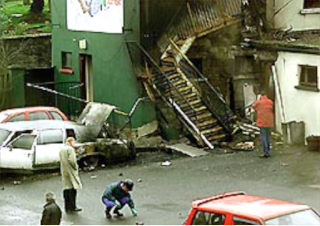
A Continuity Irish Republican Army (IRA) bomb explodes at Mahon’s Hotel in Irvinestown, County Fermanagh, Northern Ireland, on February 6, 2000, less than 24 hours before the Ulster Unionist Party’s Ken McGuinness is due to visit. The Continuity IRA is the only republican organisation which has not called a ceasefire.

The bombing follows repeated warnings from senior police officers on both sides of the Northern Ireland border that republican dissidents continue to pose a threat. Both the Continuity IRA and Real IRA have been recruiting and rearming in preparation for a campaign to wreck the Northern Ireland peace process.

The splinter republican organisation is behind a bomb attack on the Killyhevlin Hotel in Enniskillen in July 1996. The attack follows a week-long marching stand-off at Drumcree.

In September 1997, it places at bomb in Markethill, in County Armagh, just 24 hours after Sinn Féin joins the political negotiations which lead to the Good Friday Agreement.

In January 1998, a Continuity IRA bomb wrecks a club in County Fermanagh. The explosion coincides with a series of loyalist attacks, which follow the murder of the Portadown Loyalist Volunteer Force (LVF) leader Billy Wright.

The latest explosion in Irvinestown comes in a week when the new political institutions are facing suspension because of the stalemate over paramilitary arms decommissioning. This attack by the Continuity IRA looks deliberately timed to add to the peace process’s troubles.

BBC Northern Ireland political editor Stephen Grimason says the bomb will not help the current situation. “We are hearing an argument reinforced from unionists that if these things are left lying around then people will use them,” he says. “So the anti-agreement unionists will be using this as a weapon. But I would have thought it will harden the attitudes of the Ulster Unionist Council and the Ulster Unionist executive, meeting tonight on the issue of weapons,” he adds.

Grimason adds that unionists in general will want to hear about the forensics of the bomb and if there was a Semtex booster charge used. “They will use that as another means of saying that this is all the IRA,” he says. But he adds that there will be those who will see this as a move against Sinn Féin President Gerry Adams because it removes the room for manoeuvre that he has.

BBC Northern Ireland chief security correspondent Brian Rowan says the bomb contained one to two kilos of high explosive, but that the security forces had not yet revealed what type it is. He says the bomb had the appearance of the Continuity IRA which in “times of trouble made more trouble.” He adds, “They would see this as a reminder that they are still out there and as a reminder to other republicans that there is an alternative to the mainstream IRA, and to the peace process strategy. It is about damaging a process that this organisation very much opposes, a process in which they believe republicans principles have been sold out.”

Rowan says security sources believe in some areas the Real IRA, Continuity IRA and the more mainstream Irish National Liberation Army (INLA) co-operate in attacks. INLA prisoners have been released under the Good Friday Agreement early prisoner release scheme, following the INLA’s ceasefire declaration.

“In the Fermanagh area security forces believe the Continuity IRA is operating alone and there is a pattern of activity over a period of years. There is nothing to suggest it was any other group.” He says there is nothing coming from republicans or security sources at this time to suggest that the IRA has any intention of actual decommissioning in the “immediate period ahead.”

(From: “Bombing follows dissident pattern,” BBC News, http://www.news.bbc.co.uk, February 7, 2000 | Photo: RUC forensic experts examine the scene of the bomb attack at Mahons Hotel in Irvinestown, Northern Ireland, Associated Press)


Leave a comment

Birth of Political Cartoonist Ian Knox

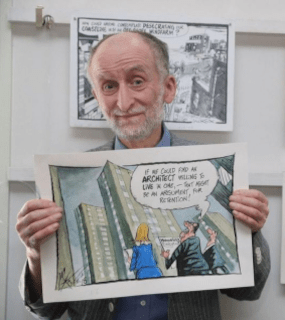
Ian Knox, political cartoonist for The Irish News, is born on May 4, 1943, in Belfast, Northern Ireland. He also draws cartoons for the BBC Northern Ireland political show Hearts and Minds.

Knox trains as an architect at Edinburgh College of Art in Scotland from 1963 to 1967 and Heriot-Watt University in Edinburgh from 1967 to 1968 and works as an architect before establishing himself as a cartoonist. He works in animation from 1970 to 1975 for Halas & Batchelor in London, Potterton Productions in Montreal, and Kotopoulis Productions in Toronto. He then joins Red Weekly and Socialist Challenge as a political cartoonist, as well as contributing to various children’s comics for IPC Media from 1975 to 1988.

Knox signs much of his political work “Blotski,” and he and Republican News cartoonist Brian Moore, better known as “Cormac,” work together as “Kormski,” drawing the anti-clerical strip “Dog Collars” for Fortnight magazine. Since 1989 he has been the editorial cartoonist for The Irish News, a nationalist newspaper based in Belfast. Since 1996 he has contributed the “As I See It” feature to Hearts and Minds on BBC2 Northern Ireland. From 1997 to 1998 he is political cartoonist for Ireland on Sunday.

Knox cites Ronald Searle, David Low, John Glashan, Victor Weisz, Steve Bell, Pat Oliphant and Charles Addams among those who have influenced him.


Leave a comment

Birth of Charlie Lawson, Northern Irish Actor

charles-lawson

Quintin Charles Devenish “Charlie” Lawson, actor from Northern Ireland best known for playing Jim McDonald in the ITV soap opera Coronation Street, is born in Enniskillen, County Fermanagh on September 17, 1959.

Lawson is raised in a Protestant family and is educated at Campbell College, a grammar school in Belfast. He then trains as an actor at the Guildhall School of Music and Drama in London, where a classmate and good friend of his is fellow Enniskillen native Adrian Dunbar, whom Lawson says is the first Catholic he has ever met.

Lawson appears in at least three films and in at least twenty television productions. He is probably best known for appearing as Jim McDonald in the ITV television soap opera Coronation Street. He first appears as Jim in 1989 and remains a regular character for eleven years, since which time his appearances have been few and far between.

Lawson’s other television work includes appearing as Seamus Duffryn in the 1982 Yorkshire Television thriller miniseries Harry’s Game (also known as Belfast Assassin), and as one of the main characters, Billy, in Mike Leigh‘s television film Four Days in July, both based on The Troubles in Northern Ireland. He plays Trigg in the 1989 television film The Firm and has also appeared in various other television series including Doctors, Bread, The Bill and Rosemary & Thyme.

In 2000, Lawson makes a programme for ITV Granada, Passion for Peace, which follows him back to Northern Ireland and reports on the creation of the Tim Parry Johnathan Ball Peace Centre in Warrington. In 2005 he appears in the TV documentary Titanic: Birth of a Legend. In 2009 he appears alongside an eight-foot Frankfurter sausage in a German television commercial, advertising hot dogs. His overdubbed catchphrase in the commercial is Betrachten Sie die Größe meiner Wurst! (English: “Look at the size of my sausage!”).

In 2010, Lawson reveals that he is returning to Coronation Street for its fiftieth anniversary celebrations. He speculates that bosses may be planning to kill his character off, however, this never happens. He stays until April 2011. He then returns for a three-month stint on the soap between August and November 2014.

In 2015, Lawson makes a guest appearance in an episode of the Comedy Central sitcom Brotherhood as the father of the three main characters. He also appears as Doctor Black in the 2016 BBC Northern Ireland drama My Mother and Other Strangers.

Lawson returns to Coronation Street in September 2018 with his supposed long-lost daughter from his relationship with Liz. On October 8, 2018, while portraying Inspector John Rebus in the play Long Shadows in Edinburgh, he suffers a minor stroke on stage but recovers shortly afterwards.

Lawson lives in Belfast with his partner, Debbie Stanley, having previously lived with her in Chester, Cheshire, for a number of years.


Leave a comment

Claire McCollum Proposes to Alastair Clarke

claire-mccollum

Claire McCollum, newsreader at Downtown Radio in Newtownards, County Down, Northern Ireland, makes headlines herself on February 29, 2000 when she proposes on air to Dungannon and Ulster rugby star Alastair Clarke and he accepts.

McCollum is born on June 5, 1974 in Carrickfergus, County Antrim. An MA graduate at the University of Dundee, she begins her career in broadcasting with Macmillan Media in 1997. She also works as a researcher for CNN and as a newsreader on Downtown Radio.

McCollum joins UTV in March 2000. As well as presenting and reporting for UTV Sport, she has also presented UTV News bulletins and Sport on Sunday.

In February 2009, McCollum announces she is leaving UTV as part of a voluntary redundancy scheme at the station. In an interview with a regional newspaper, she announces her intention to become a freelance broadcast journalist.

Following her departure from UTV, McCollum builds up her portfolio with BBC Northern Ireland. She becomes synonymous with many of Northern Ireland television’s highest profile events. She co-hosts BBC Proms in the Park at Titanic Slipways, the Olympic flame arriving at Belfast City Hall and the Clipper Homecoming in Derry.

McCollum also presents and reports on two series of the popular BBC Northern Ireland consumer programme In Your Corner and covers many major sporting events including the North West 200, Commonwealth Games in Manchester, Northern Ireland’s Football World Cup qualifiers, Tennis Legends in Belfast and the Belfast International Horse Show. She is also a regular presenter on Balmoral Agricultural Show and Children In Need programmes and hosts the second glittering ‘Celebrity Strictly Come Dancing’ extravaganza for Children in Need.

McCollum and Clarke have two children and reside in her hometown of Newtownabbey, County Antrim.


Leave a comment

Death of Broadcaster Derek Davis

derek-davis

Irish broadcaster Derek Davis dies in Dublin on May 13, 2015. On television, he co-hosts Live at 3, presents Davis at Large and Out of the Blue and wins Celebrity Bainisteoir.

Davis is born on April 26, 1948, in Bangor, County Down, Northern Ireland to a Protestant father and a Roman Catholic mother. He attends St. MacNissi’s College, a Catholic boarding school in County Antrim and describes his early childhood life as ecumenical. During his childhood he acquires a love of boats which later provide the inspiration for the TV series Out of the Blue.

Davis starts as a news reporter with the American network ABC and BBC Northern Ireland before spending 11 years in the newsroom at RTÉ. In the early 1980s he becomes a newsreader for The Six-o-clock News and begins to become well-known due to his sometimes-off-the-cuff comments on news stories.

Davis impersonates Big Tom on the RTÉ satirical programme Hall’s Pictorial Weekly and, as a result, is offered a part in a showband in Cork. After a ballroom tour, he joins RTÉ proper in 1975, initially to work as a television news reporter, eventually becoming newsreader on the nine o’clock news. In the mid-1980s, he hosts his own talk show, Davis at Large. It is on this show, which is screened live, that he is attacked and hurled across the studio by a guest female body builder. In addition to this he has an interactive summer current affairs show, simply called Davis. In 1986, he begins co-hosting (with Thelma Mansfield) RTÉ 1’s afternoon programme Live at 3, a role he fills for eleven years.

Davis presents the Rose of Tralee twice in 1995 and 1996, the first of these when Gay Byrne is taken ill at short notice. He memorably thanks the providers of the air conditioning while wiping sweat from his brow. Live at 3 comes to an end in 1997. Davis returns to the screen in the late 1990s with a marine programme devoted to boats and the waters around Ireland called Out of the Blue, which runs for four series, the last of which is broadcast in 2001.

In 2000, Davis presents a radio quiz show called A Question of Food. During the summer season he takes over RTÉ Radio 1‘s mid-morning slot usually occupied by Today with Pat Kenny, and he also hosts the radio phone-in show, Liveline, when regular presenter Joe Duffy is on holiday. Later, he presents Sunday Magazine with Davis on 4 on 4fm.

In 2005, Davis hosts a show called Time on Their Hands, a travel series for older people. One of his last television appearances is on the second season of Celebrity Bainisteoir in 2009, in which he and seven other Irish celebrities manage an intermediate Gaelic football club team from their home county in an official GAA tournament. Davis’s team wins the tournament.

During the 2010s, Davis makes frequent guest appearances on TV3‘s Tonight with Vincent Browne, where he and another guest preview the following morning’s papers.

After a short illness Derek Davis dies on May 13, 2015, at the age of 67. His funeral takes place in the Victorian Chapel, Mount Jerome Cemetery and Crematorium in Harold’s Cross, Dublin.