seamus dubhghaill

Promoting Irish Culture and History from Little Rock, Arkansas, USA


Leave a comment

Death of Leslie Montgomery, Playwright & Writer

lynn-doyle-ballygullion

Leslie Alexander Montgomery, playwright, humorist, and writer who writes under the pen name “Lynn Doyle,” dies in Dublin on August 18, 1961. He adopts the pseudonym for his writing, using a homophone of “linseed oil.” Supposedly, he chooses the name after seeing a large tin of linseed oil in a paint shop, initially signing “Lynn C. Doyle” but later dropping the “C.”

Born in Downpatrick, County Down on October 5, 1873, Montgomery is educated at Dundalk in County Louth. He commences work as a bank clerk at the age of 16, and remains with the Northern Banking Company, working in locations such as Keady and Cushendall before a transfer to the quaint seaside town of Skerries in County Armagh. There he becomes branch manager until his retirement in 1934.

Aside from this rather strait-laced, white-collar career, however, Montgomery fosters a life-time passion for writing in various forms and genres, and his contribution to Ulster literature in the early part of the 20th century should not be underestimated.

Montgomery is part of the Ulster Literary Theatre movement founded by Bulmer Hobson and David Parkhill in 1902, and early works include Love and Land, a play that is produced at the Little Theatre in London and represents Montgomery’s first critical success.

Other works during this decade include The Summons and The Lilac Ribbon. By the beginning of the 1920s, Montgomery is a leading northern playwright. He is best known, however for the Ballygullion series, twenty books which fondly caricature Northern Irish village life. The first in the series is published in 1908 and the last in 1957.

Montgomery writes the first book, which would lend its title to the rest of the series, in Dublin. This is followed by other works every few years such as Mr. Wildridge of the Bank, Lobster Salad, Dear Ducks, Me and Mr. Murphy and Rosabelle and Other Stories.

Written in the dialect of the east Ulster region, the stories celebrate an imaginary townland area in the Slieve Gullion region of County Down. They reflect Montgomery’s early years there and in Dundalk. The books also reveal a lot about contemporary Ulster life.

The versatile writer also produces poetry during the 1930s. Ballygullion Ballads, published in 1936 is illustrated by the famous Belfast artist William Conor, as are several of the later editions of his books.

In 1936, Montgomery has the somewhat dubious honour of being the first Irish writer to be appointed to the Censorship Board. He resigns within two years of accepting the job, however, claiming that it is “so terribly easy to read only the marked passages, so hard to wade through the whole book afterwards.”

Following his retirement from the Northern Banking Company, he gains further notoriety as a lecturer, and also regularly broadcasts his stories for the fledgling BBC in Belfast. Indeed, his most productive period as a writer is in his 1960s, during which time he writes his autobiography, An Ulster Childhood, in 1954.

Montgomery dies in Dublin on August 18, 1961, but his legacy is preserved in the Lynn Doyle Collection at Belfast Central Library, which consists of a series of archival boxes which were purchased by the library. The collection is extensive, and includes broadcasts and lecture transcripts, manuscripts, essays, short stories, poetry, personal correspondence, photographs, land leases and legal documents.


Leave a comment

Death of Keyboardist Lou Martin

lou-martin

Louis Michael “Lou” Martin, piano and organ player from Belfast, dies in Bournemouth, Dorset, on August 17, 2012. He is most famous for his work with the London-based band Killing Floor and with fellow Irish musician Rory Gallagher.

Martin is born in Belfast on August 12, 1949. He starts learning the piano at the age of six and joins his first professional band, Killing Floor, in April or May 1968. In 1969 Martin and Stuart McDonald are recruited by 17-year-old Darryl Read who forms a band for Emperor Rosko‘s brother, Jeff Pasternak, called Crayon Angels. Read assembles the band and plays drums while Rosko acts as manager. Martin later leaves Killing Floor to play alongside Gallagher, and is featured on several of Gallagher’s albums, including Blueprint, Tattoo, Irish Tour ’74, Against the Grain, Calling Card, Defender and Fresh Evidence. He also plays rhythm guitar on one track, “Race the Breeze” from Blueprint.

After leaving Gallagher’s band, Martin and drummer Rod de’Ath form Ramrod, after which Martin plays with Downliners Sect and Screaming Lord Sutch. He also tours with Chuck Berry and Albert Collins.

Martin plays in the Nickey Barclay band in London in the 1980s, alongside Barclay on keyboards, with John Conroy and Dave Ball on lead guitar. The band plays across London on the blues rock circuit during the 1980s at venues such as The White Lion, Putney, The Star and Garter on Lower Richmond Road, The Golden Lion, Fulham and the Cartoon, Croydon.

Killing Floor releases an album in 2004 named Zero Tolerance, on which Martin participates.

After a period of illness including cancer and a number of strokes, Lou Martin dies peacefully in a hospital in Bournemouth, Dorset, at the age of 63, on August 17, 2012.


Leave a comment

The Bayardo Bar Attack

bayardo-bar-attack

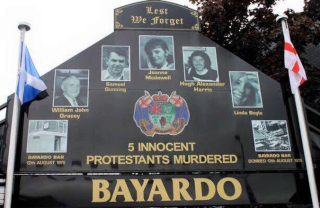
The Bayardo Bar attack takes place on August 13, 1975, in Belfast as a unit of the Provisional Irish Republican Army (IRA), led by Brendan McFarlane, launch a bombing and shooting attack on a pub on Aberdeen Street, in the loyalist Shankill Road area of the city.

By 1975, the conflict in Northern Ireland known as “the Troubles” is more than six years old. On February 10, 1975, the Provisional IRA and the British government enter into a truce and restart negotiations. There is a rise in sectarian killings during the truce, which ‘officially’ lasts until early 1976. The truce, however, is interrupted in the early hours of July 31, 1975, by the Miami Showband killings at Buskhill outside Newry, County Down.

Two weeks later, on August 13, 1975, the Bayardo Bar is crowded with people of all ages. Shortly before closing time a stolen green Audi automobile, containing a three-man unit of the IRA’s Belfast Brigade, pulls up outside. It is driven by the unit’s leader Brendan “Bik” McFarlane, a 24-year-old volunteer from Ardoyne. Volunteers Seamus Clarke and Peter “Skeet” Hamilton get out and approach the pub’s side entrance on Aberdeen Street. One of them immediately opens fire with an ArmaLite, instantly killing doorman William Gracey and his brother-in-law Samuel Gunning, with whom he had been chatting outside. The other volunteer then enters the pub, where patrons are drinking and singing, and drops a duffel bag containing a ten-pound bomb at the entrance. Both men make their getaway back to the waiting car. As panicked customers run to the toilets for safety, the bomb explodes and brings down a section of the old brick-and-plaster building upon them. The bodies of civilian Joanne McDowell and UVF member Hugh Harris are later found beneath the rubble of fallen masonry. Seventeen-year-old civilian Linda Boyle is pulled out alive but dies of her injuries at the hospital on August 21. Over 50 people are injured in the attack.

A Belfast Telegraph article later claims that, as the IRA unit drives away down Agnes Street, they fire into a crowd of women and children queuing at a taxi rank although there are no fatalities. Within 20 minutes of the blast, the IRA unit is arrested after their car is stopped at a roadblock. The ArmaLite that had been used to kill Gracey and Gunning is found inside the car along with spent bullet casings and fingerprints belonging to the three IRA men.

The IRA does not initially claim responsibility, however, IRA members later state that the Bayardo was attacked because it was a pub where Ulster Volunteer Force (UVF) members met and planned terrorist assaults against nationalists. The pub is in the UVF-dominated middle Shankill Road area, and the Ulster Banner is displayed from its upper windows. A former IRA prisoner claims that fellow inmate Lenny Murphy told him he had left the Bayardo ten minutes before the attack and that the Brigade Staff had just finished holding a meeting there.

Loyalists, especially the UVF, respond with another wave of sectarian attacks against Catholics. Two days after the pub attack, a loyalist car bomb explodes without warning on the Falls Road, injuring 35 people. On 22 August, the UVF launches a gun and bomb attack on McGleenan’s Bar in Armagh. The attack is strikingly similar to that at Bayardo. One gunman opens fire while another plants the bomb, the explosion causing the building to collapse. Three Catholic civilians are killed and several more are wounded. That same night, another bomb wrecks a Catholic-owned pub in nearby Blackwatertown, although there are no injuries.

In May 1976, Brendan McFarlane, Seamus Clarke, and Peter Hamilton are convicted in a non-jury Diplock court and sentenced to life imprisonment inside the HM Prison Maze for carrying out the Bayardo murders. In 1983 McFarlane leads the Maze Prison escape, a mass break-out of 38 republican prisoners, including Clarke and Hamilton.


Leave a comment

Operation Demetrius

long-kesh-internment-camp

Operation Demetrius, a British Army operation in Northern Ireland begins on August 9, 1971, during the Troubles. The operation involves the mass arrest and internment (imprisonment without trial) of 342 people suspected of being involved with the Irish Republican Army (IRA), which is waging a campaign for a united Ireland against the British state.

Operation Demetrius, proposed by the Government of Northern Ireland and approved by the Government of the United Kingdom, begins throughout Northern Ireland in the early morning hours of Monday, August 9 and progresses in two parts:

  1. Arrest and movement of the detainees to one of three regional holding centers: Girdwood Barracks in Belfast, Abercorn Barracks in Ballykinler, County Down, or HM Prison Magilligan near Limavady, County Londonderry.
  2. The process of identification and questioning, leading either to release of the detainee or movement into detention at HM Prison Crumlin Road or aboard HMS Maidstone, a prison ship in Belfast Harbour.

The operation sparks four days of violence in which 20 civilians, two IRA members and two British soldiers are killed. All of those arrested are Irish nationalists, the vast majority of them Catholic. Due to faulty intelligence, many have no links with the IRA. Ulster loyalist paramilitaries are also carrying out acts of violence, which are mainly directed against Catholics and Irish nationalists, but no loyalists are included in the sweep.

The introduction of internment, the way the arrests are carried out, and the abuse of those arrested, lead to mass protests and a sharp increase in violence. Amid the violence, about 7,000 people flee or are forced out of their homes. The interrogation techniques used on some of the internees are described by the European Commission of Human Rights in 1976 as torture, but the superior court, the European Court of Human Rights (ECHR), rules on appeal in 1978 that, although the techniques are “inhuman and degrading”, they do not, in this instance, constitute torture. It is later revealed that the British government had withheld information from the ECHR and that the policy had been authorized by British government ministers. In December 2014, in light of the new evidence, the Irish government asks the ECHR to revise its 1978 judgement. The ECHR declines the request in 2018.

The backlash against internment contributes to the decision of the British Government under Prime Minister Edward Heath to suspend the Northern Ireland Government and replace it with direct rule from Westminster, under the authority of a British Secretary of State for Northern Ireland. This takes place in 1972.

Following the suspension of the Northern Ireland Government and Parliament, internment is continued by the direct rule administration until December 5, 1975. During this time 1,981 people are interned, 1,874 are nationalist while 107 are loyalist. The first loyalist internees are detained in February 1973.

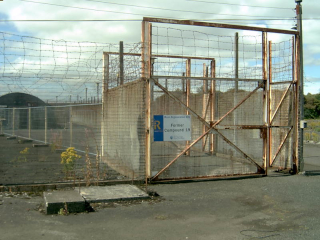
(Pictured: The entrance to Compound 19, one of the sections of Long Kesh internment camp)


Leave a comment

Premiere of “O’Neil of the Glen”

o-neil-of-the-glen

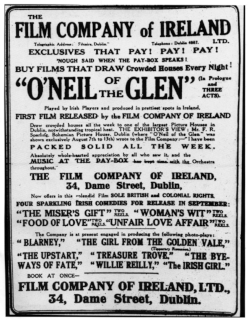
O’Neil of the Glen, the first production released by the Film Company of Ireland (FCOI), premieres at Dublin’s Bohemian Picture Theatre on August 7, 1916. The film is adapted by W.J. Lysaght from a book by the acclaimed Irish novelist, Mrs. M. T. Pender. The film is a romantic tale which features two well-known Abbey Theatre members, as well as a host of rising stars.

Formed in March 1916 by James Mark Sullivan and Henry Fitzgibbon, the FCOI becomes the most important indigenous fiction film producer of the 1910s.

On 29 June, FCOI announces a “trial exhibition,” or what would now be called a test screening, of their first completed production, O’Neil of the Glen, at Dublin’s Carlton Cinema. Addressing a lunch for the press at the Gresham Hotel following the screening, Fitzgibbon claims that FCOI “had started an industry which would eventually be a source of great revenue in Ireland.” For his part, Sullivan argues that the film showed that Irish productions – taking advantage of Irish “imagination, ideals, and artistic temperament and beautiful scenery” – could compete with those anywhere.

The Bohemian is one of Dublin’s biggest and most luxurious cinemas, and Frederick A. Sparling’s commitment to a run that is twice the usual three days “speaks well for the film and the undoubted drawing powers such a production will have for Irish audiences.” In the event, Sparling also includes an unplanned Sunday show to take advantage of the phenomenal level of interest.

In the following weeks and months, O’Neil of the Glen is exhibited around the country. Following substantial runs in Dublin and Belfast it is announced for a three-day runs at Galway’s Victoria Cinema Theatre on September 11-13 and Cork’s Coliseum Theatre on September 14-16.


Leave a comment

Birth of Elizabeth Hamilton, Poet & Novelist

LEAD Technologies Inc. V1.01

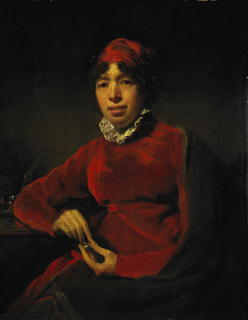
Elizabeth Hamilton, essayist, poet, satirist and novelist, is born in Belfast on July 25, 1756, though the date is often given as 1758.

Hamilton is born to Charles Hamilton (d.1759), a Scottish merchant, and his wife Katherine Mackay (d.1767). She lives most of her life in Scotland, moving there in 1762 to live with a Mrs. Marshall, her paternal aunt, near Stirling and spending much of her later life in Edinburgh.

Hamilton’s first literary efforts are directed in supporting her brother Charles in his orientalist and linguistic studies. After his death in 1792 she continues to publish orientalist scholarship, as well as historical, educationalist and theoretical works. She writes The Cottagers of Glenburnie (1808), a tale which has much popularity in the day, and perhaps has some effect in the improvement of certain aspects of humble domestic life in Scotland. She also writes the anti-Jacobin novel Memoirs of Modern Philosophers (1800), and the satirical Translation of the Letters of a Hindoo Rajah in 1796, a work in the tradition of Montesquieu and Oliver Goldsmith. Her most important pedagogical works are Letters on Education (1801), Letters on the Elementary Principles of Education (1801), Letters addressed to the Daughter of a Nobleman, on the Formation of Religious and Moral Principle (1806), and Hints addressed to the Patrons and Directors of Schools (1815).

Elizabeth Hamilton dies in Harrogate, North Yorkshire, England on July 23, 1816, following a short illness.

(Pictured: Portrait of Elizabeth Hamilton, 1812, by Sir Henry Raeburn)


Leave a comment

Birth of James Owen Hannay, Clergyman & Novelist

Generated by IIPImage

James Owen Hannay, Irish clergyman and prolific novelist who writes under the pen name of George A. Birmingham, is born on July 16, 1865, in Belfast. Today the house where he is born is a part of the administration building of Queen’s University Belfast.

Hannay receives his education in England. He enters Temple Grove School near the River Thames at the age of nine, and later studies at a public school called Haileybury School. He then returns to Ireland to enter the Divinity School of Trinity College Dublin. He is ordained in 1889 as a Church of Ireland (Anglican) minister and starts working as a curate for Delgany, County Wicklow, a seaside town south of Dublin.

To make up for a deficiency in their living Hannay writes a short story and sends it to a London publisher. It is accepted for publication, and he receives a check of £10. On his wife’s advice, he gives up writing fiction and commits himself to the study of Christian theology with her. This bears fruit with the publications of The Spirit and Origin of Christian Monasticism (1903) and The Wisdom of the Desert (1904).

Hannay then serves as rector of Holy Trinity Church in Westport, County Mayo. It is here that he makes his debut as a novelist. His early writings raise the ire of nationalist Catholics, and he withdraws from the Gaelic League in the wake of ongoing protests about the tour of his successful play General John Regan.

Hannay becomes rector of Kildare parish from 1918 to 1920, and after serving as chaplain to the Lord Lieutenant of Ireland, he joins the British ambassadorial team in Budapest in 1922. He returns to officiate at Mells, Somerset from 1924 to 1934, after which he is appointed vicar of Holy Trinity Church in the London suburb of Kensington where he serves from 1934 until his death in London on February 2, 1950.

Hannay enjoys sailing and is taught the rudiments by his father and grandfather in Belfast. When he is based in Westport, the financial success of his writing enables him to purchase a boat, a Dublin Bay Water Wag. In recognition of Hannay, the Water Wag Club of Dun Laoghaire returns to Westport and Clew Bay in 2016. In the frontispiece of his book The Inviolable Sanctuary Hannay includes a picture of the Water Wag.


Leave a comment

2012 North Belfast Riots

belfast-violence-july-2012

The first incident of the 2012 North Belfast Riots occurs on July 12, 2012, during “The TwelfthLoyalist celebrations. The sectarian disorder and rioting between loyalists and republicans take place when rival parades, authorised by the Parades Commission, take place.

Catholic rioting has been common in recent years when the parades are forced through the mostly Irish nationalist Ardoyne in north Belfast. The local Orangemen parade down the predominantly Ulster loyalist Crumlin Road towards the loyalist Woodvale area. Before turning into the Woodvale, they are met by Irish republican protesters and a nearby counter-parade organised by the Greater Ardoyne Residents Association (GARC). Nationalists then attack the Police Service of Northern Ireland (PSNI) and the parade with bricks, bottles and petrol bombs.

There is also violence in the Bogside area of Derry, where petrol bombs are thrown at police and a car is set afire. In south and east Belfast there are five arrests for a variety of offences including disorderly behaviour.

Prolonged attacks on the PSNI by Catholics follow the parades with missiles being thrown at police lines. Three cars are hijacked and pushed at police lines with at least one of them being set on fire, and at night ten shots are fired at police by a nationalist gunman who intends to kill police officers. On July 18, 2012, a 47-year-old man is charged with attempted murder of the police officers. The PSNI blames the violence on “thugs” and makes a further 26 arrests across Northern Ireland relating to the trouble.

In another incident during a different parade, a Shankill Road-based loyalist band “The Young Conway Volunteers” is filmed by a Sinn Féin activist playing The Famine Song outside St. Patrick’s Catholic Church in Ardoyne. The activist filming the incident is attacked by band members who try to snatch the phone from him. The incident brings condemnation, with Sinn Féin declaring it “provocative.” Protestant church leaders also condemn the incident as “blatantly sectarian.” It is this incident that is believed to ignite tensions in the area which continue over the next few months.

In the days that follow strong loyalist criticism is levelled at the Parades Commission blaming them for the violence. Nigel Dodds of the Democratic Unionist Party (DUP) accuses the Parades Commission of making a “bizarre, crazy, and mad decision” to allow the nationalist parade to coincide with the Orange parade while Sinn Féin’s Gerry Kelly blames the Orangemen for violating regulations set out by the Parades Commission. The Parades Commission denies responsibility, explaining “We have to balance the rights of everybody concerned in parades, not just the rights of paraders, but the rights of people who live in the areas and the rights of police officers.”


Leave a comment

Death of Hunger Striker Joe McDonnell


joe-mcdonnell

Joseph (Joe) McDonnell, a volunteer in the Provisional Irish Republican Army (IRA), dies on July 8, 1981, after 61 days on hunger strike during the 1981 Irish hunger strike.

McDonnell is born on Slate Street in the lower Falls Road of Belfast, Northern Ireland on September 14, 1951, as one of ten children. He attends a nearby Roman Catholic school. He marries Goretti in 1970 and moves into her sister’s house in Lenadoon. There are only two Catholic houses in this predominantly Ulster Protestant housing estate, and their house is attacked on numerous occasions.

McDonnell is arrested in Operation Demetrius and, along with Gerry Adams and others, is interned on the prison ship HMS Maidstone. He is later moved to HM Prison Maze in County Down for several months. Upon release, he joins the Provisional IRA Belfast Brigade. He meets Bobby Sands during the preparation for a firebomb attack on the Balmoral Furnishing Company’s premises in Dunmurry. During the ensuing shoot-out between the IRA and the Royal Ulster Constabulary (RUC) and British Army, both men, along with Séamus Finucane and Seán Lavery, are arrested. McDonnell and the others are sentenced to 14 years in prison for possession of a firearm. None of the men accept the jurisdiction of the court.

McDonnell agrees with the goals of the Irish hunger strike, namely: the right not to wear a prison uniform; the right not to do prison work; the right of free association with other prisoners; the right to organise their own educational and recreational facilities and the right to one visit, one letter and one parcel per week.

Although McDonnell is not involved in the first hunger strike in 1980, he joins Bobby Sands and the others in the second hunger strike the following year. During the strike he fights the general election in the Republic of Ireland, and only narrowly misses election in the Sligo–Leitrim constituency. He goes 61 days without food before dying on July 8, 1981. He has two children. His wife takes an active part in the campaign in support of the hunger strikers.

McDonnell is buried in the grave next to Bobby Sands at Milltown Cemetery in west Belfast. John Joe McGirl, McDonnell’s election agent in Sligo–Leitrim, gives the oration at his funeral. Quoting Patrick Pearse, he states, “He may seem the fool who has given his all, by the wise men of the world; but it was the apparent fools who changed the course of Irish history.”

McDonnell is commemorated on the Irish Martyrs Memorial at Waverley Cemetery in Sydney, Australia and is also commemorated in The Wolfe Tones song, “Joe McDonnell.”


Leave a comment

Birth of Forrest Reid, Novelist & Critic

forrest-reid

Forrest Reid, novelist, literary critic and translator, is born in Belfast on June 24, 1875. He is, along with Hugh Walpole and J. M. Barrie, a leading pre-war novelist of boyhood. He is still acclaimed as the greatest of Ulster novelists and is recognised with the award of the 1944 James Tait Black Memorial Prize for his novel Young Tom.

Reid is the youngest son of a Protestant family of twelve, six of whom survive. His mother, his father’s second wife, comes from an aristocratic Shropshire family. Although proud of this ancestry, he finds the strict Protestant ethics of his immediate family constricting. He is educated at the Royal Belfast Academical Institution, after which he is initially apprenticed into the Belfast tea-trade before going to Christ’s College, Cambridge, where he reads medieval and modern languages, and is influenced by the novelist E. M. Forster. His first book, The Kingdom of Twilight, is published in 1904. Following graduation in 1908, he returns to Belfast to pursue a writing career.

As well as his fiction, Reid also translates poems from the Greek Anthology. His study of the work of W. B. Yeats, W. B. Yeats: A Critical Study, has been acclaimed as one of the best critical studies of that poet. He also writes the definitive work on the English woodcut artists of the 1860s, Illustrators of the Sixties (1928). His collection of original illustrations from that time is housed in the Ashmolean Museum, Oxford.

Reid is a close friend of Walter de la Mare, whom he first meets in 1913, and about whose fiction he publishes a perceptive book in 1929. He is also an influence on novelist Stephen Gilbert and has good connections to the Bloomsbury Group of writers. He is a founding member of the Imperial Art League (later the Artists League of Great Britain) and is also a close friend of Arthur Greeves, the artist known to be C. S. Lewis‘s best friend. Greeves paints several portraits of Reid, now all in the possession of the Royal Belfast Academical Institution.

Reid publishes articles in many magazines, including Uladh, The Westminster Review and the Ulster Review, and he reviews books for The Manchester Guardian. Apostate, an autobiography, is published in 1926, and its sequel, Private Road, is published in 1940. He is a founder member of the Irish Academy of Letters.

Forrest Reid dies on January 4, 1947, in Warrenpoint, County Down, Northern Ireland.

Though Reid’s books are not necessarily well known today, he has been labelled “the first Ulster novelist of European stature,” and comparisons have been drawn between his own coming of age novel of Protestant Belfast, Following Darkness (1912), and James Joyce‘s seminal novel of growing up in Catholic Dublin, A Portrait of the Artist as a Young Man (1914). Reid’s fiction, which often uses submerged narratives to explore male beauty and love, can be placed within the historical context of the emergence of a more explicit expression of homosexuality in English literature in the 20th century.

A ‘Forrest Reid Collection’ is held at the University of Exeter, consisting of first editions of all Reid’s works and books about him. Many of his original manuscripts are in the archives of the Belfast Central Library. In 2008, Queen’s University Belfast catalogues a large collection of Forrest Reid documentary material including many letters from E. M. Forster.

In 1952 Forster travels to Belfast to unveil a plaque commemorating Forrest Reid’s life at 13 Ormiston Crescent.