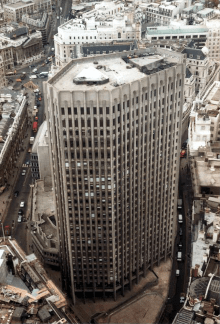
The London Stock Exchange bombing occurs at 8:49 a.m. on the morning of July 20, 1990, with the explosion of a 5 to 10 lb. (2.3 to 4.5 kg) bomb of high explosives inside the London Stock Exchange building on Threadneedle Street in the City of London, England, planted by the Provisional Irish Republican Army (IRA). The building and surrounding area are evacuated after the IRA gives a telephone warning 40 minutes prior to the explosion, and thus nobody is wounded. As many as 300 people are evacuated from the building alone. The bomb’s strength blows a 10-foot hole inside the Stock Exchange Tower and causes massive damage to the visitors’ gallery on the first floor, which is frequently used by foreign tourists and schoolchildren and had been scheduled to open ten minutes after the explosion. The bomb is placed in the men’s toilets behind the gallery. The gallery and public viewing area is forced to close in 1992.
The bombing comes on the eighth anniversary of the July 20, 1982, Hyde Park and Regent’s Park bombings which killed eleven soldiers and wounded 53 people. The IRA launches a renewed campaign in London in 1990. During May, a soldier at an army recruiting centre is killed by a bomb in Wembley, while five are injured in a similar explosion in Eltham. In June 1990, bombs at the Honourable Artillery Company (HAC) and the Carlton Club injure 19 and 20 people respectively.
Scotland Yard‘s anti-terrorist chief George Churchill-Coleman says eight phone calls from the same man with an Irish accent are made between 8:02 a.m. and 8:20 a.m. to the City of London Police, the London Fire Brigade, Reuters, the Financial Times, The Salvation Army and the Stock Exchange itself. The caller telephones Reuters just after 8:00 a.m. and says, “This is the IRA. The bomb is due to go off in half an hour at the stock exchange.” The caller then gives a code word that the police say is known to them and used by the IRA to show that its threats are serious, and says, “Clear the building.”
The Stock Exchange’s chairman, however, says after the attack, “If the purpose of this callous act was to bring the City to a halt, they have failed singularly.” The explosion has little impact on stock trading since that is being carried out by computers elsewhere.
A spokesman for Prime MinisterMargaret Thatcher says she is “appalled when people leave explosive devices in this manner in public areas.” On October 12, 1984, a bomb planted by the IRA at the Grand Brighton Hotel in Brighton, where the Conservative Party is holding its annual conference, kills five people and comes close to killing Thatcher.
In 1992, the IRA bombs the Baltic Exchange building in the city.
(Pictured: The Stock Exchange Tower in 1983, taken from the top of the National Westminster Tower (now Tower 42), clearly showing the symbolic coffin shape of the building)
Allen is born on July 6, 1936, in a nursing home at 37 Lower Leeson Street, Dublin, the youngest of three sons of (Gerard John) Cullen Tynan Allen, journalist, manager of The Irish Times, and raconteur, and his wife Jean Ballantyne (née Archer), an English-born nurse. His paternal grandmother, Nora Tynan O’Mahony, is the first women’s features editor of the Freeman’s Journal, and the poet Katharine Tynan is his great-aunt. Allen loses half a finger on his left hand in a childhood accident which becomes a favourite theme (and occasional prop) in his shows.
After initially attending Beaumont convent school, Allen goes to Firhousenational school, County Dublin, near the family residence outside Templeogue. For a period during World War II, he lives with his mother and brothers at Keenagh, County Longford, where they had moved for fear that Dublin might be targeted by air raids. On returning to Dublin, he goes to Terenure College, run by the Carmelite fathers. His reminiscences in later life often centre on memories of frequent and sadistic corporal punishment, and warnings from priests that adolescent male sexuality is a device of Satan leading straight to hell. His resentment is formative in his lifelong and outspoken atheism.
Allen, who is close to his father, is severely affected emotionally by his death in 1948, after which his relations with the school deteriorate further. The discovery that his father’s drinking and gambling had left the family heavily indebted means that, notwithstanding assistance from journalistic friends, his elder brothers are obliged to leave school and work as journalists to support the family. Restless and even more discontented at school than previously, he often plays truant to visit museums and art galleries. Expelled from Terenure College, he briefly attends the Catholic University School before leaving school at the age of 16. After working as a clerk for the Irish Independent, in 1954 he becomes a journalist on the Drogheda Argus, reporting weddings and gymkhanas. He later attributes this career path to the contemporary tradition of following a family profession.
Moving to London but failing to secure a job on a Fleet Street newspaper, Allen follows his brother John by becoming a “redcoat” attendant at Butlin’s holiday camps in Filey (Yorkshire), Skegness, Margate, and Brighton, performing various functions and telling jokes and stories during intervals between stage acts. In the winters he sells educational toys in Sheffield. Acquiring an agent, he becomes a professional comedian, adopting the stage name Dave Allen. He initially works the declining club and variety circuit, later claiming that he had toured with the last old-style nude tableaux show. In 1959, he makes his first television appearance on the BBC talent show New Faces and realises that television is the medium of the future. He tours with pop singer Helen Shapiro in 1963 and 1964, joined in the latter year by an emerging support band, the Beatles. At this period, he models himself on American stand-up comedians such as Jerry Lewis, focusing his act on discrete gags leading up to a punchline.
While performing in support of the singer Helen Traubel in Australian nightclubs, Allen often reminisces to her off stage about his early life. Traubel suggests that he incorporate such material into his act. Such is the genesis of his mature style of rambling absurdist monologues, which he describes as influenced by the Irish storytelling tradition in general, and his father’s stories in particular. After appearing in Melbourne and Sydney, he becomes the host of a ninety-minute chat show, Tonight with Dave Allen, on Sydney-based Channel 9. Eighty-four episodes are recorded of what becomes one of Australian television’s most successful programmes ever, its popularity boosted by the rumour that he is having an affair with singer Eartha Kitt, his hilarious interviews with eccentrics, and the frequent deployment of dangerous animals onstage.
Allen marries the English actress Judith Stott in Australia on March 9, 1964, a divorcée with one son. They have two children, including the comedian Ed Allen (Edward James Allen). After separating in 1980, the couple divorces in 1983. Returning to England in December 1964 to be with his wife, he establishes a reputation there through well-received performances as a compère at the televised Sunday Night at the London Palladium (1967) and The Blackpool Show (1966). After a slot as resident comedian on The Val Doonican Show (1965–67), he obtains his first stand-alone show, Tonight with Dave Allen, in 1967 on ITV, a mixture of sketches with the monologues for which he becomes best known. He usually performs seated on a barstool, smoking a cigarette, and sipping from a presumed glass of whiskey (actually ginger ale), while musing on the oddities of life, often expressing his suspicion of authority figures. His signature farewell phrase is “Goodnight, and may your God go with you.”
On BBC television Allen headlines two programmes: The Dave Allen Show (1968–69), and Dave Allen at Large (1971–79). He writes much of his own material, compulsively scouring newspapers for items that he can work into his act. He resists suggestions that he should move to an early evening slot, as this would entail restrictions on his material. In the 1970s and 1980s he tours widely with a one-man stage show, “An evening with Dave Allen,” containing more “adult” material than would be allowed on television at the time. His stage performances are less well-received in the United States than elsewhere.
Allen’s treatment of sex and religion involves him in frequent controversies. Priests and the confessional are frequent targets. In 1975, he provokes widespread protests from Catholics over a sketch in which the pope, played by Allen himself, and his cardinals perform a striptease on the steps of St. Peter’s Basilica. In 1977, his shows are banned from RTÉ. In 1984, the British anti-indecency campaigner Mary Whitehouse formally complains about his televised act, with particular reference to a simulated post-coital conversation. As with many stage comedians, his angry and outspoken stage persona contrasts with a reserved offstage life. He keeps his stage persona distinct from his private life and does not allow his children to attend his shows.
Allen gives occasional straight performances, notably in Edna O’Brien‘s plays A Pagan Place (1972) and Flesh and Blood (1985); in the dual roles of Captain Hook and Mr. Darling in a production of Peter Pan (1973); and in Alan Bennett‘s television play One Fine Day (1979). He has a supporting role in the Australian comedy film Squeeze a Flower (1970). He also presents several documentaries, notably Dave Allen in the Melting Pot (1969); surveying life in New York City, he discusses racism and drug addiction and conducts one of the first television interviews with openly gay men. Other documentaries for ITV include Dave Allen in Search of the Great English Eccentric (1974), and Dave Allen (1978), which deals with American eccentrics. Long fascinated with ghost stories, he publishes an anthology of horror stories, A Little Night Reading (1974).
In the 1980s, Allen is regarded by many fans of the new, politically engaged “alternative comedians” as old-fashioned. His leisurely style contrasts with their quick-fire delivery, and some of his references to the Irish and other ethnic groups are seen as demeaning. He makes a partial television comeback with a six-part BBC One series, Dave Allen (1990), using considerably more outspoken material than he had previously deployed on television.
In 1993, Allen appears in a six-part series for the new ITV London franchise, Carlton Television. Thereafter he moves into semi-retirement, partly because of health problems, while continuing to make guest television appearances. At the British Comedy Awards he is named best comedy performer (1993) and is granted a lifetime achievement award (1996). He occasionally releases videos of older material “to keep myself in the style to which I had become accustomed – a bit of an Irish retirement, actually.” He maintains tight editorial control over his recordings, having been annoyed when his first television shows were chopped and changed when re-broadcast by American networks. They are released on DVD after his death. He presents a six-part BBC series based on his old material, The Unique Dave Allen (1998). After giving his last performance on BBC Radio 4 in 1999, he retires and devotes himself to his hobby as an amateur painter.
After a seventeen-year relationship, Allen marries secondly Karin Stark, a theatrical producer, on December 9, 2003. Their one son is born three weeks after Allen dies peacefully in his sleep as a result of sudden arrhythmic death syndrome on March 10, 2005, in Kensington, London.
A selection of his routines, edited by Graham McCann, is published as The Essential Dave Allen (2005). His obituarists see him as prefiguring the aggressive mocking of authority by the alternative comedians who had once criticised him, and as paving the way for such irreverent and anti-deferential satire of political and religious authority as Not the Nine O’Clock News and Father Ted. The widespread use of the monologue by Irish dramatists such as Conor McPherson in the first decade of the twenty-first century also owes something to his influence.
(From: “Allen, Dave” by Patrick Maume, Dictionary of Irish Biography, http://www.dib.ie, June 2011)
On January 21, 2002, Sinn Féin‘s four MPs take the historic step of signing up to use the facilities of the House of Commons, whose authority over Northern Irelandrepublicans have been fighting for almost a century. Party policy is also changed to allow MPs to sit in the Irish Parliament, the Dáil.
Amid concern among some republicans that the move comes close to recognising British rule, Sinn Féin president and Belfast West MP, Gerry Adams, insists that his party will never take its seats at Westminster. “There will never ever be Sinn Féin MPs sitting in the British houses of parliament,” he tells a Westminster press conference.
However, flanked by his three fellow Sinn Féin MPs, Martin McGuinness (Mid Ulster), Pat Doherty (West Tyrone) and Michelle Gildernew (Fermanagh and South Tyrone), Adams says taking up seats in the Dáil is a very different proposition from doing so the Commons. No Sinn Féin member would take the loyalty oath to the Queen, needed to take up a seat in Parliament, but that was a mere side issue to the key question of sovereignty, he says. Even if the oath were amended, the party would still refuse to take its seats because republicans do not recognise parliament’s jurisdiction over Northern Ireland.
“There are lots of things which there can be no certainty of and there are some things of which we can be certain,” Adams says. “There will never, ever be Sinn Féin MPs sitting in the British Houses of Parliament. The transfer of power by London and Dublin to the Assembly in the north … is all proof of where we see the political centre of gravity on the island of Ireland and that is in the island of Ireland.”
Adams insists his party’s presence in the Commons is a “temporary” measure until they can join the parliament of a united Ireland.
A ban on MPs using Commons facilities without taking the loyalty oath was lifted in December 2001 to Conservative fury. Tories end three decades of cross-party cooperation over the move, which also entitles Sinn Féin’s four MPs to allowances of £107,000 a year each.
Shadow Secretary of State for Northern IrelandQuentin Davies claims Adams plans to use the cash for party political campaigning – something forbidden by Westminster rules. He accuses British Prime MinisterTony Blair of “deliberately contributing to a great propaganda coup in which … the British Government are licking their boots.” The Prime Minister’s spokesman says Blair acknowledges “many victims do feel very strongly about what has happened, but the Prime Minister’s view is that this peace process has saved many lives.”
Sitting alongside a giant Irish tricolour inside his new office, Adams likens his presence there to that of MPs who had served in the British Army and intelligence services – suggesting some of them still do. He also dismisses concerns about the misuse of the money, accusing those “complaining loudest” of being from parties “indicted for corruption and sleaze.”
Sinn Féin’s move into their new offices coincides with a “routine” meeting with the Prime Minister in Downing Street to discuss the peace process. The Sinn Féin president uses publicity surrounding the controversial move to issue a new challenge to Blair to tackle the loyalist “killing campaign.” Adams is joined in Downing Street by his three fellow Sinn Féin MPs.
“There have been 300 bombs over the last nine or ten months,” Adams says. “The British Prime Minister has to face up to the reality that the threat to the peace process within Northern Ireland comes from within loyalism.”
Adams blames Betty Boothroyd‘s decision to bar Sinn Féin MPs from using Commons facilities for the current controversy. “We are here, elected, with our mandate renewed and increased,” he adds.
Adams is asked how he would react if he met former Cabinet minister Lord Tebbit and his wife, who was badly injured by the 1984 Provisional Irish Republican Army (IRA) bomb attack at the Tories conference at the Grand Brighton Hotel in Brighton, at the Commons. “I don’t ignore anyone. As someone who has been wounded and shot and someone whose house has been bombed, I understand precisely how others who have suffered more than me feel about all of this,” Adams replies. “I would like to think that as part of building a peace process that all of us agree there must be dialogue.”
(Pictured: from left, Sinn Fein MPs Michelle Gildernew, Martin McGuinness, Gerry Adams and Pat Doherty)
Whiteside is the son of William Whiteside, a clergyman of the Church of Ireland. His father is transferred to the parish of Rathmines but dies when his son is only two years old, leaving his widow in straitened circumstances. She schools her son personally in his early years. He is educated at Trinity College Dublin, enters the Middle Temple, and is called to the Irish bar in 1830.
Whiteside very rapidly acquires a large practice, and after taking silk in 1842 he gains a reputation for forensicoratory surpassing that of all his contemporaries and rivalling that of his most famous predecessors of the 18th century. He defends Daniel O’Connell in the state trial of 1843, and William Smith O’Brien in 1848. His greatest triumph is in the Yelverton case in 1861. He is elected Member of Parliament (MP) for Enniskillen in 1851, and in 1859 becomes an MP for Dublin University. In Parliament, he is no less successful as a speaker than at the bar, and in 1852 is appointed Solicitor-General for Ireland in the first administration of Prime MinisterEdward Smith-Stanley, becoming Attorney-General for Ireland in 1858, and again in 1866. In the same year he is appointed Lord Chief Justice of the Queen’s Bench, having previously turned down offers of a junior judgeship. His reputation as a judge does not equal his reputation as an advocate, although he retains his great popularity. In 1848, after a visit to Italy, he publishes Italy in the Nineteenth Century. In 1870 he collects and republishes some papers contributed many years before to periodicals, under the title Early Sketches of Eminent Persons.
In July 1833, Whiteside marries Rosetta, daughter of William and Rosetta Napier, and sister of Sir Joseph Napier, Lord Chancellor of Ireland. Like his brother-in-law, Joseph, he is devoted to the Church of Ireland and strongly opposes its disestablishment.
Whiteside is universally well-liked, being noted for charm, erudition and a sense of humour. Barristers who practise before him say that his charm, courtesy and constant flow of jokes make appearing in his Court a delightful experience.
Whiteside’s last years on the bench ware affected by ill health. He dies on November 25, 1876, at Brighton, Sussex, England. His brother-in-law, from whom he is estranged in later years, is overcome with grief at his death and collapses at the funeral. He is buried at Mount Jerome Cemetery in Dublin.
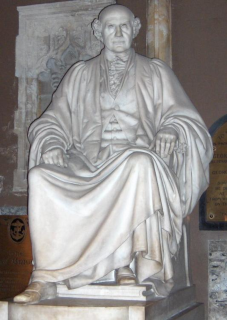
(Pictured: Statue of James Whiteside by Albert Bruce-Joy on display in St. Patrick’s Cathedral)
Described as having an “ardent and self-confident manner,” Hughes is first heard of in an Irish musical capacity (beyond being honorary organist at St. Peter’s Church on Antrim Road at the age of fourteen) collecting traditional airs and transcribing folksongs in North Donegal in August 1903 with his brother Fred, Francis Joseph Bigger, and John Patrick Campbell. Dedicated to seeking out and recording such ancient melodies as are yet to be found in the more remote glens and valleys of Ulster, he produces Songs of Uladh (1904) with Joseph Campbell, illustrated by his brother John and paid for by Bigger. Throughout his career, he collects and arranges hundreds of traditional melodies and publishes many of them in his own unique arrangements. Three of his best-known works are the celebrated songs, My Lagan Love, She Moved Through the Fair, and Down by the Salley Gardens, which are published as part of his four collections of Irish Country Songs, his key achievement. These are written in collaborations with the poets Joseph Campbell and Padraic Colum, and W. B. Yeats himself. A dispute with Hamilton Harty over copyright on My Lagan Love is pursued on Bigger’s advice, but fails.
Hughes has a unique approach to arranging Irish traditional music. He calls upon the influence of the French impressionistClaude Debussy in his approach to harmony: “Musical art is gradually releasing itself from the tyranny of the tempered scale. […] and if we examine the work of the modern French school, notably that of M. Claude Debussy, it will be seen that the tendency is to break the bonds of this old slave-driver and return to the freedom of primitive scales.” He regards arrangements as an independent art form on an equal level with original composition: “[…] under his [i.e. the arranger’s] hands it is definitively transmuted into an art-song, an art-song of its own generation.” His folksong arrangements have been sung all across the English-speaking world. John McCormack and Kathleen Ferrier are the first to record them on gramophone records.
Hughes also composes a limited amount of original chamber music (a violin sonata is mentioned in a letter to Hughes from Bernard van Dieren dated April 4, 1932), and some scores for the stage (like And So to Bed by James Bernard Fagan) and film. Hughes and John Robert Monsell also create songs for a musical version of Richard Brinsley Sheridan‘s The Rivals called Rivals!, which is staged at the Kingsway Theatre in London in October 1935 by Vladimir Rosing and runs for 86 performances.
Married to Lillian Florence (known as Meena) Meacham and Suzanne McKernan, Hughes has three children: Patrick, known professionally as Spike Hughes, Angela and Helena. He dies in Brighton, England, at the relatively early age of fifty-four on May 1, 1937.
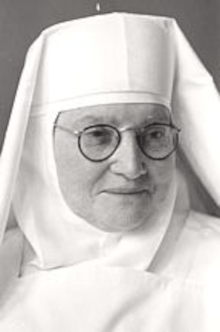
Kearney is the third daughter of farmer Michael Kearney and Teresa Kearney. Three months prior to her birth, her father dies in an accident. Following his death, her mother remarries and has three more children. When she is ten years old, her mother dies. Her maternal grandmother, Grannie Grenell, then raises her in Curranstown, County Wicklow. Grannie Grenell has a profound impact on her spiritual beliefs and deep faith. When she is 17, Grannie Grenell dies.
Kearney attends the local convent school in Arklow following her mother’s death. In 1889, following her grandmother’s death, she goes to convent of Mercy at Rathdrum, to train as an assistant teacher. She does not have the finances to pay for training, and becomes a Junior Assistant Mistress. A year later, she goes to teach in a school run by the Sisters of Charity in Essex.
Following the death of her grandmother, Kearney turns toward thoughts of religious life. She believes that God is calling her to be a sister, and she applies for admission to the Franciscan Missionary Sisters of the Five Wounds at Mill Hill, London. In 1895, she enters the St. Mary’s Abbey, Mill Hill. On April 21, 1898 she takes the name Sister Mary Kevin of the Sacred Passion. Her motto is “For Thee, Lord.” She volunteers to work with African Americans in London. She waits three years for a posting to the American mission, but when the call from a foreign mission comes, it comes from Africa.
On December 3, 1902, Kearney and five other sisters leave London for Nsambya, Uganda. They are chosen at the request of Bishop Henry Hanlon of the Mill Hill Fathers. The sisters arrive on January 15, 1903 and establish a dispensary and school in the Buganda. Their task is to care for the women and girls and to further weaken the association of Catholicism with French missionaries and Protestantism with British missionaries in the then British Protectorate. Among the sisters are three Irish, one American, one English, and one Scottish woman.
Kearney starts her first clinic under a mango tree near the convent. The first seven years of missionary work are tough for the sisters. Various diseases, from smallpox to malaria, ravage Buganda. The infant mortality rate is also relatively high due to the high frequency of maternal deaths. In 1906, she expands the missionary and sets up a hospital in Nagalama, twenty-three miles away. She is appointed the new superior of the convent following Sister Paul’s illness and return to the United States in 1910. In 1913, three more sisters arrive, which allows her to establish a third mission station in Kamuli, Busoga. All three stations focus on medicine and education for the local population with a focus on primary and secondary education, training of nurses, and the founding of clinics, hospitals and orphanages.
During World War I, the Nsambya Hospital is used to treat the Native Carrier Corp, porters for European troops. At times, Kearney is outraged by the treatment Europeans give to the African porters. She works to uphold the rights of African people caught up in the European war. On December 25, 1918 she is awarded the Member of Order of the British Empire (MBE) for her services to the wounded during the war years.
Kearney is credited for promoting higher education in Catholic African women in her mission. In 1923, she founds the Little Sisters of St. Francis, a community of African nuns for teaching and nursing. This program starts with only eight local girls. A year later, she and Dr. Evelyn Connolly, a lay missionary, found a nursing and midwifery school in Nsambya. Their goal is to promote the education of women throughout Uganda.
In September 1928, Kearney returns to England to establish a novitiate exclusively for training sisters for African missions. The novitiate is officially opened in 1929 in Holme Hall, Yorkshire. Many women from England, Scotland and Ireland travel to Holme Hall to assist the missionary efforts. This creates a shortage for the Mill Hill Fathers, who also need sisters for their school in England and American missions. Upon realization of this divide, Kearney and the Mill Hill Fathers break off from each other. On June 9, 1952 she founds the new congregation of the Franciscan Missionary Sisters for Africa. She is appointed the first superior general. Mount Oliver, Dundalk, becomes the motherhouse for this new congregation. With the formation of the FMSA, she expands the missionary work to Uganda, Kenya, Zambia, the United States, Scotland, and South Africa.
Kearney retires in 1955 at age 80. During retirement, she is appointed Superior of a convent in Boston, Massachusetts and raises funds for African projects. She travels and talks to donors to garner support for projects in Africa.
On October 17, 1957, Kearney dies at the age of 82 in Brighton, Massachusetts. Her remains are flown to Ireland and buried at Mount Oliver. Ugandan Catholics rally to have her body flown to Uganda to be buried. On December 3, 1957, her body is buried in the cemetery at Nkokonjeru, the motherhouse of the Little Sisters of St. Francis.
Kearney’s legacy is evident today. In Uganda, the word Kevina means “hospital” or “charitable institute.” The Mother Kevin Postgraduate Medical School is named after her. The Little Sisters of St. Francis has over 500 members throughout Africa, while the Franciscan Missionary Sisters for Africa currently works in Uganda, Kenya, Zambia, Zimbabwe, and South Africa.
Parnell dies of pneumonia at half-past eleven on the night of October 6 at his residence at 10 Walsingham Terrace, Aldrington, near Brighton, England. He dies in the arms of his wife Katherine whom he had married just five months earlier.
Prior to the funeral, Parnell’s body lay in state for several hours and his death is the primary topic of conversation around Dublin. The belief that his demise would close the chasm in the Irish ranks is no longer tenable. His death makes it too wide even to be bridged. His old opponents may have felt inclined to forget and forgive, but this spirit is crushed almost before it is born, and his old adherents are simply ferocious in their enmity.
The city is astir at an unusually early hour, and there is a crowd of thousands in and around the Westland Row Station before seven o’clock. In front, as a guard of honor, stands a body of the Gaelic Athletic Association, armed with camans, around which are bound crape and green ribbon. It is nearly eight o’clock when Parnell’s body is placed in a hearse drawn by four black horses. The Gaels march in front. Thousands join the cortège, which includes several bands and fife corps.
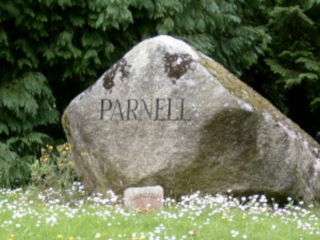
Though an Anglican, Parnell’s funeral at the Irish National nondenominational Glasnevin Cemetery in Dublin is attended by more than 200,000 people. His notability is such that his gravestone of unhewn Wicklow granite, erected in 1940, reads only “Parnell.”
Parnell is buried amid warring elements and in the presence of an immense assemblage. As a scene of great but suppressed excitement, and of still greater impressiveness, the funeral and its surroundings will never be forgotten by those who witness it, and it will long furnish a landmark in history for Ireland.
Shee is born into an old Irish Catholic family, the son of Martin Shee, a merchant, who regards the profession of a painter as an unsuitable occupation for a descendant of the Shees. He nevertheless studies art in the Royal Dublin Society and comes to London. There, in 1788, he is introduced by Edmund Burke to Joshua Reynolds, on whose advice he studies in the schools of the Royal Academy of Arts.
In 1789 Shee exhibits his first two pictures, the “Head of an Old Man” and “Portrait of a Gentleman.” Over the next ten years he steadily increases in practice. In 1798 he is chosen an associate of the Royal Academy and in 1800 he is elected a Royal Academician. He moves to George Romney‘s former house at 32 Cavendish Square and sets up as his successor.
Shee continues to paint with great readiness of hand and fertility of invention, although his portraits are eclipsed by more than one of his contemporaries, and especially by Thomas Lawrence. His earlier portraits are carefully finished, easy in action, with good drawing and excellent discrimination of character. They show an undue tendency to redness in the flesh painting, a defect which is still more apparent in his later works, in which the handling is less square, crisp and forcible. In addition to his portraits, he executes various subjects and historical works, such as Lavinia, Belisarius, his diploma picture “Prospero and Miranda,” and the “Daughter of Jephthah.”
In 1805 Shee publishes a poem consisting of Rhymes on Art, and a second part follows in 1809. Lord Byron speaks well of it in his English Bards and Scotch Reviewers. He publishes another small volume of verse in 1814, entitled The Commemoration of Sir Joshua Reynolds, and other Poems, but this is less successful. He also produces a tragedy, Alasco, set in Poland. The play is accepted at Covent Garden, but is refused a licence, on the grounds that it contains treasonable allusions, and Shee angrily resolves to make his appeal to the public. He carries out his threat in 1824, but Alasco is still on the list of unacted dramas in 1911. He also publishes two novels – Oldcourt (1829, in three volumes) and Cecil Hyde (1834).
On the death of Sir Thomas Lawrence in 1830, Shee is chosen president of the Royal Academy in his stead and shortly afterwards receives a knighthood. In 1831 he is elected a Fellow of the Royal Society. In an examination before the parliamentary committee of 1836 concerning the functions of the Royal Academy, he ably defends its rights. He continues to paint until 1845, when illness makes him retire to Brighton. He is deputised for at the Academy by J. M. W. Turner, who had appointed him a trustee of the projected Turner almshouse.
Martin Archer Shee dies in Brighton, Sussex, England on August 13, 1850, and is buried in the western extension to St. Nicholas’ Churchyard in Brighton. His headstone remains but has been laid flat and moved to the perimeter of the site.
Patrick Magee stays in the hotel under the pseudonym Roy Walsh during the weekend of September 14-17, 1984. During his stay, he plants the bomb under the bath in his room, number 629. The device, described as a “small bomb by IRA standards,” is fitted with a long-delay timer made from videocassette recorder components and a Memo Park Timer safety device. The device may have avoided detection by sniffer dogs due to it being wrapped in cling film to mask the smell of the explosive.
The bomb detonates at approximately 2:54 AM (BST) on October 12. The midsection of the building collapses into the basement, leaving a gaping hole in the hotel’s facade. Firemen say that many lives are likely saved because the well-built Victorian hotel remained standing. Margaret Thatcher is still awake at the time, working on her conference speech for the next day in her suite. The blast badly damages her bathroom but leaves her sitting room and bedroom unscathed. Both she and her husband escape injury. She changes her clothes and is led out through the wreckage along with her husband and her friend and aide Cynthia Crawford and driven to Brighton police station.
At about 4:00 AM, as Thatcher leaves the police station, she gives an impromptu interview to the BBC‘s John Cole, saying that the conference would go on as scheduled. Alistair McAlpine persuades Marks & Spencer to open early at 8:00 AM so those who have lost their clothes in the bombing can purchase replacements. Thatcher goes from the conference to visit the injured at the Royal Sussex County Hospital.
Five people are killed, none of whom are government ministers. But a Conservative MP, Sir Anthony Berry, is killed, along with Eric Taylor, North-West Area Chairman of the Conservative Party, Lady Jeanne Shattock, wife of Sir Gordon Shattock, Western Area Chairman of the Conservative Party, Lady Muriel Maclean, wife of Sir Donald Maclean, President of the Scottish Conservatives, and Roberta Wakeham, wife of Parliamentary Treasury Secretary John Wakeham. Donald and Muriel Maclean are in the room in which the bomb explodes, but Mr. Maclean survives.
Several more, including Walter Clegg, whose bedroom is directly above the blast, and Margaret Tebbit, the wife of Norman Tebbit, who is then President of the Board of Trade, are left permanently disabled. Thirty-four people are taken to the hospital and recover from their injuries. When hospital staff asks Norman Tebbit, who is less seriously injured than his wife, whether he is allergic to anything, he is said to answer “bombs.”
MacGowan spends his early childhood in County Tipperary, before his family moves back to England when he is six years old. He lives in many parts of the southeast of England, including Brighton and London.
MacGowan’s father, Maurice, works for a department store. MacGowan’s mother, Therese, is a singer and traditional Irish dancer, and has worked as a model in Dublin. In 1971, after attending Holmewood House School at Langton Green, Tunbridge Wells, MacGowan earns a literature scholarship and is accepted into Westminster School. He is found in possession of drugs and is expelled in his second year.
MacGowan gets his first taste of fame in 1976 at a concert by British punk band The Clash, when his earlobe is damaged by Jane Crockford, later to be a member of Mo-dettes. A photographer snaps a picture of him covered in blood and it makes the papers, with the headline “Cannibalism at Clash Gig.” Shortly after this, he forms his own punk rock band, The Nipple Erectors, later renamed The Nips.
MacGowan draws upon his Irish heritage when founding The Pogues and changes his early “punk” voice for a more authentic sound with tutoring from his extended family. Many of his songs are influenced by Irish nationalism, Irish history, the experiences of the Irish in London and the United States, and London life in general.
Between 1985 and 1987, he co-writes “Fairytale of New York,” which he performs with Kirsty MacColl. In the coming years MacGowan and The Pogues release several albums.
After The Pogues throw MacGowan out for unprofessional behaviour, he forms a new band, Shane MacGowan & The Popes, recording two studio albums, a live album, three tracks on The Popes Outlaw Heaven (2010) and a live DVD, and touring internationally. From December 2003 until May 2005, Shane MacGowan & The Popes tour extensively in the UK, Ireland, and Europe.
The Pogues and MacGowan reform for a sell-out tour in 2001 and each year from 2004 to 2009 for further tours, including headline slots at GuilFest in England and the Azkena Rock Festival in Basque Country. In May 2005, he rejoins The Pogues permanently.
For many years MacGowan suffers from binge drinking and heroin use. In 2001, Sinéad O’Connor reports MacGowan to the police in London for drug possession in what she says is an attempt to discourage him from using heroin. Initially furious, MacGowan later expresses gratitude towards O’Connor and claims that the incident helped him kick his heroin habit.
MacGowan has long been known for having very bad teeth. He loses the last of his natural teeth around 2008. In 2015, he has 28 new dentures on a titanium frame fitted in a nine-hour procedure which is the subject of an hour-long television programme. Dr. Darragh Mulrooney, the dental surgeon who carries out the procedure, comments that MacGowan recorded most of his great works while he still had some teeth: “We’ve effectively re-tuned his instrument and that will be an ongoing process.”
In the summer of 2015, MacGowan falls as he is leaving a Dublin studio, fracturing his pelvis. He is seen in public on crutches by December 2015, and continues to experience difficulty with general mobility.




 The funeral and burial of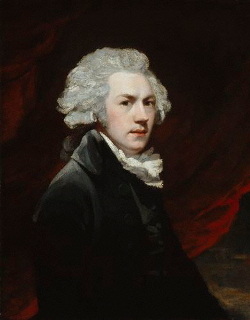


 seamus dubhghaill