seamus dubhghaill

Promoting Irish Culture and History from Little Rock, Arkansas, USA


Leave a comment

Death of Albert Morrow, Illustrator, Poster Designer & Cartoonist

Albert George Morrow, Irish illustrator, poster designer and cartoonist, dies at his home in West Sussex, England, on October 26, 1927.

Morrow is born on April 26, 1863, in Comber, County Down, the second son of George Morrow, a painter and decorator from Clifton Street in west Belfast. Of his seven brothers, four, GeorgeJack, Edwin, and Norman, are also illustrators and all but one are artists. He is a keen ornithologist in his youth. In later life he is a keen walker and paints landscapes for leisure.

Morrow is educated at the Belfast Model School and latterly at the Belfast Government School of Art between 1878 and 1881.

While studying under T. M. Lindsay at the Government School of Art in 1880, Morrow is awarded a £10 prize for drawing from the eminent publishers Cassell, Petter and Galpin. In 1881, while still learning his trade, he paints a mural of Belfast for the Working Men’s Institute in Rosemary Street, where his father is chairman. Later in that same year he exhibits a watercolour sketch of a standing figure entitled Meditative at the gallery of Rodman & Company, Belfast.

Morrow then wins a three-year scholarship worth £52 per year which he takes to the National Art Training School at South Kensington in 1882, where he begins a lifelong friendship with the British sculptor Albert Toft. In 1883, while still attending South Kensington, he joins the staff of The English Illustrated Magazine in preparation for the launch of the first edition. Two of his works are published in the Sunday at Home magazine in September of the same year.

J. Comyns Carr, first editor of The English Illustrated Magazine, commissions Morrow to complete a series on English industry when he has yet to complete his studies at South Kensington.

In 1890, Morrow begins illustrating for Bits and Good Words. He exhibits nine works at the Royal Academy of Arts between 1890 and 1904, all of which are watercolours, and another in 1917, and an offering in chalk at the 159th Exhibition, in the year of his death.

Morrow becomes a member of the Belfast Art Society in 1895, exhibiting with them in the same year. In 1896, a Morrow print is published in Volume 2 of the limited-edition print-collection Les Maîtres de l’Affiche selected by “Father of the Poster” Jules Chéret. In the same year he shows a watercolour of a Gurkha at the Earls Court in the Empire of India and Ceylon exhibition. In 1900, he exhibits with two Ulster artists, Hugh Thomson and Arthur David McCormick, at the Linen Hall Library in Belfast, who along with Morrow had contributed to the early success of The English Illustrated Magazine.

Morrow is one of the founders of the Ulster Arts Club in November 1902 along with five of his brothers, an organisation that has a nonsectarian interest in Celtic ideas, language and aesthetics. In November 1903, he exhibits at the first annual exhibition of the Club when he shows alongside John LaveryHans Iten, James Stoupe and F. W. Hull. He exhibits The Itinerant Musician, a watercolour that he had previously shown at the Royal Academy in 1902. Honorary membership is conferred upon him the following year. Three years later he is honoured with a solo exhibition of sketches and posters in conjunction with the Ulster Arts Club, at the Belfast Municipal Gallery.

In 1908, Morrow joins his brothers in an exhibition at 15 D’Olier Street, Dublin, an address which is later registered to the family business in 1913. Among his contributions to the family exhibition is his painting of Brandon ThomasThe Clarionette Player, which had previously been exhibited at the Royal Academy, and a poster entitled Irving in Dante.

In 1917, Morrow joins his brother George and 150 artists and writers, in petitioning the British Prime Minister David Lloyd George to find a way of enacting the unsigned codicil to Hugh Lane’s will and establish a gallery to house Lane’s art collection in Dublin. Among the 32 notable artists who sign this petition are Jack B. Yeats, Sir William Orpen, Sir John Lavery, and Augustus John.

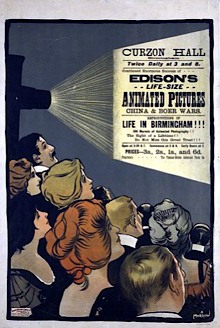
Morrow illustrates books for children and adults, but he is best known for the hundreds of posters he designs for the theatre, with the bulk of his commissions coming from just one lithographical printer, David Allen and Sons. As a cartoonist he draws for children’s annuals, and contributes three cartoons to Punch in 1923, 1925 and posthumously in 1931.

Morrow dies at his home in West Hoathly, West Sussex, on October 26, 1927, at the age of 64. He is survived by his wife and two children. His headstone in the local churchyard at All Saints Church, Highbrook is designed by his friend, the sculptor and architect, Albert Toft.

Morrow’s works can be found in many public and private collections such as the Victoria and Albert MuseumMusée des Arts Décoratifs and the British Museum.

(Pictured: Colour lithograph poster by Albert Morrow advertising a cinematic showing at the Curzon Hall, Birmingham, c. 1902)


Leave a comment

Birth of E. M. O’R. Dickey, Wood Engraver & Painter

E. M. O’R. Dickeywood engraver and oil painter who is active at the beginning of the twentieth century, is born Edward Montgomery O’Rorke Dickey in Belfast on July 1, 1894. He is a founder member of the Society of Wood Engravers.

Dickey is the son of Edward O’Rorke Dickey. He later marries Eunice Emmeline Howard and they have one son, Daniel. He is educated at Wellington College and Trinity College, Cambridge. He studies painting under Harold Gilman at the Westminster School of Art.

Dickey is art master at Oundle School in OundleNorthamptonshireEngland, and then becomes professor of fine art and director of King Edward VII School of Art, Armstrong College, Durham University from 1926 to 1931. He is then staff inspector of art from 1931 to 1957 for the Ministry of Education.

At the beginning of World War II Dickey is seconded from the Ministry of Information and, from 1939 to 1942, is secretary of the War Artists’ Advisory Committee. He is a full member of the committee from 1942 to 1945. During this period he establishes a close relationship with Eric Ravilious. He is appointed a CBE in 1952.

Dickey becomes the first curator of The Minories in ColchesterEssex, a post he holds for five years from 1957 to 1962.

Dickey is a founder member of the Society of Wood Engravers in 1920, and exhibits with them from 1920 to 1924. He is at his most active in the early 1920s and virtually all his engravings date from this period.

In 1922 Dickey contributes a wood engraving to Contemporary English Woodcuts, an anthology of wood engravings produced by Thomas Balston, a director at Gerald Duckworth and Company and an enthusiast for the new style of wood engravings. Campbell Dodgson, Keeper of Prints and Drawings at the British Museum, writes about him in his introduction to the book Mr. Hagreen and Mr. Dickey are among the engravers who rely very much upon the effective use of white lines and spaces. This is a limited edition of 550 copies, as is the only book that he illustrates with wood engravings, Workers by the Irish writer Richard Rowley, published by Balston at Duckworth in 1923.

Dickey devotes more time to working in oils. He is one of the most experimental painters in Ireland technically and stylistically. He paints extensively on the continent, and shows at the Royal Academy of Arts and the New English Art Club. He is elected to the London Group in 1920. He has several one-man exhibitions, at the Leicester Galleries in 1923, at the Manchester City Art Gallery in 1924, and the Beaux Arts Gallery in 1935.

Dickey dies on August 12, 1977. There are a number of examples of his oil paintings in public collections.

Dickey’s lasting legacy, rather than his wood engravings and oils, is his distinguished contribution to arts administration and art education.

(Pictured: “Kentish Town Railway Station” by Edward Montgomery O’Rorke Dickey, oil on canvas, 1919, Hollytrees Museum, United Kingdom)


Leave a comment

Birth of Nannie Dryhurst, Writer, Translator, Activist & Nationalist

Nannie Florence Dryhurst, Irish writer, translator, activist and nationalist, is born Hannah Anne Robinson in Dublin on June 17, 1856.

Dryhurst is born to Alexander Robinson and Emily Egan. Her father is a dyer. She is known as Nannie to her sisters and she decides to change her name to Nannie Florence in honour of a young friend who had died. As a result she is known variously (and following her marriage) as N.F. Dryhurst, Nannie, Nora and Florence Dryhurst.

After the death of her father, Dryhurst takes a position as a governess as she speaks fluent FrenchGerman and Irish, as well as having considerable skill as an artist. She works first in Ireland and then in London. She looks after a doctor’s daughter, Nellie Tenison, and through them she meets the Dryhurst family. In 1882, she becomes engaged to British Museum official Alfred Robert Dryhurst and marries him in August 1884. Their first daughter, Norah, is born in 1885 and the second, Sylvia, in 1888.

Dryhurst soon gets involved with an anarchist group and writes regularly for the Freedom newspaper. She is friends with Charlotte Wilson and acts as editor when Wilson is away. In the early 1890s she takes over as editor completely for a period of time. She also works as a translator for Peter Kropotkin‘s works. She spends time teaching with Wilson, Agnes Henry, and Cyril Bell at the International Anarchist School set up in Fitzroy Square in London by Louise Michel. She gives active support to Spanish refugees fleeing repression and gives money to support the colony at Clousden Hill from 1895 to 1902.

Dryhurst supports a number of different countries attempting to gain independence. She becomes secretary of the Nationalities and Subject Races Committee and uses her writing in working toward Irish independence. She writes for various Irish newspapers and assists with the creation of The Irish Citizen. A friend of W. B. Yeats, she appears in his play The Land of Heart’s Desire in June 1904. She speaks Georgian, having learned it from Varlam Cherkezishvili, a close associate of Kropotkin. In 1906, she is a member of the Georgian Relief Committee and travels to the country. She speaks at an international conference at The Hague in support of Georgia. She is also a supporter of Indian independence.

It was through Dryhurst that the Gifford sisters get their connection to the Irish independence movement. She introduces Muriel Gifford to Thomas McDonagh and Grace Gifford to James Plunkett. After the executions of fifteen leaders of the Easter Rising in Dublin, she spends her time campaigning unsuccessfully for the reprieve of Roger Casement. Not all her activities are purely political. She is a neighbour of Martin Shaw and on her suggestion he founds the Purcell Operatic Society in 1899. She becomes the Society’s secretary. He rents accommodation near her and through her friends they find talented amateurs to put on their productions.

Dryhurst has a long affair with Henry Nevinson, a journalist she meets in 1892. The affair ends in 1912. She dies in 1930. Her papers are kept in the National Library of Ireland.


Leave a comment

Birth of Standish Hayes O’Grady, Celticist & Antiquarian

Standish Hayes O’Grady (Irish: Anéislis Aodh Ó Grádaigh), Celticist and antiquarian, is born on May 19, 1832, in Erinagh House, Castleconnell, County Limerick.

O’Grady is the son of Admiral Hayes O’Grady and his wife, Susan Finucane. His father is one of the chiefs of the Cinél Donnghaile, the collective name of the O’Gradys. He is a nephew of Standish O’Grady, 1st Viscount Guillamore, and a cousin of the novelist Standish James O’Grady, with whom he is sometimes confused. As a child he is fostered in Coonagh, County Limerick, an Irish-speaking area. There he learns Irish and comes into contact with the Gaelic manuscript tradition, listening to stories read aloud from manuscripts in farmers’ houses during wakes or while carding wool. He maintains this interest in the literary tradition throughout his life.

O’Grady receives his secondary education in Rugby School in Rugby, Warwickshire, England, his name appearing in the school register for August 1846. Subsequently he attends Trinity College Dublin (TCD) from 1850 to 1854 but does not graduate. He is critical of an education system that makes no mention of Irish history and legend. During his student days he becomes a friend of the leading scholars and antiquarians, John O’DonovanGeorge Petrie and Eugene O’Curry, as well as the bookseller and publisher, John O’Daly. At this time he begins copying Gaelic manuscripts under their direction. He purchases from O’Daly in 1853 a collection in Irish of “tales and other pieces, in prose and verse” which he presents to the British Museum in 1892. He is a founding member of the Ossianic Society in 1853 and becomes its president in 1856. O’Curry attacks him publicly in a review in The Tablet, questioning his ability as a scholar. The publication of the society’s third volume prompts the review.

In 1857 O’Grady moves to the United States where he remains for thirty years. In 1901 he contributes an essay on Anglo-Irish Aristocracy to a collection entitled Ideals in Ireland edited by Augusta, Lady Gregory.

O’Grady is competent in a number of languages including Arabic and Scots Gaelic, and the University of Cambridge awards him a Doctor of Letters degree in 1893.

O’Grady is a bachelor all his life and dies on October 16, 1915, in his home in Ballinruan, Hale, Cheshire, England. He is buried in Altrincham cemetery.


2 Comments

Birth of Georgie Hyde-Lees Yeats, Wife of Poet W. B. Yeats

Georgie Hyde-Lees Yeats, the wife of the poet William Butler Yeats, is born Bertha Hyde-Lees in Fleet, Hart District, Hampshire, England, on October 16, 1892.

Hyde-Lees is the daughter of militia captain (William) Gilbert Hyde-Lees (1865–1909), of the Manchester Regiment, and Edith “Nelly” Ellen (1868–1942), daughter of barrister and manufacturer Montagu Woodmass, JP. Her father is regarded by her mother’s family as “a most undesirable character, but ‘rolling in money,'” having taken up the life of a “gentleman alcoholic” on resigning his commission after receiving an inheritance from his wealthy uncle Harold Lees, of Pickhill Hall, near Wrexham, then part of Denbighshire. He is “attractive, reckless, witty, and… musical,” and fond of pranks. She has an elder brother, Harold (1890–1963), who becomes a clergyman, with “rigid moral standards” and “a less than joyous existence,” his only indulgence being “a fine collection of drawings and etchings.” When she is only a few years old, her parents’ marriage fails due to her father’s alcoholism. Her father has enough income to support his family, allowing Georgie and her mother to spend “a good deal of their time” travelling in Europe, but his wife is in the awkward social position of being a “married woman without a husband.” The family lives a vaguely bohemian and nomadic lifestyle, travelling frequently to country homes and spending long periods visiting relatives.

Hyde-Lees attends a number of schools in Knightsbridge, London art schools, studies languages and classics, and piano. She becomes a close friend of Dorothy Shakespear, who is fond of Georgie and shares many of her interests despite being six years her senior. After the death of her father in 1909 at the age of 44, her mother marries Dorothy’s uncle, Henry Tucker, Olivia Shakespear‘s brother, and they move to Kensington.

Hyde-Lee’s mother often brings young musicians and artists she has recently met to Olivia Shakespear’s salon, many of whom become well-known modernists, including Ezra Pound, Walter Rummel, and Frederic Manning. She continues to make the rounds of country estates with her mother and Olivia and Dorothy Shakespear. It is in their company in 1910 or 1911, as a seventeen-year-old, that one morning she meets W. B. Yeats at the British Museum and again that afternoon during tea at the Shakespears.

Seven years later, when Hyde-Lees is 25 and Yeats is 52, he asks her to marry him. Only a few weeks earlier, Iseult Gonne, the daughter of Maud Gonne whom Yeats had loved for many years, had rejected his marriage proposal. She and Yeats marry just three weeks later, on October 20, 1917, in a public register office, witnessed by her mother and Ezra Pound. During the honeymoon, while Yeats is still brooding about Iseult’s rejection, she begins the automatic writing which fascinates him. Yeats writes about her psychography days later in what is to be A Vision (1925), and it holds the marriage together for many years. Within a year of marriage, Yeats declares her name of Georgie to be insufferable, and henceforth calls her George.

The couple has two children, Anne and Michael. Hyde-Lees Yeats dies on August 23, 1968, in Rathmines, County Dublin. She is buried at Drumcliff Churchyard, Drumcliff, County Sligo.


Leave a comment

Birth of Maurice Lenihan, Journalist & Author

Maurice Lenihan, journalist and author, is born on February 5, 1811, in St. Patrick’s parish, Waterford, County Waterford.

Lenihan is the eldest of fifteen children (ten sons and five daughters) of James Lenihan, woolen draper, and Margaret Lenihan (née Bourke) from Carrick-on-Suir, County Tipperary, where her family is also involved in the woolen trade. He receives his early education at a school attached to St. John’s College, Waterford, and in 1823 goes to Carlow College, which then caters both for junior seminarians and lay students, and it is clear that he is in the latter category. He studies there as a boarder for eight years despite the financial pressure on the family arising from the death of his father in 1829.

Lenihan begins his journalistic career with the Tipperary Free Press in 1831, moves to The Waterford Chronicle two years later, and in 1841 becomes the editor of The Limerick Reporter. This is followed by a brief stint with The Cork Examiner before he settles in Nenagh in 1843 and establishes his own newspaper, The Tipperary Vindicator. In 1849 he purchases The Limerick Reporter, amalgamates it with his existing publication to form The Limerick Reporter and Tipperary Vindicator, and moves to Limerick, where he resides for the remainder of his life. His paper integrates local reporting and analysis with reports and commentary on national and international events and discussion of the major intellectual ideas of the age. He also fosters the careers of local writers, in particular the poets John Francis O’Donnell and Michael Hogan.

Lenihan plays a distinguished role in Limerick local politics, serving on the municipal council continuously from 1863 until his retirement in 1887, and as mayor in 1884. He takes a prominent part also in national political debates and controversies of the period. He is a moderate constitutional nationalist, strongly influenced in his youth by Daniel O’Connell, though he later defends Fenian prisoners. In the 1830s he supports the abolition of tithes, and campaigns in the 1860s for the disestablishment of the Church of Ireland. He champions the cause of Catholic education and favours the teaching of the Irish language in schools and colleges. He consistently supports liberal party candidates in elections and in the 1880s espouses the twin aims of land reform and parliamentary independence.

Lenihan marries a local Nenagh woman, Elizabeth Spain, in November 1843. They have two sons and seven daughters. The family is dogged by ill-health and steadily declining fortunes. The financial problems are caused in part by the losses incurred in the publication in 1866 of Lenihan’s major work of scholarship, Limerick, its history and antiquities. The genesis of this enterprise lay in a series of articles on the sieges of 1690 and 1691, which he had researched and published in his own newspaper. With the encouragement and guidance of his friend, the historian and scholar Eugene O’Curry, he spends five years in research and writing. He had amassed through purchase and borrowing an impressive collection of manuscript materials, most notably the Arthur manuscripts, and these are supplemented by transcripts from most of the principal sources then extant in both Britain and Ireland. He supplements this documentary material with his own local knowledge and oral evidence from elderly residents. The work is haphazardly, even chaotically, arranged and is notable for its voluminous footnotes. These arise from a self-confessed problem in organising his material and from the fact that he acquires further information after the main text has been drafted. These deficiencies are more than compensated for by the vast range of primary source material that, in addition to forming the basis for the main narrative, is reproduced in total or summary form in both the footnotes and appendices. This material has proved invaluable to subsequent generations of scholars researching the history of Limerick.

Poverty, poor health, and personal tragedy are prominent in his final years. His newspaper becomes progressively unprofitable, and he is forced to sell his books and manuscripts to the British Museum. Five of his children predecease him. He dies on December 25, 1895, and is buried in Mount St. Lawrence Cemetery in Limerick.

(From: “Lenihan, Maurice” by Liam Irwin, Dictionary of Irish Biography, http://www.dib.ie, October 2009)


Leave a comment

Death of E. M. O’R. Dickey, Wood Engraver & Painter

E. M. O’R. Dickey, wood engraver and oil painter who is active at the beginning of the twentieth century, dies on August 12, 1977. He is a founder member of the Society of Wood Engravers.

Edward Montgomery O’Rorke Dickey is born in Belfast on July 1, 1894, the son of Edward O’Rorke Dickey. He later marries Eunice Emmeline Howard and they have one son, Daniel. He is educated at Wellington College and Trinity College, Cambridge. He studies painting under Harold Gilman at the Westminster School of Art.

Dickey is art master at Oundle School in Oundle, Northamptonshire, England, and then becomes professor of fine art and director of King Edward VII School of Art, Armstrong College, Durham University from 1926 to 1931. He is then staff inspector of art from 1931 to 1957 for the Ministry of Education.

At the beginning of World War II Dickey is seconded from the Ministry of Information and, from 1939 to 1942, is secretary of the War Artists’ Advisory Committee. He is a full member of the committee from 1942 to 1945. During this period he establishes a close relationship with Eric Ravilious. He is appointed a CBE in 1952.

Dickey becomes the first curator of The Minories in Colchester, Essex, a post he holds for five years from 1957 to 1962.

Dickey is a founder member of the Society of Wood Engravers in 1920, and exhibits with them from 1920 to 1924. He is at his most active in the early 1920s and virtually all his engravings date from this period.

In 1922 Dickey contributes a wood engraving to Contemporary English Woodcuts, an anthology of wood engravings produced by Thomas Balston, a director at Gerald Duckworth and Company and an enthusiast for the new style of wood engravings. Campbell Dodgson, Keeper of Prints and Drawings at the British Museum, writes about him in his introduction to the book Mr. Hagreen and Mr. Dickey are among the engravers who rely very much upon the effective use of white lines and spaces. This is a limited edition of 550 copies, as is the only book that he illustrates with wood engravings, Workers by the Irish writer Richard Rowley, published by Balston at Duckworth in 1923.

Dickey devotes more time to working in oils. He is one of the most experimental painters in Ireland technically and stylistically. He paints extensively on the continent, and shows at the Royal Academy of Arts and the New English Art Club. He is elected to the London Group in 1920. He has several one-man exhibitions, at the Leicester Galleries in 1923, at the Manchester City Art Gallery in 1924, and the Beaux Arts Gallery in 1935.

There are a number of examples of Dickey’s oil paintings in public collections.

Dickey’s lasting legacy, rather than his wood engravings and oils, is his distinguished contribution to arts administration and art education.

(Pictured: “Kentish Town Railway Station” by Edward Montgomery O’Rorke Dickey, oil on canvas, 1919, Hollytrees Museum, United Kingdom)


Leave a comment

Birth of David James O’Donoghue, Biographer & Editor

David James O’Donoghue, Irish biographer, editor, and bookseller, is born in Chelsea, London, England on July 22, 1866.

O’Donoghue is born to Irish parents and grows up in the Hans Town area of Chelsea. He is the son of John O’Donoghue, a bricklayer from Kilworth, County Cork, and Bridget Griffin, who is from County Tipperary. He is the third of nine children, and has four brothers, Thomas, John, James, and Edmund, and four sisters, Mary, Ellen, Katherine, and Agnes. He is first an upholsterer‘s apprentice from the age of sixteen before becoming a journalist and author.

O’Donoghue attends a Catholic school and furthers his education at the British Museum. He begins his journalistic work by writing for the Dublin papers upon subjects relating to Irish music, art, and literature. A founder-member of the Irish Literary Society in London, he is also vice president of the National Literary Society, Dublin, and the compiler of a biographical dictionary, The Poets of Ireland (1891–93; revised edition, 1912), with entries on 2,000 authors. His published works also include Irish Poetry of the Nineteenth Century (1894), Humor of Ireland (1894), List of 1300 Irish Artists (1894), The Life and Writings of James Clarence Mangan (1897), Bibliographical Catalogue of Collections of Irish Music (1899), and Geographical Distribution of Irish Ability (1906).

O’Donoghue publishes an edition of James Fintan Lalor‘s writings (1895) and an edition of William Carleton‘s Traits and Stories of the Irish Peasantry (four volumes, 1896–97). He edits the works of Samuel Lover (six volumes, 1898–99) and the prose works (1903) and poems (1904) of James Clarence Mangan. He writes biographies on William Carleton (1896), Richard Pockrich (1899), and Robert Emmet (1902).

In 1896 O’Donoghue moves to Dublin. In 1909 he becomes librarian of University College Dublin. He is co-editor of Catalogue of the Gilbert Library (in Dublin; 1918). William Butler Yeats writes of him in his Autobiographies of William Butler Yeats (1938).

O’Donoghue dies suddenly on June 27, 1917, at his home on Auburn Avenue, Donnybrook, Dublin. He is buried in Dublin’s Glasnevin Cemetery.


Leave a comment

Birth of Joss Lynam, Civil Engineer & Mountaineer

Joss Lynam, Irish civil engineer who is well known as a mountaineer, hillwalker, orienteer, writer and sports administrator, is born James Perry O’Flaherty Lynam in London on June 29, 1924. He is one of Ireland’s most influential figures in outdoor activities.

Lynam is born to Irish parents Edward and Martha (née Perry), both Galway natives. He and his older sister, Biddy, are both raised in London where his father works as curator of maps in the British Museum. This is where he is first introduced to orienteering and cartography. The family frequently returns to the west coast of Ireland to holiday. Here he finds his love for mountaineering and climbs his first mountain, Knocknarea in County Sligo, with his aunt.

At 18, Lynam joins the British Army and trains as an officer. He is deployed to India in 1944 under the Corps of Royal Engineers where he spends the remainder of World War II. While there, he participates in his first of many Himalayan expeditions, climbing Kolahoi Peak. When he returns in 1947, he immediately moves to Dublin and enrolls in Trinity College Dublin, after encouragement from his parents, where he begins to study engineering. He graduates and receives his degree with Upper Second Class (2.1) Honours.

Lynam is a civil engineer by profession but devotes most of his life developing the sport of mountaineering in Ireland. He climbs extensively in Ireland, Great Britain, the Alps and in India. He is leader, or deputy leader, of expeditions to Greenland, the Andes, Kashmir, Tian Shan, Garhwal, Tibet and India, including the 1987 expedition to Changtse, that is the forerunner to the successful first Irish ascent of Mount Everest in 1993.

With his involvement in developing adventure sport in Ireland Lynam is active in promoting access and developing waymarked trails. He is involved in the creation and administration of the Federation of Mountaineering Clubs in Ireland (now Mountaineering Ireland), the Association for Adventure Sports, Bord Oiliúint Sléibhte (Irish Mountain Training Board), Tiglin (National Outdoor Training Centre), Outdoor Education Ireland, and Cospóir (now Sport Ireland) and the National Waymarked Ways Advisory Committee (part of Sport Ireland).

Lynam is a founder member of the Irish Mountaineering Club (IMC) serving as president from 1982-1984. He is also a founder member of both the Irish Orienteers and Three Rock Orienteering club. He is president of the Union Internationale des Associations d’Alpinisme‘s expeditions commission in the 1990s.

Lynam writes and edits many guide books on walking and climbing in Ireland and helps create and is editor of The Mountain Log (the journal of Mountaineering Ireland).

In 2001, Lynam is awarded an honorary degree from Trinity College Dublin in acknowledgment of his volunteer work and remarkable achievements. He celebrates his 80th birthday by climbing the Paradise Lost Route and then goes on to abseil down Winder’s Slab for his 82nd birthday, both routes in Dalkey Quarry. Both climbs are to raise funds for cancer research, as he had been undergoing chemotherapy for Hodgkin’s Disease.

As a result of a short illness, which is being treated at St. Vincent’s University Hospital Dublin, Lynam dies on the January 9, 2011, aged 86. His funeral is held in the Church of St. Therésè, Mount Merrion, Dublin and then continues to Mount Jerome Cemetery and Crematorium.

After Lynam’s death, his two daughters, Clodagh and Ruth, donate his papers to his alma mater, Trinity College Dublin. These papers cover a vast range of topics such as his life and career, family, childhood, experience of war, his involvement with different mountaineering clubs, and his many writings. The collection also contains photos and slides that he captures himself of landscapes and mountaineering, and consists of maps that are collected by him and his father. There is so much material in the collection that it takes a year for the collection to be catalogued by an archivist.

Lynam’s ashes are scattered by his daughters over the Knocknarea Mountain on the February 12, 2011, being the first mountain he climbed. The Lynam Lecture is introduced in 2011 by Mountaineering Ireland in his memory and his achievements in climbing, hillwalking and mountaineering in Ireland and around the world. Every December the Lynam Lecture is held by leading national and international mountaineers and discusses the development and future of mountaineering in Ireland. Past speakers include Ines Papert, Frank Nugent and Paddy O’Leary.


Leave a comment

Birth of Richard Sankey, Officer in the Madras Engineer Group

Lieutenant-General Sir Richard Hieram Sankey KCB, officer in the Madras Engineer Group in the East India Company‘s army in British India, is born on March 22, 1829, at Rockwell Castle, County Tipperary.

Sankey is the fourth son of Eleanor and Matthew Sankey. His mother is herself from a family of military men, her father being Colonel Henry O’Hara, J.P of O’Hara Broom, County Antrim. His father is a barrister at Bawnmore, County Cork and Modeshil, County Tipperary. He does his schooling at Rev. Flynn’s School on Harcourt Street in Dublin and enters the East India Company’s Addiscombe Military Seminary at Addiscombe, Surrey in 1845. At Addiscombe he is awarded for his excellence at painting.

Sankey is commissioned as a second lieutenant in the Madras Engineer Group in November 1846 and is then trained in military engineering with the Royal Engineers at Chatham, Kent from January 1, 1847, holding temporary rank as an ensign in the British Army. He then arrives in India in November 1848. After two years of service at Mercatur, he officiates in 1850 as Superintending Engineer at Nagpur. During this time, he makes a small collection of fossils of Glossopteris from the Nagpur district and writes a paper on the geology of the region in 1854. The collection is moved from the Museum of Practical Geology to the British Museum in 1880.

In 1856, Sankey is promoted as the Superintendent of the East Coast Canal at Madras. In May 1857, he is promoted Under-Secretary of the Public Works Department under Col. William Erskine Baker in Calcutta. During the Indian Rebellion of 1857, he is commissioned as the Captain of the Calcutta Cavalry Volunteers but is soon despatched to Allahabad where he leads the construction of several embankments and bridges across the Yamuna and Ganges. He is involved in the construction of shelters to advancing troops along the Grand Trunk Road to aid the quelling of the Indian Rebellion of 1857. He arrives in course of this work at Cawnpore (now Kanpur) a day before the Second Battle of Cawnpore. He also is involved in crucial civil works that aid the quelling of the rebellion by bridging the Ghaghara and Gomti rivers at Gorakhpur and Phulpur that enable the Gurkha regiment to cross these rivers.

Sankey receives several commendations from his commanders here and later in the taking of the fort at Jumalpur, Khandua nalla and Qaisar Bagh, vital actions in the breaking of the Siege of Lucknow. For his actions at Jumalpur he is recommended for the Victoria Cross, although he does not receive this honour. He receives a medal for the Indian Rebellion of 1857 and is promoted to second captain on August 27, 1858, and given brevet promotion to major the following day for his services in the quelling of the rebellion. He is sent to the Nilgiris due to ill-health during this time.

Sankey spends a year in Burma as the executive engineer and Superintendent of the jail at Moulmein. On June 29, 1861, he is promoted to substantive captain and is posted as the Garrison Engineer at Fort William, Calcutta and later as the assistant to Chief Engineer, Mysore until 1864, when he is made the Chief Engineer. During this period, he creates a system within the irrigation department to deal with old Indian water catchment systems, surveying the catchment area and determining the area drained and the flows involved. Due to the reorganisation of the armed forces following the assumption of Crown rule in India he is transferred to the Royal Engineers on April 29, 1862.

In 1870, at the request of the Victorian Colonial Government in Australia, in view of his experience with hydrological studies in Mysore, Sankey is invited to be Chairman of the Board of Enquiry on Victorian Water Supply. During this visit, he also gives evidence to the Victorian Select Committee on Railways, as well as reports on the Yarra River Floods, and the Coliban Water Supply, and later contributes to the report on the North West Canal. While in Australia, he is also invited to the colony of South Australia to report on the water supply of Adelaide.

Sankey is appointed as an under-secretary to the Government of India in 1877, which earns him the Afghanistan Medal. In 1878, he is promoted as the Secretary in the public works department at Madras and is promoted substantive colonel on December 30. He is appointed Companion of the Order of the Bath on July 25, 1879, and also commands the Royal Engineers on the advance from Kandahar to Kabul during the Second Anglo-Afghan War. For about five years he is in Madras where he becomes a member of the legislative council in Madras and is elected as a Fellow of the University of Madras. He also helps in the creation and improvements of the Marina, the gardens and the Government House grounds. He is promoted major general on June 4, 1883, and retires from the army on January 11, 1884, with the honorary rank of lieutenant general. He also receives the distinguished service award in India.

After retirement, Sankey returns to Ireland, where he becomes the Chairman of the Board of Works. He is promoted Knight Commander of the Order of the Bath on May 25, 1892, for his work in Ireland. He also undertakes projects in Mexico. Later he settles in London where he dies at St. George’s Hospital on November 11, 1908, and is interred at Hove, East Sussex.

Sankey is memorialised in Phoenix Park, Dublin. A circle of trees bears the name Sankey’s Wood. A plaque dated 1894 lies half-hidden in the undergrowth there.