seamus dubhghaill

Promoting Irish Culture and History from Little Rock, Arkansas, USA


Leave a comment

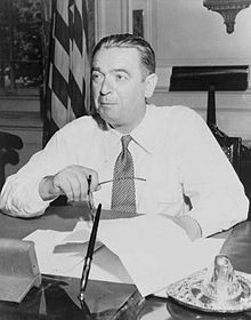
Birth of William O’Dwyer, 100th Mayor of New York City

william-o-dwyer

William O’Dwyer, Irish American politician and diplomat who serves as the 100th Mayor of New York City, holding that office from 1946 to 1950, is born in Bohola, County Mayo on July 11, 1890.

O’Dwyer studies at St. Nathy’s College, Ballaghaderreen, County Roscommon. He emigrates to the United States in 1910, after abandoning studies for the priesthood. He sails to New York City as a steerage passenger on board the liner Philadelphia and is inspected at Ellis Island on June 27, 1910. He first works as a laborer, then as a New York City police officer, while studying law at night at Fordham University Law School. He receives his degree in 1923 and then builds a successful practice before serving as a Kings County (Brooklyn) Court judge. He wins election as the Kings County District Attorney in November 1939 and his prosecution of the organized crime syndicate known as Murder, Inc. makes him a national celebrity.

After losing the mayoral election to Fiorello La Guardia in 1941, O’Dwyer joins the United States Army for World War II, achieving the rank of brigadier general as a member of the Allied Commission for Italy and executive director of the War Refugee Board, for which he receives the Legion of Merit. During that time, he is on leave from his elected position as district attorney and replaced by his chief assistant, Thomas Cradock Hughes, and is re-elected in November 1943.

In 1945, O’Dwyer receives the support of Tammany Hall leader Edward V. Loughlin, wins the Democratic nomination, and then easily wins the mayoral election. He establishes the Office of City Construction Coordinator, appointing Park Commissioner Robert Moses to the post, works to have the permanent home of the United Nations located in Manhattan, presides over the first billion-dollar New York City budget, creates a traffic department and raises the subway fare from five cents to ten cents. In 1948, he receives The Hundred Year Association of New York‘s Gold Medal Award “in recognition of outstanding contributions to the City of New York.” In 1948, he receives the epithets “Whirling Willie” and “Flip-Flop Willie” from U.S. Representative Vito Marcantonio of the opposition American Labor Party while the latter is campaigning for Henry A. Wallace.

Shortly after his re-election to the mayoralty in 1949, O’Dwyer is confronted with a police corruption scandal uncovered by the Kings County District Attorney, Miles McDonald. O’Dwyer resigns from office on August 31, 1950. Upon his resignation, he is given a ticker tape parade up Broadway‘s Canyon of Heroes in the borough of Manhattan. President Harry Truman appoints him U.S. Ambassador to Mexico. He returns to New York City in 1951 to answer questions concerning his association with organized crime figures and the accusations follow him for the rest of his life. He resigns as ambassador on December 6, 1952, but remains in Mexico until 1960.

O’Dwyer visits Israel for 34 days in 1951 on behalf of his Jewish constituents. Along with New York’s Jewish community, he helps organize the first Israel Day Parade.

William O’Dwyer dies in New York City on November 24, 1964, in Beth Israel Hospital, aged 74, from heart failure. He is interred at Arlington National Cemetery, Section 2, Grave 889-A-RH.


2 Comments

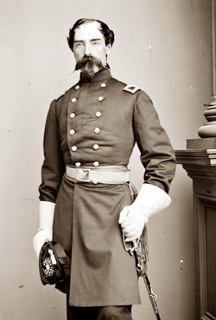
Birth of Robert Nugent, Civil War and Indian Wars Officer

robert-nugent

Brigadier General Robert Nugent, Irish-born American United States Army officer during the American Civil War and the American Indian Wars, is born on June 27, 1824, in Kilkeel, County Down, in what is now Northern Ireland.

Nugent serves with the Irish Brigade‘s 69th Infantry Regiment, from its days as a National Guard unit and into its incorporation into the Union Army at the start of the war. He is one of its senior officers at the First Battle of Bull Run.

When the unit is originally mustered out of service, the 90-day enlistment terms having expired, Nugent accepts a commission as a captain in the regular army. He is immediately assigned to the 13th Infantry Regiment whose commanding officer, Colonel William Tecumseh Sherman, personally requests. Taking a leave of absence to return to New York, he assists Thomas Francis Meagher in organizing the Irish Brigade. The newly reformed 69th Infantry Regiment is the first unit assigned to the Irish Brigade and, with Nugent as its colonel, he leads the “Fighting 69th” at the Battles of Fair Oaks, Gaines’ Mill, Savage’s Station, White Oak Swamp, Glendale and Malvern Hill.

Nugent is shot in the stomach at the Battle of Fredericksburg and is eventually forced to resign his command. He is appointed acting assistant provost marshal for the southern district of New York, which includes New York City and Long Island, by the United States War Department. An Irishman and Democrat, his appointment is thought to assure the Irish American population that conscription efforts would be carried out fairly. The Irish American, a popular Irish language newspaper, writes that the selection is a “wise and deservedly popular one.” He encounters resistance from city officials wanting to remain uninvolved, however by mid-June reports to his superior officer and provost marshal general Colonel James Barnet Fry that conscription efforts are “nearing completion without serious incident.”

Understanding the seriousness of the situation, Nugent attempts to keep the draft selections quiet and in isolated parts of the city. In Manhattan however, lotteries are placed in the heart of Irish tenement and shanty neighborhoods where the draft is most opposed.

In the ensuing New York City draft riots, Nugent takes command of troops and attempts to defend the city against the rioters. Despite issuing the cancellation of the draft, the riots continue for almost a week. His home on West 86th Street is looted and burned by the rioters during that time, his wife and children barely escaping from their home. Upon breaking into his house, furniture is destroyed, and paintings of Nugent and Meagher are slashed, although a painting of Brigadier General Michael Corcoran is reportedly left untouched.

On October 28, Nugent is relieved of his post and succeeded by General William Hays. Returning to active duty, he assumes command of the Irish Brigade in November 1864, shortly after the death of Corcoran. He is present at the battle of Battle of Spotsylvania Court House, the Siege of Petersburg and the Appomattox Campaign. As its last commanding officer, he and the Irish Brigade also march in the victory parade held in Washington, D.C. following Robert E. Lee‘s surrender at Appomattox Court House.

Nugent is brevetted Brigadier General for distinguished leadership of the 69th Regiment on March 13, 1865. The veterans of the Irish Brigade are honorably discharged and mustered out three months later. Nugent remains in the regular U.S. Army for the next twenty years, a formidable “Indian fighter” during the American Indian Wars with the 13th and 24th Infantry Regiments. In 1879, he retires at the rank of major and resides in New York where he is involved in the Grand Army of the Republic, the War Veterans’ Association of the 7th Regiment and an honorary member of The Old Guard.

Nugent becomes ill in his old age, complications arising from his wounds suffered at Fredericksburg, and remains bedridden for two months before his death at his McDonough Street home in Brooklyn on June 20, 1901. In accordance with his last wishes, he is buried at Cypress Hills National Cemetery.


Leave a comment

Birth of Boxer Jack McAuliffe

jack-mcauliffe

Jack McAuliffe, Irish American boxer who fights mostly out of Williamsburg, Brooklyn, is born in Cork, County Cork, on March 24, 1866. Nicknamed “The Napoleon of the Ring,” he is one of only fifteen world boxing champions to retire without a loss. He is the World Lightweight champion from 1886 to 1893. He is posthumously inducted into The Ring magazine Hall of Fame in 1954 and the International Boxing Hall of Fame in 1995.

McAuliffe’s parents are Cornelius McAuliffe and Jane Bailey, who are living at 5 Christ Church Lane, Cork, at the time of Jack’s birth. He emigrates to the United States in 1871, where he spends his early years in Bangor, Maine.

McAuliffe makes his first appearance as an amateur boxer in 1883. He turns professional soon after, fighting Jem Carney 78 rounds to a draw at Revere Beach, Massachusetts. He fights Billy Dacey for the lightweight championship and a $5,000 purse in 1888, knocking him out in eleven rounds. He is known as a strong two-handed fighter with “cat-like” reflexes.

McAuliffe is married twice, both times to stage actresses. His first wife is Katie Hart, who plays in farce comedies. After her death, he marries Catherine Rowe in 1894, whose stage name is Pearl Inman, of the song and dance team The Inman Sisters. Between marriages he dates a third actress, Sadie McDonald. McAuliffe and Rowe move back to Bangor, Maine, in 1894, where he undertakes preliminary training for a fight later that year at the Seaside Athletic Club on Coney Island.

McAuliffe retires in 1897. According to the International Boxing Hall of Fame, he has 36 professional fights. He finishes his career with 30 victories with 22 by knockout, five draws and one no decision.

Jack McAuliffe dies on November 5, 1937, at his home on Austin Street in Forest Hills, Queens.


Leave a comment

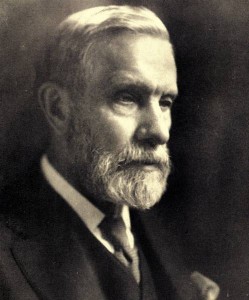
Birth of Poet John Montague

john-montague

Irish poet John Montague is born on Bushwick Avenue at St. Catherine’s Hospital in Brooklyn, New York City, New York, on February 28, 1929. His father, James Montague, an Ulster Catholic, from County Tyrone, had come to the United States in 1925.

Life in New York is difficult during the Great Depression, so John and his two brothers are shipped back to Ireland in 1933. The two eldest are sent to their maternal grandmother’s house in Fintona, County Tyrone, but John is sent to his father’s ancestral home at Garvaghey, then maintained by two spinster aunts.

John studied at University College Dublin in 1946. Stirred by the example of other student poets he begins to publish his first poems in The Dublin Magazine, Envoy, and The Bell, edited by Peadar O’Donnell. But the atmosphere in Dublin is constrained and he leaves for Yale University on a Fulbright Fellowship in 1953.

A year of graduate school at University of California, Berkeley convinces Montague that he should return to Ireland. He settles in Dublin working at the Irish Tourist Office. In 1961 he moves to Bray, County Wicklow. A regular rhythm of publication sees his first book of stories, Death of a Chieftain (1964) after which the musical group The Chieftains is named, his second book of poems, A Chosen Light (1967), Tides (1970).

All during the 1960s, Montague continues to work on his long poem, The Rough Field, a task that coincides with the outbreak of the Northern Ireland civil rights movement. A Patriotic Suite appears in 1966, Hymn to the New Omagh Road and The Bread God in 1968, and A New Siege, dedicated to Bernadette Devlin which he reads outside Armagh Jail in 1970.

In 1972, Montague takes a teaching job at University College Cork, at the request of his friend, the composer Seán Ó Riada, where he inspires an impressive field of young writers including Gregory O’Donoghue, Seán Dunne, Thomas McCarthy, William Wall, Maurice Riordan, Gerry Murphy, Greg Delanty and Theo Dorgan.

Montague settles in Cork in 1974 and publishes an anthology, the Faber Book of Irish Verse (1974) with a book of lyrics, A Slow Dance (1975). Recognition is now beginning to come, with the award of the Irish American Cultural Institute in 1976, the first Marten Toonder Award in 1977, and the Alice Hunt Bartlett Award for The Great Cloak in 1978.

In 1987, Montague is awarded an honorary doctor of letters by the State University of New York at Buffalo. He serves as distinguished writer-in-residence for the New York State Writers Institute during each spring semester, teaching workshops in fiction and poetry and a class in the English Department of the University at Albany. In 1998, he is named the first Irish professor of poetry, a three-year appointment to be divided among Queen’s University Belfast, Trinity College Dublin, and University College Dublin. In 2008, he publishes A Ball of Fire, a collection of all his fiction including the short novella The Lost Notebook.

John Montague dies at the age of 87 in Nice, France on December 10, 2016, after complications from a recent surgery.


2 Comments

Deportation of Joe Doherty

joseph-doherty

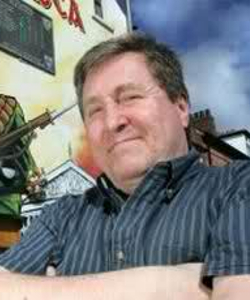
Joe Doherty, a volunteer in the Belfast Brigade of the Provisional Irish Republican Army (IRA) who escapes during his 1981 trial for killing a member of the Special Air Service (SAS) in 1980, is arrested in the United States in 1983 and is deported to Northern Ireland by the U.S. government on February 19, 1992. A first season episode of Law & Order entitled “The Troubles” is based on his case.

The trial of Doherty and the other members of their four-man active service unit nicknamed the “M60 gang” begins in early May 1981, on charges including three counts of murder. On June 10, Doherty and seven other prisoners, including Angelo Fusco and the other members of the IRA unit, take a prison officer hostage at gunpoint in Crumlin Road Gaol and ultimately escape in waiting cars. Two days after the escape, Doherty is convicted in absentia and sentenced to life imprisonment with a minimum recommended term of thirty years.

Doherty escapes across the border into the Republic of Ireland, and then travels to the United States on a false passport. He lives with an American girlfriend in Brooklyn and New Jersey, working on construction sites and as a bartender at Clancy’s Bar in Manhattan, where he is arrested by the FBI on June 28, 1983. He is imprisoned in the Metropolitan Correctional Center in Manhattan, and a legal battle ensues with the British government seeking to extradite him back to Northern Ireland. Doherty claims he is immune from extradition as the killing of Royal Irish Constabulary Captain Herbert Westmacott was a political act. In 1985 federal judge John E. Sprizzo rules Doherty cannot be extradited as the killing is a “political offense.” Doherty’s legal battle continues as the United States Department of Justice then attempts to deport him for entering the country illegally.

Doherty remains in custody at the Metropolitan Correctional Center and attempts to claim political asylum, and on June 15, 1988, Attorney General Edwin Meese overturns an earlier ruling by the Federal Board of Immigration Appeals that Doherty can be deported to the Republic of Ireland and orders his deportation to Northern Ireland. In February 1989 new Attorney General Dick Thornburgh chooses not to support the decision made by his predecessor and asks lawyers for Doherty and the Immigration and Naturalization Service to submit arguments for a review of the decision and Doherty’s claim for asylum. By this time Doherty’s case is a cause célèbre with his sympathisers including over 130 Congressmen and a son of then President of the United States George H. W. Bush. In 1990 a street corner near the Metropolitan Correctional Center is named after him.

In August 1991, Doherty is transferred to a federal prison in Lewisburg, Pennsylvania, and on January 16, 1992, the Supreme Court of the United States overturns a 1990 Federal Appeals Court ruling by a 5-to-3 decision, paving the way for his deportation. On February 19, 1992, Doherty is deported to Northern Ireland, despite pleas to delay the deportation from members of Congress, Mayor of New York City David Dinkins, and the Cardinal Archbishop of New York, John Joseph O’Connor.

Doherty is returned to Crumlin Road Gaol before being transferred to HM Prison Maze. He is released from prison on November 6, 1998, under the terms of the Good Friday Agreement. After his release Doherty becomes a community worker specialising in helping disadvantaged young people. In 2006, he appears in the BBC television show Facing the Truth opposite the relatives of a soldier killed in the Warrenpoint ambush.


Leave a comment

New Departure

Fenians propose a “New Departure,” an alliance with the Parnellites, on October 27, 1878. The term New Departure is used to describe several initiatives in the late 19th century by which Irish republicans, who are committed to independence from Britain by physical force, attempt to find a common ground for co-operation with groups committed to Irish Home Rule by constitutional means. The term refers to the fact that Fenians are to some extent departing from their orthodox doctrine of noninvolvement with constitutional politics, especially the British parliament.

In January 1877, James Joseph O’Kelly, a journalist with the New York Herald persuades John Devoy to meet with Irish parliamentarians. In January 1878, Devoy meets with Charles Stewart Parnell in Dublin. In March the exiled senior Irish Republican Brotherhood member John O’Leary and Supreme Council secretary John O’Connor meet secretly in London with MPs Charles Stewart Parnell, Frank Hugh O’Donnell, William Henry O’Sullivan and O’Kelly. The meeting is sought by Parnell or by William Carroll of Clan na Gael to consider co-operation between the IRB and Parnell. Parnell apparently merely listens and does not commit himself.

John O’Connor and Dr. Mark Ryan, both members of the IRB’s Supreme Council, believe O’Connor Power has some hand in the new departure. John O’Connor suspects that Michael Davitt of the IRB has been influenced by O’Connor Power, and that the new departure proposals conceal some sinister scheme of Power’s devising, assumptions that Davitt hotly rejects. The precedent for constitutional agitation set by Power is not lost on orthodox Fenians such as Dr. Ryan, who sees behind the new departure the nefarious influence of the member for Mayo.

In late 1878 Michael Davitt makes a fund-raising political lecture tour of the United States, promoted by William Carroll and John Devoy of Clan na Gael. On October 13 in Brooklyn, New York, Davitt first presents, in a lecture titled “Ireland in parliament from a nationalist’s point of view,” a doctrine that Irish republicans cannot prevent Irishmen voting or being elected to the British parliament, but they can influence who is sent to that parliament. He states that the Home Rule League, especially Isaac Butt and John O’Connor Power, are failing to prevent Ireland from being “imperialised” or “West Britainised.” Davitt however believes that Parnell and Joseph Biggar are acceptable Irish MPs, and Irish republicans should ensure that more such strong nationalists are voted in. John Devoy follows and points out that if Irish republicans are to gain the support of Britain’s potential enemies, such as Russia, they need to provide far stronger opposition to Britain both inside and outside parliament. He points out that Russia has not yet seen the Irish as providing any such meaningful opposition, in fact to Russia they appear loyal to Britain. Hence it is necessary to replace representatives in all Irish public bodies with suitable committed nationalists. Both Davitt and Devoy at this meeting stress that resolution of the Irish land question by transfer of ownership to the farmers themselves is integral to Irish demands on Britain.

On October 27, 1878, Devoy, without first consulting Davitt, summarises these ideas in what he terms a “new departure” in the New York Herald, and it is reported in Ireland on November 11. He also states that Irish participation in the British parliament is to be temporary, and that at a suitable time Irish nationalist MPs will withdraw to Dublin and form an independent Irish legislature. Davitt is at first worried that perceived connections to the Fenians will threaten Parnell in parliament, but Devoy convinces him that Parnell will not be affected. IRB leaders John O’Leary and Charles Kickham reject the overture to constitutionalists and Parnell gives no comment. He does however adopt the militant rhetoric of land ownership to be transferred to the Irish farmers themselves in various public speeches in Ireland. Hence the stage is set for the successful collaboration in 1879 over the Land War.

(Pictured: John Devoy)


Leave a comment

Birth of Brigadier General James Lawlor Kiernan

James Lawlor Kiernan, Irish-born Brigadier General in the American Civil War, is born in Mountbellew, County Galway, on October 26, 1837.

Kiernan’s father is a retired British navy surgeon. Kiernan attends Trinity College, Dublin, before emigrating to the United States around 1854. He studies medicine at New York University and practices law in New York until 1861. Upon the outbreak of American Civil War in 1861 he joins the 69th New York State Infantry Regiment as Assistant Surgeon and serves as such through the First Battle of Bull Run. When the 69th returns to Manhattan, he moves west and becomes the surgeon of the 6th Missouri Volunteer Infantry.

After the Battle of Pea Ridge, Kiernan insists on joining the fighting ranks, and in that capacity is seemingly appointed a Major in the 6th Missouri Volunteer Infantry. In May 1863 at Port Gibson, Mississippi, he is wounded in the left lung and left on the battlefield for dead. Recovered and imprisoned, he effects an escape back to Union forces and resigns his commission. On August 1, 1863, he is commissioned a Brigadier General of the United States Volunteers by President Abraham Lincoln, commanding a post at Miliken’s Bend on the Mississippi River. However, ill-health as a result of his battlefield wounds forces him to resign on February 3, 1864.

In May 1865 Kiernan gains a U.S. consular post at Chinkiang, China. He manages to make the trip there, but his health does not allow him to perform the duties. He returns to New York where he becomes an examining physician for the Bureau of Pensions, a position he holds until his death.

James Lawlor Kiernan dies on November 26, 1869. The official cause of death is “congestion of the lungs.” Perhaps he is killed by that Confederate ball that wounded him six years earlier. He is buried in Green-Wood Cemetery in Brooklyn, New York.


Leave a comment

Transatlantic Flight of “Wrong Way” Corrigan

Douglas Corrigan, an American aviator born in Galveston, Texas, earns the nickname “Wrong Way” Corrigan on July 17, 1938. After a transcontinental flight from Long Beach, California, to New York City, he flies from Floyd Bennett Field in Brooklyn, New York, to Ireland, though his flight plan is filed to return to Long Beach. He claims his unauthorized flight is due to a navigational error, caused by heavy cloud cover that obscures landmarks and low-light conditions, causing him to misread his compass. However, he is a skilled aircraft mechanic and has made several modifications to his own plane, preparing it for his transatlantic flight. He had been denied permission to make a nonstop flight from New York to Ireland, and his “navigational error” is seen as deliberate. Nevertheless, he never publicly admits to having flown to Ireland intentionally.

On July 9, 1938, Corrigan departs California in his 1929 Curtiss Robin OX-5 monoplane bound for Floyd Bennett Field, Brooklyn, New York. With the Robin cruising at 85 miles per hour (137 km/h) for maximum fuel efficiency, the outward journey takes him 27 hours. Fuel efficiency becomes critical towards the end of the flight as a gasoline leak develops, filling the cockpit with fumes.

Upon his unannounced arrival at Floyd Bennett Field, in the midst of Howard Hughes‘s preparations for takeoff on a world tour, Corrigan decides repairing the leak will take too long if he is to meet his schedule. His logged flight plan has him returning to California on July 17. Before takeoff, Corrigan asks the manager of Floyd Bennett Field, Kenneth P. Behr, which runway to use, and Behr tells him to use any runway as long as he does not take off to the west, in the direction of the administration building where Behr has his office. As recorded in Corrigan’s autobiography, Behr wishes him “Bon Voyage” prior to take-off, perhaps in a nod to Corrigan’s intentions to fly the Atlantic. Upon take off at 5:15 on the morning of July 17 with 320 US gallons of gasoline and 16 US gallons of oil, Corrigan heads east from the 4,200-foot runway of Floyd Bennett Field and keeps going. Behr later swears publicly that he has no foreknowledge of Corrigan’s intentions.

Corrigan claims to have noticed his “error” after flying for about 26 hours. This is not entirely consistent with his claim that after 10 hours, he feels his feet go cold. The cockpit floor is awash with gasoline leaking from the unrepaired tank. He uses a screwdriver to punch a hole through the cockpit floor so that the fuel will drain away on the side opposite the hot exhaust pipe, reducing the risk of a midair explosion. Had he been truly unaware he was over ocean, it seems likely he would descend at this point. Instead, he claims to increase the engine speed by almost 20% in the hope of decreasing his flight time.

Corrigan lands at Baldonnel Aerodrome, County Dublin, on July 18, after a 28-hour, 13-minute flight. His provisions for the flight consisted of just two chocolate bars, two boxes of fig bars, and 25 US gallons of water. Corrigan’s plane has fuel tanks mounted on the front, allowing him to see only out of the sides. He has no radio, and his compass is 20 years old.

Aviation officials require 600 words to list the regulations broken by his flight in a telegram, a medium that encourages brevity by charging at a rate per word. Despite the extent of Corrigan’s illegality, he receives only a mild punishment and his pilot’s certificate is suspended for 14 days. He and his plane return to New York on the steamship Manhattan and arrive on August 4, the last day of his suspension. His return is marked with great celebration. More people attend his Broadway ticker tape parade than had honored Charles Lindbergh after his triumph. He is also given a ticker tape parade in Chicago.


Leave a comment

Beginning of the New York City Draft Riots

The New York City draft riots, one of the more regrettable incidents related to Irish American history, begin on July 13, 1863, and continue through July 16. Known at the time as Draft Week, they are violent disturbances in Lower Manhattan, widely regarded as the culmination of working-class discontent with new laws passed by Congress that year to draft men to fight in the ongoing American Civil War. The riots remain the largest civil and racial insurrection in American history, aside from the Civil War itself.

The cry of “rich man’s war, poor man’s fight” is the cry of many in the Northern states. The rioters, predominantly Irish immigrants, are overwhelmingly working-class men, who resent those wealthier men, who can afford to pay a $300 commutation fee to hire a substitute, are spared from the draft, worried that the eventual emancipation of blacks will rob them of their jobs and are egged on by some politicians and Southern agents.

Initially intended to express anger at the draft, the protests turn into a race riot, with white predominantly Irish rioters, attacking blacks throughout the city. The official death toll is listed at either 119 or 120 individuals. Conditions in the city are such that Major General John E. Wool, commander of the Department of the East, says on July 16 that “Martial law ought to be proclaimed, but I have not a sufficient force to enforce it.”

U.S. President Abraham Lincoln diverts several regiments of militia and volunteer troops from following up after the Battle of Gettysburg to control the city.

The military does not reach the city until after the first day of rioting, by which time the mobs, have already ransacked or destroyed numerous public buildings, two Protestant churches, the homes of various abolitionists or sympathizers, many black homes, and the Colored Orphan Asylum at 44th Street and Fifth Avenue, which is burned to the ground.

The area’s demographics change as a result of the riot. Many blacks leave Manhattan permanently, many moving to Brooklyn. By 1865 their population falls below 10,000, the number in 1820.

Through the years the story is told as if only Irish riot, but in fact many besides the Irish take part, and many Irish policemen, fireman, priests, and trade unionists are among the most influential in quelling them. Still, it cannot be denied, a large number of Irish do participate in the burning of the black orphanage and murder of blacks in the city. This unfortunate episode leaves a lasting stain on the reputation of New York’s Irish community.


5 Comments

Death of Irish American Mobster Mickey Spillane

Michael J. Spillane, Irish American mobster much better known as Mickey Spillane from Hell’s KitchenNew York City, is killed outside his apartment in Queens on May 13, 1977. Spillane, who is called the “last of the gentleman gangsters,” is a marked contrast to the violent Westies mob members who succeed him in Hell’s Kitchen.

As a young boy in Hell’s Kitchen, Spillane starts as a numbers runner for various organized crime figures in his neighborhood. In 1960, he takes over the rackets left to him by his predecessor Hughie Mulligan. He marries Maureen McManus, the daughter of the Democratic district leader Eugene McManus.

Though Italian mobsters dominate organized crime in the city, the Italian mob stays out of Hell’s Kitchen while Spillane is the boss. Often, Spillane kidnaps members of the Italian Mafia and holds them for ransom to raise money for his operations. Although he runs the rackets such as gambling and loansharking, he never allows the sale of drugs.

It is Spillane’s refusal to allow the Italian mobsters to participate in the Hell’s Kitchen rackets that leads to his downfall. The Jacob K. Javits Convention Center is being built on Spillane’s westside at the time. The amount of money the new convention center, Madison Square Garden, the waterfront and the unions are generating for Spillane is enormous, and the Italians are desperate for a piece of the action. Spillane refuses to allow the Italian mob to participate, and the New York Irish-Italian Mob War begins.

In the 1970s the Irish mob sees an increased threat from the Italian Mafia as the Genovese crime family seeks control over the soon to be built Jacob K. Javits Convention Center. Since the convention center is located in Spillane’s Hell’s Kitchen neighborhood, Spillane refuses to allow any involvement by the Italians. Although the Italian gangsters greatly outnumber the members of the Irish mob, Spillane is successful in keeping control of the convention center and Hell’s Kitchen. The Italians, frustrated and embarrassed by their defeat to Spillane and the Irish gangsters, respond by hiring a rogue Irish American hitman named Joseph “Mad Dog” Sullivan to assassinate Tom DevaneyEddie “the Butcher” Cummiskey, and Tom “the Greek” Kapatos, three of Spillane’s chief lieutenants. By the mid-1970s, Spillane has moved his family out of Hell’s Kitchen to Woodside, Queens, because of threats of violence against his children.

In 1966, a young upstart named Jimmy Coonan attempts to take the neighborhood from Spillane, muscling in on his territory and murdering a Spillane underling. Ultimately, Coonan is sent to prison in 1967. When he is released from prison, Coonan seeks to align himself with the Gambino crime family through an up-and-coming mobster from Brooklyn, named Roy DeMeo. This marks the beginning of the end for the Irish mob, as Coonan eventually goes to work for the Gambinos.

On May 13, 1977, Spillane is killed outside his apartment in Queens. It has long been rumored that DeMeo murdered Spillane as a favor to Coonan, who subsequently takes over as the boss of the Hell’s Kitchen Irish Mob. Spillane is buried in Calvary Cemetery in Queens, New York.