seamus dubhghaill

Promoting Irish Culture and History from Little Rock, Arkansas, USA


Leave a comment

Birth of Peter Boyle, Irish American Actor

peter-boyle

Peter Lawrence Boyle Jr., Irish American character actor and comedian, is born on October 18, 1935, in Norristown, Pennsylvania. He is most noted for his role as Frank Barone on the sitcom Everybody Loves Raymond and the comical monster in Mel Brooks‘s film spoof Young Frankenstein (1974).

Boyle is born to Alice (Lewis) and Francis Xavier Boyle. His paternal grandparents are Irish immigrants, and his mother is of mostly French and British Isles descent. He eventually moves to Philadelphia, where his father is a sought-after local TV personality and children’s show host. Following a solid Catholic upbringing, he is a sensitive youth and joins the Christian Brothers religious order at one point while attending La Salle University in Philadelphia. He leaves the monastery after only a few years when he “lost” his calling.

Bent on an acting career, Boyle initially studies with guru Uta Hagen in New York. The tall, hulking, prematurely bald actor wannabe struggles through a variety of odd jobs as a postal worker, waiter and bouncer while simultaneously building up his credits on stage and waiting for that first big break. Things start progressing for him after appearing in the national company of The Odd Couple in 1965 and landing TV commercials on the sly. In the late 1960s Boyle joins Chicago‘s The Second City improv group and makes his Broadway debut as a replacement for Peter Bonerz in Paul Sills’ Story Theatre (1971).

Boyle gains acclaim for his first starring role, playing the title character, a bigoted New York City factory worker, in the 1970 movie Joe, directed by John G. Avildsen. The film’s release is surrounded by controversy over its violence and language. The role leads to major notoriety, however, and some daunting supporting parts in T.R. Baskin (1971), Slither (1973) and as Robert Redford‘s calculating campaign manager in The Candidate (1972). During this time his political radicalism finds a visible platform after joining Jane Fonda and Donald Sutherland on anti-war crusades, which also includes the anti-establishment picture Steelyard Blues (1973). This period also sees the forging of a strong friendship with former Beatle John Lennon.

Destined to be cast as monstrous undesirables throughout much of his career, Boyle plays a monster of another sort in his early film days, and thus avoids a complete stereotype as a film abhorrent. His hilarious, sexually potent Frankenstein’s Monster in the cult Mel Brooks spoof Young Frankenstein (1974) sees him in a sympathetic and certainly more humorous vein. His creature’s first public viewing, in which Boyle shares an adroit tap-dancing scene with “creator” Gene Wilder in full Fred Astaire regalia, is a show-stopping audience pleaser. Late 1970s filmgoers continue to witness him in seamy, urban settings with brutish roles in Taxi Driver (1976) and Hardcore (1979). At the same time, he addresses several TV mini-movie roles with the same brilliant darkness such as his Senator Joe McCarthy in Tail Gunner Joe (1977), for which he receives an Emmy nomination, and his murderous, knife-wielding Fatso in the miniseries remake of From Here to Eternity (1979).

While the following decade finds Boyle in predominantly less noteworthy filming and a short-lived TV series lead as remote cop Joe Bash (1986), the 1990s bring him Emmy glory for a guest role in an episode of The X-Files (1993). Despite a blood clot-induced stroke in 1990 that impairs his speech for six months, he ventures on and caps his enviable career on TV wielding funny but crass one-liners in the “Archie Bunker” mold on the long-running sitcom Everybody Loves Raymond (1996). A major Emmy blunder has him earning seven nominations for his Frank Barone character without a win, the only prime player on the show unhonored. He survives a heart attack while on the set of Everybody Loves Raymond in 1999 but manages to return full time for the remainder of the series’ run through 2005.

Following a superb turn as Billy Bob Thornton‘s unrepentantly racist father in the sobering Oscar-winner Monster’s Ball (2001), the remainder of Boyle’s films are primarily situated in frivolous comedy fare such as The Adventures of Pluto Nash (2002), The Santa Clause 2 (2002), Scooby-Doo 2: Monsters Unleashed (2004), and The Santa Clause 3: The Escape Clause (2006), typically playing cranky curmudgeons.

Boyle dies of multiple myeloma and heart disease at NewYork-Presbyterian Hospital on December 12, 2006. He is interred at Green River Cemetery in Springs, New York. At the time of his death, he has completed his role in the film All Roads Lead Home and is scheduled to appear in The Golden Boys. The end credits of All Roads Lead Home include a dedication to his memory.

Leave a comment

Hume & Trimble Receive 1998 Nobel Peace Prize

hume-trimble-noble-prize-1998

The 1998 Nobel Peace Prize is awarded on October 16, 1998, to John Hume and David Trimble, leaders of the largest Roman Catholic and Protestant political parties in Northern Ireland, for their efforts to bring peace to the long-polarized British province. The two men share the prize money of $960,000.

Hume, 61, the Catholic head of the Social Democratic and Labor Party, is cited by the Nobel Committee in Oslo for having been the “clearest and most consistent of Northern Ireland’s political leaders in his work for a peaceful solution.”

Trimble, 54, the Protestant leader of the Ulster Unionist Party, is honored for having demonstrated “great political courage when, at a critical stage in the process, he advocated solutions which led to the peace agreement.”

The leader of a third prominent party, Gerry Adams of Sinn Féin, the political wing of the Irish Republican Army (IRA), is not named as a prize winner. While it does not honor Adams, the committee says it wishes to “emphasize the importance of the positive contributions to the peace process made by other Northern Irish leaders.” Nor are several other figures mentioned as possibilities, including former Senator George Mitchell, who led the talks, British Prime Minister Tony Blair and Irish Taoiseach Bertie Ahern, United States President Bill Clinton, and Mo Mowlam, the British Government’s Secretary of State for Northern Ireland.

The accord, signed on April 10 and known as the Good Friday Agreement, gives the 1.7 million residents of Northern Ireland a respite from the sectarian violence that has claimed more than 3,200 lives in the previous 30 years. It also opens the possibility of lasting stability for the first time since the establishment of Northern Ireland with partition from Ireland in 1921.

Forging concessions from fiercely antagonistic populations, the accord seeks to balance the Protestant majority’s wish to remain part of Britain with Catholic desires to strengthen ties to the Republic of Ireland to the south. The committee, seeing in Northern Ireland’s two warring groups a dispute with notable similarities to violent tribal confrontations elsewhere, expresses the hope that the accord will serve “to inspire peaceful solutions to other religious, ethnic and national conflicts around the world.”

Adams, in New York on a fund-raising trip for Sinn Féin, welcomes the Oslo announcement and particularly praises Hume, who is widely seen as having helped persuade the IRA to adopt a cease-fire and having eased Sinn Féin’s entry into the talks. “Indeed, there would be no peace process but for his courage and vision,” Adams says, adding, “No one deserves this accolade more.” He also wishes Trimble well and says the prize imposes on everyone the responsibility to “push ahead through the speedy implementation of the agreement.”

In the unforgiving politics of Northern Ireland, the Unionist dissidents and members of other Protestant parties who do not join in the peace talks attack both Trimble and Hume. Ian Paisley Jr., son of the head of the Democratic Unionist Party, calls the Nobel Committee’s decision a “farce” and says of the winners, “These people have not delivered peace, and they are not peacemakers.”

Trimble says he is “slightly uncomfortable” with the award because so many other people have been involved beside him in reaching the settlement and much remains to be done to put it in place. “We know that while we have the makings of peace, it is not wholly secure yet,” he tells the BBC from Denver, where he is on an 11-city North American tour to spur foreign investment in Ulster. “I hope it does not turn out to be premature.”

Hume receives word of the prize at his home in Londonderry and terms it “an expression of the total endorsement of the work of very many people.” He adds, “This isn’t just an award to David Trimble and myself. It is an award to all the people in Northern Ireland.”

In Washington, D.C., President Clinton says “how very pleased” he is, “personally and as President, that the Nobel Prize Committee has rewarded the courage and the people of Northern Ireland by giving the Nobel Peace Prize to John Hume and to David Trimble.” He adds “a special word of thanks” to George Mitchell, who issues a statement praising Hume and Trimble as “fully deserving of this honor.”

The peace talks began in the summer of 1996. They eventually draw the participation of 8 of the 10 Northern Irish parties, with many of the men around the table convicted murderers and bombers who had emerged from prison with a commitment to peaceful resolution to what for nearly a century have been referred to wearily as “the Troubles.” The paramilitary groups had also made the tactical decision that violence would not secure their goals; a shared conviction that gives these talks a chance for success that past fitful attempts at settlement lacked.

The peace talks move in a desultory manner until Blair takes office in May 1997 and highlights the cause of peace in Northern Ireland as an early commitment. At his and Ahern’s urging, the IRA declares a cease-fire in July, and by September Sinn Féin is permitted to join the talks.

Blair also gives Trimble and Adams unprecedented access to 10 Downing Street, and the Ulster Protestants report that they obtained from Clinton the most sympathetic hearing they ever had from an American President, allaying their longtime suspicions of Washington’s bias in favor of the Catholic minority.

(From: “2 Ulster Peacemakers Win the Nobel Prize,” The New York Times, Warren Hoge, October 17, 1998)


Leave a comment

Death of Liam Cosgrave, 6th Taoiseach of Ireland

liam-cosgrave

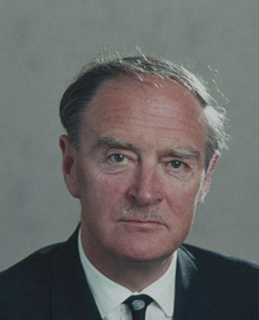
Liam Cosgrave, politician who serves as Taoiseach from February 1973 to July 1977, dies at the age of 97 in Tallaght, Dublin on October 4, 2017. He is the longest-lived Taoiseach, dying at the age of 97 years, 174 days.

Born in Castleknock, Dublin on April 13, 1920, Cosgrave is the son of William Thomas Cosgrave, the first President of the Executive Council and head of the government of the Irish Free State during the first 10 years of its existence (1922–32). He is educated at Castleknock College, Dublin, studies law at King’s Inns and is called to the Irish bar in 1943. In that same year he enters Dáil Éireann (the lower house of the Oireachtas, the Irish parliament), and he retains his seat until his retirement from politics in 1981.

In 1948, when the first inter-party government replaces Éamon de Valera’s Fianna Fáil regime, which had been in power for the previous 16 years, Cosgrave becomes Parliamentary Secretary to the Taoiseach and to the Minister for Industry and Commerce. It is a short-lived administration, going out of power in 1951 after three years of rule. But in a second inter-party government (1954–57), he becomes Minister for External Affairs and leads the first Irish delegation to the United Nations General Assembly in 1956.

Cosgrave succeeds James Dillon as leader of the Fine Gael party in 1965. Eight years later, as leader of a coalition government in which Fine Gael combines forces with the Labour Party, he becomes Taoiseach. He and British Prime Minister Edward Heath are the main participants in the intergovernmental conference at Sunningdale in December 1973 that gives birth to Northern Ireland’s first, though short-lived, power-sharing executive (1973–74). A devout Roman Catholic, he is intensely conservative on social issues and shocks his cabinet colleagues by voting against his own government’s bill on liberalizing the sale of contraceptives in 1974. The National Coalition is defeated in the 1977 Irish general election, largely on the economic issues of inflation and unemployment.

Cosgrave retires at the 1981 Irish general election. In 1981, he retires as Dáil Deputy for Dún Laoghaire to be replaced by his son, Liam T. Cosgrave. He reduces his involvement in public life but makes occasional appearances and speeches.

Liam Cosgrave dies on October 4, 2017, at the age of 97 of natural causes. He had been at Tallaght Hospital for several months prior to his death there. His funeral is held on October 7, 2017, after which he is interred alongside his father at Inchicore‘s Goldenbridge Cemetery.


Leave a comment

Closing of the Magdalene Laundries

magdalene-laundries

The last of the Magdalene Laundries in Ireland, also known as the Magdalene Asylums, closes on September 25, 1996.

The Magdalene Laundries are institutions usually run by Roman Catholic orders, which operate from the 18th to the late 20th centuries. They are run ostensibly to house “fallen women,” a term primarily referring to prostitutes in the late 18th century. By the end of the 19th century, Magdalene laundries are filled with many different kinds of women, including girls who are “not prostitutes at all”, but either “seduced women” or women who have yet to engage in sexual activity.

Several religious institutes establish even more Irish laundries, reformatories and industrial schools, sometimes all together on the same plot of land, with the aim to “save the souls primarily of women and children.” Examples are Sisters of Our Lady of Charity of Refuge and the Congregation of the Sisters of Mercy, who run the largest laundries in Dublin. These large complexes become a massive interlocking system, carefully and painstakingly built up over a number of decades. Consequently, Magdalene laundries become part of Ireland’s “larger system for the control of children and women.”

An estimated 30,000 women are confined in these institutions in the 19th and 20th centuries. It is unknown how many women resided in the Magdalene institutions after 1900. Vital information about the women’s circumstances, the number of women, and the consequence of their incarceration is unknown. Due to the religious institutes’ “policy of secrecy,” their penitent registers and convent annals remain closed to this day, despite repeated requests for information.

In Dublin in 1993, the Sisters of Our Lady of Charity sell part of the land in their convent to a property developer to cover money lost in share dealings on the stock exchange. This leads to the discovery of 133 corpses in a mass grave. The Sisters arrange to have the remains cremated and reburied in another mass grave at Glasnevin Cemetery, splitting the cost of the reburial with the developer who had bought the land. It later transpires that there are 22 more corpses than the sisters had applied for permission to exhume. In all, 155 corpses were exhumed and cremated.

Discovery of the mass grave leads to media revelations about the operations of the secretive institutions. A formal state apology is issued in 2013, and a £50 million compensation scheme for survivors is set up by the Irish Government. The religious orders which operate the laundries have rejected activist demands that they financially contribute to this programme.


Leave a comment

Death of Dick Dowling, Confederate Commander

Southern Methodist University, Central University Libraries, DeGolyer Library

Richard William “Dick” Dowling, the victorious confederate commander at the Second Battle of Sabine Pass in the American Civil War, dies of yellow fever in Houston, Texas on September 23, 1867.

Dowling is born in the townland of Knockballyvishteal, Milltown, County Galway on January 14, 1837, the second of eight children, born to tenant farmer Patrick and Bridget Dowling (née Qualter). Following the eviction of his family from their home in 1845, the first year of the Great Famine, nine-year-old Dowling leaves Ireland in 1846 with his older sister Honora, bound for New Orleans in the United States.

As a teenager, Dowling displays his entrepreneurial skills by successfully running the Continental Coffeehouse, a saloon in the fashionable French Quarter. His parents and siblings follow from Ireland in 1851, but the joy of reunion is short-lived. In 1853, a yellow fever outbreak in New Orleans takes the lives of his parents and one of his younger brothers. With rising anti-Irish feeling growing in New Orleans, following local elections which see a landslide victory for the “Know Nothing” party, Dowling moves to Houston in 1857.

In 1857 Dowling marries Elizabeth Ann Odlum, daughter of Benjamin Digby Odlum, a Kildare-born Irishman, who had fought in the Texas Revolution, being captured at the Battle of Refugio in 1836.

By 1860, Dowling owns a number of saloons. His most successful is named the Bank of Bacchus, located on Courthouse Square in downtown Houston. “The Bank” as it is known locally becomes Houston’s most popular social gathering place in the 1860s and is renowned for its hospitality. He is also involved in setting up Houston’s first gaslight company and is first to have it installed in his home and “The Bank.” He is a founding member of Houston’s Hook and Ladder Company Number One fire department and is also involved in running the city’s first streetcar company.

Prior to the outbreak of the American Civil War, Dowling makes a name for himself as an able and successful entrepreneur. Among other things, he is involved with a predominantly Irish militia company which serves a more social than military role in Houston society. Upon Secession, this militia company is mustered straight into the Confederate States Army, with Dowling being elected First Lieutenant. The unit names themselves the “Jefferson Davis Guards” in honor of Confederate President Jefferson Davis. The Davis Guards are initially part of a Texas State Troops/Confederate expedition sent to take over Union Army forts and arsenals along the border with Mexico. The expedition is successfully completed without a shot being fired. They participate in the Battle of Galveston on New Year’s Day 1863, following which they are assigned to a newly constructed artillery post near the mouth of the Sabine River called Fort Sabine.

Sabine Pass was important as a point of arrival and departure for blockade runners. It is suspected that the Union Army will attempt an invasion of Texas via Sabine Pass because of its value as a harbor for blockade runners and its proximity 18 miles southeast of Beaumont, which lies on the railroad between Houston and the eastern part of the Confederacy.

To negotiate Sabine Pass all vessels except small boats take one of the two river channels. No seagoing ship can traverse the Pass without great risk of running aground should it stray from one of the channels. The inevitable course of any steam-powered warship, including shallow-draft gunboats then common to the U.S. Navy, would use one of the channels, both of which are within fair range of the fort’s six smoothbores.

Dowling spends the summer of 1863 at the earthen fort instructing his men in gunnery. On September 8, 1863, a Union Navy flotilla of some 22 gunboats and transports with 5,000 men accompanied by cavalry and artillery arrive off the mouth of Sabine Pass. The plan of invasion is sound, but monumentally mismanaged. Four of the flanking gunboats are to steam up the pass at speed and draw the fire of the fort, two in each channel, a tactic which had been used successfully in subduing the defensive fortifications of Mobile and New Orleans prior to this. This time, however, Dowling’s artillery drills pay off as the Confederates pour a rapid and withering fire onto the incoming gunboats, disabling and capturing two, while the others retreat in disarray. The rest of the flotilla retreats from the mouth of the pass and returns ignominiously to New Orleans, leaving the disabled ships with no option but to surrender to Dowling. With a command of just 47 men, Dowling had thwarted an attempted invasion of Texas, in the process capturing two gunboats, some 350 prisoners and a large quantity of supplies and munitions.

The Confederate government offers its gratitude and admiration to Dowling, now promoted to Major, and his unit, as a result of their battlefield prowess. In gratitude, the ladies of Houston present the unit with specially struck medals, which are actually Mexican eight reale coins with both faces sanded down and inscribed “Sabine Pass, 1864” on one side and a Maltese cross with the letters D and G on the other. Because of the official recognition given to the action, it is now accepted that these Davis Guard Medals are the only medals of honor issued by the Confederate government, and consequently are collector’s items today.

After the battle of Sabine Pass Dowling is elevated to hero status in his hometown of Houston. He subsequently serves as a recruiter for the Confederacy and is personally commended for his action at the battle by Jefferson Davis. After the war he returns to his saloon business and quickly becomes one of the city’s leading businessmen.

Dowling’s promising future is cut short by another yellow fever epidemic which devastates Houston in the late summer of 1867, and he dies on September 23, 1867. He is buried at St. Vincent’s Catholic Cemetery, the oldest Catholic cemetery in Houston.


Leave a comment

Premier of RTÉ One Drama Series “Glenroe”

glenroe

The first episode of Glenroe, a television drama series broadcast on RTÉ One, airs on September 11, 1983. The series runs for eighteen years, ending in May 2001.

A spin-off from Bracken, a short-lived RTÉ drama itself spun off from The Riordans, Glenroe is broadcast, generally from September to May, each Sunday evening at 8:30 PM. It is created, and written for much of its run, by Wesley Burrowes, and later by various other directors and producers including Paul Cusack, Alan Robinson and Tommy McCardle. Glenroe is the first show to be subtitled by RTÉ, with a broadcast in 1991 starting the station’s subtitling policy.

Glenroe centers on the lives of the people living in the fictional rural village of the same name in County Wicklow. The real-life village of Kilcoole is used to film the series. The series is also filmed in studio at RTÉ and in various other locations when directors see fit.

The main protagonists are the Byrne and McDermott/Moran families, related by the marriage of Miley Byrne to Biddy McDermott, colloquially known as Biddy and Miley. Other important characters include Teasy McDaid, the proprietor of the local pub, Tim Devereux, the Roman Catholic priest, George Black, the Church of Ireland Rector of the village, Fidelma Kelly, a cousin of Biddy, Blackie Connors, George Manning and Stephen Brennan.

Glenroe is noted for its original title sequence, which features the words “Gleann Rua” in Gaelic script morphing into “Glenroe” over a series of rural images. The original title sequence is used from the 1983-1984 season to the end of the 1992-1993 season. It is replaced with a more up-to-date title sequence at the start of the 1993-1994 season.

Glenroe‘s original theme tune is a traditional Irish song called “Cuaichín Ghleann Néifinn” and is arranged by Jim Lockhart of the Celtic rock band Horslips. A newly recorded version, arranged by Máire Ní Bhraonáin of the band Clannad, is introduced at the start of the 1993-1994 season.

In 2000 it seems the series is going into inevitable decline. On January 19, 2001, despite claims four years previously that it could run for another ten years, RTÉ announces that Glenroe is to end after eighteen seasons. The final episode of the series is broadcast on May 6, 2001.


Leave a comment

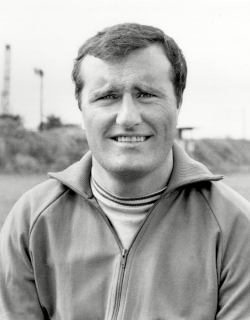
Death of Noel Cantwell, Soccer Player & Cricketer

noel-cantwell

Noel Euchuria Cornelius Cantwell, soccer player and sometime cricketer, dies of cancer on September 8, 2005. Born in Cork, County Cork on February 28, 1932, he is educated at the Roman Catholic Presentation Brothers College there.

Cantwell plays as a full-back for Western Rovers, Cork Athletic F.C., West Ham United F.C. and Manchester United F.C. While at West Ham, he features in the London XI side that competes in the 1955–58 Inter-Cities Fairs Cup final on May 1, 1958. He captains the Hammers to winning the Division Two championship in the 1957–58 season and thereby leads the club into the topflight for the first time since 1932.

In November 1960, Cantwell joins Manchester United for £29,500 which at the time is a record for a full-back. He helps the club win the 1965 and 1967 league titles and captains United when winning the 1963 FA Cup Final, just as his fellow countryman Johnny Carey had done in United’s previous FA Cup win 15 years earlier. He also serves as Chairman of the Professional Footballers’ Association.

Cantwell wins 36 full International caps for the Republic of Ireland national football team, typically playing at left full-back and on several occasions at centre-forward. He makes his debut against Luxembourg in October 1953 with his final appearance coming away to Turkey in February 1967. He scores 14 goals including 5 from penalties and also captains the Republic on several occasions including a match against England at Wembley Stadium.

In his first managerial role at Coventry City F.C. he has the onerous task of following Jimmy Hill who had taken the club into the Football League First Division for the first time in their history. He narrowly keeps the Sky Blues in the top in his first two seasons before taking them to a sixth-place finish in 1969–70, earning them qualification for the Inter-Cities Fairs Cup, a year before it was replaced by the UEFA Cup.

Cantwell departs from Highfield Road on March 12, 1972, to take charge of the New England Tea Men in the United States, but within seven months is back in English football as manager of Peterborough United F.C. He helps Peterborough win the Football League Fourth Division title in his first full season as manager, before leaving on May 10, 1977, for a second spell with the Tea Men. This time he spends a year in the United States.

Cantwell returns to Peterborough on November 19, 1986, for a second spell as manager, remaining in this role until he becomes general manager on July 12, 1988. He is general manager at London Road for a year until he quits football to become licensee of the New Inn at Peterborough, where he remains for 10 years until he retires in 1999. He also is landlord of the Bull and Swan in Stamford, Lincolnshire.

Cantwell also plays cricket for Cork Bohemians Cricket Club and Ireland as a left-handed batsman and a right-arm medium bowler. He plays five times for Ireland making his debut in what is his sole first-class match versus Scotland at Edinburgh in 1956, scoring 31 and 17. His last match for Ireland is against Lancashire in July 1959.

Cantwell dies on September 8, 2005, from cancer at the age of 73, leaving a widow and two children. His former teams each hold a minute of silence for him before their next matches.


Leave a comment

Death of John Hely-Hutchinson, Lawyer & Statesman

CH35304

John Hely (later Hely-Hutchinson), Irish lawyer, statesman, and Provost of Trinity College Dublin, dies on September 4, 1794, at Buxton, Derbyshire, England.

Hely is born in 1724 at Gortroe, Mallow, son of Francis Hely, a gentleman of County Cork. He is educated at Trinity College Dublin (BA 1744) and is called to the Irish bar in 1748. He takes the additional name of Hutchinson upon his marriage in 1751 to Christiana Nixon, heiress of her uncle, Richard Hutchinson.

Hely-Hutchinson is elected member of the Irish House of Commons for the borough of Lanesborough in 1759, but from 1761 to 1790 he represents Cork City. He at first attaches himself to the patriotic party in opposition to the government, and although he afterwards joins the administration, he never abandons his advocacy of popular measures.

After a session or two in parliament he is made a privy councillor and prime Serjeant-at-law. From this time, he gives a general, though by no means invariable, support to the government. In 1767 the ministry contemplates an increase of the army establishment in Ireland from 12,000 to 15,000 men, but the Augmentation Bill meets with strenuous opposition, not only from Henry Flood, John Ponsonby and the habitual opponents of the government, but from the Undertakers, or proprietors of boroughs, on whom the government has hitherto relied on to secure them a majority in the House of Commons.

It therefore becomes necessary for Lord Townshend to turn to other methods for procuring support. Early in 1768 an English Act is passed for the increase of the army, and a message from King George III setting forth the necessity for the measure is laid before the House of Commons in Dublin. An address favourable to the government policy is, however, rejected as Hely-Hutchinson, together with the speaker and the attorney general, do their utmost both in public and private to obstruct the bill. Parliament is dissolved in May 1768, and the lord lieutenant sets about the task of purchasing or otherwise securing a majority in the new parliament. Peerages, pensions and places are bestowed lavishly on those whose support could be thus secured. Hely-Hutchinson is won over by the concession that the Irish army should be established by the authority of an Irish act of parliament instead of an English one.

The Augmentation Bill is carried in the session of 1769 by a large majority. Hely-Hutchinson’s support had been so valuable that he receives as reward an addition of £1,000 a year to the salary of his sinecure of alnager, a major’s commission in a cavalry regiment, and a promise of the Secretaryship of State. He is at this time one of the most brilliant debaters in the Irish parliament and is enjoying an exceedingly lucrative practice at the bar. This income, however, together with his well-salaried sinecure, and his place as prime serjeant, he surrenders in 1774 to become provost of Trinity College, although the statute requiring the provost to be in holy orders has to be dispensed with in his favour.

For this great academic position Hely-Hutchinson is in no way qualified and his appointment to it for purely political service to the government is justly criticised with much asperity. His conduct in using his position as provost to secure the parliamentary representation of the university for his eldest son brings him into conflict with Patrick Duigenan, while a similar attempt on behalf of his second son in 1790 leads to his being accused before a select committee of the House of Commons of impropriety as returning officer. But although without scholarship Hely-Hutchinson is an efficient provost, during whose rule material benefits are conferred on Trinity College.

Hely-Hutchinson continues to occupy a prominent place in parliament, where he advocates free trade, the relief of the Catholics from penal legislation, and the reform of parliament. He is one of the very earliest politicians to recognise the soundness of Adam Smith‘s views on trade and he quotes from the Wealth of Nations, adopting some of its principles, in his Commercial Restraints of Ireland, published in 1779, which William Edward Hartpole Lecky pronounces one of the best specimens of political literature produced in Ireland in the latter half of the 18th century.

In the same year, the economic condition of Ireland being the cause of great anxiety, the government solicits from several leading politicians their opinion on the state of the country with suggestions for a remedy. Hely-Hutchinson’s response is a remarkably able state paper, which also shows clear traces of the influence of Adam Smith. The Commercial Restraints, condemned by the authorities as seditious, goes far to restore Hely-Hutchinson’s popularity which has been damaged by his greed of office. Not less enlightened are his views on the Catholic question. In a speech in parliament on Catholic education in 1782 the provost declares that Catholic students are in fact to be found at Trinity College, but that he desires their presence there to be legalised on the largest scale.

In 1777 Hely-Hutchinson becomes Secretary of State. When Henry Grattan in 1782 moves an address to the king containing a declaration of Irish legislative independence, he supports the attorney general’s motion postponing the question. On April 16, however, after the Easter recess, he reads a message from the Lord Lieutenant, the William Cavendish-Bentinck, 3rd Duke of Portland, giving the king’s permission for the House to take the matter into consideration, and he expresses his personal sympathy with the popular cause which Grattan on the same day brings to a triumphant issue. Hely-Hutchinson supports the opposition on the regency question in 1788, and one of his last votes in the House is in favour of parliamentary reform. In 1790 he exchanges the constituency of Cork for that of Taghmon in County Wexford, for which borough he remains member until his death at Buxton, Derbyshire on September 4, 1794.

(Pictured: Portrait, oil on canvas, of John Hely-Hutchinson (1724–1794) by Sir Joshua Reynolds (1723–1792))


Leave a comment

The Execution of Tom Williams, IRA Volunteer

File source: http://en.wikipedia.org/wiki/File:Vol._Tom_Williams.jpg

Thomas Joseph Williams, a volunteer in C Company, 2nd Battalion of the Belfast Brigade in the Irish Republican Army (IRA), is hanged in the Crumlin Road Gaol on September 2, 1942, for his involvement in the killing of Royal Ulster Constabulary (RUC) police officer Patrick Murphy during the Northern campaign.

Williams is born in the Beechmount area of Belfast on May 12, 1923. He is the third child in a family of six. After the death of his mother, he and his brother go to live with their grandmother at 46 Bombay Street in the Clonard area of Belfast. The Williams family has to leave the small Catholic enclave in the Shore Road area of Belfast after their house is attacked and burned.

As a child, Williams suffers from asthma and as a result is often very ill. He attends St. Gall’s Primary School but leaves at an early age to obtain work, which at the time is difficult due to discrimination. His work therefore consists of labouring and as a delivery boy.

As soon as Williams is old enough, he joins Na Fianna Éireann, the republican Scout Organisation founded by Constance Markievicz in 1909, becoming a member of the Con Colbert slua in the Clonard area. Alfie Hannaway, a friend of Williams, is his OC in Na Fianna, and assigns him to the rank of Quartermaster for the company. He takes his role in Na Fianna very seriously and all who came to know him are struck by his dedication and maturity, even at this early age.

At the age of 17, Williams is old enough to become a volunteer and joins C Company of the IRA in the Clonard area where he lives. Due to his “dedication and his remarkable ability” he is appointed to the role of Adjutant of C Company.

At Easter 1942 the government of Northern Ireland bans all parades to commemorate the anniversary of the Easter Rising. An IRA unit of six men and two women stage a diversionary action against the RUC to allow three parades to take place in West Belfast, but in this clash a RUC officer is killed, and the six IRA men are captured. The RUC officer, Constable Patrick Murphy, a father of nine children, from the Falls Road area of Belfast, is one of a minority of Catholics serving in the RUC.

There is debate over the years about who actually fired the fatal shot. The six IRA members are convicted and sentenced to death for murder under the law of common purpose. Five have their sentences commuted. The sentence of Williams, who acknowledges that he is the leader of the IRA unit involved and takes full responsibility for the actions of his men, is not commuted.

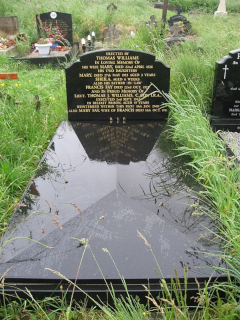
Williams is hanged in Crumlin Road Gaol in Belfast on the morning of September 2, 1942. The executioner is the official English hangman Thomas Pierrepoint, assisted by his nephew Albert Pierrepoint. Afterwards Williams’ body is interred in unhallowed ground in an unmarked grave within the grounds of the prison. His remains are only released in January 2000 after the closure of the prison in 1996 and a lengthy campaign by the National Graves Association, Belfast.

Williams’s funeral is held on January 19, 2000, and is attended by thousands, with burial at Milltown Cemetery. Joe Cahill, Williams’s cell mate, and John Oliver, sentenced to death with Williams but later reprieved, as well as Madge McConville, who had been arrested with Williams, Greta McGlone, Billy McKee, Eddie Keenan and perhaps least known, Nell Morgan, Williams’s girlfriend at the time of his death, are all present. Six senior Sinn Féin members including Gerry Adams are also present in St. Paul’s Church on the Lower Falls Road for the Mass.

Williams is remembered in a ballad Tom Williams. Various recordings have been made, most notably by the Flying Column and Éire Óg, who preamble their version with the story of the campaign to release his body. The now disbanded, Volunteer Tom Williams Republican Flute Band from Glasgow, Scotland is named in his memory as is the Tom Williams Camogie Club in Belfast.

(Pictured: Tom Williams’ headstone at Milltown Cemetery after being reinterred)


Leave a comment

Birth of Dan Breen, IRA Volunteer & Fianna Fáil Politician

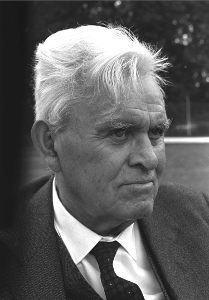
Irish republican Dan Breen (1967)

Daniel “Dan” Breen, volunteer in the Irish Republican Army (IRA) during the Irish War of Independence and the Irish Civil War, is born in Grange, Donohill parish, County Tipperary, on August 11, 1894. In later years, he is a Fianna Fáil politician.

Breen’s father dies when he is six, leaving the family very poor. He is educated locally before becoming a plasterer and later a linesman on the Great Southern Railways.

Breen is sworn into the Irish Republican Brotherhood in 1912 and the Irish Volunteers in 1914. On January 21, 1919, the day the First Dáil meets in Dublin, Breen takes part in the Soloheadbeg Ambush. The ambush party of eight men, led by Seán Treacy, attacks two Royal Irish Constabulary (RIC) men who are escorting explosives to a quarry. The two policemen, James McDonnell and Patrick O’Connell, are fatally shot during the incident. The ambush is considered to be the first incident of the Irish War of Independence.

During the conflict, the British put a £1,000 price on Breen’s head, which is later increased to £10,000. He quickly establishes himself as a leader within the Irish Republican Army. He is known for his courage. On May 13, 1919 he helps rescue his comrade Seán Hogan at gunpoint from a heavily guarded train at Knocklong station in County Limerick. Breen, who is wounded, remembers how the battalion is “vehemently denounced as a cold-blooded assassins” and roundly condemned by the Catholic Church. After the fight, Treacy, Séumas Robinson, and Breen meet Michael Collins in Dublin, where they are told to make themselves scarce although they do not necessarily agree.

Breen and Sean Treacy shoot their way out through a British military cordon in the northern suburb of Drumcondra (Fernside). They escape, only for Treacy to be killed the next day. Breen is shot at least four times, twice in the lung.

The British reaction is to make Tipperary a “Special Military Area,” with curfews and travel permits. Volunteer GHQ authorises entrerprising attacks on barracks. The British policy forces Breen and Treacy to retreat to Dublin. They join Michael Collins’ Squad of assassins, later known as the Dublin Guard, and Dublin becomes the centre of the war.

Breen is present in December 1919 at the ambush in Ashtown beside Phoenix Park in Dublin where Martin Savage is killed while trying to assassinate the Lord Lieutenant of Ireland, Viscount John French. The IRA hides behind hedges and a dungheap as the convoy of vehicles drives past. They have been instructed to ignore the first car but this contains their target, Lord French. Their roadblock fails as a policeman removes the horse and cart intended to stop the car.

Breen utterly rejects the Anglo-Irish Treaty, which makes him, like many others, angry and embittered. In the June 1922 elections Breen is nominated as a candidate by both the pro- and anti-Treaty sides, but is not elected.

Breen is elected to Dáil Éireann at the 1923 general election as a Republican anti-Treaty Teachta Dála (TD) for the Tipperary constituency. Following the Anglo-Irish Treaty, Breen joins the Anti-Treaty IRA in the civil war, fighting against those of his former comrades in arms who support the Treaty. He is arrested by the National Army of the Irish Free State and interned at Limerick Prison. He spends two months there before going on hunger strike for six days followed by a thirst strike of six days, prompting his release.

Breen writes a best-selling account of his guerrilla days, My Fight for Irish Freedom, in 1924. He represents Tipperary from the fourth Dáil in 1923 as a Republican with Éamon de Valera and Frank Aiken. He is defeated in the June 1927 Irish general election and travels to the United States where he opens a prohibition speakeasy. In 1932 he returns to Ireland and regains his seat as a member of Fianna Fáil in the Dáil at that year’s general election. During World War II he is said to hold largely pro-Axis views. He represents his Tipperary constituency without a break until his retirement at the 1965 election.

Breen dies in Dublin on December 27, 1969 and is buried in Donohill, near his birthplace. His funeral is the largest seen in west Tipperary since that of his close friend and comrade-in-arms Seán Treacy at Kilfeacle in October 1920. An estimated attendance of 10,000 mourners assemble in the tiny hamlet, giving ample testimony to the esteem in which he was held.

Breen is the subject of a 2007 biography Dan Breen and the IRA by Joe Ambrose.