seamus dubhghaill

Promoting Irish Culture and History from Little Rock, Arkansas, USA


Leave a comment

Death of Chicago Mobster Charles Dean O’Banion

Charles Dean O’Banion, better known as Dion O’Banion, is murdered by Frankie Yale, John Scalise, and Albert Anselmi in Chicago, Illinois, on November 10, 1924. He graduates from the violent newspaper wars of early 20th century Chicago to become the chief bootlegging rival of mobsters Al Capone and Johnny Torrio.

O’Banion is born to Irish Catholic parents in Maroa, Illinois on July 8, 1892. After the death of his mother in 1901, he moves with his family to a North Side neighborhood populated largely by other Irish Americans. The neighborhood, then known as Kilgubbin after an Irish place name and now called Goose Island, is notorious for its high crime rate, and by all accounts he fits easily into that environment. In his teens, he forms a street gang with Earl “Hymie” WeissVincent “The Schemer” Drucci and George “Bugs” Moran with whom he continues to associate throughout his life.

Chicago of the period is, according to Mayor William Hale “Big Bill” Thompson, a “wide open city.” Wide open for rackets such as prostitution and gambling, and wide open for violent competition among gangsters. Bombings and murder are met with token official resistance but are often settled by uneasy truces among the rivals.

The violence extends to the press. O’Banion and his friends are “sluggers” for, first, the Chicago Tribune and later for the Tribune’s rival, the Chicago Examiner. Sluggers intimidate sellers and readers of the wrong newspaper. Although played for laughs in stage and film in productions such as The Front Page, the Chicago newspaper wars are quite violent and include lethal gunfights in saloons and on the streets.

In 1909, O’Banion is arrested and convicted of robbery and assault.

The newspapers wars are a good warm-up for O’Banion’s work as a bootlegger when Prohibition comes into effect in 1920. Chicago, with its large population of immigrants from Ireland, GermanyItaly and Eastern Europe, is a town that loves its beer, wine and liquor. Almost from the start, O’Banion’s North Side Gang is at odds with the South Side outfit led at the time by Torrio.

About 1921, O’Banion and Torrio, who actively wants peace with his rival, work out a deal that seems to satisfy both the South Side gangsters and O’Banion’s group. O’Banion not only keeps the North Side and the Gold Coast, a wealthy neighborhood on Lake Michigan, but he even gets a slice of Cicero, a suburb controlled by Torrio and Capone on the South Side of Chicago, and they all share profits from a lakefront casino called The Ship.

Eventually the peace breaks down. O’Banion is enraged by efforts of a third gang, the Genna crime family’s West Side Gang, to expand its bootlegging and rackets operations into his territory. The Gennas are allied with Torrio’s South Side gang. O’Banion seals his fate when he refuses to forgive a gambling debt that one of the Gennas had racked up at The Ship.

On the morning of November 10, 1924, O’Banion is in his North Side flower shop, Schofield’s, a front for his mob activities. A Torrio associate from New York City, Frankie Yale, enters the shop with Genna gunmen John Scalise and Albert Anselmi. When O’Banion and Yale shake hands, Yale grasps O’Banion’s hand in a tight grip. At the same time, Scalise and Anselmi step aside and fire two bullets into O’Banion’s chest and two into his throat. One of the killers fires a final shot into the back of his head as he lies face down on the floor.

Since O’Banion is a major crime figure, the Catholic Church denies him burial in consecrated ground. However, a priest O’Banion has known since childhood recites the Lord’s Prayer and three Hail Marys in his memory. Despite this restriction, his funeral is the biggest anyone can remember. Among those attending are Al Capone and members of the South Side Gang. But there soon will be other funerals. The Beer Wars, as they become known, are just beginning.

Torrio escapes an assassination attempt in 1925 and turns over his operation to Capone, the greatest gangster of all. O’Banion’s friend and conspirator Hymie Weiss, who is fingered as one of those who tried to kill Torrio, is gunned down in 1926. In 1929, in an effort to permanently put down the North Side Gang, led then by Bugs Moran, seven of the North Side mobsters are killed in the infamous Saint Valentine’s Day Massacre, but Moran survives through the end of Prohibition in 1933.


Leave a comment

Birth of Des Hanafin, Fianna Fáil Politician

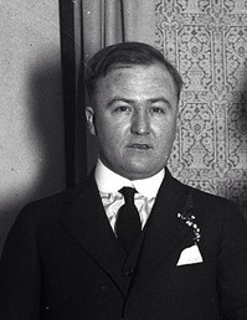
Desmond A. HanafinFianna Fáil politician who serves for over 30 years as a member of Seanad Éireann, is born in Thurles, County Tipperary, on September 9, 1930. He opposes social liberalisation, particularly the legalisation of abortion, divorce and same-sex marriage, and is one of the founders of the anti-abortion advocacy group, Pro Life Campaign (PLC).

Hanafin is the son of John Hanafin (1890–1953), a draper and newsagent who serves for many years as a Fianna Fáil councillor for North Tipperary County Council and previously is a member of the Irish Republican Brotherhood (IRB) and an elected Sinn Féin councillor.

Hanafin marries Mona Brady, daughter of J. P. Brady, on August 2, 1958, in Clonmel, County Tipperary. The wedding is followed by a reception at the Galtee Hotel, Cahir, which is attended by various notables including Rev. Father J. J. Hampson, president of Blackrock College. Their first child, Mary Hanafin, is born in June 1959, followed by John Hanafin in September 1960. Mary Hanafin is a former Fianna Fáil TD and government minister, and John Hanafin is a former Fianna Fáil senator.

Hanafin operates the Anner Hotel, located in Thurles during the 1960s. Initially successful, the business fails in 1967, which Mary Hanafin later blames on her father’s excess drinking. Subsequently, Hanafin is a director of the Transinternational Oil Company.

Hanafin’s first attempt for election to public office proves unsuccessful. In 1953, he seeks to be co-opted to fill the vacancy on North Tipperary County Council created by the death of his father. In the event councillors co-opt a Labour Party nominee, Michael Treacy, by eleven votes to seven.

Hanafin is elected a member of North Tipperary County Council in 1955, polling 934 first preference votes. Subsequently, in 1956, drawing support from the Clann na Poblachta representatives, he is elected Chairman of the County Council.

In 1957, Hanafin conducts a three-month tour of the United States, during which he is commissioned a Kentucky colonel by then Kentucky Governor Albert Benjamin “Happy” Chandler, Sr.. He is also awarded the freedom of Louisville, Kentucky, and is received by Mayor Richard J. Daley of Chicago.

Hanafin is re-elected to North Tipperary County Council in 1960, polling 797 first preference votes. In 1961, he votes against the Fianna Fáil nominee for Chair of the County Council, Thomas F. Meagher, and in favour of the Clann na Poblachta nominee, Michael F. Cronin, who is elected by 10 votes to 9. In 1964, he controversially votes in favour of Jeremiah Mockler, “a former school mate,” who is elected by 10 votes to 9 to the office of Rate Collector for Borrisokane, County Tipperary.

Hanafin holds the seat until 1985. He is first elected to Seanad Éireann in 1969 and retains his seat until the 1993 Seanad election at which he loses his seat by one vote. He regains his seat in the 1997 elections, and in 2002 announces his retirement from politics. He unsuccessfully contests the 1977 and 1981 Irish general elections for the Tipperary North constituency. He is a chief fundraiser of the Fianna Fáil party for many years.

In May 2015, Hanafin accuses “Yes” campaigners in the same-sex marriage referendum of spreading a “palpable climate of fear,” and calls for a “No” vote.

Hanafin opposes the legalisation of divorce, which is introduced in 1995, and attempts to overturn the referendum result in the Supreme Court, but is refused by the court.

An opponent of abortion, Hanafin is one of the promoters of the constitutional amendment that enshrines the legal ban on abortion in the Constitution of Ireland. He is co-founder, chairman and later honorary president of the Pro Life Campaign.

Hanafin dies in County Tipperary at the age of 86 on June 22, 2017. A Requiem Mass is held at the Cathedral of the Assumption, Thurles, on June 25, with burial afterward in St. Patrick’s Cemetery.


Leave a comment

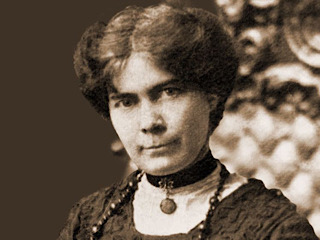
Death of Teresa Brayton, Irish Republican & Poet

Teresa Brayton, an Irish republican and poet who uses the pen name T. B. Kilbrook, dies in Kilbrook, a small village near Kilcock, County Kildare, on August 19, 1943.

Brayton is born Teresa Coca Boulanger in Kilbrook, the youngest daughter and fifth child of Hugh Boylan and Elizabeth Boylan (née Downes). Her family are long-time nationalists, with her great grandfather previously leading a battalion of pikesmen at the Battle of Prosperous.

Brayton later becomes a notable member of Irish national parties, the United Irish League and Cumann na mBan. She is described as “a patriot, but never in the vulgar sense a politician” in The Irish Times. She is closely associated with leaders of the 1916 Easter Rising, and writes poems in honour of Irish patriots including Charles Stewart ParnellRoger Casement and Patrick Pearse.

Brayton is educated from the age of 5 in Newtown National School. She writes her first poem at the age of twelve, and soon after wins her first literary award. Later on, she trains to be a teacher, and then becomes an assistant teacher to her older sister Elizabeth in the same school she received her education.

Brayton’s father is a tenant farmer, and from a young age she witnesses the effects of the land wars in Ireland. She is a supporter of Parnell, the Irish National Land League and the Irish Home Rule movement. Her work is largely influenced by her family history and Irish nationalism.

In September 1895, Brayton emigrates to the United States at the age of 27. She first lives in Boston, Chicago, and later moves to New York City. She meets Richard H. Brayton, a French-Canadian who works as an executive in the Municipal Revenue Department, who she then marries. She looks after their home and focuses on her career as a freelance journalist. She lives in the United States for 40 years and becomes well known in Irish American circles as a prominent figure in the Celtic Fellowship. It was in the United States that her reputation is established.

In the 1880s, Brayton begins her career as a poet, writing poetry for both national and provincial Irish newspapers, including Young Ireland and the King’s County Chronicle. She uses the pseudonym “T. B. Kilbrook” while contributing to these papers.

Brayton continues writing under the pseudonym until moving to the United States, where she becomes an acclaimed writer and continues to contribute to papers including the Boston newspaper The PilotNew York Monitor and Rosary Magazine. Her target audience is the Irish immigrant population of the United States. After establishing herself she releases her poetry in collections including Songs of Dawn (1913) and The Flame of Ireland (1926).

Brayton makes return trips to Ireland regularly and develops a relationship with nationalist peers, and the leaders of the Easter Rising. Upon returning to the United States, she becomes an activist for the Irish Republic and participates in organising the distribution of information to the Irish population through pamphlets and public speaking. Her contribution is acknowledged by Constance Markievicz. Her patriotism to Ireland admit her to the Celtic Fellowship in America, where she shares her poetry at events.

Brayton’s best-known poem is “The Old Bog Road,” which is later set to music by Madeline King O’Farrelly. It has since been recorded and released by many Irish musicians including Finbar FureyDaniel O’Donnell and Eileen Donaghy, among many others. Many more of her best-known ballads include, The Cuckoo’s CallBy the Old Fireside and Takin’ Tea in Reilly’s.

Brayton makes her permanent return to Ireland at the age of 64 following the death of her husband in 1932 and continues her career as a journalist writing for Irish newspapers and publishes religious poetry in the volume Christmas Verses in 1934. A short story called The New Lodger written by Brayton is published by the Catholic Trust Society in 1933. She dedicates much of her work to the exiled Irish living in the United States, incorporating themes of nostalgia, the familiarity of home and religion throughout her poetry.

Initially upon moving back to Ireland, she lives for a few years with her sister in Bray, County Wicklow. She then moves to Waterloo Avenue, North StrandCounty Dublin. Here, she witnesses the bombing of the North Strand on May 31, 1941 during World War II. Shortly after the bombing, she eventually settles back in Kilbrook, where she was born, and lives there for the rest of her life. She spends a brief period of time in the Edenderry Hospital before her death. During her stay there she becomes a good friend with Padraig O’Kennedy, the “Leinster Leader,” who is able to reveal to her something that is linked to a family member of his. A copy of her The Old Bog Road which had been set to music and autographed by her while she was living in the United States. She had it sent to O’Kennedy’s eldest son and on it she wrote the words: “To the boy who sings the Old Bog Road so sweetly.”

Two years after her return to Kilbrook, on August 19, 1943, Brayton dies in the same room where her mother had given birth to her over 75 years previously. She is buried at the Cloncurry cemetery in County Kildare. Her funeral is attended by many, including the then TaoiseachÉamon de Valera.

From the vivid imagery she speaks of in her poetry, Brayton, both a poet and a novelist, is described by some as “the poet of the homes of Ireland.” Such scenes include the vivid imagery of the fireside chats, the sound of her latch lifting as neighbours in to visit at night from her poem “The Old Boreen” and about her home cooking and work from “When the Leaves Begin to Fall.” Such images can be compared to most Irish households and can depict a vivid picture to those reading her poetry.

Brayton’s poetry leaves a lasting sense of Irish beauty and community. This can be seen in such poems as “A Christmas Blessing” where she speaks of “taking and giving in friendship” during Christmas. Since her passing she has continued to keep an audience from overseas from Boston and New York primarily, this as a result of the reminder her poems give to Irish exiles of Irish traditions and music which was close to them. While her poems are more often serious, some portray an almost comical undertone tone. In an article in The Irish Times, her poetry is also said to have a racy feel to them.


Leave a comment

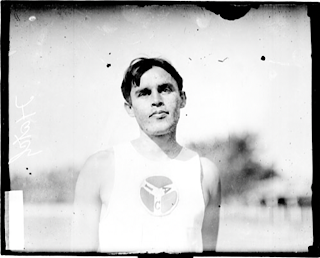
Birth of Sidney Hatch, Member of the Irish American Athletic Club

Sidney Herbert Hatch, an American athlete and a member of the Irish American Athletic Club, is born in River Forest, Illinois, on August 18, 1883. He competes for the United States in the 1904 Summer Olympics held in St. Louis, Missouri, in the 4-mile team where he wins the silver medal with his teammates Jim LightbodyFrank VernerLacey Hearn and Frenchman Albert Corey.

Hatch is also a well-known marathon runner. From 1904 through 1922 he runs more than 45 marathons with a score of victories including the Chicago Marathon in 1909 and the Yonkers Marathon in 1911, competing as a member of the Illinois State Gaelic Athletic Association (GAA). In 1910, he finishes in 5th place in the Yonkers Marathon, competing as a member of the Chicago Irish American Athletic Club.

Hatch never fails to finish a marathon. He is a six-time (1906, 1907, 1908, 1911, 1914, and 1915) winner of the Missouri Athletic Club‘s All Western Marathon in St. Louis including the 1908 marathon that qualifies him for the 1908 Summer Olympics in London. He competes in the marathon in two Olympics, placing 8th in 1904 at St. Louis and 14th in 1908 in London. He wins a silver medal in the 1904 Olympics Four-Mile team event.

On January 8, 1909, Hatch finishes third behind Matthew Maloney and James Crowley in an indoor marathon before 5,000 “wildly cheering” spectators held within the second Madison Square Garden with a time of 3:03:29.4. Maloney is reported to have set a new indoor record for the event (2:54:45.4).

On November 27, 1909, Hatch finishes sixth in the third edition of the Yonkers Marathon with a time of 3:00:24. In July of the same year, he wins a 100-mile race in Chicago, Illinois.

In March 1912, Hatch is one of “twenty of the best distance runners in the middle west” scheduled to participate in a 20-mile indoor marathon at Riverview Rink in Chicago. He also qualifies for the 1912 Summer Olympics but does not compete. He places in the top 10 in the Boston Marathon several times with a second-placed finish in 1917. He finishes third in the Boston Marathon in 1915 and 1916. In October 1916, he sets a record in the 96-mile Milwaukee to Chicago Run, completing the race in 14 hours, 50 minutes and 30 seconds.

Hatch serves as a U.S. Army messenger in World War I and is decorated for “extraordinary heroism” under fire near Brieulles, France, October 11, 1918. He is awarded the Purple Heart and Distinguished Service Cross as well as the French Croix de Guerre. After World War I, he returns to run two more Boston Marathons before retiring from marathon running. He is a letter carrier in River Forest, Illinois, from 1923 to 1953, retiring at age 70. He and Gertrude Morris are married in 1921 and have three children, Herbert, and twin girls June and Jane.

Hatch dies in Maywood, Illinois, on October 17, 1966. He is buried at the Chapel Hills Gardens West Cemetery, Oak Brook Terrace, Illinois.


Leave a comment

Birth of Donal Donnelly, Theatre & Film Actor

Donal Donnelly, Irish theatre and film actor, is born to Irish parents in BradfordWest YorkshireEngland, on July 6, 1931. Perhaps best known for his work in the plays of Brian Friel, he has a long and varied career in film, on television and in the theatre. He lives in Ireland, the United Kingdom and the United States at various times, and his travels lead him to describe himself as “an itinerant Irish actor.”

Donnelly’s father, James, is a doctor from County Tyrone, and his mother, Nora O’Connor, is a teacher from County Kerry.

Donnelly is raised in Dublin where he attends Synge Street CBS, where he acts in school plays with Milo O’SheaEamonn AndrewsJack MacGowran, Bernard Frawley (Seattle Repertory Co.) and Jimmy Fitzsimons (brother of Maureen O’Hara), under the direction of elocution teacher, Ena Burke.

Donnelly gets his start in an amateur group calling itself the Globe Theatre Players. It is organised and run by Jim Fitzgerald and Monica Brophy. He then later tours with Anew McMaster‘s Irish repertory company before moving to England where he stars with Rita Tushingham in the film The Knack …and How to Get It.

Donnelly’s breakthrough role comes when he is cast as Gar Private in the world premiere of Brian Friel’s Philadelphia, Here I Come! directed by Hilton Edwards for the Gate Theatre at the Dublin Theatre Festival in 1964. The production subsequently transfers to Broadway where it plays for over 300 performances and establishes Donnelly and Patrick Bedford, who plays his alter-ego Gar Public, as formidable new talents to be reckoned with. They are jointly nominated for the Tony Award for Best Performance by a Leading Actor in a Play in 1966.

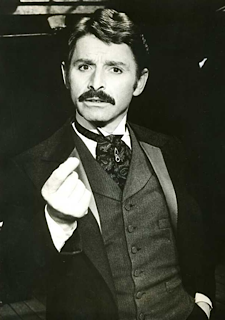
Donnelly returns to Broadway a number of times, replacing Albert Finney in A Day in the Death of Joe Egg in 1968, playing Milo Tindle in Anthony Shaffer‘s Sleuth and appearing as Frederick Treves opposite David Bowie as The Elephant Man. He also renews his relationship with Brian Friel, appearing in the world premieres of Volunteers at the Abbey Theatre in 1975 and Faith Healer with James Mason at the Longacre Theatre in New York City in 1979, as well as the Broadway premieres of Dancing at Lughnasa in 1991 and Translations in 1995.

For many years, Donnelly tours a one-man performance of the writings of George Bernard Shaw, adapted and directed by Michael Voysey and entitled My Astonishing Self.

Donnelly’s film roles include Archbishop Gilday in The Godfather Part III and as Freddy Malins in John Huston‘s final work, The Dead, based on the short story by James Joyce, where he gains particular acclaim for his performance.

On television, Donnelly plays the lead role of Matthew Browne in the 1970s ITV sitcom Yes, Honestly, opposite Liza Goddard. But from the late 1950s onwards, he often appears in such British TV programs as The AvengersZ-Cars and The Wednesday Play.

Donnelly is an acclaimed audiobook reader whose catalogue includes PinocchioPeter PanVoltaire‘s Philosophical Dictionary, and several audio versions of the works of James Joyce.

In 1968, Donnelly records an album of Irish songs, Take the Name of Donnelly, which is arranged, produced and conducted by Tony Meehan formerly of the Shadows.

Donnelly, who is a heavy smoker all his life, dies from cancer at the age of 78 in Chicago, Illinois, on January 4, 2010. He is survived by his wife, Patricia ‘Patsy’ Porter, a former dancer he met working on Finian’s Rainbow, and two sons, Jonathan and Damian. Their only daughter, Maryanne, predeceases him after being killed in a riding accident. A brother, Michael Donnelly, is a Fianna Fáil senator and councillor, and Lord Mayor of Dublin(1990–91).

(Pictured: Publicity still of Donal Donnelly as Frederick Treves in the Broadway’s play The Elephant Man)


Leave a comment

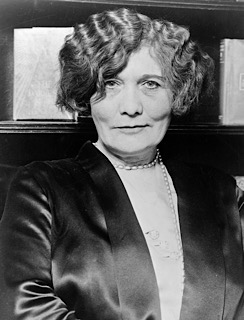
Death of Chicago May

Chicago May, the nickname of Mary Anne Duignan, an Irish-born criminal who becomes notorious in the United StatesUnited Kingdom and France, dies in Philadelphia, Pennsylvania, on May 30, 1929. She refers to herself as the “queen of crooks” and sometimes uses the name May Churchill.

Duignan is born in Edenmore, BallinamuckCounty Longford, on December 26, 1871. In 1890, at the age of 19, she steals the proceeds earned by her parents from a recent cattle fair and runs away to Liverpool, England where she buys new clothes and books a ticket to America. Upon arrival in New York City she supports herself by prostitution and picking pockets.

She moves to Chicago to take advantage of the large influx of visitors at the 1893 World’s Columbian Exposition. She teams up with another prostitute. One robs customers while the other is having sex with them. She returns to New York City, where she works as a dancer, but is soon arrested for stealing a wallet, earning her first jail sentence. She briefly marries friend Jim Sharpe but the couple soon separates. After this, she calls herself May Churchill Sharpe. She soon establishes herself with the local criminal underworld, becoming involved in various crimes, mostly of a petty nature, including fraud, assault, brawling, drunk and disorderly behaviour, beggary and pickpocketing.

Duignan has various criminal lovers, but she graduates from petty criminality to major crime when she meets Eddie Guerin, who organises a robbery of the American Express office in Paris. She is imprisoned for her role in the crime. She operates her schemes on four continents and in nine countries. She reaches the height of her career in England when she is taken up by aristocrat Sir Sidney Hamilton Gore, who supposedly proposes marriage to her, shortly before he shoots himself.

After Guerin escapes from a French prison island, he makes his way to London where he meets Duignan again, but the relationship turns sour. She takes up with a burglar named Charley Smith. In 1907, during an altercation with Guerin, Smith shoots him, wounding him in the foot. Smith and Duignan are both accused of attempted murder. She is convicted and sentenced to 15 years. She is released in 1917, and returns to the United States.

By the 1920s, Duignan is living in Detroit and has become destitute. No longer young, she is reduced to propositioning men on the streets and is repeatedly arrested for soliciting and common prostitution. She hopes to make money from her former notoriety by writing magazine articles and an autobiography with the help of a journalist, which is published in 1928 as Chicago May, Her Story, by the Queen of Crooks. Her former lover Guerin publishes his own life story at the same time, under the title I Was a Bandit. She dies at the age of 58 in Philadelphia on May 30, 1929.


Leave a comment

Birth of Patrick “Patsy” Touhey

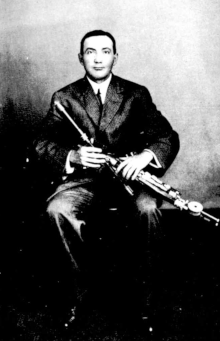
Patrick “Patsy” J. Touhey, a celebrated player of the uilleann pipes, is born on February 26, 1865, in Cahertinny, Bullaun, Loughrea, County Galway. His innovative technique and phrasing, his travels back and forth across the United States to play on the variety and vaudeville stage, and his recordings make his style influential among Irish American pipers. He can be seen as the greatest contributor to a distinctive American piping style.

According to Chief Francis O’Neill of the Chicago Police Department, in his seminal work O’Neill’s Irish Minstrels and Musicians, Touhey is the third generation of accomplished pipers stemming from his grandfather, Michael Twohill (the original spelling, b. ca. 1800), his father James and his uncle Martin, who are considered accomplished players. The family arrives in Boston around 1868, and his father arranges for his instruction from Bartley Murphy of County Mayo. However, at the age of ten Patsy loses his father and later lays the pipes aside.

In his late teens Touhey strays into a Bowery music hall where John Eagan, the “White Piper” of Galway, is engaged. Enthralled by Eagan’s virtuosity, he takes up the pipes again, and under the instruction of Eagan and Billy Taylor of Philadelphia soon becomes a master.

Touhey and Eagan tour the northeastern United States with “Harrigan’s Double Hibernian Co., Irish and American Tourists” in 1885 and 1886. This is his apparent introduction to theatrical life. Harrigan’s company stars Jeremiah “Jere” Cohan, the father of George M. Cohan, later a famous songwriter and showman. Despite a persistent legend, there is no evidence that Touhey plays publicly for the step-dancing of George M. Cohan, who is seven or eight years old at the time. Between 1886 and 1895 he appears in several theatre productions including “Inshavogue” and “The Ivy Leaf.” At the 1893 World’s Columbian Exposition in Chicago, he plays at the Irish Village, one of two rival Irish pavilions, and is later engaged for the 1904 World’s Fair in St. Louis (Louisiana Purchase Exposition). From about 1896 until 1921 he plays in vaudeville skits, trading jokes with his wife, Mary, and their on and off partner Charles Henry Burke. The shows include slapstick, low-brow gags, Irish nostalgia, and a piping finale to which Mary Touhey dances.

Chicago Police Chief Francis O’Neill, a prominent compiler of Irish dance tunes, calls Touhey “the genial wizard of the Irish pipers . . . A stranger to jealousy, his comments are never sarcastic or unkind, neither does he display any tendency to monopolize attention in company when other musicians are present.”

Touhey lives on Bristow Street in the Bronx, New York City, from at least 1900 until 1908. He and Mary live in rural East Haddam, Connecticut from 1908 to 1919, then in Freeport, New York from 1919 to 1922. In 1922 he moves back to the Bronx. He dies suddenly in his home at 1175 Concourse, New York, on January 10, 1923. He is buried in Saint Raymond’s Cemetery in the Bronx.

A statue of Patsy Touhey is unveiled in 2008 in Loughrea, near the place where he was born. It is a bronze sculpture by James MacCarthy that shows Touhey sitting on a limestone block and playing his pipes. Behind him, on the wall, there are three plaques with portraits of Peter and Vincent Broderick, two other local musicians, and Touhey himself. The statue is a tribute to the musical heritage of Loughrea and Galway, and a reminder of the connection between Ireland and its diaspora.

Recordings made of Tuohy in the 1900s have been digitised and made available on the website of the Irish Traditional Music Archive (ITMA), Dublin.


Leave a comment

Birth of Jake Burns, Frontman of Stiff Little Fingers

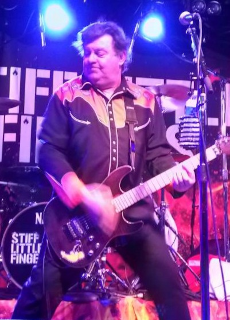
John “Jake” Burns, singer and guitarist best known as the frontman of Stiff Little Fingers, is born on February 21, 1958, in Belfast, Northern Ireland. He also records with Jake Burns and the Big Wheel, 3 Men + Black, and as a solo artist.

Burns grows up in Joanmount in Ballysillan. His mother is a seamstress, and his father is a machinist in a textile machinery factory/steel foundry, where he is a shop steward, and his socialist views are an influence on his son. Prior to punk, Burns’s musical influences include Rory Gallagher, Dr. Feelgood, Graham Parker, and Bob Marley.

Burns starts off his career at Belfast Boys’ Model School with a rock covers band, Highway Star, which consists of Burns, Gordon Blair, Henry Cluney, and Brian Faloon. Blair subsequently leaves the group to join Rudi, and Ali McMordie joins at about the time the band discovers punk.

The band is briefly named the Fast, but as there is already a group of that name, they change it to Stiff Little Fingers, taken from the song of the same name that had appeared on Pure Mania, the 1977 album by the Vibrators. Apart from a five-year gap from 1983 to 1987, Stiff Little Fingers has been active since 1977 to the present day and have released ten studio albums.

In 1981, Burns makes his acting debut in an episode of the BBC‘s Play for Today series entitled Iris in the Traffic, Ruby in the Rain, written by Belfast-born poet and playwright Stewart Parker, which also features the rest of Stiff Little Fingers effectively playing themselves as “The Band.”

After the breakup of Stiff Little Fingers in 1983, Burns forms Jake Burns and the Big Wheel. The band consists of Burns on vocals and guitar, Steve Grantley on drums, Sean Martin on bass guitar, and Pete Saunders on keyboards. Big Wheel records a total of three singles, “On Fortune Street,” “She Grew Up” and “Breathless.” A compilation album, also called On Fortune Street, is released in 2002 after the band’s demise.

In 1987, Burns disbands Big Wheel, and Stiff Little Fingers reforms, because they are “skint and wanted to make a bit of cash to get back to Ireland for Christmas.”

From about 2001 to 2005, Burns is involved in a side project with Pauline Black of the Selecter, called 3 Men and Black. This involves Black touring with three male artists from the late 1970s and early 1980s doing acoustic versions of songs they are famous for and talking a little about how they came to write the songs. The lineup for the concerts is fairly fluid, and includes such people as Bruce Foxton, Jean-Jacques Burnel, Eric Faulkner and Nick Welsh.

On March 27, 2006, Burns releases a solo album titled Drinkin’ Again.

In 2009, Burns forms a Chicago punk rock supergroup called the Nefarious Fat Cats to raise money for local charities. Notable members include John Haggerty (Pegboy, Naked Raygun), Joe Haggerty (Pegboy), Joe Principe (Rise Against), Scott Lucas (Local H), Herb Rosen (Beer Nuts, Right of the Accused) and Mark DeRosa (Dummy). Burns also contributes guitar and vocals on a track of the Black Sheep Band charity record for Children’s Memorial Hospital, A Chicago Punk Rock Collaboration for the Kids, Vol 1.

In 2016, Burns joins an acoustic “supergroup” formed by Kirk Brandon of Spear of Destiny, called Dead Men Walking which also includes David Ruffy and John “Segs” Jennings, both of Ruts DC.

Burns lives in London for over ten years from 1978 after Stiff Little Fingers relocates there. His first wife lives in Newcastle upon Tyne, and after their marriage, he moves to Newcastle, where he lives for 16 years, becoming a supporter of Newcastle United F.C. He is also an avid supporter of the Northern Ireland national football team.

Burns’s second wife, Shirley, is American and they have lived in Chicago since 2004. Burns eventually becomes a U.S. citizen, partially so he can help vote out Donald Trump.

(Pictured: Jake Burns, performing with Stiff Little Fingers in 2019)


Leave a comment

Lt. Edward O’Hare Becomes First WWII Navy Fighter Ace

On February 20, 1942, Lieutenant Edward Henry O’Hare becomes the first United States Navy fighter ace of World War II when he single-handedly attacks a formation of nine medium bombers approaching his aircraft carrier. Even though he has a limited amount of ammunition, he is credited with shooting down five enemy bombers and becomes the first naval aviator recipient of the Medal of Honor in World War II.

O’Hare is born in St. Louis, Missouri on March 13, 1914, the son of Edward Joseph O’Hare and Selma Anna (née Lauth). He is of Irish and German descent. When his parents divorce in 1927, he and his sisters, Patricia and Marilyn, stay with their mother in St. Louis while their father moves to Chicago. His father is a lawyer who works closely with Al Capone before turning against him and helping convict Capone of tax evasion.

O’Hare graduates from the Western Military Academy in 1932. The following year, he goes on to the United States Naval Academy at Annapolis, Maryland. After graduation and is commissioned as an ensign on June 3, 1937, serving two years on the battleship USS New Mexico. In 1939, he starts flight training at Naval Air Station Pensacola in Florida. When he finishes his naval aviation training on May 2, 1940, he is assigned to Fighter Squadron Three (VF-3) on board USS Saratoga.

On Sunday evening, January 11, 1942, as O’Hare and other VF-3 officers eat dinner in the wardroom, the USS Saratoga is damaged by a Japanese torpedo while patrolling southwest of Hawaii. She spends five months in repair on the west coast, so VF-3 squadron transfers to the USS Lexington on January 31.

At 15:42 on February 20, 1942, a jagged vee signal draws the attention of the USS Lexington‘s radar operator. The contact is then lost but reappears at 16:25 forty-seven miles west. O’Hare is one of several pilots launched to intercept nine Japanese Mitsubishi G4M “Betty” bombers from the 4th Kōkūtai‘s 2nd Chutai. His squadmates shoot down eight bombers but he and his wingman, Marion “Duff” Dufilho, are held back in the event of a second attack.

At 16:49, the USS Lexington‘s radar picks up a second formation of “Bettys” from the 4th Kōkūtai’s 1st Chutai, only 12 miles out, on the disengaged side of the task force. With the majority of VF-3 still chasing the 2nd Chutai, only O’Hare and Dufilho are available to intercept.

O’Hare’s initial maneuver is a high-side diving attack from the formation’s starboard side employing deflection shooting. He manages to hit the outside Betty’s right engine and wing fuel tanks. When the stricken aircraft abruptly lurches to starboard, he switches to the next plane up the line. The plane catches fire, but the crew manages to extinguish the flames with a fire-extinguisher. This plane catches up with the group before bomb release.

With two “Bettys” out of formation, O’Hare begins his second firing pass, this time from the port side. His first target is the outside plane. His bullets damage the right engine and left fuel tank, forcing the pilot to dump his bombs and abort his mission. O’Hare then targets another plane which becomes his first definite kill.

As O’Hare begins his third firing pass, again from the port side, the remaining “Bettys” are nearing their bomb release point. He shoots down another plane, leaving the lead plane exposed. His concentrated fire causes the plane’s port engine nacelle to break free from its mountings and fall from the plane. The resulting explosion leaves a gaping hole in the left wing, and the plane falls out of formation.

Shortly afterward, O’Hare makes a fourth firing pass, likely against the plane that had caught fire during his initial pass but runs out of ammunition. Frustrated, he pulls away to allow the ships to fire their anti-aircraft guns. The four surviving bombers drop their ordnance, but all their 250 kg bombs miss. O’Hare believes he has shot down six bombers and damaged a seventh. Captain Frederick C. Sherman later reduces this to five, as four of the reported nine bombers are still overhead when he pulls off.

In fact, O’Hare destroys only three “Bettys.” One of the planes, however, is not yet finished. The command pilot regains enough control to level his damaged plane and attempts to crash it into USS Lexington. He misses and crashes into the water near the carrier at 17:12. Another three “Bettys” are damaged by O’Hare’s attacks. Two safely land at Vunakanau Airfield at 19:50, while the third becomes lost in a storm and eventually ditches at Simpson Harbour at 20:10.

On March 26, O’Hare is greeted at Pearl Harbor by a horde of reporters and radio announcers. Credited with shooting down five bombers, he becomes a flying ace, is selected for promotion to lieutenant commander, and becomes the first naval aviator to receive the Medal of Honor. With President Franklin D. Roosevelt looking on, his wife Rita places the Medal around his neck. After receiving the Medal of Honor, he is described as “modest, inarticulate, humorous, terribly nice and more than a little embarrassed by the whole thing.”

O’Hare receives further decorations later in 1943 for actions in battles near Minamitorishima in August and subsequent missions near Wake Island in October.

O’Hare’s final action takes place on the night of November 26, 1943, while he is leading the U.S. Navy’s first-ever nighttime fighter attack launched from an aircraft carrier. During this encounter with a group of Japanese torpedo bombers, his Grumman F6F Hellcat is shot down. A radio message is sent out, but there is no response. The aircraft is never found. He is declared dead a year later, his widow Rita receiving her husband’s posthumous decorations, a Purple Heart and the Navy Cross on November 26, 1944. On January 27, 1945, the U.S. Navy names a Gearing-class destroyer, USS O’Hare (DD-889), in his honor.

On September 19, 1949, the Chicago-area Orchard Depot Airport is renamed O’Hare International Airport, six years after O’Hare perished. A Grumman F4F Wildcat, in a livery identical to the aircraft flown by O’Hare, is on display in Terminal 2. The display is formally opened on the seventy-fifth anniversary of his Medal of Honor flight.

(Pictured: Lieutenant Edward H. “Butch” O’Hare, USN, circa April-May 1942, official U.S. Navy photograph, now in the collections of the National Archives)


Leave a comment

Birth of “Buckey” O’Neill, Sheriff, Editor & Member of the Rough Riders

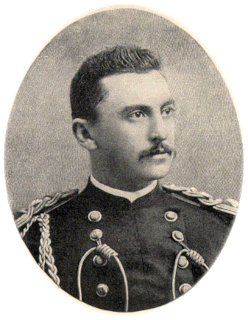
William Owen “Buckey” O’Neill, a sheriff, newspaper editor, miner, politician, Georgist, gambler and lawyer, mainly in Arizona, is born the first of four children to John Owen, an Irish immigrant, and Mary O’Neill (nee McMenimin) in St. Louis, Missouri, on February 2, 1860.

O’Neill’s father most likely arrived in the United States during the 1850s. By Spring 1862, the family has moved to Philadelphia, Pennsylvania. When the American Civil War begins, his father joins the 116th Pennsylvania Volunteers. On December 13, 1862, during the Battle of Fredericksburg, he is wounded and serves the rest of the war as a member of the Invalid Corps. The younger O’Neill is educated at Gonzaga College High School and Georgetown Law School.

During the first part of 1879, O’Neill responds to an item in The Washington Star calling for men to migrate to the Arizona Territory. He arrives in Phoenix, riding a burro, in September of the same year. Upon his arrival in town, he is hired as a printer by the Phoenix Herald. By late 1880, he has become bored with the position and seeks to experience the “Real West” in the boomtown of Tombstone, Arizona.

In Tombstone, O’Neill takes the opportunity to experience the local saloons before taking a job with The Tombstone Epitaph. By mid-1881 he again feels a wanderlust and leaves town. Where he goes next is unknown, one story having him journey to Hawaii, unlikely due to the travel time, and then traveling through California. He is known to visit Santa Fe before going to Albuquerque, New Mexico and works briefly as a court reporter. In early 1882, he is back in Phoenix working as a deputy to Marshal Henry Garfias. Several weeks later he moves to Prescott, his home for the next fifteen years.

In Prescott O’Neill rapidly progresses in his journalistic career. Starting as a court reporter, he soon founds his own newspaper, Hoof and Horn, a paper for the livestock industry. He becomes the editor of the Arizona Miner weekly newspaper in 1884 to February 1885.

In 1886, O’Neill becomes captain of the Prescott Grays, the local unit of the Arizona Militia. On February 5, 1886, Dennis Dilda, a convicted murderer, is hanged. O’Neill and the Prescott Grays stand honor guard for the event. When the trap drops, O’Neill faints, which causes him severe embarrassment. He later writes a story called “The Horse of the Hash-Knife Brand.” In it, a member of a posse admits to nearly fainting at the hanging of a horse thief.

On April 27, 1886, O’Neill marries Pauline Schindler. They have a son, but he dies shortly after being born premature.

In 1888, while serving as Yavapai County, Arizona judge, O’Neill is elected county sheriff, running on the Republican ticket.

On March 20, 1889, four masked men, William Sterin, John Halford, Daniel Harvick, and J. J. Smith, rob the Atlantic and Pacific Railroad passenger train in Canyon Diablo. A four-man posse, made up of O’Neill, Jim Black, Carl Holton, and Ed St. Clair, is soon formed and they take off after the robbers. On April 1, the posse catches up with the robbers. After exchanging rifle shots, the posse captures the four men. During the fight, no men are injured, but one of the robber’s horses is killed. All four are sent to the Yuma Territorial Prison but are pardoned eight years later. There is unfounded speculation that, in 1898, Sterin enlists under a false name in the Rough Riders and is killed in action in the Battle of San Juan Hill.

After his term is up, O’Neill is unanimously elected mayor of Prescott. In 1894 and 1896 he runs for Delegate to the United States House of Representatives from Arizona Territory, running on the People’s Party ticket.

In 1897, after years of speculating on mines, O’Neill sells a group of claims near the Grand Canyon to Chicago backers, who also propose building a railroad from Williams to the mines and the South Rim. He becomes a director of the development companies, and soon begins railroad surveys, mine developments, and building a smelter. He also uses profits to begin building rental buildings, leading him to financial independence.

O’Neill also helps introduce a bill allowing women to vote in municipal elections in 1897. Although he convinces his Populist friends to sign the bill into law, the high court dismisses the bill in 1899.

In 1898, war breaks out between the United States and Spain. O’Neill joins Theodore Roosevelt‘s Rough Riders and becomes Captain of Troop A. First Lieutenant Frank Frantz serves as O’Neil’s Deputy Commander. Along with Alexander Brodie and James McClintock, he tries to make an entire regiment made up of Arizona cowboys. Eventually though, only three troops are authorized.

The Rough Riders land at Daiquirí on June 22, 1898. Two Buffalo Soldiers of the 10th Cavalry Regiment fall overboard. Upon seeing this, O’Neill jumps into the water in full uniform and sabre. He searches for the men for two minutes before having to come up for breath.

On June 25, 1898, the Rough Riders see their first action. O’Neill leads his men at the front of the line in the Battle of Las Guasimas, capturing the Spanish flank. During the action he sees several men, who he believes to be Spaniards, across the road from him, and shouts “Hostiles on our right, fire at will!” He learns after the firing ceases that the men he exchanged shots with were Cuban rebels.

On July 1, 1898, at about 10:00 a.m., the Rough Riders and the 10th Cavalry are stationed below Kettle Hill. The Spaniards, who are on top of the hill, pour Mauser rifle fire down on the Americans. O’Neill is killed in action.

Before the fighting is over, O’Neill’s men bury him on the slope of San Juan Hill. After the war, his family and friends enlist help from the United States Department of War to find and recover his body. After six men fail to find the site, the War Department sends Henry Alfred Brown, the Rough Riders’ Chaplain, to find him. Despite it being eight months since O’Neill’s death, Chaplain Brown locates the site within two hours after arriving in Santiago de Cuba. The well-preserved body is exhumed, placed in a coffin, and returned to the United States on the Army transport Crook. He is buried at Arlington National Cemetery, in Arlington County, Virginia. The epitaph on his gravestone reads, “Who would not die for a new star on the flag?”

On July 3, 1907, a monument by sculptor Solon Borglum is dedicated to O’Neill and the other Rough Riders in their memory in Prescott, Arizona. Seven thousand people gather to witness the unveiling.

O’Neill Spring, in the Pumphouse Wash wetlands south of Flagstaff, Arizona, is named after O’Neill, as is O’Neill Butte in the Grand Canyon and Bucky O’Neill Hill in Bisbee, Arizona. Bucky (sic) O’Neill is a main character in the TNT movie Rough Riders, portrayed by Sam Elliott.