On December 30, 2002, to mark the 400th anniversary of the exodus of the O’Sullivan Beare clan from West Cork to Leitrim, a group of 40 people begin walking the entire 260-mile route which takes them through eleven counties over a two-week period. Over the course of 15 days, the route takes them through Cork, Limerick, Tipperary, Offaly, Galway, Roscommon and Sligo.
The group, including O’Sullivan Beare descendants from the United States, set out from the ruins of Dunboy Castle, Castletownbere, which was the seat of the chieftain Donal Cam O’Sullivan Beare and was destroyed after the defeat of the Irish and Spanish forces in the Battle of Kinsale in 1602. Author Deirdre Purcell launches the march at 9:00 AM. The group meets up with others from Tuosist and Kenmare in the oak woods near Glengarriff in the evening to commemorate the gathering of the clan from the peninsula before setting off for Leitrim on their winter march exactly four hundred years earlier.
The group averages 15 miles per day, with the longest leg being 30 miles and the shortest just 6.5 miles. Many join the walk for local legs.
Among the walkers setting out for the entire route is Dara O’Sullivan, age 21, the first O’Sullivan in 400 years to walk the historic route, according to Jim O’Sullivan, the co-ordinator of the project. The chieftain of the O’Sullivan clan, Michael O’Sullivan, also participates in the march.
The walkers carry two wooden staffs upon which brass rings from each town and village along the route are placed. The clan staffs of each area are also collected. Of the 1,000 people who originally set out 400 years earlier, only 35, among them only one woman, arrive at their destination.
In the summer of 2002, a series of festivals and events supported by national tourism, heritage and cultural as well as community organisations are organised in recognition of the O’Sullivan Beare march.
Beara-Breifne Way, a trail that closely follows the line of the historical march of O’Sullivan Beare opens in 2004, forming part of the European Greenways network.
Butler is the son of Richard and Ellen Butler. The great famine of 1847 and scenes of suffering and eviction are amongst his earliest recollections. He is educated chiefly by the Jesuits at Tullabeg College.
On June 11, 1877, Butler marries Elizabeth Thompson, an accomplished painter of battle scenes, notably The Roll Call (1874), Quatre Bras (1875), Rorke’s Drift (1881), The Camel Corps (1891), and The Dawn of Waterloo (1895). They have six children. His daughter, Elizabeth Butler, marries Lt.-Col. Randolph Albert Fitzhardinge Kingscote (1867-1940) on July 24, 1903.
In 1898 Butler succeeds General William Howley Goodenough as commander-in-chief in South Africa, with the local rank of lieutenant general. For a short period (December 1898 – February 1899), during the absence of Sir Alfred Milner in England, he acts as high commissioner, and as such, and subsequently in his military capacity, he expresses views on the subject of the probabilities of war which are not approved by the home government. He is consequently ordered home to command the Western District and holds this post until 1905. He also holds the Aldershot Command for a brief period from 1900 to 1901. He is promoted to lieutenant general in 1900 and continues to serve, finally leaving the King‘s service in 1905.
In October 1905, having reached the age limit of sixty-seven, Butler is placed on the retired list. The few years of life which remain to him he spends at Bansha Castle in Ireland, devoted chiefly to the cause of education. He is a frequent lecturer both in Dublin and the provinces on historical, social, and economic questions. He is known as a Home Ruler and an admirer of Charles Stewart Parnell. He is a member of the Senate of the National University of Ireland, and a commissioner of the Board of National Education. In June 1906, he is appointed Knight of the Grand Cross of the Order of the Bath, and in 1909 he is made a member of the Privy Council of Ireland.
William Butler dies at Bansha Castle in Bansha, County Tipperary, on June 10, 1910, and is buried at the cemetery of Killaldriffe, a few miles distant and not far from his ancestral home.
Butler had long been known as a descriptive writer, since his publication of The Great Lone Land (1872) and other works and he was the biographer (1899) of Sir George Pomeroy Colley. He had started work on his autobiography a few years before his death but died before it was completed. His youngest daughter, Eileen, Viscountess Gormanston, completes the work and has it published in 1911.
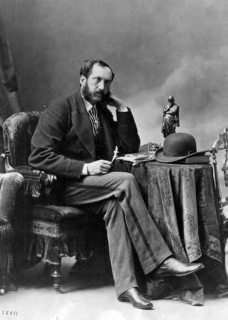
(Pictured: William Francis Butler, Source: Archives of Manitoba, Personalities – Butler, W. F. 1, N10492)
Charles Bianconi, Italo-Irish passenger car entrepreneur, is born Carlo Bianconi in Tregolo, Costa Masnaga, Italy on September 24, 1786.
Bianconi moves from an area poised to fall to Napoleon and travels to Ireland in 1802, by way of England, just four years after the Irish Rebellion of 1798. At the time, British fear of continental invasion results in an acute sense of insecurity and additional restrictions on the admission of foreigners. He is christened Carlo but anglicises his name to Charles when he arrives in Ireland.
Bianconi works as an engraver and printseller in Dublin, near Essex Street, under his sponsor, Andrea Faroni, when he is 16. In 1806 he sets up an engraving and print shop in Carrick-on-Suir, County Tipperary, moving to Clonmel in 1815.
Bianconi eventually becomes famous for his innovations in transport and is twice elected mayor of Clonmel.
Bianconi is the founder of public transportation in Ireland, at a time preceding railways. He establishes regular horse-drawn carriage services on various routes from about 1815 onward. These are known as “Bianconi coaches” and the first service, Clonmel to Cahir, takes five to eight hours by boat but only two hours by Bianconi’s carriage. Travel on one of his carriages cost one penny farthing a mile.
In 1832 Bianconi marries Eliza Hayes, the daughter of a wealthy Dublin stockbroker. They have three children – Charles Thomas Bianconi, Catherine Henrietta Bianconi and Mary Anne Bianconi, who marries Morgan O’Connell and is the mother of his grandson John O’Connell Bianconi.
Bianconi’s transport services continue into the 1850s and later, by which time there are a number of railway services in the country. The Bianconi coaches continue to be well-patronised, by offering connections from various termini, one of the first and few examples of an integrated transport system in Ireland. By 1865 Bianconi’s annual income was about £35,000.
Charles Bianconi dies on September 22, 1875 at Longfield House, Boherlahan, County Tipperary. Having donated land to the parish of Boherlahan for the construction of a parish church, he wishes to be buried on the Church grounds. He, and his family, are buried in a side chapel, separate from the parish church in Boherlahan, approximately 5 miles from Cashel, County Tipperary.
Cusack becomes a national school teacher, and after teaching in various parts of Ireland becomes a professor in 1874 at Blackrock College, then known as the French College. In 1877, he establishes his own Civil Service Academy, Cusack’s Academy, in Dublin which proves successful in preparing pupils for the civil service examinations.
A romantic nationalist, Cusack is also “reputed” to have been associated with the Fenian movement. He is active in the Gaelic revival as a member of the Society for the Preservation of the Irish Language which is founded in 1876, and later the Conradh na Gaeilge who in 1879 breaks away from the Society. Also in 1879, he meets Pat Nally, who is a member of the Irish Republican Brotherhood and a leading nationalist and athlete. He finds that Nally’s views on the influence of British landlordism on Irish athletics are the same as his. He recalls how both Nally and himself while walking through the Phoenix Park in Dublin seeing only a handful of people playing sports in the park so depressed them that they agreed it was time to “make an effort to preserve the physical strength of [their] race.” Nally organises a National Athletics Sports meeting in County Mayo in September 1879 which is a success, with Cusack organising a similar event which is open to ‘artisans’ in Dublin the following April.
Richard Boyle, 1st Earl of Cork, English-born politician who serves as Lord Treasurer of the Kingdom of Ireland and is also known as the Great Earl of Cork, dies on September 15, 1643 in Youghal, County Cork. He is an important figure in the continuing English colonisation of Ireland in the 16th and 17th centuries, as he acquires large tracts of land in plantations in Munster in southern Ireland.
Boyle goes to Ireland in 1588. He becomes deputy Escheator under Ireland’s Escheator General John Crofton and uses his office to enrich himself, only to lose his property in the Munster rebellion in 1598. Returning to England, he is imprisoned on charges of embezzlement arising from his activities in Ireland. He is acquitted by a royal court, however, and in 1600 Elizabeth I of England appoints him clerk of the council of Munster.
Two years later, Boyle purchases Sir Walter Raleigh’s estates in the Irish counties of Cork, Waterford, and Tipperary. By employing settlers imported from England, he develops his lands and founds ironworks and other industries. The enormous wealth he accumulates brings him honours and political influence. Created Earl of Cork in 1620, he is appointed a Lord Justice of Appeal in 1629 and Lord High Treasurer in 1631. Nevertheless, soon after Sir Thomas Wentworth (afterward Earl of Strafford) goes to Ireland as lord deputy in 1633, Boyle is fined heavily for possessing defective titles to some of his estates. Thereafter his political influence declines.
Boyle dies at Youghal on September 15, 1643, having been chased off his lands in the Irish Rebellion of 1641. His sons, however, recover the family estates after the suppression of the rebellion.
Boyle’s first wife, Joan Apsley, the daughter and co-heiress of William Apsley of Limerick, whom he marries on November 6, 1595, dies at Mallow, County Cork on December 14, 1599 during childbirth. By his second wife, Catherine Fenton, daughter of Sir Geoffrey Fenton, he has eight daughters and seven sons, including the renowned chemist Robert Boyle and the statesman-dramatist Roger Boyle, 1st Earl of Orrery.
Breen’s father dies when he is six, leaving the family very poor. He is educated locally before becoming a plasterer and later a linesman on the Great Southern Railways.
Breen is sworn into the Irish Republican Brotherhood in 1912 and the Irish Volunteers in 1914. On January 21, 1919, the day the First Dáil meets in Dublin, Breen takes part in the Soloheadbeg Ambush. The ambush party of eight men, led by Seán Treacy, attacks two Royal Irish Constabulary (RIC) men who are escorting explosives to a quarry. The two policemen, James McDonnell and Patrick O’Connell, are fatally shot during the incident. The ambush is considered to be the first incident of the Irish War of Independence.
During the conflict, the British put a £1,000 price on Breen’s head, which is later increased to £10,000. He quickly establishes himself as a leader within the Irish Republican Army. He is known for his courage. On May 13, 1919 he helps rescue his comrade Seán Hogan at gunpoint from a heavily guarded train at Knocklong station in County Limerick. Breen, who is wounded, remembers how the battalion is “vehemently denounced as a cold-blooded assassins” and roundly condemned by the Catholic Church. After the fight, Treacy, Séumas Robinson, and Breen meet Michael Collins in Dublin, where they are told to make themselves scarce although they do not necessarily agree.
Breen and Sean Treacy shoot their way out through a British military cordon in the northern suburb of Drumcondra (Fernside). They escape, only for Treacy to be killed the next day. Breen is shot at least four times, twice in the lung.
The British reaction is to make Tipperary a “Special Military Area,” with curfews and travel permits. Volunteer GHQ authorises entrerprising attacks on barracks. The British policy forces Breen and Treacy to retreat to Dublin. They join Michael Collins’ Squad of assassins, later known as the Dublin Guard, and Dublin becomes the centre of the war.
Breen is present in December 1919 at the ambush in Ashtown beside Phoenix Park in Dublin where Martin Savage is killed while trying to assassinate the Lord Lieutenant of Ireland, Viscount John French. The IRA hides behind hedges and a dungheap as the convoy of vehicles drives past. They have been instructed to ignore the first car but this contains their target, Lord French. Their roadblock fails as a policeman removes the horse and cart intended to stop the car.
Breen utterly rejects the Anglo-Irish Treaty, which makes him, like many others, angry and embittered. In the June 1922 elections Breen is nominated as a candidate by both the pro- and anti-Treaty sides, but is not elected.
Breen is elected to Dáil Éireann at the 1923 general election as a Republican anti-Treaty Teachta Dála (TD) for the Tipperary constituency. Following the Anglo-Irish Treaty, Breen joins the Anti-Treaty IRA in the civil war, fighting against those of his former comrades in arms who support the Treaty. He is arrested by the National Army of the Irish Free State and interned at Limerick Prison. He spends two months there before going on hunger strike for six days followed by a thirst strike of six days, prompting his release.
Breen writes a best-selling account of his guerrilla days, My Fight for Irish Freedom, in 1924. He represents Tipperary from the fourth Dáil in 1923 as a Republican with Éamon de Valera and Frank Aiken. He is defeated in the June 1927 Irish general election and travels to the United States where he opens a prohibitionspeakeasy. In 1932 he returns to Ireland and regains his seat as a member of Fianna Fáil in the Dáil at that year’s general election. During World War II he is said to hold largely pro-Axis views. He represents his Tipperary constituency without a break until his retirement at the 1965 election.
Breen dies in Dublin on December 27, 1969 and is buried in Donohill, near his birthplace. His funeral is the largest seen in west Tipperary since that of his close friend and comrade-in-arms Seán Treacy at Kilfeacle in October 1920. An estimated attendance of 10,000 mourners assemble in the tiny hamlet, giving ample testimony to the esteem in which he was held.
Breen is the subject of a 2007 biography Dan Breen and the IRA by Joe Ambrose.
In 1846, William Smith O’Brien, alongside John Mitchel, form the Irish Confederation with the Young Ireland movement which is dedicated to direct action against the British. Two short years later they are already calling for open rebellion, despite the fact that Ireland is now in the third year of the devastating famine which is leaving millions of the country’s people in brutal starvation.
Just a year after Black ‘47, the worst year of the Great Famine, the Young Ireland movement is hoping to uprise and overthrow the British but with the starving Irish just struggling to stay alive, dying or emigrating in their thousands, their revolutionary talk does little to act as a call to arms for the average Irish person.
Whereas the mistreatment of the Irish people by the British had rightly led to an increased radicalism in Irish nationalist movement, without the general Irish population able to think of anything other than staying alive, it seems doomed to failure, especially after the arrest of Mitchel before the rebellion is even started. He is convicted of sedition and transported to a penal colony in Australia before the revolt begins, a move that leads to an increased furor to revolt among the leaders that remain.
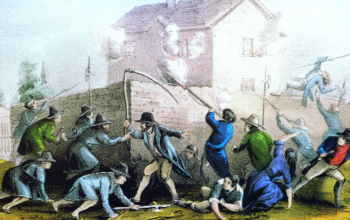
On July 29, 1848, O’Brien launches his rebellion. After being chased by a force of Young Irelanders and their supporters, a Royal Irish Constabulary unit takes refuge in a house and holds those inside as hostages.
It was evident to the rebels that the position of the police is almost impregnable. When a party of the Cashel police are seen arriving over Boulea Hill, the rebels attempt to stop them even though they are low on ammunition. The police continue to advance, firing up the road. It becomes clear that the police in the house are about to be reinforced and rescued. The rebels then fade away, effectively terminating both the era of Young Ireland and Repeal, but the consequences of their actions follow them for many years. This event is colloquially known as “The Battle of Widow McCormack’s cabbage plot.”
In O’Brien’s subsequent trial, the jury finds him guilty of high treason. He is sentenced to be hanged, drawn, and quartered. Petitions for clemency are signed by 70,000 people in Ireland and 10,000 people in England. On June 5, 1849, the sentences of O’Brien and other members of the Irish Confederation are commuted to transportation for life to Van Diemen’s Land (Tasmania in present-day Australia). In 1854, after five years in Van Diemen’s Land, O’Brien is released on the condition he never return to the United Kingdom. He settled in Brussels.
(Pictured: The attack on the Widow McCormack’s house on Boulagh Common, Ballingarry, County Tipperary)
After the failure of the Young Ireland Rebellion of 1848, O’Leary attempts to rescue the Young Ireland leaders from Clonmel Gaol, and is himself imprisoned for a week from September 8, 1849. He takes part in a further attempted uprising in Cashel on September 16, 1849, but this proves abortive.
On September 16, 1865, O’Leary is arrested and later tried on charges of high treason, eventually reduced to “treason felony.” He is sentenced to twenty years of penal servitude, of which five years are spent in English prisons, prior to his release and exile in January 1871. During his exile, he lives mainly in Paris, also visiting the United States, remains active in the IRB and its associated organisations, and writes many letters to newspapers and journals.
On the expiration of his 20-year prison term and therefore of the conditions associated with his release in 1885, O’Leary returns to Ireland. He and his sister, the poetEllen O’Leary, both become important figures within Dublin cultural and nationalist circles, which include William Butler Yeats, Maud Gonne, Rose Kavanagh, Rosa Mulholland, George Sigerson, and Katharine Tynan. He also functions as an elder statesman of the separatist movement, being active in the Young Ireland Society, and acts as president of the Irish Transvaal Committee, which supports the Boer side in the Second Boer War.
John O’Leary dies at his residence in Dublin on the evening of March 16, 1907. He is referred to famously by W.B. Yeats in his poem September 1913: “Romantic Ireland’s dead and gone/It’s with O’Leary in the grave.”
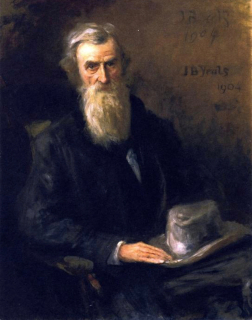
(Pictured: Painting of John O’Leary, a favorite subject of John Butler Yeats (1904). The National Gallery of Ireland owns three oil portraits of O’Leary.)
Myles is the third of eleven children born to John Myles (1807-1871), a wealthy corn merchant, and his second wife Prudence, daughter of William Bradshaw of Kylebeg, County Tipperary. The Myles family has been prominent merchants in and around Limerick city since Oliver Cromwell‘s time.
A prominent sportsman from an early age, Myles graduates in medicine at Trinity College Dublin in 1881. One of his duties in his first job as resident surgeon at Dr. Steevens’ Hospital is to render medical assistance to the victims of the Phoenix Park murders on May 6, 1882.
Myles is also an active Home Ruler. He owns a yacht, the Chotah. In 1914, he is recruited by James Creed Meredith to help in the importation of guns for the Irish Volunteers with Erskine Childers, Edward Conor Marshall O’Brien and others. Childers lands his part of the consignment from the Asgard at Howth on July 26, 1914. Myles’s cargo is landed by the Chotah at Kilcoole, County Wicklow a week later. Meredith himself helps out aboard the Chotah during the operation. On August 1, 1914, 600 Mauser rifles and 20,000 rounds of ammunition are landed at the beach in Kilcoole. Once the arms are landed, they are taken away by Volunteers on bicycles and in vehicles. The arms are taken to Patrick Pearse‘s St. Enda’s School, in Rathfarnham, County Dublin.
Myles is appointed temporary Lieutenant Colonel in the Royal Army Medical Corps on November 21, 1914, and also becomes Honorary Surgeon in Ireland to the King. He is appointed to be an Additional Member of the Military Division of the Third Class, or Companion, of the Most Honourable Order of the Bath, for services rendered in connection with the war, the appointment to date from January 1, 1917.
Sir Thomas Myles dies at the St. Lawrence’s Hospital in Dublin on July 14, 1937, and is buried at Deansgrange Cemetery in Dublin. Every year at the University of Limerick, the Sir Thomas Myles lecture is delivered as part of the Sylvester O’Halloran Surgical Meeting in honour of this remarkable surgeon and son of Limerick.
The first clash of the Tithe War takes place on March 3, 1831, in Graiguenamanagh, County Kilkenny, when a force of 120 yeomanry attempts to enforce seizure orders on cattle belonging to a Roman Catholic priest. Encouraged by his bishop, he has organised people to resist tithe collection by placing their stock under his ownership prior to sale.
The Tithe War is a campaign of mainly nonviolent civil disobedience, punctuated by sporadic violent episodes, in Ireland between 1830 and 1836 in reaction to the enforcement of tithes on the Roman Catholic majority for the upkeep of the established state church – the Church of Ireland. Tithes are payable in cash or kind and payment is compulsory, irrespective of an individual’s religious adherence.
After Emancipation in 1829, an organized campaign of resistance to collection begins. It is sufficiently successful to have a serious financial effect on the welfare of established church clergy. In 1831, the government compiles lists of defaulters and issues collection orders for the seizure of goods and chattels. Spasmodic violence breaks out in various parts of Ireland, particularly in counties Kilkenny, Tipperary and Wexford. The Royal Irish Constabulary, which had been established in 1822, attempts to enforce the orders of seizures. At markets and fairs, the constabulary often seize stock and produce, which often results in violent resistance.
A campaign of passive resistance is proposed by Patrick “Patt” Lalor, a farmer of Tenakill, Queen’s County (now County Laois), who later serves as a repeal MP. He declares at a public meeting in February 1831 in Maryborough that he would never again pay tithes and, although the tithe men might take his property and offer it for sale, his countrymen would not buy or bid for it if offered for sale. Lalor holds true to his word and does not resist the confiscation of 20 sheep from his farm but is able to ensure no buyers appear at subsequent auctions.
Following the clash at Graiguenamanagh, the revolt soon spreads. On June 18, 1831, in Bunclody, County Wexford, people resisting the seizure of cattle are fired upon by the Royal Irish Constabulary, who kill twelve and wound twenty. One yeoman is shot dead in retaliation. This massacre causes objectors to organise and use warnings such as church bells to signal the community to round up the cattle and stock. On December 14, 1831, resisters use such warnings to ambush a detachment of 40 Constabulary at Carrickshock, County Kilkenny. Twelve constables, including the Chief Constable, are killed and more wounded.
Regular clashes causing fatalities continue over the next two years. On December 18, 1834, the conflict comes to a head at Rathcormac, County Cork, when armed Constabulary reinforced by the regular British Army kill twelve and wound forty-two during several hours of fighting when trying to enforce a tithe order reputedly to the value of 40 shillings.
Finding and collecting livestock chattels and the associated mayhem creates public outrage and proves an increasing strain on police relations. The government suspends collections. In 1838, parliament introduces a Tithe Commutation Act. This reduces the amount payable directly by about a quarter and makes the remainder payable in rent to landlords. They in turn are to pass payment to the authorities. Tithes are thus effectively added to a tenant’s rent payment. This partial relief and elimination of the confrontational collections ends the violent aspect of the Tithe War.






 seamus dubhghaill