seamus dubhghaill

Promoting Irish Culture and History from Little Rock, Arkansas, USA


Leave a comment

Death of Major General William Hickie, Irish-Born British Army Officer

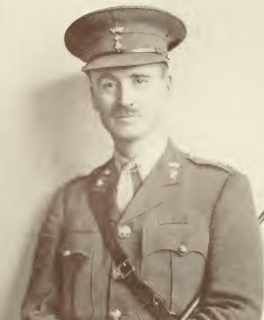
Major General Sir William Bernard Hickie, KCB, Irish-born senior British Army officer and Irish nationalist politician dies in Dublin on November 3, 1950. He sees active service in the Second Boer War from 1899 to 1902, is Assistant Quartermaster General in the Irish Command from 1912 to 1914 and serves in World War I from 1914 to 1918. He commands a brigade of the British Expeditionary Force in 1914 and is commander of the 16th (Irish) Division from 1915 on the Western Front.

Hickie is born on May 21, 1865, at Slevoir, Terryglass, near Borrisokane, County Tipperary, the eldest of the eight children of Colonel James Francis Hickie and his wife Lucila Larios y Tashara, originally of Castile. He is educated at St. Mary’s College, Oscott, Birmingham, England, a renowned seminary for training youths of prosperous Roman Catholic families.

Hickie attends the Royal Military College, Sandhurst, from 1882 to 1885. He is commissioned into his father’s regiment, the Royal Fusiliers at Gibraltar, in 1885 and serves with them for thirteen years in the Mediterranean, Egypt, and India, during which time he is promoted to captain on November 18, 1892. In 1899 he graduates as captain at the Staff College, Camberley, and is selected when the Second Boer War breaks out as a Special Service Officer in which capacity he acts in various positions of authority and command. He leaves Southampton for South Africa on board the SS Canada in early February 1900 and is promoted from captain of mounted infantry to battalion command as major on March 17, 1900. He is subsequently in command of a corps until eventually at the end of 1900 he is given command of an independent column of all arms. He holds this position for eighteen months. He serves with distinction at the Battle of Bothaville in November 1900 and receives the brevet promotion to lieutenant colonel on November 29, 1900. He serves in South Africa throughout the war, which ends with the Treaty of Vereeniging in June 1902. Four months later he leaves Cape Town on the SS Salamis with other officers and men of the 2nd battalion Royal Fusiliers, arriving at Southampton in late October, when the battalion is posted to Aldershot Garrison. In December 1902 he is elected a Fellow of the Royal Geographical Society (FRGS).

After the end of the war in South Africa there follows various staff appointments, the first from December 1902 as deputy-assistant adjutant general for district staff in the Cork district. In 1907 Hickie is back in regimental service in Dublin and Mullingar with the 1st Royal Fusiliers, where he is in command of the regiment for the last two years. From 1909 to 1912 is appointed to the Staff of the 8th Infantry Division in Cork where for four years he is well known in the hunting field and on the polo ground. In May 1912, he is promoted to colonel and becomes Quartermaster General of the Irish Command at Royal Hospital Kilmainham for which he is appointed a Companion of the Order of the Bath.

When war is declared, the Staff of the Irish Command becomes automatically the staff of the II Army Corps and accordingly with the outbreak of World War I in August 1914, Hickie is promoted to brigadier general and, as part of the British Expeditionary Force in France, takes charge of the Adjutant and Quartermaster-General’s Department during the retreat of the II Corps after the Battle of Mons, to Paris, and during the First Battle of the Marne. In mid-September 1914, he relieves one of the brigadiers in the fighting line as commander of the 13th Brigade (5th Infantry Division) and then commands the 53rd Brigade (18th Infantry Division) until December 1915, when he is ordered home to assume command of the 16th (Irish) Division at Blackburn.

Promoted to major general, Hickie takes over from Lieutenant General Sir Lawrence Parsons. It is politically a highly sensitive appointment which requires the professionalism and political awareness he, fortunately, possesses as the division is formed around a core of Irish National Volunteers in response to Edward Carson‘s Ulster Volunteers. He is much more diplomatic and tactful than his predecessors and speaks of the pride which his new command gives him but does not hesitate to make sweeping changes amongst the senior officers of the Irish Division. After putting the division through intensive training, it leaves under Irish command of which each man takes personal pride. It arrives in December 1915.

In the next two years and four months during which Hickie commands the 16th (Irish) Division, it earns a reputation for aggression and élan and wins many memorials and mentions for bravery in the engagements during the 1916 Battle of Guillemont and the capture of Ginchy, both of which form part of the Battle of the Somme, then during the Battle of Messines, the Third Battle of Ypres and in attacks near Bullecourt in the Battle of Cambrai offensive in November 1917.

During this period the Division makes considerable progress in developing its operational techniques but at a price in losses. The growing shortage of Irish replacement recruits, due to nationalist disenchantment with the war and the absence of conscription in Ireland, is successfully met by Hickie by integrating non-Irish soldiers into the division.

In February 1918, Hickie is invalided home on temporary sick leave, but when in the hospital the German spring offensive begins on March 21, with the result that after his division moves under the command of General Hubert Gough it is practically wiped out and ceases to exist as a division. Although promised a new command, this does not happen before the Armistice in November. He typifies the army’s better divisional commanders, is articulate, intelligent and is competent and resourceful during the BEF’s difficult period 1916–17, laying the foundations for its full tactical success in 1918. He is advanced to Knight Commander of the Order of the Bath in 1918.

Hickie retires from the army in 1922, when the six Irish line infantry regiments that have their traditional recruiting grounds in the counties of the new Irish Free State are all disbanded. He identifies himself strongly with the Home Rule Act and says that its scrapping is a disaster and is equally outspoken in condemning the activities of the Black and Tans. In 1925, he is elected as a member of Seanad Éireann, the Irish Free State Senate.

Hickie holds his seat until the Seanad is dissolved in 1936, to be replaced by Seanad Éireann in 1937. He is President of the Area Council (Southern Ireland) of the Royal British Legion from 1925 to 1948. He never marries.

Hickie dies on November 3, 1950, in Dublin and is buried in Terryglass, County Tipperary.


Leave a comment

Birth of Sir William Bernard Hickie, British Army General

Sir William Bernard Hickie, British Army general, commander of the 16th (Irish) Division (1915–18) and an Irish nationalist politician, is born on May 21, 1865, at Slevoir, Terryglass, near Borrisokane, County Tipperary.

Hickie is the eldest son of Colonel James Francis Hickie, JP, of Slevoir, former commanding officer of the 7th Royal Fusiliers, and Lucila Calista (de Tejada) Hickie, daughter of Don Pablo Lariosy Herreros de Tejada of Laguna de Cameros, Castile. He is educated at St. Mary’s College, Oscott, before attending the Royal Military College, Sandhurst, and is commissioned into the Royal Fusiliers in 1885, serving in Egypt and India.

A major at the outbreak of the Second Boer War in 1899, Hickie serves on the staff of Lieutenant-Colonel P. W. J. Le Gallais, commanding officer of the mounted infantry. On November 6, 1900, he is involved in an attempt to capture General Christiaan De Wet at the Battle of Bothaville, when a force led by Le Gallais and Lieutenant-Colonel Wally Ross storm De Wet’s camp. De Wet escapes, while a rearguard of 100 men engages the British force. In a fierce fight Le Gallais is killed, and Wally Ross is badly wounded. Hickie decides to charge the Boer position and leads his small force forward just as reinforcements under Major-General C. E. Knox arrive. The Boers immediately surrender, and some are found with explosive bullets. He wants to execute them immediately, but Knox insists that they be tried. Exasperated with the whole affair, Hickie gives a highly critical interview after the action which is later published in The Times History of the War in South Africa (7 vols, 1900–09), edited by Leo Amery.

Hickie is promoted to brevet lieutenant colonel in 1901 and appointed deputy-assistant adjutant general of the 8th division (1903–06). In 1906, he is given command of the 1st battalion of the Royal Fusiliers. Promoted to colonel in 1912, he serves as assistant quartermaster general of the Irish command (1912–14) and is appointed a Companion of the Order of the Bath in 1914. On the outbreak of World War I, he is promoted to brigadier general and serves in Belgium and France in command of the adjutant’s and quartermaster-general’s department of II Corps. In this capacity, he is involved in the retreat following the Battle of Mons and during the First Battle of the Marne (September 1914). In December 1915, he is appointed to command the 16th (Irish) Division, with the rank of major general, replacing General Sir Lawrence W. Parsons. The division is based around a core of Redmondite National Volunteers, and Hickie, a Catholic and a home ruler, is an acceptable commander to John Redmond and other Irish nationalists.

Hickie is professional, politically adept, and popular with his men, and under his leadership the 16th is renowned for its aggressive fighting spirit. He commands the division during the Battle of the Somme in 1916 and, while proud of his men’s success in capturing Guillemont and Ginchy (September 1916), is appalled by their losses. When the division is ordered to capture Messines (now Mesen) in June 1917, he gives Major Willie Redmond permission to advance as far as the first objective and, following Redmond’s death, reproaches himself bitterly. After this attack the division is transferred to the fifth army and provides assault troops for future attacks. During the Third Battle of Ypres, and especially during the attack on Langemarck in August 1917, the division suffers horrendous casualties, losing 221 officers and 4,064 men. Among the casualties is Fr. Willie Doyle, who Hickie unsuccessfully recommends for a Victoria Cross. The division’s losses at Langemarck are highlighted by Irish MPs in the House of Commons, and Hickie’s handling of the attack is criticised. By this time, nationalist disillusionment with the war means that few Irish replacements are available, and Hickie is forced to accept increasing numbers of non-Irish conscripts into the division. Worn down by years of command, his health finally breaks, and, in February 1918, he is sent home on sick leave, being replaced by Major-General Sir Richard Amyatt Hull.

In 1918, Hickie is created a Knight Commander of the Order of the Bath (KCB) and is also awarded the French Croix de Guerre. During the Irish War of Independence (1919–21), he is critical of the methods used by Crown forces, denouncing in particular the indiscipline of the Black and Tans. In 1921 he retires from the army and becomes a prominent figure in the Royal British Legion in Ireland, tirelessly campaigning on behalf of ex-servicemen. In the 1920s he is involved with the Irish battlefield memorial committee, which erects memorial crosses at Wytschaete, Guillemont, and Salonika, commemorating the 10th and 16th divisions. He later serves as a senator of the Irish Free State (1925–36). Retiring from public life in 1936 to his residence at Terryglass, County Tipperary, he devotes his last years to gardening and reading.

Hickie dies on November 3, 1950, in Dublin, and is buried at Terryglass. He marries a daughter of the novelist Rev. J. O. Hannay, who predeceases him. There is a small collection of his papers in the National Library of Ireland (NLI).

(From: “Hickie, Sir William Bernard” by David Murphy, Dictionary of Irish Biography, http://www.dib.ie, October 2009)


Leave a comment

Death of William Wilde, Surgeon, Author & Father of Oscar Wilde

Sir William Robert Wills Wilde, Irish otoophthalmologic surgeon and the author of significant works on medicine, archaeology and folklore, particularly concerning his native Ireland dies on April 19, 1876. He is the father of poet and playwright Oscar Wilde.

Wilde is born in March 1815 at Kilkeevin, near Castlerea, County Roscommon, the youngest of the three sons and two daughters of a prominent local medical practitioner, Thomas Wills Wilde, and his wife, Amelia Flynne. His family are members of the Church of Ireland, and he is descended from a Dutchman, Colonel de Wilde, who came to Ireland with King William of Orange‘s invading army in 1690, and numerous Anglo-Irish ancestors. He receives his initial education at the Elphin Diocesan School in Elphin, County Roscommon. In 1832, he is bound as an apprentice to Abraham Colles, the pre-eminent Irish surgeon of the day, at Dr. Steevens’ Hospital in Dublin. He is also taught by the surgeons James Cusack and Sir Philip Crampton and the physician Sir Henry Marsh. He also studies at the private and highly respected school of anatomy, medicine, and surgery in Park Street (later Lincoln Place), Dublin. In 1837, he earns his medical degree from the Royal College of Surgeons in Ireland. In the same year, he embarks on an eight-month-cruise to the Holy Land with a recovering patient, visiting various cities and islands throughout the Mediterranean. Porpoises are flung on board the ship, Crusader, and Wilde dissects them. Taking notes, he eventually composes a two-volume book on the nursing habits of the creatures. Among the places he visits on this tour is Egypt. In a tomb he finds the mummified remains of a dwarf and salvages the torso to bring back to Ireland. He also collects embalmed ibises.

Once back in Ireland, Wilde publishes an article in the Dublin University Magazine suggesting that one of the “Cleopatra’s Needles” be transported to England. In 1878, one of the Needles is transported to London, and in 1880 the other one is brought to New York City‘s Central Park. In 1873 he is awarded the Cunningham Gold Medal by the Royal Irish Academy.

Wilde runs his own hospital, St. Mark’s Ophthalmic Hospital for Diseases of the Eye and Ear, in Dublin and is appointed to serve as Oculist-in-ordinary to Queen Victoria. At one point, he performs surgery on the father of another famous Irish dramatist, George Bernard Shaw.

Wilde had a very successful medical practice and is assisted in it by his natural son, Henry Wilson, who had been trained in Dublin, Vienna, Heidelberg, Berlin, and Paris. Wilson’s presence enables him to travel, and he visits Scandinavia, where he receives an honorary degree from Uppsala University, and is welcomed in Stockholm by Anders Retzius, among others. King Charles XV of Sweden confers on him the Nordstjärneorden (Order of the Polar Star). In 1853, he is appointed Surgeon Occulist in Ordinary to the Queen in Ireland, the first position of its kind, probably created for him.

Wilde is awarded a knighthood in a ceremony at Dublin Castle on January 28, 1864, more for his involvement with the Irish census than for his medical contributions, although he had been appointed medical commissioner to the Irish census in 1841. In 1845, he becomes editor of the Dublin Journal of Medical & Chemical Science, to which he contributes many articles.

Wilde marries the poet Jane Francesca Agnes Elgee on November 12, 1851, who writes and publishes under the pen name of Speranza. The couple has two sons, William (Willie) and Oscar, and a daughter, Isola Francesca, who dies in childhood.

In addition to his children with his wife, Wilde is the father of three children born out of wedlock before his marriage: Henry Wilson, born in 1838, and Emily and Mary Wilde, born in 1847 and 1849, respectively, of different parentage to Henry. He acknowledges paternity of his illegitimate children and provides for their education, but they are reared by his relatives rather than with his wife and legitimate children. Emily and Mary both die in 1871 following a Halloween party at which their dresses accidentally catch fire.

From 1855 until his death in 1876, Wilde lives at 1 Merrion Square, now the headquarters of American College Dublin. The building is named Oscar Wilde House after William Wilde’s son, who also lives at the address from 1855 until 1878. There is a plaque at 1 Merrion Square dedicated to him.

Wilde’s reputation suffers when Mary Travers, a long-term patient of his and the daughter of a colleague, claims that he had seduced her two years earlier. She writes a pamphlet crudely parodying Wilde and Lady Wilde as Dr. and Mrs. Quilp, and portraying Dr. Quilp as the rapist of a female patient anaesthetised under chloroform. She distributes the pamphlets outside the building where Wilde is about to give a public lecture. Lady Wilde complains to Mary’s father, Robert Travers, which results in Mary bringing a libel case against her. Mary Travers wins her case but is awarded a mere farthing in damages by the jury. Legal costs of £2,000 are awarded against Lady Wilde. The case is the talk of all Dublin, and Wilde’s refusal to enter the witness box during the trial is widely held against him as ungentlemanly behaviour.

From this time onwards, Wilde begins to withdraw from Dublin to the west of Ireland, where he had started in 1864 to build what becomes Moytura, his house overlooking Lough Corrib in Connemara, County Galway. His health deteriorates in 1875. He dies, likely of cancer, at the age of 61 on April 19, 1876. He is buried in Mount Jerome Cemetery in Dublin.

(Pictured: Sketch of William Wilde by J.H. Maguire, 1847)


Leave a comment

Death of Gerald O’Sullivan, Victoria Cross Recipient

Gerald Robert O’Sullivan VC (Irish: Gearóid Roibeard Ó Súilleabháin), Irish recipient of the Victoria Cross, the highest and most prestigious award for gallantry in the face of the enemy that can be awarded to British and Commonwealth forces, dies on August 21, 1915, at Scimitar Hill, Gallipoli, Ottoman Turkey.

O’Sullivan is born in Frankfield, Douglas, County Cork, on November 8, 1888. His father is a career soldier in the Argyll and Sutherland Highlanders. Known as ‘Jerry’, he is educated at Wimbledon College from which he graduates in 1906. He desires a career in the British Army and attends the Royal Military Academy Sandhurst.

Commissioned into the Royal Inniskilling Fusiliers in 1909, O’Sullivan spends much of the next three years serving in China with his unit, 2nd Battalion. From 1912, the battalion is based in British India but on the outbreak of World War I is brought back to England.

The Royal Inniskilling Fusiliers form part of 29th Division, intended for service in the Gallipoli campaign. Now a captain in the 1st Battalion, O’Sullivan commands a company during the landing at X Beach on the Gallipoli peninsula on April 25, 1915, and acquits himself well during the early stages of the fighting. On June 18, 1915, the Turks mount an attack on positions adjacent to those of O’Sullivan’s company, forcing the troops manning the defenses to abandon it. He leads his company in a counterattack to reclaim the lost position which exchanges hands several times during the next few hours. The commanding officer in the area, Brigadier General W. R. Marshall, eventually directs O’Sullivan to lead a party of Inniskilling and South Wales Borderers soldiers to capture the position which is achieved at dawn the following day.

Two weeks later, O’Sullivan is involved in a further action near Krithia, and this results in his recommendation for the Victoria Cross (VC). The citation, published in The London Gazette on September 1, 1915, reads as follows:

“For most conspicuous bravery during operations south-west of Krithia on the Gallipoli Peninsula. On the night of July 1-2, 1915, when it was essential that a portion of a trench which had been lost should be regained, Captain O’Sullivan, although not belonging to the troops at this point volunteered to lead a party of bomb throwers to affect the recapture. He advanced in the open under a very heavy fire and in order to throw his bombs with greater effect, got up on the parapet, where he was completely exposed to the fire of the enemy occupying the trench. He was finally wounded, but not before his inspiring example had led his party to make further efforts, which resulted in the recapture of the trench. On the night of June 18-19, 1915, Captain O’Sullivan had saved a critical situation in the same locality by his personal gallantry and good leading.”

The wounds O’Sullivan receives in the action of July 1-2 necessitates his evacuation to Egypt for medical treatment, but he quickly recovers and returns to his unit on August 11, 1915. The 29th Division is now at Suvla Bay and preparing for a new offensive. The Inniskillings are tasked with the capture of a feature known as Hill 70 or Scimitar Hill. During this battle, on August 21, 1915, he leads a charge of 50 men to the hilltop but is killed.

O’Sullivan has no known grave and is remembered on the Helles Memorial to the Missing. His VC is delivered to his mother who lives in Dorchester, and his name also appears on the memorial there.


Leave a comment

Death of John Henry Patterson, Army Officer, Hunter, Author & Zionist

John Henry Patterson, known as J. H. Patterson, Irish officer in the British Army, game hunter, author and Christian Zionist, dies in Bel Air, California, on June 18, 1947.

Patterson is born on November 10, 1867, at Forgney, Ballymahon, County Longford, the son of a Protestant father and a Roman Catholic mother. He joins the British Army at Dublin in 1885 and is posted with the 3rd Dragoon Guards to India. In 1892 he is seconded to the Indian military works department as a supervisor of civil engineering projects. In 1894 he marries Frances Helena Gray, daughter of William Gray of Cork and Belfast, a building surveyor who founded the free library movement in Belfast. She goes on to earn science and law degrees.

In 1898 Patterson is sent to British East Africa to supervise 3,000 Indian and African labourers who are building a railway bridge spanning the Tsavo River as part of the Mombasa to Lake Victoria line. Construction is interrupted when two man-eating lions repeatedly attack the labourers’ camp at night. He embarks on a lion hunt, but by the time he shoots the two lions they have mauled and mutilated between 130 and 140 labourers.

Patterson volunteers for service in the South African War in 1900. He is mentioned in dispatches by Lord Frederick Roberts and Lord Herbert Kitchener and is awarded the Distinguished Service Order (DSO). In 1902 he is appointed lieutenant colonel commanding the 33rd Battalion Imperial Yeomanry. While on a shooting trip in east Africa in 1906, he discovers a new species of eland, which is named Taurotragus oryx pattersonianus after him. His account of his adventures in Africa, The Man-Eaters of Tsavo, is published in 1907 to instant international acclaim. His exploits are twice made the subject of films: Bwana Devil (1952) and The Ghost and the Darkness (1996). In 1907 he is seconded as chief game warden, British East Africa Protectorate (Kenya), and he combines his work of conducting surveys with escorting private safari parties.

The following year Patterson leads a safari trip in the protectorate accompanied by Audley James Blyth, a son of James Blyth, 1st Baron Blyth, and his wife, Ethel Jane. During the expedition Blyth shoots himself in the head with a revolver and dies. Patterson claims that Blyth was suffering from heat stroke, but there are rumours of a romantic attachment between Patterson and Mrs. Blyth. The colonial secretary Lord Crewe exonerates Patterson in return for his resignation as chief game warden. The incident serves as the plot for Ernest Hemingway‘s short story “The Short Happy Life of Francis Macomber.”

In 1913 Patterson commands the West Belfast division of the Ulster Volunteer Force (UVF) and sees service in Flanders before being sent to Egypt in early 1915. In Alexandria, two Russian Jewish Zionists, the journalist Ze’ev Jabotinsky and veteran of the Russo–Japanese War Joseph Trumpeldor, ask General John Maxwell, commander of the British forces in Egypt, to establish a Jewish legion that will liberate the Holy Land from the Turks. Maxwell refuses, proposing instead that the Jews form a volunteer transport unit to serve in Gallipoli. Patterson, who is imbued with a deep knowledge of the Old Testament and draws spiritual sustenance from biblical heroes such as Joshua and Gideon, is appointed commander of the Assyrian Jewish refugee mule corps, a colonial corps of the Egyptian expeditionary force. He sails with the Zion Mule Corps, as it is popularly known, to Gallipoli in April 1915, where the corps serves with distinction, carrying water and ammunition to the Allied troops on the peninsula. He falls ill in November 1915 and is sent to convalesce in London. The Zion Mule Corps is evacuated from Gallipoli in December and disbanded in March 1916.

When manpower and political considerations persuade the British authorities to create the Jewish Legion in 1917, Patterson is appointed its commander. He marches his 38th Battalion Royal Fusiliers through the City of London and Whitechapel, cheered by a crowd of several thousand Jews. The Jewish Legion participates in General Edmund Allenby‘s sustained attack, which successfully pushes the Turks out of Palestine. His experiences with his Jewish soldiers turn him into a committed Zionist. In 1916 he writes With the Zionists in Gallipoli, and in 1922 With the Judaeans in the Palestine Campaign, which contain a scathing attack on Britain’s policy towards the Jews during and after World War I.

Throughout the 1920s and 1930s, Patterson increasingly allies himself with the revisionist Zionist agenda espoused by Jabotinsky’s New Zionist Organisation. When World War II breaks out, he travels with Jabotinsky to the United States, moving permanently to La Jolla, California, in 1940. With others, including the Irish Jew and later Lord Mayor of Dublin Robert Briscoe, he agitates for the formation of a large Jewish army that would fight with the Allies against Nazi Germany. After Jabotinsky’s death in 1940, he works with Benzion Netanyahu, the Palestinian Jewish executive director of the American revisionist Zionists. In 1946 he becomes godfather to Netanyahu’s first son, who is named Yonatan (the closest Hebrew name to John) in Patterson’s honour. Yonatan later leads Operation Entebbe, the successful 1976 Israeli raid on Entebbe Airport to free Israeli hostages.

On June 18, 1947, just a year before the establishment of the Zionist state of Israel, for which he had worked so hard, Patterson dies at Bel Air, California. A week later, the United Zionist Revisionists of Great Britain hold a memorial meeting at the Anglo–Palestinian Club near Piccadilly Circus in Patterson’s memory. His documents and personal effects are held at the Jabotinsky Institute and Museum in Tel Aviv. His uniform and other memorabilia are on display in Beit Hagdudim, the Jewish Legions Museum at Netanya, Israel. His two man-eating lions are on display in Chicago’s Field Museum of Natural History, where his son Bryan Patterson later serves as curator.

(From: “Patterson, John Henry” by Yanky Fachler, Dictionary of Irish Biography, http://www.dib.ie)


Leave a comment

Birth of Sir Eyre Coote, Soldier, Politician & Governor of Jamaica

Sir Eyre Coote, Irish-born British soldier and politician who serves as Governor of Jamaica, is born on May 20, 1759.

Coote is the second son of the Very Reverend Charles Coote of Shaen Castle, Queen’s County (now County Laois), Dean of Kilfenora, County Clare, and Grace Coote (née Tilson). Educated at Eton College (1767–71), he enters Trinity College Dublin (TCD) on November 1, 1774, but does not graduate. In 1776 he is commissioned ensign in the 37th (North Hampshire) Regiment of Foot and carries the regiment’s colours at the Battle of Long Island on August 27, 1776, during the American Revolutionary War. He fights in several of the major battles in the war, including Rhode Island (September 15, 1776), Brandywine (September 11, 1777) and the siege of Charleston (1780). He serves under Charles Cornwallis, 1st Marquess Cornwallis, in Virginia and is taken prisoner during the siege of Yorktown in October 1781.

On his release Coote returns to England, is promoted major in the 47th (Lancashire) Regiment of Foot in 1783, and in 1784 inherits the substantial estates of his uncle Sir Eyre Coote. He inherits a further £200,000 by remainder on his father’s death in 1796. He resides for a time at Portrane House, Maryborough, Queen’s County, and is elected MP for Ballynakill (1790–97) and Maryborough (1797–1800). Although he opposes the union, he vacates his seat to allow his elder brother Charles, 2nd Baron Castle Coote, to return a pro-union member. He serves with distinction in the West Indies (1793–95), particularly at the storming of Guadeloupe on July 3, 1794, and becomes colonel of the 70th (Surrey) Regiment of Foot (1794), aide-de-camp to King George III (1795), and brigadier-general in charge of the camp at Bandon, County Cork (1796).

Coote is active in suppressing the United Irishmen in Cork throughout 1797, and in June arrests several soldiers and locals suspected of attempting to suborn the Bandon camp. On January 1, 1798, he is promoted major-general and given the command at Dover. He leads the expedition of 1,400 men that destroy the canal gates at Ostend on May 18, 1798, holding out stubbornly for two days against superior Dutch forces until he is seriously wounded and his force overwhelmed. Taken prisoner, he is exchanged and in 1800 commands a brigade in Sir Ralph Abercromby‘s Mediterranean campaign, distinguishing himself at Abu Qir and Alexandria. For his services in Egypt, he receives the thanks of parliament, is made a Knight of the Bath, and is granted the Crescent by the Sultan.

In 1801 Coote returns to Ireland. Elected MP for Queen’s County (1802–06), he generally supports the government and is appointed governor of the fort of Maryborough. He gives the site and a large sum of money towards the building of the old county hospital in Maryborough. In 1805 he is promoted lieutenant-general, and he serves as lieutenant-governor of Jamaica (1806–08). His physical and mental health deteriorates in the West Indian climate, and he is relieved of his post in April 1808. He is second in command in the Walcheren Campaign of 1809 and leads the force that takes the fortress of Flushing. However, he shows signs of severe stress during the campaign and asks to be relieved from command because his eldest daughter is seriously ill.

Coote is conferred LL.D. at Trinity College, Cambridge in 1811. Elected MP for Barnstaple, Devon (1812–18), he usually votes with government, but opposes them by supporting Catholic emancipation, claiming that Catholics strongly deserve relief because of the great contribution Catholic soldiers had made during the war. He strongly opposes the abolition of flogging in the army. Despite a growing reputation for eccentricity, he is promoted full general in 1814 and appointed Knight Grand Cross (GCB) on January 2, 1815, but his conduct becomes increasingly erratic. In November 1815 he pays boys at Christ’s Hospital school, London, to allow him to flog them and to flog him in return. Discovered by the school matron, he is charged with indecent behaviour. The Lord Mayor of London dismisses the case and Coote donates £1,000 to the school, but the scandal leads to a military inquiry on April 18, 1816. Although it is argued that his mind had been affected by the Jamaican sun and the deaths of his daughters, the inquiry finds that he is not insane and that his conduct is unworthy of an officer. Despite the protests of many senior officers, he is discharged from the army and deprived of his honours.

Coote continues to decline and dies in London on December 10, 1823. He is buried at his seat of West Park, Hampshire, where in 1828 a large monument is erected to him and his uncle Sir Eyre Coote.

Coote first marries Sarah Robard in 1785, with whom he has three daughters, all of whom die young of consumption. Secondly, he marries in 1805, Katherine, daughter of John Bagwell of Marlfield, County Tipperary, with whom he has one son, his heir Eyre Coote III, MP for Clonmel (1830–33). He also has a child by Sally, a slave girl in Jamaica, from whom Colin Powell, United States Army general and Secretary of State, claims descent.


Leave a comment

Birth of Walter Edward Guinness, 1st Baron Moyne

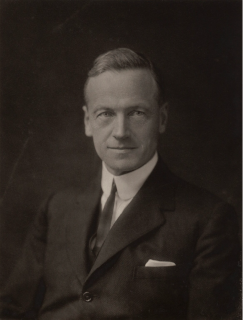
Walter Edward Guinness, 1st Baron Moyne, soldier, politician, traveler, and anthropologist, is born on March 29, 1880, in Dublin.

Guinness is the third son of Edward Cecil Guinness, 1st Earl of Iveagh, and Adelaide Maria Guinness, a cousin. He is educated at Eton College, where he displays a keen interest in the sciences, especially biology, and considerable athletic prowess. Forsaking an intention to enter the University of Oxford, he joins the Suffolk Yeomanry regiment of the British Army as a second lieutenant on November 15, 1899, and serves in the Second Boer War (1899–1902), where he is wounded and mentioned in dispatches.

On return from South Africa Guinness enters politics, unsuccessfully contesting Stowmarket in the 1906 United Kingdom general election as a Conservative Party candidate. In the following year he becomes MP for Bury St. Edmunds, holding the seat until 1931. He is also elected as a member of the London County Council (1907–10). He interrupts his career yet again at the outbreak of World War I and, rejoining the Suffolk Yeomanry, serves in Gallipoli and Egypt. By the end of the war he is a lieutenant colonel, three times mentioned in dispatches, with the Distinguished Service Order (DSO) in 1917 and a bar to it in 1918.

In the immediate postwar years Guinness devotes himself to his political career, and his work is soon rewarded with important appointments: Under-Secretary of State for War (1922) and Financial Secretary to the Treasury (1923). He serves for a second time at the Treasury (1924–5) under Winston Churchill, then Chancellor of the Exchequer. Sworn of the Privy Council in 1924, he enters the cabinet in November 1925 as Minister of Agriculture and Fisheries. After the defeat of the Conservatives in the 1929 United Kingdom general election, he gradually withdraws from the political scene, retiring from his parliamentary seat in 1931. He is raised to the peerage in 1932 as Baron Moyne of Bury St. Edmunds, Suffolk.

Always a keen traveler, during the following years Guinness makes several expeditions in search of biological specimens and archaeological material. He travels twice to New Guinea and also goes to Greenland and the Bay Islands near Honduras. These voyages are vividly described in his books Walkabout (1936) and Atlantic circle (1938). He still maintains a political profile, however, serving in several different capacities including financial commissioner to Kenya (1932) and chairman of the West India Royal Commission (1938–9). At the outbreak of World War II, he works as chairman of the Polish Relief Fund before being appointed as Joint Parliamentary Secretary at the Ministry of Agriculture on the formation of the Churchill government (1940). In 1941 he becomes Secretary of State for the Colonies and Leader of the House of Lords. Appointed Deputy Resident Minister of State in Cairo (August 1942), he becomes Minister-Resident for the Middle East in January 1944. On November 6, 1944, he is assassinated in Cairo by members of the ‘Stern Gang’, the Jewish terrorist group based in Palestine.

Guinness marries (1903) Lady Evelyn Hilda Stuart Erskine, daughter of the 14th Earl of Buchan. They have two sons and one daughter.

(Pictured: Walter Edward Guinness, 1st Baron Moyne of Bury St. Edmunds, bromide print, 1929, by Walter Stoneman, National Portrait Gallery)


Leave a comment

Birth of Thomas Heazle Parke, Physician, British Army Officer & Author

Thomas Heazle Parke FRSGS, Irish physician, British Army officer and author who is known for his work as a doctor on the Emin Pasha Relief Expedition, is born at Clogher House in Kilmore, County Roscommon on November 27, 1857.

Parke is brought up in Carrick-on-Shannon, County Leitrim. He attends the Royal College of Surgeons in Ireland in Dublin, graduating in 1878. He becomes a registered medical practitioner in February 1879, working as a dispensary medical officer in Ballybay, County Monaghan, and then as a surgeon in Bath, Somerset, England.

Parke joins the British Army Medical Services (AMS) in February 1881 as a surgeon, first serving in Egypt during the final stages of the ʻUrabi revolt in 1882. As a senior medical officer at a field hospital near Cairo, he is responsible for treating battle casualties as well as the deadly cholera epidemic that afflicts 20% of British troops stationed there. In late 1883, he returns to Ireland, where he is stationed at Dundalk with the 16th The Queen’s Lancers. He arrives in Egypt once again in 1884 as a part of the Nile Expedition sent in relief of General Charles Gordon, who is besieged in Khartoum by Mahdists in neighbouring Sudan. The expedition arrives too late, and Gordon is killed. Parke later negatively recounts this experience in an 1892 journal article titled How General Gordon Was Really Lost. Following the expedition, he spends the next few years stationed in Alexandria, where he notably introduces fox hunting to Egypt, becoming master of the Alexandria Hunt Club.

In January 1887, while in Alexandria, Parke is invited by Edmund Musgrave Barttelot to accompany him on the Emin Pasha Relief Expedition. The expedition is led by Henry Morton Stanley, and journeys through the African wilderness in relief of Emin Pasha, an Egyptian administrator who had been cut off by Mahdist forces following the Siege of Khartoum. He is initially rejected by Stanley upon his arrival in Alexandria but is invited by telegram a day later to join the expedition in Cairo. On February 25, 1887, the expedition sets off from Zanzibar for the Congo.

The expedition lasts for three years and faces great difficulty, with the expedition of 812 men suffering from poor logistical planning and leadership. The rainforest is much larger than Stanley expected, leading much of the party to face starvation and disease. The expedition has to resort to looting native villages for food, escalating the conflict between the two groups. Parke, for his part, saves the lives of many in the party, including Stanley, who suffers from acute abdominal pain and a bout of sepsis. Stanley describes Parke’s care as “ever striving, patient, cheerful and gentle…most assiduous in his application to my needs, and gentle as a woman in his ministrations.” Parke also treats Arthur Jephson for fever, and nurses Robert H. Nelson through starvation. Furthermore, after a conflict with the natives, he has to save William Grant Stairs by orally sucking the poison out of an arrow wound.

During the expedition, Parke purchases from an Arab slaver a Mangbetu Pigmy girl, who serves as his nurse and servant for over a year.

After returning to Ireland, Parke receives an Honorary Fellowship of the Royal College of Surgeons in Ireland and is awarded gold medals from the British Medical Association (BMA) and the Royal Geographical Society. He publishes several books, including My Personal Experiences in Equatorial Africa (1891) and A Guide to Health in Africa.

In August 1893, Parke visits William Beauclerk, 10th Duke of St. Albans in Ardrishaig, Scotland. He dies during that visit on August 11, 1893, presumably due to a seizure. His coffin is brought back to Ireland, where he receives a military funeral as it passes from the Dublin docks to Broadstone railway station. He is buried near his birthplace in Drumsna, County Roscommon.

A bronze statue of Parke stands on Merrion Street in Dublin, outside the National Museum of Ireland – Natural History. He is also commemorated by a bust in the Royal College of Surgeons in Ireland.

(Pictured: Photograph of Thomas Heazle Parke by Eglington & Co., Wellcome Collection gallery)


3 Comments

Birth of Charles Edward Jennings, Soldier & Revolutionary

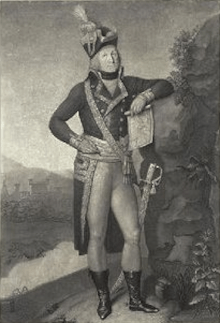
General Charles Edward Saul Jennings, Irish soldier and revolutionary who serves France in the eighteenth century and is sometimes romanticised as Brave Kilmaine, is born on October 19, 1751, in Sauls Court, Dublin.

Jennings is the second son of Theobald Jennings, a physician of Polaniran (Ironpool), Tuam, County Galway, and Eleonore Saul, daughter of Laurence Saul, a wealthy Dublin distiller. Educated privately in Dublin, he leaves Ireland in 1769, settling in Tonnay-Charente in the south of France, where his father had set up practice. His father had, several years previously, assumed the fictitious title of ‘baron of Kilmaine’ in the hope of improving his position in French society, and he subsequently assumes the same title.

In 1774 Jennings joins the Royal Dragoons as a trooper, transferring in 1778 into the Légion de Lauzun, a corps made up mostly of foreign volunteers. After the campaign in Senegal (1778–79) he returns to France and is commissioned as a sous-lieutenant. He then campaigns with Gilbert du Motier, Marquis de Lafayette, during the American Revolutionary War and teaches cavalry tactics at Metz on his return. Promoted to captain in 1788, at the outbreak of the French Revolution, he is stationed at Verdun and, despite a short period in prison, continues to serve with his regiment. In 1791, when several of the regiment’s officers flee from France, he remains and is one of the first officers to swear allegiance to the national assembly.

Promoted to Chef d’escadron in April 1792, Jennings serves under Charles François Dumouriez during the invasion of the Netherlands, distinguishing himself at the Battle of Valmy and the Battle of Jemappes, where he reinforces the French centre at a critical point, ensuring victory. A series of rapid promotions follow. He is made a colonel in January 1793, a general of brigade in March 1794, and a general of division in May1794.

After a series of reverses in the summer of 1793, in which the French lose the fortress-towns of Condé and Valenciennes, the committee of public safety appoints Jennings to command the Armée du Nord on May 15, 1793, with the rank of full general. In August, in order to preserve his force in the face of overwhelming opposition, he retreats from a position 120 miles north of Paris known as ‘Caesar’s camp.’ Although the allied army swings away to invest Dunkirk, he is arrested and imprisoned for endangering the city, and remains in prison until after the fall of Robespierre in July 1794. Within a few days, due to the turbulent political situation, he is rearrested and not released until December 1794. In May 1795 he cooperates with Napoléon Bonaparte in suppressing the Jacobin uprising in Faubourg Saint-Antoine in Paris and, having reestablished his credentials, commands the cavalry during the invasion of Italy (1796). Bonaparte regards him highly, and he distinguishes himself at the Battle of Lodi on May 10, 1796, seizing the city of Milan five days later. He defeats a large Austrian force in the Battle of Borghetto before investing and taking the fortress-town of Mantua in February 1797.

When peace terms are agreed with Austria, Jennings returns to France, taking command of the centre column of the Armée d’Angleterre, which had been raised to invade Britain and Ireland. However, his deteriorating health makes some observers question his suitability for such an appointment. An associate of Thomas Paine and James Napper Tandy, and a friend of Wolfe Tone, he is forced to watch the gradual reduction of his army as Napoleon diverts troops for his campaign in Egypt. Tone is at first suspicious of him, given that many Irish-born French officers had deserted the revolutionary cause but comes to admire him.

After the defeat of Admiral Bombard’s expedition to Ireland and Tone’s arrest on November 3, 1798, Jennings requests that the French government should take a senior British prisoner as hostage and subject him to the same treatment as Tone. After Tone’s death he assists Matilda Tone and her children. In early 1799 he is appointed military governor of Switzerland but is forced to resign due to his failing health.

In a fragile condition Jennings leaves Switzerland and returns to Passy in Paris, where his domestic griefs and chagrins add to the poignancy of his bodily sufferings, for his constitution is now completely broken up. He dies of dysentery on December 11, 1799, at the age of 48. He is buried with full military honours.

Jennings is historically honored at the Arc de Triomphe in Paris, where his name can be seen on the inside triumphal arch, on the Northern pillar, Column 05. Underneath the Arc is the Tomb of the Unknown Soldier (World War I). There is a personal portrait of Jennings in the ‘Hotel de Ville’ (City Hall) at Tonnay-Charente, where his father Dr. Theobald Jennings practiced as a physician.

A monument was erected in Jennings’s memory in Tonnay-Charente in the 19th century. Rue du Général Kilmaine, a street in Tonnay-Charente, is named in his honour in the 19th century.


Leave a comment

Death of David Lord, RAF Officer & Victoria Cross Recipient

David Samuel Anthony Lord, VC, DFC, recipient of the Victoria Cross, the highest award for gallantry in the face of the enemy that can be awarded to British and Commonwealth forces, is killed at Arnhem, Netherlands, on September 19, 1944, during World War II. A transport pilot in the Royal Air Force, he receives the award posthumously for his actions during the Battle of Arnhem while flying resupply missions in support of British paratroopers.

Lord is born on October 18, 1913, in Cork, County Cork, one of three sons of Samuel (a warrant officer in the Royal Welsh Fusiliers) and Mary Lord (née Miller). One of his brothers dies in infancy.

After World War I the family is posted to British India and Lord attends Lucknow Convent School. On his father’s retirement from the Army the family moves to Wrexham and then he is a pupil at St. Mary’s College, Aberystwyth, and then the University of Wales. Later, he attends the English College, Valladolid, Spain, to study for the priesthood. Deciding that it was not the career for him, he returns to Wrexham, before moving to London in the mid-1930s to work as a freelance writer.

Lord enlists in the Royal Air Force on August 6, 1936. After reaching the rank of corporal in August 1938, he applies to undertake pilot training, which he begins in October 1938. Successfully gaining his pilot’s wings, he becomes a sergeant pilot in April 1939, and is posted to No. 31 Squadron RAF, based in Lahore, India. He later flies the Vickers Type 264 Valentia biplane transport. In 1941, No. 31 Squadron is the first unit to receive the Douglas DC-2 which is followed by both the Douglas DC-3 and Dakota C-47 Skytrain transports. That year he is promoted to flight sergeant and then warrant officer. He flies in North Africa, supporting troops in Libya and Egypt for four months, before being posted back to India. Commissioned as a pilot officer in May 1942, he flies supply missions over Burma, for which he is mentioned in despatches.

Lord is awarded the Distinguished Flying Cross in July 1943, receiving the award at Buckingham Palace, and is promoted to flight lieutenant shortly afterwards. By January 1944, he has joined No. 271 Squadron RAF, based at RAF Down Ampney, Gloucestershire, and begins training as part of preparations for the invasion of Europe. On D-Day, he carries paratroopers into France and his aircraft was hit by flak, returning to base without flaps.

The Battle of Arnhem is part of Operation Market Garden, an attempt to secure a string of bridges through the Netherlands. At Arnhem, the British 1st Airborne Division and Polish 1st Independent Parachute Brigade are tasked with securing bridges across the Lower Rhine, the final objectives of the operation. However, the airborne forces that drop on September 17 are not aware that the 9th SS and 10th SS Panzer divisions are also near Arnhem for rest and refit. Their presence adds a substantial number of Panzergrenadiers, tanks and self-propelled guns to the German defences and the Allies suffer heavily in the ensuing battle. Only a small force manages to hold one end of the Arnhem road bridge before being overrun on September 21. The rest of the division becomes trapped in a small pocket west of the bridge and has to be evacuated on September 25. The Allies fail to cross the Rhine, which remains under German control until Allied offensives in March 1945.

Lord is 30 years old, and a flight lieutenant serving with No. 271 Squadron, Royal Air Force during World War II when he is awarded the Victoria Cross. On September 19, 1944, during the Battle of Arnhem in the Netherlands, the British 1st Airborne Division is in desperate need of supplies. His Dakota III “KG374” encounters intense enemy anti-aircraft fire and is hit twice, with one engine burning. He manages to drop his supplies, but at the end of the run finds that there are two containers remaining. Although he knows that one of his wings might collapse at any moment, he nevertheless makes a second run to drop the last supplies, then orders his crew to bail out. A few seconds later, the Dakota crashes in flames with its pilot and six crew members.

Only the navigator, Flying Officer Harold King, survives, becoming a prisoner of war. It is only on his release in mid-1945, as well as the release of several paratroops from the 10th Parachute Battalion, that the story of Lord’s action becomes known. He is awarded a posthumous Victoria Cross.

After Arnhem is liberated in April 1945, Grave Registration Units of the British 2nd Army move into the area and began to locate the Allied dead. Lord is buried alongside his crew in the Arnhem Oosterbeek War Cemetery. There are many plaques in memory of him, including one at Wrexham Cathedral in Wales.

Several aircraft have carried tributes to Lord. Between 1993 and 1998, the RAF Battle of Britain Memorial Flight‘s Dakota, serial “ZA947”, is painted in the colours of Lord’s aircraft during the Arnhem battle and bears the same code letters: YS-DM. Between 1973 and 2005, the Dakota displayed at RAF Museum Cosford is similarly painted and coded to represent Lord’s aircraft. From 1966 until its disbandment in 2005, No. 10 Squadron RAF is equipped with Vickers VC-10s, each of which is named after a Royal Air Force or Royal Flying Corps VC recipient. Aircraft serial number ‘XR810’ is named David Lord VC.

Lord’s Victoria Cross is presented to his parents at Buckingham Palace in December 1945. In 1997, his Victoria Cross, along with his other decorations and medals, are sold at auction by Spinks to Lord Ashcroft. As of 2014, the medal group is on display at the Imperial War Museum.