In mid-1863, James Stephens informs his colleagues he wishes to start a newspaper, with financial aid from John O’Mahony and the Fenian Brotherhood in America. The offices are established at 12 Parliament Street, almost at the gates of Dublin Castle. The first edition of The Irish People appears on November 28, 1863. The staff of the paper along with Charles Kickham are Thomas Clarke Luby and Denis Dowling Mulcahy as the editorial staff. Jeremiah O’Donovan Rossa and James O’Connor are in charge of the business office, with John Haltigan being the printer. John O’Leary is brought from London to take charge in the role of Editor. Shortly after the establishment of the paper, James Stephens departs on an American tour, and to attend to organisational matters.
American Fenians make plans for a rising in Ireland, but the plans are discovered on July 15, 1865 when an emissary loses them at Kingstown railway station. They find their way to Dublin Castle and to Superintendent Daniel Ryan head of G Division. Ryan has an informer within the offices of The Irish People named Pierce Nagle, who supplies Ryan with an “action this year” message on its way to the Irish Republican Brotherhood unit in Tipperary. With this information, Ryan raids the offices of The Irish People on September 15, followed by the arrests of John O’Leary, Thomas Clarke Luby and Jeremiah O’Donovan Rossa. The last edition of the paper is dated September 16, 1865.
Before leaving for America, Stephens entrusts to Luby a document containing secret resolutions on the Committee of Organization or Executive of the IRB. Though Luby intimates its existence to O’Leary, he does not inform Kickham as there seems no necessity. This document later forms the basis of the prosecution against the staff of The Irish People. The document reads:
EXECUTIVE
I hereby appoint Thomas Clarke Luby, John O’Leary and Charles J. Kickham, a Committee of Organisation or Executive, with the same supreme control over the Home Organisation (Ireland, England, Scotland, etc.) I have exercised myself. I further empower them to appoint a Committee of Military Inspection, and a Committee of Appeal and Judgment, the functions of which Committee will be made known to each member of them by the Executive. Trusting to the patriotism and ability of the Executive, I fully endorse their action beforehand, and call on every man in our ranks to support and be guided by them in all that concerns our military brotherhood.
9 March 1864, Dublin J. STEPHENS
Charles Kickham is caught after a month on the run and James Stephens is also eventually caught but with the support of Fenian prison warders John J. Breslin and Daniel Byrne is less than a fortnight in Richmond Bridewell Prison when he vanishes and escapes to France.
Rossa’s body had been returned from New York City where he died June 29. He had been exiled by the British for his Fenian activities in 1871. While in exile, Rossa manages to alienate many of his former Fenian colleagues, including his good friend John Devoy, with his uncompromising advocacy of violence to end British rule in Ireland. Perhaps his attitude is due in part to the harsh treatment he receives in British prisons as well as scenes he witnesses while helping to distribute relief in his native County Cork during the Great Hunger.
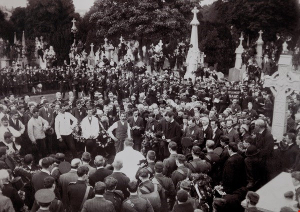
Rossa’s funeral is one of the seminal events in the revival of the Irish republican movement in Ireland. During the three days when Rossa lays in the vestibule of the City Hall, encased in a coffin with a plate glass lid, thousands of citizens pass by to pay their final respects.
The coffin is conveyed from the City Hall in the four-horse bier in waiting at 2:25 PM and fifteen minutes later the cortège starts, headed by a guard of honour of the Irish Volunteers with rifles, a mounted guard being supplied by the same body. The coffin is thickly covered with wreaths and an open carriage behind is also filled with floral tokens, while many of the contingents carry wreaths to be placed on the grave.
The procession, in marching four deep at a slow pace, takes a little over fifty minutes to pass the corner of Dame Street into George’s Street. A conservative estimate of those who actually take part in the procession give the numbers as exceeding 6,000 and there must be at least ten times that number lining the streets.
The funeral comes into College Green at about 3:00 PM, headed by a body of Volunteers with the St. James’s Band. It is nearing 6:00 PM when the hearse passes through the main gates of Glasnevin Cemetery. The avenue leading to the mortuary chapel is lined by detachments of Volunteers. The prayers in the chapel are said by the Rev. D. Byrne, chaplain. Several priests then accompany the coffin to the grave, which is situated just beyond the eastern fringe of the O’Connell circle, close to the graves of two other prominent Fenians, John O’Leary and James Stephens.
Patrick Pearse gives an address at the graveside which has resounded with republicans down through the years. The final words of his oration provide them with one of their most enduring slogans, “Ireland unfree will never be at peace.”
A firing party then fires a volley, the Last Post is sounded, and wreaths are laid on the grave.
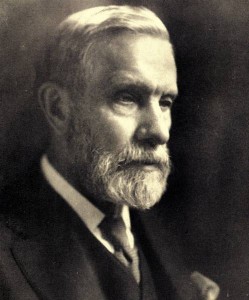
O’Grady is born on March 22, 1846, at Castletown, County Cork, the son of Reverend Thomas O’Grady, the scholarly Church of Ireland minister of Castletown Berehaven, County Cork, and Susanna Doe. After a rather severe education at Tipperary Grammar School, O’Grady follows his father to Trinity College, Dublin, where he wins several prize medals and distinguishes himself in several sports.
O’Grady proves too unconventional of mind to settle into a career in the church and earns much of his living by writing for the Irish newspapers. Reading Sylvester O’Halloran‘s General history of Ireland sparks an interest in early Irish history. After an initial lukewarm response to his writing on the legendary past in History of Ireland: Heroic Period (1878–81) and Early Bardic Literature of Ireland (1879), he realizes that the public wants romance, and so follows the example of James Macpherson in recasting Irish legends in literary form, producing historical novels including Finn and his Companions (1891), The Coming of Cuculain (1894), The Chain of Gold (1895), Ulrick the Ready (1896) and The Flight of the Eagle (1897), and The Departure of Dermot (1913).
O’Grady also studies Irish history of the Elizabethan period, presenting in his edition of Sir Thomas Stafford‘s Pacata Hibernia (1896) the view that the Irish people have made the Tudors into kings of Ireland in order to overthrow their unpopular landlords, the Irish chieftains. His The Story of Ireland (1894) is not well received, as it sheds too positive a light on the rule of Oliver Cromwell for the taste of many Irish readers. He is also active in social and political campaigns in connection with such issues as unemployment and taxation.
Until 1898, he works as a journalist for the Daily Express of Dublin, but in that year, finding Dublin journalism in decline, he moves to Kilkenny to become editor of the Kilkenny Moderator. It is here he becomes involved with Ellen Cuffe, Countess of Desart and Captain Otway Cuffe. He engages in the revival of the local woolen and woodworking industries. In 1900 he founds the All-Ireland Review and returns to Dublin to manage it until it ceases publication in 1908. O’Grady contributes to James Larkin‘s The Irish Worker paper.
O’Grady’s works are an influence on William Butler Yeats and George Russell and this leads to him being known as the “Father of the Celtic Revival.” Being as much proud of his family’s Unionism and Protestantism as of his Gaelic Irish ancestry, identities that are increasingly seen as antithetical in the late 1800s, he is described by Augusta, Lady Gregory as a “fenian unionist.”
Advised to move away from Ireland for the sake of his health, O’Grady passes his later years living with his eldest son, a clergyman in England, and dies on the Isle of Wight on May 18, 1928.
O’Grady’s eldest son, Hugh Art O’Grady, is for a time editor of the Cork Free Press before he enlists in World War I early in 1915. He becomes better known as Dr. Hugh O’Grady, later Professor of the Transvaal University College, Pretoria, who writes the biography of his father in 1929.
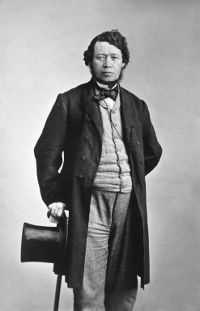
McGee, born on April 13, 1825 in Carlingford, County Louth, grows up a Catholic Irishman who hates the British rule of Ireland and works for a peasant revolution to overthrow British rule and secure Irish independence. He escapes arrest and flees to the United States in 1848, where he reverses his political beliefs. He becomes disgusted with American republicanism and democracy, and becomes intensely conservative in his politics and in his religious support for the Pope.
McGee moves to Canada in 1857 and works hard to convince the Irish Catholics to cooperate with the Protestant British in forming a Confederation that will make for a strong Canada in close alliance with Britain. His fervor for Confederation garners him the title “Canada’s first nationalist.” He fights the Fenians in Canada, who are Irish Catholics who hate the British and resemble his younger self politically. McGee succeeds in helping create the Canadian Confederation in 1867.
On 7 April 1868, McGee, having participated in a parliamentary debate that goes on past midnight, walks back to the boarding house where he is staying. McGee is opening the door to Trotter’s Boarding House in Ottawa when he is shot by someone waiting for him on the inside. Several people run to the scene, however there is no sign of the assassin. It is later determined that McGee is assassinated with a shot from a handgun by Patrick J. Whelan.
McGee is given a state funeral in Ottawa and interred in a crypt at the Cimetière Notre Dame des Neiges in Montreal. His funeral procession in Montreal draws an estimated crowd of 80,000 out of a total city population of 105,000.
Patrick J. Whelan, a Fenian sympathiser and a Catholic, is accused, tried, convicted, and hanged for the crime on February 11, 1869, in Ottawa. The jury is decisively swayed by the forensic evidence that Whelan’s gun had been fired shortly before the killing, together with the circumstantial evidence that he had threatened and stalked McGee. Historian David Wilson points out that forensic tests conducted in 1972 show that the fatal bullet is compatible with both the gun and the bullets that Whelan owned. Wilson concludes, “The balance of probabilities suggests that Whelan either shot McGee, or was part of a hit-squad, but there is still room for reasonable doubt as to whether he was the man who actually pulled the trigger.”
The government of Canada’s Thomas D’Arcy McGee Building stands near the site of the assassination. The case is dramatised in the Canadian play Blood on the Moon by Ottawa actor/playwright Pierre Brault. The assassination of McGee is also a major component of Away, a novel about Irish immigration to Canada by Canadian novelist Jane Urquhart.
Founding members include John O’Daly, William Elliot Hudson, John Edward Pigot, Owen Connellan, John Windele, and William Smith O’Brien. The antiquary Standish Hayes O’Grady is a principal member and later becomes its president. By 1860 the list of subscribers numbers 746, six volumes of Transactions are produced, and the preparations for further issues are extant when it ceases operations in 1863.
The group of Irish scholars emerge from competing societies, such as the Celtic Society and the Irish Archaeological Society, focusing on the translation of Irish literature from the “Fenian period of Irish history,” specifically, the mythological works of Oisín and the Fianna, and the promotion of the Irish language. The manifesto stipulates the membership be entirely composed of Irish scholars, the intent being to distinguish itself from similar societies that cater to Anglo-Irish interests and influence. Though such societies have credible scholars as steering members, the work produced is thought to be influenced by the local ascendancy and their royal (English) patrons.
The correspondence of members of the Society reveals a fractious relationship with other important figures of the time, Eugene O’Curry and those of the Royal Irish Academy, and are often frustrated in their attempts to access early manuscripts.
Holland, the second of four siblings, all boys, is born in a coastguard cottage in Liscannor, County Clare, where his father, John Philip Holland, Sr., is a member of the British Coastguard Service. His mother, a native Irish speaker from Liscannor, Máire Ní Scannláin, is John Holland’s second wife. His first wife, Anne Foley Holland, believed to be a native of Kilkee, dies in 1835. The area is heavily Irish-speaking and Holland learns English properly only when he attends the local English-speaking St. Macreehy’s National School, and from 1858, in the Christian Brothers in Ennistymon.
Holland joins the Irish Christian Brothers in Limerick and teaches in CBS Sexton Street in Limerick and many other centres in the country, including North Monastery CBS in Cork, St. Joseph’s CBS in Drogheda, and as the first Mathematics teacher in Coláiste Rís in Dundalk. Due to ill health, he leaves the Christian Brothers in 1873 and emigrates to the United States. Initially working for an engineering firm, he returns to teaching again for an additional six years in St. John’s Catholic school in Paterson, New Jersey.
While a teacher in Cork, Holland reads an account of the battle between the ironclads USS Monitor and USS Merrimack in the Battle of Hampton Roads during the American Civil War. He realizes that the best way to attack such ships would be through an attack beneath the waterline. He draws a design, but when he attempts to obtain funding, he is turned away. After his arrival in the United States, Holland slips and falls on an icy Boston street and breaks a leg. While recuperating from the injury in a hospital, he uses his time to refine his submarine designs and is encouraged by a priest, Isaac Whelan.
In 1875, his first submarine designs are submitted for consideration by the U.S. Navy, but are turned down as unworkable. The Fenians, however, continue to fund Holland’s research and development expenses at a level that allows him to resign from his teaching post. In 1881, Fenian Ram is launched, but soon after, Holland and the Fenians part company on bad terms over the issue of payment within the Fenian organization, and between the Fenians and Holland. The submarine is now preserved at Paterson Museum in New Jersey.
Holland continues to improve his designs and works on several experimental boats, prior to his successful efforts with a privately built type, launched on May 17, 1897. This is the first submarine having power to run submerged for any considerable distance, and the first to combine electric motors for submerged travel and gasoline engines for use on the surface. The submarine is purchased by the U.S. Navy on April 11, 1900, after rigorous tests and is commissioned on October 12, 1900 as USS Holland (SS-1). Six more of her type are ordered and built at the Crescent Shipyard in Elizabeth, New Jersey. The company that emerges from under these developments is called The Electric Boat Company, founded on February 7, 1899. Isaac Leopold Rice becomes the company’s first President with Elihu B. Frost acting as vice president and chief financial officer. The company eventually evolves into the major defense contractor General Dynamics.
The USS Holland design is also adopted by others, including the Royal Navy in developing the Holland-class submarine. The Imperial Japanese Navy employs a modified version of the basic design for their first five submarines, although these submarines are at least 10 feet longer at about 63 feet. These submarines are also developed at the Fore River Ship and Engine Company in Quincy, Massachusetts. Holland also designs the Holland II and Holland III prototypes. The Royal Navy ‘Holland 1’ is on display at the Submarine Museum in Gosport, England.
O’Mahony is born in 1816 in Kilbeheny, County Limerick. His father and uncle were members of the Society of United Irishmen and took part in the Irish Rebellion of 1798. On the death of an elder brother, he inherits a property which yields £300 per annum. He enters Trinity College, Dublin, where he studies Sanskrit, Hebrew, and Irish. He becomes an accomplished Gaelic scholar, and later teaches Greek and Latin, and contributes articles to Irish and French journals. He leaves Trinity without getting a degree.
In 1843, O’Mahony joins Daniel O’Connell‘s movement for the Repeal of the Acts of Union 1800, but quickly becomes dissatisfied with the lack of progress and joins the Young Ireland movement which William Smith O’Brien leads and takes part in the failed Young Ireland Rebellion of 1848. His participation in the rebellion obligates him to leave Ireland, and he settles for a time in Paris, where he lives in great poverty. In 1854, he joins John Mitchel in New York City, and takes part in the Emigrant Aid Association, the Emmet Monument Association, and other Irish organisations.
In 1857, O’Mahony publishes History of Ireland, by Geoffrey Keating, D. D., translated from the Original Gaelic, and Copiously Annotated (New York, 1857). O’Mahony’s notes are copied from John O’Donovan‘s translations of Annals of the Four Masters, and it is on this ground that Hodges & Smith procures an injunction against the sale of the book in the United Kingdom. The mental strain to which O’Mahony is subjected in the preparation of this work, which brings him no pecuniary gain, affects his reasoning and he is removed by his friends for a short time to a lunatic asylum.
In 1860, O’Mahony organises the Fenian Brotherhood, also known as the Irish Republican Brotherhood. The object of the association is to secure the freedom of Ireland. The name is probably derived from O’Mahony’s Gaelic studies, the Fenians having been a military body in pagan Ireland, celebrated in the songs of Ossian. The organisation of the new society is completed at conventions that are held in Chicago in 1864 and in Cincinnati in January 1865.
At the time of the Cincinnati convention, O’Mahony holds the rank of colonel of the 69th Regiment of New York State Militia, recruited mainly from the ranks of the Brotherhood, which has also furnished a large proportion of Thomas Francis Meagher‘s Irish Brigade, Michael Corcoran‘s legion, and Irish regiments engaged in the American Civil War. The rapid growth in membership of the Fenian Brotherhood renders it impossible for O’Mahony to retain the colonelcy of the 69th regiment, which he has held for some time. He resigns in order to give all his attention to the spread of Fenianism.
The close of the civil war in the spring of 1865 gives a great impetus to the Fenians, owing to the number of Irish American soldiers that are disbanded and anxious to see service elsewhere. Money pours into the Fenian exchequer. Many differences occur between O’Mahony and James Stephens and the Central Council relative to the policy to be pursued for the attainment of their object, but O’Mahony remains president of the organisation for several years. He does not take any part personally in the attempted insurrection in Ireland or in the raids on Canada, although his advice counts for much in these enterprises.
He devotes the last years of his life to literary pursuits, but suffers from ill health, and he has a hard struggle to secure the bare means for subsistence. However, visionary may have been his objectives, he is honest, and although thousands have passed through his hands, he is often at a loss for a dollar. When his poverty is discovered, he declines to receive assistance in any form. He dies in New York City on February 7, 1877, and soon after his death his remains are returned to Ireland and interred with the honors of a public funeral in Glasnevin Cemetery in Dublin.
John Devoy, one of the most devoted revolutionaries the world has ever seen, is born in Kill, County Kildare, on September 3, 1842. Dedicating over 60 years of his life to the cause of Irish freedom, he is one of the few people to have played a leading role in the Fenian Rising of 1867, the 1916 Easter Rising, and the Irish War of Independence (1919 – 1921).
After the Great Famine, the family moves to Dublin where Devoy’s father obtains at job at Watkins’ brewery. Devoy attends night school at the Catholic University before joining the Fenians. In 1861 he travels to France with an introduction from Timothy Daniel Sullivan to John Mitchel. Devoy joins the French Foreign Legion and serves in Algeria for a year before returning to Ireland to become a Fenian organiser in Naas, County Kildare.
In 1865, when many Fenians are arrested, James Stephens, founder of the Irish Republican Brotherhood (IRB), appoints Devoy Chief Organiser of Fenians in the British Army in Ireland. His duty is to enlist Irish soldiers in the British Army into the IRB. In November 1865 Devoy orchestrates Stephens’ escape from Richmond Prison in Dublin.
In February 1866 an IRB Council of War calls for an immediate uprising but Stephens refuses, much to Devoy’s annoyance, as he calculated the Fenian force in the British Army to number 80,000. The British get wind of the plan through informers and move the regiments abroad, replacing them with regiments from Britain. Devoy is arrested in February 1866 and interned in Mountjoy Gaol, then tried for treason and sentenced to fifteen years penal servitude. In Portland Prison Devoy organises prison strikes and, as a result, is moved to Millbank Prison in Pimlico, London.
In January 1871, he is released and exiled to the United States as one of the “Cuba Five.” He receives an address of welcome from the House of Representatives. Devoy becomes a journalist for the New York Herald and is active in Clan na Gael. Under Devoy’s leadership, Clan na Gael becomes the central Irish republican organisation in the United States. In 1877 he aligns the organisation with the Irish Republican Brotherhood in Ireland.
Devoy’s fundraising efforts and work to sway Irish Americans to physical force nationalism makes possible the Easter Rising in 1916. In 1914, Patrick Pearse visits the elderly Devoy in America, and later the same year Roger Casement works with Devoy in raising money for guns to arm the Irish Volunteers. Though he is skeptical of the endeavor, he finances and supports Casement’s expedition to Germany to enlist German aid in the struggle to free Ireland from English rule. Also, before and during World War I, Devoy is also identified closely with the Ghadar Party, and is accepted to have played a major role in supporting Indian Nationalists, as well as playing a key role in the Hindu-German Conspiracy which leads to the trial that is the longest and most expensive trial in the United States at the time.
In 1916 Devoy plays an important role in the formation of the Clan-dominated Friends of Irish Freedom, a propaganda organization whose membership totals 275,000 at one point. The Friends fail in their efforts to defeat Woodrow Wilson for the presidency in 1916. Fearful of accusations of disloyalty for their cooperation with Germans and opposition to the United States’ entering the war on the side of Great Britain, the Friends significantly lower their profile after April 1917. Sinn Féin‘s election victories and the British government’s intentions to conscript in Ireland in April 1917 help to revitalize the Friends.
With the end of the war, Devoy plays a key role in the Friends’ advocacy for not the United States’ recognition of the Irish Republic but, in keeping with President Wilson’s war aims, self-determination for Ireland. The latter does not guarantee recognition of the Republic as declared in 1916 and reaffirmed in popular election in 1918. American Irish republicans challenge the Friends’ refusal to campaign for American recognition of the Irish Republic. Not surprisingly, Devoy and the Friends’ Daniel F. Cohalan become the key players in a trans-Atlantic dispute with de facto Irish president Éamon de Valera, touring the United States in 1919 and 1920 in hopes of gaining U.S. recognition of the Republic and American funds. Believing that the Americans should follow Irish policy, de Valera forms the American Association for the Recognition of the Irish Republic in 1920 with help from the Philadelphia Clan na Gael.
Devoy returns to Ireland and in 1919 addresses Dáil Éireann. He later supports the Anglo-Irish Treaty of 1921. Devoy is editor of The Gaelic American from 1903 until his death in Atlantic City on September 29, 1928. His body is returned to Ireland and buried in Glasnevin Cemetery. A large memorial to him stands on the road between his native Kill and Johnstown.
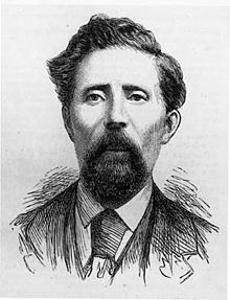
Carey is born in James Street, Dublin, in 1845. He becomes a bricklayer and builder as well as the leading spokesman of his trade and obtains several large building contracts. During this period Carey is engaged in an Irish nationalist conspiracy, but to outward appearance he is one of the rising men of Dublin. He is involved in religious and other societies, and at one time is spoken of as a possible lord mayor. In 1882 he is elected a town councillor.
About 1861 Carey joins the Irish Republican Brotherhood, soon becoming treasurer. In 1881 he breaks with the IRB and forms a new group which assumes the title of the Irish National Invincibles and establishes their headquarters in Dublin. Carey takes an oath as one of the leaders. The object of the Invincibles is to remove all “tyrants” from the country.
The secret head of the Invincibles, known as No. 1, gives orders to kill Thomas Henry Burke, the under-secretary to the lord-lieutenant. On May 6, 1882, nine of the conspirators proceed to the Phoenix Park where Carey, while sitting on a jaunting-car, points out Burke to the others. At once they attack and kill him with knives and, at the same time, also kill Lord Frederick Cavendish, the newly appointed chief secretary, who happens to be walking with Burke.
For a long time no clue can be found to identify the perpetrators of the act. However, on January 13, 1883, Carey is arrested and, along with sixteen other people, charged with a conspiracy to murder public officials. On February 13, Carey turns queen’s evidence, betraying the complete details of the Invincibles and of the murders in the Phoenix Park. His evidence, along with that of getaway driver Michael Kavanagh, results in the execution of five of his associates by hanging.
His life being in great danger, he is secretly put onboard the Kinfauns Castle with his wife and family, which sails for the Cape on July 6. Carey travels under the name of Power. Aboard the same ship is Patrick O’Donnell, a bricklayer. Not knowing his true identity, O’Donnell becomes friendly with Carey. After stopping off in Cape Town, he is informed by chance of Carey’s real identity. He continues with Carey on board the Melrose for the voyage from Cape Town to Natal. On July 29, 1883, when the vessel is twelve miles off Cape Vaccas, O’Donnell uses a pistol he has in his luggage to shoot Carey dead.
O’Donnell is brought to England and is tried for murder. After being found guilty, he is executed on December 17 at Newgate.
In December 1858, Roosa is arrested and jailed without trial until July 1859. He is charged with plotting a Fenian rising in 1865, put on trial for high treason, and sentenced to penal servitude for life due to previous convictions. He serves his time in Pentonville, Portland, and Chatham prisons in England.
After giving an understanding that he will not return to Ireland, Rossa is released as part of the Fenian Amnesty of 1870. Boarding the S.S. Cuba, he leaves for the United States with his friend John Devoy and three other exiles. Together they were dubbed “The Cuba Five.”
In 1885, Rossa is shot outside his office near Broadway by an Englishwoman, Yseult Dudley, but his wounds are not life-threatening. He is allowed to visit Ireland in 1894, and again in 1904. On the latter visit, he is made a “Freeman of the City of Cork.”
Rossa is seriously ill in his later years and is finally confined to a hospital bed in St. Vincent’s Hospital, Staten Island, where he dies at the age of 83 on June 29, 1915. His body is returned to Ireland for burial and a hero’s welcome. The funeral at Glasnevin Cemetery on August 1, 1915, is a huge affair, garnering substantial publicity for the Irish Volunteers and the IRB at time when a rebellion, later to emerge as the Easter Rising, is being actively planned. The graveside oration given by Patrick Pearse remains one of the most famous speeches of the Irish independence movement stirring his audience to a call to arms.






 seamus dubhghaill