seamus dubhghaill

Promoting Irish Culture and History from Little Rock, Arkansas, USA


Leave a comment

Irish Neutrality During World War II

File written by Adobe Photoshop? 4.0

On February 19, 1939 Taoiseach Éamon de Valera states his intention to preserve Irish neutrality in the event of a second world war.

The policy of Irish neutrality during World War II is adopted by the Oireachtas at the instigation of De Valera upon the outbreak of World War II in Europe. It is maintained throughout the conflict, in spite of several German airstrikes by aircraft that miss their intended British targets and attacks on Ireland’s shipping fleet by Allies and Axis alike. De Valera refrains from joining either the Allies or Axis powers. While the possibilities of not only a German but also a British invasion are discussed in Dáil Éireann, and either eventuality is prepared for, with the most detailed preparations being done in tandem with the Allies under Plan W, De Valera’s ruling party, Fianna Fáil, supports his neutral policy for the duration of the war.

This period is known in the Republic of Ireland as “The Emergency“, owing to the wording of the constitutional article employed to suspend normal government of the country.

Pursuing a policy of neutrality requires attaining a balance between the strict observance of non-alignment and the taking of practical steps to repel or discourage an invasion from either of the two concerned parties.

Ireland maintains a public stance of neutrality to the end, although this policy leads to a considerable delay in Ireland’s membership of the United Nations (UN). Ireland’s applications for membership are vetoed by the Soviet Union, a permanent member of the United Nations Security Council, from 1946 to December 1955. Seán MacBride considers that the UN boycott of Ireland had been originally agreed upon at the 1945 Yalta Conference by Winston Churchill and Joseph Stalin. Ireland’s acceptance into the UN is finally announced by John A. Costello on December 15, 1955.

Despite the official position of neutrality, there are many unpublicised contraventions of this, such as permitting the use of the Donegal Corridor to Allied military aircraft, and extensive co-operation between Allied and Irish intelligence, including exchanges of information, such as detailed weather reports of the Atlantic Ocean. For example, the decision to go ahead with the Normandy landings is decided by a weather report from Blacksod Bay, County Mayo.

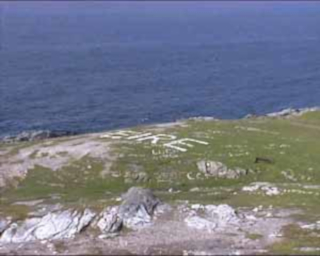
(Pictured: Markings to alert aircraft to neutral Ireland during World War II on Malin Head, County Donegal)


Leave a comment

Birth of Tomás Mac Giolla, Irish Workers’ Party Politician

tomas-mac-giolla

Tomás Mac Giolla, Workers’ Party of Ireland politician who serves as Lord Mayor of Dublin from 1993 to 1994, leader of the Workers’ Party from 1962 to 1988 and leader of Sinn Féin from 1962 to 1970, is born Thomas Gill in Nenagh, County Tipperary on January 25, 1924. He serves as a Teachta Dála (TD) for the Dublin West constituency from 1982 to 1992.

Mac Giolla’s uncle T. P. Gill is a Member of Parliament (MP) and member of the Irish Parliamentary Party (IPP) of Charles Stewart Parnell. His father, Robert Paul Gill, an engineer and architect, also stands unsuccessfully for election on a number of occasions. His mother is Mary Hourigan.

Mac Giolla is educated at the local national school in Nenagh before completing his secondary education at St. Flannan’s College in Ennis, County Clare. It is while at St. Flannan’s that he changes to using the Irish language version of his name. He wins a scholarship to University College Dublin where he qualifies with a Bachelor of Arts degree, followed by a degree in Commerce.

A qualified accountant, Mac Giolla is employed by the Irish Electricity Supply Board (ESB) from 1947 until he goes into full-time politics in 1977.

In his early life Mac Giolla is an active republican. He joins Sinn Féin and the Irish Republican Army (IRA) around 1950. He is interned by the Government of Ireland during the 1956–1962 IRA border campaign. He also serves a number of prison sentences in Mountjoy Prison in Dublin.

At the 1961 Irish general election, Mac Giolla unsuccessfully contests the Tipperary North constituency for Sinn Féin. In 1962, he becomes President of Sinn Féin and is one of the people who moves the party to the left during the 1960s. In 1969, Sinn Féin splits, and he remains leader of Official Sinn Féin. It is also in 1962 that he marries May McLoughlin who is also an active member of Sinn Féin as well as Cumann na mBan, the women’s section of the IRA. In 1977, the party changes its name to Sinn Féin the Workers Party and in 1982 it becomes simply the Workers’ Party.

Mac Giolla is elected to Dublin City Council representing the Ballyfermot local electoral area in 1979 and at every subsequent local election until he retires from the council in 1997. In the November 1982 Irish general election, he is elected to Dáil Éireann for his party. In 1988, he steps down as party leader and is succeeded by Proinsias De Rossa. He serves as Lord Mayor of Dublin from 1993 to 1994 and remains a member of Dublin Corporation until 1998.

While president Mac Giolla is regarded as a mediator between the Marxist-Leninist wing headed by Sean Garland and the social democratic wing of Prionsias De Rossa. At the 1992 special Ardfheis he votes for the motion to abandon democratic centralism and to re-constitute the party much as the Italian Communist Party became the Democratic Party of the Left. However, the motion fails to reach the required two-thirds majority. Following the departure of six Workers’ Party TDs led by De Rossa to form the new Democratic Left party in 1992, Mac Giolla is the sole member of the Workers’ Party in the Dáil. He loses his Dáil seat at the 1992 Irish general election by a margin of just 59 votes to Liam Lawlor of Fianna Fáil.

In 1999, Mac Giolla writes to the chairman of the Flood Tribunal calling for an investigation into revelations that former Dublin Assistant City and County Manager George Redmond had been the official supervisor at the election count in Dublin West and was a close associate of Liam Lawlor. In 2003, Redmond is convicted of corruption by a Dublin court but subsequently has his conviction quashed due to conflicting evidence.

In his eighties Mac Giolla continues to be active and is a member of the group which campaigns to prevent the demolition of No. 16 Moore Street in Dublin city centre, where the surrender after the Easter Rising was completed. He also serves on the Dublin ’98 committee to commemorate the 200th anniversary of the Irish Rebellion of 1798.

Tomás Mac Giolla dies in Beaumont Hospital in Beaumont, Dublin on February 4, 2010, after a long illness.


Leave a comment

Death of Eileen Desmond, Labour Party Politician

eileen-desmond

Eileen Christine Desmond (née Harrington), Irish Labour Party politician who serves as Minister for Health and Minister for Social Welfare from 1981 to 1982, dies suddenly in Cork, County Cork on January 6, 2005. She serves as a Teachta Dála (TD) from 1965 to 1969, 1973 to 1981 and 1981 to 1987. She serves as a Member of the European Parliament (MEP) for the Munster constituency from 1979 to 1984. She is a Senator for the Industrial and Commercial Panel from 1969 to 1973.

Desmond is born in Kinsale, County Cork on December 29, 1932. She is educated locally at the Convent of Mercy in Kinsale, where she is one of only two girls in her class to sit the Leaving Certificate examination. Before entering politics, she works as a civil servant with the Department of Posts and Telegraphs. She marries Dan Desmond in 1958.

Desmond is first elected to Dáil Éireann in a by-election on March 10, 1965, due to the death of her husband who had been a Teachta Dála (TD) since 1948. Her victory in the Cork Mid constituency leads Taoiseach Seán Lemass to dissolve the 17th Dáil and call a general election. She is elected for the second time in a year but loses her seat at the 1969 general election. However, she is then elected to the 12th Seanad on the Industrial and Commercial Panel, where she serves until her re-election to the 20th Dáil at the 1973 general election.

Desmond is elected to the European Parliament at the 1979 European Parliament election for the Munster constituency. However, her time in Europe is short-lived, as she returns to domestic politics when she is offered a position as Minister and the chance to impact upon national legislation. At the 1981 general election she switches her constituency to Cork South-Central. A Fine Gael–Labour Party coalition comes to power, and she is appointed Minister for Health and Social Welfare.

Desmond’s cabinet appointment is historic, as she is only the second woman to be a member of cabinet since the foundation of the state in 1922, and the first in any Fine Gael or Labour Party cabinet. Countess Markievicz had held the cabinet post of Minister for Labour in the revolutionary First Dáil in 1919, but only one woman had held cabinet office after the foundation of the state, Máire Geoghegan-Quinn of Fianna Fáil who was appointed as Minister for the Gaeltacht in 1979.

Desmond retires from full-time politics at the 1987 general election for health reasons. She dies suddenly in Cork, County Cork on January 6, 2005. Her funeral Mass takes place at Our Lady and St. John’s Church, Carrigaline with burial following in Crosshaven Cemetery.


Leave a comment

The Constitution of Ireland Comes Into Force

constitution-of-ireland-1937

The Constitution of Ireland, the second constitution of the Irish state since independence, comes into force on December 29, 1937, following a statewide plebiscite held on July 1, 1937, replacing the 1922 Constitution of the Irish Free State. It asserts the national sovereignty of the Irish people. The constitution falls broadly within the tradition of liberal democracy, being based on a system of representative democracy. It guarantees certain fundamental rights, along with a popularly elected non-executive president, a bicameral parliament based on the Westminster system, a separation of powers and judicial review. The Constitution may be amended solely by a national referendum.

The Constitution of Ireland replaces the Constitution of the Irish Free State which had been in effect since the independence, as a dominion, of the Irish state from the United Kingdom on December 6, 1922. There are two main motivations for replacing the constitution in 1937. Firstly, the Statute of Westminster 1931 grants parliamentary autonomy to the six British Dominions (now known as Commonwealth realms) within a British Commonwealth of Nations. This has the effect of making the dominions sovereign nations in their own right. The Irish Free State constitution of 1922 is, in the eyes of many, associated with the controversial Anglo-Irish Treaty. The anti-treaty faction, who oppose the treaty initially by force of arms, is so opposed to the institutions of the new Irish Free State that it initially takes an abstentionist line toward them, boycotting them altogether. However, the largest element of this faction becomes convinced that abstentionism cannot be maintained forever. This element, led by Éamon de Valera, forms the Fianna Fáil party in 1926, which enters into government following the 1932 Irish general election.

After 1932, under the provisions of the Statute of Westminster, some of the articles of the original Constitution which were required by the Anglo-Irish Treaty are dismantled by acts of the Oireachtas of the Irish Free State. Such amendments remove references to the Oath of Allegiance, appeals to the United Kingdom’s Judicial Committee of the Privy Council, the British Crown and the Governor-General of the Irish Free State. The sudden abdication of Edward VIII in December 1936 is quickly used to redefine the Royal connection. Nevertheless, the Fianna Fáil government still desires to replace the constitutional document they see as having been imposed by the British government in 1922.

The second motive for replacing the original constitution is primarily symbolic. De Valera wants to put an Irish stamp on the institutions of government and chooses to do this in particular through the use of Irish Gaelic nomenclature.

The text of the draft constitution, with minor amendments, is approved on June 14, 1937, by Dáil Éireann, then the sole house of parliament as the Seanad had been abolished the previous year.

The draft constitution is then put to a plebiscite on July 1, 1937, the same day as the 1937 Irish general election, when it is passed by a plurality of 56% of the voters, comprising 38.6% of the whole electorate. The constitution formally comes into force on December 29, 1937.

Among the groups who oppose the constitution are supporters of Fine Gael and the Labour Party, Unionists, and some independents and feminists. The Seal of the President of Ireland is also adopted in the same year. Ireland does not become a republic until 1948.

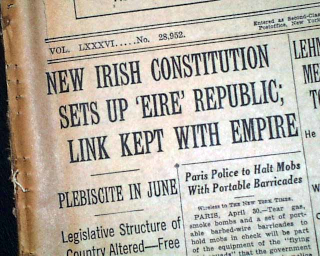
(Pictured: Headline from The New York Times, May 1, 1937)


Leave a comment

Birth of Erskine H. Childers, 4th President of Ireland

erskine-hamilton-childers-1

Erskine Hamilton Childers, Irish politician and a member of the Fianna Fáil party who serves as the fourth President of Ireland (1973–74), is born on December 11, 1905, in the Embankment Gardens, Westminster, London, to a Protestant family, originally from Glendalough, County Wicklow.

Childers is educated at Gresham’s School, Holt, and the University of Cambridge, hence his striking British upper-class accent. On November 24, 1922, when he is sixteen, his father, Robert Erskine Childers, is executed by the new Irish Free State on politically inspired charges of gun-possession. The pistol he had been found with had been given to him by Michael Collins. Before his execution, in a spirit of reconciliation, the elder Childers obtains a promise from his son to seek out and shake the hand of every man who had signed his death warrant.

Following his father’s funeral, he returns to Gresham’s, then two years later he goes on to Trinity College, Cambridge. He returns to Ireland in 1932 and becomes advertising manager of The Irish Press, the newly founded newspaper owned by the family of Éamon de Valera.

Childers’s political debut is as a successful Fianna Fáil candidate for a seat in Dáil Éireann, the lower house of the Oireachtas, the Irish parliament, in 1938. He becomes a Parliamentary secretary in 1944 and is later Minister for Posts and Telegraphs (1951–54), Minister for Lands (1957–59), and Minister for Transport and Power (1959–69). He also serves as Tánaiste and Minister for Health (1969–73). He supports Taoiseach Jack Lynch’s condemnation of the violence in Northern Ireland and Lynch’s advocacy of a European role for the Irish republic within the European Economic Community (now European Community, embedded in the European Union).

Childers is nominated as the presidential candidate of Fianna Fáil at the behest of de Valera, who pressures Jack Lynch in the selection of the presidential candidate. He is a controversial nominee, owing not only to his British birth and upbringing but to his Protestantism. However, on the campaign trail his personal popularity proved enormous, and in a political upset at the 1973 Irish presidential election, he is elected the fourth President of Ireland on May 30, 1973, defeating Tom O’Higgins by 635,867 (52%) votes to 578,771 (48%). He becomes the second Protestant to hold the office, the first being Douglas Hyde (1938–1945).

Prevented from transforming the presidency as he desires, Childers instead throws his energy into a busy schedule of official visits and speeches, which is physically taxing.

On November 17, 1974, during a conference to the psychiatrists of the Royal College of Physicians of Ireland in Dublin, Childers suffers a congestional heart failure causing him to lie sideways and turn blue before suddenly collapsing. He is pronounced dead the same day at Mater Misericordiae University Hospital.

Childers’s state funeral in St. Patrick’s Cathedral, Dublin, is attended by his presidential predecessor Éamon de Valera and world leaders including Louis Mountbatten, 1st Earl Mountbatten of Burma (representing Queen Elizabeth II), the British Prime Minister Harold Wilson and British Opposition Leader Edward Heath, and Presidents and crowned heads of state from Europe and beyond. He is buried in the grounds of the Church of Ireland Derralossary Church, in Roundwood, County Wicklow.


Leave a comment

Inauguration of Mary McAleese as 8th President of Ireland

CREATOR: gd-jpeg v1.0 (using IJG JPEG v62), quality = 100

Mary Patricia McAleese (née Leneghan) is inaugurated as the eighth President of Ireland on November 11, 1997. She succeeds Mary Robinson, making her the second female president of Ireland and the first woman in the world to succeed another woman as president. She is the first president to come from Northern Ireland.

Leneghan is born into a Roman Catholic family on June 27, 1951, in Ardoyne, north Belfast. The eldest of nine children, she grows up in Northern Ireland through the violent times that have come to be known as “The Troubles.” She is educated at St. Dominic’s High School, Queen’s University Belfast, from which she graduates in 1973, and Trinity College Dublin. She is called to the Bar of Northern Ireland in 1974 and remains a member of the Bar Council of Ireland. In 1975, she is appointed Reid Professor of Criminal Law, Criminology and Penology at Trinity College Dublin.

Leneghan marries Martin McAleese, an accountant and dentist in 1976. They have three children, Emma, born 1982, and twins Justin and SaraMai, born in 1985.

In 1987, McAleese returns to her Alma Mater, Queen’s University Belfast, to become Director of the Institute of Professional Legal Studies. In 1994, she becomes the first female Pro-Vice-Chancellor of the university.

McAleese defeats former Taoiseach Albert Reynolds in an internal party election in 1997, held to determine the Fianna Fáil nomination for the Irish presidency. Her opponents in the 1997 presidential election are Mary Banotti of Fine Gael, Adi Roche of the Labour Party and two Independents, Dana Rosemary Scallon and Derek Nally.

McAleese wins the presidency with 45.2% of first preference votes. In the second and final count against Banotti, McAleese wins 55.6% of preferences. Within weeks of her November 1997 inauguration, she makes her first official overseas trip to Lebanon.

McAleese describes the theme of her presidency as “building bridges.” The first individual born in Northern Ireland to become President of Ireland, McAleese is a regular visitor to Northern Ireland throughout her presidency, where she is on the whole warmly welcomed by both communities, confounding critics who had believed she would be a divisive figure. While on an official visit to the United States in 1998, Archbishop of Boston Cardinal Bernard Francis Law tells her he is “sorry for Catholic Ireland to have you as President.” She tells the cardinal that she is the “President of Ireland and not just of Catholic Ireland.”

McAleese’s initial seven-year term of office ends in November 2004, but she stands for a second term in the 2004 presidential election. She is re-elected on October 1, 2004, being the only validly nominated candidate.

McAleese is an experienced broadcaster, having worked as a current affairs journalist and presenter in radio and television with Radio Telefís Éireann. She has a longstanding interest in many issues concerned with justice, equality, social inclusion, anti-sectarianism and reconciliation.


Leave a comment

Death of Margaret Mary Pearse

margaret-mary-pearse

Margaret Mary Pearse, Fianna Fáil politician and teacher, dies at Linden Convalescent Home in Dublin on November 7, 1968. She is a sister of Patrick Pearse, one of the leaders of the 1916 Easter Rising, and Willie Pearse, both of whom are executed for their part in the Rising.

Pearse is born on August 24, 1878, at 27 Great Brunswick Street (now Pearse Street) in Dublin, the eldest child of James Pearse and Margaret Pearse (née Brady), who serves as a Teachta Dála (TD) in the 1920s. She is educated at the Holy Faith Convent in Glasnevin. After leaving school, she trains as a teacher. She helps to found St. Enda’s School with her brothers Patrick and Willie. Following the executions of her brothers in the aftermath of the Easter Rising, she continues to run St. Enda’s, along with Fergus De Búrca, until 1933.

Following in her mother’s footsteps, Pearse is first elected to Dáil Éireann as a Fianna Fáil TD for the Dublin County constituency at the 1933 general election. She is defeated at the 1937 general election on the 7th count of votes but is elected to the Administrative Panel of the 2nd Seanad. She serves in the Seanad until her death in 1968, however, she and her mother are never considered to be more than figureheads for the party. She is a founding member of the teaching staff of Ardscoil Éanna in Crumlin, Dublin, upon its establishment in 1939.

Illness forces Pearse into the Linden Convalescent Home in Blackrock, County Dublin when she is in her 80s. In 1967, when she is 89 years old, her condition is described to be deteriorating. However, in 1968 during the months leading up to her 90th birthday, she leaves the Linden Convalescent Home for a short while in order to spend her birthday at St. Endas in Rathfarnham. The president of Ireland at the time, Éamon de Valera, visits her at St. Endas to congratulate her on her upcoming 90th birthday.

Margaret Pearse dies, unmarried, at the Linden Convalescent Home in Blackrock, County Dublin, on November 7, 1968, and is given a state funeral. President de Valera, the church and the state all pay tribute to her at the funeral. She is buried beside her parents and sister at Glasnevin Cemetery. The Taoiseach, Jack Lynch, says that Margaret Mary Pearse is the last remaining member of the noble Pearse family. He says her life, like her patriotic brothers, was dedicated to Ireland.

As per her mother’s wishes, Pearse bequeaths St. Enda’s to the people of Ireland as a memorial to her brother’s sacrifice. The school is now home to the Pearse Museum.


Leave a comment

Death of Jack Lynch, Politician & Taoiseach of Ireland

jack-lynch

Jack Lynch, Irish politician and Taoiseach of Ireland from 1966 to 1973 and from 1977 to 1979, dies in the Royal Hospital, Donnybrook in Dublin on October 20, 1999.

Lynch is born on August 15, 1917, in Blackpool, on the north side of Cork, County Cork. He is educated at St. Vincent’s Convent on Peacock Lane, and later at the North Monastery Christian Brothers School. He sits his Leaving Certificate in 1936, after which he moves to Dublin and works with the Dublin District Milk Board, before returning to Cork to take up a position in the Circuit Court Office.

Lynch eventually decides on a legal career, is called to the bar (1945), resigns from the civil service, and practices on the Cork circuit. He already enjoys a national reputation as a sports hero having won five All-Ireland medals as a Cork hurler and another as a footballer. He joins Fianna Fáil and wins a seat in Dáil Éireann, the lower house of the Oireachtas, in 1948. He works closely with Éamon de Valera in opposition (1948–51), and de Valera appoints him a parliamentary secretary in 1951–54, minister for the Gaeltacht in 1957, and Minister for Education in 1957–59. When Seán Lemass succeeds de Valera as Taoiseach in 1959, he makes Lynch Minister for Industry and Commerce and in 1965–66 Minister for Finance.

Lemass’s retirement in 1966 causes an internal party conflict over the succession that leads to Lynch’s selection as a compromise candidate, a position he reluctantly accepts. In November of that year, he becomes leader of Fianna Fáil and Taoiseach. In June 1969 he becomes the only Fianna Fáil leader other than de Valera to win an overall majority in a general election. In 1969–1973 Lynch plays an important role when civil unrest leads to the collapse of the government of Northern Ireland and poses a threat to the stability of the Irish state. He fires two cabinet ministers who are suspected of involvement in smuggling arms to the Provisional Irish Republican Army (IRA). He also creates a consensus in Irish party politics on a policy of conciliation and cooperation with the British government in seeking a solution to the Northern Ireland problem based on establishing power-sharing between the unionist majority and the Roman Catholic minority.

In 1972 Lynch wins an 83 percent majority in a referendum on Ireland’s entry into the European Economic Community. On January 1, 1973, Ireland becomes a member. Although he is defeated in the 1973 elections, he again demonstrates his remarkable popularity at the polls in 1977 when Fianna Fáil wins their largest and their last overall majority. In December 1979, however, discouraged by challenges to his authority from party colleagues, he resigns his leadership and soon after retires from politics. He serves on a number of corporate boards after his retirement.

In 1992 Lynch suffers a severe health setback, and in 1993 suffers a stroke in which he nearly loses his sight. Following this he withdraws from public life, preferring to remain at his home with his wife Máirín where he continues to be dogged by ill-health.

Lynch dies in the Royal Hospital, Donnybrook, Dublin on October 20, 1999, at the age of 82. He is honoured with a state funeral which is attended by the President of Ireland Mary McAleese, Taoiseach Bertie Ahern, former Taoisigh John Bruton, Albert Reynolds and Charles Haughey, and various political persons from all parties. The coffin is then flown from Dublin to Cork where a procession through the streets of the city draws some of the biggest crowds in the city’s history. After the Requiem Mass celebrated in his home parish of the Cathedral of St. Mary and St. Anne, Lynch’s friend and political ally, Desmond O’Malley, delivers the graveside oration, paying tribute to Lynch’s sense of decency. He is buried in St. Finbarr’s Cemetery in Cork.


Leave a comment

Death of Liam Cosgrave, 6th Taoiseach of Ireland

liam-cosgrave

Liam Cosgrave, politician who serves as Taoiseach from February 1973 to July 1977, dies at the age of 97 in Tallaght, Dublin on October 4, 2017. He is the longest-lived Taoiseach, dying at the age of 97 years, 174 days.

Born in Castleknock, Dublin on April 13, 1920, Cosgrave is the son of William Thomas Cosgrave, the first President of the Executive Council and head of the government of the Irish Free State during the first 10 years of its existence (1922–32). He is educated at Castleknock College, Dublin, studies law at King’s Inns and is called to the Irish bar in 1943. In that same year he enters Dáil Éireann (the lower house of the Oireachtas, the Irish parliament), and he retains his seat until his retirement from politics in 1981.

In 1948, when the first inter-party government replaces Éamon de Valera’s Fianna Fáil regime, which had been in power for the previous 16 years, Cosgrave becomes Parliamentary Secretary to the Taoiseach and to the Minister for Industry and Commerce. It is a short-lived administration, going out of power in 1951 after three years of rule. But in a second inter-party government (1954–57), he becomes Minister for External Affairs and leads the first Irish delegation to the United Nations General Assembly in 1956.

Cosgrave succeeds James Dillon as leader of the Fine Gael party in 1965. Eight years later, as leader of a coalition government in which Fine Gael combines forces with the Labour Party, he becomes Taoiseach. He and British Prime Minister Edward Heath are the main participants in the intergovernmental conference at Sunningdale in December 1973 that gives birth to Northern Ireland’s first, though short-lived, power-sharing executive (1973–74). A devout Roman Catholic, he is intensely conservative on social issues and shocks his cabinet colleagues by voting against his own government’s bill on liberalizing the sale of contraceptives in 1974. The National Coalition is defeated in the 1977 Irish general election, largely on the economic issues of inflation and unemployment.

Cosgrave retires at the 1981 Irish general election. In 1981, he retires as Dáil Deputy for Dún Laoghaire to be replaced by his son, Liam T. Cosgrave. He reduces his involvement in public life but makes occasional appearances and speeches.

Liam Cosgrave dies on October 4, 2017, at the age of 97 of natural causes. He had been at Tallaght Hospital for several months prior to his death there. His funeral is held on October 7, 2017, after which he is interred alongside his father at Inchicore‘s Goldenbridge Cemetery.


Leave a comment

Birth of William O’Brien, Journalist & Politician

william-o-brien

William O’Brien, journalist and politician who is for several years second only to Charles Stewart Parnell among Irish Nationalist leaders, is born on October 2, 1852, in Mallow, County Cork. He is perhaps most important for his Plan of Campaign (1886), by which Irish tenant farmers withhold all rent payments from landlords who refuse to lower their rents and instead pay the money into a mutual defense fund on which evicted tenants can draw.

O’Brien shares his primary education with a townsman with whom he is later to have a close political connection, Canon Patrick Augustine Sheehan of Doneraile. He enjoys his secondary education at the Cloyne diocesan college, which results in his being brought up in an environment noted for its religious tolerance. He greatly values having had this experience from an early age, which strongly influences his later views for the need of such tolerance in Irish national life.

A journalist from 1869, O’Brien is appointed editor of the Irish Land League’s weekly United Ireland by Parnell in 1881. In October of that year the British authorities suppress the paper and put O’Brien in Kilmainham Gaol in Dublin, along with Parnell and others. There he draws up a No Rent Manifesto, which, when read at a Land League meeting, results in the outlawing of the League. Released from prison in 1882, he resumes the editorship of United Ireland, and in 1883 he is elected to the British House of Commons, remaining there until 1895. His “plan of campaign” is disavowed by Parnell but nonetheless stirs up fierce agitation. To suppress the movement, the British government passes the Criminal Law and Procedure (Ireland) Act 1887, under which O’Brien is jailed again.

For some time following the O’Shea divorce case (1889–90), in which Parnell is corespondent, O’Brien attempts to mediate between the Parnellites and their opponents, although he sides with the majority in rejecting Parnell’s continued leadership of the Irish Home Rule struggle. In 1902 he supports the Land Conference, which secures agreement between landlords and tenants’ representatives and results in George Wyndham‘s Land Purchase Act (1903), which is designed to turn Irish tenant farmers into occupying owners.

In 1898 O’Brien founds the United Irish League, and in 1910, after control of that group passes to the Parnellite John Redmond, he establishes the All-for-Ireland League in opposition to the older organization. Most of his personal following, however, join Arthur Griffith’s Sinn Féin party by the end of World War I.

Retiring from political life, O’Brien contents himself with writing and declines Éamon de Valera‘s offer to stand for Fianna Fáil in the 1927 general election. He dies suddenly at the age of 75 on February 25, 1928, while on a visit to London with his wife. His remains rest in Mallow, and one of the principal streets in the town bears his name to this day. His head-bust overlooks the town Council’s Chamber Room and one of his finest portraits hangs in University College Cork.