The Irish Catholic Hierarchy formally endorses Home Rule on February 16, 1886, a significant moment in the Irish political landscape.
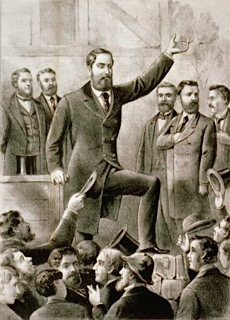
The Home Rule movement, led by Charles Stewart Parnell (pictured) and the Irish Parliamentary Party (IPP), seeks to establish a separate Irish parliament to handle domestic affairs while remaining within the British Empire. The campaign gains significant momentum throughout the late 19th century, but opposition from the British government and Irish unionists make progress difficult. Up to this point, the Catholic Church in Ireland had largely remained cautious about taking an overtly political stance on Home Rule. However, their endorsement on this day in 1886 changes the dynamic of the movement, giving it an unprecedented boost in legitimacy and support among the Irish people.
The Catholic Church plays a central role in Irish society, wielding immense influence over the daily lives of the majority Catholic population. Many of the clergy are already sympathetic to nationalist aspirations, but an official endorsement from the hierarchy signals a unified front that cannot be ignored. By formally backing Home Rule, the bishops strengthen nationalist demands and provide moral authority to the movement, reinforcing the argument that Home Rule is not just a political necessity but also a just and rightful cause.
This endorsement comes at a critical time. British Prime MinisterWilliam Ewart Gladstone is preparing to introduce the Government of Ireland Bill 1886, commonly known as the First Home Rule Bill, in April 1886, a legislative measure that, if passed, would grant Ireland limited self-government. The backing of the Catholic hierarchy is instrumental in rallying public support and reinforcing Parnell’s leadership. While the bill ultimately fails in the House of Commons on June 8, 1886, due to strong opposition from Conservative and Unionist factions, the Catholic Church’s stance ensures that Home Rule remains a dominant political issue for decades to come.
Despite the failure of the 1886 bill, the endorsement by the Catholic bishops has long-term implications. It solidifies a powerful alliance between Irish nationalism and the Church, an influence that persists well into the 20th century. The endorsement also helps to counteract Protestant unionist claims that Home Rule is merely a radical or sectarian endeavor, presenting it instead as a moderate and just political cause with widespread backing.
Over the following years, Home Rule remains a contentious issue, with subsequent attempts to pass similar legislation met with resistance. The Government of Ireland Bill 1893, commonly known as the Second Home Rule Bill, is again defeated in the House of Lords, and it is not until the Government of Ireland Act 1914, commonly referred to as the Third Home Rule Bill, that significant progress is made. Even then, implementation is delayed by World War I and ultimately overshadowed by the 1916 Easter Rising and the Irish War of Independence.
Looking back, the Catholic Church’s endorsement of Home Rule on February 16, 1886, is a defining moment in Ireland’s political history. It reinforces the nationalist cause, legitimizes the demand for self-governance, and plays a crucial role in shaping Ireland’s path toward eventual independence. While Home Rule itself is never fully realized in the form originally envisioned, its legacy influences the Irish Free State’s establishment in 1922 and Ireland’s eventual emergence as a fully independent republic.
(From: “February 16, 1886 – The Catholic Church Embraces Home Rule,” by Bagtown Clans, This Day in Irish History Substack, http://www.thisdayinirishhistory.substack.com, February 2025)
The eldest of the three sons and one daughter of Daniel Sheehan, tenant farmer, and his wife, Ellen (née Fitzgerald). He is educated at the local primary school. In his book Ireland since Parnell (1921) he states that witnessing the ragged poverty of labourers’ and smallholders’ children who attended the school made him determined to do something for the poor. The family’s Fenian tradition and his parents’ eviction from their holding in 1880 form his early years. At the age of sixteen he becomes a schoolteacher.
In 1890, Sheehan takes up journalism, serving as correspondent of the Kerry Sentinel and special correspondent of the Cork Daily Herald in Killarney. He also becomes correspondence secretary to the Kanturk trade and labour council, which campaigns on behalf of agricultural labourers. He manages to get reports of meetings into the Cork papers, and this helps the rapid spread of the association, which in 1890 becomes the Irish Democratic Trade and Labour Federation, under the leadership of Michael Davitt. It is, however, fatally disrupted by the Parnell split. While Sheehan continues to admire Davitt, and despite the pre-split Irish party leadership having opposed the federation as a threat to Charles Stewart Parnell‘s leadership, he becomes a Parnellite, and always remembers his only meeting with Parnell at Tralee, when the chief is presented with a loyal address (drafted by Sheehan) from his Killarney supporters. After Parnell’s death and the defeat of the Second Home Rule Bill, he temporarily drops out of Irish politics.
Following his marriage on February 6, 1894, to Mary Pauline O’Connor of Tralee, Sheehan joins the staff of the Glasgow Observer in pursuit of journalistic experience, then becomes editor of the Catholic News in Preston, Lancashire. In 1898, he returns to Ireland and works on various papers, including the Cork Constitution, before serving as editor of the Skibbereen-based Cork County Southern Star (1899–1901), where his Parnellism brings him into conflict with the Bishop of Ross, Denis Kelly. He expresses sympathy for the newly founded United Irish League (UIL), established by William O’Brien in Connacht with the dual aim of representing western smallholders and using a new land agitation as a vehicle for Irish Party reunion. He does not, however, join the UIL himself.
In August 1894, the Clonmel solicitor J. J. O’Shee, anti-Parnellite MP for West Waterford from 1895, forms the Irish Land and Labour Association (ILLA) to agitate on behalf of agricultural labourers and small tenant farmers. Its appearance reflects the breakdown of the centralised party discipline which had existed before the Parnell split, and recognition that the land war’s prime beneficiaries had been large and middle-sized tenant farmers rather than the nation as a whole. On returning from Britain in 1898, Sheehan throws himself into organising the ILLA and becomes its president. In 1900 there are 100 branches, mostly in Cork, Tipperary, and Limerick. The Irish Party leadership look on this organisation with some suspicion.
At the 1900 United Kingdom general election in Ireland Sheehan seeks the Irish Parliamentary Party (IPP) nomination for South Cork but was defeated by Edward Barry. After the death of Dr Charles Tanner, however, he succeeds in obtaining the IPP nomination for the constituency of Mid Cork, despite the party leadership’s attempts to deny recognition to ILLA branches in order to hand the nomination to its favoured candidate. Sheehan is elected unopposed on May 17, 1901. At the age of 28, he is the youngest Irish member of parliament. Although he has been admitted to the party, his position as a labour representative and his perceived independent base make him something of an outsider.
From October 1904 Sheehan allies himself with O’Brien, writing regularly for the latter’s weekly a TheIrish People. Redmondites accuse him of opportunism, but he always maintains that his personal inclination as an old Parnellite has been towards John Redmond and that his support for O’Brien derives from the older man’s willingness from 1904 to identify himself with the labourers’ campaign. Although their alliance originally likely contains elements of expediency, Sheehan and O’Brien develop a deep personal friendship.
Sheehan’s support for O’Brien leads to a split in the ILLA in 1906, with Tipperary and Waterford branches following O’Shee and Redmond, and Sheehan retaining the support of his Cork base and of some branches in Limerick and Kerry. He serves on the Cork advisory committee which represents tenant interests in land purchase negotiations under the Wyndham Land Act. It’s policy of “conference plus business” combines an offer to negotiate with willing landlords and a threat of agitation against those unwilling to give satisfactory terms. His faction of the ILLA becomes the basis for the grassroots organisation of O’Brien’s followers, and sporadic attempts, financed by O’Brien, are made to spread it outside its Munster base. Both factions of the ILLA claim credit for the passage of the 1906 and 1911 Labourers’ (Ireland) Acts which provide for the allocation of cottages and smallholdings to labourers. In Cork and some other parts of Munster these buildings become popularly known as “Sheehan’s cottages,” a term which long outlives Sheehan’s political career. He also helps to bring about the creation of a “model village” at Tower, near Blarney, the result of cooperation between the local ILLA branch and the rural district council.
At the 1906 general election the Redmond leadership attempts to avoid an open split by allowing O’Brien’s supporters to return unopposed. However, the continuing conflict between the two factions rapidly leads to a formal break. Shortly after the election Sheehan is excluded from the IPP, and thereby deprived of the parliamentary stipend paid to MPs with insufficient resources to maintain themselves. With the support of O’Brien and the small group of O’Brienite MPs, he maintains that the party has no right to exclude an elected MP willing to take the party pledge. After resigning his seat to which he was re-elected without opposition on December 31, 1906, he demands readmission to the party and mounts an unsuccessful lawsuit demanding payment of the stipend. He is subsequently supported from the proceeds of collections outside church gates on Sundays.
Sheehan and the other O’Brienite MPs are readmitted to the party in 1908 as part of an attempt at general reconciliation after the disruptions following the rejection of the Irish Council Bill. Dissensions rapidly reappear over Augustine Birrell‘s 1909 land act, which the O’Brienites see as wriggling out of the financial responsibilities accepted by the British government in the Wyndham land act and as sabotaging land purchase, since landlords will not accept the terms offered. Sheehan’s section of the ILLA is denied official recognition and thereby prevented from sending delegates to a party convention called to consider the bill. At the convention, groups of “heavies”recruited from Joseph Devlin‘s Ancient Order of Hibernians (AOH) exclude delegates with Cork accents, while O’Brienite speakers are howled down. This leads to the formation in March 1909 of the All-for-Ireland League (AFIL), a body based on the existing O’Brienite organisation and advocating O’Brien’s policy of gradually implementing home rule through step-by-step cooperation with moderate unionist supporters of devolution. Although O’Brien’s temporary retirement for health reasons in April 1909 leads to the suspension of the AFIL, it is revived in response to an attempted purge of the O’Brienite MPs by the leadership and by O’Brien’s reappearance in response to the January 1910 general election. Sheehan writes regularly for its paper, the Cork Free Press.
In the general election the O’Brienites hold their seats while two Cork Redmondites are displaced. Sheehan is re-elected for Mid Cork, defeating the Redmondite W. G. Fallon in a campaign marked by widespread rioting and impassioned clerical denunciations of Sheehan. Fallon subsequently attempts to get up a “red scare” against the ILLA. The Cork ILLA later splits over Sheehan’s slightly erratic leadership. While the split is initially personality-driven, the breakaway faction, led by Patrick Bradley and centred in east Cork, moves back toward alignment with Redmond. At the December 1910 election the AFIL consolidates its position in Cork, but is defeated everywhere else. Sheehan retains his Mid Cork seat against a local candidate but is defeated in a simultaneous contest in East Limerick. He is also defeated when he stands for Cork County Council in June 1911, though the AFIL wins control of that body.
Sheehan studies law at University College Cork (UCC) (1908–09), where he is an exhibitioner and prizeman, and at King’s Inns, where he graduated with honours. He is called to the bar in 1911 and practised on the Munster circuit. In 1913–14 he is active in the AFIL’s attempts to avert partition by trying to recruit sections of British political opinion in favour of a conference between the parties. He becomes vice-chairman of the Imperial Federation League. This receives considerable attention among the British political classes but contributes to the decline of the AFIL’s electoral base. The policy of conciliation has been driven to a considerable extent by the belief that it is the only way of achieving home rule. The abolition of the House of Lords’ veto and the introduction of the third home rule bill by the Asquith government undercuts this argument and increases Redmond’s prestige, while AFIL denunciations of Redmondism are seen as driven by personal resentment and playing into the hands of unionists. The decision of the AFIL MPs to abstain from supporting the bill on its final passage through the House of Commons in 1914 as a protest against the prospect of a partition-based compromise is represented by Redmondites as a vote against home rule itself and contributed to AFIL loss of Cork County Council in June 1914.
On the outbreak of World War I, Sheehan supports O’Brien in calling for Irish enlistment for foreign service. In November 1914, at the age of forty-two, he enlists himself and is gazetted as a lieutenant in the Royal Munster Fusiliers. It is claimed that he is almost single-handedly responsible for raising the 9th (service) battalion of this regiment. Three of his sons also enlist. Two of his sons are killed in action with the Royal Flying Corps, and a daughter is disabled by injuries received in an air raid while serving as a nurse. In the spring and summer of 1915 he organises and leads recruiting campaigns in Cork, Limerick, and Clare. This is part of a nationwide drive for recruits, aimed in particular at the farming community, which reflects the realisation that the war is going to last much longer than expected.
In 1915, Sheehan is promoted to the rank of captain and serves with his battalion on the Loos-en-Gohellesalient and at the Battle of the Somme, contributing a series of articles from the trenches to the London Daily Express. Various ailments, including deafness caused by shellfire, and hospitalisation necessitate his transfer to the 3rd Royal Munster Fusiliers (Reserve) Battalion, and he resigns his commission on January 13, 1918, due to ill health. In April 1918 he speaks at Westminster against the bill extending conscription to Ireland, threatening to resist it by force. One of his last parliamentary speeches (in October 1918) is in support of a bill providing land grants for Irish ex-servicemen. With the growth of Sinn Féin and the virtual demise of the AFIL, his position in Cork grows increasingly untenable. The Sheehan family faces intimidation and are obliged to leave their home on the Victoria Road for London, where he has secured the Labour Party nomination for the Limehouse–Stepney division of the East End, later represented by Clement Attlee.
Sheehan is unsuccessful in the 1918 United Kingdom general election, and is obliged to leave politics after a financially disastrous involvement in an Achill Island mining company leads to his bankruptcy. Unable to practise at the bar because of the hearing loss caused by his war service, he returns to journalism and becomes editor and publisher of TheStadium, a daily newspaper for sportsmen. In 1921, shortly before the Anglo-Irish truce, he publishes Ireland since Parnell, a history of recent events heavily dependent on the writings of O’Brien but incorporating some personal reminiscences. It concludes by blaming the outbreak of the IRA guerrilla campaign on provocation by Crown forces, denouncing reprisals, and pleading for British recognition of Dáil Éireann and dominion home rule for an undivided Ireland.
Sheehan moves to Dublin in 1926 after hearing that the threats against him have been lifted. His wife, who has never fully recovered from the stresses and bereavements she has experienced since 1914, dies soon afterward. Sheehan himself becomes managing editor of Irish Press and Publicity Services and, in 1928, publisher and editor of the South Dublin Chronicle. The paper gives critical support to the Irish Labour Party, publishes campaigning articles on slum conditions, and advocates housing reform. In September 1930, he is an unsuccessful Labour candidate for Dublin County Council. In the 1930s, as his health deteriorates further, he works as coordinator for the ex-servicemen’s group the Old Comrades’ Association, editing both northern and southern editions of its annual journal. In 1942, he offers himself to Richard Mulcahy as a Fine Gael candidate for Cork South-East, but is turned down. He dies on November 28, 1948, while visiting his daughter at Queen Anne Street, London. Both he and his wife are buried in Glasnevin Cemetery.
(From: “Sheehan, Daniel Desmond (‘D. D.’)” by Patrick Maume, Dictionary of Irish Biography, http://www.dib.ie, October 2009)
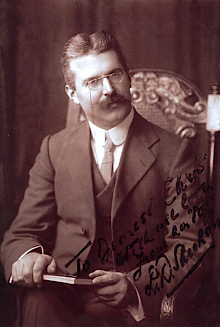
David Patrick Moran (Irish: Dáithí Pádraig Ó Móráin), better known as simply D. P. Moran, Irish journalist, activist and cultural-political theorist, dies on January 31, 1936. He is known as the principal advocate of a specifically Gaelic CatholicIrish nationalism during the early 20th century. Associated with the wider Celtic Revival, he promotes his ideas primarily through his journal, The Leader, and compilations of his articles such as the book The Philosophy of Irish Ireland.
Moran is born in Manor, a townland in Waterford, the youngest of twenty children born to James Moran, a builder, and Elizabeth Moran (née Casey). One of his brothers goes on to serve on the defense team of Patrick O’Donnell.
Despite the failure of the 1893 Home Rule Bill and the division of the Irish Parliamentary Party (IPP) in 1891, nationalists take heart from Douglas Hyde‘s 1892 speech, entitled “The Necessity for De-anglicising Ireland.” Moran builds upon this thesis and provides a wider ideology for enthusiasts, particularly after the re-unification of most of the nationalist parties from 1900.
In his 1905 text The Philosophy of Irish-Ireland, Moran argues that to be Irish requires:
the use of the Irish language
membership in the Roman Catholic Church
an anti-materialist outlook on life
the playing of only Gaelic games
Though a sponsor of the use of Irish, he never becomes fluent in the language himself. He emphasises the use of English in 1908–09 as “an active, vigilant, and merciless propaganda in the English language.” In the longer term, when Irish becomes again the language of the people, its use enables a de facto censorship of any foreign and unwelcome ideas written in English.
While Moran argues that the idea of “the Gael” is one that can assimilate others, he also feels that it will be hard if not impossible for members of the Church of Ireland who support the British Empire to ever qualify as Irish, being “resident aliens.” This extends to Anglo-Irish literature. He rejects the Abbey Theatre and questions Yeats‘ genius. He once speaks out against the influence Britain has over Irish Universities, stating, “We are all Palemen now.” In the matter of religious differences, Daniel O’Connell had said in 1826 that “the [Roman] Catholics of Ireland are a nation.” Moran moves beyond that, affirming in 1901 that “…the Irish Nation is de facto a Catholic nation.” He is virulent in his opposition to female suffrage.
Moran’s articles frequently contrast “Belfast” with “Ireland,” yet hope that Belfast can eventually change and assimilate. He feels that Ulster unionists should “… be grateful to the Irish nation for being willing to adopt them.” His paper publishes numerous articles by the future TDArthur Clery (writing under the pen name “Chanel”), who advocates partition on the grounds that Ulster unionists are a separate nation, but Moran himself disagrees and refuses to concede the legitimacy of a northern Protestant identity.
When Irish republicans initiate the Irish War of Independence in 1919, widescale anti-Catholic rioting breaks out in Belfast in 1920 and 1922. Moran identifies this as being caused by Orangeism, which he describes as “a sore and a cancer” in Ireland. He also alleges that “bigotry on the part of Catholics in the Six Counties is immediately due to Orange bigotry.”
Moran is initially a supporter of the Irish Parliamentary Party, believing that the separatism advocated by Arthur Griffith‘s Sinn Féin is impracticable; however, he opposes John Redmond‘s support of the British World War I effort.
Moran supports the Anglo-Irish Treaty agreed in 1921–22 and sees the partition of Ireland as beneficial for a truly Irish culture in the Irish Free State. This causes a sea-change in his opinions; from now on Northern Ireland can be safely ignored, along with what he sees as the English evils of “free thought, free trade, and free literature.” He claims Irish life and culture has to be protected from foreign influences, including the twin evils of the music hall and the English press. The new jazz music of the 1920s and other imported cultural elements are deprecated as “imported debasement and rot.”
On January 9, 1901, Moran marries Theresa Catherine, daughter of Thomas Francis O’Toole, a former Parnellite mayor of Waterford. They have four sons and one daughter.
Moran dies suddenly at his home in Skerries, Dublin, on January 31, 1936. His daughter, Nuala, who has written for the paper since the early 1920s, generally on artistic and social matters, takes over the running of the paper on his death, though it is then much diminished in size and influence. Nuala, who never marries, retains control of The Leader until it ceases publication in 1971.
The Plan of Campaign is a stratagem adopted in Ireland between 1886 and 1891, co-ordinated by Irish politicians for the benefit of tenant farmers, against mainly absentee and rack-rentlandlords and the tyrannical regime of enforced massive rents and evictions. It is launched to counter agricultural distress caused by the continual depression in prices of dairy products and cattle from the mid-1870s, which leaves many tenants in arrears with rent. Bad weather in 1885 and 1886 also cause crop failure, making it harder to pay rents. The Land War of the early 1880s is about to be renewed after evictions increase and outrages become widespread.
The Plan, conceived by Timothy Healy, is devised and organised by Timothy Harrington, secretary of the Irish National League, William O’Brien and John Dillon. It is outlined in an article headed Plan of Campaign by Harrington which is published on October 23, 1886, in the League’s newspaper, the United Ireland, of which O’Brien is editor.
Dillon is among those who organise a campaign whereby tenants pay their rents to the Land League instead of their landlords. If the tenants are evicted, they are to receive financial assistance from a general fund established for that purpose. As a result of his involvement in this campaign, Dillon spends a number of months in jail.
The measures are to be put into operation on 203 estates, mainly in the south and west of the country though including some scattered Ulster estates. Initially sixty landlords accept the reduced rents, twenty-four holding out but then agreeing to the tenant conditions. Tenants give in on fifteen estates. The chief trouble occurs on the remaining large estates.
The organisers of the Plan decide to test a number of their measures, expecting the remainder will then give in. Widespread attention is focused on it being implemented by Dillon and O’Brien on the estate of Hubert de Burgh-Canning, 2nd Marquess of Clanricarde, at Portumna, County Galway, on November 19, 1886, where the landlord is an absentee ascendancy landlord. The estate comprising 52,000 acres, or 21,000 hectare, yields 25,000 sterling annually in rents paid by 1,900 tenants. The hard-pressed tenants look for a reduction of twenty-five percent. The landlord refuses to give any abatement. The tenant’s reduced rents are then placed into an estate fund, and the landlord informed he will only receive the monies when he agrees to the reduction. Tenants on other estates then follow the example of the Clanricarde tenants, the Plan on each estate led by a member of the Irish Parliamentary Party (IPP) Campaign activists including Pat O’Brien, Alexander Blane or members of its constituency organisation, the National League. Some 20,000 tenants are involved.
In 1887, a rent strike takes place on the estate of Lady Kingston near Mitchelstown, County Cork. Another of the Land Leaguers, William O’Brien, is brought to court on charges of inciting non-payment of rent. Dillon organises an 8,000 strong crowd to demonstrate outside the courthouse. Three estate tenants are shot by police and others are injured. This incident becomes known as the “Mitchelstown Massacre.”
In December 1890, following the verdict in the O’Shea v O’Shea and Parnell divorce case, the IPP splits. This diverts attention from the Campaign which slowly peters out. The IPP also wants to disassociate itself from the more violent aspects on the approach to the Second Home Rule Bill that narrowly succeeds with a majority of 30 in the House of Commons but is then defeated by the House of Lords in 1893.
(Pictured: Eviction scene, Woodford Galway 1888, during the Plan of Campaign. The Woodford evictions become some of the most highly resisted with numerous pamphlets, during the period, referring to them)
Gillespie is educated locally and in Derry. She studies music at the Royal University of Ireland in Dublin, graduating in 1902, and becomes a teacher. As a student she meets the poet and literary critic James Cousins. They are married in 1903. The pair explore socialism, vegetarianism, and parapsychology together. In 1906, after attending a National Conference of Women (NCW) meeting in Manchester, Cousins joins the Irish branch of the NCW. In 1907 she and her husband attend the London convention of the Theosophical Society, and she makes contact with suffragettes, vegetarians, anti-vivisectionists, and occultists in London.
Cousins co-founds the Irish Women’s Franchise League with Hanna Sheehy-Skeffington in 1908, serving as its first treasurer. In 1910 she is one of six Dublin women attending the Parliament of Women, which attempt to march to the House of Commons to hand a resolution to the Prime Minister. After 119 women marching to the House of Commons have been arrested, fifty requiring medical treatment, the women decide to break the windows of the houses of Cabinet Ministers. Cousins is arrested and sentenced to a month in Holloway Prison.
In 1913, she and her husband move to Liverpool, where James Cousins works in a vegetarian food factory. In 1915 they move to India. James Cousins initially works for New India, the newspaper founded by Annie Besant. After Besant is forced to dismiss him for an article praising the 1916 Easter Rising, she appoints him Vice-Principal of the new Besant Theosophical College, where Margaret teaches English.
In 1916, Cousins becomes the first non-Indian member of the SNDT Women’s University at Poona. In 1917, Cousins co-founds the Women’s Indian Association (WIA) with Annie Besant and Dorothy Jinarajadasa. She edits the WIA’s journal, Stri Dharma. In 1919 Cousins becomes the first Head of the National Girls’ School at Mangalore. She is credited with composing the tune for the Indian national anthem Jana Gana Mana in February 1919, during Rabindranath Tagore’s visit to Besant Theosophical College. In 1922, she becomes the first woman magistrate in India. In 1927, she co-founds the All India Women’s Conference, serving as its President in 1936.
In 1932, she is arrested and jailed for speaking against the Emergency Measures. By the late 1930s she feels conscious of the need to give way to indigenous Indian feminists:
“I longed to be in the struggle, but I had the feeling that direct participation by me was no longer required, or even desired by the leaders of India womanhood who were now coming to the front.”
A stroke leaves Cousins paralysed from 1944 onwards. She receives financial support from the Madras government, and later Jawaharlal Nehru, in recognition of her services to India. She dies on March 11, 1954. Her manuscripts are dispersed in various collections across the world.



 seamus dubhghaill