seamus dubhghaill

Promoting Irish Culture and History from Little Rock, Arkansas, USA


Leave a comment

The Convening of the Second Dáil

The Second Dáil (Irish: An Dara Dáil) is Dáil Éireann as it convenes on August 16, 1921, following the dissolution of the First Dáil. The Second Dáil runs until June 8, 1922.

From 1919 to 1922, Dáil Éireann is the revolutionary parliament of the self-proclaimed Irish Republic. The Second Dáil consists of members elected at the 1921 Irish elections, but with only members of Sinn Féin taking their seats. On January 7, 1922, it ratifies the Anglo-Irish Treaty by 64 votes to 57 which ends the Irish War of Independence and leads to the establishment of the Irish Free State on December 6, 1922.

Since 1919, those elected for Sinn Féin at the 1918 Irish general election had abstained from the House of Commons and established Dáil Éireann as a parliament of a self-declared Irish Republic, with members calling themselves Teachtaí Dála or TDs. In December 1920, in the middle of the Irish War of Independence, the British Government passes the Government of Ireland Act 1920, which enacts partition by establishing two home rule parliaments in separate parts of Ireland. These provisions arise out of discussions held at the Irish Convention held in 1917, from which Sinn Féin abstains. In May 1921 the first elections to the House of Commons of Northern Ireland and the House of Commons of Southern Ireland are held, by means of the single transferable vote. On May 10, 1921, the Dáil passes a resolution that the elections scheduled to take place later in the month in both parts of the country will be “regarded as elections to Dáil Éireann.”

In the elections for Southern Ireland, all seats are uncontested, with Sinn Féin winning 124 of the 128 seats, and Independent Unionists winning the four seats representing the Dublin University. In the 1921 Northern Ireland general election, the Ulster Unionist Party (UUP) wins 40 of the 52 seats, with Sinn Féin and the Nationalist Party winning 6 seats each. Of the six seats won by Sinn Féin in Northern Ireland, five are held by people who had also won seats in Southern Ireland.

The Second Dáil responds favourably to the proposal from King George V on June 22, 1921, for a truce, which becomes effective from noon on July 11, 1921. This is upheld by nearly all of the combatants while the months-long process of arranging a treaty gets under way. The Truce allows the Dáil to meet openly without fear of arrest for the first time since September 1919, when it had been banned and driven underground.

During the Second Dáil the Irish Republic and the British Government of David Lloyd George agree to hold peace negotiations. As President of Dáil Éireann, Éamon de Valera is the highest official in the Republic at this time but is notionally only the head of government. In August 1921, to strengthen his status in the negotiations, the Dáil amends the Dáil Constitution to grant him the title President of the Republic, and he thereby becomes head of state.

On September 14, 1921, the Dáil ratifies the appointment of Arthur Griffith, Michael Collins, Robert Barton, Eamonn Duggan and George Gavan Duffy as envoys plenipotentiary for the peace conference in England. These envoys eventually sign the Anglo-Irish Treaty on December 6. The debate on the Treaty starts on December 14 and continues until January 7, 1922. On that date, the Dáil approves the treaty by 64 in favour to 57 against. As the leader of the anti-Treaty minority, de Valera resigns as President. He allows himself to be nominated again but is defeated on a vote of 60–58. He is succeeded as president by Arthur Griffith. The anti-Treaty deputies continue to attend the Dáil, with de Valera becoming the first Leader of the Opposition in the Dáil.

The ratification specified by the Treaty is by “a meeting summoned for the purpose of the members elected to sit in the House of Commons of Southern Ireland.” The Dáil vote does not fulfil this because four unionists are absent and one Northern Ireland member is present. The requisite approval comes at a separate meeting on January 14, 1922, attended by the unionists and boycotted by anti-Treaty TDs. The meeting also approves a Provisional Government led by Collins, which runs in parallel to Griffith’s Dáil government and with overlapping membership. The Government of Ireland Act 1920 requires the Commons to be summoned by the Lord Lieutenant and its members to take an oath of allegiance to the king, whereas the meeting on January 14 is summoned by Griffith and the members present do not take an oath.

Under the terms of the Treaty, a Constituent Assembly is to be elected to draft a Constitution for the Irish Free State to take effect by December 6, 1922. The assembly is also to serve as a “Provisional Parliament” to hold the Provisional Government responsible. This election is held on June 16, 1922, pursuant to both a resolution by the Second Dáil on May 20 and a proclamation by the Provisional Government on 27 May 27.

The Third Dáil is elected at the general election held on June 16, 1922. This election is required to be held under the Anglo-Irish Treaty signed on December 6, 1921.

(Pictured: Some members of the Second Dáil at the Grosvenor Hotel in London, seated (L to R) Éamon de Valera and Arthur Griffith, National Library of Ireland, NPA-RPH-10)


Leave a comment

Death of Robert Barton, Nationalist & Anglo-Irish Politician

Robert Childers Barton, Anglo-Irish politician, Irish nationalist and farmer who participates in the negotiations leading up to the signature of the Anglo-Irish Treaty, dies in Annamoe, County Wicklow, on August 10, 1975. His father is Charles William Barton, and his mother is Agnes Alexandra Frances Childers. His wife is Rachel Warren of Boston, daughter of Fiske Warren. His double first cousin and close friend is the English-born Irish writer Erskine Childers.

Barton is born in Annamoe on March 14, 1881, into a wealthy Irish Protestant land-owning family, namely of Glendalough House. His two younger brothers, Erskine and Thomas, die while serving in the British Army during World War I. He is educated in England at Rugby School and the University of Oxford and becomes an officer in the Royal Dublin Fusiliers on the outbreak of World War I. He is stationed in Dublin during the 1916 Easter Rising and comes into contact with many of its imprisoned leaders in the aftermath while on duty at Richmond Barracks. He resigns his commission in protest at the heavy-handed British government suppression of the revolt. He then joins the Irish Republican Brotherhood (IRB).

At the 1918 Irish general election to the British House of Commons, Barton is elected as the Sinn Féin member for West Wicklow. In common with all Sinn Féin members, he boycotts the Westminster parliament and sits instead in Dáil Éireann (the First Dáil). Arrested in February 1919 for sedition, he escapes from Mountjoy Prison on Saint Patrick’s Day, leaving a note to the governor explaining that, owing to the discomfort of his cell, he felt compelled to leave, and requests the governor to keep his luggage until he sends for it. He is appointed as Director of Agriculture in the Dáil Ministry in April 1919. He is recaptured in January 1920 and sentenced to three years’ imprisonment but is released under the general amnesty of July 1921.

In May of that year, prior to his release, Barton is elected as a Sinn Féin member for Kildare–Wicklow in the 1921 Irish election to the House of Commons of Southern Ireland. Once again, all Sinn Féin members boycott this parliament, sitting as the Second Dáil. In August 1921, he is appointed to cabinet as Secretary for Economic Affairs.

Barton is one of the Irish plenipotentiaries to travel to London for the Anglo-Irish Treaty negotiations. His cousin is a secretary to the delegation. He reluctantly signs the Treaty on December 6, 1921, defending it “as the lesser of two outrages forced upon me and between which I had to choose.”

Although he had signed the Treaty and voted for it in the Dáil, Barton stands in the 1922 Irish general election for Anti-Treaty Sinn Féin, the only TD who had voted for the Treaty to do so and wins a seat in the Third Dáil. In common with other Anti-Treaty TDs, he does not take his seat. In October 1922 he is appointed Minister for Economic Affairs in Éamon de Valera‘s “Emergency Government,” a shadow government in opposition to the Provisional Government and the later Executive Council of the Irish Free State. His memoir of this period is completed in 1954 and can be seen on the Bureau of Military History website. He is arrested and interned for most of the war at the Curragh Camp.

Barton is defeated at the 1923 Irish general election and retires from politics for the law, practicing as a barrister. He later becomes a judge. He is chairman of the Agricultural Credit Corporation from 1934 to 1954. He dies at home in County Wicklow on August 10, 1975, at the age of 94, the last surviving signatory of the Anglo-Irish Treaty. Éamon de Valera dies only nineteen days later, on August 29, 1975.

Glendalough House, run by Barton for over 70 years right up until his death, is still considered one of Ireland’s most notable properties, alongside nearby Powerscourt Estate. The house is the center of numerous political meetings and gatherings from 1910 to 1922. It has also been featured as a location in many large Hollywood films including Excalibur, Saving Private Ryan and Braveheart.


Leave a comment

Death of 1981 Hunger Striker Thomas McElwee

Thomas McElwee, Irish republican volunteer in the Provisional Irish Republican Army (IRA), dies on August 8, 1981, at the age of 23 after 62 days on hunger strike at Long Kesh Prison.

McElwee, the sixth of twelve children, is born on November 30, 1957, into the small, whitewashed home built by his father, along the Tamlaghtduff Road in Bellaghy, County Derry, Northern Ireland. He attended St. Mary’s primary in Bellaghy, and then Clady intermediate. After leaving school he goes to Magherafelt technical college for a while but later changes his mind and goes to Ballymena training centre to begin an apprenticeship as a motor mechanic. Harassment from loyalist workers there forces him to leave and he then goes to work with a local mechanic.

McElwee and his cousin Francis Hughes form an independent Republican unit, which for several years carries out ambushes on British Army patrols as well as bomb attacks in neighbouring towns such as Magherafelt, Castledawson, and Maghera.

In October 1976, McElwee takes part in a planned bombing blitz on the town of Ballymena. Along with several colleagues, he is transporting one of the bombs, which explodes prematurely and blinds him in his right eye. He is transferred from the Ballymena hospital to the Royal Victoria Hospital in Belfast for emergency surgery to save his remaining eye. It is three weeks before he is able to see at all.

After six weeks McElwee is transferred again, this time to the military wing of the Musgrave Park Hospital. One week before Christmas, he is charged and sent to Crumlin Road Gaol.

At McElwee’s subsequent trial in September 1977, having spent over eight months on remand in Crumlin Road, he is charged and sentenced to 20 years’ imprisonment for possession of explosives and the murder of Yvonne Dunlop, who is killed when one of the firebombs destroys the shop where she is employed. His murder charge is reduced to manslaughter on appeal, although the original jail term stands. He returns to the blanket protest he had joined immediately after his trial, in the H-Blocks of Long Kesh.

Imprisonment is particularly harsh for McElwee and his brother Benedict who are frequently singled out for brutality by prison warders, outraged at the stubborn refusal of the two to accept any form of criminal status. On one occasion he is put on the boards for fourteen days for refusing to call a prison warder ‘sir.’ In a letter smuggled out to his sister Mary, Benedict writes of the imprint of a warder’s boot on his back and arms after a typical assault. However, throughout the brutality and degradation they have to endure serves only to deepen yet further, and harder, their resistance to criminalisation.

McElwee joins the 1981 Irish hunger strike on June 7, 1981, and died on August 8, 1981, after 62 days on the strike. Indicative of the callousness of the British government towards prisoners and their families alike, he is denied the comfort of his brother’s presence at that tragic moment. He dies after 62 days of slow agonising hunger strike with no company other than prison warders – colleagues of those who had brutalised, degraded and tortured him for three-and-a-half years.

In 2009, Republican Sinn Féin (RSF) name their Waterford cumann after McElwee, replacing that of George Lennon, O/C of the Waterford Flying Column who led the IRA anti-Treaty Republicans into Waterford City in March 1922. The Waterford RSF had adopted the Lennon name without the permission of his son who noted that his father had, in later years, become a committed pacifist and opponent of the Vietnam War.

McElwee is the main subject of the song Farewell to Bellaghy, which also mentions his cousin Francis Hughes, other members of the independent Republican unit and deceased volunteers of the South Derry Brigade of the Provisional IRA. He is also the subject of The Crucifucks‘ song The Story of Thomas McElwee.


Leave a comment

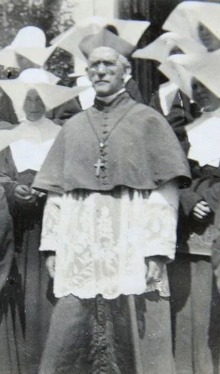
Birth of Daniel Cohalan, Bishop of Cork

Daniel Cohalan, Irish Roman Catholic clergyman who serves as the Bishop of Cork from 1916 to 1952, is born on July 14, 1858, in Kilmichael, County Cork.

After graduating at St. Patrick’s College, Maynooth, Cohalan is ordained a priest at the Cathedral of St. Mary and St. Anne, Cork on July 25, 1882. His first pastoral appointment is a curate at Kilbrittain, County Cork, from October 1883 to January 1884. He briefly resumes his post-graduate studies at St. Finbarr’s Seminary (now College), Cork, from January to November 1884. His second curacy is at Tracton, County Cork, from November 1884 to September 1896. He returns to St. Patrick’s College, Maynooth, as a professor of Theology from September 7, 1896, to June 7, 1914.

Cohalan is appointed Auxiliary Bishop of Cork and Titular Bishop of Vaga on May 25, 1914. He is consecrated bishop at the Cathedral of St. Mary and St. Anne on June 7, 1914, by John Harty, Archbishop of Cashel and Emly. Two years later, he is appointed Diocesan Bishop of Cork on August 29, 1916.

Cohalan is an outspoken critic during the Irish War of Independence, condemning acts of violence on both sides. In particular, he denounces the policy of reprisals. In July 1920, he pronounces an interdict on the killers of a Royal Irish Constabulary (RIC) sergeant, shot dead in the church porch in Bandon. He declares that anyone killing from ambush will be excommunicated. On December 12, 1920, Cohalan issues a decree saying that “anyone within the diocese of Cork who organises or takes part in ambushes or murder, or attempted murder, shall be excommunicated.” In turn, his life is threatened by the Irish Republican Army (IRA). In August 1928, he condemns the British government which had allowed Terence MacSwiney to die on hunger strike in 1920.

The Bessborough Home in Cork is run by the Sisters of the Sacred Hearts of Jesus and Mary and when the department “sought a change of superior in Bessborough because of the appallingly high death rate, he [Catholic Bishop of Cork Dr. Daniel Cohalan] denounced the request. The replacement of the Bessborough superior was delayed for four years after the department requested it, and many infants died during that time. It seems probable that the bishop’s intervention was elicited by the congregation.” In general, the report finds that the major causes of infant mortality in the homes were respiratory infections and gastroenteritis, while “public attention has focused on marasmus [malnutrition]” suggesting “willful neglect.” However, it says that “the term marasmus is best seen as indicating that a child was failing to thrive, but medical experts suggest that this was due to an underlying, undiagnosed medical condition.”

Cohalan dies in office at the age of 94 at Bon Secours Hospital, Cork, on August 24, 1952. A story, current at the time in Cork, refers to his antipathy towards bishops of the Church of Ireland who styled themselves “Bishop of Cork.” A month before his death, and on his deathbed, word is brought to him of the death of the Church of Ireland Bishop of Cork, Cloyne and Ross, Robert Hearn. The response of Cohalan, known “affectionately” as “Danny Boy”, is reputedly, “now he knows who’s Bishop of Cork.”

Originally buried at St. Finbarr’s College, Farranferris, Cohalan is reinterred in the grounds of St. Mary and St. Anne’s Cathedral, Cork, in 1996. His nephew of the same name, Daniel Cohalan, is Bishop of Waterford and Lismore from 1943 to 1965.


Leave a comment

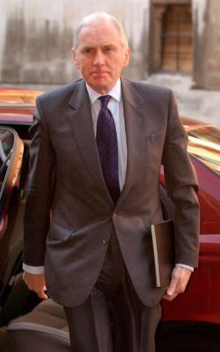
Birth of Brian Hutton, Lord Chief Justice of Northern Ireland

James Brian Edward Hutton, Baron Hutton, PC, a British Lord Chief Justice of Northern Ireland and Lord of Appeal in Ordinary, is born in Belfast, Northern Ireland, on June 29, 1932.

Hutton is the son of a railways executive. He wins a scholarship to Shrewsbury School and Balliol College, Oxford (BA jurisprudence, 1953) before returning to Belfast to study at Queen’s University Belfast and becoming a barrister, being called to the Bar of Northern Ireland in 1954. He begins working as junior counsel to the Attorney General for Northern Ireland in 1969.

Hutton becomes a Queen’s Counsel in 1970. From 1979 to 1989, as Sir Brian Hutton, he is a High Court judge. In 1989, he becomes Lord Chief Justice of Northern Ireland, becoming a member of the Privy Council of Northern Ireland, before moving to England to become a Lord of Appeal in Ordinary on January 6, 1997. He is consequently granted a life peerage as Baron Hutton, of Bresagh in the County of Down.

On March 30, 1994, as Lord Chief Justice of Northern Ireland, Hutton dismisses Private Lee Clegg‘s appeal against his controversial murder conviction. On March 21, 2002 he is one of four Law Lords to reject David Shayler‘s application to use a “public interest” defence as defined in section 1 of the Official Secrets Act 1989 at his trial.

Hutton represents the Ministry of Defence at the inquest into the killing of civil rights marchers on “Bloody Sunday.” Later, he publicly reprimands Major Hubert O’Neil, the coroner presiding over the inquest, when the coroner accuses the British Army of murder, as this contradicts the findings of the Widgery Tribunal.

Hutton also comes to public attention in 1999 during the extradition proceedings of former Chilean dictator General Augusto Pinochet. Pinochet had been arrested in London on torture allegations by request of a Spanish judge. Five Law Lords, the UK’s highest court, decide by a 3-2 majority that Pinochet is to be extradited to Spain. The verdict is then overturned by a panel of seven Law Lords, including Hutton, on the grounds that Lord Lennie Hoffmann, one of the five Law Lords, has links to human rights group Amnesty International which had campaigned for Pinochet’s extradition.

In 1978, Hutton defends the UK at the European Court of Human Rights in the case of Ireland v United Kingdom, when the court decides that the interrogation techniques used were “inhuman and degrading” and breached the European Convention on Human Rights, but do not amount to “torture.” The court also finds that the practice of internment in Northern Ireland had not breached the Convention. He sentences ten men to 1,001 years in prison on the word of “supergrass” informer Robert Quigley, who is granted immunity in 1984.

Hutton is appointed by Tony Blair‘s government to chair the inquiry on the circumstances surrounding the death of scientist David Kelly. The inquiry commences on August 11, 2003. Many observers are surprised when he delivers his report on January 28, 2004 and clears the British Government in large part. His criticism of the BBC is regarded by some as unduly harsh with one critic commenting that Hutton had given the “benefit of judgement to virtually everyone in the government and no-one in the BBC.” In response to the verdict, the front page of The Independent newspaper consists of one word, “Whitewash?”

Peter Oborne writes in The Spectator in January 2004: “Legal opinion in Northern Ireland, where Lord Hutton practised for most of his career, emphasises the caution of his judgments. He is said to have been habitually chary of making precedents. But few people seriously doubt Hutton’s fairness or independence. Though [he is] a dour Presbyterian, there were spectacular acquittals of some very grisly IRA terrorist suspects when he was a judge in the Diplock era.”

Hutton retires as a Law Lord on January 11, 2004. He remains a member of the House of Lords until retiring under the House of Lords Reform Act 2014 on April 23, 2018.

Hutton dies at the age of 88 on July 14, 2020.


Leave a comment

The Fenian Invasion of Canada

On June 1, 1866, a group of Fenian soldiers cross the border from the United States into Canadian territory. The events of the so-called Fenian invasion of Canada leave the organisation utterly discredited and cause much dismay among Irish American communities.

The roots of the invasion go back to 1865 when the Fenians in the United States break into two factions, one headed by William Roberts and the other by John O’Mahony, a founding member of the Fenian Brotherhood in the United States. It is the Roberts wing which proposes a Fenian invasion of Canada. A number of facts are put forward by Roberts and others in support of this plan. In 1865 there are tens of thousands of battle-hardened Irish veterans of the American Civil War, as well as many officers from both the Union and Confederate armies. It is initially proposed to utilise these soldiers for an incursion into Canada that would be timed to coincide with a revolution in Ireland, thus causing Great Britain to be engaged in two widely separated theatres of war.

When it becomes apparent that the hoped-for rising in Ireland is not going to take place, the goal of the invasion is changed. The Fenians now hope that they can engineer a border incident that will entangle British forces in a war with the United States.

At the time the U.S. Government has a fractious relationship with their British counterparts, a remnant of the British Empire‘s partiality towards the Confederacy during the American Civil War. During the war the British Government comes close to granting diplomatic recognition to the Confederacy and British shipyards provide raiding vessels such as the notorious USS Alabama to the South. While this ill-feeling is unlikely to lead to full-scale conflict, the U.S. Government is in no mood to provide any aid to the British in Canada. President Andrew Johnson is aware of the Fenian’s plans but does little to hinder them.

The two competing Fenian factions launch separate operations. In April 1866, the O’Mahony wing attempts to seize Campobello Island near New Brunswick but the Fenian attackers are easily dispersed by U.S. naval forces. The Roberts wing launches its attack on Canada under the command of a civil war veteran, General John Charles O’Neill, on June 1, 1866.

General O’Neill leads a force of over one thousand men into Canadian territory near Fort Erie, Ontario. His invading army has some initial success, winning two engagements including the so-called Battle of Ridgeway with around ten fatalities (with a similar number on the Canadian side). O’Neill’s troops keep their discipline and local civilians are respected, as are Canadian prisoners of war. One soldier, Lance Corporal William Ellis, later writes, “the Fenians treatment of myself and the other prisoners was kind and considerate in the extreme.”

Yet, O’Neill is aware that far larger Canadian forces are approaching and on June 3 feels it prudent to take his army back to American territory, while they await reinforcements. However, the U.S. government is now fearful that events are spiralling out of control. Once back across the border, O’Neill’s army is met by American troops who intervene to prevent the Fenians from making any further attacks. Over the following days the Fenian army is broken up by American forces. O’Neill is arrested by U.S. Marshals and temporarily incarcerated. A second, smaller, incursion into Canada follows on June 6 but this, too, makes little headway. This second Fenian army is also broken up by U.S. forces when back on American soil. By June 8 the Fenian invasion of Canada is over.

The whole invasion demonstrates the futility of the Fenian strategy. It proves that the Canadians would fight to preserve their territory and that they could mobilise thousands of their population to do so. There is little hope that the Fenians could muster the required number of troops necessary to seize and then to hold Canadian territory. Most importantly, there could be no doubt now that the U.S. Government would not, despite its tempestuous relationship with the British Empire, offer any support to a Fenian invasion. Nor would the U.S. Government allow itself to be embroiled in a border war with British or Canadian forces. Nevertheless, these lessons are ignored by some Fenians for whom the idea of attacking Canada is a worthwhile objective over the following few years.

In 1870 another convention takes place amid more internal wrangling within the Brotherhood. There, a decision is made to launch a new attack on Canada. Once again John O’Neill commands the Fenians, among whose army is John Boyle O’Reilly, a young journalist. O’Reilly makes detailed reports on the invasion, an event that proves disastrous for Fenianism in the United States.

(From: “The Fenian Invasion Of Canada, 1866” by Ian Kenneally, The Irish Story, http://www.theirishstory.com)


Leave a comment

Anzac Day Centenary Services in Dublin

Some 600 people turn out on April 25, 2015 for the annual Anzac Day service at Grangegorman Military Cemetery in Dublin to mark the 100th anniversary of the landings at Gallipoli. The crowd is three times that which usually attends the service and reflects the increased interest in the Gallipoli campaign on the centenary of the military debacle.

The Australian ambassador to Ireland Dr. Ruth Adler and British ambassador to Ireland Dominick Chilcott are both at the ceremony along with diplomatic representatives from both New Zealand and Turkey. The Irish Government is represented by Tánaiste Joan Burton, Minister for Communications, Energy and Natural Rersources Alex White and Minister of State for Communities, Culture and Equality Aodhán Ó Ríordáin. Poems and prayers are recited and ten schoolchildren read out the names of Anzac troops who drowned when the RMS Leinster was torpedoed off the Irish coast on October 10, 1918.

Burton says so many people from all the nations involved in the Gallipoli campaign lost relatives there and it is important that such an event should never happen again.

Ó Ríordáin says his own great-uncle James Sheridan was killed at Gallipoli five days after the landings and now lies for eternity in V Beach Cemetery. He adds that the decade of centenaries has sought to “reawaken the dormant memories, the forgotten, the unspoken and maybe even dispel some of the shame there that might have existed. Like so many other Irish families I too have discovered in recent years to those who fought in World War I as well as those who fought for Irish freedom here”.

A wreath is laid at Grangegorman Military Cemetery on behalf of the people of Ireland by Minister for Communications White.

Later White and the British ambassador unveil at Glasnevin Cemetery eight paving stones commemorating Irish-born soldiers who won the Victoria Cross (VC) during the war. Four of the soldiers involved, Pte. William Kenealy from the Lancashire Fusiliers, Pte. William Cosgrove from the Royal Munster Fusiliers, Capt. Gerald O’Sullivan from the Royal Inniskilling Fusiliers and Sgt. James Somers also from the Royal Inniskilling, won theirs at Gallipoli.

Among those present at Glasnevin Cemetery is Joe Day, a relation of Corporal William Cosgrove.

At the unveiling ceremony in Glasnevin Cemetery, White reveals that he had two great-uncles who were killed at the Somme. He says a “great silence” had descended on Ireland after the first World War but he hoped that silence has now ended.

Chilcott says nine million soldiers served in the British Imperial Forces during World War I and only 628 were awarded the Victoria Cross, the equivalent of less than one in 10,000 of those who fought. “Those who earn it are certainly the bravest of the brave. These men are very special. That is why we honour them,” he says.

The other Irish VC winners who are honoured with paving stones are Lieuteant George Roupell from the Royal Irish Fusiliers, CSM Frederick Hall from the Canadian (Winnipeg Rifles), Major David Nelson from the Royal Artillery and William Kenny from the Gordon Highlanders.

The paving stones are paid for by the British Government and all 34 awarded to those who were from what is now the Republic of Ireland are placed around the Cross of Sacrifice in Glasnevin Cemetery.

(From: “Hundreds attend Anzac service in Dublin to remember Gallipoli dead” by Ronan McGreevy, The Irish Times, http://www.irishtimes.com, April 25, 2015. Pictured: British Ambassador to Ireland Dominick Chilcott (right) meets Joe Day from Whitegate in Cork, whose grand uncle William Cosgrove VC survived Gallipoli, at the Glasnevin Cemetery commemoration to mark the 100th Anzac anniversary. Photograph: Peter Houlihan/Fennells)


Leave a comment

Birth of Daniel Murray, Archbishop of Dublin

Daniel Murray, Roman Catholic Archbishop of Dublin, is born on April 18, 1768, at Sheepwalk, near Arklow, County Wicklow.

Murray is the son of Thomas and Judith Murray, who are farmers. At the age of eight he goes to Thomas Betagh‘s school at Saul’s Court, near Christ Church Cathedral, Dublin. At sixteen, Archbishop John Carpenter sends him to the Irish College at Salamanca, completing his studies at the University of Salamanca. He is ordained priest in 1792 at the age of twenty-four.

After some years as curate at St. Paul’s Church in Dublin, Murray is transferred to Arklow and is there in 1798 when the rebellion breaks out. The yeomanry shoots the parish priest in bed and Murray, to escape a similar fate, flees to the city where for two years he serves as curate at St. Andrew’s Chapel on Hawkins Street. As a preacher, he is said to be particularly effective, especially in appeals for charitable causes, such as the schools. He is then assigned to the Chapel of St. Mary in Upper Liffey Street where Archbishop John Troy is the parish priest.

In 1809, at the request of Archbishop Troy, Murray is appointed coadjutor bishop and consecrated on November 30, 1809. In 1811 he is made Administrator of St. Andrew’s. That same year he helps Mary Aikenhead establish the Religious Sisters of Charity. While coadjutor he fills for one year the position of president of St. Patrick’s College, Maynooth.

Murray is an uncompromising opponent of a proposal granting the British government a “veto” over Catholic ecclesiastical appointments in Ireland, and in 1814 and 1815, makes two separate trips to Rome concerning the controversy.

Murray becomes Archbishop of Dublin in 1825 and on November 14, 1825, celebrates the completion of St. Mary’s Pro-Cathedral. He enjoys the confidence of successive popes and is held in high respect by the British government. His life is mainly devoted to ecclesiastical affairs, the establishment and organisation of religious associations for the education and relief of the poor. With the outbreak of cholera in the 1830s, in 1834 he and Mother Aikenhead found St. Vincent’s Hospital. He persuades Edmund Rice to send members of the Christian Brothers to Dublin to start a school for boys. The first is opened in a lumber yard on the city-quay. He assists Catherine McAuley in founding the Sisters of Mercy, and in 1831 professes the first three members.

Edward Bouverie Pusey has an interview with Murray in 1841, and bears testimony to his moderation, and John Henry Newman has some correspondence with him prior to Newman’s conversion from the Anglican Church to the Roman Catholic Church in 1845. A seat in the privy council at Dublin, officially offered to him in 1846, is not accepted. He takes part in the synod of the Roman Catholic clergy at Thurles in 1850.

Towards the end of his life, Murray’s eyesight is impaired, and he reads and writes with difficulty. Among his last priestly functions is a funeral service for Richard Lalor Sheil who had died in Italy, and whose body had been brought back to Ireland for burial. Murray dies in Dublin on February 26, 1852, at the age of eighty-four. He is interred in the St. Mary’s Pro-Cathedral, Dublin, where a marble statue of him has been erected in connection with a monument to his memory, executed by James Farrell, president of the Royal Hibernian Academy of Fine Arts.

(Pictured: Portrait of Daniel Murray, Archbishop of Dublin, by unknown 19th century Irish portrait painter)


Leave a comment

The Limerick Soviet

The Limerick Soviet exists for a two-week period from April 15 to April 27, 1919, and is one of a number of self-declared Irish soviets that are formed around Ireland between 1919 and 1923. At the beginning of the Irish War of Independence, a general strike is organised by the Limerick Trades and Labour Council, as a protest against the British Army‘s declaration of a “Special Military Area” under the Defence of the Realm Act 1914, which covers most of Limerick city and a part of the county. The soviet runs the city for the period, prints its own money and organises the supply of food.

From January 1919 the Irish War of Independence develops as a guerrilla conflict between the Irish Republican Army (IRA) (backed by Sinn Féin‘s Dáil Éireann), and the British government. On April 6, 1919, the IRA tries to liberate Robert Byrne, who is under arrest by the Royal Irish Constabulary (RIC) in a hospital, being treated for the effects of a hunger strike. In the rescue attempt Constable Martin O’Brien is fatally wounded, and another policeman is seriously injured. Byrne is also wounded and dies later the same day.

In response, on April 9 British Army Brigadier Griffin declares the city to be a Special Military Area, with RIC permits required for all wanting to enter and leave the city as of Monday, April 14. British Army troops and armoured vehicles are deployed in the city.

On Friday, April 11 a meeting of the United Trades and Labour Council, to which Byrne had been a delegate, takes place. At that meeting Irish Transport and General Workers’ Union (ITGWU) representative Sean Dowling proposes that the trade unions take over Town Hall and have meetings there, but the proposal is not voted on. On Saturday, April 12 the ITGWU workers in the Cleeve’s factory in Lansdowne vote to go on strike. On Sunday, April 13, after a twelve-hour discussion and lobbying of the delegates by workers, a general strike is called by the city’s United Trades and Labour Council. Responsibility for the direction of the strike is devolved to a committee that describes itself as a soviet as of April 14. The committee has the example of the Dublin general strike of 1913 and “soviet” (meaning a self-governing committee) has become a popular term after 1917 from the soviets that had led to the Russian Soviet Federative Socialist Republic.

A transatlantic air race is being organised from Bawnmore in County Limerick at the same time but is cancelled. The assembled journalists from England and the United States take up the story of an Irish soviet and interview the organisers. The Trades Council chairman John Cronin is described as the “father of the baby Soviet.” Ruth Russell of the Chicago Tribune remarks on the religiosity of the strike committee, observes “the bells of the nearby St. Munchin’s Church tolled the Angelus and all the red-badged guards rose and blessed themselves.” The Sinn Féin Mayor of Limerick, Phons O’Mara, tells Russell there is no prospect of socialism, as “There can’t be, the people here are Catholics.”

The general strike is extended to a boycott of the troops. A special strike committee organises food and fuel supplies, prints its own money based on the British shilling, and publishes its own newspaper called The Worker’s Bulletin. The businesses of the city accept the strike currency. Cinemas open with the sign “Working under authority of the strike committee” posted. Local newspapers are allowed to publish once a week as long as they have the caption “Published by Permission of the Strike Committee.” Outside Limerick there is some sympathy in Dublin, but not in the main Irish industrial area around Belfast. The National Union of Railwaymen does not help.

On April 21 The Worker’s Bulletin remarks that “A new and perfect system of organisation has been worked out by a clever and gifted mind, and ere long we shall show the world what Irish workers are capable of doing when left to their own resources.” On Easter Monday 1919, the newspaper states “The strike is a worker’s strike and is no more Sinn Féin than any other strike.”

Liam Cahill argues, “The soviet attitude to private property was essentially pragmatic. So long as shopkeepers were willing to act under the soviet’s dictates, there was no practical reason to commandeer their premises.” While the strike is described by some as a revolution, Cahill adds, “In the end the soviet was basically an emotional and spontaneous protest on essentially nationalist and humanitarian grounds, rather than anything based on socialist or even trade union aims.”

After two weeks the Sinn Féin Lord Mayor of Limerick, Phons O’Mara, and the Catholic bishop Denis Hallinan call for the strike to end, and the Strike Committee issues a proclamation on April 27, 1919, stating that the strike is over.

(Pictured: Photograph of Members of the 1919 Limerick Soviet, April 1919, Limerick City)


Leave a comment

Birth of Terence MacSwiney, Playwright, Author & Lord Mayor of Cork

This image has an empty alt attribute; its file name is terence-macswiney.jpg

Terence James MacSwiney, Irish playwright, author, politician and Sinn Féin Lord Mayor of Cork during the Irish War of Independence, is born at 23 North Main Street, Cork, County Cork, on March 28, 1879.

MacSwiney is one of eight children of John and Mary MacSwiney. His father had volunteered in 1868 to fight as a papal guard against Giuseppe Garibaldi, had been a schoolteacher in London and later opened a tobacco factory in Cork. Following the failure of this business, John MacSwiney emigrates to Australia in 1885, leaving the children in the care of their mother and his eldest daughter.

MacSwiney is educated by the Christian Brothers at the North Monastery school in Cork but leaves at fifteen to help support the family. He becomes an accountancy clerk but continues his studies and matriculates successfully. He continues in full-time employment while he studies at the Royal University (now University College Cork), graduating with a degree in Mental and Moral Science in 1907.

In 1901 MacSwiney helps to found the Celtic Literary Society, and in 1908 he founds the Cork Dramatic Society with Daniel Corkery and writes a number of plays for them. His first play, The Last Warriors of Coole, is produced in 1910. His fifth play, The Revolutionist (1915), takes the political stand made by a single man as its theme.

Described as a sensitive poet-intellectual, MacSwiney’s writings in the newspaper Irish Freedom bring him to the attention of the Irish Republican Brotherhood. He is one of the founders of the Cork Brigade of the Irish Volunteers in 1913 and is President of the Cork branch of Sinn Féin. He founds a newspaper, Fianna Fáil, in 1914, but it is suppressed after only eleven issues. In April 1916, he is intended to be second in command of the Easter Rising in counties Cork and Kerry but stands down his forces on the order of Eoin MacNeill.

Following the rising, MacSwiney is imprisoned by the British Government under the Defence of the Realm Act 1914 in Reading and Wakefield Gaols until December 1916. In February 1917 he is deported from Ireland and imprisoned in Shrewsbury and Bromyard internment camps until his release in June 1917. It is during his exile in Bromyard that he marries Muriel Murphy of the Cork distillery-owning family. In November 1917, he is arrested in Cork for wearing an Irish Republican Army (IRA) uniform, and inspired by the example of Thomas Ashe, goes on a hunger strike for three days prior to his release.

In the 1918 Irish general election, MacSwiney is returned unopposed to the first Dáil Éireann as Sinn Féin representative for Mid Cork, succeeding the Nationalist MP D. D. Sheehan. After the murder of his friend Tomás Mac Curtain, the Lord Mayor of Cork, on March 20, 1920, he is elected as Lord Mayor. On August 12, 1920, he is arrested in Cork for possession of “seditous articles and documents,” and also possession of a cipher key. He is summarily tried by a court on August 16 and sentenced to two years’ imprisonment at Brixton Prison in England.

In prison MacSwiney immediately starts a hunger strike in protest of his internment and the fact that he was tried by a military court. Eleven other Irish Republican prisoners in Cork Jail go on hunger strike at the same time. On August 26, the British Government states that “the release of the Lord Mayor would have disastrous results in Ireland and would probably lead to a mutiny of both military and police in south of Ireland.”

MacSwiney’s hunger strike gains world attention. The British Government is threatened with a boycott of British goods by Americans, while four countries in South America appeal to Pope Benedict XV to intervene. Protests are held in Germany and France as well. An Australian member of Parliament, Hugh Mahon, is expelled from the Parliament of Australia for “seditious and disloyal utterances at a public meeting,” after protesting against the actions of the British Government. Two weeks later, the Spanish Catalan organization Autonomous Center of Employees of Commerce and Industry (CADCI) sends a petition to British Prime Minister David Lloyd George calling for his release and the newspaper of the organization, Acció (Acción in Spanish), begins a campaign for MacSwiney.

Food is often placed near MacSwiney to persuade him to give up the hunger strike. Attempts at force-feeding are undertaken in the final days of his strike. On October 20, 1920, he slips into a coma and dies in London’s Brixton Prison on October 25, after 73 days on hunger strike. His body lay in St. George’s Cathedral, Southwark in London where 30,000 people file past it. Fearing large-scale demonstrations in Dublin, the authorities divert his coffin directly to Cork, and his funeral in the Cathedral of St. Mary and St. Anne on October 31 attracts huge crowds. He is buried in the Republican plot in St. Finbarr’s Cemetery in Cork. Arthur Griffith delivers the graveside oration. His death brings him and the Irish Republican campaign to international attention.