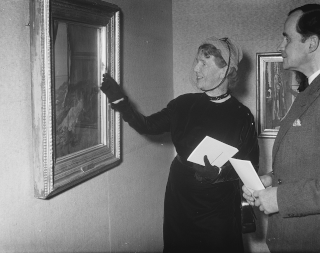
Josephine McNeill, Irish diplomat, dies in Dublin on November 19, 1969. She is the first Irish female diplomat appointed to represent Ireland abroad in a ministerial capacity.
McNeill is born Josephine Ahearne on March 31, 1895, in Fermoy, County Cork, the daughter of shopkeeper and hotelier, James Ahearne, and his wife Ellen Ahearne (née O’Brien). She attends the Loretto Convent, Fermoy, and goes on to graduate from University College Dublin (UCD) with a BA, H.Dip.Ed. in French and German. With this she begins a teaching career, at St. Louis’ Convent, Kiltimagh, at the Ursuline Convent, Thurles, and at Scoil Íde. Scoil Íde, the female counterpart to St. Enda’s School, had been established by her friend, Louise Gavan Duffy. She is fluent in the Irish language and takes an active part in the cultural elements of the Irish independence movement, such as literature and music. She is a member of Cumann na mBan, serving as a member of the executive committee in 1921.
After the death of her husband in 1938, McNeill becomes the honorary secretary of the council of the Friends of the National Collections, as well as serving as chair of the executive committee of the Irish Countrywomen’s Association until 1950. As a member of the Department of External Affairs advisory committee on cultural relations, she writes on economic, social and cultural issues. She represents Ireland at the UNESCO general assembly in Paris in 1949.
McNeill is an active member of Clann na Poblachta from its foundation in 1946. She is appointed the minister to the Netherlands in 1950 by Seán MacBride, making her the first Irish female diplomat to represent the Republic of Ireland abroad in a ministerial capacity. This appointment is not well received by diplomats in the Department of External Affairs. Her reports from The Hague focus on the issues the Netherlands faces with decolonisation. In 1955, she becomes the minister to Sweden, going on to hold the joint appointment to Austria and Switzerland from 1956 to 1960, after which she retires. While serving in Switzerland she puts aside the resentment she feels towards Éamon de Valera based on how he had treated her husband, to sit with him during a convalescence while de Valera recovers from an eye operation.
McNeill is an amateur pianist and collects paintings and porcelains. In 1933, she publishes the Irish language book, Finnsgéalta ó India.
O’Kelly is born on August 25, 1882, on Capel Street in the north inner-city of Dublin. He joins the National Library of Ireland in 1898 as a junior assistant. That same year, he joins the Gaelic League, becoming a member of the governing body in 1910 and General Secretary in 1915.
In 1905 O’Kelly joins Sinn Féin who, at the time, supports a dual monarchy. He is an honorary secretary of the party from 1908 until 1925. In 1906 he is elected to Dublin Corporation, which is Dublin’s city council. He retains the seat for the Inns Quay Ward until 1924.
O’Kelly is elected Sinn Féin MP for Dublin College Green in the 1918 Irish general election. Along with other Sinn Féin MPs he refuses to take his seat in the British House of Commons. Instead, they set up an Irish parliament, called Dáil Éireann, in Dublin. O’Kelly is Ceann Comhairle (Chairman) of the First Dáil. He is the Irish Republic’s envoy to the post-World War I peace treaty negotiations at the Palace of Versailles, but the other countries refuse to allow him to speak as they do not recognise the Irish Republic.
O’Kelly is a close friend of Éamon de Valera, and both he and de Valera oppose the Anglo-Irish Treaty of December 1921. When de Valera resigns as President of the Irish Republic on January 6, 1922, O’Kelly returns from Paris to try to persuade de Valera to return to the presidency but de Valera orders him to return to Paris.
During the Irish Civil War, O’Kelly is jailed until December 1923. Afterwards he spends the next two years as a Sinn Féin envoy to the United States.
In 1926 when de Valera leaves Sinn Féin to found his own republican party, Fianna Fáil, O’Kelly follows him, becoming one of the party’s founding members. In 1932, when de Valera is appointed President of the Executive Council of the Irish Free State, he makes O’Kelly the Minister for Local Government and Public Health. He often tries to publicly humiliate the Governor-General of the Irish Free State, James McNeill, which damages O’Kelly’s reputation and image, particularly when the campaign backfires.
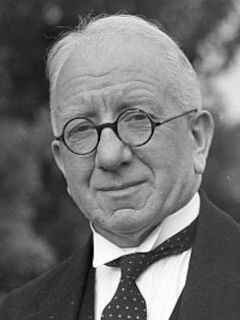
In 1938, many believe that de Valera wants to make O’Kelly the Fianna Fáil choice to become President of Ireland, under the new Irish constitution, Bunreacht na hÉireann. When Lord Mayor of Dublin, Alfie Byrne, says he wants to be president there is an all-party agreement to nominate Douglas Hyde, a Protestant Irish Senator, Irish language enthusiast and founder of the Gaelic League. They believe Hyde to be the only person who might win an election against Alfie Byrne. O’Kelly is instead appointed Minister of Finance and helps create Central Bank in 1942.
O’Kelly leaves the cabinet when he is elected President of Ireland on June 18, 1945, in a popular vote of the people, defeating two other candidates. He is re-elected unopposed in 1952. During his second term he visits many nations in Europe and speaks before the United States Congress in 1959. He retires at the end of his second term in 1959, to be replaced by his old friend, Éamon de Valera. Following his retirement, he is described as a model president by the normally hostile newspaper, The Irish Times. Though controversial, he is widely seen as genuine and honest, but tactless.
O’Kelly’s strong Roman Catholic beliefs sometimes cause problems. Éamon de Valera often thinks that O’Kelly either deliberately or accidentally leaks information to the Knights of Saint Columbanus and the Church leaders. He ensures that his first state visit, following the creation of the Republic of Ireland in 1949, is to the Vatican City to meet Pope Pius XII. He accidentally reveals the Pope’s private views on communism. This angers the Pope and Joseph Stalin and is why he is not given the papal Supreme Order of Christ which is given to many Catholic heads of state.
On his retirement O’Kelly gives a series of radio talks about his early life and the independence movement. These form the basis of an account serialised in TheIrish Press (July 3 to August 9, 1961) and subsequently translated into Irish and published as Seán T. (1963), echoing the nickname by which he is commonly known. The book relies heavily on memory and its accuracy on points of detail has been questioned by scholars such as F. X. Martin. In retirement he lived at his home, Roundwood Park in County Wicklow.
O’Kelly dies at the Mater Private Nursing Home in Dublin on November 23, 1966, at the age of 84, fifty years after the Easter Rising that first brought him to prominence. He is buried in Glasnevin Cemetery, Glasnevin, Dublin. His perceived unctuousness and his opportunistic tendencies in his later career should not efface his significance as a separatist organiser and an effective populist politician, who played a major role in the establishment of Fianna Fáil political hegemony.
Josephine McNeill, Irish diplomat, is born on March 31, 1895, in Fermoy, County Cork. She is the first Irish female diplomat appointed to represent Ireland abroad in a ministerial capacity.
McNeill is born Josephine Ahearne, the daughter of shopkeeper and hotelier, James Ahearne, and his wife Ellen Ahearne (née O’Brien). She attends the Loretto Convent, Fermoy, and goes on to graduate from University College Dublin (UCD) with a BA, H.Dip.Ed. in French and German. With this she begins a teaching career, at St. Louis’ Convent, Kiltimagh, at the Ursuline Convent, Thurles, and at Scoil Íde. Scoil Íde, the female counterpart to St. Enda’s School, had been established by her friend, Louise Gavan Duffy. She is fluent in the Irish language and takes an active part in the cultural elements of the Irish independence movement, such as literature and music. She is a member of Cumann na mBan, serving as a member of the executive committee in 1921.
After the death of her husband in 1938, McNeill becomes the honorary secretary of the council of the Friends of the National Collections, as well as serving as chair of the executive committee of the Irish Countrywomen’s Association until 1950. As a member of the Department of External Affairs advisory committee on cultural relations, she writes on economic, social and cultural issues. She represents Ireland at the UNESCO general assembly in Paris in 1949.
McNeill is an active member of Clann na Poblachta from its foundation in 1946. She is appointed the minister to the Netherlands in 1950 by Seán MacBride, making her the first Irish female diplomat to represent the Republic of Ireland abroad in a ministerial capacity. This appointment is not well received by diplomats in the Department of External Affairs. Her reports from The Hague focus on the issues the Netherlands faces with decolonisation. In 1955, she becomes the minister to Sweden, going on to hold the joint appointment to Austria and Switzerland from 1956 to 1960, after which she retires. While serving in Switzerland she puts aside the resentment she feels towards Éamon de Valera based on how he had treated her husband, to sit with him during a convalescence while de Valera recovers from an eye operation.
McNeill is an amateur pianist and collects paintings and porcelains. In 1933, she publishes the Irish language book, Finnsgéalta ó India.
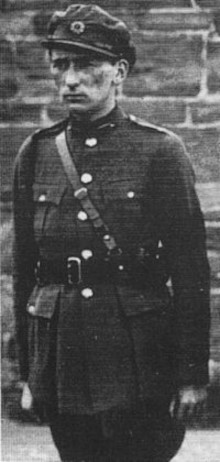
Tobin is the eldest son of Mary Agnes (nee Butler) and David Tobin, a hardware clerk. He has two younger siblings, Katherine and Nicholas Augustine Tobin, also born in Cork. His family moves to John Street in Kilkenny and then to Dublin. He goes to school in Kilkenny and is an apprentice in a hardware shop at the time of the 1916 Easter Rising. As a participant in the Rising, he fights in the Four Courts garrison under Edward Daly. He is arrested, court martialed, and sentenced to death but his sentence is commuted to life imprisonment. He is a prisoner in Kilmainham, Mountjoy, Lewes, Dartmoor, Broadmoor and Pentonville prisons. He is released in June 1917.
In October 1921, Tobin travels with the Irish Treaty Delegation as part of Collins’ personal staff.
Tim Pat Coogan and James Mackay have examined Tobin’s involvement in the assassination of British Field MarshalSir Henry Wilson. Wilson’s public tirades about Collins is evidence of mutual personal dislike between the two men. In May 1922 Collins tells Tobin “We’ll kill a member of that bunch” to the news of “bloody pogroms” in Belfast. Wilson is intimately involved with the Ulster loyalist cause, including the Curragh Mutiny and the establishment of the Ulster Special Constabulary. Just before the shooting, Coogan places Tobin in London. He meets courier Peig Ni Braonain at Euston Station collecting a document that has been sent from Dublin. Returning to Dublin before the incident, he is jubilant when he tells defence ministerRichard Mulcahy about Wilson’s death. Mulcahy is appalled and threatens to resign.
In October 1922, Tobin’s brother Nicholas, a Free State captain, is accidentally shot dead by his own troops during the raid and capture of a bomb making factory at number 8 Gardiner’s Place, Dublin.
Tobin believes in the steppingstone doctrine which sees the Treaty as a stage towards full independence. With the outbreak of the Irish Civil War he remains loyal to Collins and takes the Pro-Treaty side. He leads in the fight against the Anti-Treaty IRA in the south. Disillusioned with the continuing hostilities and in the aftermath of the death of Collins, he forms an association called the IRA Organisation (IRAO) or “Old Irish Republican Army” to distinguish themselves from the anti-treaty insurgents.
Richard Mulcahy, the new Irish defence minister, proposes to reduce the army from 55,000 to 18,000 men in the immediate post- Civil-War period. Tobin knows his own position is to be affected and shares the perception that the Irish Army treats former British officers better than former IRA officers. On March 7, 1924, Tobin, together with Colonel Charlie Dalton, sends an ultimatum to President of the Executive Council of the Irish Free StateW. T. Cosgrave demanding an end to the army demobilisation. The immediate response is an order for the arrest of the two men on a charge of mutiny. The cabinet, already wary of the Irish Army, orders an inquiry and appoints Garda CommissionerEoin O’Duffy to the army command.
On March 18, the mutineers assemble with hostile intent at a Dublin pub. An order is made to arrest the mutineers and the cabinet demands the resignation of the army council. The generals resign, affirming the subservience of the military to the civilian government of the new state.
In later years, Tobin rebuilds relations with his Civil War foes and joins Éamon de Valera‘s Anti-Treaty Fianna Fáil party. He joins up with Joseph McGrath to form the Irish Hospitals’ Sweepstake in the 1930s. Many other former army comrades find work in this lottery. He leaves the Sweep in 1938. After World War II, he becomes Superintendent of the Oireachtas for the Irish Dáil.
On October 14, 1929, Tobin marries Monica “Mona” Higgins at the Church of the Holy Family, Aughrim Street, Dublin. They have two daughters, Máire and Anne Tobin. Following the death of his father, David, in 1956, Tobin’s health declines, resulting in his death in Dublin on April 30, 1963.
Healy is the second son of Maurice Healy, clerk of the Bantry Poor Law Union, and Eliza Healy (née Sullivan). His elder brother, Thomas Healy (1854–1924), is a solicitor and Member of Parliament (MP) for North Wexford and his younger brother, Maurice Healy (1859–1923), with whom he holds a lifelong close relationship, is a solicitor and MP for Cork City.
Healy then moves to England in 1871, working first as a railway clerk and then from 1878 in London as parliamentary correspondent of The Nation, writing numerous articles in support of Charles Stewart Parnell, the newly emergent and more militant home rule leader, and his policy of parliamentary obstructionism. Healy takes part in Irish politics and becomes associated with Parnell and the Irish Parliamentary Party. After being arrested for intimidation in connection with the Irish National Land League, he is promptly elected as member of Parliament for Wexford Borough in 1880.
In Parliament, Healy becomes an authority on the Irish land question. The “Healy Clause” of the Land Law (Ireland) Act 1881, which protects tenant farmers’ agrarian improvements from rent increases imposed by landlords, not only makes him popular throughout nationalist Ireland but also wins his cause seats in ProtestantUlster. He breaks with Parnell in 1886 and generally remains at odds with subsequent leaders of the Irish Parliamentary Party, though he is a strong supporter of proposals for Irish Home Rule. Meanwhile, he is called to the Irish bar in 1884 and becomes a queen’s counsel in 1899.
Healy believes that he has been awarded the Governor-Generalship for life. However, the Executive Council of the Irish Free State decides in 1927 that the term of office of Governors-General will be five years. As a result, he retires from the office and public life in January 1928 and publishes his extensive two volume memoirs later in that year. Throughout his life he is formidable because he is ferociously quick-witted, because he is unworried by social or political convention, and because he knows no party discipline. Towards the end of his life, he becomes more mellowed and otherwise more diplomatic.
The oath, pledging allegiance to the Constitution and fidelity to George V as King of Ireland, is required by the Anglo-Irish Treaty signed in 1921, and has been the symbolic focus of Irish republican opposition to the Treaty in the 1922–23 Irish Civil War. When Fianna Fáil is founded in 1926 by veterans of the losing anti-Treaty side in the Civil War, abolishing the oath is a core aim. It is a main item in the manifesto for its successful 1932 Irish general election campaign, after which it forms a minority government whose first action is to introduce the Constitution (Removal of Oath) Bill 1932. Seanad Éireann has more ex-unionists and others conciliatory towards the United Kingdom and vote to reject the bill unless the Treaty can be amended by agreement. After the 1933 Irish general election, the Fianna Fáil majority government is able to override the Seanad and enact the law.
As well as amending the Constitution, the 1933 act also amends the Constitution of the Irish Free State (Saorstát Eireann) Act 1922, which had both created the Constitution in Irish law and also prohibited any Constitutional amendment incompatible with the Treaty. Since the Free State cannot unilaterally amend the Treaty, Fianna Fáil amends the 1922 act to remove the Treaty’s precedence over the Constitution. Later constitutional amendments are also incompatible with the terms of the Treaty, in particular by weakening and ultimately abolishing the office of Governor-General of the Irish Free State. There is legal controversy over whether the Oireachtas has the power to amend the 1922 act, because it had been passed by the Third Dáil sitting as a constituent assembly before the Oireachtas had come into being. In 1935 the Judicial Committee of the Privy Council (JCPC) in London rules that, in British law, the Oireachtas does have the power, under the Statute of Westminster 1931. Irish jurisprudence takes issue with many of the assumptions underlying the 1935 decision.
Tobin is born William Joseph Tobin at 13 Great Georges Street in Cork, County Cork, on November 15, 1895, the eldest son of Mary Agnes (nee Butler) and David Tobin, a hardware clerk. He has two younger siblings, Katherine and Nicholas Augustine Tobin, also born in Cork. His family moves to John Street in Kilkenny and then to Dublin. He goes to school in Kilkenny and is an apprentice in a hardware shop at the time of the 1916 Easter Rising. As a participant in the Rising he fights in the Four Courts garrison under Edward Daly. He is arrested, court martialed, and sentenced to death but his sentence is commuted to life imprisonment. He is a prisoner in Kilmainham, Mountjoy, Lewes, Dartmoor, Broadmoor and Pentonville prisons. He is released in June 1917.
In October 1921, Tobin travels with the Irish Treaty Delegation as part of Collins’ personal staff.
Tim Pat Coogan and James Mackay have examined Tobin’s involvement in the assassination of British Field MarshalSir Henry Wilson. Wilson’s public tirades about Collins is evidence of mutual personal dislike between the two men. In May 1922 Collins tells Tobin “We’ll kill a member of that bunch” to the news of “bloody pogroms” in Belfast. Wilson is intimately involved with the Ulster loyalist cause, including the Curragh Mutiny and the establishment of the Ulster Special Constabulary. Just before the shooting, Coogan places Tobin in London. He meets courier Peig Ni Braonain at Euston Station collecting a document that has been sent from Dublin. Returning to Dublin before the incident, he is jubilant when he tells defence ministerRichard Mulcahy about Wilson’s death. Mulcahy is appalled and threatens to resign.
In October 1922, Tobin’s brother Nicholas, a Free State captain, is accidentally shot dead by his own troops during the raid and capture of a bomb making factory at number 8 Gardiner’s Place, Dublin.
Tobin believes in the stepping stone doctrine which sees the Treaty as a stage towards full independence. With the outbreak of the Irish Civil War he remains loyal to Collins and takes the Pro-Treaty side. He leads in the fight against the Anti-Treaty IRA in the south. Disillusioned with the continuing hostilities and in the aftermath of the death of Collins, he forms an association called the IRA Organisation (IRAO) or “Old Irish Republican Army” to distinguish themselves from the anti-treaty insurgents.
Richard Mulcahy, the new Irish defence minister, proposes to reduce the army from 55,000 to 18,000 men in the immediate post- Civil-War period. Tobin knows his own position is to be affected and shares the perception that the Irish Army treats former British officers better than former IRA officers. On March 7, 1924, Tobin, together with Colonel Charlie Dalton, sends an ultimatum to President of the Executive Council of the Irish Free StateW. T. Cosgrave demanding an end to the army demobilisation. The immediate response is an order for the arrest of the two men on a charge of mutiny. The cabinet, already wary of the Irish Army, orders an inquiry and appoints Garda CommissionerEoin O’Duffy to the army command.
On March 18, the mutineers assemble with hostile intent at a Dublin pub. An order is made to arrest the mutineers and the cabinet demands the resignation of the army council. The generals resign, affirming the subservience of the military to the civilian government of the new state.
In later years, Tobin rebuilds relations with his Civil War foes and joins Éamon de Valera‘s Anti-Treaty Fianna Fáil party. He joins up with Joseph McGrath to form the Irish Hospitals’ Sweepstake in the 1930s. Many other former army comrades find work in this lottery. He leaves the Sweep in 1938. After World War II, he becomes Superintendent of the Oireachtas for the Irish Dáil.
On October 14, 1929, Tobin marries Monica “Mona” Higgins at the Church of the Holy Family, Aughrim Street, Dublin. They have two daughters, Máire and Anne Tobin. Following the death of his father, David, in 1956, Tobin’s health declines, resulting in his death in Dublin on April 30, 1963.
One of five children born to Archibald McNeill, a Roman Catholic working class “baker, sailor and merchant,” and his wife, Rosetta (née McAuley) McNeill, McNeill is the brother of nationalist leader Eoin MacNeill. He serves as a high-ranking member of the Indian Civil Service in Calcutta.
When the first Governor-General of the Irish Free State, Tim Healy, retires in December 1927, McNeill is proposed as his replacement by the Irish government of W. T. Cosgrave and duly appointed by King George V as Governor-General of the Irish Free State.
In office, McNeill clashes with the King’s Private Secretary when he insists on following the constitutional advice of his Irish ministers, rather than that of the Palace, in procedures relating to the receipt of Letters of Credence accrediting ambassadors to the King in Ireland. He also refuses to attend ceremonies in Trinity College, Dublin, when some elements in the college try to ensure that the old British national anthemGod Save the King is played, rather than the new Irish anthem, Amhrán na bhFiann.
However, McNeill’s tact is not reciprocated by de Valera’s government, and some of its ministers seek to humiliate him as the King’s representative by withdrawing the Irish Army‘s band from playing at functions he attends and demanding he withdraw invitations to visitors to meet him. In one notorious incident in April, two ministers, Seán T. O’Kelly (a future President of Ireland) and Frank Aiken, publicly walk out of a diplomatic function when McNeill, there as the guest of the French ambassador, arrives. In a fury, McNeill writes to de Valera demanding an apology for this treatment. When none is forthcoming, apart from an ambiguous message from de Valera that could be interpreted as partially blaming McNeill for attending functions at which ministers would be present, he publishes his correspondence with de Valera, even though de Valera had formally advised him not to do so. De Valera then demands that George V dismiss him.
The King engineers a compromise, whereby de Valera withdraws his dismissal request and McNeill, who is due to retire at the end of 1932, will push forward his retirement date by a month or so. McNeill, at the King’s request, resigns on November 1, 1932.
The Free State’s Provisional Government puts the “Public Safety Bill” before Dáil Éireann on September 27, 1922, which passes by 41 votes to 18. This is emergency legislation which allows for the execution of those captured bearing arms against the State. The legislation passes to the National Army powers of punishment for anyone “taking part in or aiding and abetting attacks on the National Forces,” having possession of arms or explosives “without the proper authority” or disobeying an Army General Order.
The legislation gives the Military Courts the right to impose the sentence of death, imprisonment or penal servitude on those found to be guilty of such offences, the sentence only requiring the signatures of two officers. By time the bill is a year old, 81 men are executed under its terms and over 12,000 men and women imprisoned.
The reason for such punitive legislation is the dragging on of the Irish Civil War caused by the Anglo-Irish Treaty. A pro-Treaty offensive against the anti-Treaty Irish Republican Army (IRA) in the summer of 1922 appears to have won the war for the government but the anti-Treatyites or republicans subsequently fall back on guerrilla tactics which the newly formed Free State or National Army have great difficulty in suppressing. Ernest Blythe, the Minister for Finance in the Provisional Government, later recalls, “there was for some time a feeling that the Civil War would speedily end as major resistance was broken, but actually it began to assume a chronic character.”
In the week preceding the Dáil’s motion, on September 21, six National Army soldiers are killed in a prolonged engagement with Republican fighters near Ballina, County Mayo. On the same day, the Free State barracks in Drumshambo, County Leitrim, is attacked and taken and one soldier is killed. On September 22, a National Army soldier is killed and several soldiers and three civilians injured in a gun and grenade attack by Republicans on Free State troops on Eden Quay in central Dublin. And on the day of the Bill itself coming before the Dáil, in County Kerry several hundred anti-Treaty IRA guerrillas attack the town of Killorglin and are only repulsed after 24 hours of fighting, when Free State troops arrive from Tralee.
At the time and since, the legislation passed in 1922 is known as the Public Safety Bill. However, no such Bill or Act can be found in the records of the Irish state. The Provisional Government have no legal right under the Treaty to enact new legislation without royal assent, the King being represented in the person of the Governor-General. And in theory the Provisional Government’s powers do not apply after the Treaty formally passes into law on December 6, 1922.
So technically speaking the Public Safety Bill is not a law but simply a resolution passed in the Dáil. However, since there was, as yet no Governor-General who could give his assent and as the government felt the situation was too grave for legal niceties, the legislation setting up military courts was passed anyway. It is not until August 1923, when the Free State passes an Act of Indemnity for all actions committed during the Irish Civil War and also pass new, formal special powers legislation – The Emergency Powers Act – that retrospectively legalises what it had enacted in the autumn of 1922.
After an amnesty of two weeks, in which anti-Treaty fighters could surrender without consequences, the legislation comes into force in mid-October. Republicans at first do not believe that the government is serious about enforcing what its foes term “the Murder Bill.” It is in practice nearly two months before it is used in earnest.
On November 17, 1922, four IRA men who had been captured in Dublin are shot by firing squad. By the end of the week, Erskine Childers, who had served as secretary to the delegation which signed the Treaty but later organized Republican propaganda against it, is also dead. He had been captured at his home in County Wicklow on November 11 in possession of a small pistol Michael Collins had given him before he departed for Treaty negotiations in London. He is sentenced and shot on November 24. On November 30 another three Republican prisoners are executed in Dublin.
Liam Lynch, IRA Chief of Staff, issues a general order that Teachtaí Dála (TDs) who had voted for the Bill be shot on sight. On December 6, in retaliation for the executions, IRA members assassinate the TD Sean Hales in Dublin. In reprisal for that four senior republicans, Rory O’Connor, Liam Mellows, Richard Barrett and Joe McKelvey, who had been captured long before the Public Safety legislation is passed are summarily shot.
The legislation passed on September 27, 1922, may well have helped, as its supporters claimed, to break anti-Treaty resistance and to bring the Irish Civil War to an end. However, it also helped to convert the conflict into a feud as bitter and as personal as a vendetta.
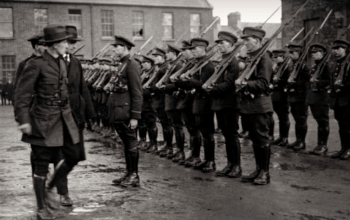
(From: “The passing of legislation allowing for executions during the Irish Civil War” by John Dorney, The Irish Story (www.theirishstory.com), September 27, 2013 | Photo: Richard Mulcahy, shown inspecting soldiers in Dublin, argued that permitting official executions would prevent National Army troops from carrying out unofficial killings)
O’Kelly is born on August 25, 1882, on Capel Street in the north inner-city of Dublin. He joins the National Library of Ireland in 1898 as a junior assistant. That same year, he joins the Gaelic League, becoming a member of the governing body in 1910 and General Secretary in 1915.
In 1905 O’Kelly joins Sinn Féin who, at the time, supports a dual monarchy. He is an honorary secretary of the party from 1908 until 1925. In 1906 he is elected to Dublin Corporation, which is Dublin’s city council. He retains the seat for the Inns Quay Ward until 1924.
O’Kelly is elected Sinn Féin MP for Dublin College Green in the 1918 Irish general election. Along with other Sinn Féin MPs he refuses to take his seat in the British House of Commons. Instead, they set up an Irish parliament, called Dáil Éireann, in Dublin. O’Kelly is Ceann Comhairle (Chairman) of the First Dáil. He is the Irish Republic’s envoy to the post-World War I peace treaty negotiations at the Palace of Versailles, but the other countries refuse to allow him to speak as they do not recognise the Irish Republic.
O’Kelly is a close friend of Éamon de Valera, and both he and de Valera oppose the Anglo-Irish Treaty of December 1921. When de Valera resigns as President of the Irish Republic on January 6, 1922, O’Kelly returns from Paris to try to persuade de Valera to return to the presidency but de Valera orders him to return to Paris.
During the Irish Civil War, O’Kelly is jailed until December 1923. Afterwards he spends the next two years as a Sinn Féin envoy to the United States.
In 1926 when de Valera leaves Sinn Féin to found his own republican party, Fianna Fáil, O’Kelly follows him, becoming one of the party’s founding members. In 1932, when de Valera is appointed President of the Executive Council of the Irish Free State, he makes O’Kelly the Minister for Local Government and Public Health. He often tries to publicly humiliate the Governor-General of the Irish Free State, James McNeill, which damages O’Kelly’s reputation and image, particularly when the campaign backfires.
In 1938, many believe that de Valera wants to make O’Kelly the Fianna Fáil choice to become President of Ireland, under the new Irish constitution, Bunreacht na hÉireann. When Lord Mayor of Dublin, Alfie Byrne, says he wants to be president there is an all-party agreement to nominate Douglas Hyde, a Protestant Irish Senator, Irish language enthusiast and founder of the Gaelic League. They believe Hyde to be the only person who might win an election against Alfie Byrne. O’Kelly is instead appointed Minister of Finance and helps create Central Bank in 1942.
O’Kelly leaves the cabinet when he is elected President of Ireland on June 18, 1945, in a popular vote of the people, defeating two other candidates. He is re-elected unopposed in 1952. During his second term he visits many nations in Europe and speaks before the United States Congress in 1959. He retires at the end of his second term in 1959, to be replaced by his old friend, Éamon de Valera. Following his retirement, he is described as a model president by the normally hostile newspaper, The Irish Times. Though controversial, he is widely seen as genuine and honest, but tactless.
O’Kelly’s strong Roman Catholic beliefs sometimes cause problems. Éamon de Valera often thinks that O’Kelly either deliberately or accidentally leaks information to the Knights of Saint Columbanus and the Church leaders. He ensures that his first state visit, following the creation of the Republic of Ireland in 1949, is to the Vatican City to meet Pope Pius XII. He accidentally reveals the Pope’s private views on communism. This angers the Pope and Joseph Stalin and is why he is not given the papal Supreme Order of Christ which is given to many Catholic heads of state.
O’Kelly dies in Blackrock, Dublin on November 23, 1966, at the age of 84, fifty years after the Easter Rising that first brought him to prominence. He is buried in Glasnevin Cemetery, Glasnevin, Dublin.




 seamus dubhghaill