O’Neill is born on March 9, 1834, in Drumgallon, Clontibret, County Monaghan, where he receives some schooling. He emigrates to New Jersey in 1848 at the height of the Great Famine. He receives an additional year of education there and works various jobs. In 1857 he enlists in the 2nd United States Dragoons and serves in the Utah War (May 1857 – July 1858), apparently deserting afterwards to California.
In California, O’Neill joins the 1st Cavalry, and serves as a sergeant in the American Civil War with this regiment until December 1862, at which time he is commissioned as an officer in the 5th Indiana Cavalry. He is credited as being a daring fighting officer but believes he has not received due promotion, which leads to a transfer to the 17th United States Colored Infantry as captain. He leaves the Union Army prior to the end of the conflict, marrying Mary Crow, with whom he has several children.
While in Tennessee, O’Neill joins the militant Irish American movement, the Fenian Brotherhood, which eschews politics in favor of militant action to expel the British presence in Ireland. He attaches himself to the group led by William Randall Roberts, who wishes to attack Canada.
O’Neill, ranked as colonel, travels to the Canada–US border with a group from Nashville to participate in the Fenian raids. The assigned commander of the expedition does not appear, so O’Neill takes command. On June 1, 1866, he leads a group of six hundred men across the Niagara River and occupies Fort Erie.
The following day, north of Ridgeway, Ontario, O’Neill’s group encounters a detached column of Canadian volunteers, commanded by Lt-Col. Alfred Booker. The inexperienced Canadians are routed by the Civil War veterans. O’Neill withdraws back to Fort Erie and fights a battle against a detachment led by John Stoughton Dennis. With overwhelming numbers of Canadian forces closing in, O’Neill oversees a successful evacuation on the night of June 2-3 back to United States territory. He is later charged with violating the neutrality laws of the United States, but the charge is dropped.
The split between two factions of the Fenians remain, and penetration of O’Neill’s organisation by British and Canadian spies ensures that his next venture into Canada in 1870 is known in advance, and Canada is accordingly prepared. After the Battle of Trout River ends in a disorganized rout, O’Neill is arrested by United States MarshalGeorge P. Foster and charged with violating neutrality laws. That leads to O’Neill’s imprisonment in July 1870 with a sentence of two years, but he and other Fenians are pardoned by President Ulysses S. Grant that October.
Though O’Neill renounces the idea of further attacks on Canada, he changes his mind at the urging of an associate of Louis Riel, William Bernard O’Donoghue. With the latter, and without the backing of the bulk of the Fenians, he leads an attack on the Hudson’s Bay Company‘s post at Pembina, Manitoba, on October 5, 1871. The area is then disputed between America and Canada. He is arrested by American troops.
Following his military career, O’Neill works for a firm of land speculators in Holt County, Nebraska. He dies of a paralytic stroke on January 7, 1878, and is buried in Omaha, Nebraska.
Violet Florence Martin, Irish author, dies in Drishane, County Cork, on December 21, 1915. She is the co-author of a series of novels with her cousin Edith Somerville under the pen name of Martin Ross in the late nineteenth and early twentieth centuries.
Martin is born at Ross House in Connemara, County Galway, the youngest of sixteen children of James Martin of Ross (1804–1872). The Martin family, a branch of the Martyn family – one of the Tribes of Galway – had settled at Ross by the early seventeenth century, having previously inhabited the town of Galway for some three hundred years. Her father is a Protestant, his grandfather having converted from the Catholic faith in order to retain the family estates under the Penal Laws. Nevertheless, each child of the family is secretly ‘baptised’ by the family servants.
Martin is a kinswoman of Richard Martin and her contemporary, Edward Martyn, two other notable members of the tribe. Her older brother, Robert Jasper Martin, is a noted songwriter and a well-regarded member of the Tory party in London. She shares a great-grandmother with the writer Maria Edgeworth, whose use of Irish vernacular speech she follows in her work.
Martin’s father manages to save both his estate and his tenants during the Great Famine boasting that not one of his people died during the disaster, but at the cost of bankruptcy. Following his death in 1872, the family moves to Dublin and only returns to Ross in 1888 following revelations of financial fraud of the estate by their agent.
Violet Martin and Edith Somerville are second cousins. They originally meet on January 17, 1886, at Castletownshend, after which they become lifelong companions and literary partners. They come to share a home in Drishane, County Cork. In 1889, Violet adopts the pseudonym Martin Ross, which comprises her surname and the name of her ancestral home. Thus, the authors are called Somerville and Ross. Their works include The Real Charlotte (1889), Some Reminiscences of an Irish R.M. and In the Vine Country.
Martin is a convinced Irish Unionist, in opposition to Somerville’s open nationalism. Both she and her brother Robert are well-regarded members of the literary circle in Irish unionism. However, unlike her brother, Martin is a convinced suffragette, becoming vice-president of the Munster Women’s Franchise League. While on friendly terms with the leading members of the Gaelic literary revival such as W.B. Yeats and Lady Gregory, she objects to their romantic version of Irish peasantry. She is on good terms with Edward Martyn, partner of Gregory and Yeats – and her kinsman – and shares his love of the Irish language and culture.
Martin is seriously injured in a riding accident in November 1898, from which she never fully recovers. This is a contributing factor to her death in Drishane, County Cork, on December 21, 1915. Edith Somerville continues to write under their joint literary names, claiming that they are still in contact. The two women leave thousands of letters and 116 volumes of diaries, detailing their lives, much of them yet unpublished. Edith dies at Castletownshend in October 1949, aged 91, and is buried alongside Violet Florence Martin at Saint Barrahane’s Church, Castletownsend, County Cork, Ireland.
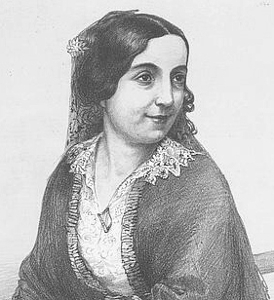
Her debut at La Scala in Milan quickly followed in 1845 with phenomenal success. Shortly thereafter the young Giuseppe Verdi becomes interested in her for one of his new operas. Her great success continues in Vienna, as well as in Venice, Florence, Genoa, Rome and other cities in Italy, where she becomes the most sought after Lucia di Lammermoor.
During Ireland’s Great Famine in November 1849, her emotional return to her native country results in rave notices for her performance in Lucia di Lammermoor and other operas and concerts in Dublin, Limerick and Cork. Her success is now almost complete.
In 1851 Hayes goes to the United States, where Jenny Lind is creating such a wave of success. Hayes gives concerts in New York City, Boston, Toronto, Philadelphia, Washington, D.C., Charleston, Savannah and New Orleans and forty-five other places including the river towns along the Mississippi River, with equal success. She meets presidents, statesmen and business leaders along the way. She is also destined to meet her future lover and husband in America, Jenny Lind’s former manager. Her travels take her to the “gold rush” in the San Francisco area in the 1850s, where her presence creates a furor, singing for the miners and the elite of San Francisco. The great showman P.T. Barnum sponsors her tour.
She sings in opera and concerts in Peru and Chile, then travels to Hawaii where she gives a concert before continuing on to Australia. Hayes is the first great European opera star to visit Australia. She is mentioned in most Australian history books about early culture in the young colony. She also travels to Calcutta, India where she performs for the British Military and then on to Singapore and Batavia (Java) before returning to Australia for more opera and concerts.
Hayes returns to England in August 1856, after an absence of five years. On October 8, 1857, at St. George’s, Hanover Square, she marries William Avery Bushnell. He soon falls into ill-health and dies at Biarritz, France, on July 2, 1858. After her husband’s death she takes part in concerts in London and the country towns.
Catherine Hayes dies in the house of a friend, Henry Lee, at Roccles, Upper Sydenham, Kent, on August 11, 1861, and is buried in Kensal Green Cemetery.
Rossa’s body had been returned from New York City where he died June 29. He had been exiled by the British for his Fenian activities in 1871. While in exile, Rossa manages to alienate many of his former Fenian colleagues, including his good friend John Devoy, with his uncompromising advocacy of violence to end British rule in Ireland. Perhaps his attitude is due in part to the harsh treatment he receives in British prisons as well as scenes he witnesses while helping to distribute relief in his native County Cork during the Great Hunger.
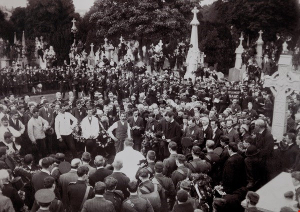
Rossa’s funeral is one of the seminal events in the revival of the Irish republican movement in Ireland. During the three days when Rossa lays in the vestibule of the City Hall, encased in a coffin with a plate glass lid, thousands of citizens pass by to pay their final respects.
The coffin is conveyed from the City Hall in the four-horse bier in waiting at 2:25 PM and fifteen minutes later the cortège starts, headed by a guard of honour of the Irish Volunteers with rifles, a mounted guard being supplied by the same body. The coffin is thickly covered with wreaths and an open carriage behind is also filled with floral tokens, while many of the contingents carry wreaths to be placed on the grave.
The procession, in marching four deep at a slow pace, takes a little over fifty minutes to pass the corner of Dame Street into George’s Street. A conservative estimate of those who actually take part in the procession give the numbers as exceeding 6,000 and there must be at least ten times that number lining the streets.
The funeral comes into College Green at about 3:00 PM, headed by a body of Volunteers with the St. James’s Band. It is nearing 6:00 PM when the hearse passes through the main gates of Glasnevin Cemetery. The avenue leading to the mortuary chapel is lined by detachments of Volunteers. The prayers in the chapel are said by the Rev. D. Byrne, chaplain. Several priests then accompany the coffin to the grave, which is situated just beyond the eastern fringe of the O’Connell circle, close to the graves of two other prominent Fenians, John O’Leary and James Stephens.
Patrick Pearse gives an address at the graveside which has resounded with republicans down through the years. The final words of his oration provide them with one of their most enduring slogans, “Ireland unfree will never be at peace.”
A firing party then fires a volley, the Last Post is sounded, and wreaths are laid on the grave.
Foster is the third son of Sir Augustus John Foster, 1st Baronet and his wife, Albinia Jane, daughter of George Vere Hobart, and granddaughter of George Hobart, 3rd Earl of Buckinghamshire. He is educated at Eton College, and matriculated at Christ Church, Oxford, on May 30, 1838.
Leaving Oxford without a degree, Foster joins the diplomatic service. From 1842 to 1843 he is attached to the diplomatic mission of Sir Henry Ellis in Rio de Janeiro, and from 1845 to 1847 to that of Sir William Gore Ouseley in Montevideo.
In 1847 Foster visits a family estate in County Louth, Ireland at the time of the Great Famine, with his eldest brother, Sir Frederick George Foster. They become involved in famine relief. In 1848 their father dies and Foster undergoes a crisis in his life, and he comes to concentrate on philanthropy in Ireland.
Foster makes three voyages to the United States as a steerage passenger in a ship of emigrants, finding the accommodations bad, and the treatment of emigrants exploitative. Through his cousin Vere Hobart, Lord Hobart, he is able to influence parliament and the Passengers Act 1851. He also takes practical steps to promote Irish emigration to the United States.
Later, Foster takes up the improvement of education in Ireland. This is a time of Catholic suspicion of the national education system introduced by Richard Whately. Foster contributes to the provision of better school accommodation and apparatus, and gives grants in aid of building several hundred new school-houses. He agitates for improved wages and conditions for teachers, and develops the “Vere Foster copy-books” to improve and standardise the teaching of writing. The immense popularity of these texts draw him to the Belfast printing firm Marcus Ward & Company, and into personal friendship with John Ward, one of the firm’s owners.
In 1867, Foster settles permanently in Belfast where he continues to work as the president of the Congress of the Irish National Teachers’ Organisation. He fundraises for the Royal Belfast Hospital, and helps to establish a school of art in the town, while continuing to promote emigration.
In 1879, with the Land War in Ireland, Foster concentrates on promoting female emigration to the United States and the British colonies. He is supported in his projects by both Catholic and Protestant clergy.
Vere Foster dies, unmarried, in Belfast on December 21, 1900. He is buried in Belfast City Cemetery.
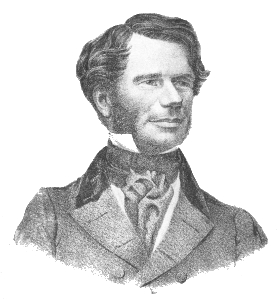
Although a Protestant country-gentleman, O’Brien supports Catholic Emancipation while remaining a supporter of British-Irish union. In 1843, in protest against the imprisonment of Daniel O’Connell, he joins O’Connell’s anti-union Repeal Association.
Three years later, O’Brien withdraws the Young Irelanders from the association. In January 1847, along with Thomas Francis Meagher, he founds the Irish Confederation, although he continues to preach reconciliation until O’Connell’s death in May 1847. He is active in seeking relief from the hardships of the famine. In March 1848, he speaks out in favour of a National Guard and tries to incite a national rebellion. He is tried for sedition on May 15, 1848, but is not convicted.
On July 29, 1848, O’Brien and other Young Irelanders lead landlords and tenants in a rising in three counties, with an almost bloodless battle against police at Ballingarry, County Tipperary. In O’Brien’s subsequent trial, the jury finds him guilty of high treason. He is sentenced to be hanged, drawn, and quartered. Petitions for clemency are signed by 70,000 people in Ireland and 10,000 people in England.
In Dublin on June 5, 1849, the sentences of O’Brien and other members of the Irish Confederation are commuted to transportation for life to Van Diemen’s Land, which is Tasmania in present-day Australia.
O’Brien attempts to escape from Maria Island off Tasmania but is betrayed by Captain Ellis of the schooner hired for the escape. He is sent to Port Arthur where he meets up with John Mitchel, who had been transported prior to the rebellion. The cottages which O’Brien lives in on Maria Island and Port Arthur have been preserved in their 19th century state as memorials.
Having emigrated to the United States, Ellis is tried by another Young Irelanders leader, Terence MacManus, at a lynch court in San Francisco for the betrayal of O’Brien. He is freed for lack of evidence.
In 1854, after five years in Tasmania, O’Brien is released on the condition he never return to Ireland. He settles in Brussels. In May 1856, he is granted an unconditional pardon and returns to Ireland that July. He contributes to The Nation newspaper but plays no further part in politics.
In 1864 he visits England and Wales, with the view of rallying his failing health, but no improvement takes place, and he dies at Bangor, Wales on June 16, 1864.
Sadlier publishes roughly sixty novels and numerous stories in her lifetime. She writes for Irish immigrants in both the United States and Canada, encouraging them to attend mass and retain the Catholic faith. In so doing, Sadlier also addresses the related themes of anti-Catholicism, the Great Famine, emigration, and domestic work. Her writings are often found under the name Mrs. J. Sadlier.
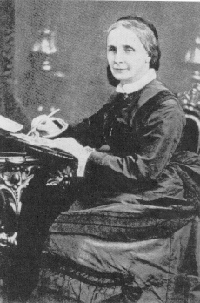
Upon the death of her father, Francis, a merchant, Mary Madden emigrates to Sainte-Marthe, Quebec in 1844, where she marries publisher James Sadlier, also from Ireland, on November 24, 1846. Sadlier publishes much of her work in the family’s Catholic magazine, The Tablet. Sadlier experiences her most productive literary period after her marriage and is most creative after the time all of her children are born. While living in Canada, Sadlier publishes eighteen books — five novels, one collection of short stories, a religious catechism, and nine translations from the French — in addition to assorted magazine articles she contributes to the Pilot and American Celt free of charge. In New Lights (1853), Sadlier deals with the Great Famine for the first time. The book proves one of her most popular, going through at least eight editions in fifty years. In this novel, Sadlier focuses a polemical attack on the Protestant practice of converting Irish peasants by promising them soup but condemns peasant retaliation and violence.
In the early 1860s, the couple moves to New York City. The Sadlier’s New York home becomes the hub of literary activity in the Catholic community, and Sadlier also enjoys the company of the brightest Irish writers in the United States and Canada, including New York Archbishop John Hughes, editor Orestes Brownson, and Thomas D’Arcy McGee. She holds weekly salons in her Manhattan home, as well as her summer home on Far Rockaway on Long Island. Her closest friend is D’Arcy McGee, a poet, Irish nationalist exile and Canadian statesman known as one of the founding “Fathers of Confederation” who helps bring about Canada’s independence. McGee and Sadlier share an interest in a “national poetry” that does not only capture the spirit of a people but inspires them to political and national independence. While McGee, as a man, can take part in political rallies and organize Irish American support for Home Rule, Sadlier, as a woman, directs her support for Irish independence into literature. McGee’s biographer notes that Sadlier’s success inspires him to write emigrant novels and is planning a novel on this subject at the time of his assassination by an Irish American radical in 1868. His death is a crushing blow to Sadlier and her husband. Sadlier edits a collection of McGee’s poetry in 1869 in tribute to his memory.
Sadlier remains in New York for nine years before returning to Canada, where she dies in Montreal on April 5, 1903. In later years she loses the copyright to all her earlier works, many of which remain in print. One of Mary Anne’s daughters, Anna Theresa Sadlier, also becomes a writer.
Patrick Henry Pearse, teacher, barrister, poet, writer, nationalist, and political activist who is one of the leaders of the 1916 Easter Rising, is born in Dublin on November 10, 1879. Pearse’s father, James, is a stone worker who works on church buildings in Dublin and his mother, Margaret, comes from a family that has endured the Great Famine in 1846 and has left County Meath for Dublin. Here she brings up four children, Patrick being the second. Pearse has a comfortable childhood as his father is in constant work.
It is at school that Pearse first develops a love of Irish history. He is also taught the Irish language for the first time and while still a teenager, Patrick joins the Gaelic League, an organisation that wants to promote the Irish language and Irish literature. Pearse graduates with a law degree from the King’s Inns and, in 1901, he starts a BA course in modern languages but is called to the Bar in Dublin.
Regardless of his law training, Pearse is more interested in what he is learning about Ireland as a nation. All his knowledge about law has been based around the English language and he wants to know more about what he considers to be the rightful language of Ireland. This is not the Gaelic used in Dublin. Pearse has convinced himself that the real Irish language is based in Connaught, and he teaches himself the dialect of the area. Connaught is also a region that has been severely affected by the Great Famine. Therefore, the number of people who speak what Pearse considers to be proper Gaelic have been greatly reduced. From 1903 to 1909, Pearse develops his involvement in the Gaelic League’s An Claidheamh Soluis (The Sword of Light) which seeks to expand the use of Gaelic in Irish life, and, in particular, literature.
By 1909, Pearse has developed some political leanings. He cannot accept the impact England, and all things English have on Ireland and the Irish people, but his concern is more for Irish culture rather than Irish politics. Pearse wants Irish history and culture taught as compulsory subjects in both Irish schools and colleges. He breaks with the Roman Catholic Church when its national college, St. Patrick’s College, Maynooth, demotes courses in Irish history/culture to topics for trainee priests. He is keen for Maynooth to have compulsory Irish courses simply because priests then have a major influence in the areas where they work. However, all of Pearse’s protests fall on deaf ears. As a result, he founds his own school in Dublin, an “Irish-Ireland” school called St. Enda’s School.
Between 1909 and 1912, Pearse becomes more interested and involved in politics. Despite a limited income and the problems of keeping St. Edna’s on an even financial keel, Pearse launches his own newspaper called An Barr Buadh (The Trumpet of Victory). At this time the Home Rule issue has reared its head again. Sinn Féin and other republican movements have far more impact than Pearse, who seems to many to be no more than a political maverick. Many feel that Pearse is out of his depths in politics and that his input into Irish politics is no more than romanticism with an Irish slant.
By 1913, Pearse has become more depressed about the way Ireland is going under the rule of London. Those who know him, describe him as becoming more and more melancholy as the year progresses. Others believe that he is becoming more fanatical. He helps to organise the Irish Volunteers, the public face of the outlawed Irish Republican Brotherhood, before the outbreak of World War I. In 1914, he is sent on a fund-raising tour of America by Clan na Gael, an organisation that aids the Irish Republican Brotherhood. While the tour is a reasonable success financially, not many Americans are swayed by Pearse’s speeches.
By the time World War I starts, Pearse has taken an extreme political stance. He wants full Irish independence – not what the suspended Home Rule Bill of 1912 offers. He does not support the part Ireland plays in the war effort. He also splits the Irish Volunteers. He takes a small number of these men with him when John Redmond gives his agreement to suspend the Home Rule Bill until the war is over. By now, Pearse has become extreme. He publishes a pamphlet called The Murder Machine which is a severe condemnation of the Irish educational system. He also realises that with London totally focused on the war in Europe, the time is ripe to overthrow British rule in Ireland.
However, in this respect, Pearse is totally wrong. The young men who have volunteered to fight in the war have done so because they want to. Pearse has no mass support in Ireland whereas John Redmond has far more public support in the south. He also assumes incorrectly that all those in southern Ireland are completely against British rule. What Pearse fails to recognise, is that many people in Dublin itself rely on the British for work. They may not like this, but work brings in money regardless of where or who it comes from.
Those who participate in the Easter Uprising of 1916 are in the minority. Pearse decides to take command of the rebellion, and he reads aloud the declaration of independence at the General Post Office. Pearse also is one of the signatories of “Poblacht na hÉireann” (To the People of Ireland).
If Pearse expects the actions of the rebels in Dublin to spark off other uprisings in other Irish cities and towns, he is mistaken. In Dublin, the people of the city fail to offer the rebels any support. In fact, some Dubliners take the opportunity of the rebellion to loot the shops in Sackville Street. The Uprising is doomed from the start.
During the rebellion, Pearse says, “When we are all wiped out, people will blame us for everything, condemn us…. (but) in a few years they will see the meaning of what we tried to do.” Ironically, he is correct in this assessment.
On Friday, April 28, 1916, Pearse surrenders to the British army. By the following day all the rebels have surrendered. As they are paraded through the streets of Dublin before going to Kilmainham Gaol, they are jeered and verbally abused by Dubliners who have seen parts of their city destroyed. They blame Pearse and his followers rather than the British.
At Kilmainham Gaol, Pearse is charged with treason by a military court and sentenced to death. On May 16, Pearse is shot by firing squad. Eventually fourteen other rebel leaders are also executed by firing squad. Pearse’s body, and those of the other leaders, are thrown into a pit without a coffin or a burial service. Ironically, it is in death that Pearse finds real fame.
No one knows the fate of the rebel leaders until after the executions. Many in Ireland are horrified at the way they have been treated. If Pearse had not received national support during his life, his movement certainly received it after his death. Pearse had written that he wanted his fame and deeds to “live after me.” In death, Patrick Pearse is known as the “First President of Ireland” and Irish history and culture become part of the educational system after 1922.
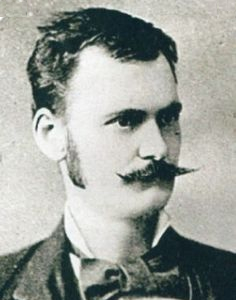
The style of trompe-l’œil painting that Harnett develops is distinctive and inspired many imitators, but it is not without precedent. A number of 17th century Dutch painters, Pieter Claesz for instance, specialize in tabletop still life of astonishing verisimilitude. Raphaelle Peale, working in Philadelphia in the early 19th century, pioneers the form in America. What sets Harnett’s work apart, besides his enormous skill, is his interest in depicting objects not usually made the subject of a painting.
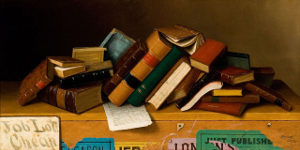
Harnett paints musical instruments, hanging game, and tankards, but also painted the unconventional Golden Horseshoe (1886), a single rusted horseshoe shown nailed to a board. He paints a casual jumble of second-hand books set on top of a crate, Job Lot, Cheap (1878), as well as firearms and even paper currency. His works sell well, but they are more likely to be found hanging in a tavern or a business office than in a museum, as they did not conform to contemporary notions of high art.
Harnett spent the years 1880–1886 in Europe, staying in Munich from 1881 until early 1885. Harnett’s best-known paintings, the four versions of After the Hunt, are painted between 1883 and 1885. Each is an imposing composition of hunting equipment and dead game, hanging on a door with ornate hinges at the right and keyhole plate at the left. These paintings, like the horseshoe or currency depictions mentioned earlier, are especially effective as trompe-l’œil because the objects occupy a shallow space, meaning that the illusion is not spoiled by parallax shift if the viewer moves.
Overall, Harnett’s work is most comparable to that of the slightly younger John F. Peto. The two artists know each other, and a comparison can be made between two paintings featuring violins. Harnett’s Music and Good Luck from 1888 shows the violin hanging upright on a door with ornate hinges and with a slightly torn piece of sheet music behind it. The elements are arranged in a stable, deliberate manner. Peto’s 1890 painting shows the violin hanging askew, as well as chipped and worn, with one string broken. The sheet music is dog-eared and torn around the edges and placed haphazardly behind the instrument. The hinges are less ornate, and one is broken. Harnett’s objects show signs of use but are well preserved, while Peto’s more humble objects are nearly used up.
Crippling rheumatism plagues Harnett in his last years, reducing the number but not the quality of his paintings. He seeks relief in the waters at Karlsbad and Wiesbaden, Germany and later at Hot Springs, Arkansas. But he continues to worsen and is hospitalized several times. He dies in New York City in 1892.
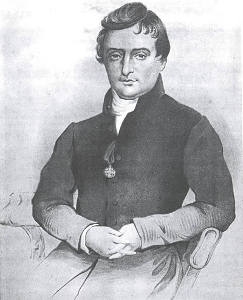
Mathew receives his schooling in Kilkenny, then moves for a short time to Maynooth. From 1808 to 1814 he studies in Dublin, where in the latter year he is ordained to the priesthood. Having entered the Capuchin order, after a brief period of service at Kilkenny, he joins the mission in Cork.
The movement with which his name is associated begins on April 10, 1838, with the establishment of the Cork Total Abstinence Society, which in less than nine months enrolls no fewer than 150,000 names. It rapidly spreads to Limerick and elsewhere, and some idea of its popularity may be formed from the fact that at Nenagh 20,000 persons are said to take the pledge in one day, 100,000 at Galway in two days, and 70,000 in Dublin in five days. At its height, just before the Great Famine, his movement enrolls some 3 million people, or more than half of the adult population of Ireland. In 1844 he visits Liverpool, Manchester, and London with almost equal success.
His work has a remarkable impact on the condition of the people in Ireland. The number committed to jail falls from 12,049 in 1839 to 9,875 by 1845. Sentences of death fall from 66 in 1839 to 14 in 1846, and transportations fall from 916 to 504 over the same period.
Mathew visits the United States in 1849, returning in 1851. While there, he finds himself at the center of the Abolitionist debate. Many of his hosts are pro-slavery and want assurances that their influential guest will not stray outside his remit of battling alcohol consumption. But Mathew has signed a petition encouraging the Irish in the U.S. to not partake in slavery in 1841 during Charles Lenox Remond‘s tour of Ireland. Now however, in order to avoid upsetting his slave-owning friends in the U.S., he snubs an invitation to publicly condemn chattel slavery, sacrificing his friendship with that movement. He defends his position by pointing out that there is nothing in the scripture that prohibits slavery. He is condemned by many on the abolitionist side, including the former slave and abolitionist Frederick Douglass who had received the pledge from Mathew in Cork in 1845.
Mathew dies on December 8, 1856, in Queenstown, County Cork, after suffering a stroke. He is buried at St. Joseph’s Cemetery, Cork City, which he had established himself.




 seamus dubhghaill