seamus dubhghaill

Promoting Irish Culture and History from Little Rock, Arkansas, USA


Leave a comment

Birth of Annie Horniman, Theatre Patron & Manager

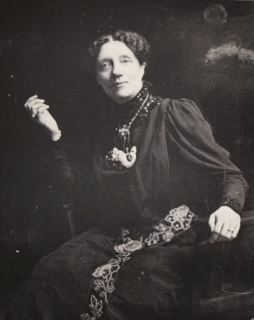
Annie Elizabeth Fredericka Horniman CH, English theatre patron and manager, is born at Surrey Mount, Forest Hill, London, on October 3, 1860. She establishes the Abbey Theatre in Dublin and founds the first regional repertory theatre company in Britain at the Gaiety Theatre in Manchester. She encourages the work of new writers and playwrights, including W. B. YeatsGeorge Bernard Shaw and members of what become known as the Manchester School of dramatists.

Horniman, the elder child of Frederick John Horniman and his first wife Rebekah (née Emslie). Her father is a tea merchant and the founder of the Horniman Museum. Her grandfather is John Horniman who founds the family tea business of Horniman and Company. She and her younger brother, Emslie, are educated privately at their home. Her father is opposed to the theatre, which he considers sinful, but their German governess takes her and Emslie secretly to a performance of The Merchant of Venice at The Crystal Palace when she is fourteen years old.

Horniman’s father allows her to enter the Slade School of Fine Art in 1882. Here she discovers that her talent in art is limited but she develops other interests, particularly in the theatre and opera. She takes great pleasure in Richard Wagner‘s Der Ring des Nibelungen and in Henrik Ibsen‘s plays. She cycles in London and twice over the Alps, smokes in public and explores alternative religions. The “lonely rich girl” has become “an independent-minded woman.” In 1890 she joins the occult society, the Hermetic Order of the Golden Dawn, where she remains a member until disagreements with its leaders lead to her resignation in 1903. During this time she meets and becomes a friend of W. B. Yeats, acting as his amanuensis for some years. Their friendship endures. Frank O’Connor recalls that on the day Yeats hears of her death, he spends the entire evening speaking of his memories of her.

Horniman’s first venture into the theatre is in 1894 and is made possible by a legacy from her grandfather. She anonymously supports her friend Florence Farr in a season of new plays at the Royal Avenue Theatre, London. This includes a new play by Yeats, The Land of Heart’s Desire, and the première of George Bernard Shaw’s play Arms and the Man. In 1903, Yeats persuades her to go to Dublin to back productions by the Irish National Theatre Society. Here she discovers her skill as a theatre administrator. She purchases a property and develops it into the Abbey Theatre, which opens in December 1904. Although she moves back to live in England, she continues to support the theatre financially until 1910. Meanwhile, in Manchester she purchases and renovates the Gaiety Theatre in 1908 and develops it into the first regional repertory theatre in Britain.

At the Gaiety, Horniman appoints Ben Iden Payne as the director and employs actors on 40-week contracts, alternating their work between large and small parts. The plays produced include classics such as Euripides and Shakespeare, and she introduces works by contemporary playwrights such as Ibsen and Shaw. She also encourages local writers who form what becomes known as the Manchester School of dramatists, the leading members of which are Harold BrighouseStanley Houghton and Allan Monkhouse. The Gaiety company undertakes tours of the United States and Canada in 1912 and 1913. Horniman becomes a well-known public figure in Manchester, lecturing on subjects which include women’s suffrage and her views about the theatre. In 1910 she is awarded the honorary degree of MA by the University of Manchester. During World War I the Gaiety continues to stage plays but financial difficulties lead to the disbandment of the permanent company in 1917, following which productions in the theatre are by visiting companies. In 1921 she sells the theatre to a cinema company.

As a result of her tea connection, Horniman is known as “Hornibags.” She holds court at the Midland Hotel, wearing exotic clothing and openly smoking cigarettes, which is considered scandalous at the time. She introduces Manchester to what is called at the time “the play of ideas.” The theatre critic James Agate notes that her high-minded theatrical ventures have “an air of gloomy strenuousness” about them.

Horniman moves to London where she keeps a flat in Portman Square. In 1933 she is made a Companion of Honour. She and Algernon Blackwood might be the only past or present members of an occult society to receive a United Kingdom honour.

Horniman dies, unmarried, on August 6, 1937, while visiting friends in Shere, Surrey. Her estate amounts to a little over £50,000. The Annie Horniman Papers are held in the John Rylands Research Institute and Library at the University of Manchester. Her portrait, painted by John Butler Yeats in 1904, hangs in the public area of the Abbey Theatre.


Leave a comment

Death of Donal McCann, Stage, Film & Television Actor

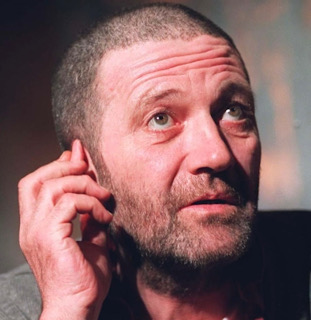
Donal McCann, Irish stage, film, and television actor, dies from pancreatic cancer in Dublin on July 17, 1999. He is best known for his roles in the works of Brian Friel and for his lead role in John Huston‘s last film, The Dead (1987). In 2020, he is listed as number 45 on The Irish Times list of Ireland’s greatest film actors.

McCann is born on May 7, 1943, in Terenure, Dublin. His father is John J. McCann, a playwright and politician who serves twice as Lord Mayor of Dublin. Although he acts in a production of his father’s Give Me a Bed of Roses at Terenure College in 1962, he briefly studies architecture before taking a job as a trainee sub-editor at the Evening Press which allows him to pursue part-time acting classes at the Abbey School of Acting at the same time. He joins the Abbey Players in the late 1960s.

Among his most important early roles are Cú Chulainn in W. B. Yeats‘s On Baile Strand (1966), and as Estragon in a seminal production of Samuel Beckett‘s Waiting for Godot, partnering with Peter O’Toole as Vladimir (1969).

McCann’s career includes parts in many plays from the Irish literary canon, including Tarry FlynnThe Shaughran, and the Gate Theatre‘s highly acclaimed production of Seán O’Casey‘s classic Juno and the Paycock in the 1980s (McCann plays the “Paycock” (Captain Boyle) opposite Geraldine Plunkett as Juno and John Kavanagh as Joxer Daly) as well as a subsequent production of O’Casey’s The Plough and the Stars.

McCann develops a particularly fruitful relationship with the playwright Brian Friel. He plays the role of Gar O’Donnell, the public figure, in a film adaptation of Philadelphia, Here I Come! in 1970 and, despite popular belief, he never plays either public or private Gar on stage. He gives a landmark performance as Frank Hardy, the title character, in Faith Healer in 1980 (a role he reprised in 1994), continuing his relationship with Friel through productions of Translations (1988) and Wonderful Tennessee (1993).

Friel says that McCann’s work “contains extraordinary characteristics that go beyond acting … it is deeply spiritual.” Perhaps McCann’s most renowned role is as Thomas Dunne in Sebastian Barry‘s The Steward of Christendom. He wins the London Critics’ Circle Theatre Award (Drama Theatre) as best actor for this role in 1995. He reprises this role in a 1996 production at the Gate Theatre, Dublin and, following a twelve-week run at the Brooklyn Academy of Music in 1997, his “performance of unarguable greatness” (The New York Observer) had Newsweek hailing him as “a world-class star,” and The New York Times referring to this “astonishing Irish actor…widely regarded as the finest of them all.”

On the London stage, McCann plays in Prayer for My Daughter opposite Antony Sher (1978), and is Jean to Dame Helen Mirren‘s Julie in Miss Julie (1971). This is filmed for the BBC, and he much later plays Judge Brack with Fiona Shaw in the title role of Henrik Ibsen‘s Hedda Gabler, a production filmed for the BBC in 1993.

McCann begins his film career early, in 1966, in Walt Disney Pictures’s The Fighting Prince of Donegal (this later becomes a TV series). More significant roles include the title character’s father Shamie in Cal and one of the feuding brothers in Thaddeus O’Sullivan‘s December Bride (1990). He works a number of times with Neil Jordan (in AngelThe Miracle and High Spirits).

His best-known film role is as Gabriel Conroy in The Dead (1987), starring opposite Anjelica Huston and directed by her father, John Huston. Significant late roles include Bernardo Bertolucci‘s Stealing Beauty (1996) and in John Turturro‘s Illuminata (released in 1999, after McCann’s death).

McCann’s television work includes the featured role of Phineas Finn in the BBC’s serialised adaptation of Anthony Trollope‘s The Pallisers, Willie Burke in RTÉ‘s Prix Italia drama entry The Burke Enigma (1979) and Barney Mulhall in RTÉ’s Strumpet City (1980), as well as many one-off parts.

McCann plays in Bob Quinn‘s Irish language film Poitín (1979) and in Quinn’s somewhat experimental The Bishop’s Story (1995). After hearing that McCann is ill, Tom Collins asks Quinn to make a TV documentary about McCann for RTÉ called It Must Be Done Right (1999), after a remark by McCann on his craft. The film airs on RTÉ a week before McCann’s death.

In his private life, McCann is a quiet and unassuming man, but he battles both depression and alcoholism all his life. He has many friends in Irish theatre and artistic circles but also across all strata of life. His hobbies include sketching and he is passionate about horse racing.

Remembering McCann on the 25th anniversary of his death, Gerald Smyth writes, “In the melancholy of that life-worn voice could be heard the cadences of a lyric heart.”


Leave a comment

Death of Theatrical Producer Hilton Edwards

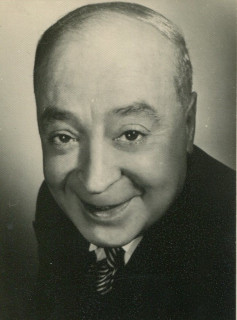
Hilton Edwards, an English-born Irish actor, lighting designer, and theatrical producer, dies in a Dublin hospital on November 18, 1982, following a short illness.

Edwards is born in London on February 2, 1903. He begins his career acting with the Charles Doran Shakespeare Company in 1920 in Windsor and then joins The Old Vic in London, playing in all but two of Shakespeare‘s plays before leaving the company a few years later. Trained in music, he also sings baritone roles with the Old Vic Opera company.

After touring with various companies in Britain and South Africa, Edwards goes to Ireland in 1927 for a season with Anew McMaster‘s company and meets McMaster’s brother-in-law, Micheál Mac Liammóir. As he tells an interviewer once, both men want a theater of their own. Mac Liammóir wants it to be in Ireland and Edwards does not care. “I don’t care about nationalism, I care about the theater,” he says.

Edwards and Mac Liammóir co-found the Gate Theatre in Dublin in 1928. The two men’s talents are complementary. Mac Liammóir is an actor, designer, and writer. Edwards is a director, actor, producer, and lighting designer. Edwards produces and directs more than 300 plays at the Gate, ranging from the works of Aeschylus and Sophocles, Johann Wolfgang von Goethe and Henrik Ibsen to the comedies of George Bernard Shaw and Richard Brinsley Sheridan and new Irish plays, by such authors as W. B. Yeats, Brian Friel, and Mac Liammóir.

In New York City in 1948 Edwards plays in and directs John Bull’s Other Island and directs The Old Lady Says No and Where Stars Walk. In 1961, Edwards takes a two-year leave from the Gate to become the first Head of Drama at Telefís Éireann. A year later, he wins a Jacob’s Award for his television series Self Portrait.

Edwards appears in 15 films, including Captain Lightfoot (1955), David and Goliath (1960), Victim (1961), and Half a Sixpence (1967). He also writes and directs Orson Welles‘s Return to Glennascaul (1951). However, he is primarily known for his theatre work. He is nominated for a Tony Award in 1966 for Best Director of a Drama for Philadelphia, Here I Come!

Hilton Edwards dies in a Dublin hospital on November 18, 1982. Edwards and Mac Liammóir are the subject of a biography, titled The Boys by Christophor Fitz-Simon.


Leave a comment

Death of Annie Horniman, Theatre Patron & Manager

Annie Elizabeth Fredericka Horniman CH, English theatre patron and manager, dies on August 6, 1937, while visiting friends in Shere, Surrey, England. She establishes the Abbey Theatre in Dublin and founds the first regional repertory theatre company in Britain at the Gaiety Theatre in Manchester. She encourages the work of new writers and playwrights, including W. B. Yeats, George Bernard Shaw and members of what become known as the Manchester School of dramatists.

Horniman is born at Surrey Mount, Forest Hill, London, on October 3, 1860, the elder child of Frederick John Horniman and his first wife Rebekah (née Emslie). Her father is a tea merchant and the founder of the Horniman Museum. Her grandfather is John Horniman who founds the family tea business of Horniman and Company. She and her younger brother Emslie are educated privately at their home. Her father is opposed to the theatre, which he considers sinful, but their German governess takes her and Emslie secretly to a performance of The Merchant of Venice at The Crystal Palace when she is fourteen years old.

Horniman’s father allows her to enter the Slade School of Fine Art in 1882. Here she discovers that her talent in art is limited but she develops other interests, particularly in the theatre and opera. She takes great pleasure in Richard Wagner‘s Der Ring des Nibelungen and in Henrik Ibsen‘s plays. She cycles in London and twice over the Alps, smokes in public and explores alternative religions. The “lonely rich girl” has become “an independent-minded woman.” In 1890 she joins the occult society, the Hermetic Order of the Golden Dawn, where she remains a member until disagreements with its leaders lead to her resignation in 1903. During this time she meets and becomes a friend of W. B. Yeats, acting as his amanuensis for some years. Their friendship endures. Frank O’Connor recalls that on the day Yeats hears of her death, he spends the entire evening speaking of his memories of her.

Horniman’s first venture into the theatre is in 1894 and is made possible by a legacy from her grandfather. She anonymously supports her friend Florence Farr in a season of new plays at the Royal Avenue Theatre, London. This includes a new play by Yeats, The Land of Heart’s Desire, and the première of George Bernard Shaw’s play Arms and the Man. In 1903 Yeats persuades her to go to Dublin to back productions by the Irish National Theatre Society. Here she discovers her skill as a theatre administrator. She purchases a property and develops it into the Abbey Theatre, which opens in December 1904. Although she moves back to live in England, she continues to support the theatre financially until 1910. Meanwhile, in Manchester she purchases and renovates the Gaiety Theatre in 1908 and develops it into the first regional repertory theatre in Britain.

At the Gaiety, Horniman appoints Ben Iden Payne as the director and employs actors on 40-week contracts, alternating their work between large and small parts. The plays produced include classics such as Euripides and Shakespeare, and she introduces works by contemporary playwrights such as Ibsen and Shaw. She also encourages local writers who form what becomes known as the Manchester School of dramatists, the leading members of which are Harold Brighouse, Stanley Houghton and Allan Monkhouse. The Gaiety company undertakes tours of the United States and Canada in 1912 and 1913. Horniman becomes a well-known public figure in Manchester, lecturing on subjects which include women’s suffrage and her views about the theatre. In 1910 she is awarded the honorary degree of MA by the University of Manchester. During World War I the Gaiety continues to stage plays but financial difficulties lead to the disbandment of the permanent company in 1917, following which productions in the theatre are by visiting companies. In 1921 she sells the theatre to a cinema company.

As a result of her tea connection, Horniman is known as “Hornibags.” She holds court at the Midland Hotel, wearing exotic clothing and openly smoking cigarettes, which is considered scandalous at the time. She introduces Manchester to what is called at the time “the play of ideas.” The theatre critic James Agate notes that her high-minded theatrical ventures have “an air of gloomy strenuousness” about them.

Horniman moves to London where she keeps a flat in Portman Square. In 1933 she is made a Companion of Honour. She and Algernon Blackwood might be the only past or present members of an occult society to receive a United Kingdom honour.

Horniman dies, unmarried, on August 6, 1937, while visiting friends in Shere, Surrey. Her estate amounts to a little over £50,000. The Annie Horniman Papers are held in the John Rylands Research Institute and Library at the University of Manchester. Her portrait, painted by John Butler Yeats in 1904, hangs in the public area of the Abbey Theatre.

Leave a comment

Birth of Jimmy O’Dea, Actor & Comedian

Jimmy O’Dea, Irish actor and comedian, is born at 11 Lower Bridge Street, Dublin, on April 26, 1899.

O’Dea, born James Augustine O’Dea, is one of eleven children of James O’Dea, an ironmonger, and Martha O’Gorman, who keeps a small toy shop. His father has a shop in Capel Street. He is educated at the Irish Christian Brothers O’Connell School in North Richmond Street, Dublin, where a classmate is future Taoiseach Seán Lemass, by the Holy Ghost Fathers at Blackrock College, and by the Jesuits at Belvedere College. From a young age he is interested in taking to the stage. He co-founds an amateur acting group, the Kilronan Players, in 1917, but his father will not hear of it. He is apprenticed to an optician in Edinburgh, Scotland, where he qualifies as an optician.

O’Dea returns to Dublin where, at age 21, he sets up his own business which he eventually gives to his sister, Rita. In his spare time he takes part in amateur productions of Henrik Ibsen and Anton Chekhov. From 1920 he is in the Irish theatre in Hardwicke Street working with actor-producer John MacDonagh. In 1922 he makes a series of comedy films for Norman Whitten. After working in plays by George Bernard Shaw for a few years he rejoins MacDonagh in revues, the first of which, Dublin To-Night, is produced at the Queen’s Theatre, Dublin in 1924. In 1927 he takes to the stage full-time. In 1928, the company’s first production Here We Are wins international acclaim, and in December of the same year it produces its first Christmas Pantomime, Sinbad the Sailor.

O’Dea forms a partnership with Harry O’Donovan whom he first meets in a production of You Never Can Tell in 1924. Their first show is Look Who’s Here at Queen’s Theatre. For more than two decades beginning in 1929 the duo produces two shows a year in Dublin, first in the Olympia Theatre, then in the Gaiety Theatre. They create O’Dea’s most famous character, Mrs. Biddy Mulligan. The role draws on O’Dea’s previous manifestations as “Dames” in Variety performances and pantomimes. Biddy Mulligan is the representation (caricature, parody and stereotype) of a Dublin street-seller, with all the working-class repartee, wisdom and failings implicit. He makes a number of recordings of sketches starring Mrs. Mulligan. Biddy Mulligan is referenced in many Dublin music hall songs such as “Biddy Mulligan the Pride of the Coombe,” “Daffy the Belle of the Coombe” and “The Charladies’ Ball.”

O’Dea makes some film appearances, such as Darby O’Gill and the Little People (1959) in which he plays King Brian of the little people and Johnny Nobody (1961). He also has a successful career in pantomime and tours Ireland and England many times, and is much associated with actress Maureen Potter, with whom he often partners.

O’Dea is also a prolific songwriter in his day. Many of his songs are still well known to this day, some of them having been sung and recorded by Dublin singer Frank Harte.

O’Dea marries Ursula Doyle, a theatrical impresario, in September 1959 with Seán Lemass standing in as best man and Maureen Potter as the bridesmaid. O’Dea had been best man at Lemass’s wedding in 1924.

Jimmy O’Dea dies at Dr. Steevens’ Hospital, Dublin, at age 65, on January 7, 1965. Seán Lemass, at the time Taoiseach, gives the valedictory oration at his funeral. He is buried in Glasnevin Cemetery, Dublin.


Leave a comment

Death of Irish Playwright George Bernard Shaw

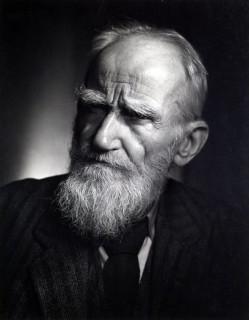
George Bernard Shaw, Irish playwright, critic, and polemicist, dies at the age of 94 on November 2, 1950, at Ayot St. Lawrence, Hertfordshire, England. His influence on Western theatre, culture, and politics extends from the 1880s to his death and beyond.

Shaw writes more than sixty plays, including major works such as Man and Superman (1902), Pygmalion (1912) and Saint Joan (1923). With a range incorporating both contemporary satire and historical allegory, he becomes the leading dramatist of his generation, and in 1925 is awarded the Nobel Prize in Literature.

Shaw is born on July 26, 1856, at 3 Upper Synge Street in Portobello, a lower-middle-class area of Dublin. The Shaw family is of English descent and belong to the dominant Protestant Ascendancy in Ireland. Between 1865 and 1871, Shaw attends four schools, all of which he hates. His experiences as a schoolboy leave him disillusioned with formal education. In October 1871 he leaves school to become a junior clerk in a Dublin firm of land agents, where he works hard and quickly rises to become head cashier. During this period, he is known as “George Shaw”; after 1876, he drops the “George” and styles himself “Bernard Shaw.”

Shaw moves to London in 1876, where he struggles to establish himself as a writer and novelist and embarks on a rigorous process of self-education. By the mid-1880s he has become a respected theatre and music critic. Following a political awakening, he joins the gradualist Fabian Society and becomes its most prominent pamphleteer. He has been writing plays for years before his first public success, Arms and the Man in 1894. Influenced by Henrik Ibsen, he seeks to introduce a new realism into English-language drama, using his plays as vehicles to disseminate his political, social, and religious ideas. By the early twentieth century his reputation as a dramatist is secured with a series of critical and popular successes that include Major Barbara, The Doctor’s Dilemma, and Caesar and Cleopatra.

Shaw’s expressed views are often contentious. He promotes eugenics and alphabet reform and opposes vaccination and organised religion. He courts unpopularity by denouncing both sides in World War I as equally culpable, and although not a republican, castigates British policy on Ireland in the postwar period. These stances have no lasting effect on his standing or productivity as a dramatist.

The inter-war years see a series of often ambitious plays, which achieve varying degrees of popular success. In 1938 Shaw provides the screenplay for a filmed version of Pygmalion for which he receives an Academy Award. His appetite for politics and controversy remains undiminished. By the late 1920s he has largely renounced Fabian gradualism and often writes and speaks favourably of dictatorships of the right and left — he expresses admiration for both Mussolini and Stalin. In the final decade of his life, he makes fewer public statements, but continues to write prolifically until shortly before his death, refusing all state honours including the Order of Merit in 1946.

During his later years, Shaw enjoys tending the gardens at Shaw’s Corner. He dies on November 2, 1950, at the age of 94 of renal failure precipitated by injuries incurred when falling while pruning a tree. His body is cremated at Golders Green Crematorium on November 6, 1950. His ashes, mixed with those of his wife Charlotte, are scattered along footpaths and around the statue of Saint Joan in their garden.

Since Shaw’s death scholarly and critical opinion has varied about his works, but he has regularly been rated as second only to Shakespeare among English-language dramatists. Analysts recognise his extensive influence on generations of playwrights. The word “Shavian” has entered the language as encapsulating Shaw’s ideas and his means of expressing them.


Leave a comment

Birth of Herbert Trench, Poet & Playwright

herbert-trench

Frederic Herbert Trench, Irish poet and playwright, is born at Avoncore, County Cork on November 12, 1865.

Trench is educated at Haileybury and Keble College, Oxford, and is elected a fellow of All Souls College, Oxford. In 1891, after some years spent in traveling, he is appointed an examiner in the Board of Education. He gives up this appointment in 1908 in order to devote himself to literary work.

In 1908 a dramatic symphony, Apollo and the Seaman (Op.51), written by Joseph Holbrooke setting Trench’s poem Apollo and the Seaman is performed, under Thomas Beecham. Trench then moves into theatrical work for a few years becoming director of the Theatre Royal Haymarket in London. Here he collaborates with his friend Thomas Evelyn Scott-Ellis, 8th Baron Howard de Walden. They stage The Blue Bird by Maurice Maeterlinck in 1909, and Henrik Ibsen‘s The Pretenders in 1913.

During World War I Trench works in Florence for the establishment of a better understanding between Great Britain and Italy.

From his school days Trench has been a writer of verse, and his first volume of poems, Deirdre Wed and other Poems, appears in 1901. It is followed by further poems, notably Apollo and the Seaman, included in New Poems (1907), and Lyrics and Narrative Poems (1911). Among his later publications are an Ode from Italy in time of War (1915), Poems with Fables in Prose (1917) and a poetic play Napoleon (1919), which is produced in London by the Stage Society in 1919. Some of his poems are set to music by Arnold Bax.

Herbert Trench dies in Boulogne-sur-Mer, a coastal city in Northern France, on June 11, 1923.


Leave a comment

First Production by the Gate Theatre Company

gate-theatre

The Gate Theatre Company of Dublin produces its first play, Henrik Ibsen‘s Peer Gynt, in the Peacock Theatre on October 13, 1928.

The Gate Theatre is founded in 1928 by Hilton Edwards and Micheál Mac Liammóir. During their first season, the company presents seven plays, including Eugene O’Neill‘s The Hairy Ape and Oscar Wilde‘s Salome. Their productions are innovative and experimental, and they offer Dublin audiences an introduction to the world of European and American theatre as well as classics from the modern and Irish repertoire. It is at the Gate that Orson Welles, James Mason, Geraldine Fitzgerald and Michael Gambon begin their prodigious acting careers.

The company plays for two seasons at the Peacock Theatre and then on Christmas Eve 1929, in Groome’s Hotel, a lease is signed for the 18th Century Rotunda Annex, the “Upper Concert Hall,” the Gate’s present home, with Johann Wolfgang von Goethe‘s Faust opening on February 17, 1930.

In 1931, the newly established Gate Theatre runs into financial difficulties and Edward Pakenham, 6th Earl of Longford and Christine Longford, Countess of Longford provide financial support. The Longfords work with Edwards and MacLiammóir at the Gate until 1936, then a split develops, and two separate companies are formed and play at the Gate Theatre for six months each. The companies also tour for six months until the death of Lord Longford in 1961.

During this period Edwards and MacLiammóir (Gate Theatre Productions) run shows in Dublin’s Gaiety Theatre and tour productions to Europe, Egypt and North America.

From the 1980s onwards the Gate Theatre, under the directorship of Michael Colgan, cements its international relationship, touring plays around the world for audiences from Beijing to New York. The theatre establishes unique relationships with leading contemporary playwrights including Samuel Beckett, Harold Pinter and Brian Friel. The first ever Beckett Festival is produced, presenting all 19 of the stage plays over a three-week period. The first ever festival of Pinter’s plays follows, along with many premieres and productions of Friel’s work including the acclaimed production of Faith Healer with Ralph Fiennes which wins a Tony Award on Broadway.

With the generous support of funders, the fabric of the building is restored and renovated under the guidance of Ronnie Tallon and Scott, Tallon Walker Architects. This includes the provision of a new wing, which incorporates a studio space, The Gate Studio, for rehearsals and workshops, offering practitioners an opportunity to develop and nurture creativity.

On April 3, 2017, Selina Cartmell becomes Director of the Gate Theatre. As a freelance artist, she has directed a diverse range of work from Greek tragedy and Shakespeare to international work and contemporary Irish drama. In 2004, she establishes Dublin-based Siren Productions, a multi-award-winning company conceived to innovate the classics and create relevant and dynamic new work, integrating theatre, dance, visual arts, architecture, film and music. Her productions have been nominated for thirty-five theatre awards, winning ten, including three for best director.


Leave a comment

Birth of Fiona Shaw, Actress & Director

fiona-shaw

Fiona Mary Shaw, accomplished classical actress and theatre and opera director, is born in Farranree, County Cork on July 10, 1958. She is best known for her role as Petunia Dursley in the Harry Potter films and her role portraying Marnie Stonebrook in the HBO series True Blood.

Shaw attends secondary school at Scoil Mhuire in Cork. She receives her degree at University College Cork. She trains at the Royal Academy of Dramatic Art (RADA) in London and is part of a ‘new wave’ of actors to emerge from the Academy. She receives much acclaim as Julia in the Royal National Theatre production of Richard Sheridan‘s The Rivals (1983).

Shaw’s theatrical roles include Celia in As You Like It (1984), Madame de Volanges in Les Liaisons Dangereuses (1985), Katherine in The Taming of the Shrew (1987), Lady Franjul in The New Inn (1987), Young Woman in Machinal (1993), for which she wins the Laurence Olivier Award for Best Actress, Winnie in Happy Days (2007), and the title roles in Electra (1988), The Good Person of Sechuan (1989), Hedda Gabler (1991), The Prime of Miss Jean Brodie (1998) and Medea (2000). She performs T. S. Eliot‘s poem The Waste Land as a one-person show at the Liberty Theatre in New York City to great acclaim in 1996, winning the Drama Desk Award for Outstanding One-Person Show for her performance.

Shaw plays Miss Morrison in the 1984 The Adventures of Sherlock Holmes episode “The Adventure of the Crooked Man” and Catherine Greenshaw in Agatha Christie’s Marple episode “Greenshaw’s Folly” in 2013.

Shaw notably plays the male lead in Richard II, directed by Deborah Warner in 1995. She has collaborated with Warner on a number of occasions, on both stage and screen. She has also worked in film and television, including My Left Foot (1989), Mountains of the Moon (1990), Three Men and a Little Lady (1990), Super Mario Bros. (1993), Undercover Blues (1993), Persuasion (1995), Jane Eyre (1996), The Butcher Boy (1997), The Avengers (1998), Gormenghast (2000), and five of the Harry Potter films in which she plays Harry Potter‘s aunt Petunia Dursley. She has a brief but key role in Brian DePalma‘s The Black Dahlia (2006).

In 2009, Shaw collaborates with Deborah Warner again, taking the lead role in Tony Kushner‘s translation of Bertolt Brecht‘s Mother Courage and Her Children. In a 2002 article for The Daily Telegraph, Rupert Christiansen describes their professional relationship as “surely one of the most richly creative partnerships in theatrical history.” Other collaborations between the two women include productions of Brecht’s The Good Woman of Szechuan and Henrik Ibsen‘s Hedda Gabler, the latter adapted for television.

Shaw appears in The Waste Land at Wilton’s Music Hall in January 2010 and in a Royal National Theatre revival of London Assurance in March 2010. In November 2010, she stars in Ibsen’s John Gabriel Borkman at the Abbey Theatre, Dublin alongside Alan Rickman and Lindsay Duncan. The play is also staged in New York’s Brooklyn Academy of Music in 2011.

Shaw appears in season four of American TV show True Blood. Her character, Marnie Stonebrook, has been described as an underachieving palm reader who is spiritually possessed by an actual witch. Her character leads a coven of necromancer witches who threaten the status quo in Bon Temps, erasing most of Eric Northman‘s memories and leaving him almost helpless when he tries to kill her and break up their coven.

In 2012, Shaw appears in the Royal National Theatre revival of Scenes from an Execution by Howard Barker.

The world’s largest solo theatre festival, United Solo Theatre Festival, recognizes her performance in The Testament of Mary on Broadway with the 2013 United Solo Special Award.

In 2018 Shaw begins portraying Carolyn Martens, head of the MI6 Russian Desk, in BBC America‘s Killing Eve, for which she wins the BAFTA Award for Best Actress in a Supporting Role in a Television Series. Later the same year, she plays a senior MI6 officer in Mrs. Wilson.


Leave a comment

George Bernard Shaw Wins the Nobel Prize in Literature

George Bernard Shaw, Irish playwright, critic and polemicist, wins the Nobel Prize in Literature on November 11, 1925. Born in Dublin on July 26, 1856, Shaw is the only person to receive both a Nobel Prize in Literature and an Oscar (1938), for his work on the film Pygmalion, the adaptation of his play of the same name.

Shaw’s influence on Western theatre, culture and politics extends from the 1880s to his death and beyond. He writes more than sixty plays, including major works such as Man and Superman (1902), Pygmalion (1912) and Saint Joan (1923). With a range incorporating both contemporary satire and historical allegory, Shaw becomes the leading dramatist of his generation, culminating in 1925 with his awarding of the Nobel Prize in Literature.

Shaw moves to London in 1876, where he struggles to establish himself as a writer and novelist and embarks on a rigorous process of self-education. By the mid-1880s he has become a respected theatre and music critic. Following a political awakening, he joins the gradualist Fabian Society and becomes its most prominent pamphleteer. He has been writing plays for years before his first public success, Arms and the Man, in 1894. Influenced by Henrik Ibsen, he seeks to introduce a new realism into English-language drama, using his plays as vehicles to disseminate his political, social and religious ideas. By the early twentieth century his reputation as a dramatist is secured with a series of critical and popular successes that included Major Barbara, The Doctor’s Dilemma and Caesar and Cleopatra.

Shaw’s expressed views are often contentious. He promotes eugenics and alphabet reform and opposes vaccination and organised religion. He courts unpopularity by denouncing both sides in World War I as equally culpable, and although not a republican, castigates British policy on Ireland in the postwar period. These stances have no lasting effect on his standing or productivity as a dramatist. The inter-war years see a series of often ambitious plays, which achieve varying degrees of popular success. In 1938 he provides the screenplay for a filmed version of Pygmalion for which he receives an Academy Award.

Shaw’s appetite for politics and controversy remains undiminished. By the late 1920s he has largely renounced Fabian gradualism and often writes and speaks favourably of dictatorships of the right and left. He expresses admiration for both Benito Mussolini and Joseph Stalin. In the final decade of his life, he makes fewer public statements, but continues to write prolifically until shortly before his death on November 2, 1950, refusing all state honours including the Order of Merit in 1946.

Since Shaw’s death scholarly and critical opinion has varied about his works, but he has regularly been rated as second only to William Shakespeare among British dramatists. Analysts recognise his extensive influence on generations of English-language playwrights. The word “Shavian” has entered the language as encapsulating Shaw’s ideas and his means of expressing them.