seamus dubhghaill

Promoting Irish Culture and History from Little Rock, Arkansas, USA


Leave a comment

Founding of the American Committee for Relief in Ireland

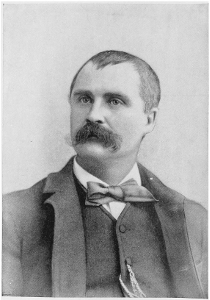
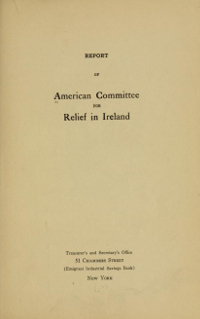
american-committee-for-relief-in-irelandThe American Committee for Relief in Ireland (ACRI) is founded through the initiative of Dr. William J. Maloney and others on December 16, 1920, with the intention of giving financial assistance to civilians in Ireland who have been injured or suffer severe financial hardship due to the ongoing Irish War of Independence.

The Committee is only one of several U.S. based philanthropic organisations that emerge following World War I with a view to influencing the post-war settlement from their perspective of social justice, economic development and long term stability in Europe. Some of them concentrate their efforts on events in Ireland, and while activists of Irish ethnicity are well represented, membership is far from confined to Americans of Irish heritage. Apart from the ACRI, bodies such as the American Commission on Irish Independence and the American Commission on Conditions in Ireland raise money and attempt to influence U.S. foreign policy in a manner sympathetic to the goal of Irish secession from the United Kingdom.

This period of Irish political radicalism coincides with a Red Scare in the United States. Jim Larkin, an Irish trade unionist, who has been closely associated with James Connolly in Ireland and with the Wobblies in the U.S., is serving a five-year sentence in Sing Sing prison for promoting his socialist agenda. While his political views differ fundamentally from most of the Sinn Féin leadership, Irish republicanism is seen by many of the American establishment as based on a questionable ideology. During the Irish War of Independence, the activities of Irish-American fund-raising organisations are viewed with suspicion and kept under close scrutiny by the intelligence services including J. Edgar Hoover, head of the General Intelligence Division of the Federal Bureau of Investigation. U.S. policy towards Irish concerns, initially hostile or at best indifferent, become somewhat less so following the 1920 U.S. presidential election and the landslide victory of Warren G. Harding over James M. Cox.

Following the burning of parts of Cork on December 11, 1920 by elements of the British security forces known as the Black and Tans, approaches are made by the city’s Lord Mayor, Donal O’Callaghan, to the American Red Cross for humanitarian assistance. The society, having taken advice from President Woodrow Wilson, the British embassy, the Foreign Office and the British Red Cross, decline at this time to act on his appeal. Numerous organisations and committees across the United States, operating independently in raising humanitarian aid money for Ireland realise that their funds will not be channelled through the U.S. Committee of the Red Cross and so another distribution channel is needed.

Five days after the inferno at Cork, a widely publicised meeting takes place at the Banker’s Club in New York City. It is organised by William Maloney with the intention of establishing a single nationwide organisation. It will have as its goal, explicitly and solely for the purpose of humanitarian relief, the raising and distribution in Ireland of $10 million. The body which soon emerges styles itself “The American Committee for Relief in Ireland.” One of its founding members, Levi Hollingsworth Wood, approaches a Dublin-based businessman and fellow Quaker, James Douglas, requesting his assistance in the local distribution of the funds on a non-partisan basis. In Ireland, Douglas speaks with Laurence O’Neill, the Lord Mayor of Dublin, who in turn contacts senior members of Sinn Féin to inform them of the wishes of the American Committee. These meetings culminate in the establishment of the Irish White Cross, for the purpose of local distribution of the Committee’s funds.
Leave a comment

Birth of Astronaut & Test Pilot Michael Collins

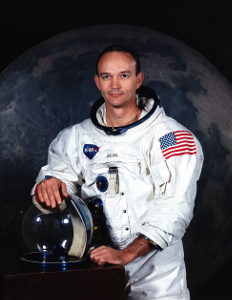
Michael Collins, Irish American former astronaut and test pilot who is part of the Gemini 10 and Apollo 11 missions, is born in Rome, Italy, on October 31, 1930. The Apollo 11 mission includes the first lunar landing in history. His Irish roots can be traced to the town of Dunmanway in County Cork, from which his grandfather, Jeremiah Collins, emigrates in the 1860s.

Collins is born in Rome where his father, United States Army Major General James Lawton Collins, is stationed at the time. After the United States enters World War II, the family moves to Washington, D.C., where Collins attends St. Albans School. During this time, he applies and is accepted to the United States Military Academy in West Point, New York, and decides to follow his father, two uncles, brother and cousin into the armed services.

In 1952, Collins graduates from West Point with a Bachelor of Science degree. He joins the United States Air Force that same year and completes flight training at Columbus Air Force Base in Mississippi. His performance earns him a position on the advanced day fighter training team at Nellis Air Force Base, flying the F-86 Sabres. This is followed by an assignment to the 21st Fighter-Bomber Wing at the George Air Force Base, where he learns how to deliver nuclear weapons. He also serves as an experimental flight test officer at Edwards Air Force Base in California, testing jet fighters.

Collins makes the decision to become an astronaut after watching John Glenn‘s Mercury-Atlas 6 flight. He applies for the second group of astronauts that same year but is not accepted. Disappointed, but undaunted, Collins enters the USAF Aerospace Research Pilot School as the Air Force begins to research space. That year, NASA once again calls for astronaut applications, and Collins is more prepared than ever. In 1963 he is chosen by NASA to be part of the third group of astronauts.

Collins makes two spaceflights. The first, on July 18, 1966, is the Gemini 10 mission, where Collins performs a spacewalk. The second is the Apollo 11 mission on July 20, 1969, the first lunar landing in history. Collins, accompanied by Neil Armstrong and Edwin “Buzz” Aldrin, remains in the Command Module while his partners walk on the moon’s surface. Collins continues circling the moon until July 21, when Armstrong and Aldrin rejoin him. The next day, he and his fellow astronauts leave lunar orbit. They land in the Pacific Ocean on July 24. Collins, Armstrong and Aldrin are all awarded the Presidential Medal of Freedom by Richard Nixon. However, Aldrin and Armstrong end up receiving a majority of the public credit for the historic event, although Collins is also on the flight.

Collins leaves NASA in January 1970, and one year later, he joins the administrative staff of the Smithsonian Institution in Washington, D.C. In 1980, he enters the private sector, working as an aerospace consultant. In his spare time, Collins says he stays active and spends his days “worrying about the stock market” and “searching for a really good bottle of cabernet under ten dollars.”

Collins and his wife, Patricia Finnegan, have three children. The couple lived in both Marco Island, Florida, and Avon, North Carolina until her death in April 2014.

On April 28, 2021, Collins dies of cancer at his home in Naples, Florida, at the age of 90. Buzz Aldrin, who becomes the last survivor of Apollo 11, says that “wherever [Collins has] been or will be, you will always have the Fire to Carry us deftly to new heights and the future.”

On January 30, 2023, Collins’ ashes are interred in Arlington National Cemetery.


Leave a comment

Laying of the Cornerstone for the White House

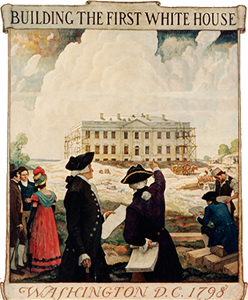
The cornerstone is laid for the White House in the newly designated capital city of Washington, D.C., on October 13, 1792. Earlier in the year, work begins on the neoclassical White House building at 1600 Pennsylvania Avenue under the guidance of Irish American architect James Hoban, whose design is influenced by Leinster House in Dublin and by a building sketch in James GibbsA Book of Architecture.

Hoban is an Irish Catholic raised on an estate belonging to the Earl of Desart in Cuffesgrange, near Callan, County Kilkenny. He works there as a wheelwright and carpenter until his early twenties, when he is given an “advanced student” place in the Dublin Society‘s Drawing School on Lower Grafton Street. He studies under Thomas Ivory. He excels in his studies and receives the prestigious Duke of Leinster‘s medal from the Dublin Society for drawings of “Brackets, Stairs, and Roofs” in 1780. Later, Hoban finds a position as an apprentice to Ivory, from 1779 to 1785.

Following the American Revolutionary War, Hoban emigrates to the United States, and establishes himself as an architect in Philadelphia, Pennsylvania in 1785.

Hoban is in South Carolina by April 1787, where he designs numerous buildings including the Charleston County Courthouse. President George Washington admires Hoban’s work on his Southern Tour and summons the architect to Philadelphia, the temporary national capital, in June 1792.

In July 1792, Hoban is named winner of the design competition for the White House. His initial design seems to have had a 3-story facade, nine bays across, much like the Charleston courthouse. Under Washington’s influence, Hoban amends this to a 2-story facade, eleven bays across, and, at Washington’s insistence, the whole presidential mansion is faced with stone. It is unclear whether any of Hoban’s surviving drawings are actually from the competition.

In 1800, President John Adams becomes the first president to reside in the executive mansion, which soon becomes known as the “White House” because its white-gray Virginia freestone contrasts strikingly with the red brick of nearby buildings.


Leave a comment

Birth of Fanny Parnell, Poet & Nationalist

Fanny Parnell, Irish poet and Nationalist, is born Frances Isabelle Parnell in Avondale, County Wicklow on September 4, 1848. She is the sister of Charles Stewart Parnell, an important figure in nineteenth century Ireland.

Parnell is the eighth child out of eleven and fourth daughter born to John Henry Parnell, a landowner and the grandson of the last Chancellor of the Exchequer of Ireland, and Delia Tudor Stewart Parnell, an Irish American and the daughter of Admiral Charles Stewart (1778–1869) of the United States Navy. Her mother hates British rule in Ireland, a view presented through her children’s works. She is an intelligent girl and before she is through her teen years, she has studied mathematics, chemistry, and astronomy, and she can speak and write fluently in almost all the major European languages. She also has talents in music and painting and drawing in oil and water colours. Her parents separate when she is young. Soon afterwards, in July 1859, her father dies at the age of forty-eight and she and her mother move to Dalkey. A year later they move to Dublin, and in 1865 they move to Paris where Fanny studies art and writes poetry. In 1874 they move to Bordentown, New Jersey in the United States.

Parnell is known as the Patriot Poet. She shows interest in Irish politics and much of her poetry is about Irish nationalism. While she is living in Dublin in 1864, she begins publishing her poetry under the pseudonym “Aleria” in The Irish People, the newspaper of the Fenian Brotherhood. Most of her later work is published in The Pilot in Boston, the best-known Irish newspaper in America during the nineteenth century. Two of her most widely published works are The Hovels of Ireland, a pamphlet, and Land League Songs, a collection of poems. Her best-known poem is “Hold the Harvest,” which Michael Davitt refers to as the “Marseillaise of the Irish peasant.”

Parnell’s brother, Charles, becomes active in the Irish National Land League, an organisation that fights for poor tenant farmers, in 1879 and she strongly supports him. She and her younger sister, Anna Parnell (1852–1911), co-found the Ladies’ Land League in 1880 to raise money in America for the Land League. In 1881 the Ladies’ Land League continues the work of the men in the Land League while they are being imprisoned by the British government. In Ireland Anna becomes the president of the Ladies’ Land League, and the women hold many protests and quickly become more radical than the men, to the resentment of the male leaders. Fanny stays in America and works to raise money for the organisation. Most of the Land League’s financial support comes from America because of the campaigning done by Fanny Parnell.

Fanny Parnell dies on July 20, 1882, at the young age of 33, of a heart attack at the family mansion in Bordentown, New Jersey. She is buried at the Tudor family plot at Mount Auburn Cemetery in Cambridge, Massachusetts.


Leave a comment

Death of James O’Neill, Irish American Theatre Actor

James O’Neill, Irish American theatre actor and the father of American playwright Eugene O’Neill, dies in New London, Connecticut, on August 11, 1920.

O’Neill is born on November 15, 1847, in County Kilkenny. The family emigrates to the United States and settles in Buffalo, New York. In 1857 they move to Cincinnati, Ohio where James is apprenticed to a machinist.

At the age of 21, he makes his stage debut in a Cincinnati production of Dion Boucicault‘s The Colleen Bawn (1867). Also in 1867, he has a minor part in Edwin Forrest‘s production of Virginius, and then joins a travelling repertory company. By the age of 24 he has already established a reputation among theater managers as a box-office draw, particularly with the ladies. But he is also working doggedly at his craft, ridding himself of all vestiges of brogue and learning to pitch his voice resonantly. He is considered a promising actor, quickly working his way up the ranks to become a matinée idol.

In 1874 O’Neill joins Richard M. Hooley‘s company, and the following year tours San Francisco, Virginia City and Sacramento. He then heads back east to join the Union Square Company.

On June 14, 1877, while in New York City, O’Neill marries Mary Ellen Quinlan, daughter of Thomas and Bridget Quinlan. In the fall of 1877, three months after his marriage, a woman by the name of Nettie Walsh sues O’Neill, claiming that he had married her five years earlier, when she was only 15, and that he is the father of her three-year-old son. Nettie Walsh loses her case and the publicity, although it wounds his bride, enhances his reputation as a romantic leading man.

As early as 1875, while a stock star at Hooley’s Theatre in Chicago, O’Neill plays the title role in a stage adaptation of Alexandre DumasThe Count of Monte Cristo. In early 1883 he takes over the lead role in Monte Cristo at Booth’s Theater in New York, after Charles R. Towne dies suddenly in the wings after his first performance. O’Neill’s interpretation of the part caused a sensation with the theater-going public.

O’Neill soon tires of the Count and his lines come out by rote and his performances become lackadaisical. Monte Cristo remains a popular favorite, so he continues the role on tour as regular as clockwork. He goes on to play this role over 6,000 times.

In the middle of 1920 O’Neill is struck by an automobile in New York City and taken to Lawrence+Memorial Hospital in New London, Connecticut. He dies, at the age of 72, on August 11, 1920, of colorectal cancer at the family summer home, the Monte Cristo Cottage, in Connecticut. His funeral at St. Joseph’s Church is attended by, among others, O’Neill’s sister, Mrs. M. Platt of St. Louis and Edward Douglass White, Sr., Chief Justice of the United States Supreme Court. O’Neill is buried in St. Mary’s cemetery.


Leave a comment

Patrick Francis Healy Becomes President of Georgetown University

Patrick Francis Healy, Jesuit priest and educator, becomes the 29th President of Georgetown University on July 31, 1874. He is known for expanding the school following the American Civil War. Healy Hall is constructed during his tenure and is named after him. It is designated as a National Historic Landmark in the late 20th century.

Healy is born into slavery in 1834 in Macon, Georgia, the third son of Irish American plantation owner Michael Healy and his African American slave Mary Eliza, who is the multiracial daughter of a black slave and white slaveowner. The law establishes during colonial slavery in the United States that children are to take the legal status of the mother. By the principle of partus sequitur ventrum, Patrick and his siblings are legally considered slaves in Georgia, although their father is free, and they are three-quarters or more European in ancestry.

Discriminatory laws in Georgia prohibit the education of slaves and require legislative approval for each act of manumission, making these essentially impossible to gain. Michael Healy arranges for all his children to leave Georgia and move to the North to obtain their educations and have opportunities in their lives. They are raised as Irish Catholics. Patrick’s brothers and sisters are nearly all educated in Catholic schools and colleges. Many achieve notable firsts for Americans of mixed-race ancestry during the second half of the 19th century, and the Healy family of Georgia is remarkably successful.

Healy sends his older sons first to a Quaker school in Flushing, New York. Despite the Quakers’ emphasis on equality, Patrick encounters some discrimination during his grade school years, chiefly because his father is a slaveholder, which by the late antebellum years the Quakers consider unforgivable. Patrick also meets resistance in the school as an Irish Catholic. When Michael Healy hears of a new Jesuit college, the College of the Holy Cross in Worcester, Massachusetts, he sends his four oldest sons, including Patrick, to study there in 1844. They are joined at Holy Cross by their younger brother Michael in 1849.

Following Patrick’s graduation in 1850, he enters the Jesuit order, the first African American to do so, and continues his studies. The order sends him to Europe to study in 1858. His mixed-race ancestry has become an issue in the United States, where tensions are rising over slavery. He attends the Catholic University of Leuven in Belgium, earning his doctorate, becoming the first American of openly acknowledged part-African descent to do so. During this period, he is also ordained to the priesthood on September 3, 1864.

In 1866 Healy returns to the United States and teaches philosophy at Georgetown University in Washington, D.C. On July 31, 1874, he is selected as the school’s twenty-ninth president. He is the first college president in the United States of African American ancestry. At the time, he identifies as Irish Catholic and is accepted as such.

Patrick Healy’s influence on Georgetown is so far-reaching that he is often referred to as the school’s “second founder,” following Archbishop John Carroll. Healy helps transform the small nineteenth-century college into a major university for the twentieth century, likely influenced by his European education.

He modernizes the curriculum by requiring courses in the sciences, particularly chemistry and physics. He expands and upgrades the schools of law and medicine. The most visible result of Healy’s presidency is the construction of the university’s flagship building designed by Paul J. Pelz, begun in 1877 and first used in 1881. The building is named in his honor as Healy Hall.

Healy leaves the College in 1882 and travels extensively through the United States and Europe, often in the company of his brother James, a bishop in Maine. In 1908 he returns to the campus infirmary, where he dies on January 10, 1910. He is buried on the grounds of the university in the Jesuit cemetery.


2 Comments

Birth of Sculptor Seamus Murphy

Seamus Murphy, Irish sculptor and stone carver best known for designing the Church of the Annunciation, Blackpool, Cork, is born near Mallow, County Cork on July 15, 1907.

Murphy is the son of James Murphy, a railway employee, and Margaret Sheehan of Little Island, County Cork. He attends Saint Patrick’s School on Gardiner’s Hill. In 1921 he enrolls as a part-time student at the Crawford School of Art, Emmet Place, Cork. In 1922 he finds work as an apprentice stone-carver at John Aloysius O’Connell’s Art Marble Works, Watercourse Road, Blackpool. There he specialises in architectural and foliage carving while continuing his studies at Crawford by night.

Murphy studies at the Académie Colarossi and at the Académie de la Grande Chaumière in Paris in 1932-1933 where he is befriended by the Irish American sculptor Andrew O’Connor. He opens his studio/workshop on Watercourse Road, Blackpool, Cork in 1934.

He is elected associate of the Royal Hibernian Academy in 1944, elected a full member in 1954, and appointed Royal Hibernian Academy Professor of Sculpture in 1964.

Also in 1944, he married Maighread Higgins, daughter of the Cork sculptor Joseph Higgins, and they go on to have three children – the knitwear designer Bebhinn Marten, the novelist Orla Murphy and the painter and De Dannan member Colm Murphy.

Murphy designs the Church of the Annunciation on Great William O’Brien Street in Blackpool, Cork, for William Dwyer in 1945. The stonework in the church is mostly by Murphy himself. It is officially dedicated on October 7, 1945.

Seamus Murphy dies in Cork on October 2, 1975. He is buried in Rathcooney, County Cork.

Examples of Murphy’s unique carvings of statues, gravestones, monuments and plaques can be seen around Cork and Ireland, including a signed panel of the four evangelists outside the entrance of the church of Our Lady and Saint John in Carrigaline, County Cork.


Leave a comment

Beginning of the New York City Draft Riots

The New York City draft riots, one of the more regrettable incidents related to Irish American history, begin on July 13, 1863, and continue through July 16. Known at the time as Draft Week, they are violent disturbances in Lower Manhattan, widely regarded as the culmination of working-class discontent with new laws passed by Congress that year to draft men to fight in the ongoing American Civil War. The riots remain the largest civil and racial insurrection in American history, aside from the Civil War itself.

The cry of “rich man’s war, poor man’s fight” is the cry of many in the Northern states. The rioters, predominantly Irish immigrants, are overwhelmingly working-class men, who resent those wealthier men, who can afford to pay a $300 commutation fee to hire a substitute, are spared from the draft, worried that the eventual emancipation of blacks will rob them of their jobs and are egged on by some politicians and Southern agents.

Initially intended to express anger at the draft, the protests turn into a race riot, with white predominantly Irish rioters, attacking blacks throughout the city. The official death toll is listed at either 119 or 120 individuals. Conditions in the city are such that Major General John E. Wool, commander of the Department of the East, says on July 16 that “Martial law ought to be proclaimed, but I have not a sufficient force to enforce it.”

U.S. President Abraham Lincoln diverts several regiments of militia and volunteer troops from following up after the Battle of Gettysburg to control the city.

The military does not reach the city until after the first day of rioting, by which time the mobs, have already ransacked or destroyed numerous public buildings, two Protestant churches, the homes of various abolitionists or sympathizers, many black homes, and the Colored Orphan Asylum at 44th Street and Fifth Avenue, which is burned to the ground.

The area’s demographics change as a result of the riot. Many blacks leave Manhattan permanently, many moving to Brooklyn. By 1865 their population falls below 10,000, the number in 1820.

Through the years the story is told as if only Irish riot, but in fact many besides the Irish take part, and many Irish policemen, fireman, priests, and trade unionists are among the most influential in quelling them. Still, it cannot be denied, a large number of Irish do participate in the burning of the black orphanage and murder of blacks in the city. This unfortunate episode leaves a lasting stain on the reputation of New York’s Irish community.


Leave a comment

Birth of Writer John Boyle O’Reilly

John Boyle O’Reilly, poet, journalist and fiction writer, is born in Dowth, County Meath on June 28, 1844.

O’Reilly is the third child of a headmaster and a schoolteacher. When he is fifteen, he moves to Lancashire and lives with his aunt and uncle. There he becomes a reporter with a local newspaper and joins the 11th Lancashire Rifle Volunteers in 1861. He returns to Ireland in 1863 and enlists with the 10th Royal Hussars in Dublin. However, after realising the way the British are treating his fellow people, he leaves the army and joins the Irish Republican Brotherhood around 1865.

In 1866 O’Reilly, along with many other members of the Brotherhood, are arrested and put on trial for treason. O’Reilly is found guilty and sentenced to death however, due to his young age, his sentence is reduced to 20 years penal servitude. He spends a year and a half in some English prisons before being transported to Western Australia in 1867, arriving in 1868.

A month after arriving O’Reilly is moved to the town of Bunbury where he starts receiving attention for protesting the chopping down of a tree. A year after arriving he decides to escape from the colony with the help of a local Catholic priest and some farmers from the nearby town of Dardanup. In February 1869 O’Reilly absconds from his convict camp and makes his way towards the Leschenault Peninsula where he waits for a ship to arrive. After approximately two weeks O’Reilly escapes on the Gazelle bound for the United States, arriving there in November 1869.

O’Reilly moves to Boston and becomes a well-known figure in the town where he becomes involved in civil rights, sports, and Irish American causes. He also becomes part owner of The Pilot newspaper. He publishes four books of poetry – Songs from the Southern Seas (1873), Songs, Legends and Ballads (1878), The Statues in the Block (1881) and In Bohemia (1886). He also publishes a novel Moondyne (1879) based on the convict of the same name and O’Reilly’s experiences in Western Australia. It becomes his most popular work. He also writes one last book of poems entitled Watchwords, which is released after his death.

John Boyle O’Reilly dies in Hull, Massachusetts on August 10, 1890, from heart failure after overdosing on his wife’s medication. His sudden death receives an outpouring of grief and tributes from the Boston community and also globally.

His funeral is held at St. Mary’s Church in Charlestown on August 13 and is attended by thousands. The streets near the church are lined with mourners. His wife does not attend the funeral due to grief and is unable to leave her bed. He is originally buried at Calvary Cemetery in Roxbury, but in November 1890 his remains are exhumed and moved to Holyhood Cemetery in Brookline.


Leave a comment

The Broad Street Riot

The Broad Street Riot, a massive brawl between Irish Americans and Yankee firefighters, occurs in Boston, Massachusetts, on June 11, 1837. At the time of this particular riot, nearly all of Boston’s firefighters are volunteers.

Boston is a major center for immigration in the 19th century due to its large seaport. Nativist and anti-Catholic sentiment is strong, especially among working-class men whose jobs and wages are threatened by an influx of poor Irish immigrants. On Broad Street, it is common for groups of nativist Yankees to vandalize Irish homes and attack lone Irishmen.

At about 3:00 PM on Sunday, June 11, 1837, Fire Engine Company 20 returns to their station on East Street from a fire at the Boston Neck. Some of the men go straight home from there, however most stop at a nearby pub for drinks. The pub is apparently operating illegally as it is a Sunday and, in Massachusetts, blue laws are then in effect.

The men have just emerged from the pub “in a more or less bellicose mood,” when they collide with a crowd of about a hundred Irishmen who are on their way to join a large funeral procession on Sea Street. Nearly all of the firefighters pass through the crowd without incident, however, when 19-year-old George Fay, who has reportedly had too much to drink, insults or shoves several of the Irishmen, and a fight breaks out. Fay’s friends rush to his aid, but the firemen are outnumbered and are badly beaten. Their foreman, W.W. Miller, orders them back into the firehouse.

By some accounts, the Irishmen then take over the firehouse. According to others, the crowd had begun to disperse, and the matter might have ended there had the foreman not “lost his head completely.” In any case, Miller orders his men to sound the emergency alarm. First, they roll their wagon into the street, ringing the fire alarm bell. Then Miller sends men to ring the church bells, summoning all the fire engines in Boston. According to the Boston Transcript, Miller then runs to another firehouse, shouting, “The Irish have risen upon us, and are going to kill us!”

Company 9, responding to what they think is a legitimate fire alarm, arrives just as the funeral procession is turning onto New Broad Street. Their horse-drawn wagon veers into the crowd, scattering and knocking down the mourners. The Irish assume the assault is deliberate, and another brawl erupts. As more fire companies arrive, and Irishmen pour out of nearby houses into the street to help their friends and relatives, the fight escalates into a full-blown riot. Before long, an estimated 800 men are doing battle with sticks, stones, bricks, and cudgels while at least 10,000 more urged them on. Protestant workmen come running to the aid of the firefighters, while underfoot, injured and unconscious men lay sprawled on the pavement.

Outnumbered, the Irish are defeated and driven back to their homes. That is when the home invasions begin. A “gang of stout boys and loafers” raid nearby houses, breaking doors and windows, and in some cases beating the occupants. Furniture and other possessions are destroyed and thrown into the street. Some Irish families lose their homes altogether.

After raging for about three hours, the riot is quelled when Mayor Samuel Atkins Eliot calls in the National Lancers, a newly formed cavalry company, and some 800 other members of the state militia with fixed bayonets. Among them are the Montgomery Guards, a short-lived Irish American infantry company which is forced to disband the following year due to the extreme nativist and anti-Catholic sentiment in Boston.

No immediate deaths result from the violence. Many people suffer serious wounds, however, and there is no nearby hospital to care for them. Given the lack of hospital and police records, the number of people who eventually die of their injuries cannot be determined. Thousands of dollars in damage are done to property belonging to some of the city’s poorest inhabitants.

The militia, being composed nearly entirely of Yankees, arrest 34 Irishmen and 4 Yankees. A grand jury indicts 14 of the Irishmen and all four of the Yankees. At the municipal court trial, a Yankee jury acquits the four Yankees and convicts four Irishmen, three of whom are sentenced to several months of hard labor.

Three months later, in September, Mayor Eliot establishes a professional, paid fire department, with all new hires requiring the approval of the mayor and aldermen. The Boston Police Department is established the following year.