seamus dubhghaill

Promoting Irish Culture and History from Little Rock, Arkansas, USA


Leave a comment

Death of Gordon Lambert, Businessman, Senator & Art Collector

Charles Gordon Lambert, Irish businessman, senator and art collector, dies in a Dublin hospital on January 27, 2005.

Lambert is born on April 9, 1919, in the family home at Highfield Road, Rathmines, Dublin, the youngest of four sons of Robert James Hamilton Lambert, a veterinarian and renowned cricketer, and his wife Nora (née Mitchell). His eldest brother, Noel Hamilton “Ham” Lambert, is a versatile sportsman and noted veterinary practitioner.

Lambert is educated at Sandford Park School, Dublin, and at Rossall School, Lancashire. He is steered by his mother toward a career in accountancy for which he prepares by studying commerce at Trinity College Dublin (TCD). Graduating in 1940, he joins the accounting firm Stokes Brothers and Pim, qualifying Associate Chartered Accountant in 1943. In 1944, after auditing biscuit manufacturers W. & R. Jacob and Co. Ltd, one of Ireland’s largest and most prestigious industrial companies, he is offered and accepts a £300 a year job at Jacob’s as assistant accountant.

In 1953, Lambert becomes Jacob’s chief accountant as the management grooms him for an executive career. During 1948–56, Jacob’s suffers from profit and price controls, lack of capital investment and complacency brought about by the absence of competition. The entry of Boland’s Bakery into the Irish biscuit market in 1957 is exploited by Lambert who urges the alarmed board, which has long regarded advertising as vulgar, to market its products more vigorously. This assertiveness yields his advancement to the position of commercial manager in 1958. A year later he becomes the first non-member of the Bewley and Jacob families to be appointed to the board.

Between 1959 and 1970, biscuit consumption in Ireland doubles for which Lambert can claim much credit. Recognising that the advent of self-service stores means that manufacturers can no longer rely on retailers to sell their products, he pioneers advanced promotional techniques in Ireland, particularly the use of marketing surveys and of mass advertising in newspapers, on radio and on the emerging medium of television. To further accord with retailers’ preferences, Jacob’s drives the widespread packaging of biscuits in airtight packets rather than tins and also introduces a striking red flash logo for its packets. His interest in contemporary art enables him to contribute directly to Jacob’s packaging designs.

Lambert is appointed to the board of the Electricity Supply Board (ESB) in 1964, a position he holds until 1977, and serves as president of the National Agricultural and Industrial Development Association (NAIDA) in 1964–65, spearheading a “Buy Irish” campaign. His involvement with NAIDA dates to the mid-1950s and leads to his friendship with Jack Lynch, Minister for Industry and Commerce. This relationship and his admiration for Seán Lemass incline him toward Fianna Fáil. He also believes the party is the one most likely to deliver economic growth.

In 1977, Lambert is appointed to Seanad Éireann by Taoiseach Jack Lynch. He sits as an independent but assures Lynch he will broadly support the government. Dismayed by Ireland’s economic uncompetitiveness, he uses this platform to bemoan the state’s financial profligacy and failure to control inflation, and the indifference of Irish politicians towards the business community, contending that Irish industrialists suffer and need to learn from the expert lobbying of the indigenous agricultural sector and of large multi-national companies based in Ireland. He also articulates his social liberalism, desire for peaceful reconciliation in Northern Ireland and support for cultural and environmental causes. But his commitment to the Seanad wanes as he grasps its irrelevance. When Lynch resigns in December 1979, Lambert joins the Fianna Fáil party in a futile bid to preserve his political influence.

Following Jacob’s takeover of Boland’s Bakery in 1966, Lambert becomes joint managing director of a new entity, Irish Biscuits Ltd, the manufacturing and trading company for the Boland’s and Jacob’s biscuits operations. W. & R. Jacob and Co. Ltd becomes a holding company. In 1968, he becomes the sole managing director. From 1977 he begins withdrawing from the active administration of the company, relinquishing his managing directorship in 1979 to become chairman.

Initially, Lambert views art as a hobby but he comes to see it as a calling, drawing inspiration from Sir William Basil Goulding, his predecessor as Ireland’s leading collector and advocate of modern art. From the late 1970s he serves as head of the Contemporary Irish Art Society (CIAS) and on the Arts Council of Northern Ireland, the advisory committee of the Dublin Municipal Gallery, the board of the National Gallery of Ireland, the editorial board of the Irish Arts Review and the international council of the Museum of Modern Art (MoMA) in New York City.

The Irish Museum of Modern Art (IMMA) opens in 1991 and receives through the medium of the Gordon Lambert Trust some 212 works, which form the centerpiece of its collection. Thereafter Lambert gifts another 100 works to IMMA. He sits on IMMA’s board from 1991, and the west wing of the museum is named after him in 1999.

Despite being diagnosed with Parkinson’s disease in 1988, Lambert remains relatively active and plays golf into his 80s. In 1999 he receives an honorary LLD from TCD. From 1997, he relies increasingly on Anthony Lyons, an acquaintance of longstanding, to care for him. His last years are overshadowed by the collapse in autumn 2002 of his close but complex relationship with his family. Thereafter he shuns his relations and changes his will, granting Lyons a substantial portion of his estate while curtailing the amount to be received by his family. He dies in a Dublin hospital on January 27, 2005. Relatives challenge his final will in the High Court in 2009, but it is upheld.

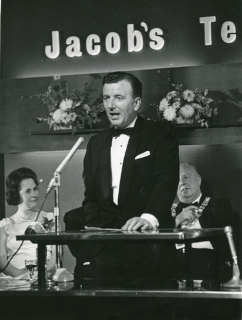
(Pictured: Photograph of director of Jacob’s Biscuits, Gordon Lambert, speaking from a podium at the first Jacob’s Television Awards. The Lord Mayor of Dublin, James O’Keefe, is sitting behind Lambert. The awards ceremony takes place at the Bishop Street factory, Dublin.)


Leave a comment

Birth of Anthony Cronin, Poet, Activist, Critic & Editor

Anthony Gerard Richard Cronin, Irish poet, arts activist, biographer, commentator, critic, editor and barrister, is born in Enniscorthy, County Wexford, on December 28, 1923.

After obtaining a B.A. from the National University of Ireland, Cronin enters the King’s Inns and is later called to the Bar.

Cronin is known as an arts activist as well as a writer. He is Cultural Adviser to Taoiseach Charles Haughey and briefly to Garret FitzGerald. He involves himself in initiatives such as Aosdána, the Irish Museum of Modern Art and the Heritage Council. He is a founding member of Aosdána, and is a member of its governing body, the Toscaireacht, for many years. He is elected Saoi, a distinction for exceptional artistic achievement, in 2003. He is also a member of the governing bodies of the Irish Museum of Modern Art and the National Gallery of Ireland, of which he is for a time Acting Chairman.

With Flann O’Brien, Patrick Kavanagh and Con Leventhal, Cronin celebrates the first Bloomsday in 1954. He contributes to many television programmes, including Flann O’Brien: Man of Parts (BBC) and Folio (RTÉ).

From 1966 to 1968 Cronin is a visiting lecturer at the University of Montana in Missoula, Montana, and from 1968 to 1970 he is poet in residence at Drake University in Des Moines, Iowa. He reads a selection of his poems for the Irish Poetry Reading Archive in 2015. He has honorary doctorates from several institutions, including the University of Dublin, the National University of Ireland and the Adam Mickiewicz University in Poznań, Poland.

Cronin begins his literary career as a contributor to Envoy, A Review of Literature and Art. He is editor of The Bell in the 1950s and literary editor of Time and Tide (London). He writes a weekly column, “Viewpoint,” in The Irish Times from 1974 to 1980. Later he contributes a column on poetry to the Sunday Independent.

His first collection of poems, called simply Poems (Cresset Press, London), is published in 1958. Several collections follow and his Collected Poems (New Island Books, Dublin) is published in 2004. The End of the Modern World (New Island Books, 2016), written over several decades, is his final publication.

Cronin’s novel, The Life of Riley, is a satire on Bohemian life in Ireland in the mid-20th century, while his memoir Dead as Doornails addresses the same subject.

Cronin knows Samuel Beckett from when they do some work for the BBC during the 1950s and 1960s. He gives a prefatory talk to Patrick Magee‘s reading of The Unnamable on the BBC Third Programme. Beckett is not impressed, saying, “Cronin delivered his discourse… It was all right, not very exciting.” Cronin later publishes a biography of him, Samuel Beckett: The Last Modernist (1996), followed on from No Laughing Matter: The Life and Times of Flann O’Brien (1989).

In his later years, Cronin suffers from failing health, which prevents him from traveling abroad, thus limiting his dealings to local matters. He dies in Dublin on December 27, 2016, one day short of his 93rd birthday.

Cronin firstly marries Thérèse Campbell, from whom he separates in the mid-1980s. She dies in 1999. They have two daughters, Iseult and Sarah. Iseult is killed in a road accident in Spain. He secondly marries the writer Anne Haverty who, along with daughter Sarah, survives him.


Leave a comment

Birth of Patrick Hennessy, Irish Realist Painter

Patrick Anthony Hennessy RHA, Irish realist painter known for his highly finished still lifes, landscapes and trompe-l’œil paintings, is born in Cork, County Cork, on August 28, 1915. The hallmark of his style is his carefully observed realism and his highly finished surfaces, the result of a virtuoso painting technique.

Hennessy is the son of John Hennessy an army sergeant major from County Kerry and Bridget Hennessy from Cork. His father is killed in World War I at the Battle of Passchendaele in 1917. In 1921, when he is five years old, his mother remarries in Cork. Her second husband is a Scot named John Duncan and shortly afterwards the whole family moves to Arbroath, Scotland, where Duncan has relatives.

Hennessy is educated in Arbroath at St. Thomas RC Primary School followed by secondary education at Arbroath High School, where he begins to show an aptitude for art, leaving in 1933 with the Dux for Art and an accompanying medal. In the autumn of 1933 he enrolls at the Dundee of Jordanstone College of Art & Design, for a four-year Diploma course in Drawing and Painting under James McIntosh Patrick and Edward Baird. Here he meets Harry Robertson Craig who becomes his lifelong companion. He plays a full part in the social activities of the college, winning a fancy-dress award at the Christmas revels in 1935 and producing a ballet “Paradise Lost” the following year. He gains a First-Class Pass in each year of the course along with winning first prize in 1934 and 1936 for work done during the summer vacation. He graduates with a First-Class Distinction in 1937.

Having gained a scholarship, Hennessy continues his studies at the Dundee of Jordanstone College of Art & Design for a further year by doing a Post-Graduate Diploma course in Drawing and Painting. Within a month of gaining his Post-Graduate Diploma he holds his first joint exhibition at the Art Galleries in Arbroath. In June 1938 he is awarded the Annual Travelling Scholarship for further studies in Paris and Italy. In Paris he meets up with the artists Robert Colquhoun and Robert MacBryde, whom he had met the previous year, the three travelling south together to Marseilles towards the end of that year. On his return to Scotland he is selected for the residential summer school course at Hospitalfield House near Arbroath under James Cowie. Two of his paintings, a still life and a self-portrait, are accepted that year by the Royal Scottish Academy for their Annual Exhibition. However, by the autumn of 1939 with war looming and feeling somewhat disenchanted on his return to Scotland, he decides to return to Ireland.

On arrival in Dublin Hennessy is offered an exhibition in December 1939 at the Country Shop on St. Stephen’s Green which is opened by Mainie Jellett. This attracts favourable attention. During the early 1940s he lives at various addresses in and around Dublin with frequent trips to Cork. In 1940 he is invited to join the Society of Dublin Painters and holds regular annual exhibitions of his work there during the 1940s and early 1950s. These exhibitions are supplemented by an eclectic mix of commissions, mostly portraits which he undertakes during this period. In 1941 he has three of his paintings accepted by the Royal Hibernian Academy (RHA) for their annual exhibition. This is the beginning of a long relationship with the RHA. He exhibits there virtually every year from 1941 until 1979, the year before his death.

From the early 1940s onwards, Hennessey’s work sometimes incorporates a homosexual visual subtext. He re-unites with Harry Robertson Craig in 1946 and soon after they move to Crosshaven, County Cork, and later to Cobh. In 1947, Time magazine selects him as one of Ireland’s outstanding painters, in recognition of the important position he has then attained in the art world. In 1948 he has an exhibition at the Victor Waddington Gallery, Dublin, and that same year is elected an associate of the Royal Hibernian Academy and a full member the following year. In 1950 his painting De Profundis is selected for the Contemporary Irish Painting exhibition that tours North America. As a result of this tour, the American public and critics begin to take notice of his work. In 1951 he visits Italy, taking in Venice and Sicily and returning to Dublin with many of his canvases painted abroad. One of these paintings, Bronze Horses of St. Marks, is exhibited at the Royal Academy of Arts in London in 1954.

In 1956, a friend of Hennessy, David Hendriks, opens the Ritchie Hendriks Gallery on St. Stephen’s Green, Dublin and it is this gallery that is to be the main outlet for his work over the following 22 years. In October 1956 the Thomas Agnew Gallery in London holds an exhibition of his work comprising 38 of his paintings. However, during the winter of 1959 he becomes seriously ill with pneumonia. As a consequence of this, in the autumn of that year he and Craig decide to winter in Morocco. This is the beginning of a new era in both their lives. They would never again spend a full year in Ireland. His exhibitions at the Ritchie Hendriks Gallery had for many years enjoyed favourable reviews from the art critics but in the 1960s this changes with critics claiming his paintings to be dull, repetitive and suggest he needs to explore new areas. Despite the barrage of criticism, in 1965 the Guildhall Gallery in Chicago offers him a major exhibition. Shortly after this exhibition takes place in 1966, he becomes one of the artists on permanent display at the gallery with an annual exhibition. The North American market is extremely lucrative for him and by the end of the decade he is selling more of his work in the United States than in Ireland. In 1968 he finally moves to Tangier, Morocco on a permanent basis and in 1970 sells his studio on Raglan Lane, Dublin.

In Morocco, Hennessy paints prolifically for nine years to keep up with demand from the Hendriks Gallery and Guildhall Gallery along with the RHA. In 1975 the Guildhall Gallery mounts a highly successful Retrospective of his work. In 1978 he has his last exhibition in Dublin at the Hendriks Gallery. By this time he has moved to the Algarve, Portugal and is beginning to have health problems.

In November 1980, with his health deteriorating, Craig brings Hennessy to a hospital in London for treatment. However, on December 30, 1980 he dies from cancer. Following cremation his ashes are buried in nearby Golders Green Crematorium. He leaves his entire estate to Harry Robertson Craig with the proviso that on Craig’s death the Royal Hibernian Academy should be the beneficiary. This legacy has been used to set up the annual Hennessy Craig Scholarship for aspiring artists.

Hennessy falls into the category of painter who develops a distinctive personal style, labelled at various times in his life as a Traditional Realist, Romantic, Photo Realist, Illusionary and Surrealist. However, he always remains intrinsically himself. His subjects range from still life and interiors to landscapes and portraits.

Examples of Hennessy’s work can be found in the public collections of the Crawford Art Gallery, the Dublin City Gallery The Hugh Lane, the Irish Museum of Modern Art (IMMA), the Limerick City Gallery of Art (LCGA), the National Gallery of Ireland (NGI), the National Self-Portrait Collection of Ireland (NSPCI) at the University of Limerick (UL), and in the collections of University College Cork (UCC) and University College Dublin (UCD).


Leave a comment

Birth of Gordon Lambert, Businessman, Senator & Art Collector

Charles Gordon Lambert, Irish businessman, senator and art collector, is born on April 9, 1919, in the family home at Highfield Road, Rathmines, Dublin, the youngest of four sons of Robert James Hamilton Lambert, a veterinarian and renowned cricketer, and his wife Nora (née Mitchell). His eldest brother, Noel Hamilton “Ham” Lambert, is a versatile sportsman and noted veterinary practitioner.

Lambert is educated at Sandford Park School, Dublin, and at Rossall School, Lancashire. He is steered by his mother toward a career in accountancy for which he prepares by studying commerce at Trinity College Dublin (TCD). Graduating in 1940, he joins the accounting firm Stokes Brothers and Pim, qualifying Associate Chartered Accountant in 1943. In 1944, after auditing biscuit manufacturers W. & R. Jacob and Co. Ltd, one of Ireland’s largest and most prestigious industrial companies, he is offered and accepts a £300 a year job at Jacob’s as assistant accountant.

In 1953, Lambert becomes Jacob’s chief accountant as the management grooms him for an executive career. During 1948–56, Jacob’s suffers from profit and price controls, lack of capital investment and complacency brought about by the absence of competition. The entry of Boland’s Bakery into the Irish biscuit market in 1957 is exploited by Lambert who urges the alarmed board, which has long regarded advertising as vulgar, to market its products more vigorously. This assertiveness yields his advancement to the position of commercial manager in 1958. A year later he becomes the first non-member of the Bewley and Jacob families to be appointed to the board.

Between 1959 and 1970, biscuit consumption in Ireland doubles for which Lambert can claim much credit. Recognising that the advent of self-service stores means that manufacturers can no longer rely on retailers to sell their products, he pioneers advanced promotional techniques in Ireland, particularly the use of marketing surveys and of mass advertising in newspapers, on radio and on the emerging medium of television. To further accord with retailers’ preferences, Jacob’s drives the widespread packaging of biscuits in airtight packets rather than tins, and also introduces a striking red flash logo for its packets. His interest in contemporary art enables him to contribute directly to Jacob’s packaging designs.

Lambert is appointed to the board of the Electricity Supply Board (ESB) in 1964, a position he holds until 1977, and serves as president of the National Agricultural and Industrial Development Association (NAIDA) in 1964–65, spearheading a “Buy Irish” campaign. His involvement with NAIDA dates to the mid-1950s and leads to his friendship with Jack Lynch, Minister for Industry and Commerce. This relationship and his admiration for Seán Lemass incline him toward Fianna Fáil. He also believes the party is the one most likely to deliver economic growth.

In 1977, Lambert is appointed to Seanad Éireann by Taoiseach Jack Lynch. He sits as an independent but assures Lynch he will broadly support the government. Dismayed by Ireland’s economic uncompetitiveness, he uses this platform to bemoan the state’s financial profligacy and failure to control inflation, and the indifference of Irish politicians towards the business community, contending that Irish industrialists suffer and need to learn from the expert lobbying of the indigenous agricultural sector and of large multi-national companies based in Ireland. He also articulates his social liberalism, desire for peaceful reconciliation in Northern Ireland and support for cultural and environmental causes. But his commitment to the Seanad wanes as he grasps its irrelevance. When Lynch resigns in December 1979, Lambert joins the Fianna Fáil party in a futile bid to preserve his political influence.

Following Jacob’s takeover of Boland’s Bakery in 1966, Lambert becomes joint managing director of a new entity, Irish Biscuits Ltd, the manufacturing and trading company for the Boland’s and Jacob’s biscuits operations. W. & R. Jacob and Co. Ltd becomes a holding company. In 1968, he becomes the sole managing director. From 1977 he begins withdrawing from the active administration of the company, relinquishing his managing directorship in 1979 to become chairman.

Initially, Lambert views art as a hobby but he comes to see it as a calling, drawing inspiration from Sir William Basil Goulding, his predecessor as Ireland’s leading collector and advocate of modern art. From the late 1970s he serves as head of the Contemporary Irish Art Society (CIAS) and on the Arts Council of Northern Ireland, the advisory committee of the Dublin Municipal Gallery, the board of the National Gallery of Ireland, the editorial board of the Irish Arts Review and the international council of the Museum of Modern Art (MoMA) in New York City.

The Irish Museum of Modern Art (IMMA) opens in 1991 and receives through the medium of the Gordon Lambert Trust some 212 works, which form the centerpiece of its collection. Thereafter Lambert gifts another 100 works to IMMA. He sits on IMMA’s board from 1991, and the west wing of the museum is named after him in 1999.

Despite being diagnosed with Parkinson’s disease in 1988, Lambert remains relatively active and plays golf into his 80s. In 1999 he receives an honorary LLD from TCD. From 1997, he relies increasingly on Anthony Lyons, an acquaintance of longstanding, to care for him. His last years are overshadowed by the collapse in autumn 2002 of his close but complex relationship with his family. Thereafter he shuns his relations and changes his will, granting Lyons a substantial portion of his estate while curtailing the amount to be received by his family. He dies in a Dublin hospital on January 27, 2005. Relatives challenge his final will in the High Court in 2009 but it is upheld.

(Pictured: Photograph of director of Jacob’s Biscuits, Gordon Lambert, speaking from a podium at the first Jacob’s Television Awards. The Lord Mayor of Dublin, James O’Keefe, is sitting behind Lambert. The awards ceremony takes place at the Bishop Street factory, Dublin.)


Leave a comment

Birth of Cecil King, Painter & Collector

Cecil King, painter and collector, is born on February 22, 1921, at Rathdrum, County Wicklow.

King is the son of Henry King, businessman, of Rathdrum, and Susan King (née Crowe). He is educated at the Church of Ireland Ranelagh School, Athlone, and at Mountjoy School, Clontarf, Dublin (1936–39). Subsequently he joins the printing firm of W. & S. McGowan in Dundalk, where he goes on to become a director. During the 1940s his interest in amateur drama leads him to take classes at the Gaiety School of Acting in Dublin, where his fellow students include Milo O’Shea and Eamonn Andrews. Around this time, he is also involved in An Óige (the Irish Youth Hostel Association), in which he serves as honorary national secretary and honorary treasurer. This involvement leads him to travel extensively from the late 1940s around Europe, where he visits many major art museums and galleries.

King begins to acquire works of art, by both European and Irish artists, and by the mid-1950s he has amassed one of the most important collections of modern art in Ireland. Around 1954 he himself begins to paint, under the guidance of Barbara Warren and the English artist Neville Johnson. In his early work he focuses on urban scenes, often based on the area of Ringsend, Dublin, where he uses subdued tones to produce poetic images of a sombre mood. Even here his interest in the formal qualities of painting – such as the flatness of the picture surface and the juxtaposition of areas of colour on it, which becomes a defining feature of his art – is evident. In 1964 he leaves his successful business career behind in order to devote himself entirely to art, a bold move considering the limited audience for modern art that exists in Ireland at the time. In his own words he recalls how “Painting was what I wanted to do, I realised I didn’t need a car. I could do without an awful lot of things.” (Sunday Independent, November 7, 1982)

By this time, King is working in a fully abstract style. However, he still draws his inspiration from the external world, particularly the milieu of the circus. A painting such as Trapeze (1976; Allied Irish Bank collection) shows how he responds to acrobatic performance, not in any literal or figurative sense, but to the tensions and balances inherent within it. The overall effect is to convey to the viewer the essence of anticipation of the performance. Indeed, his works can create an almost physical sense of involvement on the part of the viewer. This is especially true of his Berlin Suite, a series of screen-prints produced as a result of a visit to East Berlin and published by Editions Alecto of London (1970). He is also inspired to produce a number of paintings on this theme of the claustrophobia of the divided city. Ultimately, he aspires to create works which, with their economy and restraint, achieve a meticulously balanced harmony. This concern leads him, in such works as the Baggot Street Series, to move away from even the most veiled figurative references, evidence for the fact that he constantly strives to further his artistic explorations.

King often works seven days a week. This quiet determination contributes in no small part to the international standing he soon achieves, as does his prolific record as an exhibitor. Writing a foreword to an exhibition of his work at Kilkenny in 1975, the critic William Packer finds that King’s art “confounds the expectations we might have of Irish art, for it is far from local in ambition, accomplishment, and seriousness.” He mounts over twenty-five one-man exhibitions and contributes to a large number of group shows in Ireland and abroad. A significant proportion of his output is to be found in galleries in Europe and the United States, including the Museum of Modern Art, New York, and the Tate Gallery, London. He is also represented in the major public and corporate collections in Ireland, such as the Irish Museum of Modern Art, Ulster Museum, Trinity College Dublin (TCD), Crawford Municipal Gallery, Dublin City Gallery The Hugh Lane, Arts Council, Aer Lingus, Bank of Ireland, Allied Irish Bank, and ESB. In fact, King, with his hard-edge abstract style, is one of the very few artists working in Ireland at the time whose work is comparable to that of the major (principally American) international exponents of abstraction. The term “hard-edge,” applied to King’s style, may however belie the subtlety he could achieve in terms of his handling of colour and texture. This is particularly true of his works in the media of pastel and tapestry, while his last paintings show a tendency towards more expressive brushwork and a more complex approach to colour.

King enjoys a happy relationship with Oliver Dowling from 1960 to the time of his death, at Dún Laoghaire, County Dublin, on April 7, 1986, having suffered a heart attack just three days before an exhibition of his work is due to open in Dublin at the Oliver Dowling Gallery. His legacy is not alone artistic: he also makes a significant contribution to the promotion of modern art in Ireland in his capacity as a member of the organising committee for the Rosc exhibition since its inception in the 1960s, where his wide knowledge of international art is much respected. A member of Aosdána, he twice serves as commissioner for the Department of Foreign Affairs cultural committee. He is also generous in his encouragement of young artists, whose work he regularly adds to his own collection.

(From: “King, Cecil” by Rebecca Minch, Dictionary of Irish Biography, http://www.dib.ie, May 2012 | Pictured: Abstract, Oil on Canvas by Cecil King)


Leave a comment

Death of Tony O’Malley, One of Ireland’s Leading Painters

Irish artist Tony O’Malley dies at his home in Physicianstown, Callan, County Kilkenny, on January 20, 2003.

O’Malley is born in Callan, County Kilkenny, on September 25, 1913. He is a self-taught artist, having drawn and painted for pleasure from childhood. He works as a bank officìal until contracting tuberculosis in the 1940s. He begins painting in earnest while convalescing and, though he does at first return to bank work, he continues to paint and in 1951 he begins exhibiting his work.

In 1955 O’Malley holidays in St. Ives, Cornwall, England, then an important center of abstract art, and home to the artists Peter Lanyon, Patrick Heron, and Bryan Wynter, who he meets and works with. He returns again in 1957 and in 1958 retires from the bank to paint full-time. Prompted by a mixture of frustration at the indifference shown in Ireland to his work, an attraction to the sense of freedom he feels among the artists in Cornwall, and an engagement with the attempt to represent natural forms current in their abstraction, he settles in St. Ives in 1960. While he is strongly influenced by the St. Ives artistic community, his relationship is one of engagement rather than direct participation. His painting never completely assimilates the rigour and formality of the British abstract painters. It retains a muscular extravagance which is central to his artistic identity. O’Malley explains:

“Not so much abstract as essence. I could not paint for the sake of the pigment of whatever, but I like abstract form in the painting which instills it with meaning and power. Abstraction does enable you to get under the surface, to get beyond appearance, and to express the mind. But abstraction for its own sake does not interest me.”

O’Malley adopts a sombre palette in the second half of the 1960s and many of his paintings are dedicated to the memory of his friend and mentor, Peter Lanyon, who is killed when the glider he is piloting crashes in 1964.

In 1973 O’Malley marries Jane Harris, and through the mid-70s they spend time in the Bahamas and in O’Malley’s native Callan. During this period, his paintings become less sombre and the Bahamas paintings are extremely colourful and vibrant. In 1990 they move back to Ireland. In 1993 he is elected a Saoi of Aosdána.

O’Malley dies at his home in Physicianstown, County Kilkenny, on January 20, 2003. At the time he is regarded as one of Ireland’s leading painters.

The Irish Museum of Modern Art (IMMA) displays a major retrospective of his work in 2005, a selection from which is exhibited at the Tate St. Ives in 2006. The Butler Gallery, Kilkenny, stages posthumous exhibitions of his visual diaries in 2005, and his constructions in 2010.

In 2010 under the guidance of Jane O’Malley the Royal Hibernian Academy (RHA) establishes an artist’s residency in the house where O’Malley grew up in Callan, County Kilkenny. The studio residency is awarded to artists who work primarily in paint. Previous recipients of the Tony O’Malley Studio Residency Award include Magnhild Opdøl, Ciaran Murphy, Ramon Kassan, Mollie Douthit, David Quinn and Paraic Leahy.


Leave a comment

Birth of George Campbell, Artist & Writer

George Campbell, Irish artist and writer, is born on July 29, 1917, in Arklow, County Wicklow. Although he grows up in Belfast, Northern Ireland, he spends much of his adult life living and painting in Spain and Dublin.

Campbell is the son of Matthew Arthur Campbell (1866-1925), caterer, and Gretta Campbell (née Bowen) (1880-1981). He attends boarding school at Masonic Orphan Boys’ School at Clonskeagh, Dublin, before moving to Belfast to live with his widowed mother and family.

Campbell is working in an aircraft factory at the time of the Belfast Blitz, and begins to paint, taking the bomb-damage as his subject. He is one of the founders of the Irish Exhibition of Living Art in 1943. In the same year, along with his brother Arthur (1909-94), he publishes a sixteen page book entitled Ulster in Black and White, that includes drawings from the two brothers and their close contemporaries Maurice Wilks and Patricia Webb. Owing to the success of the original publication, the brothers then publish Now in Ulster (1944), an anthology of short stories, essays and poetry by young Belfast writers.

Campbell holds a joint exhibition at the William Mol Gallery, Belfast, with his brother Arthur in 1944. In the same year he also shows with Gerard Dillon at the Portadown gallery of John Lamb. In 1946 he shows with the Victor Waddington Gallery in Dublin, where he is to return on a number of occasions. The Council for the Encouragement of Art and Music hosts a solo exhibition in 1949 where he is to show twice more, in 1952 and 1960. He wins £500 at the first Council for the Encouragement of Music and the Arts (CEMA) Open Painting Competition at the Ulster Museum in 1962. Campbell also shows in one-man exhibitions with the Arts Council of Northern Ireland in 1966 and 1972.

After the war Campbell becomes increasingly interested in Spain. In 1946 he comes to know Spaniards who had settled in Dublin, and when in London paints visiting Spanish dancers in their traditional costume. He first visits Spain in 1951, encouraged by his friendship with Gerard Dillon and “an interest in bohemian characters.” He lives there for six months almost every year throughout much of the following twenty-five years.

Campbell makes stained glass windows for the Cathedral of Our Lady Assumed into Heaven and St Nicholas in Galway. He also plays flamenco guitar. A member of the Royal Hibernian Academy, he wins the Douglas Hyde Gold Medal in 1966 and the Oireachtas Prize for Landscape in 1969. The Spanish government makes him a Knight Commander of Spain in 1978.

Campbell dies in Dublin on May 18, 1979, and is buried at St. Kevin’s Cemetery in Glendalough, County Wicklow. He is survived by his wife Margaret, his mother, and two brothers, Arthur and Stanley. After his death the Arts Council of Northern Ireland and An Chomhairle Ealáion join with the Instituto Cervantes to initiate the George Campbell Memorial Travel Award. In May 2017, Arklow Municipal District Council unveils two plaques at St. Patrick’s Terrace, Arklow, marking Campbell’s birthplace and the centennial of his birth.

Campbell’s work forms part of many private and public art collections, including Queen’s University Belfast, Ulster Museum, Irish Museum of Modern Art, Hugh Lane Gallery, The National Self-Portrait Collection of Ireland, and Municipal Museum of Antequera, Málaga.

(Pictured: “Three Nuns” by George Campbell)


Leave a comment

Death of Patrick Hennessy, Irish Realist Painter

Patrick Anthony Hennessy RHA, Irish realist painter known for his highly finished still lifes, landscapes and trompe-l’œil paintings, dies in London on December 30, 1980. The hallmark of his style is his carefully observed realism and his highly finished surfaces, the result of a virtuoso painting technique.

Hennessy is born in Cork, County Cork, on August 28, 1915. The son of John Hennessy an army sergeant major from County Kerry and Bridget Hennessy from Cork. His father is killed in World War I at the Battle of Passchendaele in 1917. In 1921, when he is five years old, his mother remarries in Cork. Her second husband is a Scot named John Duncan and shortly afterwards the whole family moves to Arbroath, Scotland, where Duncan has relatives.

Hennessy is educated in Arbroath at St. Thomas RC Primary School followed by secondary education at Arbroath High School, where he begins to show an aptitude for art, leaving in 1933 with the Dux for Art and an accompanying medal. In the autumn of 1933 he enrolls at the Dundee of Jordanstone College of Art & Design, for a four-year Diploma course in Drawing and Painting under James McIntosh Patrick and Edward Baird. Here he meets Harry Robertson Craig who becomes his lifelong companion. He plays a full part in the social activities of the college, winning a fancy dress award at the Christmas revels in 1935 and producing a ballet “Paradise Lost” the following year. He gains a First Class Pass in each year of the course along with winning first prize in 1934 and 1936 for work done during the summer vacation. He graduates with a First Class Distinction in 1937.

Having gained a scholarship, Hennessy continues his studies at the Dundee of Jordanstone College of Art & Design for a further year by doing a Post-Graduate Diploma course in Drawing and Painting. Within a month of gaining his Post-Graduate Diploma he holds his first joint exhibition at the Art Galleries in Arbroath. In June 1938 he is awarded the Annual Travelling Scholarship for further studies in Paris and Italy. In Paris he meets up with the artists Robert Colquhoun and Robert MacBryde, whom he had met the previous year, the three travelling south together to Marseilles towards the end of that year. On his return to Scotland he is selected for the residential summer school course at Hospitalfield House near Arbroath under James Cowie. Two of his paintings, a still life and a self-portrait, are accepted that year by the Royal Scottish Academy for their Annual Exhibition. However, by the autumn of 1939 with war looming and feeling somewhat disenchanted on his return to Scotland, he decides to return to Ireland.

On arrival in Dublin Hennessy is offered an exhibition in December 1939 at the Country Shop on St. Stephen’s Green which is opened by Mainie Jellett. This attracts favourable attention. During the early 1940s he lives at various addresses in and around Dublin with frequent trips to Cork. In 1940 he is invited to join the Society of Dublin Painters and holds regular annual exhibitions of his work there during the 1940s and early 1950s. These exhibitions are supplemented by an eclectic mix of commissions, mostly portraits which he undertakes during this period. In 1941 he has three of his paintings accepted by the Royal Hibernian Academy (RHA) for their annual exhibition. This is the beginning of a long relationship with the RHA. He exhibits there virtually every year from 1941 until 1979, the year before his death.

From the early 1940s onwards, Hennessey’s work sometimes incorporates a homosexual visual subtext. He re-unites with Harry Robertson Craig in 1946 and soon after they move to Crosshaven, County Cork, and later to Cobh. In 1947, Time magazine selects him as one of Ireland’s outstanding painters, in recognition of the important position he has then attained in the art world. In 1948 he has an exhibition at the Victor Waddington Gallery, Dublin, and that same year is elected an associate of the Royal Hibernian Academy and a full member the following year. In 1950 his painting De Profundis is selected for the Contemporary Irish Painting exhibition that tours North America. As a result of this tour, the American public and critics begin to take notice of his work. In 1951 he visits Italy, taking in Venice and Sicily and returning to Dublin with many of his canvases painted abroad. One of these paintings, Bronze Horses of St. Marks, is exhibited at the Royal Academy of Arts in London in 1954.

In 1956, a friend of Hennessy, David Hendriks, opens the Ritchie Hendriks Gallery on St. Stephen’s Green, Dublin and it is this gallery that is to be the main outlet for his work over the following 22 years. In October 1956 the Thomas Agnew Gallery in London holds an exhibition of his work comprising 38 of his paintings. However, during the winter of 1959 he becomes seriously ill with pneumonia. As a consequence of this, in the autumn of that year he and Craig decide to winter in Morocco. This is the beginning of a new era in both their lives. They would never again spend a full year in Ireland. His exhibitions at the Ritchie Hendriks Gallery had for many years enjoyed favourable reviews from the art critics but in the 1960s this changes with critics claiming his paintings to be dull, repetitive and suggest he needs to explore new areas. Despite the barrage of criticism, in 1965 the Guildhall Gallery in Chicago offers him a major exhibition. Shortly after this exhibition takes place in 1966 he becomes one of the artists on permanent display at the gallery with an annual exhibition. The North American market is extremely lucrative for him and by the end of the decade he is selling more of his work in the United States than in Ireland. In 1968 he finally moves to Tangier, Morocco on a permanent basis and in 1970 sells his studio on Raglan Lane, Dublin.

In Morocco, Hennessy paints prolifically for nine years to keep up with demand from the Hendriks Gallery and Guildhall Gallery along with the RHA. In 1975 the Guildhall Gallery mounts a highly successful Retrospective of his work. In 1978 he has his last exhibition in Dublin at the Hendriks Gallery. By this time he has moved to the Algarve, Portugal and is beginning to have health problems.

In November 1980, with his health deteriorating, Craig brings Hennessy to a hospital in London for treatment. However, on December 30, 1980 he dies from cancer. Following cremation his ashes are buried in nearby Golders Green Crematorium. He leaves his entire estate to Harry Robertson Craig with the proviso that on Craig’s death the Royal Hibernian Academy should be the beneficiary. This legacy has been used to set up the annual Hennessy Craig Scholarship for aspiring artists.

Hennessy falls into the category of painter who develops a distinctive personal style, labelled at various times in his life as a Traditional Realist, Romantic, Photo Realist, Illusionary and Surrealist. However, he always remains intrinsically himself. His subjects range from still life and interiors to landscapes and portraits.

Examples of Hennessy’s work can be found in the public collections of the Crawford Art Gallery, the Dublin City Gallery The Hugh Lane, the Irish Museum of Modern Art (IMMA), the Limerick City Gallery of Art (LCGA), the National Gallery of Ireland (NGI), the National Self-Portrait Collection of Ireland (NSPCI) at the University of Limerick (UL), and in the collections of University College Cork (UCC) and University College Dublin (UCD).


Leave a comment

Birth of Composer Roger Doyle

Roger Doyle, composer best known for his electroacoustic work and for his piano music for theatre, is born in Malahide, County Dublin on July 17, 1949. As a teenager he is influenced by Igor Stravinsky, Claude Debussy, Pierre Henry and The Beatles.

Doyle studies piano from the age of nine. After leaving school he attends the Royal Irish Academy of Music for three years, studying composing, during which time he is awarded two composition scholarships. He also studies at the Institute of Sonology at Utrecht University in the Netherlands and the Finnish Radio Experimental Music Studio on scholarships.

As a performer Doyle begins as a drummer with the groups Supply Demand and Curve and Jazz Therapy, playing free improvisatory and fusion music. He releases his first LP, Oizzo No, in 1975, and his second, Thalia, in 1978 on CBS Classics. Rapid Eye Movements (1981) is his third LP, and his attempt at a “masterpiece before the age of thirty.”

Doyle begins his magnum opus, Babel, in 1989, a 5-CD set that takes ten years to compose. Each track corresponds to a ‘room’ or place within an imagined giant tower city, a kind of aural virtual reality. It celebrates the multiplicity of musical language. One hundred three pieces of music are composed for it and he works with 48 collaborators. From 2002 to 2007 he works on the three-volume electronic work Passades. Twenty-seven albums of his music have been released. He has also composed scores for several films including Budawanny, Pigs and the documentary Atlantean by Bob Quinn.

In 2013 Doyle founds META Productions with opera director Eric Fraad, committed to exploring new forms of opera for the 21st century. Their first production is the electronic opera Heresy. Originally titled The Death by Fire of Giordano Bruno, a 40-minute ‘in development’ version is performed as part of a fully staged concert of his works at both the Kilkenny Arts Festival and in the Dublin Theatre Festival 2013. The two hour Heresy is presented as part of ‘Project 50’, a season of work celebrating 50 years of Project Arts Centre in November 2016. The opera is based on episodes from the life and works of Giordano Bruno. It is broadcast on RTÉ Lyric fm in September 2017 and released as a double album on Heresy records in 2018. Recent album releases are The Thousand Year Old Boy (2013), Time Machine (2015), Frail Things In Eternal Places (2016), and The Heresy Ostraca (2019).

Doyle founds the music theatre company Operating Theatre with Irish actress Olwen Fouéré. They produce many important site-specific productions, including Passades, Here Lies and Angel/Babel, all featuring his music as an equal partner in the theatrical environment. Operating Theatre performs in conventional and site-specific venues in Ireland, England, the Netherlands, France, Venezuela and the United States and releases several records. With Icontact Dance Company, he produces Tower of Babel – Delusional Architecture, featuring as much of Babel as he has composed by that point. This work is originally performed in a whole wing of the Irish Museum of Modern Art in 1992. Arguably his most famous theatre work is the music he wrote and performs on piano onstage for the Steven Berkoff version of the Oscar Wilde play Salome which plays in Dublin‘s Gate Theatre, in London‘s West End and on three world tours. The Irish Times notes that “his name is revered in the realm of theatre.”

Doyle’s works Four Sketches and All the Rage are awarded second and first prizes in the Dublin Symphony Orchestra composition competition in 1970 and 1974 respectively. He has won the Programme Music Prize (1997) and the Magisterium Award (2007) at the Bourges International Electro-Acoustic Music Competition in Bourges, France. He also receives the Irish Arts Council‘s Marten Toonder Award in 2000 in recognition of his innovative work as a composer. He is a member of Aosdána, and has recently been made Adjunct Professor of Music at Trinity College Dublin.

President Michael D. Higgins confers the honour of Saoi on Doyle on August 16, 2019 by placing a gold torc around his neck. This is the highest honour of Aosdána that can be bestowed by fellow Aosdána members. No more than seven living members can be so honoured at one time. The Irish Times describes his album Chalant – Memento Mori as “a richly rewarding work that runs the full, glorious gamut of human emotion.” It is Album of the Week on March 30, 2012 in the same paper.


Leave a comment

Birth of Mary Swanzy, Landscape & Genre Artist

Mary Swanzy, Irish landscape and genre artist, is born in Dublin on February 15, 1882. Noted for her eclectic style, she paints in many styles including cubism, futurism, fauvism, and orphism, she is one of Ireland’s first abstract painters.

Swanzy is the second of three daughters of Sir Henry Rosborough Swanzy, an eye surgeon, and his wife Mary (née Denham). She attends Alexandra College, Earlsfort Terrace, a finishing school at the Lycée in Versailles, France, and a day school in Freiburg, Germany. This education means that she is fluent in French and German. She goes on to take art classes at Mary Manning‘s studio, under the direction of John Butler Yeats. Manning encourages her to study modelling with John Hughes at the Dublin Metropolitan School of Art.

Living within walking distance of the National Gallery of Ireland, she spends a lot of time studying and copying the great masters. Her first exhibition is with the Royal Hibernian Academy (RHA) in 1905 with Portrait of a child, continuing to exhibit portraits every year until 1910. In 1905 she goes to Paris and works at the Académie Delécluse, an atelier-style art school. She goes on to attend the studio of Antonio de La Gándara in 1906 and takes classes at Académie de la Grande Chaumière and Académie Colarossi. While in Paris she is exposed to the works of Gauguin, Matisse, and Picasso, which make a lasting impression on her.

On her return to Dublin, Swanzy paints portraits and genre scenes and holds her first show at Mill’s Hall, Merrion Row in 1913. She holds another show there in 1919, where she exhibits nearly 50 pieces. This exhibition is reviewed by Sarah Purser who notes the lack of melancholy and light optimism in Swanzy’s Irish landscapes. Swanzy paints in a number of styles, often reflecting the major art developments in Paris.

After the deaths of her parents, she is financially independent and can travel, spending her time between Dublin and Saint-Tropez during World War I while continuing to paint. She also exhibits with the Société des Artistes Indépendants in 1914 and 1916, being elected to the committee in 1920. While visiting her sister who is involved with the Protestant relief mission in Yugoslavia and Czechoslovakia, she paints landscapes, village life, and peasant scenes. These works are shown in the autumn of 1921 in the Dublin Painters’ Gallery with six other artists including Jack Butler Yeats, Paul Henry, and Clare Marsh with whom she shares a studio.

Swanzy begins to travel to more exotic countries from the 1920s, Honolulu around 1923, and later Samoa. As a result, she paints local tropical flowers, trees, and native women, with a palette and style similar to that of Fauvism. She stays for a time in Santa Barbara, California, working in a local studio and exhibiting some of her Samoan work at the Santa Barbara Arts Club Gallery. She returns to Ireland in February 1925 and exhibits three of her Samoan paints at the RHA, and 14 at her one-woman show in the Galerie Bernheim-Jeune, Paris in October 1925. Gertrude Stein writes her to congratulate her on her Paris exhibition.

In the mid 1920s Swanzy settles in Blackheath, London, making regular trips to Dublin and abroad. In 1932 Purser holds an exhibition of Swanzy’s work for invited guests in her house. At this time her painting is influenced by orphism and is reviewed positively. Her work becomes more allegorical in later years, with The message in the Hugh Lane Gallery demonstrating this. During World War II she stays with her sister in Coolock for three years. In 1943, she holds a one-woman show at the Dublin Painters’ Gallery, and is also featured at the first Irish Exhibition of Living Art. She is exhibited at St. George’s Gallery, London in 1946 along with Henry Moore, Marc Chagall, and William Scott.

Swanzy is made an honorary member of the RHA in 1949, showing with them in 1950 and 1951. She does not exhibit in Ireland for a number of years, but the Hugh Lane Gallery holds a major retrospective of her work in 1968. Following this she holds two one-woman shows at the Dawson Gallery in 1974 and 1976. In 1975 she is featured at the Cork ROSC art exhibition and resumes showing with the RHA. She continues to paint until her death at her home in London on July 7, 1978.

In 1982 the Taylor Galleries holds an exhibition to mark the centenary of Swanzy’s birth. More recently she is featured in the Irish Museum of Modern Art (IMMA) 2013 exhibition Analysing Cubism. From October 2018-February 2019, also in IMMA, she is the subject of the solo exhibition Mary Swanzy Voyages.

(Pictured: Sunlit Landscape, oil-on-canvas, by Mary Swanzy)