seamus dubhghaill

Promoting Irish Culture and History from Little Rock, Arkansas, USA


Leave a comment

1918 Irish General Election

irish-general-election-1918

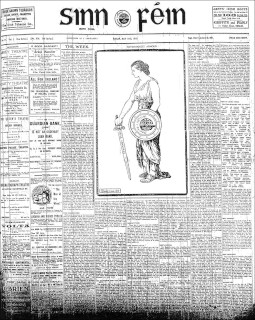
Sinn Féin, pledged to an Irish Republic, wins 73 of 105 Irish Member of Parliament (MP) seats in the 1918 United Kingdom general election in Ireland held on December 14, 1918. Winners include Constance Markievicz who becomes the first woman elected to the Parliament of the United Kingdom. In 1919 she is appointed Minister for Labour, the first female minister in a democratic government cabinet.

The Irish general election is that part of the 1918 United Kingdom general election which takes place in Ireland. The election is now seen as a key moment in modern Irish history because it sees the overwhelming defeat of the moderate nationalist Irish Parliamentary Party (IPP), which had dominated the Irish political landscape since the 1880s, and a landslide victory for the radical Sinn Féin party. The party had never stood in a general election but had won six seats in by-elections in 1917–1918. Sinn Féin vows in its manifesto to establish an independent Irish Republic. In Ulster, however, the Unionist Party is the most successful party.

The election is held in the aftermath of World War I, the Easter Rising and the Conscription Crisis. It is the first general election to be held after the Representation of the People Act 1918. It is thus the first election in which women over the age of 30, and all men over the age of 21, can vote. Previously, all women and most working-class men had been excluded from voting.

In the aftermath of the elections, Sinn Féin’s elected members refuse to attend the British Parliament in Westminster. Instead, they form a parliament in Dublin, the First Dáil Éireann, which declares Irish independence as a republic. The Irish War of Independence is conducted under this revolutionary government which seeks international recognition and sets about the process of state-building.


Leave a comment

W.B. Yeats Receives Nobel Prize in Literature

william-butler-yeats-1

William Butler Yeats, Irish poet and one of the foremost figures of 20th century literature, receives Nobel Prize in Literature on December 10, 1923.

Yeats is born at Sandymount in County Dublin on June 13, 1865. His father, John Butler Yeats, is a lawyer and a well-known portrait painter. He is educated in London and in Dublin but spends his summers in the west of Ireland in the family’s summer house at Connacht. The young Yeats is very much part of the fin de siècle in London. At the same time, he is active in societies that attempt an Irish literary revival. His first volume of verse appears in 1887, but in his earlier period his dramatic production outweighs his poetry both in bulk and in import.

Together with Lady Gregory, Yeats founds the Irish Literary Theatre, which later becomes the Abbey Theatre, and serves as its chief playwright until the movement is joined by John Millington Synge. His plays usually treat Irish legends and also reflect his fascination with mysticism and spiritualism. The Countess Cathleen (1892), The Land of Heart’s Desire (1894), Cathleen ni Houlihan (1902), The King’s Threshold (1904), and Deirdre (1907) are among the best known.

After 1910, Yeats’s dramatic art takes a sharp turn toward a highly poetical, static, and esoteric style. His later plays are written for small audiences. They experiment with masks, dance, and music, and are profoundly influenced by the Japanese Noh plays. Although a convinced patriot, he deplores the hatred and the bigotry of the Nationalist movement, and his poetry is full of moving protests against it. He is appointed to the Irish Senate, Seanad Éireann, in 1922.

Yeats is one of the few writers whose greatest works are actually written after the award of the Nobel Prize. Whereas he receives the Prize chiefly for his dramatic works, his significance today rests on his lyric achievement. His poetry, especially the volumes The Wild Swans at Coole (1919), Michael Robartes and the Dancer (1921), The Tower (1928), The Winding Stair and Other Poems (1933), and Last Poems and Plays (1940), make him one of the outstanding and most influential twentieth-century poets writing in English. His recurrent themes are the contrast of art and life, masks, cyclical theories of life (the symbol of the winding stairs), and the ideal of beauty and ceremony contrasting with the hubbub of modern life.

Yeats dies at the age of 73 at the Hôtel Idéal Séjour, in Menton, France, on January 28, 1939. He is buried after a discreet and private funeral at Roquebrune-Cap-Martin. In September 1948, his body is moved to the churchyard of St. Columba’s Church, Drumcliff, County Sligo, on the Irish Naval Service corvette Macha.

(From Nobel Lectures, Literature 1901-1967, Editor Horst Frenz, Elsevier Publishing Company, Amsterdam, 1969)


Leave a comment

Birth of Irish Language Scholar Osborn Bergin

CREATOR: gd-jpeg v1.0 (using IJG JPEG v62), quality = 100

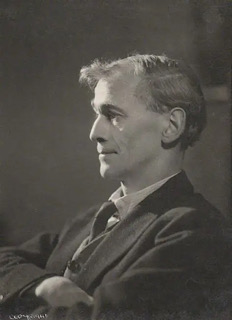
Osborn Joseph Bergin, a scholar of the Irish language and early Irish literature, is born in Cork, County Cork on November 26, 1873.

Bergin is the sixth child and eldest son of Osborn Roberts Bergin and Sarah Reddin, and is educated at Queen’s College Cork, now University College Cork. He then goes to Germany for advanced studies in Celtic languages, working with Heinrich Zimmer at the Friedrich Wilhelm University in Berlin, now the Humboldt University of Berlin, and later with Rudolf Thurneysen at the University of Freiburg, where he writes his dissertation on palatalization in 1906. He then returns to Ireland and teaches at the School of Irish Learning and at University College Dublin.

Within one year of becoming Director of the School of Irish Studies in the Dublin Institute for Advanced Studies, Bergin resigns both the senior professorship and his office of director. The reason for his resignation is never made public.

Bergin, who never uses the name Joseph except when signing with his initials, does not seem to have felt the need of institutional religion, and during his lifetime, he rarely attends religious services. He develops Irish nationalist sympathies and remains a firm nationalist all his life but without party affiliations. From the number of Irish speakers living in Cork, he quickly masters the spoken Irish of West Munster. By 1897, his knowledge of spoken and literary Modern Irish is so strong that he is appointed lecturer in Celtic in Queen’s College, Cork. It is during this time that he becomes an active member of the Gaelic League.

Bergin publishes extensively in the journal for Irish scholarship, Ériu. He is best known for his discovery of Bergin’s Law, which states that while the normal order of a sentence in Old Irish is verb-subject-object, it is permissible for the verb, in the conjunct form, to be placed at the end of the sentence. His friend Frank O’Connor writes humorously that while he discovers the law “he never really believed in it.” He writes poetry in Irish and makes a number of well-received translations of Old Irish love poetry.

Bergin is celebrated in Brian O’Nolan‘s poem Binchy and Bergin and Best, originally printed in the Cruiskeen Lawn column in The Irish Times and now included in The Best of Myles. He is noted for his feuds with George Moore and William Butler Yeats, but he enjoys a lifelong friendship with George William Russell. Frank O’Connor describes Bergin’s eccentricities affectionately in his memoir My Father’s Son.

Osborn Bergin dies in a nursing home in Dublin at the age of 76 on October 6, 1950, having never married.


Leave a comment

Death of Peadar Kearney, Composer & Irish Republican

peadar-kearney

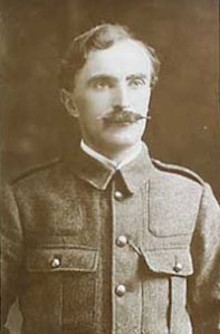
Peadar Kearney, Irish republican and composer of numerous rebel songs, dies in Inchicore, Dublin on November 24, 1942. In 1907 he writes the lyrics to “The Soldier’s Song” (“Amhrán na bhFiann“), now the Irish national anthem. He is the uncle of Irish writers Brendan Behan, Brian Behan, and Dominic Behan.

Kearney was born on December 12, 1883, at 68 Lower Dorset Street, Dublin, above one of the two grocer’s shops owned by his father, John Kearney, originally from Funshog, Collon, County Louth. His mother, Katie (née McGuinness), is from Rathmaiden, Slane, County Meath. He is educated at the Model School, Schoolhouse Lane and St. Joseph’s Secondary C.B.S. in Fairview. He hears Willie Rooney give nationalist lectures on history in the Mechanics’ Institute. For a short time, he attends Belvedere College. Following the death of his father, he is left to support his mother and five younger siblings. He has various menial jobs for three years before being apprenticed to a house painter.

In 1901, the death of Willie Rooney prompts Kearney to join the Willie Rooney Branch of the Gaelic League. He joins the Irish Republican Brotherhood in 1903. He teaches night classes in Irish and numbers Seán O’Casey among his pupils. He finds work with the National Theatre Society and in 1904 is one of the first to inspect the derelict building that becomes the Abbey Theatre. He assists with props and performs occasional walk-on parts at the Abbey until 1916.

Kearney is a co-founder of the Irish Volunteers in 1913 and takes part in the Howth and Kilcoole gun runnings in 1914. In the Easter Rising of 1916 he fights at Jacob’s biscuit factory under Thomas MacDonagh, abandoning an Abbey Theatre tour in England to take part in the Rising. He escapes before the garrison is taken into custody.

Kearney is also active in the Irish War of Independence. On November 25, 1920, he is captured at his home in Summerhill, Dublin and is interned first in Collinstown Camp in Dublin and later in Ballykinler Camp in County Down.

A personal friend of Michael Collins, Kearney at first takes the Free State side in the Irish Civil War but loses faith in the Free State after Collins’s death. He takes no further part in politics, returning to his original trade of house painting.

Kearney’s songs are highly popular with the Irish Volunteers (which later becomes the Irish Republican Army) in the 1913–1922 period. Most popular is “The Soldier’s Song.” He pens the original English lyrics in 1907 and his friend and musical collaborator Patrick Heeney composes the music. The lyrics are published in 1912 and the music in 1916. After 1916 it replaces “God Save Ireland” as the anthem of Irish nationalists. The Irish Free State is established in 1922 and formally adopts the anthem in 1926.

Other well-known songs by Kearney include “Down by the Glenside,” “The Tri-coloured Ribbon,” “Down by the Liffey Side,” “Knockcroghery” (about the village of Knockcroghery) and “Erin Go Bragh” (Erin Go Bragh is the text on the Irish national flag before the adoption of the tricolour).

Peadar Kearney dies in relative poverty in Inchicore on November 24, 1942. He is buried in Glasnevin Cemetery in Dublin.


Leave a comment

Death of Siobhán McKenna, Stage & Screen Actress

Siobhán McKenna, Irish stage and screen actress, dies of lung cancer on November 16, 1986, in Dublin.

McKenna is born Siobhán Giollamhuire Nic Cionnaith into a Catholic and nationalist family in Belfast on May 24, 1923. She grows up in Galway, where her father is Professor of Mathematics at University College Galway, and in County Monaghan, speaking fluent Irish. She is still in her teens when she becomes a member of an amateur Gaelic theatre group and makes her stage debut at Galway’s Gaelic theatre, the Taibhdhearc na Gaillimhe, in 1940.

McKenna is remembered for her English language performances at the Abbey Theatre in Dublin where she eventually stars in what many consider her finest role in the George Bernard Shaw play, Saint Joan.

While performing at the Abbey Theatre in the 1940s, she meets actor Denis O’Dea, whom she marries in 1946. Until 1970 they live in Richmond Street South, Dublin. They have one child, a son Donnacha O’Dea, who swims for Ireland at the 1968 Summer Olympics and later wins a World Series of Poker bracelet in 1998.

In 1947, McKenna makes her debut on the London stage in The Chalk Garden. She reprises the role on Broadway in 1955, for which she receives a Tony Award nomination for “Best Actress in a Leading Role, Drama.” In 1956, she appears in the Cambridge Drama Festival production of Saint Joan at the Off-Broadway Phoenix Theatre. Theatre critic Elliot Norton calls her performance the finest portrayal of Joan of Arc in memory. Siobhán McKenna’s popularity earns her the cover of Life magazine. She receives a second Tony Best Actress nomination for her role in the 1958 play, The Rope Dancers, in which she stars with Art Carney and Joan Blondell.

Although primarily a stage actress, McKenna appears in a number of made-for-television films and dramas. She also appears in several motion pictures such as King of Kings in 1961, as the Virgin Mary. In 1964, she performs in Of Human Bondage and the following year in Doctor Zhivago. She also appears in the miniseries The Last Days of Pompeii as Fortunata, wife of Gaius, played by Laurence Olivier. She stars in the title role of the Tales of the Unexpected episode “The Landlady.”

McKenna is awarded the Gold Medal of the Éire Society of Boston, for having “significantly fulfilled the ideals of the Éire Society, in particular, spreading awareness of the cultural achievements of the Irish people.”

McKenna’s final stage appearance comes in the 1985 play Bailegangaire for the Druid Theatre Company. Despite surgery, she dies of lung cancer on November 16, 1986, in Dublin, at 63 years of age. She is buried at Rahoon Cemetery in County Galway.

In 1988, two years after her death, McKenna is inducted into the American Theater Hall of Fame. The Siobhán McKenna Theatre in Cultúrlann McAdam Ó Fiaich, in her native Belfast is named in her honour.


Leave a comment

The Siege of Smerwick

smerwick-massacre-memorial

Following a three-day siege, the English Army beheads over 600 Papal soldiers and civilians at Dún an Óir, County Kerry on November 10, 1580.

On November 5, a naval force led by Admiral Sir William Wynter arrives at Smerwick Harbour, replenishing the supplies of Arthur Grey, 14th Baron Grey de Wilton, who is camped at Dingle, and landing eight artillery pieces. On November 7, Lord Grey de Wilton lays siege to the Smerwick garrison. The invading forces are geographically isolated on the tip of the narrow Dingle Peninsula, cut off by Mount Brandon, one of the highest mountains in Ireland, on one side and the much larger English force on the other. The English forces begin the artillery barrage on Dún an Óir on the morning of the November 8, which rapidly breaks down the improvised defences of the fort.

After a three-day siege, the commander Sebastiano di San Giuseppe surrenders on November 10. Accounts vary on whether they had been granted quarter. Grey de Wilton orders the summary executions, sparing only the commanders. Grey has also heard that the main Irish rebel army of 4,000 are somewhere in the hills to his east, looking to be rearmed and supplied by Di San Giuseppe, and they might in turn surround his army, but this army never appears.

According to Grey de Wilton’s account, contained in a despatch to Queen Elizabeth I dated November 11, 1580, he rejects an approach made by the besieged Spanish and Italian forces to agree to terms of a conditional surrender in which they would cede the fort and leave. Lord Grey de Wilton claims that he insisted that they surrender without preconditions and put themselves at his mercy, and that he subsequently rejects a request for a ceasefire. An agreement is finally made for an unconditional surrender the next morning, with hostages being taken by English forces to ensure compliance. The following morning, an English force enters the fort to secure and guard armaments and supplies.

Local historian Margaret Anna Cusack notes in 1871 that there is a degree of controversy about Lord Grey de Wilton’s version of events to Elizabeth, and identifies three other contemporary accounts, by O’Daly, O’Sullivan Beare and Russell, which contradict it. According to these versions, Grey de Wilton promises the garrison their lives in return for their surrender, a promise which he breaks. Like Grey himself, none of these commentators can be described as neutral, as they are all either serving the state or opposed to it. Cusack’s interpretation of the events cannot be described as unbiased, given her position as a Catholic nun and fervent Irish nationalist at the time.

According to Cusack, the few that are spared suffer a worse fate. They are offered life if they renounce their Catholic faith. On refusal, their arms and legs are broken in three places by an ironsmith. They are left in agony for a day and night and then hanged.

According to the folklore of the area, the execution of the captives takes two days, with many of the captives being beheaded in a field known locally in Irish as Gort a Ghearradh (the Field of the Cutting). Their bodies are later thrown into the sea. Archaeologists have not yet discovered human remains at the site, although a nearby field is known as Gort na gCeann (the Field of the Heads) and local folklore recalls the massacre.

(Pictured: A memorial to the victims of the massacre at Dún an Óir)


Leave a comment

First Issue of “The Nation” Published

the-nation-01-17-1852

The first issue of The Nation, an Irish nationalist weekly newspaper, is published on October 15, 1842. It is printed at 12 Trinity Street, Dublin until January 6, 1844. The paper is later published at 4 D’Olier Street from July 13, 1844, until July 28, 1848, when the issue for the following day is seized and the paper suppressed. It is published again in Middle Abbey Street on its revival in September 1849.

The founders of The Nation are three young men, Charles Gavan Duffy, its first editor, Thomas Davis and John Blake Dillon. All three are members of Daniel O’Connell‘s Repeal Association, which seeks repeal of the disastrous Acts of Union 1800 between Ireland and Britain. This association later becomes known as Young Ireland.

John Mitchel joins the staff of The Nation in the autumn of 1845. On Mitchel’s frequent trips from Banbridge, County Down to Dublin, he had come in contact with the Repeal members who gathered about The Nation office and in the spring of 1843, he becomes a member of the Repeal Association. For the next two years he writes political and historical articles and reviews for The Nation. He covers a wide range of subjects, including the Irish Potato Famine, on which he contributes some influential articles which attract significant attention.

Mitchel resigns his position as lead writer for The Nation in 1847 because he comes to regard as “absolutely necessary a more vigorous policy against the English Government than that which William Smith O’Brien, Charles Gavan Duffy and other Young Ireland leaders were willing to pursue.” Upon his resignation he starts his own paper, The United Irishman.

Women also write for The Nation and publish under pseudonyms such as Speranza (Jane Elgee, Lady Wilde, Oscar Wilde‘s mother), Eithne (Marie Thompson) and Eva (Mary Eva Kelly, who would marry Kevin Izod O’Doherty.

The role played by some of its key figures in the paper in the ill-fated Young Ireland Rebellion of 1848 cement the paper’s reputation as the voice of Irish radicalism. Dillon is a central figure in the revolt and is sentenced to death, the sentence later commuted. He flees Ireland, escaping first to France and, eventually, to the United States, where he serves the New York Bar.

Its triumvirate of founders follow differing paths. Davis dies at age 30 in 1845. Both Dillon and Duffy become MPs in the British House of Commons. Duffy emigrates to Australia where he becomes premier of the state of Victoria, later being knighted as a Knight Commander of St. Michael and St. George (KCMG). Dillon dies in 1866. His son, John Dillon, becomes leader of the Irish Parliamentary Party and his grandson, James Dillon, leader of Fine Gael.

The Nation continues to be published until 1900, when it merges with the Irish Weekly Independent. Later political figures associated with the paper included Timothy Daniel Sullivan and J.J. Clancy.


Leave a comment

The Funeral of Charles Stewart Parnell

parnell-grave-stoneThe funeral and burial of Charles Stewart Parnell, Irish nationalist politician who serves from 1875 as Member of Parliament (MP) in the House of Commons of the United Kingdom of Great Britain and Ireland, takes place in Dublin on October 11, 1891.

Parnell dies of pneumonia at half-past eleven on the night of October 6 at his residence at 10 Walsingham Terrace, Aldrington, near Brighton, England. He dies in the arms of his wife Katherine whom he had married just five months earlier.

Prior to the funeral, Parnell’s body lay in state for several hours and his death is the primary topic of conversation around Dublin. The belief that his demise would close the chasm in the Irish ranks is no longer tenable. His death makes it too wide even to be bridged. His old opponents may have felt inclined to forget and forgive, but this spirit is crushed almost before it is born, and his old adherents are simply ferocious in their enmity.

The city is astir at an unusually early hour, and there is a crowd of thousands in and around the Westland Row Station before seven o’clock. In front, as a guard of honor, stands a body of the Gaelic Athletic Association, armed with camans, around which are bound crape and green ribbon. It is nearly eight o’clock when Parnell’s body is placed in a hearse drawn by four black horses. The Gaels march in front. Thousands join the cortège, which includes several bands and fife corps.

Though an Anglican, Parnell’s funeral at the Irish National nondenominational Glasnevin Cemetery in Dublin is attended by more than 200,000 people. His notability is such that his gravestone of unhewn Wicklow granite, erected in 1940, reads only “Parnell.”

Parnell is buried amid warring elements and in the presence of an immense assemblage. As a scene of great but suppressed excitement, and of still greater impressiveness, the funeral and its surroundings will never be forgotten by those who witness it, and it will long furnish a landmark in history for Ireland.


Leave a comment

Proclamation Banning O’Connell’s Repeal Meeting Issued

daniel-oconnell

On the night of Saturday, October 7, 1843, a proclamation is issued from Dublin Castle banning a Repeal Association meeting called by Daniel O’Connell north of the city at Clontarf on the following day.

The proclamation is written by the Prime Minister of the United Kingdom of Great Britain and Ireland, Sir Robert Peel, who calls the proposed meeting for the restoration of the Parliament of Ireland, abolished in 1801, “an attempt to overthrow the constitution of the British Empire as by law established.”

Two warships, the Rhathemus and the Dee, steam into Dublin Harbour, carrying around 3,000 British troops to ensure the mass rally in favour of Repeal of the Union does not take place. The nationalist newspaper, the Freeman’s Journal, alleges that the troops have been summoned to “cut the people down” and “run riot in the blood of the innocent.”

O’Connell, the charismatic leader of the Repeal Association, has always insisted that his movement is non-violent. On the banning of the meeting and the arrival of troops, he frantically moves to call it off and to prevent “the slaughter of the people.”

Handbills are posted around the streets of Dublin advising his supporters of the meeting’s cancellation. A prominent Dublin builder and O’Connell supporter, Peter Martin, is sent to Clontarf to dismantle the platform erected there. Other activists are sent on horseback to the roads leading into the city to send back the thousands converging on Clontarf for the meeting.

The following day passes without incident. The Freeman’s Journal rages against the “corrupt and impotent Government that has perverted the form of law for the purpose of robbing the people.”

The Warder, a Dublin unionist newspaper, had been urging the suppression of the “plainly illegal under common law” O’Connellite mass meetings for months. The newspaper stops short of calling for civil war in the run–up to the meeting. Now it declares itself satisfied. It congratulates the Conservative government for belatedly seeing sense.

By contrast, the Repeal camp is deeply split. Many, particularly those Young Irelanders grouped around The Nation, blame O’Connell for capitulation to the threat of force and for his unwillingness to confront the British government. They break from him acrimoniously the following year.

With the cancellation of the Clontarf meeting, O’Connell’s strategy of mass mobilisation in pursuit of Irish self government is over. He himself is arrested on charges of “seditious conspiracy” three days later.

(From: “Today in Irish History, The Repeal Meeting at Clontarf is Banned, 8 October 1843, John Dorney, The Irish Story (theirishstory.com), October 8, 2011)


Leave a comment

Birth of William O’Brien, Journalist & Politician

william-o-brien

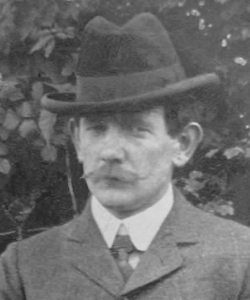
William O’Brien, journalist and politician who is for several years second only to Charles Stewart Parnell among Irish Nationalist leaders, is born on October 2, 1852, in Mallow, County Cork. He is perhaps most important for his Plan of Campaign (1886), by which Irish tenant farmers withhold all rent payments from landlords who refuse to lower their rents and instead pay the money into a mutual defense fund on which evicted tenants can draw.

O’Brien shares his primary education with a townsman with whom he is later to have a close political connection, Canon Patrick Augustine Sheehan of Doneraile. He enjoys his secondary education at the Cloyne diocesan college, which results in his being brought up in an environment noted for its religious tolerance. He greatly values having had this experience from an early age, which strongly influences his later views for the need of such tolerance in Irish national life.

A journalist from 1869, O’Brien is appointed editor of the Irish Land League’s weekly United Ireland by Parnell in 1881. In October of that year the British authorities suppress the paper and put O’Brien in Kilmainham Gaol in Dublin, along with Parnell and others. There he draws up a No Rent Manifesto, which, when read at a Land League meeting, results in the outlawing of the League. Released from prison in 1882, he resumes the editorship of United Ireland, and in 1883 he is elected to the British House of Commons, remaining there until 1895. His “plan of campaign” is disavowed by Parnell but nonetheless stirs up fierce agitation. To suppress the movement, the British government passes the Criminal Law and Procedure (Ireland) Act 1887, under which O’Brien is jailed again.

For some time following the O’Shea divorce case (1889–90), in which Parnell is corespondent, O’Brien attempts to mediate between the Parnellites and their opponents, although he sides with the majority in rejecting Parnell’s continued leadership of the Irish Home Rule struggle. In 1902 he supports the Land Conference, which secures agreement between landlords and tenants’ representatives and results in George Wyndham‘s Land Purchase Act (1903), which is designed to turn Irish tenant farmers into occupying owners.

In 1898 O’Brien founds the United Irish League, and in 1910, after control of that group passes to the Parnellite John Redmond, he establishes the All-for-Ireland League in opposition to the older organization. Most of his personal following, however, join Arthur Griffith’s Sinn Féin party by the end of World War I.

Retiring from political life, O’Brien contents himself with writing and declines Éamon de Valera‘s offer to stand for Fianna Fáil in the 1927 general election. He dies suddenly at the age of 75 on February 25, 1928, while on a visit to London with his wife. His remains rest in Mallow, and one of the principal streets in the town bears his name to this day. His head-bust overlooks the town Council’s Chamber Room and one of his finest portraits hangs in University College Cork.